F**k the Haters – I Believe in the Liberal Arts!

Aldus Manutius, Preface to Joannes Crastonus’ Greek Dictionary

“I had originally designed not to publish the Greek lexica (which we can call dictionaries in Latin) from our press before I had them sufficiently abundant and correct. But I changed my mind about this when I recognized that it was difficult in the extreme, not just for me – a man burdened by family obligations and my printing business – but even for an unencumbered person thoroughly knowledgeable of both languages, as well as the liberal arts, medicine, and all of the sciences. Indeed it is proper to know all, and to interpret all of the words according to their most proper sense, but I doubt whether anyone of our own time other than a stray person here and there has achieved excellence in this matter, when Greek and Latin literature – though they are thriving more than in many previous years – nevertheless languish in some obscurity.

For, who really knows the liberal arts? Who is thoroughly learned in the most simple things which are necessary in medicine? Alas – it is a shame to say, we hardly recognize lettuce, cabbage, and the herb which shows itself even to the blind. When I think about this, even though I cannot grieve about it too vehemently, I not only refrain from giving way to my pain, but I gird myself night and day to remedy the situation while avoiding no labor, so that I may hope that it will soon come to pass that the people of our age will know all the good arts and even have some fine skill in medicine, and that each scholar will have the strength to contend with antiquity as long as they not fail themselves. If there are any haters, imbeciles, or barbarians, then let them grieve, let them criticize, let them stand in the way as much and as long as they want. But this will turn out beautifully – it will.”


aldus1

Cicero Needs Nothing So Much as a Friend

Cicero can seem an insufferable windbag in some of his speeches–but some of his letters humanize him.

Cicero to Atticus 1.18 20 Jan 60

“Know that I need nothing so much as a person to whom I can explain the things I worry about, someone who cares about me, who is wise, to whom I may speak and fabricate nothing, lie about nothing, and hold nothing back.

My brother is away, the most honest and beloved man. Metellus is not a man but instead is “shore and air” and “only solitude”. You, moreover, who most wisely lightens by concern and anxiety of spirit with conversation and counsel, you are my companion in public affairs and my confidant in private matters, and who are usually a companion of all my speeches and plans, where are you? I am so completely isolated that I only have as much relaxation as those moments spend with my wife, my little girl and my sweetest Marcus.

For my ambitious and convenient friendships have a certain shine in public affairs, but they bear no domestic fruit. My home is so full with a crowd in the morning but when I go to the forum with flocks of friends, I can’t find a single person in the great crowd to share a joke with or to whisper familiarly.

This is why I am looking for you, why I miss you, and I am also now calling you home. Many things really trouble me and make me anxious—but these are things which I think I can get off my chest once I have your ears for a talk during a single walk.”

Nihil mihi nunc scito tam deesse quam hominem eum quocum omnia quae me cura aliqua adficiunt una communicem, qui me amet, qui sapiat, quicum ego cum loquar nihil fingam, nihil dissimulem, nihil obtegam. abest enim frater ἀϕελέστατος et amantissimus. †Metellus† non homo sed ‘litus atque aër’ et ‘solitudo me<r>a.’ tu autem qui saepissime curam et angorem animi mei sermone et consilio levasti tuo, qui mihi et in publica re socius et in privatis omnibus conscius et omnium meorum sermonum et consiliorum particeps esse soles, ubinam es? ita sum ab omnibus destitutus ut tantum requietis habeam quantum cum uxore et filiola et mellito Cicerone consumitur. nam illae ambitiosae nostrae fucosaeque amicitiae sunt in quodam splendore forensi, fructum domesticum non habent. itaque cum bene completa domus est tempore matutino, cum ad forum stipati gregibus amicorum descendimus, reperire ex magna turba neminem possumus quocum aut iocari libere aut suspirare familiariter possimus. qua re te exspectamus, te desideramus, te iam etiam arcessimus. multa sunt enim quae me sollicitant anguntque, quae mihi videor auris nactus tuas unius ambulationis sermone exhaurire posse.

Image result for medieval manuscript cicero letter to a friend
Enter a caption

Getting Tanked on Ancient Springs

Alexander Pope, An Essay on Criticism (Pt. II):

A little learning is a dang’rous thing;
Drink deep, or taste not the Pierian spring:
There shallow draughts intoxicate the brain,
And drinking largely sobers us again.
Fir’d at first sight with what the Muse imparts,
In fearless youth we tempt the heights of arts,
While from the bounded level of our mind,
Short views we take, nor see the lengths behind,
But more advanc’d, behold with strange surprise
New, distant scenes of endless science rise!
So pleas’d at first, the tow’ring Alps we try,
Mount o’er the vales, and seem to tread the sky;
Th’ eternal snows appear already past,
And the first clouds and mountains seem the last;
But those attain’d, we tremble to survey
The growing labours of the lengthen’d way,
Th’ increasing prospect tires our wand’ring eyes,
Hills peep o’er hills, and Alps on Alps arise!

The Importance of Meter in Poetry

Gerardus Vossius, On the Nature and Constitution of the Poetic Art, Cap. II:

Whether the name of poet is given for making verses or for contriving stories.

“The latter opinion pleased Aristotle and even Plato. Words in metrical form were not sufficient to get someone called a poet; rather, the diction had to be worked up and bound by meter, and animated by the poetic spirit. Yet although meter was not sufficient to make something a poem, yet that is always required. The opposite opinion is attrbuted to Aristotle both by others and by Robortellus. How greatly the most learned men seem to disagree with him about what Aristotle understood by plain words or epic poetry and the speeches of Socrates. Assent has been granted to them who understand plain words to mean prose; epic to mean imitation wrought either in prose or in song; the speeches of Socrates to mean the dialogues of Plato. Those who claim that the mimes of Sophron were written in prose have been deceived by a corrupt passage in the Suda. The true sense of song (carminis) can be recognized by that alone, that the name of poets comes more from the meter than from the contrivance of fiction. It would be right to call the history of Herodotus poetry if it were worked out in verse, and Homer’s Iliad prose if it were written without meter.”

Utrum poetis a faciendis versibus, an a fingendis fabulis, nomen impositum sit. Posteriorem sententiam placuisse Aristoteli, atque etiam Platoni. Λόγον ἔμμετρον non sufficere, ut quis poeta dicatur: sed exigi praeterea dictionem metro ligatam, et spiritu poetico animatam. Utcumque vero non sufficiat metrum, ut quid poema dicatur, semper tamen id requiri. Contrariam sententiam tribui Aristoteli, cum ab aliis, tum Robortello. Quantopere de eo dissentiant homines doctissimi, quid Aristoteles intellexerit per ψιλοὺς λόγους , per ἐποποΐαν , et per Socratis sermones. Iis assensum, qui per ψιλοὺς λόγους intelligunt sermonem pedestrem; per ἐποποΐαν , imitationem seu prosa, seu carmine, institutam; per Socratis sermones, Platonis dialogos. corrupto Suidae loco deceptos, qui Sophronis mimos prosa fuisse scriptos contendunt. Carminis ἔτυμον , ac vel eo solo cognosci, poetis potius a metro esse nomen, quam a fictione. Quo nomine vocare oporteat Herodoti historiam, si in carmen redigatur; vel Homeri Iliada, si eadem prosa conscribatur.


Poisoned Flowers – Your Bees Will Buzz No More

Quintilian, Declamation XIII

“The action is for a loss given through intentional injury. A poor man and a rich man were neighbors with conjoined gardens. The rich man had flowers in his garden, the poor man had bees. The rich man complained that his flowers were being plucked at by the poor man’s bees. He ordered that the poor man move the bees, but when he did not transfer them, the rich man sprinkled his flowers with poison. All of the poor man’s bees died.”

Image result for virgil bees

Damni per iniuriam dati sit actio. Pauper et dives in agro vicini erant iunctis hortulis. habebat dives in horto flores, pauper apes. questus est dives flores suos decerpi ab apibus pauperis. denuntiavit, ut transferret. illo non transferente flores suos veneno sparsit. apes pauperis omnes perierunt.

Philosophy Amid Neverending Business

Seneca, Moral Epistles 72.3-4

“Something needs to be done even on days like today that are completely filled with business. There’s never a time when new tasks won’t come up—the way many arise from just one. And then we keep giving ourselves excuses, ‘when I have finished this, I will focus with my whole mind’ and ‘if I complete this annoying matter, I will commit myself to studying.’

But philosophy can’t be put off until you have spare time! Everything else should be ignored so we need to pay attention to the very thing for which no amount of time is sufficient, even if we had the longest human life possible from childhood on. There’s no difference whether you ignore philosophy or return to it only intermittently. It does not stay where it was when you left it. It returns to where it was before just like things that break apart when they are stretched too tight.

We should push back against those tasks that take up our time–they can’t be disentangled; instead they need to be rejected. Truly, there is no time that isn’t good for studying. But many people don’t even bother thinking during the conditions that require us to study!”

Nihilominus his quoque occupatis diebus agatur aliquid et quidem totis. Numquam enim non succedent occupationes novae; serimus illas, itaque ex una exeunt plures. Deinde ipsi nobis dilationem damus: “cum hoc peregero, toto animo incumbam “et” si hanc rem molestam composuero, studio me dabo.”

Non cum vacaveris, philosophandum est; omnia alia neglegenda, ut huic adsideamus, cui nullum tempus satis magnum est, etiam si a pueritia usque ad longissimos humani aevi terminos vita producitur. Non multum refert, utrum omittas philosophiam an intermittas; non enim ubi interrupta est, manet, sed eorum more, quae intenta dissiliunt, usque ad initia sua recurrit, quod a continuatione discessit. Resistendum est occupationibus, nec explicandae, sed submovendae sunt. Tempus quidem nullum parum est idoneum studio salutari; atqui multi inter illa non student, propter quae studendum est.

A Priapic Poem That’s A Tad Too Defensive

Warning: this is potentially just awful trash.

Carmina Priapea, 28

“Mercury’s form has the power to please.
And Apollo’s body sticks out especially.
Lyaeus in pictures has a shapely line,
And Cupid is still finest of the fine.

My body lacks a certain beauty, I confess
But, look, my dick’s a jewel beyond the rest.
Any girl should prefer it to the gods I named,
And if she doesn’t, then a greedy pussy’s to blame.”

Forma Mercurius potest placere,
forma conspiciendus est Apollo,
formosus quoque pingitur Lyaeus,
formosissimus omnium est Cupido.
me pulchra fateor carere forma,
verum mentula luculenta nostra est:
hanc mavult sibi quam deos priores,
si qua est non fatui puella cunni.

Woman painting a statue of Priapus, from a fresco at Pompeii

Hipponax and Hanging – Hype and Hogwash

Pliny, Natural History 36.5:

“Hipponax was known for the ugliness of his face. For that reason, these two sculptors from Chios set out a mocking image of him among circles of people who laughed at it. Hipponax, wondrous wroth at this, refined the savagery of his poems to such a pitch, that it is believed by some that he drove the two men to hang themselves. Obviously this is false. For these two sculptors made many statues afterward, as in Delos, to which they appended the verse Chios is not valued for its grapes as much as for the works of Achermus’ sons.”

Image result for hipponax

Hipponacti notabilis foeditas voltus erat; quam ob rem imaginem eius lascivia iocosam hi proposuere ridentium circulis, quod Hipponax indignatus destrinxit amaritudinem carminum in tantum, ut credatur aliquis ad laqueum eos conpulisse. quod falsum est. conplura enim in finitimis insulis simulacra postea fecere, sicut in Delo, quibus subiecerunt carmen non vitibus tantum censeri Chion, sed et operibus Archermi filiorum.

A Wise Doctor, a Final Word

Sophocles, Ajax 581-582

“Close it quickly: it is not a sign of a wise doctor
To chant spells over a wound that needs cutting.”

πύκαζε θᾶσσον. οὐ πρὸς ἰατροῦ σοφοῦ
θρηνεῖν ἐπῳδὰς πρὸς τομῶντι πήματι.

691-2

“You, do what I advise and perhaps you will quickly learn
That even if I am unlucky, I have survived.”

ὑμεῖς δ᾿ ἃ φράζω δρᾶτε, καὶ τάχ᾿ ἄν μ᾿ ἴσως
πύθοισθε, κεἰ νῦν δυστυχῶ, σεσωμένον.

864-5

“This is the final word your Ajax ever says
I’ll tell the rest below in Hades to the dead.”

τοῦθ᾿ ὑμὶν Αἴας τοὔπος ὕστατον θροεῖ,
τὰ δ᾿ ἄλλ᾿ ἐν Ἅιδου τοῖς κάτω μυθήσομαι.

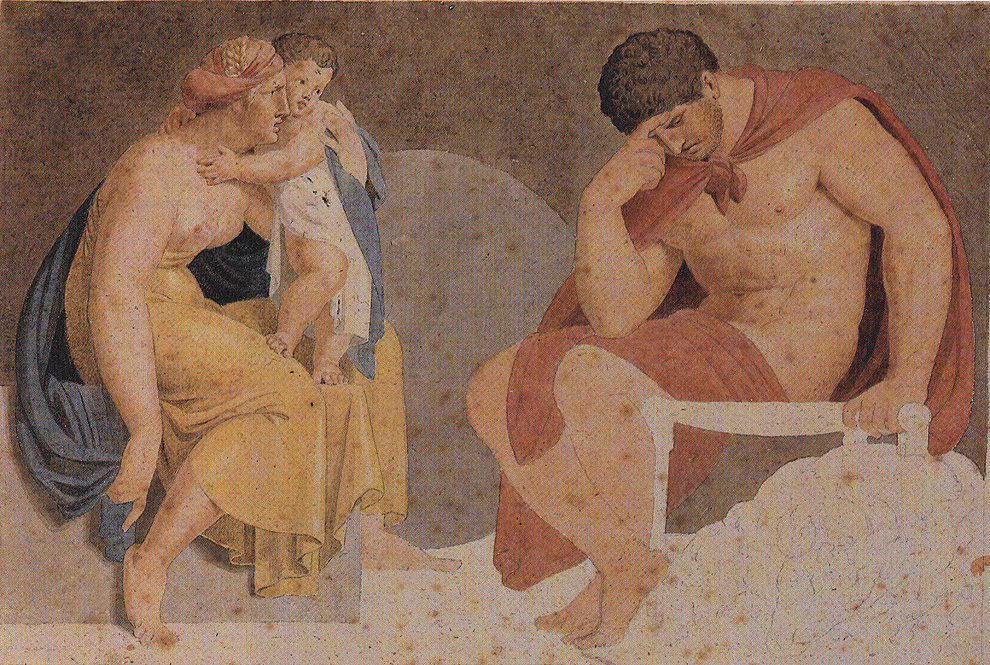
Ajax (Carstens).jpg
Asmus Jakob Carstens, Sorrowful Ajax with Termessa and Eurysakes

The Revival of Greek in Italy

Paolo Giovio, 

Elogia Doctorum Virorum: Chrysoloras

“Emanuel Chrysoloras, who first brought Greek literature back to Italy seven hundred years after it had been driven out by various barbarian invasions, was endowed with such humanity of liberal intellect in his teaching, that his famous image seems worthy of being placed first among the images of Greeks of exceptional merit, although no monuments of his weighty learning remain except some rules on the art of grammar. He was an indefatigable teacher, but he is open to the charge of having been lazy in writing, since the other part of the glory which we have chosen was sought by his useful profession.

He was sent from Byzantium by the emperor John to seek aid for Greece, which was on the verge of collapse, by pleading with all of the kings of Europe. He completed this task with such diligent traveling that he finally stopped in Italy when Greece was liberated from fear, since Tamerlane – the terror of the East – had captured alive near Mount Stella the Ottoman sultan Bayezid I (who had received the epithet of “Lightning” from the incredible swiftness of his movements). And so Chrysoloras, delighted that Greece had been freed from such an awful enemy, first in Venice, then in Florence, Rome, and finally in Pavia, which was under the rule of Giangaleazzo Visconti, managed to excite such a zeal for Greek literature that there sprang from his school minds worthy of the highest honor which on that account will never perish. Among these were Leonardo Bruni, Francesco Barbaro, Francesco Filelfo, Guarino Veronese, and Poggio Bracciolini. Later, when the synod which was called for resolving the controversy surrounding the pseudo-pontificate roused with desire to see such a spectacle, when Baldassare Cossa was deposed. Chrysoloras died in Constance. Poggio Bracciolini decorated his tomb with these lines:

‘Here lies Manuel Chrysoloras, the ornament of the Attic tongue, who came here to seek help for his afflicted country. Italy, this was a fortunate event for you, for he restored to you the grace of the Greek language, so long hidden. This was a fortunate event for you, Emanuel, for you found on Italian soil the honor which Greece never gave you – Greece, ruined in war.'”

chrysoloras3