Talking With Homer in the Underworld

While Lucian is surely messing with us here, I think there are many tomes of Homeric scholarship set aright through this one paragraph.

Lucian, True History 2.20

“Two or three days had not yet passed when I approached the poet Homer at a moment when we both had free time and I was investigated the rest of the matters about him, especially where he was from. For this is still examined by us to this day. He said that he was not ignorant that some people say he his from Khios and others say Smyrna while a majority claims he is Kolophonian. But he was saying that he is in fact Babylonian and was not called Homer among his people but Tigranes. Later on, after he was a hostage [homêreusas] among the Greeks he changed his nickname.

When I asked him about the lines which were considered spurious and whether they had been written by him, he was claiming they were all his. For this reason I started to believe that the grammarians Zenodotus and Aristarchus were guilty of the most close-minded logic. Since he had responded sufficiently on these matters, I was asking him next why he made his poem start with the “rage of Achilles”. He said that it just leapt into his head that way without any prior thought. Then I was eager to know that thing, whether he wrote the Odyssey before the Iliad as many claim. He denied this.”

Οὔπω δὲ δύο ἢ τρεῖς ἡμέραι διεληλύθεσαν, καὶ προσελθὼν ἐγὼ Ὁμήρῳ τῷ ποιητῇ, σχολῆς οὔσης ἀμφοῖν, τά τε ἄλλα ἐπυνθανόμην καὶ ὅθεν εἴη. τοῦτο γὰρ μάλιστα παρ᾿ ἡμῖν εἰσέτι νῦν ζητεῖσθαι. ὁ δὲ οὐδ᾿ αὐτὸς μὲν ἀγνοεῖν ἔφασκεν ὡς οἱ μὲν Χῖον, οἱ δὲ Σμυρναῖον, πολλοὶ δὲ Κολοφώνιον αὐτὸν νομίζουσιν· εἶναι μέντοι γε ἔλεγεν Βαβυλώνιος, καὶ παρά γε τοῖς πολίταις οὐχ Ὅμηρος, ἀλλὰ Τιγράνης καλεῖσθαι· ὕστερον δὲ ὁμηρεύσας παρὰ τοῖς Ἕλλησιν ἀλλάξαι τὴν προσηγορίαν. ἔτι δὲ καὶ περὶ τῶν ἀθετουμένων στίχων ἐπηρώτων, εἰ ὑπ᾿ ἐκείνου εἶεν γεγραμμένοι. καὶ ὃς ἔφασκε πάντας αὑτοῦ εἶναι. κατεγίνωσκον οὖν τῶν ἀμφὶ τὸν Ζηνόδοτον καὶ Ἀρίσταρχον γραμματικῶν πολλὴν τὴν ψυχρολογίαν. ἐπεὶ δὲ ταῦτα ἱκανῶς ἀπεκέκριτο, πάλιν αὐτὸν ἠρώτων τί δή ποτε ἀπὸ τῆς μήνιδος τὴν ἀρχὴν ἐποιήσατο· καὶ ὃς εἶπεν οὕτως ἐπελθεῖν αὐτῷ μηδὲν ἐπιτηδεύσαντι. καὶ μὴν κἀκεῖνο ἐπεθύμουν εἰδέναι, εἰ προτέραν ἔγραψεν τὴν Ὀδύσσειαν τῆς Ἰλιάδος, ὡς οἱ πολλοί φασιν· ὁ δὲ ἠρνεῖτο.

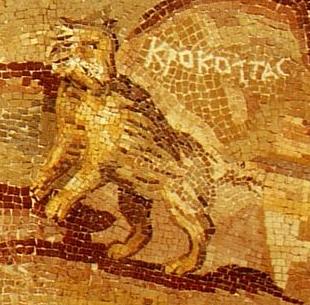
Image result for medieval manuscript homer
Ambrosian Iliad

Krokotta: A Beast Worthy of October

Paradoxographus Vaticanus 2

2 “Daliôn says in the first book of his Ethiopian Matters that there is an animal in Ethiopia called a krokotta. When that creature goes near backyards it hears people chattering, and especially the words/names of children. But when it goes out at night, it speaks words/names and the children who come out are devoured by it”

Δαλίων φησίν, ἐν τῇ πρώτῃ τῶν Αἰθιοπικῶν ἐν τῇ Αἰθιοπίᾳ θηρίον γίνεσθαι κροκότταν καλούμενον· τοῦτο ἐρχόμενον πρὸς τὰς ἐπαύλεις κατακούειν τῶν λαλουμένων, καὶ μάλιστα τὰ ὀνόματα τῶν παιδίων. νυκτὸς δὲ ἐρχόμενον λαλεῖ τὰ ὀνόματα καὶ ἐξερχόμενα τὰ παιδία καταβιβρώσκονται ὑπ’ αὐτοῦ.

Photios adds the following horror:

“[We should note the fact that] there is a creature in Ethiopia which is named krokottas which is like a combination of wolf and a dog, but it is more savage than both and is heavier in its face and at the end of its feet. It is also amazing for its boldness, and it is extremely capable compared to the rest in its teeth and its belly. For they also tear to pieces easily every type of bone and whatever they take up is consumed easily and their digestion is indescribable. In addition, while some of them have been described as imitating human language, we don’t believe it. Nevertheless, some have added that they call out people by name at night—and that they try to use a human voice in doing this—and then they gobble up whoever comes out as they fall upon them.”

     ῞Οτι ὁ κατὰ τὴν Αἰθιοπίαν ὀνομαζόμενος κροκόττας ἐστὶ μὲν ὡς ἐκ λύκου καὶ κυνὸς σύνθετον, ἀμφοῖν δὲ ἀγριώτερον καὶ πολλῷ βαρύτερον ἀπό τε τοῦ προσώπου καὶ τῶν ἄκρων ποδῶν, ἀλκῇ δὲ θαυμαστόν, ὀδοῦσι δὲ καὶ κοιλίᾳ δυνατώτατον τῶν ἄλλων. Καὶ γὰρ κατάγνυσιν εὐπόρως πᾶν ὀστοῦ γένος, καὶ τὸ διαιρεθὲν εὐθέως δεδαπάνηται, καὶ περὶ τὰς πέψεις ἀδιήγητον. Τοῦτο δὲ καὶ μιμεῖσθαί τινες τὴν ἀνθρωπίνην διάλεκτον διηγούμενοι ἡμᾶς μὲν οὐ πείθουσιν· ἐκεῖνοι δὲ καὶ τοῦτο προστιθέασιν, ὡς καὶ ἐξ ὀνόματος κατὰ τὰς νύκτας καλοῦντες, τοὺς δὲ ὡς ἐπ’ ἀνθρώπου φωνῇ προσιόντας, οἱ δὲ ἀθρόον ἐπεισπίπτοντες κατεσθίουσιν.

The crocotta shows up elsewhere as well (Pliny, Aelian, etc).

Dabbling in the Occult: Odysseus, Necromancer

It is the right time of the year for raising the dead. A student paper on the Elpenor Pelike at the MFA in Boston drew my attention to the following passage.

Servius ad Aen. 6.107

“For this reason the place is named without joy since, as people claim, it would not have been there but for necromancy or spell-craft. For, Aeneas completed these sacred rites when Misenus was killed and Ulysses did it with the death of Elpenor.

This very scene Homer himself presented falsely from the detail of its location which he specifies along with the length of time of the journey. For he claims that Ulysses sailed for one night and came to the place where he completed these sacrifices. For this reason it is abundantly clear that he doesn’t mean the ocean but Campania.”

sine gaudio autem ideo ille dicitur locus, quod necromantia vel sciomantia, ut dicunt, non nisi ibi poterat fieri: quae sine hominis occisione non fiebant; nam et Aeneas illic occiso Miseno sacra ista conplevit et Vlixes occiso Elpenore. quamquam fingatur in extrema Oceani parte Vlixes fuisse: quod et ipse Homerus falsum esse ostendit ex qualitate locorum, quae commemorat, et ex tempore navigationis; dicit enim eum a Circe unam noctem navigasse et ad locum venisse, in quo haec sacra perfecit: quod de Oceano non procedit, de Campania manifestissimum est.

The relevant passages from the Odyssey don’t give any hint that Elpenor was intentionally killed for black magic. When Odysseus actually does summon the dead, now that gets a little dark.

Odyssey, 10.552–560

“I could not even lead my companions unharmed from there.
The youngest of my companions was a certain Elpênor,
He was neither especially brave in battle or composed in his thoughts.
He separated himself from the companions in Kirkê’s holy home
Because he needed some air; then he fell asleep because he was drunk.
When he heard the noise and trouble of our companions moving out,
He got up immediately and it completely escaped his thoughts
To climb down again by the long ladder—
So he fell straight from the roof and his neck
Shattered along his spine; then his spirit flew down to Hades.”

οὐδὲ μὲν οὐδ’ ἔνθεν περ ἀπήμονας ἦγον ἑταίρους.
᾿Ελπήνωρ δέ τις ἔσκε νεώτατος, οὔτε τι λίην
ἄλκιμος ἐν πολέμῳ οὔτε φρεσὶν ᾗσιν ἀρηρώς,
ὅς μοι ἄνευθ’ ἑτάρων ἱεροῖσ’ ἐν δώμασι Κίρκης,
ψύχεος ἱμείρων, κατελέξατο οἰνοβαρείων·
κινυμένων δ’ ἑτάρων ὅμαδον καὶ δοῦπον ἀκούσας
ἐξαπίνης ἀνόρουσε καὶ ἐκλάθετο φρεσὶν ᾗσιν
ἄψορρον καταβῆναι ἰὼν ἐς κλίμακα μακρήν,
ἀλλὰ καταντικρὺ τέγεος πέσεν· ἐκ δέ οἱ αὐχὴν
ἀστραγάλων ἐάγη, ψυχὴ δ’ ῎Αϊδόσδε κατῆλθεν.

Elpênor appears twice more in the epic: 11.51–80 (Odysseus meets Elpênor’s ghost when he summons the dead); 12.9-15 (Odysseus buries Elpênor).

picture of red figure vase with three figures. the ghost of elpenor on the left, odysseus in the middle, and hermes on the right

MFA Boston, Accession Number 34.79; Caskey-Beazley, Attic Vase Paintings (MFA), no. 111; Highlights: Classical Art (MFA), p. 070-071.

Nekuomanteia, glossed by Hesychius as nekromanteia (i.e. “necromancy”) is an alternate name for the Nekyuia, the parade of the dead in book 11 of the Odyssey. From the Greek Anthology: ᾿Εν τῷ Η ἡ τοῦ ᾿Οδυσσέως νεκυομαντεία· (3.8); Scholia to the Odyssey, Hypotheses: Λ. Νεκυομαντεία, ἢ, Νεκυία. Cf. Eustathius, Comm. Ad Od. 1.396.10

Where Do Snakes Come From? A Spine-Tingling Explanation

Past mid-October, it is about time things start to get a bit creepy…

Aelian, On the Nature of Animals 1.51

“People say that the spine of a human corpse turns into a snake as the marrow decomposes. As the beast slips out, so the most savage creature is born from the mildest. In this way the remains of men who were once fine and noble rest and they have peace as their prize just as the soul too does of these kinds of men according to what is sung and hymned by the wise.

But the spines of evil men bring forth these kinds of things after life too. Well, the truth is that the story is either completely a myth or if these things prove trustworthy, then it seems to me that the evil man’s corpse has earned this reward of becoming the serpent’s father.”

Ῥάχις ἀνθρώπου νεκροῦ φασιν ὑποσηπόμενον τὸν μυελὸν ἤδη τρέπει ἐς ὄφιν· καὶ ἐκπίπτει τὸ θηρίον, καὶ ἕρπει τὸἀγριώτατον ἐκ τοῦ ἡμερωτάτου· καὶ τῶν μὲν καλῶν καὶ ἀγαθῶν τὰ λείψανα ἀναπαύεται, καὶ ἔχει ἆθλον ἡσυχίαν, ὥσπερ οὖν καὶ ἡ ψυχὴ τῶν τοιούτων τὰ ᾀδόμενά τε καὶ ὑμνούμενα ἐκ τῶν σοφῶν· πονηρῶν δὲ ἀνθρώπων ῥάχεις τοιαῦτα τίκτουσι καὶ μετὰ τὸν βίον. ἢ τοίνυν τὸ πᾶν μῦθός ἐστιν, ἤ, εἰ ταῦτα οὑτωσὶπεπίστευται, πονηροῦ νεκρός, ὡς κρίνειν ἐμέ, ὄφεως γενέσθαι πατὴρ τοῦ τρόπου μισθὸν ἠνέγκατο.

Kongelige Bibliotek, Gl. kgl. S. 1633 4º, Folio 57r

A Typology of Fear for a Spooky Time of Year

Here are some passages to go with Seneca’s ruminations on the fear of death.)

Stobaeus 2.7.10c [=Diogenes Laertius 7.113]

“Hesitation is fear of future action. Agony is fear of failure and otherwise fear of worse outcomes. Shock is fear of an uncustomary surprise. Shame is fear of a bad reputation. A ruckus is fear pressing down with sound. Divine fright is fear of gods or divine power. Terror is fear of a terrible thing. A fright is fear that comes from a story.”

     ῎Οκνος δὲ φόβος μελλούσης ἐνεργείας· ἀγωνία δὲ φόβος διαπτώσεως καὶ ἑτέρως φόβος ἥττης· ἔκπληξις δὲ φόβος ἐξ ἀσυνήθους φαντασίας· αἰσχύνη δὲ φόβος ἀδοξίας· θόρυβος δὲ φόβος μετὰ φωνῆς κατεπείγων· δει-σιδαιμονία δὲ φόβος θεῶν ἢ δαιμόνων· δέος δὲ φόβος δεινοῦ· δεῖμα δὲ φόβος ἐκ λόγου.

Suda

“Fear: flight or cowardice. Fear is expecting evil. These emotions are categorized as fear: terror, hesitation, shame, shock, commotion, anxiety. Terror is fear that brings dread. Hesitation is fear about future action. Shame is fear about a bad reputation. Shock is fear from an unusual thing. Commotion is fear from a striking sound. Anxiety is fear of an uncertain matter.”

Φόβος: φυγή. καὶ ἡ δειλία. Φόβος δέ ἐστι προσδοκία κακοῦ. εἰς δὲ τὸν φόβον ἀνάγεται ταῦτα· δεῖμα, ὄκνος, αἰσχύνη, ἔκπληξις, θόρυβος, ἀγωνία. δεῖμα μὲν οὖν ἐστι φόβος δέος ἐμποιῶν, ὄκνος δὲ φόβος μελλούσης ἐνεργείας, αἰσχύνη δὲ φόβος ἀδοξίας, ἔκπληξις δὲ φόβος ἐκ φαντασίας ἀσυνήθους πράγματος, θόρυβος δὲ φόβος μετὰ κατεπείξεως φωνῆς· ἀγωνία δὲ φόβος ἀδήλου πράγματος.

Image result for Ancient Greek monster vase

A Banquet of Learning; A Dinner No-Show

Cicero Topica V

“But because I have welcomed someone eager for a feast of learning, I shall prepare it so well that there will be some leftovers rather than allow you to leave still hungry for more….”

Sed quoniam avidum hominem ad has discendi epulas recepi, sic accipiam, ut reliquiarum sit potius aliquid quam te hinc patiar non satiatum discedere.

Pliny the Younger to Septimius Clarus (Letter 15)

“Who do you think you are?! You agree to come do dinner…but you don’t come? The judgment is passed: You must pay my cost to a penny, and this is not moderate. All was set out: a lettuce for each, three snails, two eggs, wine with honey chilled with snow—for you should include this too among the highest expense since it dissolves on the plate—and there were olives, beets, pickles, onions and countless other things no less neat.

You would have heard a comedy or a reader or a singer of all of them, given my generosity. But you went where I don’t know, preferring oysters, a sow’s belly, sea-urchins, and Spanish dancers. You will suffer for this, somehow, believe me. You did something bad to one of us, certainly to me, but perhaps to yourself too. How much we played, laughed, and studied! You might eat better food at many homes, but nowhere will you eat so enjoyably, simply, and freely. In sum: try me: and if later you don’t excuse yourself from another’s meal, you can always lie to me again. Goodbye!”

Plinius Septicio Claro Suo S.

Heus tu! promittis ad cenam, nec venis? Dicitur ius: ad assem impendium reddes, nec id modicum. Paratae erant lactucae singulae, cochleae ternae, ova bina, halica cum mulso et nive (nam hanc quoque computabis, immo hanc in primis quae perit in ferculo), olivae betacei cucurbitae bulbi, alia mille non minus lauta. Audisses comoedos vel lectorem vel lyristen vel (quae mea liberalitas) omnes. At tu apud nescio quem ostrea vulvas echinos Gaditanas maluisti. Dabis poenas, non dico quas. Dure fecisti: invidisti, nescio an tibi, certe mihi, sed tamen et tibi. Quantum nos lusissemus risissemus studuissemus! Potes adparatius cenare apud multos, nusquam hilarius simplicius incautius. In summa experire, et nisi postea te aliis potius excusaveris, mihi semper excusa. Vale.

Image result for Ancient Roman library food
Fresco from Pompeii

Lettuce Discuss a Flaccid Situation

Athenaeus, Deipnosophists 2.69b-d

“Nikandros of Kolophon says in the second book of his Glossary that lettuce (thridaks) is called brenthis among the Kyprians, for Adonis fled to lettuce when he was mortally wounded by the boar. Amphis writes in his Lamentations:

…in the worst, accursed lettuce,
If anyone eats it who is under sixty-years old
When he shares any space with a woman
He can twist the whole night without accomplishing
What he wants. Instead of getting any help,
He presses his hand on his necessary fate.

Kallimachus adds too that Aphrodite hid Adonis in a lettuce patch—a poet’s way of saying that men who continuously eat lettuce are weakened in their sexual ability. Euboulos in his Impotent Men:

Don’t serve me lettuce at the table,
Woman, or you will blame yourself.
The story goes that once Kypris placed Adonis
In this plant after he died—
Now it is food for corpses.

ADonis

Νίκανδρος δ’ ὁ Κολοφώνιος ἐν β′ Γλωσσῶν (fr. 120 Schn) βρένθιν λέγεσθαί φησι παρὰ Κυπρίοις θρίδακα, οὗ ὁ ῎Αδωνις καταφυγὼν ὑπὸ τοῦ  κάπρου διεφθάρη. ῎Αμφις τε ἐν ᾿Ιαλέμῳ φησίν

(II 241 K)·

ἐν ταῖς θριδακίναις ταῖς κάκιστ’ ἀπολουμέναις,
ἃς εἰ φάγοι τις ἐντὸς ἑξήκοντ’ ἐτῶν,
ὁπότε γυναικὸς λαμβάνοι κοινωνίαν,
στρέφοιθ’ ὅλην τὴν νύκτ’ ἂν οὐδὲ ἓν πλέον
ὧν βούλεται δρῶν, ἀντὶ τῆς ὑπουργίας
τῇ χειρὶ τρίβων τὴν ἀναγκαίαν τύχην.

καὶ Καλλίμαχος δέ φησιν (fr. 371 Schn.) ὅτι ἡ ᾿Αφροδίτη τὸν ῎Αδωνιν ἐν θριδακίνῃ κρύψειεν, ἀλληγορούντων τῶν ποιητῶν ὅτι ἀσθενεῖς εἰσι πρὸς ἀφροδίσια οἱ συνεχῶς χρώμενοι θρίδαξι. καὶ Εὔβουλος δ’ ἐν ᾿Αστύτοις φησί (II 169 K)·

μὴ παρατίθει <σύ> μοι θριδακίνας, ὦ γύναι,
ἐπὶ τὴν τράπεζαν, ἢ σεαυτὴν αἰτιῶ.
ἐν τῷ λαχάνῳ τούτῳ γάρ, ὡς λόγος, ποτὲ
τὸν ῎Αδωνιν ἀποθανόντα προὔθηκεν Κύπρις·
ὥστ’ ἐστὶ νεκύων βρῶμα.

Can Liz Truss outlast a lettuce, UK tabloid asks in Twitter post | Reuters


Adrift in Exile: Returning to Euripides’ “Heracleidae” Online

Euripides, Heracleidae 179-180 (Full text on the Scaife Viewer)

“Who could judge or recognize a speech as just,
Before clearly understanding the issue from both sides?”

τίς ἂν δίκην κρίνειεν ἢ γνοίη λόγον,
πρὶν ἂν παρ᾿ ἀμφοῖν μῦθον ἐκμάθῃ σαφῶς;

Poster for a performance of Euripdies Children of Herakles on OCtover 22 at 3 PM ESTlive Link


Euripides, Heracleidae 26-27

“I share my exile with these children who are in exile,
And I share in their sufferings as they suffer too.”

ἐγὼ δὲ σὺν φεύγουσι συμφεύγω τέκνοις
καὶ σὺν κακῶς πράσσουσι συμπράσσω κακῶς,

The “Children of Herakles”, was performed around 430 BCE, just as the Athenians were beginning their 3 decade war against the Spartans. It may not be Euripides’ most famous play, but it has just about everything you’d ask for in a tragedy: theme of Xenia, suppliancy, noble bloodlines, battle, human sacrifice, gender, a war scene described in a messenger speech, revenge.

Like any good tragedy, it focuses on the choices human beings make outside of their fate and divine meddling. But its end is troubling, perhaps reflecting the world outside of the play, where violence is far from distant and death for many is certain. For while this is the year that Athens repels a Spartan invasion and attacks the Peloponnese, it is also the first year of the famous plague. This play, so focused on the descendants of Herakles and the end of feuds, seems so precariously set at the beginnings of things.

Euripides, Heracleidae 427-430

 “Children, we are like sailors who have fled
A savage storm’s blows to touch the land
With their hand only to be pounded back
From the shore to the sea by the winds again.”

ὦ τέκν᾿, ἔοιγμεν ναυτίλοισιν οἵτινες
χειμῶνος ἐκφυγόντες ἄγριον μένος
ἐς χεῖρα γῇ συνῆψαν, εἶτα χερσόθεν
πνοαῖσιν ἠλάθησαν ἐς πόντον πάλιν.

Scenes (George Theodorids’ translation)

Performers

Demophon/Eurystheus: Tim Delap
Makaria: Tabatha Gayle
Kopreas: Paul O’Mahony
Iolaos: René Thornton Jr
Alcmene: Gabriella Weltman
Special Guest: Katherine Lu Hsu

Euripides, Heracleidae, Medea 863-866

“…with his current fortune
He announces for all mortals a clear thing to learn,
Do not envy someone who seems to be lucky
Before you see them die. For each day is its own fortune.”

…τῇ δὲ νῦν τύχῃ
βροτοῖς ἅπασι λαμπρὰ κηρύσσει μαθεῖν,
τὸν εὐτυχεῖν δοκοῦντα μὴ ζηλοῦν πρὶν ἂν
θανόντ᾿ ἴδῃ τις· ὡς ἐφήμεροι τύχαι.

Artistic Director: Paul O’Mahony (Out of Chaos Theatre)
Director of Outreach: Amy Pistone (Gonzaga University)
Producers: Keith DeStone (Center for Hellenic Studies), Hélène Emeriaud, Janet Ozsolak, and Sarah Scott (Kosmos Society)
Poster Artist: John Koelle
Poster Designer: Allie Marbry (Center for Hellenic Studies)

Euripides, Heracleidae 1016-1017

“Although I don’t long for death,
I wouldn’t be annoyed at leaving life behind.”

….θανεῖν μὲν οὐ
χρῄζω, λιπὼν δ᾿ ἂν οὐδὲν ἀχθοίμην βίον.

Euripides, Heracleidae 1-6

“For a long time now this has been my belief
One man is born just those near him
While another’s heart lusts after profit
And he is useless to the city, a heavy burden to bear,
The ‘best’ to himself…”

Πάλαι ποτ᾿ ἐστὶ τοῦτ᾿ ἐμοὶ δεδογμένον·
ὁ μὲν δίκαιος τοῖς πέλας πέφυκ᾿ ἀνήρ,
ὁ δ᾿ ἐς τὸ κέρδος λῆμ᾿ ἔχων ἀνειμένον
πόλει τ᾿ ἄχρηστος· καὶ συναλλάσσειν βαρύς,
αὑτῷ δ᾿ ἄριστος·…

Sweettalking From Trees and Stone

Before facing Achilles, Hektor stops and talks to himself. He imagines taking off his armor, offering Achilles all their wealth and Helen back too. Then he reconsiders….

Il. 22 22.126-129

“There’s no way from oak nor stone
To sweet-talk him, the way that a young woman and a young man
or a young man and a young woman sweet talk one another.”

οὐ μέν πως νῦν ἔστιν ἀπὸ δρυὸς οὐδ’ ἀπὸ πέτρης
τῷ ὀαριζέμεναι, ἅ τε παρθένος ἠΐθεός τε
παρθένος ἠΐθεός τ’ ὀαρίζετον ἀλλήλοιιν.

Schol. Ad Il. 22.126 bT

”There’s no way from oak or stone to sweet-talk him” to describe  ridiculous ancient sayings: it is either from the generation of humans who were in the mountains, or it is because early people said they were ash-born or from the stones of Deukalion. Or it is about providing oracles, since Dodona is an oak and Pytho was a stone. Or it means to speak uselessly, coming from the leaves around trees and the waves around stones. Or it is not possible for him to describe the beginning of the human race.”

<οὐ μέν πως νῦν ἔστιν> ἀπὸ δρυὸς οὐδ’ ἀπὸ πέτρης / τῷ ὀαριζέμεναι: ληρώδεις ἀρχαιολογίας διηγεῖσθαι, ἢ ἀπὸ τοῦ τὸ παλαιὸν ὀρεινόμων ὄντων τῶν ἀνθρώπων ἐκεῖσε τίκτεσθαι ἢ ἐπεὶ μελιηγενεῖς λέγονται οἱ πρώην ἄνδρες καὶ <λαοὶ> ἀπὸ τῶν λίθων Δευκαλίωνος.  ἢ χρησμοὺς διηγεῖσθαι (Δωδώνη γὰρ δρῦς, πέτρα δὲ Πυθών). ἢ περιττολογεῖν, ἀπὸ τῶν περὶ τὰς δρῦς φύλλων καὶ περὶ τὰς πέτρας κυμάτων. ἢ οὐκ ἔστιν αὐτῷ τὴν ἀρχὴν τοῦ γένους διηγεῖσθαι τῶν ἀνθρώπων.

From M. L. West’s Commentary on Hesiod’s Theogony, many other suggestions:


The Gift of the Briefest of Lives

Aelian, On the Nature of Animals 2.4

“Some animals are called Ephemera and they take their name from the length of their life. For they are born in wine and when the container is opened they fly out, they see the light, and they die. Therefore, nature has granted that they come into life but it has also rescued them from the evils in life, since they neither experience any suffering of their own and they know nothing of others’ misfortunes.”

Ζῷα ἐφήμερα οὕτω κέκληται, λαβόντα τὸ ὄνομα ἐκ τοῦ μέτρου τοῦ κατὰ τὸν βίον· τίκτεται γὰρ5ἐν τῷ οἴνῳ, καὶ ἀνοιχθέντος τοῦ σκεύους τὰ δὲ ἐξέπτη καὶ εἶδε τὸ φῶς καὶ τέθνηκεν. οὐκοῦν παρελθεῖν μὲν αὐτοῖς ἐς τὸν βίον ἔδωκεν ἡ φύσις, τῶν δὲ ἐν αὐτῷ κακῶν ἐρρύσατο τὴν ταχίστην, μήτε τι τῶν ἰδίων συμφορῶν ᾐσθημένοις μήτε μήν τινος τῶν ἀλλοτρίων μάρτυσι γεγενημένοις.

Close up of unconscious fruit fly lying on its back
Unconscious Drosophila melanogaster https://commons.wikimedia.org/wiki/File:Unconscious_female_Drosophila_melanogaster.jpg