Zonaras 7.3 Part III – The Rape of the Sabine Women

Zonaras relates the well-known story of Romulus’ plan to increase the Roman population:

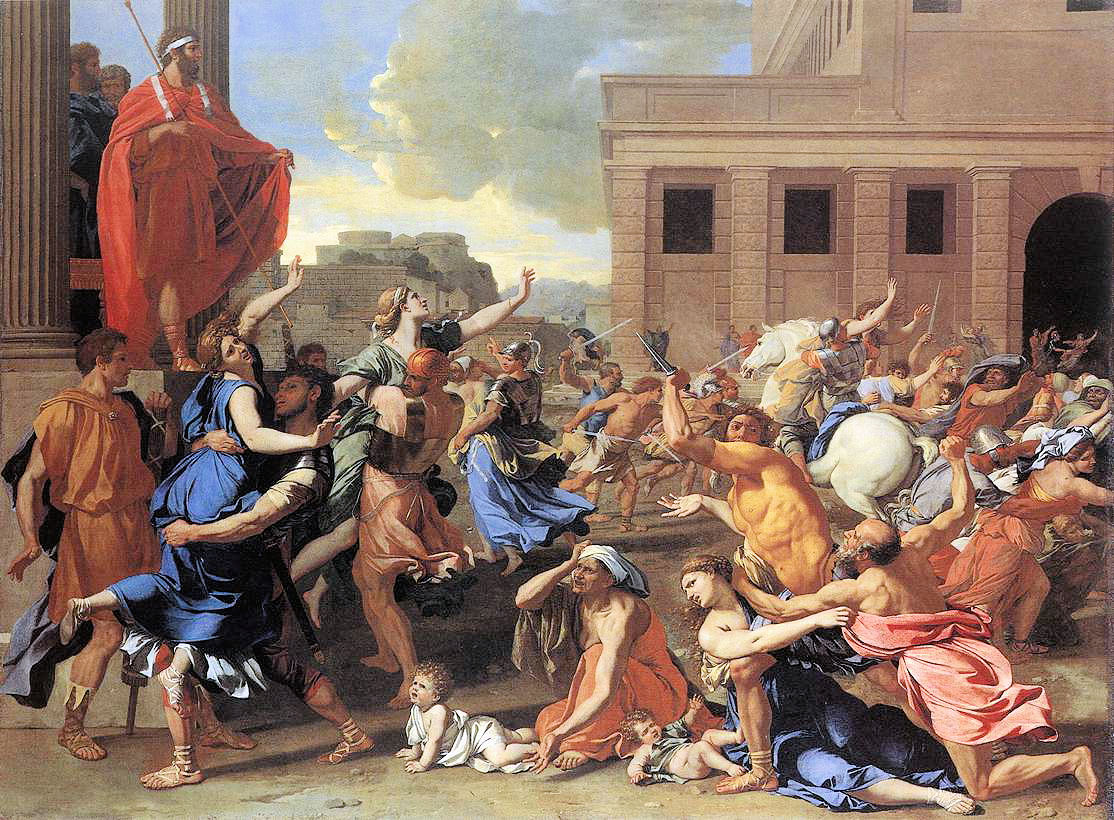
There were now many men living in the city, of whom very few were wedded to wives. So, Romulus had the idea that they could unite women to themselves. For they were just a mob who had come from difficult and undistinguished circumstances, and they were despised in their marriage suits by all of the neighboring tribes. Romulus then planned for his citizens to take wives by means of forcible seizure, so he announced that there would be a sacrifice, some games, and a religious assembly on the pretext that a strange new altar of the gods had been discovered. Many people came together for this. Romulus himself, however, sat at the front among the nobles, outfitted in a purple robe. He gave as the sign that the undertaking should commence the sudden spreading and re-fastening of his robe. Once this sign was given, the men, grabbing their swords, set out and grabbed the maiden daughters of the Sabines – not, indeed, anyone’s wife.

Πολλῶν δὲ τῇ πόλει ἐνοικισθέντων, ὧν ὀλίγοι γυναιξὶ συνεζεύγνυντο, φροντὶς τῷ ῾Ρωμύλῳ ἐγένετο ἵνα κἀκεῖνοι γυναῖκας ἑαυτοῖς συνοικίσωσι. σύγκλυδες γὰρ καὶ ἐξ ἀπόρων ὄντες καὶ ἀφανῶν, ὑπερωρῶντο πρὸς κῆδος παρὰ τῶν γειτνιώντων ἐθνῶν. βουλεύεται τοίνυν ἐξ ἁρπαγῆς λαβεῖν γυναῖκας τοὺς πολίτας αὐτοῦ, καὶ κηρύσσει θυσίαν καὶ ἀγῶνα καὶ θέαν μέλλειν τελεῖν πανηγυρικήν, ὡς βωμοῦ εὑρημένου θεοῦ καινοῦ. καὶ πολλοὶ συνῆλθον. αὐτὸς δὲ προυκάθητο μετὰ τῶν ἀρίστων, ἁλουργίδι κεκοσμημένος· δέδωκε δὲ τῷ δήμῳ τῆς ἐπιχειρήσεως σύμβολον τὴν τῆς ἁλουργίδος διάπτυξιν καὶ αὖθις ταύτης περιβολήν. οὗ γενομένου σπασάμενοι τὰ ξίφη μετὰ βοῆς ὥρμησαν καὶ ἥρπαζον τὰς θυγατέρας τῶν Σαβίνων παρθένους, οὐ μέντοι γυναῖκάς τινων

Zonaras 7.3 Part II – Romulus, The ‘Crafty Tyrant’

Zonaras relates how Romulus constructs the city walls, and employs some tricks of civic nomenclature to manipulate the people:

After burying his brother, Romulus settled his city. He yoked a bull to a cow, and threw a bronze ploughshare onto the plough; he then dug a large circular furrow, and those who followed him took the clods of earth which the plough dug out and turned them all around the furrow. Once it was time for the wall to be constructed, as it was said, the furrow was dug up where they had contrived to erect the walls, and they made intervals in the furrow, by lifting the plough up above them. For, they consider every wall a sacred thing; but if they had considered the gates sacred, it would not have been possible to bring in and send out some of the necessary and even impure articles of life.

The founding of the city was completed on the eleventh day before the Kalends of May, or better perhaps, on the twentieth of April. The Romans celebrate that day with festivals, considering it the birthday of their fatherland. It was said that Romulus was eighteen years old when he founded the city, which he founded near the home of Faustulus; this region was named the Palatine.

Now that the city was founded, he rounded up as much of the mob was the right age for military service and drew them up into military contingents. Each of these contingents consisted of three thousand infantry and three hundred cavalry, and was called a legion, because the fighters were chosen from all, while all of the rest were proclaimed part of the citizen body, which they named the people (populus). For this reason in their law books the assembly of the people is called the “popular” (popularia) assembly. He then marked out as counselors a hundred of the men most prominent for their birth, prudence, and mode of life, and called them patricians. The rest of the organized government he called the senate, which is the counsel of old men (gerousia). The patricians were so called either because they were the fathers of legitimate offspring, or perhaps more likely because they were able to demonstrate that their fathers were descended from well-known families, or from their patronia. (Thus they called the relationship of patronage, for they called those who took care of and protected a person “patrons.”) One could readily guess at Romulus’ motive here: he thought that by this appellation, he thought that it would be clear that the chief and most powerful men of the state would need to employ a certain paternal care for the lowborn, and that simultaneously the common people would be led on by the name of “patricians” not to feel put-upon by the honors granted to those more powerful than them, but would rather submit to it peacefully by both calling and considering them as “fathers.”

῾Ο δὲ ῾Ρωμύλος θάψας τὸν ἀδελφὸν ᾤκιζε τὴν πόλιν καὶ βοῦν ἄρρενα συζεύξας θηλείᾳ, καὶ ἀρότρῳ ὕννιν χαλκῆν ἐμβαλών, αὐτὸς μὲν αὔλακα βαθεῖαν κυκλοτερῆ περιέγραψεν, οἱ δ’ ἑπόμενοι τὰς βώλους, ἃς ἀνίστη τὸ ἄροτρον, εἴσω πάσας τῆς αὔλακος περιέστρεφον. καὶ ὅπου μὲν ἔμελλε τὸ τεῖχος ἀνίστασθαι, καθὼς εἴρηται, ἡ αὖλαξ ἐτέτμητο, ἔνθα δὲ πύλας στῆσαι διενοοῦντο, διάλειμμα ἐποιοῦντο τῆς αὔλακος, τὸ ἄροτρον ἀνέχοντες ὕπερθεν. πᾶν μὲν γὰρ τεῖχος νομίζουσιν ἱερόν· τὰς δὲ πύλας εἴπερ ἥγηντοἱεράς, οὐκ ἦν τὰ μὲν δι’ αὐτῶν εἰσάγειν, τὰ δὲ ἀποπέμπειν τῶν ἀναγκαίων καὶ μὴ καθαρῶν.

῾Η δὲ κτίσις τῆς πόλεως ταύτης ἡμέρᾳ τετέλεστο τῇ πρὸ ἕνδεκα καλανδῶν Μαΐων, ἣ ἂν εἴη μᾶλλον εἰκοστὴ ᾿Απριλλίου· καὶ τὴν ἡμέραν ταύτην ἑορτάζουσι ῾Ρωμαῖοι, γενέθλιον τῆς πατρίδος ὀνομάζοντες. ὀκτωκαίδεκα δ’ εἶναι ῾Ρωμύλος ἐνιαυτῶν ἀναγέγραπται ὅτε τὴν ῾Ρώμην συνῴκισεν. ἔκτισε δὲ αὐτὴν περὶ τὴν τοῦ Φαυστούλου οἴκησιν· ὠνόμαστο δ’ ὁ χῶρος Παλάτιον.

Κτισθείσης μέντοι τῆς πόλεως, ὅσον μὲν ἐν ἡλικίᾳ στρατευσίμῳ πλῆθος ἐτύγχανεν, εἰς στρατιωτικὰ διεῖλε συντάγματα, ἕκαστον δὲ σύνταγμα πεζῶν τρισχιλίων ἦν καὶ τριακοσίων ἱππέων, ἐκλήθη δὲ λεγεών, ὅτι λογάδες ἦσαν ἐκ πάντων οἱ μάχιμοι, τοῖς δ’ ἄλλοις δήμῳ ἐκέχρητο. καὶ τὸν δῆμον ποπούλους ὠνόμασεν· ὅθεν καὶ παρὰ ταῖς βίβλοις ταῖς νομικαῖς ποπουλαρία κέκληται ἡ δημοτικὴ ἀγωγή. τῶν μέντοι περιφανεστέρων γένει τε καὶ συνέσει καὶ βίου αἱρέσει ἑκατὸν ἀπέδειξε βουλευτάς, πατρικίους ὀνομάσας αὐτούς· τὸ δὲ λοιπὸν σύστημα σενάτον προσηγόρευσεν, ὅ ἐστι γερουσία. πατρίκιοι μέντοι οἱ βουλευταὶ ἐπεκλήθησαν ἢ ὅτι παίδων ἦσαν γνησίων πατέρες, ἢ μᾶλλον ὅτι αὐτοὶ πατέρας ἑαυτῶν ἀποδεικνύειν ἠδύναντο ἕκαστος ἐκ γένους ὄντες γνωρίμου, ἢ ἀπὸ τῆς πατρωνίας· οὕτω δ’ ἐκάλουν τὴν προστασίαν· πάτρωνας γὰρ τοὺς κηδεμονικοὺς καὶ βοηθητικοὺς προσηγόρευον. μάλιστα δ’ ἄν τις καταστοχάσαιτο τῆς τοῦ ῾Ρωμύλου διανοίας, εἰ οἴοιτο διὰ τῆς κλήσεως ταύτης ἐμφαίνειν χρῆναι τοὺς πρώτους καὶ δυνατωτάτους τῆς πόλεως πατρικῇ κηδεμονίᾳ κήδεσθαι τῶν ταπεινοτέρων, ἅμα δὲ καὶ τὸν δῆμον ἐνάγειν διὰ τῆς τῶν πατρικίων προσηγορίας εἰς τὸ μὴ ἄχθεσθαι ταῖς τῶν κρειττόνων τιμαῖς, ἀλλ’ εὐνοϊκῶς διακεῖσθαι, νομίζοντας πατέρας αὐτοὺς καὶ προσαγορεύοντας.

Zonaras 7.3 Part I – Romus is Murdered

Romulus and Romus abandon Alba Longa; the murder of Romus.

Romulus and Romus then gave the throne to their maternal grandfather Numitor, and to their mother they gave an honor which they judged suitable to themselves. For they did not undertake to seize power, and moreover they wished to found a city on the spot where they were nursed. When they set about the task of building the new city, there arose between the brothers a dispute about the city and who would be sovereign, and it came to blows; in this contest, Romus died. Another story has it that as Romulus was digging a trench which was to be the city enclosure, Romus now hindered the work, and now scoffed at it. At last, when Romus leapt over it as if to show how easily it could be attacked, he was killed; some say that this was at Romulus’ hands, and others aver that he was slain by some other man. For this reason, it was enacted that anyone who dared to cross the trench except by the customary paths would be condemned to death.

῾Ρωμύλος μέντοι καὶ ῾Ρῶμος τὴν τῆς ῎Αλβης ἡγεμονίαν τῷ μητροπάτορι νείμαντες, καὶ τῇ μητρὶ τιμὴν πρέπουσαν, καθ’ ἑαυτοὺς εἶναι ἔκριναν· οὔτε γὰρ ἠνείχοντο ἄρχεσθαι καὶ πόλιν ἀναστῆσαι ἔνθα προετράφησαν ἤθελον. ὡρμημένοις δὲ πρὸς τὴν τῆς πόλεως δόμησιν διαφορὰ συνέβη τοῖς ἀδελφοῖς περί τε τῆς ἀρχῆς καὶ περὶ τῆς πόλεως, καὶ διὰ μάχης ἐχώρησαν, ἐν ᾗ ὁ ῾Ρῶμος ἀπέθανεν. ἕτερος δὲ λόγος ἔχει ὡς τοῦ ῾Ρωμύλου τάφρον ἤδη ὀρύττοντος, ἣ τῆς πόλεως ἔμελλεν εἶναι προτείχισμα, πῇ μὲν ἀπεῖργε τὸ ἔργον ὁ ῾Ρῶμος, πῇ δέ γε ἐχλεύαζε· καὶ τέλος διαλλόμενον αὐτὴν ὡς εὐεπιχείρητον οἱ μὲν ῾Ρωμύλου πατάξαντος, οἱ δ’ ἑτέρου τινὸς ἱστοροῦσι πεσεῖν.ὅθεν καὶ ἐνομίσθη τὸν στρατοπέδου τάφρον τολμήσαντα διελθεῖν παρὰ τὰς συνήθεις ὁδούς, θανατοῦσθαι.

Zonaras 7.2 – Alba Longa Retaken

Romulus and Romus come of age; their identity is revealed; Amulius is expelled.

When they [Romulus and Romus] grew up, they were both manly and high-spirited. Romulus seemed more distinguished for his intelligence and was more inclined to command than obey. When a dispute arose between the cowherds of Numitor and those of Amulius, the brothers beat them and took a great share of the cattle. The cowherds of Numitor then laid a trap for Romus when he was walking alone with a few others; they captured him and brought him to Numitor. He feared retribution for coming up against Amulius, being his brother and often maltreated by the members of his household. But Amulius gave Romus to Numitor to do with him as he wished. As Numitor was returning home and gazing upon Romus, who was distinguished for his size and strength, he marveled at his boldness and indomitable nature, and then asked him in a low voice who he was and who his parents were. Romus boldly replied, ‘We are twin brothers; our lineage is said to be unspeakable, and our rearing and nursing is even more incredible, since we were nursed by beasts and birds after being set in a tiny cradle next to the great river; indeed, it still exists, with some faint words engraved on the bronze ribs which hold it together.’

Numitor was then led on by both the speech and appearance of Romus to think about the exposure of his daughter’s children. When Faustulus learned of the seizure of Romus, he urged Romulus to help him, and at that time told him clearly about his own lineage which was previously kept secret in order to prevent them from becoming small-minded. He then got the cradle and brought it to Numitor in the full bloom of zeal and anxiety. When he was seen by the guards posted outside the gates of Amulius, and appeared to be anxious under their questioning, it did not escape notice that he was hiding the cradle underneath his mantle. Thinking that he was concealing something which he had stolen, they brought the cradle out into the open. There happened to be present one of the men who had exposed the boys. He recognized the cradle, and ran to tell Amulius. When Faustulus was interrogated by the king, he laid out that the boys were alive, and further were cowherds in Alba Longa. He brought the cradle to Ilia, the mother of the boys, who wanted to see it. Disturbed by all of this, Amulius sent a man to Numitor to find out whether he could learn anything of the boys, since they were still alive. The man who had been sent on this expedition was one of Numitor’s friends. He went away and found Numitor lost in the complicated puzzle about Romus; he then urged Numitor on and counseled that there should be no delay, and he himself helped with the deed. Just then, Romulus arrived with a large band of rustics. A few of the city dwellers had also joined him from hatred of Amulius. Since matters had fallen out those, Amulius – neither doing nor contriving anything – ran away to save his life.

Αὐξανόμενοι δὲ θυμοειδεῖς ἦσαν καὶ ἀνδρώδεις ἀμφότεροι· ὁ δὲ ῾Ρωμύλος ἐδόκει συνέσει διαφορώτερος καὶ ἡγεμονικὸς μᾶλλον τὴν φύσιν ἢ πειθαρχικός.γενομένης δέ ποτε πρὸς τοὺς Νομίτωρος βουκόλους τοῖς τοῦ ᾿Αμουλίου διαφορᾶς, συγκόπτουσιν αὐτοὺς οἱ ὁμαίμονες καὶ τῆς ἀγέλης συχνὴν ἀποτέμνονται μοῖραν. μόνῳ δὲ τῷ ῾Ρώμῳ σὺν ὀλίγοις ἄλλοις βαδίζοντι οἱ τοῦ Νομίτωρος βουκόλοι λοχήσαντες συνέλαβον αὐτὸν καὶ ἀπήγαγον πρὸς Νομίτωρα· καὶ ὃς πρὸς ᾿Αμούλιον ἐλθὼν ἐδεῖτο τυχεῖν δίκης, ἀδελφὸς ὢν καὶ ὑπὸ τῶν οἰκείων αὐτοῦ ὑβρισμένος. ὁ δὲ παραδίδωσι τῷ Νομίτωρι τὸν ῾Ρῶμον ὡς βούλοιτο χρήσασθαι. ὃς οἴκοι ἐλθὼν καὶ τὸν νεανίσκον ὁρῶν ὑπερφέροντα μεγέθει καὶ ῥώμῃ, καὶ τὸ θαρραλέον αὐτοῦ καὶ ἀδούλωτον τῆς ψυχῆς θαυμάζων, ἀνέκρινεν ὅστις εἴη καὶ ὅθεν γένοιτο, φωνῇ πραείᾳ. ὁ δὲ θαρρῶν ἔλεγεν ὡς “δίδυμοι μέν ἐσμεν ἀδελφοί, γοναὶ δὲ ἡμῶν ἀπόρρητοι λέγονται καὶ τροφαὶ καὶ τιθηνήσεις θαυμασιώτεραι, θηρίοις καὶ οἰωνοῖς τραφέντων παρὰ τὸν μέγαν ποταμὸν ἐν σκάφῃ τινὶ κειμένων, ἣ ἔτι σώζεται, χαλκοῖς ὑποζώμασι γραμμάτων ἀμυδρῶν ἐγκεχαραγμένων.”

῾Ο μὲν οὖν Νομίτωρ τοῖς τε λόγοις τοῦ ῾Ρώμου καὶ τῇ ὄψει πρὸς ἔννοιαν τῆς ἐκθέσεως τῶν τῆς θυγατρὸς ἐνήγετο παίδων, ὁ δὲ Φαυστοῦλος τὴν τοῦ῾Ρώμου μαθὼν σύλληψιν τὸν μὲν ῾Ρωμύλον βοηθεῖν παρεκάλει, τότε σαφῶς διδάξας αὐτὸν περὶ τῆς γενέσεως, πρότερον γὰρ ὑπῃνίττετο, ὥστ’ αὐτοὺς μὴ μικροφρονεῖν, αὐτὸς δὲ τὴν σκάφην κομίζων ἐχώρει πρὸς τὸν Νομίτωρα σπουδῆς καὶ δέους μεστός. τοῖς δὲ περὶ τὰς πύλας τοῦ ᾿Αμουλίου φρουροῖς ὑφορώμενος, καὶ ταραττόμενος περὶ τὰς ἀποκρίσεις, οὐκ ἔλαθε τὴν σκάφην τῷ χλανιδίῳ περικαλύπτων. ὑπολαβόντες δὲ κλοπιμαῖόν τι φέρειν αὐτόν, εἰς μέσον τὴν σκάφην προήγαγον. ἔτυχε δέ τις παρὼν ἐκεῖ τῶν τὰ παιδάρια ἐκθεμένων· ὃς τὴν σκάφην γνωρίσας, δραμὼν φράζει τῷ ᾿Αμουλίῳ. καὶ ὁ Φαυστοῦλος ἀνακρινόμενος παρὰ τοῦ βασιλέως σώζεσθαι μὲν τοὺς παῖδας κατέθετο, πόρρω δὲ τῆς ῎Αλβης νέμοντας εἶναι· τὴν δὲ σκάφην πρὸς τὴν ᾿Ιλίαν κομίζειν τὴν τῶν παίδων μητέρα, ποθοῦσαν ἰδεῖν. τεταραγμένος δὲ τούτοις ᾿Αμούλιος ἄνδρα πρὸς τὸν Νομίτωρα πέπομφε πυνθανόμενος εἴ τι μάθοι περὶ τῶν παίδων ὡς περιόντων. ἦν δὲ τῶν φίλων ὁ πεμφθεὶς τοῦ Νομίτωρος. ἀπελθὼν οὖν καὶ ἐν περιπλοκαῖς τοῦ῾Ρώμου εὑρηκὼς τὸν Νομίτωρα, παρεθάρρυνέ τε καὶ μὴ μέλλειν αὐτοῖς συνεβούλευε, καὶ αὐτὸς δὲ συνέπραττεν. ἄρτι δὲ καὶ ὁ ῾Ρωμύλος ἐγγὺς ἦν, χεῖρα συχνὴν ἀγροικικὴν ἐπαγόμενος· καὶ τῶν πολιτῶν δὲ αὐτῷ οὐκ ὀλίγοι προσῄεσαν μίσει τοῦ ᾿Αμουλίου. ὃς οὕτω τῶν πραγμάτων συνενεχθέντων οὐδὲν οὔτε πράξας οὔτε βουλεύσας σωτήριον ἀνῃρέθη.

Zonaras: Romulus and… Romus? (7.1 pt. III)

Zonaras relates the birth of Romulus and Remus, how they were cast out by Amulius, and how they were raised either by a wolf or a prostitute.

So much for Lavinium and the Albans. Roman affairs had as their beginning Numitor and Amulius, who were the sons of Aventinus, and the descendants of Aeneas. Once the throne in Alba Longa had fallen to them through succession, they wished to apportion it out between themselves, along with the royal possessions. When Amulius set both the property and the crown as private, and asked his brother which of the two he would like for himself, Numitor chose the crown because he was the older brother. Amulius took the property and surrounded himself with the power which naturally attends wealth, and with it seized the crown. Numitor had a daughter and Amulius, fearing that she might have children who would rebel against him, made her a priestess of Hestia which entailed that she would be an unmarried virgin through all of her life. She was seen later to be pregnant by Ares, as the myth goes, but most probably it was by some man. She was imprisoned on that account, so that she could not escape when she gave birth. She gave birth to two children who were great and noble. Amulius, now even more terrified, ordered that the children be cast out. So, he took them and placed them in a little skiff in the Tiber. The water’s flow led the skiff away to a pleasant spot, where they say that a she-wolf came upon the children and offered them her teat; they also say that there was a woodpecker there feeding them and guarding them. One of Amulius’ swineherds, named Faustulus, came upon the children there and took them. He then raised them with his wife, whose name was Larentia. One was named Romulus, and the other Romus. Some deny that a she-wolf nursed them, which would be more credible or even have more of an air of truth, but this story took hold from the beginning. The Romans call both she-wolves and prostitutes “lupas.” The fact that Larentia, who raised the boys, was a prostitute and on that account called a lupa (she-wolf), caused the region to buy into the myth.*

  • NOTE: This idea is at least as old as Livy: Sunt qui Larentiam volgato corpore lupam inter pastores vocatam putent. “There are those who would say that Larentia was called ‘the she-wolf’ among the pastors, on account of having put her body into common circulation.”

Καὶ ταῦτα μὲν περὶ Λαουινίου καὶ ᾿Αλβανῶν· τὰ δὲ τῶν ῾Ρωμαίων ἀρχὴν ἐσχήκασι τὸν Νομίτωρά τε καὶ τὸν ᾿Αμούλιον, οἳ ᾿Αουεντίνου μὲν ἐγένοντο υἱωνοί, τοῦ δ’ Αἰνείου ἀπόγονοι. τῆς γοῦν ἐν ῎Αλβῃ βασιλείας κατὰ διαδοχὴν περιελθούσης αὐτοῖς, νείμασθαι ταύτην ἠθέλησαν καὶ τὰ χρήματα. τοῦ ᾿Αμουλίου τοίνυν ἰδίᾳ μὲν τὰ χρήματα θέντος, ἰδίᾳ δέ γε τὴν βασιλείαν, καὶ ἐξ ἀμφοῖν τὸν ἀδελφὸν προτρεψαμένου ὃ πρὸς βουλῆς αὐτῷ ἐπιλέξασθαι, τὴν βασιλείαν εἵλετο ὁ Νομίτωρ, ἅτε καὶ πρεσβύτερος ἀδελφός· λαβὼν δὲ τὰ χρήματα ὁ ᾿Αμούλιος, καὶ δύναμιν ἐκ τούτων περιβαλλόμενος, καὶ τὴν βασιλείαν ἀφείλετο. θυγατρὸς δὲ τῷ Νομίτωρι οὔσης, δεδιὼς μὴ παῖδες ἐξ αὐτῆς γένοιντο καὶ κατεξανασταῖεν αὐτοῦ, ἱέρειαν τῆς ῾Εστίας ἐκείνην ἀπέδειξεν, ἄγαμον διὰ τοῦτο καὶ παρθένον διὰ βίου μέλλουσαν ἔσεσθαι. ἡ δὲ κύουσα ἐφωράθη μετέπειτα ὑπὸ ῎Αρεος, ὡς μυθεύεται, ὑπ’ ἀνθρώπων δὲ πάντως τινός. εἵρχθη οὖν διὰ τοῦτο, ἵνα μὴ λάθῃ τεκοῦσα. καὶ ἔτεκε διδύμους παῖδας μεγάλους τε καὶ καλούς. μᾶλλον οὖν φοβηθεὶς ὁ ᾿Αμούλιος ἐκέλευσε τὰ βρέφη ῥιφῆναι. καὶ ὁ ταῦτα λαβὼν σκάφῃ ἐνθέμενος ἐμβάλλει τῷ ποταμῷ τῷ Τιβέριδι. παρασῦραν δὲ τὴν σκάφην τὸ ῥεῦμα εἴς τινα χῶρον κατήνεγκε μαλθακόν· ἔνθα κειμένοις τοῖς βρέφεσι λύκαιναν ἱστοροῦσι προσιοῦσαν θηλὴν παρέχειν αὐτοῖς, καὶ ὄρνιν δρυοκολάπτην παρεῖναι ταῦτα ψωμίζοντα καὶ φυλάττοντα. ἐκεῖ δὲ κείμενα τὰ βρέφη λαθὼν ἀφείλετό τις ᾿Αμουλίου συοφορβὸς Φαυστοῦλος καλούμενος· καὶ παρὰ τῆς ἐκείνου ἐτράφησαν γυναικός, ᾗ ὄνομα Λαρεντία· καὶ ὁ μὲν ῾Ρωμύλος, ὁ δ’ ἕτερος ῾Ρῶμος ἐκλήθησαν. τινὲς δὲ μὴ λύκαιναν εἶναι τὴν τῶν παίδων φασὶ τροφόν, ὃ καὶ πιθανώτερον ἢ ἀληθέστερον μάλιστα, ἀρχὴν δὲ τὸν λόγον οὕτω λαβεῖν. λούπας καλοῦσι ῾Ρωμαῖοι τάς τε λυκαίνας καὶ τὰς ἑταίρας· πορνευομένη δ’ ἡ Λαρεντία, ἣ τοὺς παῖδας ἐθρέψατο, καὶ λοῦπα διὰ τοῦτο καλουμένη, χώραν τῷ μύθῳ παρέσχετο.