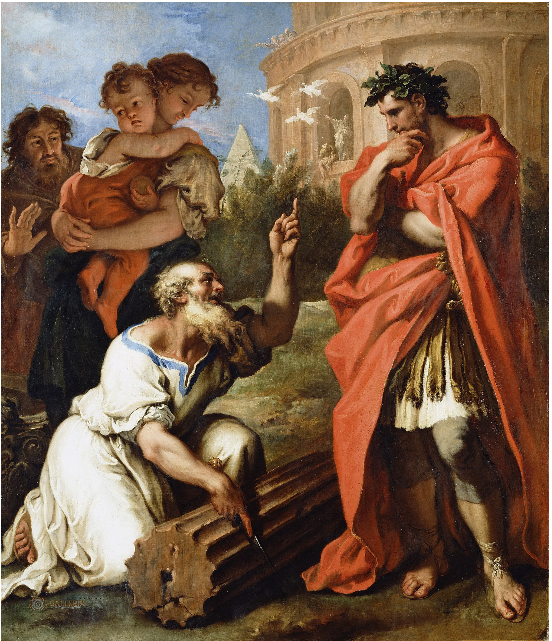
Zonaras 7.9 Part IV: A Trick Leads to Roman Supremacy

Nothing of note in Etruria; the Romans subdue the Latins with trickery:

Tullius thus won the plebeians over to his side, yet fearing the chance of a rebellion, he entrusted the greatest and strongest parts of the commonwealth to the most powerful. They worked in mutual concord, and managed public affairs as well as possible. They waged a few wars against the Veii and the Etruscans more generally, but this involved nothing worth writing down. Tullius also wanted even more to reconcile the rest of the Latins to the Romans, so he persuaded them to construct a shrine at the public expense in Rome, which they dedicated to Artemis. Yet, disagreement arose as to who should tend the shrine. A Sabine man led a rather beautiful cow to the altar, as if to sacrifice it to Artemis because of a certain oracle. The oracle stated that the one who sacrificed the cow would increase the greatness of his country. When one of the Romans heard this, he came to the man, and told him that it was first necessary to purify the cow in the river. Thus he persuaded the Sabine man, and taking the cow as if to guard it, he sacrificed it himself. When the Sabine man revealed the oracle, the Latins yielded the erection of the shrine to the Romans, and in other respects honored the Romans as their superiors.

Τὸν μὲν οὖν ὅμιλον οὕτως ὁ Τούλλιος ᾠκειώσατο, δείσας δὲ μή τις στάσις συμβῇ, τὰ πλεῖστα καὶ ἰσχυρότατα τῶν κοινῶν τοῖς δυνατωτέροις ἐπέτρεψε· καὶ οὕτω σφίσιν αὐτοῖς συνεφρόνησαν καὶ τὸ δημόσιον διήγαγον ἄριστα. καὶ πολέμους δέ τινας πρός τε τοὺς Οὐιέντας καὶ πρὸς ἅπαντας τοὺς Τυρσηνοὺς ἐπολέμησεν, ἐν οἷς οὐδὲν ἐπράχθη συγγράμματος ἄξιον. τοὺς Λατίνους δ’ ἐπὶ μᾶλλον ῾Ρωμαίοις βουληθεὶς οἰκειώσασθαι, νεών τινα ἐκ χρημάτων κοινῶν ἐν τῇ ῾Ρώμῃ κατασκευάσαι πέπεικε. καὶ τοῦτον ἀνέθεσαν τῇ ᾿Αρτέμιδι. περὶ δὲ τῆς νεωκορίας αὐτοῦ διεφέροντο. κἀν τούτῳ Σαβῖνος ἀνὴρ βοῦν ἦγε περικαλλῆ πρὸς τὴν ῾Ρώμην, ὡς ἔκ τινος χρησμοῦ θύσων αὐτὴν τῇ ᾿Αρτέμιδι. ὁ δὲ χρησμὸς τὸν ἐκείνην θύσαντα ἔλεγε τὴν πατρίδα ἐπαυξήσειν. τοῦτο δέ τις τῶν ῾Ρωμαίων μαθὼν προσῆλθεν αὐτῷ καὶ πρότερον εἶπε δεῖν ἐν τῷ ποταμῷ ἁγνισθῆναι, καὶ εἰπὼν ἔπεισε, καὶ πείσας ἔλαβε τὴν βοῦν ὡς φυλάξων, καὶ λαβὼν ἔθυσεν. ἐκφήναντος δὲ τοῦ Σαβίνου τὸ λόγιον οἱ Λατῖνοι καὶ τῆς τοῦ ἱεροῦ προστασίας τοῖς ῾Ρωμαίοις ἐξέστησαν καὶ ἐς τἄλλα ὡς κρείττονας σφῶν ἐτίμων αὐτούς.

Zonaras 7.9 Part III: Tullius the Demagogue; Patrician Footwear

Servius Tullius is the object of political intrigue, and the patricians wear fancy shoes:

When Tullius then took up the management of public affairs, he followed, for the most part, the injunctions of Tarquinius. When he saw among the multitude the men who had murdered Tarquinius, he employed a strategem to lead them to the senate house: he pretended that Tarquinius was still alive. Some of them were condemned and executed, but the sons of Marcus had fled to the Volsci in fear. Tullius then revealed the death of Tarquinius and openly took up the kingship. First, he exiled the sons of Tarquinius so as to entrust the sole rule to himself, and he then subsequently turned his attention to public service; with the aim of easily winning over the rabble rather than the nobles, he gave them property and land, while also preparing to free the slaves and enroll them in the tribes. When the powerful men of the state felt grieved by this, he ordered that those who were being freed should perform some service in turn for those who freed them. The nobles then spread the report that he held the kingship without receiving it from anyone, but had mustered the people together through demagoguery. Having said so many enticing things to them, he caused the entire state to be voted over to him. Tullius, however, responded that he had other ambitions, and enlisted some of them in the senate. The ancient plebeians had less power than the patricians, but as time went on (and except in the case of an interregnum or religious occasion) they had an equal share with the patricians, and differed from them in no way but their shoes. For, the patricians wore shoes with a fashionable interweaving of the straps and stylish inscription, so that they could easily be noticed as descending from the original hundred men who sat in the senate. They say that the inscription was the Greek letter Rho, either as the clear mark of the number 100, or as the first letter of the Roman name.

᾿Εγχειρισθεὶς οὖν ἐκεῖνος τὴν τῶν κοινῶν οἰκονομίαν, τὰ πλείω κατ’ ἐντολὰς δῆθεν διῴκει τοῦ Ταρκυνίου. ὡς δ’ ἐν πᾶσιν ἑώρα πειθαρχοῦντας αὐτῷ, τοὺς αὐτόχειρας τοῦ Ταρκυνίου πρὸς τὴν γερουσίαν παρήγαγε, διὰ τὴν ἐπιβουλὴν τάχα· ἔτι γὰρ ζῆν ἐκεῖνον προσεποιεῖτο. καὶ οἱ μὲν καταψηφισθέντες ἀπέθανον, οἱ δὲ τοῦ Μαρκίου υἱοὶ φοβηθέντες εἰς Οὐολούσκους κατέφυγον. κἀκεῖνος τότε τόν τε θάνατον τοῦ Ταρκυνίου ἐξέφηνε καὶ φανερῶς τῆς βασιλείας ἐπείληπτο. καὶ πρῶτον μὲν τοὺς τοῦ Ταρκυνίου παῖδας προυβάλλετο ὡς αὐτὸς τὴν ἡγεμονίαν ἐπιτροπεύων, εἶτα πρὸς θεραπείαν τοῦ δήμου ἐτράπετο, ὡς ῥᾷστα μᾶλλον τὸν ὅμιλον ἢ τοὺς εὐπατρίδας ὑποποιησόμενος, χρήματά τε αὐτοῖς ἐδίδου καὶ γῆν ἑκάστῳ προσένειμε καὶ τοὺς δούλους ἐλευθεροῦσθαι καὶ φυλετεύεσθαι παρεσκεύασεν. ἀχθομένων δ’ ἐπὶ τούτοις τῶν δυνατῶν, ἔταξέ τινα τοὺς ἐλευθερωθέντας τοῖς ἐλευθερώσασι σφᾶς ἀνθυπουργεῖν. ὡς δὲ χαλεπῶς εἶχον οἱ εὐπατρίδαι αὐτῷ, καὶ διεθρόουν ἄλλα τε καὶ ὅτι μηδενὸς αὐτὸν ἑλομένου τὴν ἀρχὴν ἔχει, συναγαγὼν τὸν δῆμον ἐδημηγόρησε· καὶ πολλὰ ἐπαγωγὰ διαλεχθεὶς αὐτῷ οὕτω διέθετο ὡς αὐτίκα πᾶσαν αὐτῷ τὴν βασιλείαν ἐπιψηφίσασθαι. ὁ δὲ αὐτοὺς ἀμειβόμενος ἄλλα τε ἐφιλοτιμήσατο καὶ ἐς τὸ συνέδριόν τινας αὐτῶν ἐνέγραψεν· οἳ πάλαι μὲν ἐν πλείστοις ἧττον ἔφερον τῶν εὐπατριδῶν, τοῦ χρόνου δὲ προϊόντος, πλὴν τῆς μεσοβασιλείας καὶ τῶν ἱερωσυνῶν, τῶν ἴσων μετεῖχον τοῖς εὐπατρίδαις, καὶ διέφερον ἄνευ τῶν ὑποδημάτων οὐδέν. τοῖς γὰρ εὐπατρίδαις τὰ ὑποδήματα ἀστικὰ τῇ τε ἐπαλλαγῇ τῶν ἱμάντων καὶ τῷ τύπῳ τοῦ γράμματος ἐκεκόσμηντο, ἵν’ ἐκ τούτων δοκοῖεν ἀπὸ τῶν ἑκατὸν ἀνδρῶν τῶν κατ’ ἀρχὰς βουλευσάντων κατιέναι. τὸ γράμμα δὲ ῥῶ φασιν εἶναι, ἢ τοῦ ἀριθμοῦ τῶν ἑκατὸν ἐκείνων ἀνδρῶν δηλωτικὸν ὂν ἢ ὡς τοῦ τῶν ῾Ρωμαίων κατάρχον ὀνόματος.

Zonaras 7.9 Part II – Servius Tullius Becomes King

Tanaquil and Tullius form an alliance:

The murderers of Tarquinius were caught, while his wife and Tullius – once they learned of the plot – did not make his death known to all. They took his body away and made a pretence of tending to it as though he were still alive, and they added further assurance to others that Tullius, taking up the throne, would abdicate it when her own sons came to manhood. When the people arrived, they clamored, and Tanaquil, emerging from the upper chambers, told them ‘Do not fear. My husband is alive, and you will soon see him. But, so that he may take some rest to recover himself, and lest his lack of strength stand in the way of public affairs, he has entrusted the management of the state to Tullius for the present moment.’ Thus she spoke; the people accepted Tullius not unwillingly, for he seemed to be a good man.

Συλληφθέντων οὖν τῶν τοῦ Ταρκυνίου φονέων, μαθοῦσα ἡ ἐκείνου γυνὴ καὶ ὁ Τούλλιος τὴν παρασκευὴν τῆς ἐπιβουλῆς οὐ φανερὸν αὐτίκα τὸν τοῦ Ταρκυνίου θάνατον ἔθεντο, ἀλλ’ ἀνελόμενοι αὐτὸν ὡς ἔτι ἐμπνέοντα ἐθεράπευον δῆθεν, κἀν τούτῳ πίστεις ἀλλήλοις ἔδοσαν ὥστε τὸν Τούλλιον τὴν ἀρχὴν εἰληφότα τοῖς παισὶν αὐτῆς ἀνδρωθεῖσιν ἐκστῆναι
ταύτης. ἐπεὶ δὲ τὸ πλῆθος συνδραμὸν ἐθορύβει, προκύψασα ἐκ τῶν ὑπερῴων ἡ Τανακυιλὶς “μὴ φοβεῖσθε” ἔφη· “ὁ γὰρ ἀνήρ μου καὶ ζῇ καὶ ὑμῖν μετ’ ὀλίγον ὀφθήσεται. ἵνα δὲ αὐτός τε σχολάζων ὑγιασθῇ καὶ μή τι τοῖς πράγμασιν ἐκ τῆς αὐτοῦ ἀσθενείας εἴη ἐμπόδιον, Τουλλίῳ κατά γε τὸ παρὸν τὴν τῶν κοινῶν ἐπιτρέπει διοίκησιν.” εἶπεν ἐκείνη ταῦτα· οἱ δὲ τὸν Τούλλιον οὐκ ἀκουσίως ἐδέξαντο· ἀγαθὸς γὰρ ἀνὴρ ἐδόκει.


Zonaras 7.9 Part I: Servius Tullius Destined for Greatness

How Servius Tullius became a Roman noble:

Tarquinius Priscus met such an end after reigning for thirty-eight years. Thereupon, Tullius became the king of the Romans with the assistance of Tarquinius’ wife, Tanaquil. His mother, a woman named Ocrisia, was the bedmate of a man named Servius Tullius. She was taken in war and brought to Tarquinius. She gave birth, either already being pregnant when still in her home city, or conceiving after its capture – both stories are told. Tullius, as he was nearing the end of childhood, fell asleep upon a seat during the day, and fire seemed to project forth from his head. When Tarquinius saw this, he took the boy up with eagerness, and when he had reached the proper age, enlisted him among the patricians and the senate.

῾Ο μὲν οὖν Ταρκύνιος τοιοῦτον ἔσχε τέλος, τριάκοντα καὶ ὀκτὼ βασιλεύσας ἐνιαυτούς, τὴν δὲ τῆς ῾Ρώμης βασιλείαν ὁ Τούλλιος διεδέξατο, συνεργίᾳ τῆς τοῦ Ταρκυνίου γυναικὸς Τανακυιλίδος. τοῦτον δὲ γυνή τις ᾿Οκρισία καλουμένη, Σερουίου Τουλλίου ἀνδρὸς Λατίνου εὐνέτειρα ἐν τῷ πολέμῳ ἁλοῦσα καὶ τῷ Ταρκυνίῳ ἐξαιρεθεῖσα, τέτοκεν, ἢ ἐγκύμων οἴκοθεν οὖσα ἢ συλλαβοῦσα μετὰ τὴν ἅλωσιν· λέγεται γὰρ ἀμφότερα. οὗτος ἐς παῖδας ἤδη τελῶν ἐπὶ δίφρου μεθ’ ἡμέραν κατέδαρθε, καὶ πῦρ ἀπὸ τῆς αὐτοῦ κεφαλῆς πολὺ ἐδόκει ἐξάλλεσθαι. ὅπερ ἰδὼν ὁ Ταρκύνιος διὰ σπουδῆς ἦγε τὸν παῖδα, καὶ εἰς ἡλικίαν ἀφιγμένον τοῖς εὐπατρίδαις καὶ τῇ γερουσίᾳ συνέταξε.

Zonaras 7.8 Part V: The Sons of Marcius Return

Tarquinius is slain by the sons of Marcius for usurping their throne:

The sons of Marcius then set upon Tarquinius, since he did not pass the throne on to them, but instead preferred a certain Tullius who was born to him by a captive woman. This indeed was a thing which had caused the nobles substantial distress. The sons of Marcius therefore enlisted the help of some of these nobles and plotted against Tarquinius; their plan was to send, in rustic fashion, two men armed with axes and sickles to attack Tarquinius. When it happened that they did not encounter Tarquinius in public, they went to the doors of his regal home, indeed striving against each other as they needed to come into his presence. When they met him, they fell into an argument with each other, and while Tarquinius paid attention to one of the men as he was pleading his case, the other man slew him.

᾿Επέθεντο μέντοι τῷ Ταρκυνίῳ οἱ τοῦ Μαρκίου παῖδες, ἐπεὶ μὴ τῆς ἀρχῆς αὐτοῖς παρεχώρει, ἀλλά τινα Τούλλιον τεχθέντα οἱ ἐξ αἰχμαλωτίδος προῆγε πάντων· ὃ δὴ μάλιστα τοὺς εὐπατρίδας ἐλύπει. ὧν τινας προσεταιρισάμενοι αὐτῷ ἐπεβούλευσαν, δύο
τινὰς χωριτικῶς ἐσταλμένους, ἀξίναις καὶ δρεπάνοις ὡπλισμένους, αὐτῷ ἐπιθέσθαι παρασκευάσαντες. οἳ ἐπεὶ μὴ ἀγοράζοντι τῷ Ταρκυνίῳ ἐνέτυχον, ἐπὶ τὰς θύρας τῶν βασιλείων ἧκον, ἀλλήλοις δῆθεν διαμαχόμενοι, καί οἱ ἐλθεῖν εἰς ὄψιν ἐδέοντο. καὶ τυχόντες τούτου εἰς λόγους ἀλλήλοις ἀντικατέστησαν, καὶ δικαιολογουμένῳ τῷ ἑνὶ προσέχοντα τὸν Ταρκύνιον ὁ ἕτερος κατειργάσατο.

Zonaras 7.8 Part IV: Punishment of Vestal Virgins

Tarquinius Priscus punishes a Vestal Virgin who violated her oath of chastity:

Later, Tarquinius waged war against the Latin tribes who were rebelling, and subsequently he fought against the Sabines who were aided by the Etruscans; he conquered them all. When he learned that a certain one of the Vestal Virgins (who were ordered to preserve their maidenhood throughout their lives) had engaged in indiscreet intercourse with a man, he had an oblong passage dug underground, in which he placed a couch and a table with an abundance of food. He had the ruined woman sent down there, and after she was led into the chamber, he had it sealed off. Thus, from that event, the custom prevailed that those priestesses who did not take care of their chastity were punished. The men who so defiled these women were forced to place their heads upon cloven logs in the forum, and after being stripped naked and degraded, were deprived of their lives.

Μαχεσάμενος δὲ Λατίνοις ἀποστατήσασιν, ἔπειτα καὶ Σαβίνοις εἰς τὴν ῾Ρωμαΐδα ἐμβαλοῦσι συμμαχουμένοις ὑπὸ Τυρσηνῶν, ἁπάντων ἐκράτησε. τῶν δὲ τῆς ῾Εστίας ἱερειῶν, ἃς παρθενεύειν διὰ βίου νενόμισται, φωράσας τινὰ συμφθαρεῖσαν ἀνδρί, ὑπόγεών τινα κατασκευάσας ὑποδρομὴν προμήκη, κλίνην τε θεὶς ἐν αὐτῇ καὶ λύχνον καὶ τράπεζαν σιτίων ὑπόπλεων, ἐκεῖ τὴν φθαρεῖσαν προπεμπομένην ἐκόμισε, καὶ ζῶσαν εἰσαγαγὼν ἐγκατῳκοδόμησε. καὶ οὕτω τὰς τὴν παρθενίαν μὴ τηρησάσας τῶν ἱερειῶν ἐξ ἐκείνου τιμωρεῖσθαι κεκράτηκεν· οἱ δὲ ταύτας αἰσχύνοντες εἰς ξύλον τὸν αὐχένα δίκρουν ἐμβάλλονται ἐν τῇ ἀγορᾷ, καὶ μετὰ τοῦτο γυμνοὶ αἰκιζόμενοι ἀποψύχουσιν.

Zonaras 7.8 Part III: The Tale of Attus Navius

Attus Navius gets the better of the impious Tarquinius.

Indeed, Tarquinius Priscus would have accomplished many other startling reforms, if a certain Attus Navius (who was a finer augur than any who had ever lived) had not prevented him from altering the arrangement of the tribes. Tarquinius was enraged by his opposition, and sought to entirely discredit Attus’ craft. He therefore put a razor and a whetstone in his cloak, and went among the people with the intention of cutting the whetstone with the razor – a clearly impossible task. When he began to lay out his plans and Attus began to speak out against him most violently, he did not cave in but rather said, ‘If you are not speaking against me simply from your love of argument, but are indeed telling the truth, tell me whether what I now have in mind will occur.’ Attus, divining immediately what was meant, said, ‘Indeed, my king – what you wish will come to pass.’ Tarquinius then responded, ‘Then take that whetstone, and cut it with that blade. This is what I had in mind.’ Attus then took the whetstone immediately and cut it asunder. Tarquinius was amazed, and offered to Attus various honors, including the honor of a bronze statue; he also ceased to reform civic institutions, but began to employ Attus as his advisor in all things.

Πάντως δὲ καὶ ἄλλα πλείω ἐκαινοτόμησεν ἄν, εἰ μή τις ῎Αττος Ναούιος τὰς φυλὰς αὐτὸν βουληθέντα μετακοσμῆσαι κεκώλυκεν, ὃς οἰωνιστὴς ἦν οἷος οὐχ ἕτερος γέγονε. τοῦτον ὑβρίσαι, διὰ τὴν ἐναντίωσιν ὀργισθείς, καὶ τὴν τέχνην ἐξουθενῆσαι διεμελέτησεν ὁ Ταρκύνιος. λαβὼν οὖν ἐν τῷ κόλπῳ ἀκόνην τε καὶ ξυρὸν ἐς τὸν δῆμον παρῆλθεν, ἔχων ἐν νῷ τμηθῆναι τῷ ξυρῷ τὴν ἀκόνην, πρᾶγμα τῶν ἀδυνάτων· εἰπών τε ὅσα ἐβούλετο, ἐπεὶ ῎Αττος ἀντέλεγεν ἐντονώτατα, μηδὲν ὑφιέμενος “εἰ μὴ φιλονείκως ἀντιλέγεις” ἔφη “ἀλλ’ ἀληθῆ λέγεις, ἐπὶ πάντων τούτων ἀπόκριναί μοι εἰ ὃ κατὰ νοῦν ἔχω ποιῆσαι γενήσεται.” ὁ δὲ ῎Αττος αὐτοῦ που οἰωνισάμενος παραυτίκα “καὶ πάνυ γε” εἶπεν “ὦ βασιλεῦ, ὃ διανοῇ ἔσται ἐπιτελές.” “οὐκοῦν” ἔφη “τὴν ἀκόνην ταύτην λαβὼν τῷ ξυρῷ τούτῳ διάτεμε· τοῦτο γὰρ γενέσθαι διανενόημαι.” ὁ δὲ ἔλαβέ τε αὐτὴν εὐθὺς καὶ διέκοψε. θαυμάσας δὲ ὁ Ταρκύνιος ἄλλας τε τιμὰς ἐκείνῳ παρέσχε καὶ χαλκῆς εἰκόνος ἠξίωσε, καὶ οὐδὲν ἔτι τῆς πολιτείας ἠλλοίωσε, πρὸς πάντα τε συμβούλῳ τῷ ῎Αττῳ ἐκέχρητο.

Zonaras 7.8 Part II: Lucius Tarquinius the Autocrat

Lucius Tarquinius consolidates his power among the senate and people:

This opinion however, did not last. When Ancus Marcius died, Lucius Tarquinius did wrong by Marcius’ sons, and made the throne his own. When the senate and people were on the verge of selecting the sons of Marcius as their rulers, Tarquinius went to hold an interview with the most powerful of the senators, and sent the two orphan boys off to a hunt; and by what he did and said he contrived to have the throne voted to himself. Having thus made himself the master of Roman political affairs, he managed the Romans in such a way as to prevent the two boys from ever being chosen as kings. As he made the sons of Ancus more accustomed to luxury he charmed their souls and bodies into destruction. He lived in fear because he operated this way, and so he girded himself about with force in assembly meetings. He enlisted into the senate and patrician order about two-hundred men who were favorablly disposed toward him. In this way, he placed the senate and many of the common people under his own influence. He also transformed his clothing into something more befitting his greatness. This took the form of a toga and a tunic which were entirely purple, inlaid with gold, as well as a crown set with gold stones and an ivory chair. After all of this, other people holding the the imperial throne enjoyed absolute political supremacy. He also paraded in triumphs on a four-horse chariot, and had twelve lictors through his life.

᾿Αλλ’ οὐ προσέμεινε μέχρι τέλους αὐτῷ ἡ ὑπόληψις. τοῦ Μαρκίου γὰρ τελευτήσαντος κακῶς περὶ τοὺς ἐκείνου διετέθη δύο υἱεῖς, καὶ τὴν βασιλείαν ἐσφετερίσατο. τῆς τε γὰρ βουλῆς καὶ τοῦ δήμου τοὺς τοῦ Μαρκίου παῖδας χειροτονεῖν μελλόντων, ἐκεῖνος τῶν βουλευτῶν τε τοὺς δυνατωτάτους μετῆλθε, καὶ τοὺς ὀρφανοὺς πόρρω ποι πέμψας εἰς θήραν, οἷς τε εἶπε καὶ οἷς ἔπραξεν αὐτῷ τὴν βασιλείαν ψηφίσασθαι παρεσκεύασεν, ὡς ἀνδρωθεῖσιν αὐτὴν δῆθεν τοῖς παισὶν ἀποδώσοντι. ἐγκρατὴς δὲ καταστὰς τῶν πραγμάτων οὕτω τοὺς ῾Ρωμαίους διέθετο ὥστε μηδέποτε ἐθελήσειν ἀνθελέσθαι τοὺς παῖδας ἐκείνου· καὶ τὰ μειράκια δὲ πρὸς ῥᾳστώνην ἐθίζων τάς τε ψυχὰς αὐτῶν καὶ τὰ σώματα σὺν χάριτι δή τινι ἔφθειρε. δεδιὼς δὲ καὶ οὕτως ἔχων, ἰσχὺν ἑαυτῷ ἐν τῷ συνεδρίῳ περιεποιήσατο. τοὺς γὰρ φιλίως αὐτῷ ἐκ τοῦ δήμου διακειμένους περὶ διακοσίους ἐς τοὺς εὐπατρίδας ἐνέγραψε καὶ τοὺς βουλευτάς, καὶ οὕτω τήν τε γερουσίαν ὑφ’ ἑαυτὸν καὶ τοὺς πολλοὺς ἐποιήσατο. καὶ τὴν στολὴν πρὸς τὸ μεγαλοπρεπέστερον ἤμειψεν· ἡ δὲ ἦν ἱμάτιον καὶ χιτὼν ὁλοπόρφυρα καὶ χρυσόπαστα, στέφανός τε λίθων χρυσοδέτων καὶ σκῆπτρον δίφρος τε ἐλεφάντινα, οἷς καὶ μετὰ ταῦτα οἵ τε ἄλλοι καὶ οἱ τὴν αὐτοκράτορα ἔχοντες ἡγεμονίαν ἐχρήσαντο. καὶ τεθρίππῳ ἐν τοῖς ἐπινικίοις ἐπόμπευσε, καὶ ῥαβδούχους διὰ βίου δώδεκα ἔσχε.

Zonaras 7.7: The Reign of Ancus Marcius

Rome’s neighbors underestimate Ancus Marcius’ peaceful disposition

When Tullus Hostilius died, Ancus Marcius succeeded to the throne, which he took with the approval of the Roman people. He was not perfectly formed respecting his hand, because his arm had been mutilated; it was for this reason that he received the name “Ancus.” Though he was a reasonable man, he was compelled to change, and turned himself toward military affairs. For, on account of the destruction of Alba Longa, the other Latin cities feared that they themselves might suffer something similar, and so they held themselves in hostility to the Romans while Tullus Hostilius, whom they feared as a bitter enemy, still lived. However, because they thought that Ancus Marcius could easily be attacked with impunity on account of his peaceful mindset, the Latins set upon the land and plundered it. Ancus, reasoning that war could be the cause of peace, he set upon those who had set upon the Romans, and he seized their cities, one of which he razed to the ground. He treated many of the citizens of these captured cities as prisoners, and forced some others to emigrate to Rome. As the Roman population increased and their land holdings grew in proportion, those from neighboring areas were vexed and made war against the Romans. Whereupon, the Romans overcame the people of Fidenae in a siege, and distressed the Sabines by falling upon them as they were scattered and taking the field. By instilling fear in the others, they prepared them, however unwilling, to make peace. After all of this, the life of Ancus Marcius came to an end, after he head reigned for twenty four years and given much care to the gods, as did his grandfather Numa.

᾿Επεὶ δ’ ῾Οστίλλιος ἐτελεύτησε, διεδέξατο τὴν βασιλείαν ὁ Μάρκιος, παρ’ ἑκόντων τῶν ῾Ρωμαίων ταύ-ην λαβών. ἦν δὲ τὴν χεῖρα οὐκ ἄρτιος· τὴν γὰρ ἀγκύλην πεπήρωτο, ὅθεν καὶ ῎Αγκος ἐπώνυμον ἔσχηκεν. ἐπιεικὴς δὲ ὢν ἠναγκάσθη μεταβαλέσθαι, καὶ πρὸς στρατείας ἐτράπετο. οἱ γὰρ λοιποὶ Λατῖνοι διά τε τὸν τῆς ῎Αλβης ὄλεθρον καὶ περὶ ἑαυτῶν δεδοικότες μή τι πάθωσιν ὅμοιον δι’ ὀργῆς μὲν εἶχον ῾Ρωμαίους, ἕως δὲ περιῆν ὁ Τοῦλλος, δεδιότες ἐκεῖνον ὡς μάχιμον, συνεστέλλοντο. τὸν δὲ Μάρκιον εὐεπίθετον ἡγησάμενοι διὰ τὸ εἰρηναῖον τῆς γνώμης, τῇ τε χώρᾳ ἐπῆλθον καὶ αὐτὴν ἐληίσαντο. συνεὶς δ’ ἐκεῖνος εἰρήνης εἶναι τὸν πόλεμον αἴτιον, ἐπιτίθεται τοῖς ἐπιθεμένοις καὶ ἀντημύνατο, καὶ πόλεις εἷλεν αὐτῶν, ὧν μίαν κατέσκαψεν, καὶ πολλοῖς τῶν ἁλόντων ὡς αἰχμαλώτοις ἐχρήσατο, καὶ ἐς τὴν ῾Ρώμην δὲ συχνοὺς ἑτέρους μετῴκισεν. αὐξανομένων δὲ τῶν ῾Ρωμαίων καὶ τῆς χώρας σφίσι προστιθεμένης οἱ πλησιόχωροι ἤχθοντο καὶ ἑαυτοὺς ῾Ρωμαίοις ἐξεπολέμωσαν· ὅθεν αὐτῶν Φιδηνάτας μὲν πολιορκίᾳ ἐκράτησαν, Σαβίνους δ’ ἐκάκωσαν, αὐτοῖς τε προσπεσόντες ἐσκεδασμένοις καὶ τὸ σφῶν ἑλόντες στρατόπεδον, ἑτέρους δ’ ἐκφοβήσαντες εἰρηνεῖν καὶ ἄκοντας παρεσκεύασαν. καὶ ἐπὶ τούτοις Μαρκίῳ ἐπέλιπε τὸ βιώσιμον, εἴκοσιν ἐνιαυτοὺς καὶ τέσσαρας ἄρξαντι, καὶ πολλὴν τοῦ θείου κατὰ τὸν πάππον Νόμαν ποιουμένῳ τὴν ἐπιμέλειαν.

Zonaras 7.6 Part II – Destruction of Alba Longa; Death of Tullus Hostilius

Mettius Fufetius betrays the Romans; Alba Longa is destroyed for its perfidy; Tullus Hostilius dies as Romulus did

The citizens of Alba Longa then fell under the power of the Romans (though they later disregarded their pledges) and they were summoned as subjects to assist the Romans in battle. When it was learned that they had shifted to the enemies in an opportune part of the battle and had set upon the Romans, they were punished. Many of them were stretched out and torn asunder, including their leader Mettius Fufetius; the rest were compelled to emigrate, and their city of Alba Longa was razed to the ground, after having in some way been considered the mother city to Rome for 500 years.

Tullus Hostilius was famed for his rather violent power against his enemies, but he was careless of religion. When a pestilential illness befell him, though, even he inclined somewhat to fear the gods. He is said to have ended his life after being struck by lightning, or perhaps as the result of a conspiracy formed by Ancus Martius, the grandson (as has been noted) of Numa. Tullus Hostilius reigned over the Romans for thirty two years.

Mettius Fufettius is torn apart for betraying the Romans.

Οἱ δὲ ᾿Αλβανοὶ τότε μὲν ὑπήκοοι τῶν ῾Ρωμαίων ἐγένοντο, ὕστερον δὲ τὰς συνθήκας ἀθετήσαντες, καὶ ὡς ὑπήκοοι πρὸς συμμαχίαν κληθέντες, μεταθέσθαι δὲ πρὸς τοὺς πολεμίους ἐν τῷ καιρῷ τῆς μάχης ἐπιχειρήσαντες καὶ συνεπιθέσθαι ῾Ρωμαίοις, γνωσθέντες ἐκολάσθησαν· καὶ πολλοὶ μὲν ἐκτάνθησαν καὶ ὁ αὐτῶν ἐξηγούμενος Μέττιος, οἱ ἄλλοι δὲ μετανάστασιν ἔπαθον, καὶ ἡ πόλις αὐτῶν ῎Αλβα κατεσκάφη, πεντακόσιά που ἔτη ῾Ρωμαίοις νομισθεῖσα μητρόπολις.

Πρὸς μὲν οὖν τοὺς πολεμίους ὁ Τοῦλλος κράτιστος ἔδοξε, τοῦ θείου δὲ παρημέλει. νόσου δ’ ἐνσκηψάσης λοιμώδους καὶ αὐτὸς νοσήσας εἰς δεισιδαιμονίαν ἀπέκλινεν. ἐσχηκέναι μέντοι τοῦ βίου λέγεται τέλος καταφλεχθεὶς ὑπὸ κεραυνῶν, ἢ ἐπιβουλευθεὶς ὑπὸ Μαρκίου ῎Αγκου, ὃς θυγατριδοῦς ἐτύγχανεν, ὡς εἴρηται, τοῦ Νόμα. ἐβασίλευσε δὲ ῾Ρωμαίων ἔτη δύο ἐπὶ τριάκοντα.