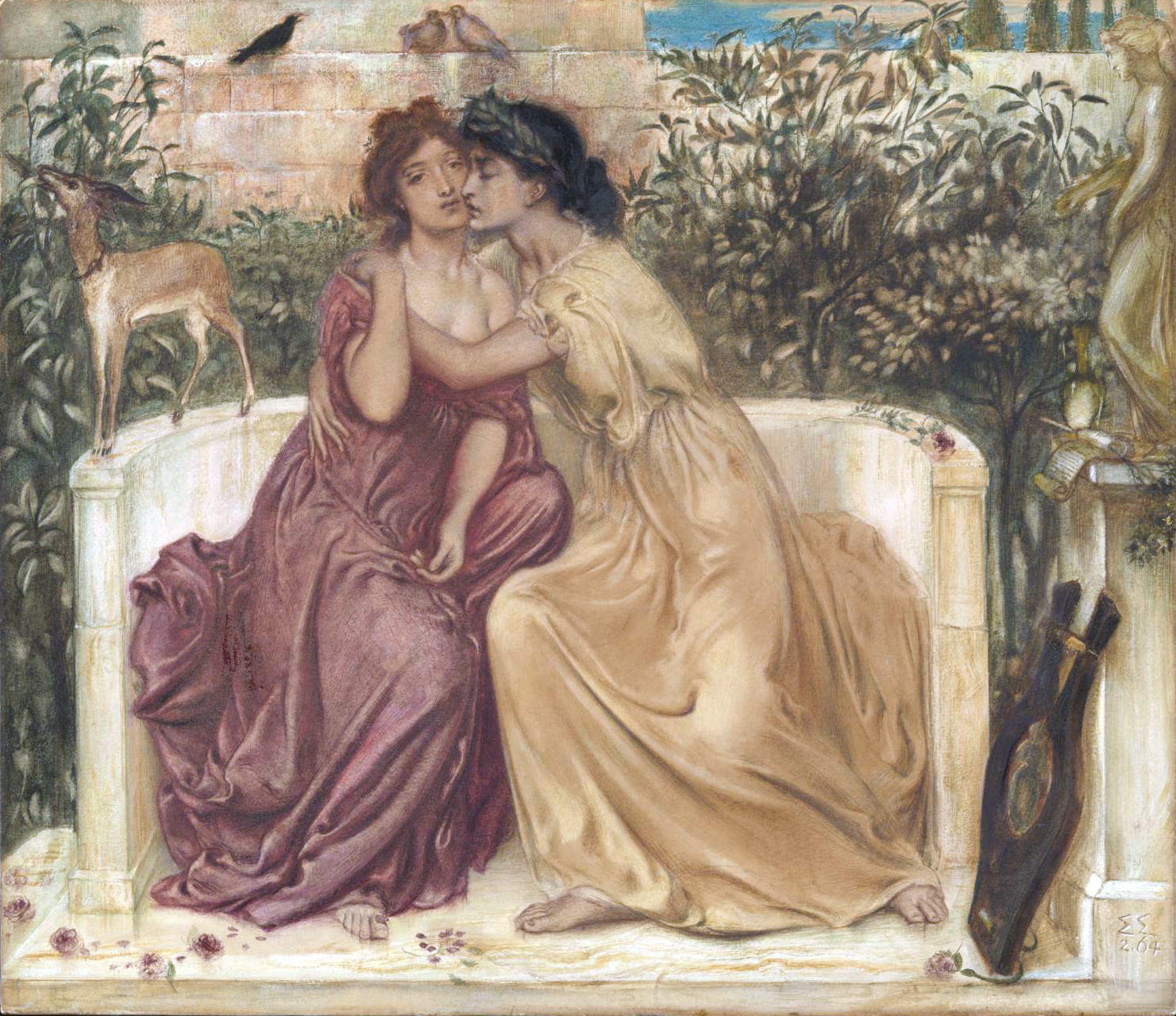
“Reverent Hera, who often comes down
From the sky to gaze upon your fragrant Lakinian home.
Take the linen robe which Theophilos, the daughter of Kleokha
Wove for you with the help of her noble daughter Nossis.”
“These weapons the Brettian men hurled down from their unlucky shoulders
As they were overcome by the hands of the fast-battling Lokrians.
They are dedicated here singing the Lokrians glory in the temple of the gods.
They don’t long at all for the hands of the cowards they abandoned.”
“Pass by me, give an honest laugh, and speak over me
A loving word. I am Rhintho from Syracuse,
A minor nightingale of the Muses. But from my tragic
Nonsense poems, I made my own ivy crown.”
“There is nothing sweeter than love: all other blessings
Take second place. I even spit honey from my mouth.
This is what Nossis says. Whomever Kypris has not kissed,
Does not understand her flowers, what kinds of things roses are.”
“This frame has the picture of Thaumareta. The painter
Caught the form and the age of the soft-glancing woman well.
Your house dog, the little puppy, would paw at you if she saw this,
Believing that she was looking down at the lady of her home.”
“Who eat bread…” He says this because there are some races who don’t eat bread. Indeed, some are called locust eaters and fish-easters, like the Skythian race and the Massagetae are called meat-eaters. Some of the locust-eaters, after seeing bread, used to believe it was shit.”
“The poet also does not show heroes eating fish or birds, but still Odysseus’ companions do try to under compulsion. Generally, the poet avoids this kind of habit because of its triviality, but he has [heroes] eat roasted meat.”
“Those who eat grain/bread.” This is perhaps said regarding the difference of other mortals who are not these kind of people—the kind of sort the story claims that the long-lived Aethiopians are too. These people, after they saw bread, compared it to shit. There were also those who lived from eating locusts and others who lived off fish. For this reason they are called locust-eaters and fish eaters. The Skythian race and the Masssegetic people who live primarily off meat do not wish to eat grain.”
“In a close land to [the Aethiopians] are people darker-skinned than the rest and shorter and the shortest-lived, the locust-eaters. They rarely see more than forty years because their flesh is rife with parasites. They live on locusts who arrive in the spring carried by the strong winds that blow into these places. After throwing burning logs into trenches and kindling them a little, they overshadow the locusts with smoke and they call. They pound them together with salt and use them as cakes for their food.”
Strabo’s passage is, from a modern perspective, fairly racist (and more so even than the Eustathius). I don’t believe that the Odyssey’s formulaic line carries the same force, however. For Homer, people who eat bread are those who cultivate the earth and have to work (they don’t live easy lives like the gods). People who don’t eat the fruit of the earth are marauders and monsters.
The Odyssey’s ethnographic frame develops structures that insist to be fully human, one must (1) live in a city and (2) have recognizable laws and institutions, and (3) cultivate the earth. Creatures who don’t do these things are marginalized and dehumanized either through their behavior (the suitors and sailors) or through actual deformity (the Cyclopes, Kikones, and, well, pretty much most of the women in the poem). So, while the epic itself is not clearly racist in the modern sense, it supplies and deploys frameworks by which other human beings may be marginalized and dehumanized.
“There is also the story that when the people of Mitylene allowed Pittacus to have half the land over which he fought in single combat, he would not take it. Instead, he assigned an equal portion to each man, saying that an “equal amount is greater than more”. For, since he took the measure of what was greater by fairness not by profit, he judged wisely. He believed that fame and safety would follow equality while gossip and fear followed greed, and they would have quickly reclaimed his gift.”
Cf. Diogenes Laertius, Lives of the Philosophers 1.75
“Then, the Mityleneans honored Pittakos powerfully and gave the rule of the state to him alone. During the ten years he held power, he also corrected the constitution and then surrendered power even though he lived ten years more. The Mityleneans gave him some land, but he donated it as sacred. The plot is called after his name even today. Sôsicrates says that he cut off a little bit for himself, saying that “half is greater than the whole.”
The idea of “half being greater than the whole” is likely proverbial, showing up as well in Hesiod’s Works and Days where the narrator uses it when he complains about how the judges act unfairly in their evaluation of cases (by taking bribes): “the fools don’t know how much greater the half is than the whole” νήπιοι, οὐδὲ ἴσασιν ὅσῳ πλέον ἥμισυ παντὸς.
Diodorus Siculus’ statement that “an equal part is greater than more” is probably a clever departure from the Hesiodic statement. Hesiod’s statement seems to be about greed (wanting more than your due), as glossed by Michael Apostolius:
13.77
“They don’t know how much greater the half is than the whole”: [this is a proverb used] for those who desire more and lose what they have.
A unifying theme between the two versions is that in early Greek culture that which is isos is not fair in terms of being equal but it possesses equity in terms of being proper to the recipient’s social status. So, Diodorus’ isos share can map out onto Hesiod’s “half” share.
Another proverbial moment for Pittakos:
Diodorus Siculus, History 9.12.3
“When Pittacus finally caught up with the poet Alcaeus, a man especially hateful to him who had mocked him savagely in his poems, he released him, remarking that forgiveness is a better choice than vengeance.”
Elena, ekkolapsis (ἐκκόλαψις) la schiusa dell’uovo, Museo archeologico nazionale di Metaponto. In calcare, V sec. a.C.
“…the egg that Orpheus claims was created, projected from the boundless matter, was born like this: the quadruple matter is alive and all of the endless deep flows eternally but it moves in an unclear war, pouring forth here and there endless incomplete mixtures from one time to another. For this reason, it pulls them back too and then opens wide as if for the birth of a creature that cannot be bound.”
The poet and classicist Anne Carson has an essay that sticks like maple syrup to your subconscious, called “Essay on What I Think About Most.” She begins the poem by addressing the idea of the error and what we can learn from it by dissecting a bit of poetry from Alcman of Sparta, a Greek lyric poet from the 7th century BCE.
[made?] three seasons, summer
and winter and autumn third
and fourth spring when
there is blooming but to eat enough
is not (trans. Carson)
Carson notes that the verb in Alcman’s laconic rumination on hunger seems to have no subject. She addresses whether this was a grammatical mistake caused by transmission and fragmentation; a way modern philologists can scrub away “errors” of the past. “But as you know, the chief aim of philology,” she says, “is to reduce all textual delight / to an accident of history. And I am uneasy with any claim to know exactly / what a poet means to say. So let’s leave the question mark there “
The lack of any punctuation is the kicker there. The absence does more work than any ellipsis or period ever could. Carson demonstrates how, for her, Alcman “sidesteps fear, anxiety, shame, remorse” connected to mistakes in order to engage with a truth:
“The fact of the matter for humans is imperfection.”
And that is in part what the first column of Pasts Imperfect argues forin addressing the construction, impact, and harm of Joseph Campbell’s Monomyth: the need to embrace the mess and variants of the past. To do this, we must also situate the “classical” Mediterranean within a global antiquity.
What is Pasts Imperfect? It is a column and a space for commentary, reviews, essays, reflections, statements, and any other words needed to help us negotiate between the past and our present world. We talk about pasts because antiquity isn’t just one land, timeline, or narrative; it is multiple and multiplied by the perspectives we bring to bear on it. Our Pasts are not just Greek, Roman, and Mediterranean; they are not just elite, white, and male. The past includes these people and perspectives, but also those who were silenced or left behind: the people, the languages, and the histories in or beyond the margins.
Imperfect is about value and aspect. We acknowledge that the past is far from perfect and we study antiquity to help us understand ourselves and the causes of things, not to render fictive, to emulate, or to praise simply because something has been praised before. To be human is to be imperfect; to love as a human is to love imperfectly. Our studies of the past and ourselves must honor and inhabit such complexities.
Imperfect is also about incompletion. We see the study of the past as a process that is ongoing and never truly done: each generation, each embodied person, each new perspective contributes to challenging what we think we know about what has come before.
Pasts Imperfect seeks to bring critical and transparently progressive reflections and scholarship on antiquity to a wider audience. It is a column, a space, and a developing network for those who want to engage in challenging discussions about antiquity, its construction and reception in scholarship, and its impact on the modern world. As our editorial college and paid writer-network begins to expand and to take pitches, we hope to venture into a more global understanding of the past while also making space for imperfection.
Plutarch, On the Affection Offspring (Moralia 496b)
“There is nothing so imperfect, helpless, naked, formless, and unclean as a human being glimpsed at the moment of birth, someone to whom nature has not even given a clear path to the light.”
“By a Lemnian Hand: [meaning] cruelly and lawlessly. This is from a story: for they say that the women in Lemnos allegedly killed their husbands because they weren’t having sex with them”
A few years ago I was looking up some odd word or another in the work of the lexicographer Hesychius (ok, to be honest, I was looking up words for feces and was looking at κοκκιλόνδις· παιδὸς ἀφόδευμα; kokkilondis: “a child’s excrement”). I found the following words which are pretty much absent from all modern lexica.
Kikkasos: the sweat flowing from between the thighs
κίκκασος· ὁ ἐκ τῶν παραμηρίων ἱδρὼς ῥέων.
Kikkê: Sex. Or the bad smell [that comes] from genitals
κίκκη· συνουσία. ἡ ἀπὸ τῶν αἰδοίων δυσοσμία
Obviously, the specificity of these two lexical items is amusing. But their very existence perplexed me a bit. Where did they come from? How were they used? (They don’t actually appear anywhere but in Hesychius.) After some contemplation and a little restraint, I can only conclude that the words emerge from a generally misogynistic context which also considered sex in some way unclean.
The story that I kept thinking of was that of the Lemnian women—it is one of the few connections I could make between sex and bad smells. It is also one of my least favorite myths because it echoes modern misogynistic taboos which marginalize and alienate female bodies. So, I almost didn’t write this post. But I do think that it is worth making these connections, however uncomfortable they are.
Here are two versions of the Lemnian women tale.
Apollodorus, 1.114
“Jason was the captain of the ship as they disembarked and neared Lemnos. The island then happened to be bereft of men and was ruled by Hypsipyle, Thoas’ daughter, for the following reason. The Lemnian women used not to honor Aphrodite. She cast a terrible smell upon them and, for this reason, their husbands acquired spear-won women from Thrace and slept with them.
Because they were dishonored, the Lemnian women slaughtered their fathers and husbands. Hypsipyle alone spared her father Thoas by hiding him. After they landed on the women-controlled island, they slept with the women. Hypsipyle gave birth to sons after sleeping with Jason: Eunêos and Nebrophonos.”
“The story goes like this: Because the Lemnian women had carried out the honors for Aphrodite improperly, the goddess inflicted a bad smell upon them: for this reason, men turned them away. They all worked together and killed their husbands in a plot. Then the Argonauts, as they were travelling to Skythia, arrived in in Lemnos; when they found that the island was bereft of men, they slept with the women and then left. The sons who were born from them went to Sparta in search of their fathers and, once they were accepted among the Lakonians, they became citizens there and settled in Sparta.
This tale seems to combine with a larger treatment of Lemnos as clear from the proverb above and this one:
A proverb from Zenobius (4.91)
“A Lemnian evil”: A proverb which they say comes from the lawless acts committed against husbands by the women of Lemnos. Or it derives from the story of the women who were abducted from Attica by the Pelasgians and settled in Lemnos. Once they gave birth, they taught their sons the ways and the language of the Athenians. They honored each other and ruled over those who descended from Thracians. Then the Pelasgians, because they were angry over this, killed them and their mothers. Or the proverb derives from the bad smell of the Lemnian women.”
The story of the Lemnian crimes (Lêmnia Erga) is told by Herodotus (6.137-138): the Pelasgians were driven out of Attic and took Lemnos; then they got their revenge by abducting Athenian women during a festival. When the sons of these women grew up, they frightened the native Pelasgians and they were all killed.
In the major tales, it is clear that the women are not completely at fault, but they are the ones who seem to suffer the most. Within the broader narrative of the Argonaut tale, especially, we can see how women are defined by their bodies as loci of sexual interest or disinterest, the ability to produce children, and anxiety that they might not remain subordinate to male desire. The casual detail of the Pelasgian tale is especially harrowing.
In our now annual tradition, we are re-posting this list with more names and updated links. Most of the evidence for these authors has been collected only in Wikipedia. I have added new translations and new names over the past few years (especially among the philosophers). Always happy to have new names and links suggested.
I originally received a link to the core list in an email from my undergraduate poetry teacher, the amazing poet and translator Olga Broumas. The post is on tumblr on a page by DiasporaChic, bit the original author is Terpsikeraunos.
Women in ancient Greece and Rome with surviving works or fragments
PHILOSOPHY
Here is a list of Women philosophers with testimonia and fragments (with French translations and commentary).
Aesara of Lucania: “Only a fragment survives of Aesara of Lucania’s Book on Human Nature, but it provides a key to understanding the philosophies of Phintys, Perictione, and Theano II as well. Aesara presents a familiar and intuitive natural law theory. She says that through the activity of introspection into our own nature – specifically the nature of a human soul – we can discover not only the natural philosophic foundation for all of human law, but we can also discern the technical structure of morality, positive law, and, it may be inferred, the laws of moral psychology and of physical medicine. Aesara’s natural law theory concerns laws governing three applications of moral law: individual or private morality, laws governing the moral basis of the institution of the family, and, laws governing the moral foundations of social institutions. By analyzing the nature of the soul, Aesara says, we will understand the nature of law and of justice at the individual, familial, and social levels.” – A History of Women Philosophers: Volume I: Ancient Women Philosophers, 600 B.C.-500 A.D., by M.E. Waith
Melissa: “Melissa (3rd century BC)[1][2] was a Pythagorean philosopher…Nothing is known about her life. She is known only from a letter written to another woman named Cleareta (or Clearete). The letter is written in a Doric Greek dialect dated to around the 3rd century BC.[2] The letter discusses the need for a wife to be modest and virtuous, and stresses that she should obey her husband.[2] The content has led to the suggestion that it was written pseudonymously by a man.[2] On the other hand, the author of the letter does not suggest that a woman is naturally inferior or weak, or that she needs a man’s rule to be virtuous.[1]” –Wikipedia
Perictione (I and II): “Two works attributed to Perictione have survived in fragments: On the Harmony of Women and On Wisdom. Differences in language suggest that they were written by two different people. Allen and Waithe identify them as Perictione I and Perictione II. Plato’s mother was named Perictione, and Waithe argues that she should be identified as the earlier Perictione, suggesting that similarities between Plato’s Republic and On the Harmony of Women may not be the result of Perictione reading Plato, but the opposite–the son learning philosophy from his mother. On the Harmony of Women, however, is written in Ionic prose with occasional Doric forms. This mixed dialect dates the work to the late fourth or third centuries BC. The reference in On the Harmony of Women to women ruling suggests the Hellenistic monarchies of the third century BC or later. On Wisdom is written in Doric and is partly identical with a work by Archytas of the same name. This work should be dated later, to the third or second centuries BC. Both the dates of the works and their dialects mean Perictione as the mother of Plato could not have written them. We then have two Pythagorean texts, attributed to otherwise unknown women named Perictione who should be dated perhaps one hundred years apart.” –Women Writers of Ancient Greece and Rome: An Anthology, by I.M. Plant
*N.B. This account leaves out the the basic narrative from Diogenes Laertius, that Plato’s father Ariston raped his mother Perictione.
Phintys: “Phintys (or Phyntis, Greek: Φίντυς; 4th or 3rd century BC) was a Pythagorean philosopher. Nothing is known about her life, nor where she came from. She wrote a work on the correct behavior of women, two extracts of which are preserved by Stobaeus.” –Wikipedia
*Note, Stobaeus (4.32.61a) calls her the daughter of Kallikrates the Pythagorean (Φιντύος τᾶς Καλλικράτεος θυγατρὸς Πυθαγορείας). Here are some of her fragments on the prudence befitting women: part 1 and part 2.
Ptolemais of Cyrene: “Ptolemais is known to us through reference to her work by Porphyry in his Commentary on the Harmonics of Ptolemy. He tells us that she came from Cyrene and gives the title of her work, The Pythagorean Principles of Music, which he quotes. She is the only known female musical theorist from antiquity. Her dates cannot be known for sure. She clearly preceded Porphyry, who was born about AD 232; Didymus, who is also quoted by Porphyry, knew Ptolemais’ work and may even have been Porphyry’s source for it. This Didymus is probably the one who lived in the time of Nero, giving us a date for Ptolemais of the first century AD or earlier…One of the problems in dealing with this text is that it is in quotation. Porphyry does not clearly distinguish between the text he quotes from Ptolemais and his own discussion of the issues raised…A second issue is the problem of the accuracy of the quotation. Porphyry says in the introduction to fragment 4 that he has altered a few things in the quotation for the sake of brevity. We should not assume that this is the only quotation to have suffered from editing. On the other hand, where he quotes the same passage twice (fragment 3 is repeated almost verbatim in fragment 4) his consistency is encouraging. Ptolemais’ extant work is a catechism, written as a series of questions and answers. She discusses different schools of thought on harmonic theory, distinguishing between the degree to which they gave importance to theory and perception. Her text prefers the approach of Aristoxenus to that of the Pythagoreans, thus she should not be thought a Pythagorean, despite the title of her work.” –Women Writers of Ancient Greece and Rome: An Anthology, by I.M. Plant
“Reverent Hera, who often comes down
From the sky to gaze upon your fragrant Lakinian home.
Take the linen robe which Theophilos, the daughter of Kleokha
Wove for you with the help of her noble daughter Nossis.”
“These weapons the Brettian men hurled down from their unlucky shoulders
As they were overcome by the hands of the fast-battling Lokrians.
They are dedicated here singing the Lokrians glory in the temple of the gods.
They don’t long at all for the hands of the cowards they abandoned.”
“Pass by me, give an honest laugh, and speak over me
A loving word. I am Rhintho from Syracuse,
A minor nightingale of the Muses. But from my tragic
Nonsense poems, I made my own ivy crown.”
“There is nothing sweeter than love: all other blessings
Take second place. I even spit honey from my mouth.
This is what Nossis says. Whomever Kypris has not kissed,
Does not understand her flowers, what kinds of things roses are.”
“This frame has the picture of Thaumareta. The painter
Caught the form and the age of the soft-glancing woman well.
Your house dog, the little puppy, would paw at you if she saw this,
Believing that she was looking down at the lady of her home.”
“May the gods grant as much as you desire in your thoughts,
A husband and home, and may they give you fine likemindness,
For nothing is better and stronger than this
When two people who are likeminded in their thoughts share a home,
A man and a wife—this brings many pains for their enemies And joys to their friends. And the gods listen to them especially”
“And, really, justice is each person taking care of his own business and not meddling in too many things. We have heard this from many others and said it ourselves many times”
“Yes, we have said this.”
Then, I said, “so, then, justice runs the risk in some way of just being taking care of your own business?”
“To exact vengeance from someone was thought to be more important than not suffering at all. If oaths were ever taken in turn, were strong because each person was at a loss and had no power at all. But as soon as one of them had the advantage, he attached if he saw anyone unguarded: it was sweeter to take vengeance despite a pledge than to do so openly. It was thought generally to be safe and to have won a prize for intelligence, prevailing by deceit. Many wicked people become famous for being clever than good people do for being ingenuous. Men are ashamed by the latter but delight in the former.
To blame for all of these things the love of power and a love of honor. From both, they fell into a voluntary love of conflict. For those who were in charge of the state each claimed identities for themselves, some the equal rights of the masses, the others the wisdom of the aristocrats; while guarding the common goods in word, they were making them the contest’s prize, competing with one another to be pre-eminent, they dared the most terrible things—and they surpassed them with greater acts of vengeance too. They did not regard either justice or advantage for the city…”
“The penalty for kidnapping and enslaving those from another country should be whatever the court will charge, but for those who kidnap and enslave their own people the penalty should be death without any appeal. For these people are your relatives, neighbors not far off from blood at a greater distance”
“This man who does not respect the people who listen to his words
Nor feel shame at his own cowardice when he’s a general,
Does not dare to come near a brave spear
But he’s the worst. Does a man like this
Come here to enslave the children of Herakles?”
“Otanês was first urging the Persians to entrust governing to the people, saying these things: “it seems right to me that we no longer have a monarchy. For it is neither pleasing nor good. For you all know about the arrogance of Kambyses and you were a party to the insanity of the Magus. How could monarchy be a fitting thing when it permits an unaccountable person to do whatever he pleases? Even if you put the best of all men into this position he might go outside of customary thoughts. For hubris is nurtured by the fine things present around him, and envy is native to a person from the beginning.
The one who has these two qualities possesses every kind of malice. For one who is overfilled does many reckless things, some because of arrogance and some because of envy. Certainly, it would be right for a man who is a tyrant at least to have no envy at all, since he has all the good things. Yet he becomes the opposite of this towards his citizens: for he envies those who are best around him and live, and he takes pleasure in the worst of the citizens—he is the best at welcoming slanders.
He becomes the most disharmonious of all people—for if you admire him only moderately, then he is upset because you do not support him ardently. But if someone supports him excessively, he is angry at him for being a toady. The worst things are still to be said: he overturns traditional laws, he rapes women, and kills people without reason.”