“Night has come with strange new fantasies
I will tell them to the sky, if that provides any relief.
I imagined in sleep that I was freed from this land
and was sleeping in my girlhood’s home in Argos….”
“I have come. What’s going on? What are your worries?
Why did you bring me to this temple,
child of the man who approached Trojan towers
with a famous fleet of one thousand ships
of ten thousand arms
that leader of an army
the oldest of the famous Atreids?”
Each week we select scenes from a play, actors and experts from around the world, and put them all together for 90 minutes or so to see what will happen. This process is therapeutic for us; and it helps us think about how tragedy may have had similar functions in the ancient world as well.
Euripides, Iphigenia in Tauris 376-379
“…I put off many embraces
to a later time,
because I thought I would go back to Argos again.
Wretched brother, Orestes, if you have died you have
such great fortune as you leave our father’s envied stores.”
This week we return to Euripides and the fate of Agamemnon’s daughter Iphigenia in the surprising and challenging Iphigenia at Aulis. This play joins other Euripidean tragedies–like the Helen or his Orestes–in presenting alternative accounts of myth and challenging well-known narratives. In this one, the very daughter who was sacrificed to Artemis was whisked away to Tauris where she became a human sacrificing priestess of the goddess. Somehow, Orestes and Pylades end up in her hands after their trial at Athens. And, well, it goes on from there.
What do we make of such a fantasy, of the willful rewriting of the past? This play was performed during some of the most troubling of the years off the Peloponnesian War and its genre bending may have appealed to audiences eager for some escape or some hope that all was not fated. Like Helen it flouts mythical tradition, but unlike Helen it seems to create a largely new ending for its characters.
Euripides, Iphigenia in Tauris 479-481
“Where have you come from, unlucky strangers?
You have sailed long to get to this land
and you will live below far from your homes for long indeed.”
“The gods who are called wise
are bigger liars than winged dreams.
The great confusion among the gods exists
among mortals too. Only one reason for lament
remains to one who’snot a fool and has not trusted the words of the prophets:
he dies as those who know he died believe.”
Artistic Director: Paul O’Mahony (Out of Chaos Theatre) Associate Director: Liz Fisher Director of Outreach: Amy Pistone (Gonzaga University) Dramaturg: Emma Pauly Executive Producer: Lanah Koelle (Center for Hellenic Studies) Producers: Keith DeStone (Center for Hellenic Studies), Hélène Emeriaud, Janet Ozsolak, and Sarah Scott (Kosmos Society) Poster Artist: John Koelle Poster Designer: Allie Marbry (Center for Hellenic Studies)
Euripides, Iphigenia in Tauris 874-885
“What end can there be for the fate that stalks me?
What will fortune bring me?
What path can be found
to send you from this man-killing city
back to our Argive home
before the sword tastes your blood.
Well, this is something you need to discover,
my dark soul.
Is the path by land, not with a ship
but with a dance of the feet?”
“Hope is a dear friend to mortal suffering,
people have no fill of it when they wander
for a weight of wealth over the sea’s swell
testing themselves against cities and foreigners
for this common belief.
But some find expectation for wealth
untimely even though it comes in moderation for others.”
“I fault the tricks of this goddess.
Any mortal who even touches blood
or dips a finger in childbirth or death,
she bars from her alters because she thinks them unclean
when she herself delights in human sacrifice!”
“Tell them that their home is already plagued,
and that the strife among their children
is no longer balanced out
by the fact that they all love life.”
“Do not send me from this land in dishonor,
but as a master of my wealth and the captain of my house.
I have said enough now. Old man, it is your task
to go and safeguard this need.
And the two of us will go: for it is the perfect moment
and the perfect moment is man’s greatest guide in every deed.”
Each week we select scenes from a play, actors and experts from around the world, and put them all together for 90 minutes or so to see what will happen. This process is therapeutic for us; and it helps us think about how tragedy may have had similar functions in the ancient world as well.
Sophocles, Elektra 91-95
“This hateful bed in our painful house
shares the pains of all my nights
how much I mourn for my wretched father…”
This week we turn to the first of many plays set around the House of Atreus, Sophokles’ Elektra. This story follows Orestes’ return home to murder his mother (and her lover Aegisthus) for the killing of his father Agamemnon. For fans of tragedy, the tale is famous from our only full trilogy from ancient Athens, Aeschylus’ Oresteia. But it was legendary—and perhaps even paradigmatic—Homer’s Odyssey as well, where Orestes is held up repeatedly as a model of youthful initiative to Telemachus and Clytemnestra’s betrayal of her husband appears as a constant threat to Odysseus’ homecoming.
The story of Orestes is, like the end of the Odyssey, about the cycle of vengeance and the dangerous narrative pull of the call to revenge. In Aeschylus’ Eumenides, Orestes ends up in Athens where he is judged by a jury for his mother’s murder: his story pits the orders of one god (Apollo) against he claims of others (the Furies) and the loyalty of a son to mother or father. The story of the Elektra is a prolonged rumination on the choices made before that crises. This version of the tale is often dated to the end of Sophocles’ life, during the middle of the Peloponnesian War. It features Orestes returning with Pylades in disguise to announce his death. The title character, Electra, has been mourning her father’s murder and longing for her brother’s return. Once she finds out about Orestes’ true identity, the play turns to the murder, but prior to that ever delayed moment of recognition, the audiences witnesses Orestes’ hesitation and Electra’s sorrow.
“No noble person wants
to ruin their good reputation by living badly
namelessly, my child.
So you have accepted for yourself
a life of fame and constant sorrow,
making a weapon from a noble cure–
with one strike you win two prizes
to be called a child excellent and wise.”
Electra – Evelyn Miller
Chrysothemis – Tabatha Gayle
Chorus – Sara Valentine
Orestes – Tim Delap
Clytemnestra – Eunice Roberts
Aegisthus – René Thornton Jr.
Special Guests, Amy. R. Cohen
Artistic Director: Paul O’Mahony (Out of Chaos Theatre) Associate Director: Liz Fisher Director of Outreach: Amy Pistone (Gonzaga University) Dramaturg: Emma Pauly Executive Producer: Lanah Koelle (Center for Hellenic Studies) Producers: Keith DeStone (Center for Hellenic Studies), Hélène Emeriaud, Janet Ozsolak, and Sarah Scott (Kosmos Society) Poster Artist: John Koelle Poster Designer: Allie Marbry (Center for Hellenic Studies)
Sophocles, Elektra 1282-1287
“My love–I am hearing a voice
I never hoped to hear,
but still I kept my eagerness quiet.
I heard with no cry in response.
But now, I have you. You are clear as day,
holding the dearest vision before me,
something I never could forget in any troubles.”
“What the greatest mob of fools and senseless wastes!
Don’t you care at all about your life
Or are you incapable of any thought at all,
When you cannot recognize that you aren’t just close,
but You’re in the middle of the worst shit there is?”
“There are many wonders and none
is more awe-inspiring than humanity.
This thing that crosses the sea
as it whorls under a stormy wind
finding a path on enveloping waves.
It wears down imperishable Earth, too,
the oldest of the gods, a tireless deity,
as the plows trace lives from year to year
drawn by the race of horses….”
Each week we select scenes from a play, actors and experts from around the world, and put them all together for 90 minutes or so to see what will happen. This process is therapeutic for us; and it helps us think about how tragedy may have had similar functions in the ancient world as well.
Sophocles, Antigone 737
“The state which belongs to one man is no state at all.”
πόλις γὰρ οὐκ ἔσθ᾽ ἥτις ἀνδρός ἐσθ᾽ ἑνός.
This week we turn to Sophocles’ Antigone, arguably one of the most famous plays from antiquity. Alongside Sophocles’ Oedipus Tyrannos and Euripides’ Bacchae, Antigone is one of the most re-interpreted and translated plays in the last generation. Its reputation is well-deserved both for some of the most memorable and moving poetic passages to the seemingly harsh simplicity of its plot which forces the title character to choose between obeying the laws of the gods or obeying the laws of the state. This choice to bury her brother against the decree of her uncle Creon seals Antigone’s fate to die, a martyr of sorts in service to the gods
Nevertheless, this simple plot belies the complexity and strangeness of the play as a whole. From the initial bitter debate between the sisters about Antigone’s decision to Creon’s bluster and the surprising death of Haemon, Sophocles’ play is not just about competing systems of loyalty: it is also about how we cast ourselves as ‘players’ in the world between competing systems of identity and affiliation. Antigone is set in Thebes and the myth-verse of that terrible Oedipal family. Her story is about civil war and the story it writes on the bodies of combatants and non-combatants; her story is about how the fight lives on after wars are over; and her story is about how words and the stories we tell can make peace impossible.
But this play is also not only about Antigone: her sister Ismene plays an important role as does her cousin Haemon who has a tragic interest in her love. Even more confusing is what we should think of the ruler Creon, the man who awarded Jocasta (unknowingly) to her own son, oversaw the war between their sons, and is now positioning himself as the only one who can keep Thebes from falling apart.
“The seven leaders appointed to their seven gates
dedicated their bronze arms
to Zeus who turns the battle
except for only those two born
of a singer mother and father
who faced each other’s spears
each with a share of victory and death.”
Antigone – Tabatha Gayle
Ismene – Evvy Miller
Creon – Tim Delap
Chorus – Sara Valentine, Austin Lee, and Gryphon Magnus
Haemon – Carlos Bellato
Messenger – Paul O’Mahony
Sophocles, Antigone 495-496
“I hate it when someone is caught in the midst of their evil deeds and tries to gloss over them.”
Artistic Director: Paul O’Mahony (Out of Chaos Theatre) Associate Director: Liz Fisher Director of Outreach: Amy Pistone (Gonzaga University) Dramaturg: Emma Pauly Executive Producer: Lanah Koelle (Center for Hellenic Studies) Producers: Keith DeStone (Center for Hellenic Studies), Hélène Emeriaud, Janet Ozsolak, and Sarah Scott (Kosmos Society) Poster Artist: John Koelle Poster Designer: Allie Marbry (Center for Hellenic Studies)
Sophocles, Antigone 72–77
“It is noble for me to do this and then die.
I will lie with him because I belong to him, with him,
Once I have completed my sacred crimes. There’s more time
When I must please those below than those here,
Since I will lie there forever. You? Go head,
Dishonor what the gods honor if it seems right.”
“Stop speaking before you fill me with rage!
And you’re revealed as a fool as well as an old man.
You speak of unendurable things, claiming that the gods
Have some plan for this corpse.
Did they do it to honor him so greatly for his fine work,
Concealing him, the man who came here
To burn their temples and their statutes,
To ruin their land and their laws?
Do you see the gods honoring evil people?”
“It is impossible to really learn a man’s
mind, thought and opinion before he’s been initiated
into the offices and laws of the state.
Indeed—whoever attempts to direct the country
but does not make use of the best advice
as he keeps his tongue frozen out of fear
Seems to me to be the worst kind of person now and long ago.
Anyone who thinks his friend is more important than the country,
I say that they live nowhere.
May Zeus who always sees everything witness this:
I could never be silent when I saw ruin
Overtaking my citizens instead of safety.
And I could never make my country’s enemy a friend
For myself, because I know this crucial thing:
The state is the ship which saves us
And we may make friends only if it remains afloat.”
“There are many wonders and none
is more awe-inspiring than humanity.
This thing that crosses the sea
as it whorls under a stormy wind
finding a path on enveloping waves.
It wears down imperishable Earth, too,
the oldest of the gods, a tireless deity,
as the plows trace lives from year to year
drawn by the race of horses….”
Each week we select scenes from a play, actors and experts from around the world, and put them all together for 90 minutes or so to see what will happen. This process is therapeutic for us; and it helps us think about how tragedy may have had similar functions in the ancient world as well.
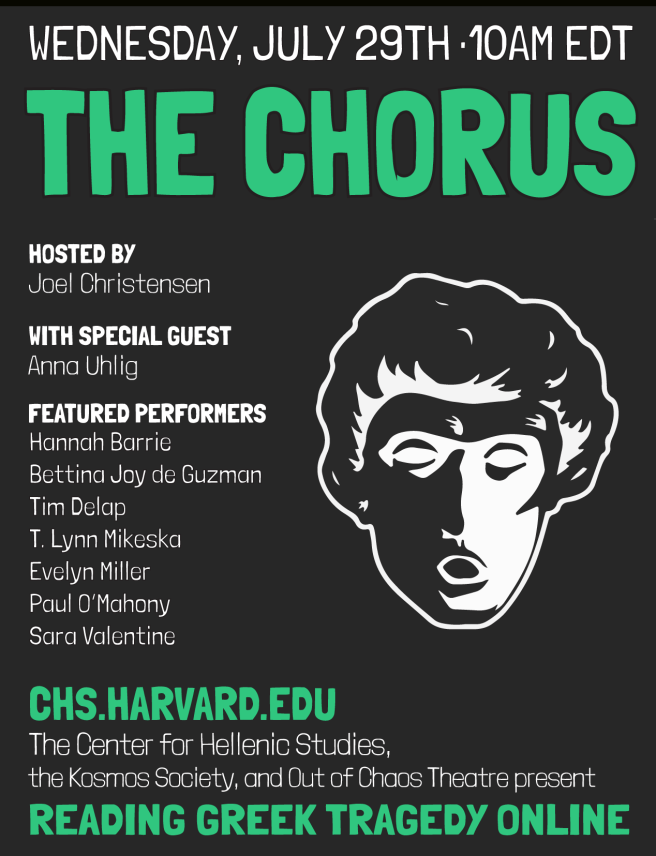
This week is dedicated entirely to the chorus, that most challenging of features of ancient Greek tragedy for modern stages. The chorus was not restricted to the dramatic stage in Ancient Greece. Ritual singing and dancing in groups seems to have been widespread: we find choral activity in Homer (Odyssey 8.264) and the Homeric hymns as well as Hesiod where the Muses are said to perform as Apollo plays the lyre. Indeed, several genres of Greek poetry where choral in structure and performance (including Epinician poetry like Pindar’s or the fragmentary poetry of Alcman).
The traditional story is that Greek tragedy developed out of Choral performances in honor of Dionysus. Over time, the performances grew more elaborate and as they told the stories of gods and heroes parts were individuated. While this traditional account is not certain, it is certain that the chorus was one of the most important parts of the performance of tragedy in Athens. It was the responsibility of an archon each year in Athens to choose the choregoi to select, finance, and have the chorus trained. The chorus was the central spectacle of tragedy in the beginning, with 12-15 performers singing and dancing in the orchestra in front of the stage and rarely leaving the scene.
In modern performances, the music and dance of the chorus often take a back seat to the poetry. The choral odes are where we find much of the most memorable poetry from ancient tragedy. But we often forget that these were songs too. So today we are going to take a look at the chorus and some different ways of conceiving it on the small screen.
Aeschylus, Agamemnon 176-183
“[Zeus] puts mortals on
The journey of comprehension.
And made this the powerful law:
We learn by suffering.
Pain-recalling trouble trickles
Through the heart in sleep—
And wisdom comes just so
To the unwilling.
The gods seated on their sacred seats
Bestow a hard grace I think.”
Ζῆνα δέ τις προφρόνως ἐπινίκια κλάζων
τεύξεται φρενῶν τὸ πᾶν,
“The seven leaders appointed to their seven gates
dedicated their bronze arms
to Zeus who turns the battle
except for only those two born
of a singer mother and father
who faced each other’s spears
each with a share of victory and death.”
Technical, Moral, Administrative Support: Lanah Koelle, Allie Mabry, Janet Ozsolak, Helene Emeriaud, Sarah Scott, Keith DeStone
Euripides, Medea1261-1270
“Pointless was the labor for your children
pointless when you raised dear offspring,
woman who escaped the Symplegades’ clash
of their dark cliffs in those straits
most unwelcoming to strangers.
Wretch of a woman, why does irrational rage
overcome you and one cruel murder answer another?
Mortals find the pollution from family’s blood overwhelming–
Grief from the gods stalks murderers equal to their deeds,
falling upon their houses.”
Over the past few years we have seen a return in public discourse to a question of “the canon”. To be honest, calling this a return is a bit dishonest because the issue has been central to discussions about public and university education, the rise and fall of the humanities, and the problematic (re)-construction of “western civilization” since the culture wars of the 1980s. Each iteration is a reactive reassertion in response to justified pressure to question the canon, to open it up, to break it down, and to make space for the majority of people some canons exclude.
One of the most frustrating things about this conversation is that reactions to disassembling or even questioning the canon are basically recycled spasms with different words. Today we hear panic about “cancel culture” and attacks on Aristotle or Homer. Such complaints present the canon as part history, part DNA, but almost always something which unites and forms us. Earlier conversations (e.g. the first period of Bloom) at least debated what belonged in this canon; the recent commentariat is mostly just enraged at the hubris of women and BIPOC students and scholars daring to ask serious questions instead of just imitating and emulating white scholars of old.
This post is already another tired rehearsal, but here’s where we can still do some work. Our discussions rarely ever follow some of the basic tenets of this so-called canon and start with definitions. What is a canon? How long have we had the canon.
In ancient Greek a kanôn is an instrument of measurement. It seems to have non-Greek origins.
As fans of Robert Beekes will undoubtedly report, he often says that unclear roots are non-Greek in origin. The Mycenaean reflex demonstrates that the word—and perhaps the concept—was available in Greece long before the Classical period, so there’s an extent to which the ultimate etymological origins really don’t matter.
From the Archaic period on, we find the kanôn as a tool for measuring, a standard for building, and then, following the broader cultural discourse around the cognitive metaphor of crooked and straight, symbolic uses for right/just behavior and other kinds of rectitude. A clear and potentially ‘canonized version of this appears in Aristotle (Nicomachean Ethics, 1113a 29-1113b):
“The good person judges everything rightly, both how things seem and are in truth. For in each thing in particular there are noble and pleasing aspects and a good person differs most in being able to observe what is true for each thing, as if they are a kanôn and measure of these things. It seems that most people are deceived by pleasure. For even though it is not good, it seems to be so and they choose what is pleasing as good and they avoid what causes pain as an evil.”
Here a philosophically informed person demonstrates the intelligence and wisdom—what some today might rephrase as taste or good sense—to judge a thing for its worth and to guide their behavior based on this. Of course, one might make the mistake of imagining that different folks might have different takes on what is pleasing and good. Aristotle addresses this elsewhere (On the Soul 411a):
“If the soul must be made out of the elements, it doesn’t need to be from all of them! It is enough for only one pair of opposites to judge itself and its counterpart. Thus we understand the straight and the crooked by the same method: the kanon is the test for them both—but neither the crooked nor the straight provides its own proof. Some might think that the soul is mixed up in everything, which is perhaps why Thales believed that everything was full of gods.”
Here, he uses kanôn as a metaphor. As any amateur carpenter knows, just because something looks straight or level, does not mean that it is. This passage seems to imply that our soul or mind has the ability to judge things outside of it. But Aristotle makes how these kinds of judgments might work more interesting in a different passage (Nicomachean Ethics 1138a26-35):
“This is the nature of equity itself: it is a correction of the law where it is deficient because it is too general. This is the reason that not all things exist according to law: there are some cases in which it is impossible to establish a law so that we need some kind of vote. For the kanôn of the undefined can only be undefined itself. This is how it is with the lead kanôn used by builders in Lesbos. Just as that kanôn does not stay the same but is reshaped to the curve of a stone, so too a vote/ordinance is made to fit the affairs at hand. This makes it clear what equitable is, that it is just, and that it is better than certain kinds of justice.”
In a passage one could argue is potentially revolutionary, Aristotle notes the slippage between descriptive measures and prescriptive measures and that standards of judgment will need to be changed for different circumstances, especially in search of what is equitable.
During the Roman imperial period, Dio Chrystosom calls law “a straight-edge [kanôn] for affairs, against which we must each align our own manner. Otherwise, we will be crooked and wrong.” (Ἔστι δὲ ὁ νόμος τοῦ βίου μὲν ἡγεμών, τῶν πόλεων δὲ ἐπιστάτης κοινός, τῶν δὲ πραγμάτων κανὼν δίκαιος, πρὸς ὃν ἕκαστον ἀπευθύνειν δεῖ τὸν αὑτοῦ τρόπον· εἰ δὲ μή, σκολιὸς ἔσται καὶ πονηρός, Discourse 75: On Law). Longinus echoes a similar use when he quotes Demosthenes’ On the Crown as complaining that those who betrayed their countries to Philip and then Alexander transgressed “the boundaries and measures [kanones] of all that the Greeks used to hold as good” (, ἃ τοῖς πρότερον Ἕλλησιν ὅροι τῶν ἀγαθῶν ἦσαν καὶ κανόνες, ἀνατετροφότες, Longinus, On the Sublime 1 32, quoting De Corona 96).
The idea of the kanôn as a thing we measure ourselves against overlaps with the philosophical notion of a kanôn as presenting rudimentary basics necessary for a discipline: Epicurus is said to have composed a Kanôn where he “says that our perceptions, preconceptions and feelings provide the criteria for truth. So, Epicureans also make perceptions of imagined ideas function in the same way” (ἐν τοίνυν τῷ Κανόνι λέγων ἐστὶν ὁ Ἐπίκουρος κριτήρια τῆς ἀληθείας εἶναι τὰς αἰσθήσεις καὶ προλήψεις καὶ τὰ πάθη, οἱ δ᾿ Ἐπικούρειοι καὶ τὰς φανταστικὰς ἐπιβολὰς τῆς διανοίας, Diogenes Laertius, Life of Epicurus 30). Such definitions are questioned by Sextus Empiricus as the “Kanon of the verifiable truth” (κανόνος τῆς κατ᾿ ἀλήθειαν τῶν πραγμάτων ὑπάρξεως,) which underlies the positions of Dogmatists and the subtraction of would undermine their belief system (Against the Logicians 1 27).
In philosophy, canonical principles of a discipline can also be extended to principles of canonical behavior, satirized by Lucian (Hermotimus 76):
“If you ever met the kind of Stoic who is at the peak, that kind who neither feels pain nor is attracted by pleasure and never feels anger, but is stronger than envy, looks down on wealth and is completely happy, we need some straight-edge and square for a life of virtue from this sort of person. If this stoic is imperfect in even the smallest way, even though possessing more of everything else, well then they’re not yet happy.”
The applications of canonical standards move easily from description to prescription and are not merely philosophical and ethical, but they also move into the aesthetic. Do just a little searching and you will find reference to thekanôn of Polyclitus, a description about the “proper” proportions of a human body described by Lucian (The Dance, 75)
“I am planning to show the body which is aligned with the kanon of Polycltius. Let it be neither too tall and long now short and dwarfish in shape, but a precisely correct proportion, not being fat, which makes the dance unbelievable, or too thin, which would be skeletal or corpse-like.”
A tool for measuring, metaphorically or literally, can function to describe the qualities of a thing but can also prescribe the boundaries of a thing itself. A measuring tape can be used to find the length of a thing but a measuring rod can also be used to indicate that something fails to adhere to some externally imposed model. In the example of Polyclitus’ kanôn the ‘ideal’ body is used to mark other bodies as deformed. In the Greek tradition of Aristotle we could say that the male body functions as a kanôn against which the female body is judged monstrous or sub-standard. In the same way, an aesthetic and intellectual canon demarcates space around it outside of which other forms, contents, and peoples are found lacking.
An additional problem comes from the dangers of exemplification: learning from representative models must be done with care. If they are haphazardly offered as “great” and admirable, audiences can be led astray. Plutarch notes this in his How to Study Poetry (25e):
“And so, the young should understand when we urge them to read poems not to have such high beliefs about them and their impressive names because they believe that they are wise and just men, the best kinds and models [kanones] of virtue and rightness.”
Oftentimes, the process of canonization tends to level with an upgrade: people who do big things (in fiction or real life) are never simply one thing or another.
Implicit then in the metaphorical use of the canon is the meaning we have in the modern world, but before we get to these meanings, it is worth considering some more recent history. Following the rise of Christianity, canon came to mean that which was authorized as legitimate by the Church (which Biblical books were divinely inspired; and these are some of the first definitions in the OED) and, eventually, laws and judgments issues by Ecclesiastical authorities. Our first use of the term canon to denote a group of authors seems to be by David Ruhnken in 1768 (Historia Critica Oratorum Graecorum see Montanari in Brill’s New Pauly, s.v. Canon and Easterling in the OCD3 and this blogpost).
Ruhnken uses the term to refer to the groups of lyric poets, orators, and tragedians who were handed down from antiquity. His use seems to have been prescriptive: if we follow his career in Sandys or Rudolph Pfeiffer, he seemed to have been dedicated to working with texts that were not in these groups. As Pat Easterling notes, however, the prescriptive meaning was long latent in scholarly circles: Photios uses it to denote the earlier model on which a later author based his work. As an authoritative, evenly divinely inspired model, the use of canon which emerges in the 19th century probably has more to do with Biblical studies than Aristotelian ethics.
How does any of this matter today? If you search google books or other sources there are very few uses of the term Canon to refer to a collection of ‘Western Great Books’ prior to the 1980s. So let’s be clear about what a canon is and what it does in this post-Biblical tradition: it provides a model with the hope of directing behavior, including ethics and aesthetics. This canon works by excluding one thing from another, by de-authorizing some traditions and burying them, and by rendering the selected object as sacred.
This, I suspect, is central to Harold Bloom’s use of the word canon in 1994’s The Western Canon: The Books and School of the Ages which functions almost entirely to exclude certain kinds of things from the halls of good taste (most often meaning any works not by European men). Regular mentions of the Western Canon at All prior to the culture wars of the 1980s/90s are further evidence of a very reactionary stance: in 1870, the Western Canon is used to refer to the imposition of the selection of New Testament Books on African Bishops. And it seems that century’s use of the phrase focused on the traditions of the Roman Catholic Church to the exclusion of others. (Although, to be honest, I would really prefer a church historian to confirm some of these assertions.)
If we can, we need to think about the other phrases people seem to use to mean something similar: in the early 20th century there was an effort to great curricula based on Great Books motivated by the overall concern that education had become too specialized and that students were missing out on the broader interdisciplinary tradition of the liberal arts and “western civilization”.
Both this movement and the subsequent culture wars of the humanities in the 1980s are reactions to higher education being opened up to new audiences: the middle classes of growing universities in the west before and after WW2 and the increasingly class, gender, and race diverse classrooms of the 1960s-1980s. Great books, Western Civilization, and The Western Canon are reactive creations, attempts to impose strict measures and rules on a world in flux.
The problem with the prescriptive canon is it obscures, I think, the aesthetic rule, responsibility of judgment, and any acknowledgment that both aesthetics and judgment are subject to experience and context.
The bigger problem is that our public discussions about canons do not acknowledge the religious and authoritative history of the term and that earlier debates about the canon—even the attempt to establish a singular one—are intentional attempts to create an authoritative culture that privileges a 19th century, Eurocentric, white supremacist, colonialist world view
A few weeks ago, I started asking myself how a canon is like a statue. Both are purportedly erected to honor something which has been lost. But both are much more about the present than they are about the past: they are raised to project a certain view of the world. And while some memorials of this kind are certainly aspirational, even these can be constrictive: those who don’t fit into that view are excluded. The implicit and explicit aesthetic and normative rules of a canon of literature of art has the same impact on expression, belief, and belonging.
A canon is unlike a statue because it cannot be brought down easily and parts of it are so thoroughly knit into our culture that it would be impossible. But we can talk about what it is, we can acknowledge the disproportionate impact canons can have, and we can broaden them understanding, following Aristotle, that to achieve equity, sometimes you need to change the measures you use.
Each week we select scenes from a play, actors and experts from around the world, and put them all together for 90 minutes or so to see what will happen. This process is therapeutic for us; and it helps us think about how tragedy may have had similar functions in the ancient world as well.
Euripides, Alcestis 71
“You can’t gain anything more by saying much.”
πόλλ᾿ ἂν σὺ λέξας οὐδὲν ἂν πλέον λάβοις·
This play is dated as one of Euripides’ earliest extant dramas, coming from around 438. It tells the story of a king in Thessaly who impressed Apollo with his reverence and whose death Apollo is trying to prevent by having his wife Alcestis take his place. The tone and content of this mythical Romance of sorts has challenged readers for some time. As a scholion introducing the play complains:
“This drama is rather like a satyr play because it mixes in joy and pleasure and and those things rejected as ill-fit to tragic poetry, which is the same thing in the Orestes and the Alkestis, they begin from misfortune and end in good fortune and ending in joy, which is more proper of comedy. [Many of this kinds of things are in tragedy]”
Of course, this play comes before Aristotle codified what a tragedy and comedy should be! It could not have been too strange, because Euripides won second place with this play, bested again by Sophocles. In the Alkestis, again, we find Euripides challenging modern assumptions about what a tragedy should provide. But what if we ignore Aristotle for a bit, and ask what a play should do instead?
1-76: Apollo and Thanatos
77-135: Chorus
238-392: Chorus, Alcestis, Admetus
509-568: Admetus, Heracles, Chorus
747-860: Servant and Heracles
1008-1158: Heracles, Admetus, Alcestis (silent)
Euripides, Alcestis252-7
“I see the double-oared skiff
In the lake, the ferryman of the corpses
Kharon keeps his hand on the rudder
And calls to me, “Why do you put this off?
Press on, you are holding me back.”
He hurries me on, fast with these words.”
Direction: Beth Burns with production assistance by Paul O’Mahony
Posters: John Koelle
Technical, Moral, Administrative Support: Lanah Koelle, Allie Mabry, Janet Ozsolak, Helene Emeriaud, Sarah Scott, Keith DeStone
Euripides, Alcestis780-784
“Do you understand the nature of mortal affairs?
I don’t think so. How would you? Listen to me.
Dying is the debt that all mortals owe
And no one who is mortal will know
Whether they will be alive on the coming day.”
“A statue of you shaped by the wise hand
Of craftsmen will be laid out in our bed.
I will cast myself into her arms while embracing
Call our your name, believing that I have
My dear wife in my arms, even though I don’t.
I believe this is a cold pleasure, but still
It will balance the weight in my soul…”
“How have I wronged you? What have I taken from you?
Don’t die for this man and I won’t for you.
You delight seeing the light. Don’t you imagine your father does too?
Really, I reckon that the time below stretches out
And that living is short but still sweet.
But you have shamefully fought not to die
And you live, passing the fate allotted to you
By killing her…”
Each week we select scenes from a play, actors and experts from around the world, and put them all together for 90 minutes or so to see what will happen. This process is therapeutic for us; and it helps us think about how tragedy may have had similar functions in the ancient world as well.
Aristophanes, Clouds 88-89
“Turn your life around ASAP
Go and learn what I am suggesting.”
This week we are taking a break from tragedy and turning to Aristophanes for some much needed comic relief. His Clouds, however, is not just funny: it is serious intellectual history in the way his other plays are serious political commentary and literary theory. Ok, that might be a step too far, but Aristophanes provides a cutting and fun critique of sophists like Socrates who attracted followers for their dynamic style of argumentation, their investigation into natural sciences, and their willingness to question religious and ritual convention. And this critique seems to have made some impact, since Plato has Socrates bring it up 20 years later.
Plato, Apology of Socrates 19c5
“You have witness these things yourself in the comedy of Aristophanes where some Socrates is carried around saying “I walk on the are” and spouting much other nonsense I don’t know anything serious or small about.”
This week we are trying something different and will be performing the whole play (a bit a abridged) from beginning to end using this translation by Ian Johnston.
Aristophanes, Clouds 94-99
“That is the thinkery of wise minds.
Inside there are men who are very convincing
when they argue that the sky is a grill cover
and that it covers over us because we are coals.
These people teach anyone who gives them money
how to kill in debates, whether they’re just or not.”
Socrates – Tony Jayawardena
Strepsaides – René Thornton Jr.
Pheidippides – Patrick Walshe McBride
Main Chorus – T. Lynn Mikeska, Valoneecia Tolbert
Main Student. -James Callás Ball
Good Argument – Judd Farris
Worse Argument – Richard Neale
Special Guest: Joel Alden Schlosser
Dramaturgical assistance: Emma Pauly
Direction: Beth Burns with production assistance by Paul O’Mahony
Posters: John Koelle
Technical, Moral, Administrative Support: Lanah Koelle, Allie Mabry, Janet Ozsolak, Helene Emeriaud, Sarah Scott, Keith DeStone
Aristophanes, Clouds 101-103
“Gross, those bums! I know them. They’re con-men,
those lilywhite, shoeless scoundrels you’re talking about–
that haunted Socrates and his Khairophon.
“Think a bit and bear down heard,
turn yourself in every direction,
cogitating, contemplating. Quick! if you get lost,
leap to some other part of your mind.
Keep sweet-tempered sleep far from your eyes!”
The Disturbing ‘Veil’ and “Double-Vision” of the Naïve White Liberal Anti-Racist Gaze
In the Odyssey, ancient Odysseus and his men accomplished yet another great feat of survival, blinding the one-eyed Cyclops to escape from his cave. One wonders today about the blinded single-eye of the good-natured, white liberal democrat: a view that sees itself as rabidly pro-justice, freedom, democracy, and the rest of the ideals that descend from the Western Enlightenment (made by and for white European men in the 18th century).
And, yet, this strange creature has a split double vision from its one eye. It ‘feels’ the dual threat of both Trumpian, right-wing, anti-democratic authoritarianismand the diverse social movements and protests against anti-Black racism leading to the tearing down of statues and what the right and left alike calls ‘cancel culture’ or the right asserts as the ‘indoctrination of the left.’
Is it fated for someone in a position of power to feel threatened at all times? If we turn to W. E. B. Du Bois’s ingenious insights on the ‘veil’ and ‘double-consciousness’ of being Black in America, one can think of another, inverted ‘veil’ and ‘double-consciousness’ of this blinded white liberal view today. The blinding strike of our historical present has led to a split within a single vision that lies beneath a kind of veil.
One can say the white liberal, democratic, maybe even progressive socialist and leftist view sees the world from within a veil that is not lifted. On the one hand, they see themselves through the eyes of two other groups: they claim how horrifying and vile white nationalism, supremacy, neo-Nazis, anti-Semites, and mostly anti-Black and other anti-Indigenous and POC, for example hatred of Latinx and Asians, are. They say in a silent voice of rage and hatred, a mixture of shame, guilt, and revulsion, that ‘we cannot be one of them,’ and that ‘the legacy of slavery and colonialism is not ours,’ as the philosopher Shannon Sullivan noted in her trenchant critique of white liberalism. The good-natured ones call those evil barbarians who espouse biological racism today the abhorrent ‘other,’ while reserving for themselves some sense of decency in claiming ‘we are different.’
But then, on the other hand, they see the other group of BIPOC facing multi-generational and daily humiliation, violence, and death: torrents of waves where past, present, and future co-mingle, at once stemming from both systematic and systemic racism that derive from and transcend white nationalists, the KKK, and Neo-Nazis. For this oppression permeates every institution and aspect of American society. Why not? Does it not come down to a fascination with ‘whiteness’ for those who live it and critique it? To them, the white liberal says, ‘I cannot possibly understand what it’s like to endure that racial oppression of non-whites,’ and ‘I want to speak out from within my silence but words escape me, and I relapse back into the silence I inhabit within the veil.’ Therefore, ‘I am in this world but not of it’ to quote the Gospel.
What can we learn from this split vision of positing and negating when it comes to two other groups that the white liberal tries to see and understand apart from itself? White supremacy is decried but also distanced so far to the point of paralyzing inaction while BIPOC suffer and die everywhere. They suffer at the hands of everyday white civilians, the militarized police, the heartless state, and the avarice corporations and their environmentally damaging atrocities, the terror continues. BIPOC, as the ‘other’, witness their suffering pornographically fetishized in white liberal discourse, but only to have this suffering doubled when the old discourse of the ‘free exchange of ideas,’ ‘tolerance of differing perspectives in a civil manner’ kicks in again. That old stalwart thinking quickly returns to diagnose the evil disease of ‘cancellation culture’ and ‘indoctrination of dogmatic intolerance’ in the ‘new religion’ of anti-racism, for example BLM.
What are we to make of this twenty-first century wounded Cyclops? The creature retains privilege as in the original myth since everything was provided for them, and they don’t have to work for what they have inherited. And that is called the utter, unfathomable, historical accident of either being born ‘white’ or ‘white enough to pass’ as such. If Marx analyzed the commodity, no one to this day has comparably or sufficiently analyzed ‘whiteness’ or ‘white passing.’
The self-denying person who says they are not reduced to biological ‘whiteness’ is the ultimate white liberal, democrat anti-racist. And this occurs across generations in our historical present, across the different generations who think they inhabit one single time-line. Here we find white supremacy and white privilege in a blind coexistence as it relates to the problem of time and therefore historical time. No whiteness exists apart from white supremacy. Color-blindness is privilege. So the blinded, fractured Cyclops does not see that problem.
They must consume everything that crosses their path in this split, double-vision, not even a double consciousness that is forever ‘irreconcilable’ for Black people as Du Bois said nearly 120 years ago and one can attribute to other POC today, albeit in intersectional terms. But this ruptured one-eyed giant called ‘white anti-racist liberalism’ doesn’t live in a cave, because there is no inside or outside distinction in the world of an eternal racism.
In some respect the veil – -as an illusion of real self-consciousness because one is always seeing oneself in relation to and different from the other — is itself the ultimate blind spot: the veil doesn’t exist at all. Rather, white supremacy becomes the mirror’s taint called ‘white liberalism’ and the objects that appear in the mirror are dialectically exchanged in the stasis of a perpetual motion: the white liberal must say I am not a ‘white supremacist’ while also failing to see the impossibility of pure connection with BIPOC because white liberals have the privilege of whiteness, and hence an-other type of ‘supremacy’ we are trying to name here.
This schizophrenic four-fold vision of identity and difference in the self-consciousness of the white liberal needs a new name: to be the same and different from white supremacy and same and different from BIPOC oppressed groups means one is never fully synthesized in two different ways. One can say that the ultimate giant, whose ideas shaped the white modern world to an extent like no other of his time, namely the imperialist Hegel, knew this well and suffered from it in the phantasm of truth called his ‘system and philosophy of world history.’
The dead bodies and skeletons slayed by systemic racism over colonialist centuries doom us to atrophy and entropy. At some point, this wounded creature will also perish on the lands they neither built nor own, and hopefully leaving a new world created not by the privileged gods but by a diverse, more humble humanity. We can call it the world after ‘Floyd.’
Rajesh Sampath is currently Associate Professor of the Philosophy of Justice, Rights, and Social Change at the Heller School for Social Policy and Management at Brandeis University. He completed his PhD at the University of California, Irvine in the humanities with a concentration in modern continental European philosophies of history and critical theory at the Critical Theory Institute. He studied under the French philosopher, Jacques Derrida, the founder of deconstruction. His areas of specialization center on the philosophy of history, historical time, and epochal shifts.
Bartolomeo Scala, On the Philosophical Sects (§6):
They go wildly astray, who think that the old Academics (who get that designation because of the new Academics, of whom I will speak a little later) differ from the Peripatetics because the Academics maintained the old method of Socrates in holding off one’s assent in all things, and in thinking that the truth could not be discovered by people; on the other hand, the Peripatetics, thinking otherwise, assented to many things and affirmed for certain what they said. But as Cicero says, even if Plato appears in his books to imitate that Socratic doubt about all things and his habit of speaking with no affirmation, just so that he can give a more lively portrait of Socrates, whom he often brings into the scene of dispute, the successors of Plato abandoned these principles.
Thus (and Socrates would have disapproved) there sprung up in philosophy a certain art of speaking, an order of things, and a description of the discipline, which was initially just one thing with two names. For there was no difference between the Peripatetics and that old Academy. Aristotle seemed to stand forth with his abundance of mental acuity, but each school had a fount of matter, and there was the same division in both schools of things to be sought and things to be avoided. They differed in name alone, which for Aristotle came from his strolling while teaching, and for Plato came from the place where he taught.
Aberrant enim qui putant veteres Academicos (sic enim dicti sunt propter novos, de quibus paulo dicetur post) ideo differre a Peripateticis quod illi antiquum Socratis morem omnibus in rebus continendi assensionem tenuissent, quod inveniri ab hominibus verum posse non putarent; contra vero hi, aliter iudicantes, et assentirentur aliis et ipsi quod dicerent pro certo confirmarent. Illam enim Socraticam dubitationem de omnibus rebus et nulla affirmatione adhbita consuetudinem disserendi, ut ait Cicero, etsi imitari videtur Plato in suis libris ut Socratem verius exprimat, quem frequentissime inducit disputantem, qui a Platone postea manarunt, reliquerunt. Ita facta est disserendi, quod minime Socrates probabat, ars quaedam philosophiae et rerum ordo et descriptio disciplinae, quae quidem primo erat duobus nominibus una. Nihil enim inter Peripateticos et illam veterem Academiam differebat. Abundantia quadam ingenii praestabat, ut mihi videtur, Aristoteles, sed idem fons rerum erat utrisque et eadem rerum expetendarum fugiendarumque partitio. Solo igitur nomine differebant, quod hinc disputando deambulatio, illinc in quo Plato docuerat locus fecerat.
Edwyn Bevan, Stoics and Sceptics (1913, pp.32-33):
“If you are determined to limit yourself to what is called objective fact, you certainly diminish the chances of your making mistakes, but you also renounce all your chances of get- ting below the surface. What, for instance, is mainly interesting, to my mind, in the physical theories of Zeno, is not their detail, but the fact that he felt it necessary to enunciate a theory of Nature at all. We cannot under- stand what he was about unless we realize the necessity which was on him to give a complete answer to the enigma of the Universe, compact in all its parts, since nothing which left any room for doubt to get in could give a bewildered world security and guidance.
Stoicism, as it appears to me, was a system put to- gether hastily, violently, to meet a desperate emergency. Some ring-wall must be built against chaos. High over the place where Zeno talked could be descried the wall, built generations before, under the terror of a Persian attack, built in haste of the materials which lay to hand, the drums of columns fitted together, just as they were, with the more regular stones. That heroic wall still looks over the roofs of modern Athens. To Zeno it might have been a parable of his own teaching.
Even the passion of the Stoics for definition may in this way be regarded with human sympathy. It began with Zeno himself, who established numerous brief formulae as fixed and canonical definitions in the school tradition. Short definitions of this kind were well adapted to become current coin of all the philosophic schools and even of the market-place. As a matter of fact the Stoic definitions had a wide circulation in later antiquity. It is always the catch-words of a philosophical theory which lay hold of the general mind. Stoicism issued its own catch-words, one might say, with the official stamp. One of Zeno’s disciples, Sphaerus, seems to have shown a special aptitude for their manufacture. One is at first inclined to treat all this as a kind of dry philosophical pedantry. Perhaps with Chrysippus and the later Stoics such a vice of the mind was not altogether absent. But I think the motive behind it does take on another, and even a pathetic, aspect, when we consider the necessity to have a cut-and-dried answer ready to every question, if a coherent dogmatic system was to be fitted out such as the ordinary man could grasp, and consider also the bitter need for such a system which the world felt at that time.”