“Since it is right that the structure of the best tragedy not be simple but be complex instead and evoking both fearful and pitiful emotions—for that is the particular power of this kind of artistic representation—as an initial principle, it is clear that decent men should not be be shown undergoing a change from good fortune to bad fortune, for that is repugnant rather than pitiful or fearful. And it is also not right for depraved people to enjoy a change from bad fortune to good fortune, because that is the least tragic notion of all and has none of the necessary qualities. Such a plot does not create empathy and fails to produce pity or fear.
[Tragedy] should also not show an especially bad person falling from good fortune to bad—for this might engender empathy but without pity or fear since the first is felt for someone who is unworthy of bad fortune and the second is for someone who is similar [to us] (pity is for someone unworthy of suffering; fear is for someone like us suffering). The response to [a wicked person] falling is not pitiful or fearful. What remains [for tragedy] is the person in between. A person like this is not impeccable in terms of justice nor for his wickedness and evil, but he falls into misfortune because of some kind of mistake. This kind of person is from those well-known families, like Oedipus or Thyestes.”
This passage (and a few others) have been misread since the rise of Christianity to mean that the tragic protagonist “suffers a fall because of a tragic flaw”. This is essentially bogus for lexicographical and contextual reasons. In early Greek, hamartia means to make a mistake: it comes from an archery metaphor and is related to the verb hamartanô, which means “to miss the mark”. This is a mistake that is not connected to an essential character goodness or badness.
from Beekes 2010
The Christian use of hamartia is “sin”, which, as we all know from our Sunday School, is innate and a sign of our essential badness. Wanting to have sex with people is a sin; driving badly and hitting someone from inattention is an accident. In my understanding of tragedy, hamartia means the latter. Yes, one might be distractable and an essentially bad driver and we may see this as in some way a flaw, but this is a cultural perspective that mixes determinism and responsibility in a strange way.
Contextually, Aristotle makes the specific point that the tragic hero should not be essentially wicked. If one is essentially wicked, the audience cannot make the key identification necessary to feel pity or fear. Now, one could argue that in a Christian context where everyone is flawed because of sin, the doctrine might still be said to apply. But this is not the Aristotelian context and this is not what Aristotle had in mind.
Alexandra Paperno. Abolished Constellations, 2016. Installation view at the ‘Møenlight Sonata’, curated by René Block. Kunsthal 44Møen, Møen, Denmark, 2018. Courtesy Galerie Volker Diehl.
Only the famous Argo sailed through there
Returning from the visit with Aeetes.
The current hurdled the ship towards the rocks,
But Hera, who loved Jason, led them safe.
Tritonian Athena herself urged him to join the band of chiefs,
And he came among them a welcome comrade.
She herself too fashioned the swift ship;
And with her Argus, son of Arestor, wrought it by her counsels.
Wherefore it proved the most excellent of all ships,
That have made trial of the sea with oars.
Alexandra Paperno. Abolished Constellations, 2016. Installation view at the ‘Observatory’, curated by Simon Mraz. Special Astrophysical Observatory of the Russian Academy of Science and its campus at Lower Arkhyz, Russia, 2016. Photograph by Yuri Palmin.
Who invented the sky? The only way to answer this question would be like this — the first person who looked up and wondered. Socrates tells us in Plato’s Theaetetus (Plat. Theaet. 155d), μάλα γὰρ φιλοσόφου τοῦτο τὸ πάθος, τὸ θαυμάζειν: οὐ γὰρ ἄλλη ἀρχὴ φιλοσοφίας ἢ αὕτη, καὶ ἔοικεν ὁ τὴν Ἶριν Θαύμαντος ἔκγονον φήσας οὐ κακῶς γενεαλογεῖν, namely: “For this feeling of wonder shows that you are a philosopher, since wonder is the only beginning of philosophy, and he who said that Iris was the child of Thaumas made a good genealogy.” Iris was a messenger of the heavens, so the sky was never too far away for those who wonder. But philosophy arrives too late, and we’re looking at an earlier world, populated with gods, heroes and stars; a world that had already eclipsed in Plato’s time. Was it perhaps at the end of the Ice Age when the brain cortex of the first modern humans began articulating symbolic orders?
An answer is impossible to come by, but the stars in the sky have lived with us for a long time, and we could never unsee them. That is, paradoxically, until the modern age, when, after thousands of years of dreams and wonders, we launched ourselves into space, in an attempt to escape from the condition of being human. Out there we realized to our despair (and our newly discovered indifference too) that there was no such a thing as the sky; this was no transcendental space or a place at all, but rather, everything that is above the surface of the earth, a combination of atmospheric layers and the infinite void. The infinite is not even an adequate concept, for the physical concept of time has no relevance for the individual person, and no use except in space physics. With the conquest of heaven, a direct consequence of the space and arms race, the sky went dimmer, if not altogether silent. Yet the void remains.
But the history of the void, with its now missing stars and constellations, is not a history of physics, as much as a story of our puzzling earthly odyssey, as astronomer John C. Barentine tells us: “However old the constellations, it is safe to conclude that they have long journeyed with us on our path to becoming human.” Constellations are some of the oldest cultural inventions of humans, predating writing and social organization (what once was called civilization). Barentine continues: “The presumably oldest figures in existence, such as the Hunter and the Bull, refer to a time in human history before the emergence of settled agricultural communities. It is probably no coincidence that Orion and Taurus reflect themes in the oldest extant works of art: the human form and game animals.” Already at the time of the Neolithic revolution, 12,000 years ago, understanding cues in the sky about the seasonal calendar was crucial to the survival of early humans.
Alexandra Paperno. Abolished Constellations, 2016. Installation view at the ‘Observatory’, curated by Simon Mraz. Special Astrophysical Observatory of the Russian Academy of Science and its campus at Lower Arkhyz, Russia, 2016. Photograph by Yuri Palmin.
Our oldest accounts of constellations and stars date back to the Middle Bronze Age and the list of Sumerian names suggest they were drawn from an earlier source. In the Mesopotamian text “Prayer to the Gods of the Night” (1700 BC), we hear of the Arrow (the star Sirius), the Yoke (the star Arcturus), the Stars (the Pleiades star cluster), or the True Shepherd of Anu (Orion). Think about the long journey of Sirius, the brightest star in the night sky, known to Homer as the autumn star (Hom. Il. 5.1-5), and to Egyptians and Greeks as the “Dog star”. Its heliacal rise, connected with an extremely hot season at the end of summer, was known not only to Homer and Hesiod but to Aeschylus, Apollonius of Rhodes, Theognis, Eratosthenes, Nonnus and the folk tales about the star and its hot season survive as late as Anna Komnene’s Alexiad in the Byzantine period. Located in the constellation Canis Major, Sirius is still visible to the naked eye.
In the Shield of Achilles (Hom. Il. 18.478-608), provided by Hephaestus in the Iliad, and the first example of ekphrasis, Homer describes in its first layer, a number of constellations: Orion and the Bear, the star clusters of the Pleiades and the Hyades. A telling star-struck passage in the ekphrasis, ἥ τ᾽ αὐτοῦ στρέφεται καί τ᾽ Ὠρίωνα δοκεύει (Hom. Il. 18-488), “She turns about in the same spot and watches for Orion”, reappears in identical form in the Odyssey in a crucial moment, when the nymph Calypso is sending Odysseus from the island of Ogygia, and instructs him to keep on the left side the constellation of the Bear (Hom. Od. 5.270-277), without specifying whether he meant the Little Bear or the Great Bear, in what is the only passage in the epic that refers to stellar navigation. For seventeen days he sailed over the sea, and then on the eighteenth day the land of the Phaeacians appeared nearest to him.
Most of the constellations referred to in these passages have come down to us in Ptolemy’s Almagest, and survived unchallenged for some fourteen centuries, as the cosmological model underwent certain revisions (the geocentric model is of course completely debased, but the Homeric cosmology of the earth as a flat disk surrounded by an ocean and in between two layers of stars, is surprisingly similar to the current model of the Milky Way). The birth of the contemporary sky that begins with the Copernican revolution and ends with Trevor Paglen’s “The Last Pictures” (the sky as a junkyard of dead satellites), arrived also with discoveries of new stars and constellations, adding up to the 48 Ptolemaic constellations. But constellations are not discovered, they’re imaginary bodies. Ptolemy missed an entire quarter of the sky, and this information could only be added during the colonial voyages in the 16th century.
Our current knowledge of astrophysics insists on the standardization of stars and constellations for the sake of the photographic process, but in fact, tells us that not only are constellations imaginary, but they also serve no purpose whatsoever in astronomy. Why do we insist then on the star map? Russian painter Alexandra Paperno turned to the star maps at the beginning of her career in the early 2000s, not necessarily out of an interest in the vast cosmic space and our perception of the structure of the universe, but from a vantage point that resembles more an architecture of first principles, with primary and secondary qualities: What are pictorial spaces? What is an empty space? What are spaces generally? Living as we are, in a moment largely defined by hyper-metaphors of time such as acceleration, apocalypse and the instant, our relationship to space is tawdry and unimaginative; space is a site of incarceration.
Alexandra Paperno. Argo Navis (from ‘Abolished Constellations’ series), 2016. Ink on paper, 76×56 cm
But our living spaces have little to do with the Aristotelian metaphors of place around the line and the point, or the fixed abode or point of origin in the myth: Our spaces are devoured by multiple overlapping temporalities, and are embedded in a percolation of spatiotemporal continuity, like a crumpled handkerchief, to use a metaphor of Michel Serres, out of which a viscous substance oozes out that contains the present as debris. In the Star Maps (2003-2005), Paperno captures what Petrus Schaesberg called the misty uncertainty of the sky, following two central interrelated ideas: First, the scant appearance of the starry sky in the history of representation of space in general as we have received it from Western painting, and secondly, the Kantian notion of the sublime, as an aesthetic category beyond the senses. The modern pictorial space resembles the stellar void: It’s unarticulated, ambiguous but never absent.
During Paperno’s research on star maps, the realization that different astronomical atlases and maps contained different constellations in the early modern period, and a curious art historical reference, the minor constellations Sculptor and Pictor (included in the Star Maps), discovered by French astronomer Abbé Nicholas Louis de Lacaille in the 1750s, and located in the southern hemisphere, led to an amazing revelation: As astronomical societies were being modernized throughout the Western world, in 1922, the modern map of 88 constellations was adopted (it was agreed that no more constellations would be added) and then more than 50 constellations, some dating back to antiquity, but for the most part coined by American and European astronomers mapping the southern skies, were abolished for a variety of reasons. Some of these were considered inaccurate, ambiguous, too faint, or too large. Looking at earlier star maps, the Russian painter carefully recomposed the fifty-one constellations as single wooden panels (also executed on paper in a different iteration).
Many of these constellations are unfamiliar to us, with their Latin names, such as “Gladii Electorales Saxonici” (Crossed swords of the Electorate of Saxony, d. 1684, by Gottfried Kirch), “Machina Electrica” or “Officina Typographica” (Electricity Generator and Printshop, d. 1800 and 1801, by Johann Elert Bode), but the style of christening the stars gives us a lot of information about the ambitions of the Enlightenment era and the scientific revolutions. At the heart of Paperno’s project, however, there’s no stars as an object of contemplation but a void of knowledge and consciousness: How would it be possible to abolish something that in fact never existed? An international bureaucracy of knowledge dethroned an imaginary which, however impractical for modern science, was richly embedded in the fabric of our historicity, and the beginning of wonder, from an era when we began to search our yet unfinished destiny on earth.
Although the sky, or rather, the void, is alive and not static (our galaxy is not necessarily too privileged a location for sighting stars, being too far away from the center of star formations, a place where life would be impossible), all the Ptolemaic constellations survived into the modern map, with the exception of one: “Argo Novis”, known since early antiquity under different names. It was considered unwieldy by science as De Lacaille explained in 1763, from his observation point in Cape Town, South Africa (there he asserted the position of nearly 10,000 stars), that there were more than a hundred and sixty stars in it, and it was initially broken into three different constellations Carina, Pupis, and Vela; Pyxis Nautica was added later. The Argo Novis was not abolished, but dismantled. Yet the history of the constellation and its accompanying myth (we are unable to ascertain which came first), dates back to the earliest era of transmissions and transformations in the Near East.
Alexandra Paperno. Abolished Constellations, 2016. Installation view at the ‘Observatory’, curated by Simon Mraz. Special Astrophysical Observatory of the Russian Academy of Science and its campus at Lower Arkhyz, Russia, 2016. Photograph by Yuri Palmin.
A discoverer of constellations himself, Johann Elert Bode tells us in 1801: “This figure commemorates the famous ship of antiquity, which was built according to legend at the command of Minerva and Neptune in Thessaly from Argo, and it is that which the Greek hero Jason and the Argonauts used to collect the Golden Fleece from the place of the eastern shore of the Black Sea known as Colchis.” Argo Navis as a constellation appears first in a list by Eudoxus of Cnidus in the 4th century BC, and the ship was known to the author of the Odyssey. In a passage concerning the witchlike goddess Circe (Hom. Od. 12.69-72), as she is giving Odysseus instructions for his return voyage, she explains that the Sirens are located between Scylla and Charbydis, adding that there is only one seafaring ship that has ever passed through, and that is the Argo, with the intervention of Hera, who loved the argonaut Jason.
The ship was thought to be a variety of galley, an oceangoing craft with a shallow draft, low profile and long narrow hull (Barentine), and according to Eratosthenes, the constellation represented the first ship to sail the ocean, long before Jason’s time. A myth of the construction of the ship was relayed by Apollonius Rhodius in his Argonautica, claiming that its builder was Argus, under the supervision of Athena (Apollon. 1.109-114). The Argonautica, composed in the 3rd century AD, is the only surviving epic poem of the Hellenistic era, incorporating Apollonius Rhodius’ research into geography, Homeric literature and Greek ethnography. Its most enduring innovation upon the Greek epic is the possibility of love between a hero and a heroine, exemplified in the vivacious story of Jason and Medea, but the story was well known in a much earlier period, and the myth of the Argonauts underlies the Homeric epic as a memory source.
Jason’s father Aeson was removed from the throne by his brother Pelias, and Jason was then entrusted to the centaur Chiron. After his upbringing with the centaur, and learning of his true story, Jason set for Iolcus, and upon confronting Pelias, the king devised for him the toil of an impossibly difficult voyage, in order that he might lose his home-return among strangers or at sea, with a mission to find the Golden Fleece. Jason visited Hera at Dodona, and with her help, Athena would have the ship built from pine trees grown on Mount Pelion, and he assembled a crew with as many heroes as he could find, known as the Argonauts. At last they reached Colchis and presented their demand to King Aetes, but unwilling to part with his most prized possession, the king declared Jason would have to catch and subdue two fire-breathing bulls dedicated to Hephaestus and use the bulls to plow a stony field sacred to Ares.
Alexandra Paperno, Pictor, (from the Star Maps Series), 2003, mixed media on canvas, 150×120 cm
But there would be more: He would have to sow the field with dragon’s teeth and then slay the army of giants that would rise. Finally, after defeating the guardian dragon, the Fleece would be his. Jason was then enchanted with the king’s daughter Medea, and agreed to marry her in exchange for her help (she’s a skilled sorceress). With the fleece in hand, Jason, Medea and the Argonauts set off from Colchis, taking Absyrtus, the king’s only son, as a hostage. A Colchian vessel set off in pursuit of the Argo and easily overtook it, and sensing that the end was near, Medea killed Absyrtus, dropping pieces of the body overboard. As expected from an epic, the Argo was led off as a punishment and a number of storms were sent by Zeus, and then Jason is told they should seek ritual purification with Circe, the famous nymph living on the island of Aeaea, whom we know well from the Odyssey.
[The episode of Circe in the Odyssey is one of the main events in my parafiction, “The Charonion”]
In Book IV of the Argonautica, the Argonauts find Circe bathing in salt water, surrounded by wild animals. The goddess invites Jason, Medea and the Argonauts into her mansion, and without any further ado, they show her the bloody sword used to cut the body of Absyrtus, and Circe realizes quickly enough that they have come in order to be purified of murder. After the purification, Medea tells Circe of their toll in great details, but omits the murder of Absyrtus. Circe knows the truth and disapproves of their crime, but on account of her kinship with Medea, she promises to cause them no harm and orders them to depart from her island immediately. It seems as if after the visit to Aeaea, the Argonautica comes to a happy conclusion in Thessaly, but ambiguous accounts remain, telling of intrigues, murders, escapes and the rise of the ship to heaven as a constellation, or another version in which a beam from the Argo’s stern detaches and kills Jason instantly while he slept under a tree.
The long journey of the Argo Navis in the mythography, protracted, inconclusive, and ultimately unfinishable, always reminds me of the liminal space of Paperno’s Abolished Constellations. In its first argonautic expedition, the Argo Navis alongside the other fifty abolished constellations (let us name a few more: Keeper of Harvests, Pendulum Clock, Marble Sculpture, Tigris River), were displayed in 2016, at a derelict unconsecrated 8th century church linked to the now extinct Albanian-Scythian Christian community, in a scientific village home to the Special Astrophysical Observatory of the Russian Academy of Sciences and the Large Altazimuth Telescope (for several years the largest single primary optical reflecting telescope in the world, but now an anachronism) in Nizhny Arkhyz, perched on the mountains of the northern Caucasus. The panels were assembled as a grid construction that resembles an altarpiece, doubling up the sense of what is meant by heavenly. A heaven that has fallen, an abolished heaven.
It was an impenetrable site… A flight from Moscow to the resort town of Mineralnye Voda, followed by long bus journeys in the mountains, and an hour-long walk inside the terrain of Lower Arkhyz, in a frosty autumn, crossing small rivulets and mud passages, in order to arrive at an altarpiece to something that doesn’t exist anymore because in fact it was never real – the gods are dead. This speaks to Paperno’s notion of the ruin as a central notion in European civilization: The ruin is fresh because it was already ruined from the outset. Later on, the abolished constellations traveled to Berlin, where they were on show in a window storefront in a gallery space where it would be the last exhibition before its eventual folding up, or on the Danish island of Møn, a biosphere reserve in the Baltic sea, loosely connected to another island, Zealand, with irregular transportation.
Alexandra Paperno. Abolished Constellations, 2016. Installation view at the ‘Observatory’, curated by Simon Mraz. Special Astrophysical Observatory of the Russian Academy of Science and its campus at Lower Arkhyz, Russia, 2016. Photograph by Yuri Palmin.
In these precarious, remote, vanishing, half-real sites, the witness to the constellations, is forced to reflect on the irrational infinity of space as such, and in the words of Schaesberg discussing Paperno’s star maps: “Reflective moods inevitably set in when one contemplates the constellations, but Paperno’s overall concept of this series — including single stars, star maps, and constellations, not to mention still lifes with globes — conjures up the Thracian maid’s laughter when Thales of Miletus fell into the well, the epitome of disdain for astronomy’s endeavors, and hints at today’s amazing awareness that we human beings, in a remote corner of the boundless universe, are terribly alone.” These empty and half-empty interiors of the pictorial space, fragile and tense, make us dwell in a world of wonder: It is a world without nature, abandoned, and yet filled with our own specters.
In the spring of 2020, as the abolished constellations in their single individual panels, rested alone in a studio, in the center of Moscow, after their unlikely argonautic travels, still incomplete, the world closed down on us, and we became separated not only from each other, but also from our world, perhaps indefinitely. Unsure whether the purification of Circe would be enough to bring us from Aeaea to Thessaly, for the first time in our lifetimes, we wandered in the silent dark. And perhaps then we remembered the lives of those early humans, who spent long nights under the stars, around a bonfire, telling each other the stories of Jason and Odysseus, under different names, giving new names to Sirius and the Bear, as if they had never been named before. I then interrogated one of the abolished constellations, the “Machina Electrica” (d. 1800), hanging on my walls: Will the night sky still be there if we stopped looking? An answer came from the Odyssey, a year and a half later, on the shores of Seleucia Pieria, during a clear night: ἥ τ᾽ αὐτοῦ στρέφεται καί τ᾽ Ὠρίωνα δοκεύει / She turns about in the same spot and watches for Orion.
Alexandra Paperno. Grey Sun, 2003. ‘Self-Love Among the Ruins’ exhibition view, curated by Ekaterina Inozemtseva. Schusev State Museum of Architecture, Moscow, 2018. Courtesy Smart Art.
Bibliography
John C. Barentine, The Lost Constellations: A History of Obsolete, Extinct, or Forgotten Star Lore, Springer, Praxis Series, 2016
Margalit Finkelberg, “She turns about in the same spot and watches for Orion”: Ancient Criticism and Exegesis of Od. 5.274 = Il. 18.488”, Greek, Roman and Byzantine Studies 44 (2004), p. 231-244
Theodossiou, E., Manimanis, V. N., Mantarakis, P., & Dimitrijevic, M. S., “Astronomy and Constellations in the Iliad and Odyssey”, Journal of Astronomical History and Heritage, Vol. 14, No. 1, p. 22 – 30 (2011)
Alexandra Paperno & Katya Inozemtseva, “Self-Love Among the Ruins: A Conversation between Katya Inozemtseva & Alexandra Paperno”, in Alexandra Paperno. Self Love Among the Ruins, Ad Marginem Press, 2019, p. 6-23
Petrus Schaesberg, “Alexandra Paperno: Star Maps”, in Alexandra Paperno: Star Maps, National Center for Contemporary Arts Moscow, 2007, p. 5-14
Arie Amaya-Akkermans is a writer and art critic based in Istanbul. He’s also tweeting about Classics, continental philosophy, contemporary art and Turkey/Greece. He’s the co-editor of Perambulation.
“As long as they were stripping them of their gleaming weapons,
The young men who were the best and the greatest in number were following
Poulydamas and Hektor, they were especially eager to break the wall
And set fire to the ships. They were still struggling standing before the wall
When a bird went over them as they were struggling to cross it,
A high-flying eagle moving its way over the left side of the army
Holding in its talons a huge dark red snake
Still alive, breathing: it had not yet lost its fighting spirit.
For it struck back at the bird who held him in the skin along the chest
As it bent double. And the bird tossed him away to the ground
tortured with pains. It dropped the snake in the middle of the throng
But flew away on the breath of the wind, sounding out in pain.
The Trojans shivered when they saw the winding serpent
Lying there, a sign from Aegis-bearing Zeus.
Then Polydamas stood aside and addressed bold Hektor:
“Hektor, you are always threatening me in the public assemblies for some reason,
Even when I advise well, since it is not ever deemed proper
For some member of the people to advise differently, either in council
Or in war. Instead, we must always increase your strength.
But now I will tell you what seems to me to be best.
Let’s not go to fight the Danaans around their ships.
I think that it will turn out this way, if truly this bird
Came over the Trojans as we struggled to cross the wall,
A high-flying eagle moving its way over the left side of the army
Holding in its talons a huge dark red snake
Still alive. For it dropped it before it could return to its dear home
And did not complete the task of giving it to his children.
In the same way we, if we break through the gates and walls
Of the Achaeans by means of great strength and the Achaeans yield
So too we will not find the same paths in order among the ships.
We will lose many Trojans there as the Achaeans
Strike them down with bronze will defending the ships/
This is how a prophet would interpret, one who clearly understands
In his heart divine signs and one the people obey.”
“Nireus who was the most beautiful man who came to Troy
Of the rest of the Danaans, after Peleus’ blameless son.
But he was weak and a small army followed him.”
<Lemma> his beauty in reputation was not of a kind with his family; Achilles, however, was adorned in both ways. Because [the poet] was a philhellene, he was trying to make everyone worthy of memory and used to praise everyone as far as he might be believed and so that we might imagine the Greeks to be differentiated in their manliness, or their body, or their beauty.”
“Diplai have been applied to question these three lines because Zenodotus athetized two of them, although he did not mark the middle one, (674) because Homer always strove to have Achilles stand out far in front of the rest.”
“And because of that, Homer mentioned [Nireus] only once and in the Catalog Of Ships, as it seems to me, to make a demonstration of the uselessness of the most beautiful men, when they have none of the other things that are useful for life.”
“Tyndareus allegedly called Helen’s suitors together and had them swear over the testicles of a castrated horse that they would defend Helen….
After they took the oath, they buried the horse on site as Pausanias writes in talking about Laconia. Indeed, it was a common practice of the ancients to take oaths over the testicles of sacrificial animals. This is why when Herakles made a treaty with the sons of Neleus, they swore an oath over the testicles of the sacrificed boar and the dual pledge to provide confirmation of the oath, as Hekataios writes in his Phoroneus.”
Tyndarus dicitur procos Helenae convocasse, qui super equi execti testibus iurarunt se Helenam defensuros … post illud iuramentum Tyndarus equum in eo loco infodit, sicuti scripsit Pausanias in Laconicis. fuit enim antiquorum consuetudo ut super testibus victimarum plerunque iuraretur, cum foedera inter aliquos percuterentur. idcirco ubi Hercules foedus iniit cum liberis Nelei, fide ultro citroque data, sue mactato, super eius testibus et ipse et illi iurarunt atque confirmarunt iuramentum insuper factum, ut scripsit in Phoroneo Hecataeus.
Tellis BNJ 61 F 1a (=Eustathios Comm. Ad Hom. Od.11.538, p. 1696, 51)
“But Tellis records that Penthesileia killed Achilles and, after Thetis begged him, Zeus returned him to life and he killed her instead. Penthesileia’s father, Ares, took Thetis to court. Poseidon was the judge and he ruled against Ares.”
“The Sixth book has the following table of contents: how Achilles, killed by Penthesileia, returned to life after his mother made this request, and then returned to Hades after killing Penthesileia”
Dio Chrysostom, Oration 11 (“On the Fact that Troy Was Never Sacked”)
“I know with some certainly that it is hard to teach all people, but easy to deceive them. And if they learn anything, they scarcely learn it from the few who do really know, while they are easily deceived by many who know nothing, and not only by others, but by themselves too. For the truth is bitter and unpleasant to the ignorant; a lie, however, is sweet and appealing. In the same way, I suppose, light is unpleasant for those with diseased eyes to see, while the darkness is harmless and dear, even if they cannot see. Or, how else would lies often be stronger than the truth, unless they prevailed because of pleasure? Although it is hard to teach, as I was saying, it is harder in every way to re-teach when people have heard lies for a long time and, even worse, when they have not been alone in their delusion, but their fathers, grandfathers and nearly every forebear has been deceived with them.
For it is not easy to take a false belief from them, not even if someone should refute it completely. Similarly, I imagine that, when children have been raised with superstitious beliefs, it is hard for someone to speak the truth later regarding the very things they would not have accepted if someone had just told them in the beginning. This impulse is so strong that many prefer wicked things and agree that they belong to them properly, if they have previously believed so, instead of good things they hear later on.”
“I would not even be surprised, Trojan men, that you believed Homer was more trustworthy when he told the harshest lies about you than me when I told that truth—since you believe him to be a divine man and wise and you have taught your children epic right from the beginning, even though he has only curses for your city, and untrue ones at that. But you wouldn’t accept that I describe things as they are and have been, because I am many years younger than Homer. Certainly, most people say that time is also the best judge of affairs, and, whenever they hear something after a long time, they disbelieve it for this very reason.
If I were dare to speak against Homer among the Argives and to show in addition that his poetry was false concerning the greatest matters, chances are they would be rightfully angry with me and expel me from the city if I appeared to be erasing and cleansing their fame. But it is right that you have some gratitude towards me and listen eagerly. I have stood in defense of your ancestors. I say at the outset to you that these stories have by necessity already been recited by others and that many have learned them. Some of those men will not understand them; others will pretend to discount them, even though they do not, and still others will try to refute them, especially, I think, those ill-fated sophists. But I know clearly that they will not be pleasing to you. For most men have their minds corrupted by fame to the extent that they would prefer to be infamous for the greatest failures rather than be unknown and suffer no evil.”
“For I think that the Argives themselves would not wish for the matters concerning Thyestes, Atreus and the descendants of Pelops to have been any different, but would be severely angry if someone were to undermine the myths of tragedy, claiming that Thyestes never committed adultery with Atreus wife, nor did the other kill his brother’s children, cut them up, and set them out as feast for Thyestes, and that Orestes never killed his mother with his own hand. If someone said all of these things, they would take it harshly as if they were slandered.
I imagine that things would go the same among the Thebans, if someone were to declare that their misfortunes were lies, that Oedipus never killed his father nor had sex with his mother, nor then blinded himself, and that his children didn’t die in front of the wall at each other’s hands, and the Sphinx never came and ate their children. No! instead, they take pleasure in hearing that the Sphinx came and ate their children, sent to them because of Hera’s anger, that Laios was killed by his own son, and Oedipus did these things and wandered blind after suffering, or how the children of previous king of theirs and founder of the city, Amphion, by Artemis and Apollo because they were the most beautiful men. They endure musicians and poets singing these things in their presence at the theater and they make contests for them, whoever can sing or play the most stinging tales about them. Yet they would expel a man who claimed these things did not happen. The majority has gone so far into madness that their obsession governs them completely.For they desire that there be the most stories about them—and it does not matter to them what kind of story it is. Generally, men are not willing to suffer terrible things because of cowardice, because they fear death and pain. But they really value being mentioned as if they suffered.”
“Still now—I hope your father Peleus lives every year he can
And that Pyrrhus come to the same good luck in weapons as you
But just notice worried Briseis, brave Achilles,
And don’t torture the miserable with painful delay.
If your desire for me has turned to boredom,
Force me to die rather than live without you.
You’re forcing it as you act now—my body and complexion are ruined;
This bit of breath that keeps me upright is only hope in you.
If that leaves me? I’ll meet my brothers and husband
And it won’t be glory for you to order a woman to die.
Why bother to tell me to? Strike at my body with bared steel.
There’s blood here to pour once my chest is opened.
Let that sword of yours find me, the very one the goddess stopped
From entering the breast of Atreus’ son.”
Nunc quoque—sic omnes Peleus pater inpleat annos,
sic eat auspiciis Pyrrhus ad arma tuis! —
respice sollicitam Briseida, fortis Achille,
nec miseram lenta ferreus ure mora!
aut, si versus amor tuus est in taedia nostri,
quam sine te cogis vivere, coge mori!
utque facis, coges. abiit corpusque colorque;
sustinet hoc animae spes tamen una tui.
qua si destituor, repetam fratresque virumque—
nec tibi magnificum femina iussa mori.
cur autem iubeas? stricto pete corpora ferro;
est mihi qui fosso pectore sanguis eat.
me petat ille tuus, qui, si dea passa fuisset,
ensis in Atridae pectus iturus erat!
Léon Cogniet, Briséis rendue à Achille découvre dans sa tente le corps de Patrocle, 1815, Orléans, musée des Beaux-Arts
“Periander was ruling Korinth as a tyrant. For the Korinthians claim (and the Lesbians agree with them) that the most wonderful thing happened in his life: Arion of Methymna was carried to Tainaron on a dolphin. He was a kithara player second to none at that time and the first man we know of who composed, named and taught the dithyramb at Corinth.
They say that this Arion spent much time at Periander’s palace but desired to sail to Italy and Sicily. After he made a lot of money there, he wanted to return to Korinth again. He left from Tarentum and hired a ship of Korinthian men because he trusted no one more than Korinthians. But once on the sea, they conspired to throw Arion out to keep his money. After he learned this, he was begging, offering money to them, trying to bargain for his life. But he was not able to persuade him—the sailors commanded him either to do himself in, so that he might have a burial on ground, or to leap into the sea as soon as possible.
When Arion realized he was at the end, he asked, since it might seem right to them, that he appear in full dress standing on the benches singing. And he promised to kill himself after singing. This came as a delight to them if they could hear the best mortal singer at work. They retreated to the middle of the ship from the stern and he donned all his equipment and took up the kithara. While standing on the benches he sang the entire Orthian nome. When he was done with it, he threw himself into the sea in full costume.
They sailed back to Korinth but people claim a dolphin picked him up and took him to Tainaros. Once he got to land, he went to Koronth with all his stuff and when he got there told the whole story. Since Periander distrusted him, he held Arion under guard, separated from everyone. He waited for the sailors. When they were present, they were asked if they could say anything about Arion. When they were claiming that they left him safe somewhere in Italy and he was doing well in Tarentum, he appeared to them looking just like he did when he leaped out of the boat. The sailors were shocked and were not able to deny it since they had been completely refuted. The Korinthians and Lesbians say these things. And there is a bronze dedication of Arion in Tarentum, not very large: a man riding a dolphin.”
Note: This essay was sent to me to be published anonymously. It is a powerful reminder that who you are fundamentally changes what the Iliad means and that the loudest voices are often the abusive ones.
CW: Sexual Assault
You hadn’t heard of Agamemnon when you started college. You didn’t know about the embassy to Achilles or Briseis or the wrath of the gods. You did know that you really liked this guy, let’s call him Carl, and you’d been hanging out with him for a while and you were excited to go to a party at his frat house.
If you had read the Iliad, you might have noticed that Briseis and Chryseis play an awfully big role for people who barely even speak. You might have thought it was weird that Agamemnon insists that he prefers Chryseis to Clytemnestra, but he would part with her if it’s for the best (εἰ τό γ᾽ ἄμεινον), because he’s so worried about the λαός—the people, but really the men. Turns out that sometimes men are only concerned about the well-being of men. But you didn’t see that on a first read anyway, and Homer couldn’t have really helped you navigate the men or the lions.
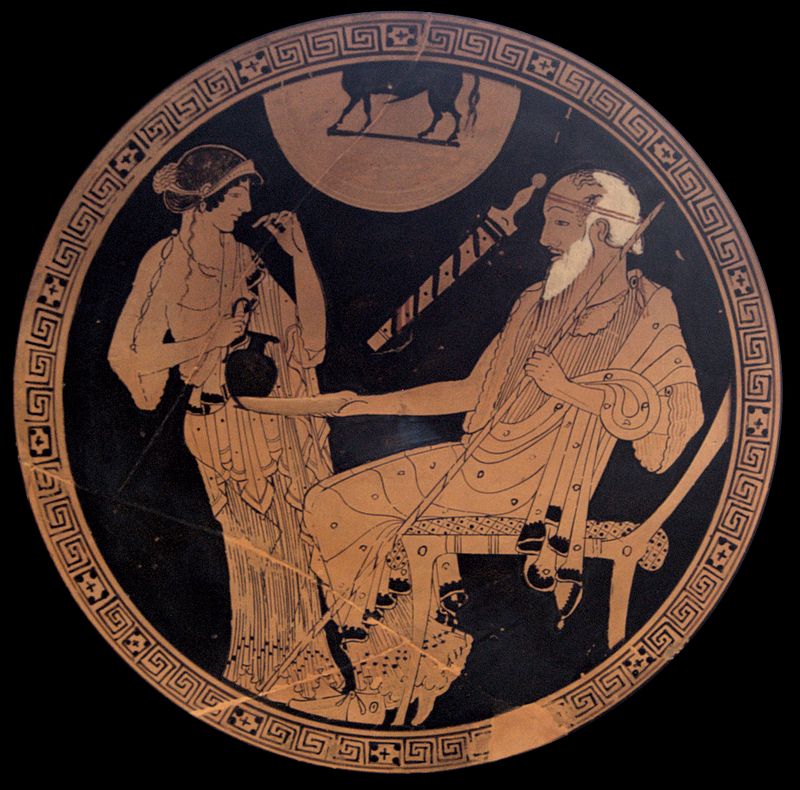
Briseis and Phoenix, red-figure kylix, c. 490 BCE, Louvre (G 152)[1]There’s a lot you don’t know about that party, but you do know that you had a lot to drink, and he took you down to his room and left you there. You might have fallen asleep, you may as well have. When you woke up, there was a stranger on top of you. “Stranger” is a bit strong – it was his ‘big brother,’ a relationship that apparently means quite a lot in a fraternity.
Agamemnon doesn’t want to part with Chryseis, but he will for a price. Or, more precisely, he will if he’s given a prize, a γέρας. Achilles and Agamemnon mention this all-important γέρας thirteen times in Book 1, and Agamemnon makes it very clear that he will not be prize-less (ἀγέραστος). We get another fourteen mentions of honor or dishonor (ἀτιμάω, τιμή, etc.), all of which have to do with the men involved. That’s a lot more than we hear about the women, the girls, whose feelings are inconsequential when men have their honor to worry about. The only feelings we hear anything about are the men—men cry, while women are bartered by men whose feelings are hurt.
Years later, you’d start to realize that words like assault and rape fit what happened to you that night, but that was after years of your pain being used as a punch line and a bargaining token among the brothers at this fraternity. Years of this being a story about how you were a slut and you shouldn’t have gotten so drunk. Years of ‘jokes’ about how you were ‘given’ to that man as a present, from little brother to big brother.
Briseis seated Red Figure Vase, London, British Museum 1843,1103.92 Cat. Vases E 76
And really, the important thing is that Briseis doesn’t end up ruining the Greek army’s chance to win the war. Eventually, the men realize that it’s not worth getting upset over something as meaningless as a girl. As Achilles spits out the words ‘I will not fight with you for the sake of a girl’ (1.298), you feel it in your gut. Ajax says this to Achilles later too – you’re doing this over only a girl (9.637). What a senseless reason to disrupt the unity of the men. Bros before hoes has a longer history than you realized.
Over the next several years, you would remain friends with everyone at the fraternity. You were a liberated college student and not someone who would make a big deal about whatever happened to you. You’re not that kind of girl, and what did it matter that something happened to you that night, that something was taken from you, but you would never – still don’t – know what?
If you look through the Iliad to see what we actually hear about Briseis, you see that she mostly shows up in Book 1 and Book 9, which makes sense. But she gets mentioned in Book 24 in passing. Or, it would be in passing until you start to look for her, and you see that Briseis is sleeping near Achilles, after Priam’s visit. Until you read Silence of the Girls, you didn’t really give this much thought. You fell into the same trap that the Greek men do, you only thought that the men mattered. You don’t like that women are seen as objects, but it is what it is and, anyway, it was a long time ago. But what must it have been like for Briseis to sleep next to this man every night? The man who gave her to Agamemnon – did it matter that Achilles was mad about it? He still handed her over –and now possessed her again. What must it be like to lay next to him every night?
Briseis taken away from Achilles – Pompeii (VI 8 5) – Napoli MAN 9105
As it happens, you were such a cool girl who would never get hung up on silly things that happen at parties – honestly, what a funny mistake it all was! You were so cool about it that you kept coming back to Carl over the following years. Agonized over how he just wasn’t sure you two could date, because seeing you being assaulted was hard for him. You see, he felt like you’d betrayed him, and you were so sorry that you’d caused so much trouble. You kept seeing him, sleeping with him, understanding why he couldn’t date you, because this was really your fault anyway, and maybe you could show him that you could be trusted.
Now you teach students, and while you’ve always warned students about triggering content, you never really knew what that experience was actually like, to have old trauma wash over you with no warning. Not until Christine Blasey Ford testified about Brett Kavanaugh, and women in your life started holding each other tight to withstand the onslaught of stories about sexual assault and how boys will be boys. Something about the volume of women who were reliving their abuse at the same time was too much, and your body couldn’t hold it. A decade of grief poured out in gasping, shuddering tears that you didn’t know were being held in.
Briseis and the other enslaved women mourn for Patroclus, but Homer tells us that they’re also mourning their own pain. Like they needed something else to center their grief on, and once Patroclus was a vessel from grief, their own unexpressed grief poured out. You know that your students can’t prop you up if all this grief comes out in class, and you make it through the end of the class session, but your distance from this text is gone. You’ve fallen out of your own story and into this one. It’s safer not to talk about Briseis’ trauma in class anymore.
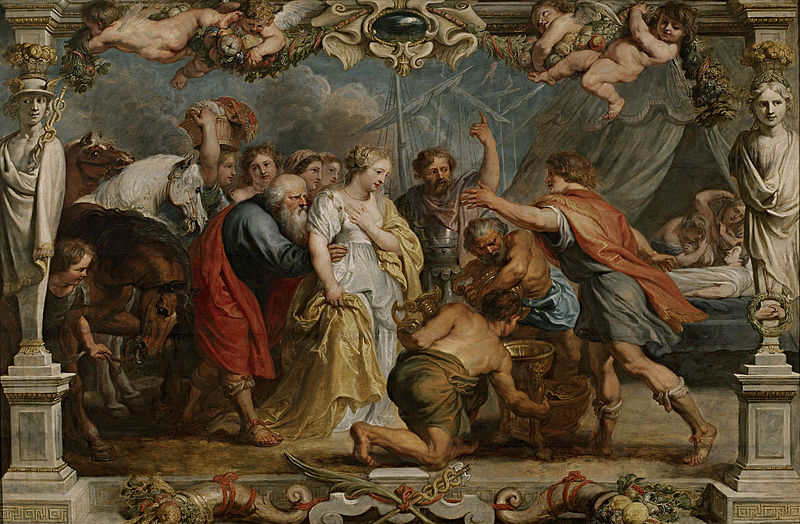
Briseis restored to Achilles, Peter Paul Reubens, 16th/17th Century
There’s no amount of philological rigor that can talk a body down that’s feeling dredged up trauma. You know that you aren’t enslaved and your family hasn’t been killed. You know that almost nothing about the Iliad is a particularly good fit for that night, but it’s not clear if you can separate the two stories anymore. You haven’t taught the Iliad since that day, but presumably you will have to again one day, and the thought is terrifying. Your body still holds the grief and the rage that you like to think your brain has processed, and what kind of a classicist can’t teach Homer anymore?
The academic part of your brain knows that no text is about one thing. The Iliad is about a million things, but for you, right now, it’s really just a story about how women have to pay terrible prices for what men want. How women have to suffer physical and psychological violence because men don’t want to be told no. For gold or glory or honor or because the gods were mad – what does it actually matter why? In the end, every woman in (or even just near) Troy is going to suffer because Paris and Agamemnon and Achilles want to take things that aren’t theirs. And how do you pull yourself out of that story enough to actually teach it?
If you or someone you know is a survivor of sexual assault and would like to talk to someone, there are a range of resources available from RAINN.org. (or call 1-800-656-HOPE) or NSVRC or helping survivors.org
Eurybates and Talthybios Lead Briseis to Agamemmon – Giovanni Battista Tiepolo (1696–1770)





.jpg)