Even the Stoics Can’t Prove Their Own Doctrines

Cicero, Paradoxa Stoicorum. §2-4

“Cato – in my opinion the perfect Stoic – believes those things which hardly receive popular approval, and is part of that school of thought which makes no effort to cultivate the flower of oratory and avoids drawing out an argument, but rather achieves its end by using little, pointed syllogisms. But there is nothing so hard to believe that it cannot be rendered probable by speaking; nothing so horrible, so tasteless, which would not shine and even be ennobled by a bit of oratory. Since this is my belief, I have acted even more boldly than Cato, of whom I speak. While Cato – in that peculiarly Stoic way – spurned oratorical ornamentation when speaking even of the greatness of the soul, on self-control, on death, on every praise of virtue, on the immortal gods, on the dearness of the fatherland, I have playfully rendered all of these doctrines into commonplaces, though the Stoics can barely prove them in their schools.

Because their doctrines are rather wondrous, and certainly contrary to universal belief (they are even called paradoxes by the Stoics themselves), I wanted to try to see whether they might be brought out into the light (that is, into the forum) and, so to speak, to see whether they might be proven, or whether school speech differs fundamentally from popular speech. I was all the more pleased in writing these out, because the beliefs which they call paradoxes seemed to me to be Socratic, and by far the most true.”

Related image
Johann Michael Rottmayr, The Suicide of Cato. (1692)

Cato autem, perfectus mea sententia Stoicus, et ea sentit, quae non sane probantur in volgus, et in ea est haeresi, quae nullum sequitur florem orationis neque dilatat argumentum, minutis interrogatiunculis quasi punctis, quod proposuit, efficit. Sed nihil est tam incredibile, quod non dicendo fiat probabile, nihil tam horridum, tam incultum, quod non splendescat oratione et tamquam excolatur. Quod cum ita putarem, feci etiam audacius quam ille ipse, de quo loquor. Cato enim dumtaxat de magnitudine animi, de continentia, de morte, de omni laude virtutis, de dis inmortalibus, de caritate patriae Stoice solet oratoriis ornamentis adhibitis dicere, ego tibi illa ipsa, quae vix in gymnasiis et in otio Stoici probant, ludens conieci in communes locos. Quae quia sunt admirabilia contraque opinionem omnium [ab ipsis etiam paradoxa appellantur], temptare volui possentne proferri in lucem [id est in forum], et ita dici, ut probarentur, an alia quaedam esset erudita, alia popularis oratio, eoque hos locos scripsi libentius, quod mihi ista paradoxa quae appellant maxime videntur esse Socratica longeque verissima.

After the Body, The Mind Fades Away

Seneca, Moral Epistle 26.1-3

“I was recently explaining to you that I am in sight of my old age—but now I fear that I have put old age behind me! There is some different word better fit to these years, or at least to this body, since old age seems to be a tired time, not a broken one. Count me among the weary and those just touching the end.

Despite all this, I still am grateful to myself, with you to witness it. For I do not sense harm to my mind from age even though I feel it in my body. Only my weaknesses—and their tools—have become senile. My mind is vigorous and it rejoices that it depends upon the body for little. It has disposed of the greater portion of its burden. It celebrates and argues with me about old age. It says that this is its flowering. Let’s believe it, let it enjoy its own good.

My mind commands that I enter into contemplation and I think about what debt I owe to wisdom for this tranquility and modesty of ways and what portion is due to my age. It asks that I think about what I am incapable of doing in contrast to what I do not wish to do, whether I am happy because I don’t want something or I don’t want something because I lack the ability to pursue it.

For, what complaint is there or what problem is it if something which was supposed to end has ended? “But,” you interject, “it is the worst inconvenience to wear out, to be diminished, or, if I can say it properly, to dissolve. For we are not suddenly struck down and dead, we are picked away at! Each individual day subtracts something from our strength!”

But, look, is there a better way to end than to drift off to your proper exit as nature itself releases you? There is nothing too bad in a sudden strike which takes life away immediately, but this way is easy, to be led off slowly.”

Modo dicebam tibi, in conspectu esse me senectutis; iam vereor, ne senectutem post me reliquerim. Aliud iam his annis, certe huic corpori, vocabulum convenit, quoniam quidem senectus lassae aetatis, non fractae, nomen est; inter decrepitos me numera et extrema tangentis.

Gratias tamen mihi apud te ago; non sentio in animo aetatis iniuriam, cum sentiam in corpore. Tantum vitia et vitiorum ministeria senuerunt; viget animus et gaudet non multum sibi esse cum corpore. Magnam partem oneris sui posuit. Exultat et mihi facit controversiam de senectute. Hunc ait esse florem suum. Credamus illi; bono suo utatur. Ire in cogitationem iubet et dispicere, quid ex hac tranquillitate ac modestia morum sapientiae debeam, quid aetati, et diligenter excutere, quae non possim facere, quae nolim †prodesse habiturus ad qui si nolim quidquid non posse me gaudeo.† Quae enim querella est, quod incommodum, si quidquid debebat desinere, defecit? “Incommodum summum est,” inquis, “minui et deperire et, ut proprie dicam, liquescere. Non enim subito inpulsi ac prostrati sumus; carpimur. Singuli dies aliquid subtrahunt viribus.”

Ecquis exitus est melior quam in finem suum natura solvente dilabi? Non quia aliquid mali est ictus et e vita repentinus excessus, sed quia lenis haec est via, subduci.

seneca strength


Or we could do this kind of fading…

Read Cicero and Go to Hell!

Jerome, Epistula ad Eustochium (§30)

Though many years earlier I had separated myself from my home, my parents, my sister, my relations, and – what is still more difficult – from the habit of eating gourmet food, all for the sake of Heaven; and when I was heading to fight in Jerusalem, I was yet not able to go wholly  without my Library, which I had put together in Rome with the greatest industry and effort. And so, in my wretchedness, I would fast before reading Cicero. After the many periods of insomnia, after my tears which the recollection of my past sins was summoning from the depths of my body, I took up Plautus in my hands. If ever I returned to myself, I had begun to read the Prophets, but the uneducated speech made me bristle; and because I could not see the light with my blind eyes, I did not think that it was the fault of my eyes, but of the sun.

While the ancient serpent this toyed with me, sometime in the middle of Lent a fever infused my marrow and invaded my exhausted body; and without any rest (which is also incredible to say), it fed upon my unfortunate limbs such that I barely clung to my bones. Meanwhile, my funeral was being prepared, and the vital heat of my soul was palpitating only in my tepid little heart as the rest of my body went cold. Suddenly, seized in spirit, I was dragged to the tribunal of the judge, where there was such light, such resplendence from the clarity of the bystanders, that as I was thrown upon the ground, I dared not look back up. When I was asked about my condition, I responded that I was a Christian. The one who was presiding said, ‘You lie! You are a Ciceronian, not a Christian! For where your treasure is, there too is your heart.’ I went silent, and in the midst of my beatings (for he had ordered me to be struck down), I was being tortured by the fire of conscience, thinking over that little verse, ‘Who shall confide in you in hell?’ I began to shout and say, ‘Have mercy on me, Lord, have mercy on me!’ My voice resounded among the beatings. Finally, those who were standing by turned to the knees of the judge and prayed that he grant some pardon to my youth and accommodate some bit of penitence to my error, with the intention of exacting torture from me if I ever afterward read books of pagan literature. I, constricted by such a bind would have been willing to swear to even greater things. I began to swear, and calling upon his name, said, ‘Lord, if I ever have worldly books, if I ever read them, I have denied you!’

Dismissed upon these words of the sacrament, then, I returned to the living. Everyone marveled as I opened my eyes soaked with such a torrent of tears that I even produced faith in the faithless with my suffering. For that indeed, that was not just sleep or the empty dreams by which were are often deluded. The witness to this is that tribunal before which I lay, the witness to this is that sad judgment, which I feared: I hope that it never falls to me to face such an inquisition again. I confess that I had bruised shoulder blades, that I felt the blows after the sleep, and that from then on I read divinity with such zeal as I had not applied to pagan literature before.

Saint Jerome, Doctor of Biblical Studies - Catholicism.org

Cum ante annos plurimos domo, parentibus sorore, cognatis, et quod his difficilius est, consuetudine lautioris cibi, propter coelorum me regna castrassem, et Jerosolymam militaturus pergerem, Bibliotheca, quam mihi Romae summo studio ac labore confeceram, carere omnino non poteram. Itaque miser ego lecturus Tullium, jejunabam. Post noctium crebras vigilias, post lacrymas, quas mihi praeteritorum recordatio peccatorum ex imis visceribus eruebat, Plautus sumebatur in manus [al. manibus]. Si quando in memetipsum reversus, Prophetas legere coepissem, sermo horrebat incultus; et quia lumen caecis oculis non videbam, non oculorum putabam culpam esse, sed solis. Dum ita me antiquus serpens [al. hostis] illuderet, in media ferme Quadragesima medullis infusa febris, corpus invasit exhaustum: et sine ulla requie (quod dictu quoque incredibile sit) sic infelicia membra depasta est, ut ossibus vix haererem. Interim parantur exequiae, et vitalis animae calor, toto frigescente jam corpore, in solo tantum tepente pectusculo palpitabat: Cum subito raptus in spiritu, ad tribunal judicis pertrahor; ubi tantum luminis, et tantum erat ex circumstantium claritate fulgoris, ut projectus in terram, sursum aspicere non auderem. Interrogatus de conditione, Christianum me esse respondi. Et ille qui praesidebat: Mentiris, ait, Ciceronianus es, non Christianus: ubi enim thesaurus tuus, ibi et cor tuum (Matth. 6. 21). Illico obmutui, et inter verbera (nam caedi me jusserat) conscientiae magis igne torquebar, illum mecum versiculum reputans: “In inferno autem quis confitebitur tibi” (Ps. 6. 6)? Clamare tamen coepi, et ejulans dicere: Miserere mei, Domine, miserere mei. Haec vox inter flagella resonabat. Tandem ad praesidentis genua provoluti qui astabant, precabantur, ut veniam tribueret adolescentiae, et errori locum poenitentiae commodaret, exacturus deinde cruciatum, si Gentilium litterarum libros aliquando legissem. Ego qui in tanto constrictus articulo, vellem etiam majora promittere, dejerare coepi, et nomen ejus obtestans, dicere, Domine, si unquam habuero codices saeculares, si legero, te negavi. In haec sacramenti verba dimissus, revertor ad superos; et mirantibus cunctis, oculos aperto tanto lacrymarum imbre perfusos, ut etiam, incredulis fidem facerem ex dolore. Nec vero sopor ille fuerat, aut vana somnia, quibus saepe deludimur. Testis est tribunal illud, ante quod jacui, testis judicium triste, quod timui: ita mihi nunquam contingat in talem incidere quaestionem. Liventes fateor habuisse me scapulas, plagas sensisse post somnum, et tanto dehinc studio divina legisse, quanto non ante mortalia legeram.

Insults Cannot Hurt the Wise

Seneca, De Constantia 5

“Serenus, if it seems apt to you, we need to distinguish injury from insult. The first is more serious by its nature and the other is lighter and an issue only for the overly sensitive because people are not wounded but offended. Some spirits are nevertheless so fragile and vain that they believe nothing is more bitter. For this reason you will find an enslaved person who would prefer lashes to fists and believes death and beatings more tolerable than insulting words.

The situation has gone to such a point of ridiculousness that we are harmed not just by pain but by opinion about pain like children whom dark shadows and the appearance of masks or changed appearances terrify! We are people moved to tears by somewhat painful words touching our ears, by rude signs with fingers, and other things which the ignorant rush from in panicked error.

Injury means to do someone evil; but wisdom allows no space for evil because the only evil it recognizes is debasement, which is incapable of entering anywhere virtue and truth already live.”

Dividamus, si tibi videtur, Serene, iniuriam a contumelia. Prior illa natura gravior est, haec levior et tantum delicatis gravis, qua non laeduntur homines sed offenduntur. Tanta est tamen animorum dissolutio et vanitas, ut quidam nihil acerbius putent. Sic invenies servum qui flagellis quam colaphis caedi malit et qui mortem ac verbera tolerabiliora credat quam contumeliosa verba. Ad tantas ineptias perventum est, ut non dolore tantum sed doloris opinione vexemur more puerorum, quibus metum incutit umbra et personarum deformitas et depravata facies, lacrimas vero evocant nomina parum grata auribus et digitorum motus et alia quae impetu quodam erroris improvidi refugiunt. Iniuria propositum hoc habet aliquem malo adficere; malo autem sapientia non relinquit locum, unum enim illi malum est turpitudo, quae intrare eo ubi iam virtus honestumque est non potest.

File:Bust of Seneca, Italian c.1700, Albertinum, Dresden.jpg
Bust of Seneca, Italian c.1700, Albertinum, Dresden

The Tyrant Offs His Friends

Seneca, de Ira 2.23:

There is the noted tyrannicide who, though his work was incomplete, was captured and when he was tortured to inform upon his fellow conspirators, named the friends of the tyrant standing around, to whom he knew the life of the tyrant was actually very dear. And when Hippias ordered them to be killed one by one as they were named, he asked whether anyone remained. The tyrannicide responded, ‘Only you – for I have left out no one else to whom you were dear.’ Anger brought it about that the tyrant accommodated his hands to the tyrannicide, and killed his guard with his very own hand.

Tyrannicide - Wikipedia

Notus est ille tyrannicida qui, inperfecto opere comprehensus et ab Hippia tortus ut conscios indicaret, circumstantes amicos tyranni nominauit quibusque maxime caram salutem eius sciebat. Et cum ille singulos, ut nominati erant, occidi iussisset, interrogauit ecquis superesset: ‘tu’ inquit ‘solus; neminem enim alium cui carus esses reliqui.’ Effecit ira ut tyrannus tyrannicidae manus accommodaret et praesidia sua gladio suo caederet.

Horace’s Minor Madness

Horace, Epistles 2.118-125

“This mistake, this minor madness, still possesses
This many advantages—consider them. The poet is
Not one with a greedy heart. He loves his lines, and desires
This alone. He mocks lost money, the flight of slaves and fires
There’s no thought of fraud against his friend or his ward
He lives as well as thin gruel and dry bread can afford.
Although he’s slow and a bad soldier, he’s still of use,
If you believe this: that grand affairs are helped by small matters too.

Hic error tamen et levis haec insania quantas
virtutes habeat, sic collige. vatis avarus
non temere est animus; versus amat, hoc studet unum;
detrimenta, fugas servorum, incendia ridet;
non fraudem socio puerove incogitat ullam
pupillo; vivit siliquis et pane secundo;
militiae quamquam piger et malus, utilis urbi,
si das hoc, parvis quoque rebus magna iuvari.

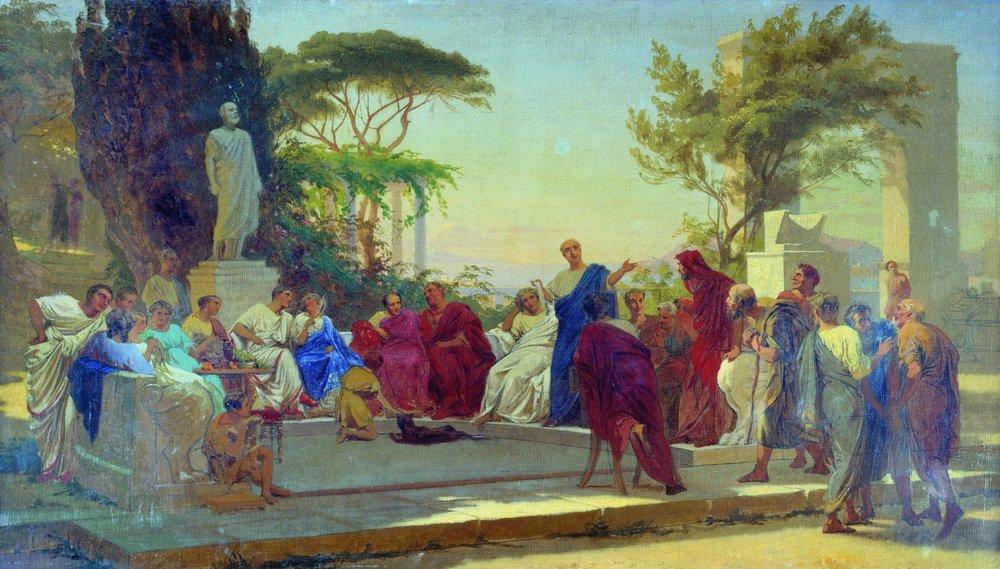
Horace reads before Maecenas, by Fyodor Bronnikov

Bruni: “Theologians Today Are Illiterate Blockheads”

Leonardo Bruni de studiis et litteris II

“By ‘erudition,’ I do not mean that common, confused sort of learning, which theologians now profess, but a real and liberal understanding, which joins experience in literature with knowledge of the world. This is the sort of learning which we find in Lactantius, Augustine, and Jerome – to be sure, the best theologians, and the men of the highest literary attainment. But now, we should be ashamed at how little the theologians of today know of literature.”

“Angel Appearing to St. Jerome” by Guido Reni

Eruditionem autem intelligo non vulgarem istam et perturbatam, quali utuntur ii qui nunc theologiam profitentur, sed legitimam illam et ingenuam, quae litterarum peritiam cum rerum scientia coniungit; qualis in Lactantio Firmiano, qualis in Aurelio Augustino, qualis in Hieronymo fuit, summis profecto theologis ac perfectis in litteris viris. Nunc vero, qui eam scientiam profitentur, pudendum est quam parum persciant litterarum.

Cicero, I Used to Believe in You!

Petrarch, Epistulae Familiares 24.3:

Francesco Petrarch sends greetings to his own Cicero

It was with the utmost avidity that I read through your letters, ‘sought for long and hard’, and found where I had hardly suspected to find them. I heard you saying many things, deploring many things, altering many things, Marcus Cicero, and I who had long ago known what a teacher you had been to others now at last recognized what you were to yourself. In turn, hear this – it’s not advice, but a lament, stemming from sincere affection. Wherever you are, hear what one of your posterity, one who loves your name most dearly, poured forth not without tears.

O, you who were always ill at ease and anxious, or – in your own words – ‘o rash and calamitous old man’, what did you want from so many contests and quarrels which were to do you no good? Where did you leave behind the leisure so suited to your age, your profession, and your fortune? What false splendor of glory wrapped you, an old man, up in the wars of the young and snatched you off, tossed about through all kinds of misfortunes, to a death unbecoming a philosopher?

Alas! So unmindful of your brother’s counsel and your own salutary precepts, bearing a lantern in the shadows like a nighttime wanderer, you showed your persecutors the footpath on which you miserably fell. I omit Dionysius, I omit your brother and grandson, I even omit Dolabella himself if I may, whom you now bear to the sky with your praise and now lacerate with your sudden curses; perhaps even these things were tolerable. I will even skip over Julius Caesar, whose well-known clemency was itself a harbor for your harassers. I even remain silent of Pompey the Great, with whom you seemed to be able to engage in some little bit of familiarity. It must have been your love of the republic, which you used to say had collapsed to its foundations. Because if pure faith, if liberty drew you on, why were you on such chummy terms with Augustus? What will you say to your Brutus? ‘If indeed’, he says, ‘Octavius meets your approval, you will not seem to have fled a master but to have sought a more friendly lord.’ This remained, and this was the last horror, unlucky Cicero, that you would badmouth this man who was so praised, and who, while he may not have done you ill, certainly did not stand in the way of those who did you ill. I mourn your fate, my friend, and I regret and lament your errors, and now with that same Brutus, ‘I attribute nothing to these arts, in which I know that you had been instructed.’ Indeed, what good does it do to teach others, or what good is it to go around talking all the time about virtue in the most ornate speeches, if at that same time you don’t even hear yourself? Ah, how much better it would have been especially for a philosopher to have grown old in a quiet country home, ‘thinking’, as you yourself write in some place, ‘about that eternal life, and not this little one which we have here.’ How much better to have had no fasces, not to have stood open-mouthed at triumphs, not to have had any Catilines to puff your mind up. But all of this is in vain. Farewell forever, my Cicero.

Petrarch - Wikipedia

[1] Franciscus Ciceroni suo salutem. Epystolas tuas “diu multumque perquisitas” atque ubi minime rebar inventas, avidissime perlegi. Audivi multa te dicentem, multa deplorantem, multa variantem, Marce Tulli, et qui iampridem qualis preceptor aliis fuisses noveram, nunc tandem quis tu tibi esses agnovi. Unum hoc vicissim a vera caritate profectum non iam consilium sed lamentum audi, ubicunque es, quod unus posterorum, tui nominis amantissimus, non sine lacrimis fundit. [2] O inquiete semper atque anxie, vel ut verba tua recognoscas, “o preceps et calamitose senex”, quid tibi tot contentionibus et prorsum nichil profuturis simultatibus voluisti? Ubi et etati et professioni et fortune tue conveniens otium reliquisti? Quis te falsus glorie splendor senem adolescentium bellis implicuit et per omnes iactatum casus ad indignam philosopho mortem rapuit?


[3] Heu et fraterni consilii immemor et tuorum tot salubrium preceptorum, ceu nocturnus viator lumen in tenebris gestans, ostendisti secuturis callem, in quo ipse satis miserabiliter lapsus es. Omitto Dyonisium, [4] omitto fratrem tuum ac nepotem, omitto, si placet, ipsum etiam Dolabellam, quos nunc laudibus ad celum effers, nunc repentinis malidictis laceras: fuerint hec tolerabilia fortassis. Iulium quoque Cesarem pretervehor, cuius spectata clementia ipsa lacessentibus portus erat; Magnum preterea Pompeium sileo, cum quo iure quodam familiaritatis quidlibet posse videbare. Sed quis te furor in Antonium impegit? [5] Amor credo reipublice, quam funditus iam corruisse fatebaris. Quodsi pura fides, si libertas te trahebat, quid tibi tam familiare cum Augusto? Quid enim Bruto tuo responsurus es? «Siquidem» inquit, «Octavius tibi placet, non dominum fugisse sed amiciorem dominum quesisse videberis». [6] Hoc restabat, infelix, et hoc erat extremum, Cicero, ut huic ipsi tam laudato malidiceres, qui tibi non dicam malifaceret, sed malifacientibus non obstaret. Doleo vicem tuam, amice, et errorum pudet ac miseret, iamque cum eodem Bruto «his artibus nichil tribuo, quibus te instructissimum fuisse scio». Nimirum quid enim iuvat alios docere, quid ornatissimis verbis semper de virtutibus loqui prodest, si te interim ipse non audias? [7] Ah quanto satius fuerat philosopho presertim in tranquillo rure senuisse, de “perpetua illa”, ut ipse quodam scribis loco, “non de hac iam exigua vita cogitantem”, nullos habuisse fasces, nullis triumphis inhiasse, nullos inflasse tibi animum Catilinas. Sed hec quidem frustra. Eternum vale, mi Cicero.

What Binds Uncertain Minds

Lucan, Pharsalia 5.249-259

“Caesar did not learn better in any other struggle
How he looked down from an unstable, shaky precipice
And that even the ground he stood on was trembling.

Undone by so many hands cut down, left only
His own sword, this man who forced so many peoples to war
He understood that the drawn sword is the soldier’s not the general’s.

The murmur was no longer timid, no more was anger
Hidden in the heart: for what binds together uncertain minds,
That each person fears the others he causes terror
And everyone thinks that they alone are oppressed by injustice,
Was no longer a cause to restrain people.”

Haud magis expertus discrimine Caesar in ullo est,
Quam non e stabili tremulo sed culmine cuncta
Despiceret staretque super titubantia fultus.
Tot raptis truncus manibus gladioque relictus
Paene suo, qui tot gentes in bella trahebat,
Scit non esse ducis strictos sed militis enses.
Non pavidum iam murmur erat, nec pectore tecto
Ira latens; nam quae dubias constringere mentes
Causa solet, dum quisque pavet, quibus ipse timori est,
Seque putat solum regnorum iniusta gravari,
Haud retinet.

Julius Caesar on Horseback, Writing and Dictating Simultaneously to His Scribes. Painted by artist Jaques de Gheyn II (1565–1629).

Pliny on the Utility of Gossip

Pliny, Epistle 18 to Fadius Rufinus 12

“You now have all the city’s rumors: for all our gossip is Tullus. His estate sale is hotly anticipated. For he had so much that on that day when he purchased the largest gardens he also filled them with the most and most ancient statues. These were works of finest beauty in which he had forgotten!

If you have any news you think is worthy of sharing, don’t keep it from me. For human ears are always pleased by news, and we use these examples to learn the art of living. Farewell.”

Habes omnes fabulas urbis; nam sunt omnes fabulae Tullus. Exspectatur auctio: fuit enim tam copiosus, ut amplissimos hortos eodem quo emerat die instruxerit plurimis et antiquissimis statuis; tantum illi pulcherrimorum operum in horreis quae neglegebat. Invicem tu, si quid istic epistula dignum, ne gravare. Nam cum aures hominum novitate laetantur, tum ad rationem vitae exemplis erudimur. Vale.

Gossip
BL MS Royal 6 E VII