Deeds Worth Writing, Writings Worth Reading

Pliny the Younger, Epistles 6.16 (To Tacitus)

“You ask that I write about the death of my uncle so that you can give a more faithful account to posterity. I thank you, for I see that immortal glory awaits his death if it be recorded by you. Although, although he continued working in the destruction of the most beautiful lands, just like the peoples and cities in that memorable crisis, he died in such a way that he will live on forever, and though he himself set down many works which will remain, the eternal duration of your writings will add much to his legacy. Indeed, I consider those as truly blessed to whom the divine gift was given either to do things worth writing or to write things worth reading – but the most blessed of all are those who do both. My uncle will be among these thanks to his books and yours. And so all the more cheerfully do I undertake what you have enjoined, and even beg for the privilege of doing it.”

Image result for pliny the elder pompeii

Petis ut tibi avunculi mei exitum scribam, quo verius tradere posteris possis. Gratias ago; nam video morti eius si celebretur a te immortalem gloriam esse propositam. Quamvis enim pulcherrimarum clade terrarum, ut populi ut urbes memorabili casu, quasi semper victurus occiderit, quamvis ipse plurima opera et mansura condiderit, multum tamen perpetuitati eius scriptorum tuorum aeternitas addet. Equidem beatos puto, quibus deorum munere datum est aut facere scribenda aut scribere legenda, beatissimos vero quibus utrumque. Horum in numero avunculus meus et suis libris et tuis erit. Quo libentius suscipio, deposco etiam quod iniungis.

Top Posts of Another Year

Outside of the top few posts, this was a year of guest posts and essays. Erik and I were always willing and interested to share the blog with other people, but we have never really had the time to go out and seek them. So, when people have reached out to us, we have been happy to have them join us.

  1. Diocletian’s Horse Saves the City!

This post wasn’t even from this year! Somehow, it turned into a hot post on Reddit for a while and burned down the house.

reddit

2. Newly Discovered Text: Caesar on Forestry in Finland

Dani Bostick’s ‘discovery’ of a fragmentary text responding to fires in California and some of our current President’s more insane comments was politely declined by a few other sites. It found a home here and Dani has shared many more new Latin discoveries since.

3. Head and Heart: A Quotation Falsely Attributed to Aristotle

This one eventually inspired a collection of false-Aristotle quotes I eventually just put in one post: Meme Police, A Collection of Things Aristotle Did not Say

4. “This is Not My Beautiful House”: Classics, Class and Identity

This post was a response to some discussion online and Erik’s post (at #9) about Class and Classics. It seems to have hit a nerve and prompted more discussion. We got a great followup from Brandon Conley: “How Was [the Expensive Classics Event]?”

5. Classics and Theory: A Monday Rant

This started out as a twitter rant and turned into an essay. There are still many, many people who have a naive attitude about what theory is and how it shapes writing, teaching, and just being in the world. There is still an alarmingly stubborn faction in Classics who falsely oppose “Philology” to theory, imagining that the former is not a species of the latter. I think forms of this one will keep coming back.

6. The Humanities: Aristotle in the Sheets, But Xenophon on the Streets

There was a NY Times Op-Ed on the Humanities that got me up in arms. I posted some tweets, wrote a thing. Erik is working on a much deeper and prolonged project on the Humanities and Classics among the Founding Fathers. Since the culture wars continue and the humanities are always already embattled, this subject will probably come back too.

7. A List of Women Authors from the Ancient World

This is a list that needs more work. I am still looking for people to help me expand these entries!

8. Famae Volent: a Personal History

The infamous and hated although obsessively checked classics job bulletin board closed down this year. I wrote a wistful and self-indulgent piece about it. Then I wrote a second one. The successor site is not nearly as interesting.

9. Classics [Itself] Is Not Classist

When Grace Bertelli (The Classics Major is Classist) first wrote on this topic, we had some discussions online and Erik wrote this overview of why the content of Classics is not essentially class-oriented. As with all of his essays, it is sharp and filled with turns of phrase I wish I could think of.

10. Terrible, Wonderful Odysseus, His Epithets, and How We Read Him

This is a hodgpodge of stuff about Odysseus which started out as a twitter discussion because people don’t like my occasional translation of polytropos as shifty. (Don’t @ me! Read the post!)

Some things I love outside the top 10

  1. The Story of Dido in the Aeneid Through Buffy GIFS
  2. Classics For the Fascists
  3. How Was the [Expensive] Classics Event: Income Inequality and the Classics
  4. Exploring Gender and Sexuality in Antiquity
  5. Reclaiming the Story: Ovid’s Mythological Hermaphrodite
  6. Post-Classical Intellectualism in the Latin Classroom


Thanks to Elton BarkerDani Bostick, Brandon ConleyHilary Ilkay, Cassie Garrison, Christian LehmannBen Stevens, and Zachary Taylor for making the past year memorable and special

Bellum Incivile: Manicula’s Holiday Tweets

Another text tentatively attributed to Caesar was discovered along with the fragments of the De Silvis and an appendix to De Bello Gallico. This is almost surely the lost Bellum Incivile.
13.4 Since his wife and son had taken a trip, Manicula stayed at home in the White House during the holidays. Having shut down the government and dismissed John Kelly, he sent out many shameful messages and absurdities to the public via his Twitter account: that he was miserable and all alone waiting for the Democrats to come back to him and make a deal; that The Wall and border security are two different things;* that everyone should give thanks to Saudi Arabia because they said they might bring help to an unfortunate nation; that the republic was doing well because of strong Borders, the return of the Army from war, and trade agreements; that he would prohibit all people from crossing into the territory and make new laws about immigrants who seek safety in flight, unless the Democrats gave him a lot of money to build the Wall; that the Fake News had gone crazy because he had signed soldiers’ red MAGA hats, which he denied bringing into theater; and that thanks should be given to Sean Parnell of Fox and Friends** for praising he and Melania after they visited the troops.***
It is said that a wise and noble politician does not dedicate himself to trivial conflicts and self-promotion, but to the administration of the republic. Manicula was neither wise nor noble.

13.4 Cum uxor filiusque iter fecissent, Manicula solus in Regia Candida dies festos manebat. Administratione rei publicae impedita Cellioque dimisso multas litteras indecoras et ineptias avibus caeruleis ad cives misit: se miserum ac persolum dum Democratici negotiandi causa ad se redirent expectare; Murum et praesidia finium inter se differre;* gratias Arabiae, quae se auxilium civitati miserae fortasse ferre posse diceret, omnibus agendas; rem publicam propter Praesidia fortia et Exercitus a bello revocationem et commericia esse salvam; se omnes ab finibus prohibiturum novasque leges de confugis, qui fuga salutem peterent, iussurum nisi Democraticos sibi multam pecuniam ad murum aedificandum darent; Falsam Famam propterea quod sanguinicis militum mitris, quas ab se ad belli sedes portari negaret, nomen notavisset conturbatam esse; gratias S. Parnello, Volpi Amico,** agendas quod is*** et Melaniam militibus salutatis laudaret.

Virum civilem, qui vere sapiens ac nobilis sit, se non otiosis disputationibus et iactationi sed administrationi rei publicae dare dicitur. Manicula erat neque sapiens neque nobilis.

* There could be a problem with the text here since a wall is quite literally a type of border security, and Manicula was promoting it as such during that time.
** Volpis Amicus, sometimes written Volpis ac Comites, is thought to be a guild of pseudo-orators who spread propaganda around the republic on behalf of Manicula.
*** The original message was uncovered along with this section of Bellum Incivile, and it appears Manicula used a nominative form of the personal pronoun instead of an accusative (‘he praised Melania and I.’ This instance of ‘is’ could be an attempt by the author to mimic Manicula’s unusual rhetorical style.

b8e0c-pompeii_-_casa_del_menandro_-_menander

How We Spend Our Days–Do Nothing Rather Than Something Useless

Pliny, Letters 9 To Minucius Fundanus

“It is amazing how the schedule is or seems on individual days in the city when they all blend together. If you ask anyone “what did you do today?” He may say, “I went to a toga-ceremony, an engagement, or a marriage. I was the witness at a will-signing, or at court as a witness or supporter.” These things which you do seem necessary on the day that you do them but empty if you remember that you have done the same kind of things every day and they seem even sillier if you consider them when you are away.

Then the realization comes over you: “How many days have I wasted in trivial pursuits!” This occurs to me whenever I am reading or writing or taking some time to exercise, to keep my mind fit for my work, at my Laurentum. I hear nothing and I say nothing which later on it hurts me that I said or heard. No one troubles me with evil rumors. I find no one to blame but myself when I write with too little ease. I am troubled by no hope, no fear; I am disrupted by no gossip. I speak only with myself and my little books.

What a fine and sincere life! What sweet and honest leisure, finer than nearly any business at all. The sea, the beach, my own true and private museum—how much you discover for me, how much you have told me!

Take the first chance you can to leave that noise, the empty conversation, and so many useless tasks and dedicate yourself to studies or relaxing. For our friend Atilius put it most elegantly and intelligently when he said “it is better to do engage in leisure than to do nothing.”

Plinius Minicio Fundano Suo S.

1Mirum est quam singulis diebus in urbe ratio aut constet aut constare videatur, pluribus iunctisque

Nam si quem interroges “Hodie quid egisti?,” respondeat: “Officio togae virilis interfui, sponsalia aut nuptias frequentavi, ille me ad signandum testamentum, ille in advocationem, ille in 3 consilium rogavit.” Haec quo die feceris, necessaria, eadem, si cotidie fecisse te reputes, inania videntur, multo magis cum secesseris. Tunc enim subit recordatio: “Quot dies quam frigidis rebus absumpsi!” 4 Quod evenit mihi, postquam in Laurentino meo aut lego aliquid aut scribo aut etiam corpori vaco, cuius fulturis animus sustinetur. Nihil audio quod audisse, nihil dico quod dixisse paeniteat; nemo apud me quemquam sinistris sermonibus carpit, neminem ipse reprehendo, nisi tamen me cum parum commode scribo; nulla spe nullo timore sollicitor, nullis rumoribus inquietor: mecum tantum et cum libellis loquor. O rectam sinceramque vitam! O dulce otium honestumque ac paene omni negotio pulchrius! O mare, o litus, verum secretumque μουσεῖον, quam multa invenitis, quam multa dictatis! 7 Proinde tu quoque strepitum istum inanemque discursum et multum ineptos labores, ut primum fuerit occasio, relinque teque studiis vel otio trade. 8 Satius est enim, ut Atilius noster eruditissime simul et facetissime dixit, otiosum esse quam nihil agere. Vale.

The Wakeful Mind and Happiness

Cicero, De Finibus 5. 87

“For this reason we must examine whether or not it is possible for the study of the philosophers to bring us [happiness].”

Quare hoc videndum est, possitne nobis hoc ratio philosophorum dare.


Aristotle, Eudemian Ethics, 2.1 (1219a25)

“Let the work of the mind be the performance of life—and what this means is using life and being awake (for sleep is some kind of a rest and cessation of life). As a result, since the work of the mind and its virtue are identical, then the work of virtue is an earnest life.

This, then, is the complete good, which is itself happiness. For it is clear from what we have argued—as we said that happiness was the best thing; the goals and the greatest of the goods are in the mind, but aspects of the mind are either a state of being or an action—it is clear that, since an action is better than a state and the best action is better than the best state, that the performance of virtue is the greatest good of the mind. Happiness, then, is the action of a good mind.”

Ἔτι ἔστω ψυχῆς ἔργον τὸ ζῆν ποιεῖν, τοῦτοχρῆσις καὶ ἐγρήγορσις (ὁ γὰρ ὕπνος ἀργία τις καὶ ἡσυχία)· ὥστ᾿ ἐπεὶ τὸ ἔργον ἀνάγκη ἓν καὶ ταὐτὸ εἶναι τῆς ψυχῆς καὶ τῆς ἀρετῆς, ἔργον ἂν εἴη τῆς ἀρετῆς ζωὴ σπουδαία.

τοῦτ᾿ ἄρ᾿ ἐστὶ τὸ τέλεον ἀγαθόν, ὅπερ ἦν ἡ εὐδαιμονία. δῆλον δὲ ἐκ τῶν ὑποκειμένων (ἦν μὲν γὰρ ἡ εὐδαιμονία τὸ ἄριστον, τὰ δὲ τέλη ἐν ψυχῇ καὶ τὰ ἄριστα τῶν ἀγαθῶν, τὰ ἐν αὐτῇ δὲ ἢ ἕξις ἢ ἐνέργεια), ἐπεὶ βέλτιον ἡ ἐνέργεια τῆς διαθέσεως καὶ τῆς βελτίστης ἕξεως ἡ βελτίστη ἐνέργεια ἡ δ᾿ ἀρετὴ βελτίστη ἕξις, τὴν τῆς ἀρετῆς ἐνέργειαν τῆς ψυχῆς ἄριστον εἶναι. ἦν δὲ καὶ ἡ εὐδαιμονία τὸ ἄριστον· ἔστιν ἄρα ἡ εὐδαιμονία ψυχῆς ἀγαθῆς ἐνέργεια.

ψυχή: can be translated into English as “spirit” or “soul” instead of “mind”. I avoided the former to sidestep the implication that Aristotle is making some kind of a mystical argument; I avoided the latter because it has such strong religious associations in English.

Seneca De Beneficiis 22

“A just reason for happiness is seeing that a friend is happy—even better, is to make a friend happy.”

iusta enim causa laetitiae est laetum amicum videre, iustior fecisse

Image result for medieval manuscript philosophy happiness
Ms 3045 fol.22v Boethius with the Wheel of Fortune, from ‘De Consolatione Philosophiae’, translated by Jean de Meung

Fanaticism Against Greek and Latin

John Adams to Benjamin Rush, October 13 1810:

“Dear Sir

Mrs Adams Says She is willing you Should discredit Greek and Latin, because it will destroy the foundation of all the Pretensions of the Gentlemen to Superiority over the Ladies, and restore Liberty, Equality and Fraternity between the Sexes. What does Mrs Rush think of this?

Hobbes calumniated the Classicks, because they filled young Mens heads with Ideas of Liberty, and excited them to rebellion against Leviathan.

Suppose We Should agree to Study the oriental Languages especially the Arabic, instead of Greek and Latin. This would not please the Ladies So well, but it would gratify Hobbes much better. According to many present appearances in the World many useful Lessons and deep Maxims might be learned from the Asiatic Writers. There are great Models of Heroes and Conquerors fit for the Imitation of the Emperors of Britain and France. For Example in the Life of Timur Bec, or Tamerlane the great We read vol. 1. p. 202. “It was Timurs Ambition of Universal Empire which caused him to undertake Such glorious Actions. He has been often heard to Say, that it was neither agreable nor decent, that the habitable World Should be governed by two Kings: according to the Words of the Poet, ‘as there is but one God, there ought to be but one King, all the Earth being very Small in Comparison of the Ambition of a great Prince” Where can you find in any Greek or Roman Writer a Sentiment so Sublime and edifying for George and Napoleon. There are Some faint Traces of it in the Conduct of Alexander and Cæsar but far less frank and noble, and these have been imprudently branded with Infamy by Greek and Roman orators and Historians. There is an Abundance more of Such profound Instruction in the Life of this Tamerlane as well as in that of Gengizcan, both of which I believe Napoleon has closely Studied. With Homer in one Pocket Cæsars Commentaries in the other Quintus Curtius under his Pillow, and the Lives of Mahomet Gengizcan, and Tamerlane in his Port Folio, and Polybius Folard, Montecucculi, Charlemagne, Charles twelfth Charles 5th cum multis aliis among his Baggage this Man has formed himself: but the Classics among them have damped his ardor and prevented his rising as yet to the lofty Heights of the Asiatic Emperors. Would it not be better that George and Napoleon Should forget all their Classicks and mount at once to all Sublimities of Mahomet, Gengizcan and Tamerlane? In that Case one or the other must Soon Succumb; and would it not be better that one Such should govern the Globe than two?

Oct. 15. Thus far I had written, when your favour of the 8th with your Invention a Tranquilliser was given to me from the Post office. The Tranquilliser is a very ingenious Mechanical Invention and I hope will be beneficial to that most deplorable Portion of our Species for whom it is intended.

But to be Serious, if I were possessed of Sovereign Power over your Hospital, (provided I could do it Secretly So that No Mortal should know it, but you and I,) I would put you into your own Tranquilliser, till I cured you, of your Fanaticism against Greek an Latin.

The Greek Testament cannot be read to effectual advantage, with out a comprehensive Knowledge and critical Skill, in all the Grecian Litterature.

The World had never Seen a Milton if a Homer and Virgil had not lived before him: nor any one of the Poets orators or Historians you mention among the English Scotch or Irish, or French if Greece and Rome had not furnished them Models.

My Friend you will labour in vain. As the Love of Science and Taste for the fine Arts increases in the World, the Admiration of Greek and Roman Science and Litterature will increase. Both are increasing very fast. Your Labours will be as Useless as those of Tom Paine against the Bible, which are already fallen dead and almost forgotten. […]”

Image result for john adams

The Fruitless Toil of Worry: Two Passages on Happiness

Horace, Odes 2.16 25-32

“The spirit which is happy for a single day
Has learned not to worry about what remains
And tempers bitter tastes with a gentle smile—
Nothing is blessed through and through.

A swift death stole famed Achilles away;
Drawn-out old age wore Tithonos down.
Perhaps some hour will hand to me
Whatever it has refused to you.”

laetus in praesens animus quod ultra est
oderit curare et amara lento
temperet risu; nihil est ab omni
parte beatum.

abstulit clarum cita mors Achillem,
longa Tithonum minuit senectus,
et mihi forsan, tibi quod negarit,
porriget hora.

Bacchylides, Processionals fr. 11-12

“There is one border, a single path to happiness for mortals—
When a person is able to keep a heart free of grief
Until the end of life. Whoever keeps a ten thousand
Affairs in their thoughts
Whoever tortures their heart
Night and day over what may come,
Has toil which brings no profit.”

εἷς ὅρος, μία βροτοῖσίν ἐστιν εὐτυχίας ὁδός,
θυμὸν εἴ τις ἔχων ἀπενθῆ δύναται
διατελεῖν βίον· ὃς δὲ μυρία
μὲν ἀμφιπολεῖ φρενί,
τὸ δὲ παρ᾿ ἆμάρ τε <καὶ> νύκτα μελλόντων
χάριν αἰὲν ἰάπτεται
κέαρ, ἄκαρπον ἔχει πόνον.

Image result for medieval manuscript happiness
BLMedieval Sloane MS 278, 1280-1300

Didn’t Get What You Want for Christmas? Cicero Writes His Brother About Books

Cicero, Letters to Quintus 25

“I believe that you will anticipate that I didn’t lose those books without some kind of a stomach ache…”

puto enim te existimaturum a me illos libros non sine aliquo meo stomacho esse relictos.

Cicero, Letters to Quintus 24

“Concerning the issue of supplementing your Greek library and trading books in order to acquire Latin ones, I would really like to help get this done, since these exchanges are to my benefit as well. But I don’t have anyone even for my own purposes whom I can trust with this. The kinds of books which are helpful are not for sale and they cannot be procured without a deeply learned person who has a serious work ethic.”

De bibliotheca tua Graeca supplenda, libris commutandis, Latinis comparandis, valde velim ista confici, praesertim cum ad meum quoque usum spectent. sed ego mihi ipsi ista per quem agam non habeo. neque enim venalia sunt, quae quidem placeant, et confici nisi per hominem et peritum et diligentem non possunt.

Bonus Quotes from Cato, Dicta Catonis

“Read books”

“Remember the things you read”

Libros lege.

Quae legeris memento.


Picture stolen from here

Suffering More than Odysseus

Ovid, Tristia 1.5:

“Learned poets, write of my sufferings instead of those of the Neritian* leader: for I have suffered more ills than Odysseus. He wandered for many years in the brief spot between his Dulichian and Trojan homes: but chance has borne me across channels separated by entire stars, and brought me into the Getic and Sarmatic bays. He had his faithful band and his faithful companions: but all of my friends have deserted me in exile. He sought his home as a happy victor: I have fled from my homeland conquered and exiled. Moreover, my home was not in Dulichium or Ithaca or Samos, from which places it would not be a hard punishment to be absent. Rather, my home was Rome, the seat of empire and the gods, which looks out at the whole world from its seven hills.

Odysseus had a hard body capable of enduring hard work: my strength is feeble, typical of noble birth. He was used to constant exercise in savage arms: I was accustomed to softer studies. A god oppressed me with no one to alleviate my suffering: but the warlike goddess gave help to him.

Consider that the one who rules the swollen waves is less than Jupiter – the anger of Neptune pressed upon him, but it is the anger of Jupiter which lays me low. Add to that the fact that the greatest part of his sufferings were made up, but there is no idle storytelling in my suffering. Finally, he nevertheless touched his long-sought Penates, and though he sought those fields for such a long time, he eventually reached them. But I must be away from my paternal soil forever, unless the anger of the wounded god should soften.”

*Ovid’s use of the adjective Neritius here is allusive in the extreme, referring to Odysseus on the basis of Iliad 2.631-2: “Odysseus led the great-hearted Cephallenians who held Ithaca and Neritus with its shaking leaves.” [αὐτὰρ Ὀδυσσεὺς ἦγε Κεφαλλῆνας μεγαθύμους, οἵ ῥ᾽ Ἰθάκην εἶχον καὶ Νήριτον εἰνοσίφυλλον]. For more on Ovid’s playful but hyper-erudite allusion, see here.

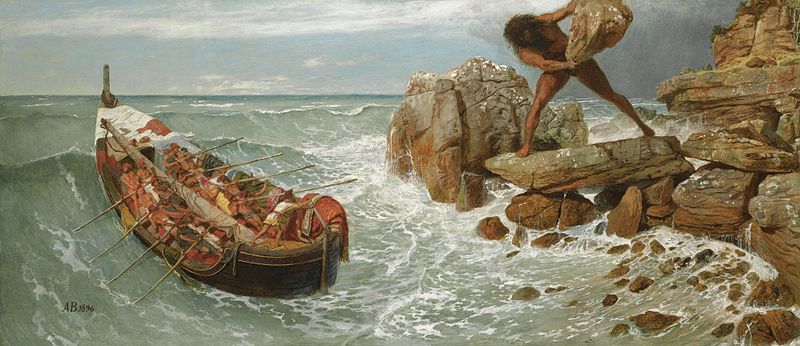
File:Arnold Böcklin - Odysseus and Polyphemus.jpg
Arnold Böcklin – Odysseus and Polyphemus

pro duce Neritio docti mala nostra poetae
scribite: Neritio nam mala plura tuli.
ille breui spatio multis errauit in annis
inter Dulichias Iliacasque domos:
nos freta sideribus totis distantia mensos
sors tulit in Geticos Sarmaticosque sinus.
ille habuit fidamque manum sociosque fideles:
me profugum comites deseruere mei.
ille suam laetus patriam uictorque petebat:
a patria fugi uictus et exul ego.
nec mihi Dulichium domus est Ithaceue Samosue,
poena quibus non est grandis abesse locis,
sed quae de septem totum circumspicit orbem
montibus, imperii Roma deumque locus.
illi corpus erat durum patiensque laborum:
inualidae uires ingenuaeque mihi.
ille erat assidue saeuis agitatus in armis:
adsuetus studiis mollibus ipse fui.
me deus oppressit, nullo mala nostra leuante:
bellatrix illi diua ferebat opem.
cumque minor Ioue sit tumidis qui regnat in undis,
illum Neptuni, me Iouis ira premit.
adde, quod illius pars maxima ficta laborum,
ponitur in nostris fabula nulla malis.
denique quaesitos tetigit tamen ille Penates,
quaeque diu petiit, contigit arua tamen:
at mihi perpetuo patria tellure carendum est,
ni fuerit laesi mollior ira dei.

Bellum Incivile: Government Shutdown Over the Wall

Another text tentatively attributed to Caesar was discovered along with the fragments of the De Silvis and an appendix to De Bello Gallico. This is almost surely from the lost Bellum Incivile.

8.3 For reasons I already mentioned, Manicula resolved to keep people of color out of the homeland by means of executive orders and an expensive wall. Since he feared that people fleeing mortal danger and actual coyotes— amazing to say!– might cross the border and that heavy bags full of drugs might be thrown into the territory, he devised a new kind of wall, through which it possible to look, but not to enter, and decreed that sharpened stakes of steel be placed at regular, two-foot intervals into the ground. Disturbed by the new and rather unusual appearance of the wall, the citizens laughed and made fun of it, saying this plan for border security was childish and stupid and that the wall looked just like a medieval fortification. 

8.3 Manicula, his de causis quas commemoravi, coloratas gentes a patria decretis ac muro magni pretii prohibere constituit. Qui veritus ne gentes periculum effugientes et veri lupi, mirabile dictu, transirent saccique tumentes multis potionibus in fines conicerentur, formam muri novam, quo perspici posset, sed non intrari, excogitavit decrevitque ut trabes ferri praeacutae paribus intervallis, distantes inter se binos pedes, in solo collocarentur. Nova atque inusitatiore specie commoti cives inridebant atque increpitabant vocibus, consilium finium tuendorum puerile et stultum murumque simillimum forma munitionibus perveteribus esse.

8.4 Moved by great anger because of these words, Manicula replied that the wall should be referred to as a Beautiful Steel Slat Barrier; that the government must be shut down until the senators provide funding for his wall; and that in the meantime, according to his usual custom, he would put everyone who crossed the border into freezers and cages.

8.4 Magna adfectus ira his verbis Manicula ad ea respondit: murum Claustrum Trabium Ferrearum Pulchrum appellandum; rem publicam non administrandam, nisi senatores pecuniam publicam ex aerario ad murum struendum darent. Se interim consuetudine sua omnes, qui in fines transirent, in arcas gelatas ac caveas mitturum.

wolfbyz