Feeling “Hangry” in Ancient Greek

My daughter  learned a series of neologisms at school this year, including the clever but cloying “hangry”. What is a classically trained pedant to do but look for ancient precedents for a newly coined term?

 Phrynichus, fr. 75

“In the grumpy rages of old men with rotting lives.”

ἐν χαλεπαῖς ὀργαῖς ἀναπηροβίων †γερόντων

Aristophanes, Knights 706-7

“You’re so cranky! Come on, what can I feed you?
What do you munch on most happily? Is it a wallet?”

ὡς ὀξύθυμος. φέρε τί σοι δῶ καταφαγεῖν;
ἐπὶ τῷ φάγοις ἥδιστ᾿ ἄν; ἐπὶ βαλλαντίῳ;

Athenaeus, Deipnosophists 291 c (book 7=Nicomachus, fr. 1)

“Some foods make you gassy or give you indigestion or give
Punishment instead of nourishment. Everyone who eats
Something which is bad for them gets sharp-tempered or crazy.”

…τῶν γὰρ βρωμάτων
πνευματικὰ καὶ δύσπεπτα καὶ τιμωρίαν
ἔχοντ᾿ ἔνι᾿ ἔστιν, οὐ τροφήν, δειπνῶν δὲ πᾶς
τἀλλότρια γίνετ᾿ ὀξύχειρ κοὐκ ἐγκρατής·

Palladas, Greek Anthology 11.371

“Don’t invite me to be a witness for your hunger-bringing plates…”

Μή με κάλει δίσκων ἐπιίστορα λιμοφορήων

Cf. λιμοκτονεῖν,  “to kill by hunger, to starve to death”


Suggested compounds (all new, of course):

λιμοχολοῦσθαι, (limokholousthai): “to feel anger because of hunger”

λιμομηνίειν, (limomêniein): “to feel rage because of hunger” (with implication that the subject is divine

λιμοθυμεῖσθαι: (limothumeisthai): “to be upset because of hunger”

λιμοδυσφορεῖν: (limodusphorein): “to handle hunger badly”

hunger killing

Ridiculous Etymologies: New York Times Edition

Folk etymology is a long-lived tradition empowering writers to fabricate etymological explanations to suit their current interpretive and argumentative needs.

Procrastinate: To be In favor of Being Out of Control from the New York Times, March 25, 2019.

NYTimesProcrast

Here’s what those joyless pedants of the Oxford English Dictionary have to say about it:

Procras OED

Akrasia

Just in case you were wondering, the ancient Romans and Greeks did have the concept of procrastination. Here are some passages I collected about it.

But where would we be without hermeneutically adventurous lexicography? Plato makes it a centerpiece of his Cratylus! And we have dictionaries dedicated to it:

“Lipless Achilles” Kallierges, Etymologicum Magnum 182

“Akhilleus: [this name comes from] lessening grief, for Achilles was a doctor. Or it is because of the woe, which is pain, he brought to his mother and the Trojans. Or it is from not touching his lips to food [khilê]. For he had no serving of milk at all, but was fed with stag-marrow by Kheiron. This is why he was hailed by the Myrmidons in the following way, according to Euphoriôn:

He came to Phthia without ever tasting any food
This is why the Myrmidons named him Achilles.”

᾿Αχιλλεύς: Παρὰ τὸ ἄχος λύειν· ἰατρὸς γὰρ ἦν. ῍Η διὰ τὸ ἄχος (ὅ ἐστι λύπην) ἐπενεγκεῖν τῇ μητρὶ καὶ τοῖς ᾿Ιλιεῦσιν. ῍Η διὰ τὸ μὴ θίγειν χείλεσι χιλῆς, ὅ ἐστι τροφῆς· ὅλως γὰρ οὐ μετέσχε γάλακτος, ἀλλὰ μυελοῖς ἐλάφων ἐτράφη ὑπὸ Χείρωνος. ῞Οτι ὑπὸ Μυρμιδόνων ἐκλήθη, καθά φησιν Εὐφορίων,

᾿Ες Φθίην χιλοῖο κατήϊε πάμπαν ἄπαστος.
τοὔνεκα Μυρμιδόνες μιν ᾿Αχιλέα φημίξαντο.

Odysseus Was Born on the Road in the Rain: Kallierges, Etymologicum Magnum 615

“The name Odysseus has been explained through the following story. For they claim that when Antikleia, Odysseus’ mother, was pregnant she was travelling [hodeuousan] on Mt. Neritos in Ithaka, and it began to rain [husantos] terribly Because of her labor and fear she collapsed and gave birth to Odysseus there. So, he obtained is name in this way, since Zeus, on the road [hodon] rained [hûsen].”

᾿Οδυσσεύς: Εἴρηται ἀπὸ ἱστορίας. ᾿Αντίκλειαν γάρ φασι τὴν ᾿Οδυσσέως μητέρα ἐγκύμονα ὁδεύουσαν τὸ Νήριτον τῆς ᾿Ιθάκης ὄρος, ὕσαντος πολὺ τοῦ Διὸς, ὑπὸ ἀγωνίας τε καὶ φόβου καταπεσοῦσαν ἀποτεκεῖν τὸν ᾿Οδυσσέα. Οὕτω ταύτης τῆς ὀνομασίας ἔτυχεν, ἐπειδὴ κατὰ τὴν ὁδὸν ὗσεν ὁ Ζεύς.

It is more typical to derive Odysseus’ name from the verb odussomai, which means something like “being hateful, being hated”.  Autolykos, Odysseus’ maternal grandfather, is reported to have named him in the Odyssey (19.407–409).

“I have come to this point hated [odussamenos] by many—
Both men and women over the man-nourishing earth.
So let his name be Ody[s]seus…”

πολλοῖσιν γὰρ ἐγώ γε ὀδυσσάμενος τόδ’ ἱκάνω,
ἀνδράσιν ἠδὲ γυναιξὶν ἀνὰ χθόνα βωτιάνειραν·
τῷ δ’ ᾿Οδυσεὺς ὄνομ’ ἔστω ἐπώνυμον…

Prostitutes and Pelts

Varro, de Lingua Latina 7.84:

“In Terence we read:

He whores (scortatur), he drinks, he smells like perfume at my cost!

The verb to whore (scortari) means quite often to take a prostitute, which is so called from a pelt. For the ancients not only called a pelt a scortum, but even today we call those things which are made of hide and pelt scortea. In some sacred rites and sacrificial places we have it written:

Let not a prostitute (scortum) be admitted

meaning by this that nothing dead should be present. In Atellan farces one may observe that they brought home a little skin (pellicula) instead of a scortum.

Image result for ancient prostitute

Apud Terentium:

Scortatur, potat, olet unguenta de meo.

Scortari est saepius meretriculam ducere, quae dicta a pelle: id enim non solum antiqui dicebant scortum, sed etiam nunc dicimus scortea ea quae e corio ac pellibus sunt facta; in aliquot sacris ac sacellis scriptum habemus:

Ne quod scorteum adhibeatur,

ideo ne morticinum quid adsit. In Atellanis licet animadvertere rusticos dicere se adduxisse pro scorto pelliculam.

Dr. False Etymology

Varro, de Lingua Latina 6.7:

“If I, knowing a thing, say it (dico) to someone who does not know it and impart to them what they were previously ignorant of, you may see the derivation of the verb ‘teach’ (doceo). This is either because we speak (dicimus) when we teach (docemus), or because those who are taught (docentur) are being led into (inducuntur) that which they are being taught. From the fact that one knows how to lead, one is a leader (dux aut ductor); and the word doctor is one who leads students in such a way that he teaches (doceat) them. From leading (ducendo) comes teaching (docere) and from discipline (disciplina) comes learning (discere), with a few letters changed. From the same principle we have documents (documenta), which are examples spoken for the sake of teaching (docendi).”

Image result for weasel teaching manuscript

Si dico quid sciens nescienti, quod ei quod ignoravit trado, hinc doceo declinatum vel quod cum docemus dicimus vel quod qui docentur inducuntur in id quod docentur. Ab eo quod scit ducere qui est dux aut ductor; hinc doctor qui ita inducit, ut doceat. Ab ducendo docere disciplina discere litteris commutatis paucis. Ab eodem principio documenta, quae exempla docendi causa dicuntur.

Sweep that Shit Out with Wild Etymology!

Varro, de Lingua Latina 6.4:

“The day which is called, ‘A court day when the shit has been taken away,’ is so named because on that day the shit is removed from the Temple of Vesta and is born through the Capitoline Hill to a certain spot.”

Dies qui vocatur “Quando stercum delatum fas,” ab eo appellatus, quod eo die ex Aede Vestae stercus everritur et per Capitolinum Clivum in locum defertur certum.

6.6:

“To take care (curare) comes from care (cura), because the heart burns (cor urat): curious is derived from the fact that the heart burns more than usual. To recall (recordari) comes from the idea to call back into one’s heart (in cor revocare). The Curia is where the senate takes care of (curat) the republic, and there is where the public concern for sacred rites is shown; the priests of the curia (curiones) are named after these as well.”

Curare a cura dictum. Cura, quod cor urat; curiosus, quod hac praeter modum utitur. Recordari, rursus in cor revocare. Curiae, ubi senatus rempublicam curat, et illa ubi cura sacrorum publica; ab his curiones.

Image result for varro lingua latina

How the Tiber Got Its Name

Varro, de Lingua Latina 5.4:

“There are various accounts of how the Tiber got its name. For both Etruria and Latium thought that the Tiber was their own, because there were those who said that it was first named the Thebris after Thebris, a neighboring prince of Veii. There are also those who committed to writing the claim that the early Latin name of the river was Albula, but it was renamed after Tiberinus ruled as king of the Latins because he died in it – the Tiber is, as they tell it, his grave.”

Image result for tiber god

Sed de Tiberis nomine anceps historia. Nam et suum Etruria et Latium suum esse credit, quod fuerunt qui ab Thebri vicino regulo Veientum, dixerint appellatum, primo Thebrim. Sunt qui Tiberim priscum nomen Latinum Albulam vocitatum litteris tradiderint, posterius propter Tiberinum regem Latinorum mutatum, quod ibi interierit: nam hoc eius ut tradunt sepulcrum.


Feeling “Hangry” in Ancient Greek

My daughter recently learned a series of neologisms at school, including the clever but cloying “hangry”. What is a classically trained pedant to do but look for ancient precedents for a newly coined term?

 Phrynichus, fr. 75

“In the grumpy rages of old men with rotting lives.”

ἐν χαλεπαῖς ὀργαῖς ἀναπηροβίων †γερόντων

Aristophanes, Knights 706-7

“You’re so cranky! Come on, what can I feed you?
What do you munch on most happily? Is it a wallet?”

ὡς ὀξύθυμος. φέρε τί σοι δῶ καταφαγεῖν;
ἐπὶ τῷ φάγοις ἥδιστ᾿ ἄν; ἐπὶ βαλλαντίῳ;

Athenaeus, Deipnosophists 291 c (book 7=Nicomachus, fr. 1)

“Some foods make you gassy or give you indigestion or give
Punishment instead of nourishment. Everyone who eats
Something which is bad for them gets sharp-tempered or crazy.”

…τῶν γὰρ βρωμάτων
πνευματικὰ καὶ δύσπεπτα καὶ τιμωρίαν
ἔχοντ᾿ ἔνι᾿ ἔστιν, οὐ τροφήν, δειπνῶν δὲ πᾶς
τἀλλότρια γίνετ᾿ ὀξύχειρ κοὐκ ἐγκρατής·

Palladas, Greek Anthology 11.371

“Don’t invite me to be a witness for your hunger-bringing plates…”

Μή με κάλει δίσκων ἐπιίστορα λιμοφορήων

Cf. λιμοκτονεῖν,  “to kill by hunger, to starve to death”


Suggested compounds (all new, of course):

λιμοχολοῦσθαι, (limokholousthai): “to feel anger because of hunger”

λιμομηνίειν, (limomêniein): “to feel range because of hunger” (with implication that the subject is divine

λιμοθυμεῖσθαι: (limothumeisthai): “to be upset because of hunger”

λιμοδυσφορεῖν: (limodusphorein): “to handle hunger badly”
hunger killing

If You Thought Your Hometown Made You Sick….

If you want to know more words for puking in Greek and Latin, we’ve got you covered.

Etymologicum Magnum [= Etymologicum Gudianum, 461.13]

“Emeia. This is a place near Mycenae. Emeia comes from emo [“to vomit”] just as Thaleia comes from thallô [“to bloom, flourish”]. It is so named either because Kerberos puked there after he came up from Hades or because Thyestes puked there after he ate his own children.”

῎Εμεια: Τόπος ἐστὶ πλησίον Μυκηνῶν· παρὰ τὸ ἐμῶ ῎Εμεια, ὡς θάλλω Θάλεια. Λέγεται δὲ, ἐπειδὴ ἐκεῖ ἤμεσεν ὁ Κέρβερος ἀνελθὼν ἐκ τοῦ ᾅδου· ἢ ἐπειδὴ ἐκεῖ ἔμεσεν ὁ Θυέστης φαγὼν τὰ τέκνα αὐτοῦ.


Eustathius, Comm. Ad Homeri Il. 1.282.24

“…after he tasted them he caused the city Emeia to be named for him because it is where he vomited up the things he ate.”

ὧν καὶ γευσάμενος ἐκεῖνος πόλιν ἐξ αὐτοῦ ἀφῆκε καλεῖσθαι τὴν ῎Εμειαν, ὅπου δηλαδὴ τὰ καταβρωθέντα ἐξήμεσε.


Interestingly, there is a bit of a slip the next time Eustathius tells the story.

Eustathius, Comm. Ad Homeri Il. 3.691.20

“[Note also] that the city Emeia comes from emein [to vomit] because it is where Aigisthos [sic] vomited after eating his own children thanks to the plan of Atreus, as the story goes.”

Οτι δὲ ἐκ τοῦ ἐμεῖν καὶ πόλις ῎Εμεια, περὶ ἣν Αἴγισθος ἤμεσε φαγὼν ἐξ ἐπιβουλῆς ᾿Ατρέως τὰ οἰκεῖα τέκνα, ἡ ἱστορία φησίν.

Picture found here

“A Man Marries, a Woman Gets Married”

Or, how philology is not apolitical….

An Anonymous Grammarian, De Adfinium Vocabulorum Differentia (“On Similar but different words”) 120

“Marrying [gêmai] is different from ‘getting married’ [gêmasthai] in that a man marries but a woman gets married. Homer has made the difference between them clear when he said of getting married:  “once she [Epikastê] got married to her own son; and he married her / after killing his father.”

And Anakreon [demonstrates the distinction] when he mocks someone for being effeminate: “and the bedroom in which that guy didn’t marry but got married instead.”

Aeschylus too in his Amumône writes: “it is your fate to be married but it is mine to marry.”

γῆμαι τοῦ γήμασθαι διαφέρει, ὅτι γαμεῖ μὲν ὁ ἀνήρ, γαμεῖται δὲ ἡ γυνή. καὶ ῞Ομηρος τὴν διαφορὰν τετήρηκεν αὐτῶν, ἐπὶ τοῦ γήμασθαι εἰπών (λ 273 sq.)

     ‘γημαμένη ᾧ υἱῷ· ὁ δ’ ὃν πατέρ’ ἐξεναρίξας

    γῆμε’,

καὶ ᾿Ανακρέων (P.M.G. 424 Page = fr. 87 D.2) διασύρων τινὰ ἐπὶ θηλύτητι

     ‘καὶ †θαλάμοις† ἐν ᾧ κεῖνος οὐκ ἔγημεν ἀλλ’ ἐγήματο’,

καὶ Αἰσχύλος (fr. 131 Mette = fr. 13 N.2) ἐν ᾿Αμυμώνῃ

     ‘σοὶ μὲν γὰρ γαμεῖσθαι μόρσιμον, γαμεῖν δ᾿ ἐμοί

The distinction between gêmai [or gamein] and gêmasthai [gameisthai] is an important example of Greek active versus mediopassive voice. The active here means “to take a spouse”; while the mediopassive form [according to LSJ] means to “offer to have your child made a spouse” or, “to give oneself in marriage”. This is also a good example of how gendered difference in agency and personhood is structured into basic linguistic distinctions.

As I teach my students, the middle voice is often about indirect agency* (when the agent of an action is not the same as the grammatical subject of the sentence). So, with the verb luô, it means in the active “I release” and in the passive “I am released” but in the middle “ransom”, because in the background is the idea that “x arranges for y to release z”. (And this is a pretty ancient meaning: Chryses appears to the Achaeans in book 1 of the Iliad “for the purpose of ransoming his daughter” [λυσόμενός τε θύγατρα]).

In two examples cited by the anonymous grammarian above words are morphologically middle (γημαμένη and ἐγήματο are aorists, one of the two tenses that has distinct middle and passive morphology in Greek), but the semantics of the words seem less middle than passive to me. At the very least, we have Epikaste “[allowing herself] to be married” in the Homeric example. Anacreon’s joke emasculates the target by taking agency away from him and Aeschylus attests to a similar distinction in the fragment. But the point to take away is that it would be striking in ancient Greece to say that a woman marries someone else as an active agent.

*Often, but not always! The middle voice can be causative, alternate with the active for transitive/intransitive meanings, be quasi-reflexive, or just downright weird (‘idiomatic’!).

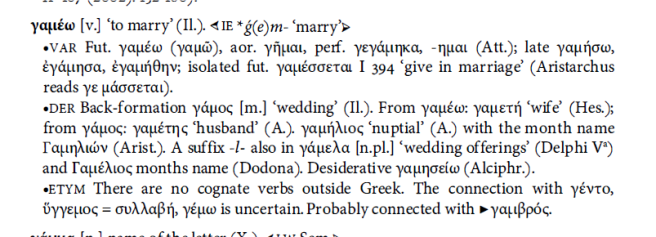
Here’s part of the LSJ Entry:

gameo lsj

Here’s Beekes on the root:

gameo beekes

Wild Etymology of the Night

Giovanni Boccaccio, The Genealogy of the Pagan Gods, 1.9:

“The fact that Night is clothed in a painted coat clearly indicates that she is the very decoration of the sky, by which the sky is covered. Night (nox) however, as Papias says, is so called ‘because she harms (noceat) the eyes’; for she takes away their power of sight, since we see nothing at night. Night is harmful, further, in that she is well-suited to evil-doers, since we say ‘one who does evil hates the light’ – from this it follows that the evil-doer loves the shadows because they are more suited to the evil work. Even Juvenal says, ‘Thieves rise at night to cut the throats of others.’ Furthermore, Homer calls her the subduer of the gods in the Iliad, by which we may understand that since great-spirited people turn over important matters in their hearts at night, nevertheless night (not being suited to such things at all) oppresses their overflowing spirits, and overpowers them, subdued, all the way until the light.”

Image result for boccaccio

Quod autem picta palla amicta sit, facile videri potest illam celi ornatum significare quo tegitur. Nox autem, ut ait Papias, ideo dicitur quia noceat oculis; aufert enim illis videndi officium, cum nil nocte cernamus. Nocet insuper quia male agentibus apta est, cum legamus: Qui male agit odit lucem; exquo sequitur ut tenebras amet tanquam malo operi aptiores. Et dicit etiam Iuvenalis: Ut iugulent homines surgunt de nocte latrones. Omerus preterea in Yliade eam domitricem deorum vocitat, ut sentiamus quoniam nocte magnanimes ingentia pectoribus versant, tamen nox minime talibus apta ebullientes opprimit spiritus, eosque tanquam domitos in lucem usque coercet.