Footnotes and Faded Youth

Perhaps I have spent too much time reading books, because on beautiful sun-lit afternoons I often find myself lapsing into fits of wayward sentimentality. The springs of melancholy gurgle forth, and my heart bathes for a while in those sorrowful waters. Usually, the object of this maudlin nostalgia is nothing grand. Today my thoughts bent toward Bradley’s Arnold Latin Prose Composition (edited by Sir James Mountford).

IMG_7876.JPG

To be sure, it is not a title to inspire enthusiasm, but it was thirteen years ago that I made my first forays into this odd little relic of a vanished age, and those youthful days are just as lost to me as the lives of Arnold, or Bradley, or Mountford. Each of those successive editors lives on in the inert product of their labors, and much of its idle curiosity remains lodged in my head. I regularly tell people (friends, family, students) that this is my favorite footnote:

For ‘Gaius and I,’ the Romans, putting ‘I’ first, said Ego et Gaius. When therefore Cardinal Wolsey said, ‘Ego et rex meus,’ he was a good grammarian but a bad courtier.

Please imagine the blank stares with which this is met by a group of teenagers. What is wrong with me? The very phrase “my favorite footnote” is absurd in its own right. But perhaps I am only the type of person who has a favorite footnote because of the psychological alteration subtly inflicted by this book.

As I flipped back through it this afternoon, I recall why it seemed like such an important book when I was young. Here was all of Latin systematized in a much more comprehensive way than even Wheelock had dared, and these guys were so goddamn sure of themselves at every turn. Indeed, one would be hard pressed to find a textbook today which matched this one for its reckless abandon in the use of phrases such as one must and we must.

IMG_7873.jpg

Many of the rules were internalized along the way, and I know not why my memory has so tenaciously held to isolated chunks of rules from a tedious volume like this while struggling to retain information of real value. I never forgot the advice that one should avoid rendering metaphorical English idioms like he ascended the throne literally into Latin as solium ascendit, because it literally meant that someone climbed atop the throne. Rather, the book advised direct and concrete expression like regnum cepit (he took power). This was a useful exercise in thinking about idiom.

Of course, the classicist propagandist line holds that studying Latin will refine one’s English by making it more direct and concrete, as Latin tends to be. Since I was, like most youths, a blockhead, I internalized that codswallop, but luckily I had enough sense in later years to recognize the smell of rancid horseshit festering in the stables of my mind. English in its most concrete forms is a drab and depressing affair, and though I enjoy a highly Latinate style (e.g. Milton), all attempts by grammarians to make English adhere to the rules of Latin now strike me as unabashed villainy.

In any event, my professor and I used to regularly joke that the real challenge of completing the exercises was determining what the English even meant. After that act of decipherment, the composition of Latin was comparatively easy. (One is reminded of Porson’s comment that it would be a salutary exercise for the student to attempt to turn a paragraph from Gibbon’s Decline and Fall into English.) Just consider some of this:

He was a man of long-tried honour and rare incorruptibility; yet at that time he was taxed with avarice, suspected of bribery, and prosecuted for extortion. You all know that he was unanimously acquitted of that charge. Who is there of you but remembers that day on which he not only cleared himself of an unjust accusation, but exposed the malice and falsehoods of his accusers?

I seem to recall that there was some rule about “he said” and “said he” being translated with dixit and inquit (or was it the other way around?), and I often thought that it would have been much easier if they had settled on a more natural introduction for indirect discourse. Yet that would have spoiled the ultimate delight of this book: that it could at times be so bewildering and hard to use that its countless rules were sublimated into a generalized anarchy, all tending toward the advice just read some Latin. Once, I defied the book directly, and rendered something about labor as barbarously as possible with the phrase lardum cubiti (“elbow grease”), which possessed the virtue of being so manifestly preposterous that my professor was compelled to love it.

IMG_7875.JPG
Why did I write that? It’s enough to conjure the emotion it describes.

As I went down this nostalgic path, I was vexed by the realization that, as a teacher, I talk in the way that this book was written. Examples are regularly followed by note that or observe how. My students begged me nearly five years ago to stop saying things like “You will note…” while demonstrating some point of grammar. I tried to wean myself off of it, but I suppose that I am just an unregenerate enthusiast for painfully high-handed and professorial modes of speech. Thanks Arnold, or Bradley, or Mountford – whoever it was.

One day, my students were complaining about the relatively simple Latin composition exercise I had assigned, and I lapsed into that last refuge of the bitter old man, the claim that “At least you’re not working through Bradley’s Arnold Latin Prose Composition by Sir James Mountford,” followed by what started as a threat that I would make them do it; somehow this threat shifted in tone to a hopeful promise. But I won’t make them, and they will never have the experience I had. Since I was the only one in that class, there is no one with whom I can reminisce about the singular experience of working through the book in those days, in those circumstances. Excepting what I have recounted here, the whole thing will remain an entirely individual memory until the day when I join Arnold, and Bradley, and Mountford, in that land where footnotes are forgotten.

IMG_7877.JPG
This was the gate code to get into the neighborhood where the seminar was held. Or so I thought! I dialed the wrong house for months and was let in without a problem for months before I was told that it was the wrong one. (Gated communities suck, by the way.)

Brillionaire’s Club

“Right next to this we find the sacred library [of Alexandria] on which is inscribed “The Healer of the Soul”; and next-door to it are the statues of the gods of Egypt….”

ἑξῆς δ’ ὑπάρχειν τὴν ἱερὰν βιβλιοθήκην, ἐφ’ ἧς ἐπιγεγράφθαι Ψυχῆς ἰατρεῖον, συνεχεῖς δὲ ταύτῃ τῶν κατ’ Αἴγυπτον θεῶν ἁπάντων εἰκόνας,

Diodorus Siculus 1.49

Early on in my first year at my current University, a graduate student was mulling over possible thesis topics and expressed an interest in one of my favorite distractions, fragmentary mythography. This student was specifically interested in the intersection between history and myth and the link between genealogy and epic formed most clearly in anecdotal evidence and early Greek records. This was a time for the fragments of the Greek Historians. (Sound the Jacoby Klaxon!)

Even though it was not that long ago (ok, closer to two decades than one) when I started, the informational landscape has utterly transformed since I entered my PhD program. When I was shopping for graduate school, I was told to ask about the library and to make sure they carried certain journals. It used to be that when I made a request for an Interlibrary Loan article or book, I would fill out a form (by hand) and then go to a dark window in the corner of the library weeks later to retrieve my request in an impersonal manila envelope, as if I were retrieving something forbidden, illicit.

(And, as I think of it, it was a whole lot easier to make many drug transactions than it was to get certain journals when I started graduate school.)

Today, ILL is slick, fast, and rarely demands that I leave the safe, enervating confines of my own office. Where twenty years ago a student would have had to sit down with a tightly printed, nearly inscrutable volume of Jacoby’s Fragments of the Greek Historians, two years ago my student and I emailed the librarian, found out the there was a digital version available through Brill, and made a request for the library to negotiate access.

It took an excruciating week. But when it came in? Well, it was glorious. Jacoby online presents all the fragments, translated, with notes! The online world of Classical Studies can turn a desk jockey anywhere into a world-class scholar by delivering bibliographies through the arcane but indispensable L’Annee Philologique and all the starting details you need with Brill’s New Pauly (now in English, fools. No German for you! And don’t give me that look, no less a leading light than Richard Porson allegedly quipped that “Life is too short to learn German.”)

Jacoby 2

this is just beautiful.

You can be transformed by this access, if you have the right library. But I knew from just a few months earlier, that this conditional makes a world of difference. Brandeis is not a wealthy University, but it is wealthy enough to drop a few grand extra so 3-5 people can benefit from a database 99.5% of the population has never heard of.

“There are those who accumulate books not from eagerness to use them, but from the desire to have them, and they possess them not as a bulwark to their minds, but as an ornament for their bedrooms.

Sunt enim qui libros, ut cetera, non utendi studio cumulent, sed habendi libidine, neque tam ut ingenii presidium, quam ut thalami ornamentum.

Petrarch, Epistles 3.18

Sometimes it is really easy to forget how much the information age has changed our access to the ancient world. The only scholarly text I saw before I picked up a copy of Cicero’s Pro Caelio at the Brandeis campus bookstore in 1998 was a dog-eared copy of Fordyce’s Catullus (that in-depth, but tragically incomplete commentary). I remember handling my first Loeb in the Classics section at the now defunct Borders (Books and Music); the first Latin text I actually owned was a bilingual edition of Catullus special-ordered from that same Borders by my high school girlfriend.

If you lived in certain regions, Greek and Latin texts were hard to find even if you could afford them. When I was in college and bar-tending in a seaside town in Maine, I noticed a patron reading Horace at the bar. I casually asked him where he was a professor, and he was like “Heavens, no, I am a stockbroker! The University is the death of the Arts.” (Really.) After a conversation filled with “o fons bandusiae” and the like, he asked me how often I frequented Schoenhof’s foreign language bookstore in Cambridge. When I said never, he had a heart attack. Ok, he only feigned a heart attack. But he did give me a 20 dollar tip and bid me to get there post haste.

For thousands of years, access to the texts bequeathed to us by antiquity was dictated by geography and class. You could be born into a family with a private library (rare) or endowed with the resources to send you to an institution which had one (less rare, but still, you know, 1% stuff) or you could happen to be near an institution that just happened to possess a Homer or a Vergil. (Assuming, of course, you’d get to look at it.) Or, of course, you could be lucky enough like Richard Bentley to get a tutoring gig for a family so well-endowed that the notes you made from their library helped launch and sustain your career.

Very few public libraries that aren’t also University libraries house Greek and Latin texts to this day. I read whatever was at the library when I was a kid. Every Stephen King book was there, so that’s what I read. When I wanted to read Frank Herbert, God Emperor of Dune was the book they stocked, so that’s the one I started with (and my favorite to this day). On the rare occasions we trekked to the largest library I had ever seen (the Portland Public Library), it was to browse and admire. It was, let’s say, simply too far to go to get a book just to return it.

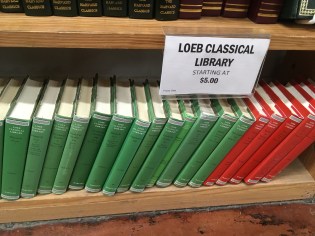
Part of the radical legacy of the late Renaissance, the rise of the printing Press, and the Enlightenment is the democritization of material once so carefully cloistered. The spirit of access is clear in the creation of the French Budé editions of Greek and Latin texts and the Loeb Classical Library in the United States. These bilingual editions were (and remain) far more affordable than most scholarly editions and more readily available.

Thanks to Perseus, The Latin Library, Lacus Curtius, Theoi.com, the Suda Online, and Dickinson College Commentaries and the hundred other sites I am forgetting, even the casual student of antiquity has nearly instant access to more Greek and Roman texts and translations from a cell phone than Poggio, Petrarch, or Erasmus saw in their entire lifetimes. And forward-thinking institution like the Center for Hellenic studies publish their scholarly texts for free online when they are released.

(Full disclosure: I have a book coming out with CHS this year with Elton Barker. We selected CHS as a venue for the book in part because of their open access policy.)

Social media can break down boundaries between the Oxford Don and the Brazilian high school student in ways I think would have shocked William Gibson in 1985. But there are other stories behind this obvious social gain: the quality of the texts are curbed (we still have trouble sharing critical texts with functioning critical apparatus), the quality of some sources is unclear, and these sites often lack the funds and expertise to ensure they are accessible for the visually impaired. And, the newest and latest material is almost always pay-walled: the neoliberal publishing market has found ways to cloister some of our most useful contributions.

“For I seriously need both the Greek books—which I have an idea about—and the Latin ones”

nam et Graecis iis libris quos suspicor et Latinis quos scio illum reliquisse mihi vehementer opus est. Cicero, Letters to Atticus 1.20

Spending time in libraries ain’t what it used to be. Don’t get me wrong, free public libraries remain one of the most essential democratic institutions in our country and we should celebrate them and their librarians. But modern libraries reflect their use and function like any other place, with real estate. More and more space is given over to computers through de-accession and that terrible three word phrase, off site storage.

Again, don’t get me wrong. This is not to be a luddite’s rant against the computer or a bibliomaniacal fetish piece. The reason I lament the absence of books is that the computer terminals are only as good as what they have access to. In a way, computers are like books: you can’t judge the contents of either by the cover. And when the contents work, it can be transformative. I have never been a Classicist without the Thesaurus Linguae Graecae. For some years, I used a purchased CD-ROM of the TLG-E; for a few, we negotiated through our library at UTSA a single computer subscription. (For others, well, let’s just say some people know how to put the ILL back in illicit. This is an essential tool for modern philology and everyone should have access to it, for free.)

If we were to re-imagine the current world of Classical Studies as one particular site, it would be a platform with different identity levels controlling access. If you have high speed internet access, you can get free public domain Latin and Greek texts with translations, the Suda Online, and random uncurated website, articles, all mediated by google and requiring time intensive labor to sift through. There are some e-books and pdfs, but many of them are teases and there’s always a threat of piggybacking malware. If you have entry-level professional organization or second tier public school access, you might get the Loeb Classical Library, and more articles through JSTOR.

But if you are at the top of the access food chain, if you’re a Brillionaire, you have L’Annee Philologique, Brill’s New Pauly, Brill’s Jacoby, the Oxford Classical Dictionary, the Encyclopedia of Ancient Greek Latin and Linguistics, and more. So much more that you don’t know about it all and you just don’t care. This is what one might call eff you level access.

At my last institution, the University of Texas at San Antonio, I could get most articles I needed, but had access to very few databases. To use L’Annee Philologique, I had to go to UT Austin and ask for computer access. But they gave it to me because of my status (Professor) and my geography (TXShare, with some hurdles, allowed for people from public libraries to use the University library).

So, while we have democritized a lot of the past in some ways, we have created new boundaries in others. Who you are, where you live, and what you do still dictates the level of access you receive to the embarrassment of research riches at our fingertips. If you have no affiliation, you get the surface level, search engine mediated access. If you are lucky enough to be at a top tier institution, you have everything, but likely don’t know about it and, until you lose that status, won’t know that your work may be dependent on one bundling plan or some administrator’s choice. If you live too far or don’t have whatever relationship it is you need to get some special status, you are left on the outside looking in

And let’s not prevaricate here. Open access is about equity and inclusion. As long as we live in a world where historical and structural racism, gender bias, ableism, and classism influence where a person is born and the lives they lead, then any system which limits access to information based on geography or class will be at its foundation racist, sexist, ableist, and classist.

“I am not ignorant in the meantime (notwithstanding this which I have said) how barbarously and basely, for the most part, our ruder gentry esteem of libraries and books, how they neglect and contemn so great a treasure, so inestimable a benefitRobert Burton, The Anatomy of Melancholy 2.2.4

“Money is the cause of many of mortals’ evils

πολλῶν τὰ χρήματ᾿ αἴτι ᾿ ἀνθρώποις κακῶν #Euripides

The information access problem is tied in part to the labyrinthine economy of the neo-liberal university system. At its base is a heinous labor scam most of us in the academy are complicit in and which most of us are too busy to notice, too tired to fight, or too weak to resist. Almost all of the databases I mentioned above were produced through free (or nearly free) labor by scholars working to get or keep their jobs. (And this overlooks the unmentioned and often unpaid labor of students, administrators and family members along the way.).

I myself have written entries for at least one of the publications mentioned above: I received a 30% off promise for 2000 words. My university does not have access to an article I have never seen in its native form. And this is all a greater part of what is the bait-and-switch of academic publishing. What a perversion that we labor for years to produce books we cannot actually afford and which almost none of our friends or colleagues could afford to purchase!

(Another part of the story that needs to be told is how this economic system makes it possible for predatory publishers to take advantaged of those already marginalized by charging them fees to get work published…)

As the university has engaged in increasingly high-stakes brinksmanship, raising its perceived rankings value by pumping up the publication stats of its professors, non-profit and for-profit presses have joined the game by furnishing both a venue and a market for these intellectual markets. Young academics are trained not to write ‘trade’ books (that is, books that make money); instead, to secure the too often elusive promise of a job we write books for which we receive no compensation and for which we are often expected to pay for our own indexing (and in some cases, copy editing).

Articles are little different: peer review requires free labor from editors, referees, and the authors themselves. Some editors do get paid (more on this soon), but rarely is there more than an annual drink or meal for an editorial board and referees can at times receive a few hundred dollars for reading a book and a digital wink-and-a-smile for reading an article. The authors themselves, after scores, if not hundreds of hours of work, are compensated with 5% less existential angst and the chance that 1 of the 5 people who read their article might cite them. And the exclusivity can keep some people out of disciplines altogether: think of some of the nearly criminal tales dogging papyrology lately or how few people actually can get decent training in paleography. Where you are and where you started still guides most of our academic journey.

The scandal behind the publication heist is that most of this labor is subsidized by Universities themselves. Full-time faculty are expected to do research and service (and all the work I mentioned above falls into this category.) But many schools also provide funds to student and graduate student workers to assist in the publication cycle; others task administrative assistants or actual journal employees to the job. Untold millions of dollars are provided by public and private universities to support the publication of academic research. Then this subsidized research is repackaged and sold back to their over-extended libraries in an over-priced bundle. This is a cartel-level scam.

(This is why employees of universities in some countries (e.g. the UK) are required to publish open access material. Such a requirement might work for public institutions in the US and is already operable for work funding by certain federal initiatives, but it would be difficult to enforce universally.)

Problems with the cost of journal subscriptions are not new—giants like Elsevier gobble up journals, ‘bundle’ them together, and extort institutions. But this parasitic crisis is not going to end. We don’t face this problem with journals and database subscriptions alone—as textbook publishers go full on digital to keep their revenues rolling in, students and authors are getting screwed.

Give up the books and pay attention to only your own affairs”

ἄφες δὲ τὰ βιβλία καὶ μόνα ἐργάζου τὰ σαυτοῦ. Lucian, On the Ignorant Book-Collector 27

I know that there is another side to the story. I got to hear first-hand from the acquisitions editor for Brill Classics why their subscription costs so much. There are multiple people working full time to support the online databases for the New Pauly and the Jacoby. Editing, formatting, and tech support takes time and costs money. I would not want to take any stance that they should not be paid fair, livable wages. The costs of articles in other disciplines are even higher: in the sciences where editors need to worry about positive result bias, misused data, an undisclosed conflicts of interest, publishing can be labor intensive.

(To be clear, I am using Brill as a metonym here: there are far worse offenders.)

And I think that it is hard for us to think about the full economic cost of online resources. Databases need servers. Servers need bandwidth, energy, and, and maintenance. The more use they get, the more they cost. And, something we probably all live in daily denial about, this use has environmental and social costs: google searches have carbon footprints. Computers don’t run on love and hope; they run on electricity and much of this is still driven by coal.

Other economic pressures shape this system too. Some publications are supported by professional organizations. Companies like JSTOR buy rights to these publications from the organizations—these deals look really good to the editorial boards. Imagine this: you and your friends write something for free every year and you don’t have the expertise or the infrastructure to digitize it. You also depend on subscription fees and individual library purchases to break even in the printing of the work. Suddenly, a friendly digital giant comes along and offers you, I don’t know, $20,000 dollars a year for the rights to digitize and distribute your journal. You take this and use it to pay the editor, lower membership fees, fund journal production costs, and even create scholarships for students. This is a win-win-win!

Except, the FDG turns around, bundles the journal, and extorts Universities and libraries all over the world. Your organization’s 20K can easily turn into 200K for them while many of your friends and colleagues without institutional access can’t get to your work. (And some estimates put the gross receipts of one article in the sciences to be $5000.00 for the publisher.) This hypothetical is not uncommon. But I am not trying to impugn any single person or organization by telling the story. Like many trends, this is the aggregate result of individuals and small groups making rational decisions in isolation. Objection to the systematic exploitation of academic labor should not lead us to condemn or dismiss colleagues who are also being exploited by this system.

University presses do similar things with books and subscriptions. And, again, we can’t blame them because they are also part of an economic system that is suffering from public divestment and new informational paradigms. Things will probably get worse: education is facing an eighth year of lower enrollments, even more severe public funding cuts—many politically manufactured crises like that at the University of Alaska, or cynical attacks on functional schools like that at the University of Tulsa—and the late capitalist land-grab of corporate takeovers: Starbucks and Amazon are talking college partnerships and credentialing now, but how long until they just open their own schools or acquire financially troubled institutions in WSJ approved experiments in innovation and public-private synergy?!

If knowledge is a public good and publication makes knowledge available, is it too much of a twisted syllogism to insist that publication be treated as a public good?

Nosse bonos libros non minima pars est bonae eruditionis.

“To know good books is not the least part of sound erudition”

motto over Bishop Cosin’s library at Durham, Henry L. Thompson, Henry George Liddell: A Memoir

When I was finishing my PhD I lucked into one of those tutoring jobs that form the stuff of legends. A high school student wanted to learn Greek from scratch. The student’s home had its own elevator to the penthouse where it overlooked central park. For two years I happily went there once or twice a week and worked through all of Hanson and Quinn, Plato’s Ion and much of Herodotus Book 1. During the second year, the student’s mother asked me if I had seen the old books she had been giving her husband for birthdays and holidays. They were late Renaissance era texts of Homer, Pindar, and more. I trembled as I asked if I needed gloves to handle them—of course, not, why would I? These were just gifts to be presented and seen on the shelves.

If schools continue to lose funding and presses pursue what meager profit is left—or worse, cease supporting the tools and databases we have already created—we run the risk of returning to the plutocratic exclusivity of the finest resources for the rarest few. Don’t consider just the students at less well endowed and funded schools who cannot test-drive the Brill-iant cadillacs like the New Pauly. What about unaffiliated scholars or students and readers from outside countries with ‘world-class’ universities? Our scholarly production is already an exclusive country club with gilded chains on the windows and doors.

Internet publishing
Ultimately, we need a public funding system to support research and publishing that makes it available for everyone. Since this is highly unlikely in our current political reality, what can we do? Some of us break the rules individually, you know, engage in a little ‘innovation’ and ‘creative disruption’. We can handout articles as if they are candy; we can give people advice on how to find those pirated TLGs. I know that academia.edu is another profiteering algorithm machine, but it and sites like it allow us to share our work with anyone with an email address.

Those of us who have secure positions can choose which venues we send our work in; we can support open access publication for our junior colleagues. We can ask our schools to host our work; we can choose to publish only in open access journals and venues, but this also means that when we judge people for employment and tenure, we need to re-evaluate the value of journal prestige.

Perhaps there is more we can do institutionally. Why can’t universities share their access more widely? At the very least they can use their informational footprint to sponsor our work and help shift the perspective on access. In our professional organizations we can make open access a clearly articulated mandate and we can raise money to support databases and journals that are subscription fee (and I am happy to hear that the TLG has a plan to do so. It is too bad it has not happened faster).

Again, there are projects that need to be done—like the digitization of the Lexicon Iconcographicum Mythologicae Classicae—which we should make sure are done for everyone and we should not only seek to support the scholars who do this work financially, but we should support their work ethically by counting open access and publicly facing work as equal to if not greater than traditional journal articles when it comes to hiring, tenure, and promotion.It is and will be personally and professionally difficult to disentangle this elegant cage we have helped make for ourselves. But the first step is acknowledging that it is there, that we have contributed to it, and that some of us have benefited from keeping many others in the dark. When you’re in it, the Club is a fine and rare place to be. But with the disappearance of full-time jobs, the increase casualization of labor in the Academy, and the fetishization of the gig-economy, more of us will be on the outside looking in.

“I confess indeed that I am obsessed with studying literature. Let this fact shame others who do not know how to make use of their books so that they can’t provide anything from their reading to common profit or to make their benefit clear in sight.

Ego vero fateor me his studiis esse deditum: ceteros pudeat, si qui se ita litteris abdiderunt, ut nihil possint ex his neque ad communem adferre fructum neque in aspectum lucemque proferre: Cicero, Pro Archa 13

Engagement/Responses/Improvements

Here’s a survey about open access issues in Classics and the UK from 2008.

We can create our own publishing paradigms

https://twitter.com/DimitriNakassis/status/1164549890929770496?s=19

Public libraries may be able to provide structure and scaffolding for more equitable access

https://twitter.com/SethLSanders/status/1164557122773741569?s=20

Counting Matters: The National Latin Exam and the Politics of Record Keeping

Dani Bostick teaches high school Latin and an occasional micro-section of ancient Greek in a Virginia public school. She has published several collections of Latin mottoes online and has a strong presence as an activist for survivors of sexual violence on Twitter.

2019 has been the year of the Equity and Diversity Statement in Classics. The American Classical League released two statements this year. The March statement affirmed, “We embrace ‘all people who have an interest in the ancient world from all levels of instruction, stages of life, and backgrounds.’ Then, in May, after criticism of problematic promotional materials, the American Classical League released a statement condemning racist and white supremacist ideas and listing proposed actions to make “Classics for Everyone” a reality.

In April, also in response to criticism that exam questions sanitize slavery and sexual violence, the National Latin Exam Committee also released a statement promising to create “exams with inclusive, affirming questions and passages,” and added, “We are grateful for those who have raised concerns about diversity, inclusion, and equity and welcome future dialogue regarding ways the NLE can support these values.”

Statements must be the starting point for meaningful action, not just reactive public relations moments in response to public criticism. The first meaningful action should be answering a simple question: Who takes Latin? Without this information, it is impossible to implement and measure the effectiveness of solutions for making our field more inclusive and diverse. 

Unfortunately, the only information we have on the demographics of our field at the secondary level is the College Board data on Advanced Placement program participation. In 2018, only 6,409 students took the AP Latin exam; in 2019, only 6,117. We know from this data that only 3.5% of students who take the AP Latin exam are black. We also know that this percentage has not changed since 1999. While these data confirms what many of us know to be true about under-representation in Latin, they only tell us who is taking AP Latin. We do not have information about who is taking Latin outside of AP Latin programs. 

There is a better source for data. In 2018, 143,952 students of all levels registered for the National Latin Exam. If NLE collected information about race and ethnicity, we would have a much clearer picture of the current state of Latin. The NLE already collects information about the types of schools participating in their exam. Including a separate question for teachers about racial/ethnic enrollment at the school could also provide information about under-representation in the field. Instead, despite statements about diversity, the ACL-sponsored NLE is not including any questions related to race and ethnicity on their 2020 exam. 

As professional organizations and Classics programs at post-secondary institutions look towards the Future of Classics, the NLE would provide a valuable service to the field by collecting and publicizing this information. In response to my most recent request, I was told that the NLE Committee is concerned that answering a question about demographics would cause students of color to do poorly on the exam. This phenomenon is called a stereotype threat, and I agree that this is a problem in Classics. According to research by Claude Steele and Joshua Aronson, stereotype threat is a condition of “being at risk of confirming, as a self-characteristic, a negative stereotype about one’s social group.”  

As a practical solution to this concern, the question could be moved to a pre-registration day or to the end of the exam. Moving the exam question to the end, or refusing to ask the question altogether, does not eliminate stereotype threat in the context of the exam or the field as a whole. Which scenario would trigger more anxiety about prejudice and stereotypes: Answering a question about one’s identity or surveying the testing room as the only person of color in a nearly all-white space? Steele and Aronson affirm that the stress of being the “sole representative of a social category” can inhibit memory during academic tasks. 

There are many ways to mitigate and even eliminate stereotype threat that do not involve a ban on questions related to race and ethnicity on exams. For example, according to 2014 research from Toni Schmader and William Hall, increasing diversity can reduce stereotype threat. They wrote, “The impact of broader representation in educational and organizational environments is that group-based stereotypes begin to break down.” Ideally, a Latin student should be able to indicate a minority race or ethnicity on an NLE demographic question and feel pride instead of anxiety. Data will not make this scenario a reality, but it will make it possible to set goals with measurable outcomes. 

The NLE’s refusal to collect data in the name of marginalized students does not protect these students; rather, it perpetuates systemic injustice by hiding under-representation in the field. Who benefits from not collecting data? Gary Orfield of the Civil Rights Project of UCLA explained in a book chapter on the importance of data, “Those in power may fear the consequences of data and probably are not prepared to take action to alleviate group problems because data and tools for the assessment of progress are essential parts of serious reform strategies… Denial of problems and refusal to collect or publish data on sensitive issues are typical responses of those wanting to preserve the status quo.” Not collecting data is a deliberate, political decision to maintain the status quo. 

As long as the composition of the field is a secret, field-level conversations about diversity and will be theoretical at best and opportunistic at worst. With data, genuine commitment to equity and diversity can become measurable results.

Calls to Action: 

  1. The NLE should collect demographic data on the 2020 exam, and publicize that data in its 2020 report. If the answer sheet has been set, these data can be collected on a supplemental sheet for paper test-takers and can be added to the computer-based exam for other test-takers.
  2. As a sponsor of the NLE, the ACL should encourage the NLE to collect and release this data as a service to the field.
  3. The ACL should also continue their own efforts to “gather information about the demographics of Latin and Greek students nationwide,” as they wrote in their May 2019 statement.
  4. Professional associations that seek to foster classical studies throughout the country and through the collegiate level (e.g. SCS, CAMWS) should encourage and support the efforts of the NLE and use their data to help support diversity, equity, and inclusion in education, outreach, and publication.
  5. Teachers should collect data on their own programs and take steps to make their classrooms more inclusive if they do not mirror the demographics of their schools. 


Image result for us census 1820
US Census 1820, from census.gov

The Ninth Gate: Movie Hell

There are no good movies about books and bibliomaniacs. Occasionally, some lover of the written word will be featured as a character in a film, but the delight in books as aesthetic objects or repositories of wisdom or even simply as a source of pleasure is relegated to the triviality of being merely incidental to the plot. (In Beauty and the Beast, Belle could have easily been an enthusiast for anything other than books; indeed, their stories really serve only as a counterpoint to the boredom of her quiet and provincial life.) Of course, the truly bookish movie would likely be a total failure. Undoubtedly the topic lacks sufficiently broad commercial appeal to make it palatable for studio executives, and those who already have a pronounced proclivity for books would just as soon read a book about books rather than watch a film.

It was with this understanding that Joel convinced me to watch one of the most execrable films in our apparently infinite treasury of media products, The Ninth Gate. Though he live-Tweeted my reactions to the movie, I nevertheless thought it worthwhile to set down some more articulate and continuous thoughts on the movie and its relation to reading culture more generally.

The plot is straightforward enough, and even for one paying as little attention as I did, it is entirely predictable after a few minutes. Totally lacking in energy or commitment to the project, Johnny Depp plays the rare book collector (detective and evaluator?) Dean Corso. He is hired by the ultra-wealthy Satan enthusiast Boris Balkan to determine the authenticity of his copy of The Nine Gates of the Kingdom of Shadows, a manual written in the 17th century by Aristide Torchia or, as rumor has it, the devil himself. Though there are three copies remaining in the world, it is rumored that only one is authentic – that is, only one of them has the power to summon the devil himself.

Each of these books possesses nine engravings supposedly crafted by Aristide Torchia, but Corso learns in comparing them that three of the engravings in each copy are not only different from the corresponding engravings in the other copies, but are in fact the work of Lucifer. As you might expect, the owners of these copies are mysteriously murdered as Corso pursues his line of inquiry, and Corso himself is nearly killed a few times, saved only by a combination of stout plot armor and the intervention of a mysterious (and obviously supernatural) green eyed woman. No surprise, Balkan had the owners of the other copies murdered, and attempted after collecting the nine true engravings to summon the devil and pledge his loyalty to the dark lord, only to accidentally burn himself to death. Corso then locates the last authentic engraving and goes to carry out the ritual himself.

As a film, it’s a total flop. If Balkan were going to resort to murder anyway, why not just murder the owners of the texts in the first place? The pacing is horrible, and the fights are worse than what a few kids could stage with a cell phone camera and a YouTube account.

Corso’s growing obsession with the authentic book is the main thread of the thinly-worn plot, and it is in effect simply a re-tooling of the Faust tale. He is an expert book collector, and in the opening minutes of the movie we see that he is able to score extremely rare editions of coveted works with little effort. While Faust summoned the devil out of boredom with the earthly disciplines he had mastered and in order to pursue more knowledge, Corso becomes obsessed with the rarest book in the world, and the attainment of the goal leads him to the devil.

What this suggests about bibliomaniacs and book culture is clear enough. In an age where science has created weapons which could annihilate all of human civilization within minutes, the dread specter of occult knowledge still has a tenacious grip on the collective mind. There’s something about all of those old tomes bound in leather, with mysteriously horrific engravings and (most mysterious of all) their impenetrable arcana locked in the secret vault of a dead language.

I suspect that the cultural associations of Latin have much to do with its frequent recurrence in movies like this. Indeed, we may only think that the devil speaks Latin because he did such a damn good job of it in Marlowe’s Tragedy of Dr. Faustus. Perhaps it makes sense that, in an age when learned doctors were apparently eager to summon the devil, and when all learned doctors knew Latin, that the devil might find it expedient for his business prospects to trudge through a grammar or two. Nevertheless, the idea that Latin is uniquely suited to spells and incantations is in fact entirely arbitrary, a sheer historical accident. One would expect that the devil exists in a kind of supralinguistic state, but even then, there is no reason for him or his demonic posse to speak and respond to Latin beyond the fact that Latin was widely employed by the Catholic Church. I strongly suspect that in places which were under not just the spiritual but also the linguistic influence of the Greek Orthodox Church there is no strongly pronounced association between demonic communication and the Latin language. The sole merit of the movie is that the production team had the decency to use grammatically functional Latin, and not the strange medley of Latin-like words which one sees most frequently either on screen or inked to someone’s skin.

Yet, as I think over the movie, it occurs to me that it really isn’t about bibliomania. Corso hardly seems like an enthusiastic intellectual, and did not appear to do much reading beyond the strict requirements of his job. Moreover, Hollywood apparently conceives of rare books as things which are regularly manhandled by any interested party. Throughout the movie, Corso carries the book with him everywhere (even through the rain), and it is rarely handled without a lit cigarette and/or drink in hand. Even reasonably rare but uninteresting books put together by second-rate hacks are guarded more carefully than this in archival rooms, but the book possibly written by the devil himself can be carted around like the latest James Patterson you picked up at the airport. (Then again, they may be rough equivalents.)

And so, you have here a movie that isn’t really about books or book lovers, and certainly has no appeal for anyone who is into cinema. I only made it through because Joel put me to it and seemed to be amused by my criticisms, and his cat kept me more or less distracted for the last horrific hour. Maybe one day Hollywood will give us a movie about bibliomania, but for now we just have to settle for the devil. I’d rather read anyway.

2019-08-10_16-39-01

Spoken Latin and the Politics of Bland Triviality

An opinion piece written by Ian Mosley appeared today in the Christian Humanist outlet Mere Orthodoxy. While not as wildly offensive as a number of other essays written in a similar mode, it nevertheless represents a kind of apparently gentle conservatism that bills itself as essentially reasonable because it is somehow wholly dispassionate and above the fray of politics. In particular, I was struck by this paragraph describing the experience of a spoken Latin conventiculum:

At these events, politics is usually a non-issue. Ardent left-wing activists happily read and discuss Augustine and Erasmus in the original Latin alongside trad-Catholic reactionaries. The medium of an ancient language is somewhat helpful here, because the hot-button buzzwords and slogans people most readily divide over are difficult to translate. It’s much easier to discuss things like family and favorite foods.

Putting aside the question of how the political views of the participants in these conventicula are so readily identified in an environment purportedly free of “hot-button” or political topics, the scene envisioned here is one of the vacuous insipidity characteristic of a morning talk show. While I didn’t learn Latin to talk about contemporary politics, I also didn’t learn Latin to talk about my favorite foods – a topic much better suited, in my own case, to the swear-enhanced superlatives of gritty colloquial English.

Mr. Mosley has also betrayed his own empty cynicism by writing that it is “buzzwords and slogans [over which] people most readily divide.” That is to say, the mode of expression itself, and not the horrific reality underlying it, is what divides people. The New York Times may consider hiring Mosley when David Brooks or Brett Stephens get tired of wiping their asses on broadsheet and handing it to the editor, because he has already mastered the art of the dispassionate and reasonable oracular pronouncement delivered by a man who clearly feels that nothing is at stake for him socially or politically. Politics is never a “non-issue.” In the most trivial sense, the groups of scholars and Latin teachers which make up many of these conventicula are subjected to constant threat of reduced funding or even elimination of classical language instruction at both secondary and post-secondary institutions for political reasons. My own Latin program received a severe blow this year thanks to a potent cocktail of budget restriction and the easy expendability of anachronistic irrelevance. But I will wait patiently for Victor Davis Hanson, or Brett Stephens, or even Ian Mosley to suggest that the decline was somehow related to identity politics or critical theory.

It is worth considering the subtext Mosley’s thesis here, though, because it is often repeated in conservative appeals for a more manly and muscular approach to the classics. Hanson and Heath are perhaps the chief exemplars of this, but I have even heard such apparently apolitical figures as Reginald Foster claim that a part of Latin’s attraction lies in its resistance to bullshitting and jargon. This is patently untrue. Medieval and scholastic Latin is replete with unintelligible jargon, mostly developed for expressing abstract philosophical ideas, and poorly suited to the rather clunky and concrete mode of Latin expression. One can already anticipate the counter-argument that Medieval Latin represents a degradation from Ciceronian purity – you don’t find jargon in classical Latin. There may be less of it, to be sure, but there is also far less abstract jargon in Chaucer’s English than in that of today.

It is also worth considering that the tradition of Latin theology (which I would assume is important to someone who cites Augustine with such unseasonable frequency) is not only dependent upon the development and importation of highfalutin philosophical jargon into Latin, but also helped to speed it on to the labyrinthine incomprehensibility of Scholasticism. Some of the more traditional fuddy-duddies have claimed that the reason why it is impossible to translate contemporary English “buzzwords and slogans” into Latin is because they don’t mean anything. But the problem is that they mean too much for Latin to handle. Much of the conceptual content behind the slogans and buzzwords here decried stems from centuries of history and philosophical thought which occurred subsequent to the point at which Latin ceased to be a living language. Modern Romance languages possess their jargon, slogans, and buzzwords for contemporary political and social issues because those languages evolved in tandem with the societies which employ them. Our politicians and social commentators can’t quite keep themselves from fucking up every day even while using the entire apparatus of their native language; I shudder to think of what they would be reduced to if all they had to work with was the thought available to Cicero.

Anyone who has walked through a Renaissance villa knows that the political reception and use of ancient literature is not some peculiarly modern phenomenon. The classics were not read simply for the extraction of ornamental mythic tales or decorous Latin tags. People read Livy, Sallust, and Tacitus for the intrigue and political conflict, and made use of that reading not just to understand the politics of their own time, but also to frame and develop their contemporary political narrative. Cosimo de Medici might return from exile and put an end to the pretense of Florentine liberty, but he could bill himself as a modern Camillus. Anyone who wanted to kill a political leader could paper over the ugliness of political assassination by commissioning a bust of Brutus or a painting of Harmodius and Aristogeiton. Yet I don’t recall that I saw much by way of classical reception focused on anyone’s favorite dinner.

People take the trouble to read Augustine and Erasmus in Latin because they were active figures who tried to influence their world by engaging that world in their writing. People still love to read Tacitus because he talked honestly (i.e. cynically) about the political history of his people; indeed, the main criticism leveled against him is that he simply wrote against tyrants when it was safe, and did little to oppose them in practice. But Apicius’ cookbook isn’t flying off the shelves (or really even in print) because no one learns dead languages just to idly toy around with artificial parlor talk.

http://www.italiamedievale.org/portale/wp-content/uploads/banchetto-con-pavone-vestito.jpg

The Books In My Dreams

Tracing my finger along the shelf of my library, I stopped upon a recently purchased volume which grabbed my attention – an old Teubner edition of Arrian’s Anabasis of Alexander, which I had found at the bookstore for the inconceivably low price of three dollars. I drew it from the shelf, and in doing so revealed the face of a demon, whose glowing eyes transfixed me and branded my soul with a dread terror I will never forget. Its gaze possessed something more than the power of an ordinary dream, for I awoke with the sleep paralysis which used to afflict me so often in former days. Anyone who has experienced sleep paralysis knows the horror of waking from the visions of a nightmare to a terror even worse – the inability to move. Worse still, my eyes when I woke up were fixed on that terrible spot – the shelf from which I had drawn Arrian in my dream.

My thoughts as I lay there entirely deprived of the faculty of motion tended exactly where you might expect: to the conclusion that the book was haunted. Indeed, I convinced myself that the entire collection of books which I had purchased along with the Arrian must be haunted. Here, I should note that all of these books were acquired at rock-bottom prices at a Half Price Books store in Austin which had clearly received boxfuls of a classics professor’s old stash. Apparently unsure of their real market value, a regular trove of Teubners, OCT’s, and even assorted editions with commentaries from the 19th and early 20th century were effectively being given away at three to five dollars each. Naturally enough, I assumed that this vast treasury was only sitting there because this old classicist (the absence of bookplates or inscriptions left their identity unknown) had died, given that surely no living person who had accumulated such a store would willingly part with it in life. Now that I had my hands on so many of the books, I was the object of the dead classicist’s malicious envy, and would somehow be dragged to the grave myself by the influence of infernal operations which the living cannot understand. I resolved that night to get rid of the books.

Rational and sober reflection belong very much to the sunlit, prosaic boredom of the daytime. After so rashly resolving to abandon the books the night before, I decided to hazard my body (and for all that, who knows? – perhaps my soul) in holding on to the books for one more night. No further apparitions ever haunted that ethereal library of dreams, and so the fresh accession of scholarly treasures was to remain. But so, too, was the horror which that night had aroused in the depths of my soul.

IMG_7697.JPG
The haunted Teubner

There is no dearth of paeans to the book – the book as object, the book as experience, the book as a bulwark against barbarism and the decay of civilization. Books as books are alternatively objects of pure pleasure and escapism or the instruments of the most serious and scientific engagement with the world. Books lie at the heart of the world’s three major monotheistic religions; books feature in some paradoxical way as one of the chief activities for pleasure at the beach; and books are converted into instruments of torture to sap the love of learning out of children in school. Readers love books, and writers love books, and so it is perhaps not accidental that writers often write books about books. I confess that I will read any of these that come in my way. Generally, they wax lyrical in the most overblown and effusive strains about the book and the act of reading as somehow the most gratifying and essential part of human experience. It is all bullshit of course, but it is bullshit which has been so thoroughly filtered, so refined, so polished and carefully curated in the hands of other literary obsessives that I cannot help but hang on to every word of it.

Yet for all that I read there about childhood experiences with books, the thrill of libraries, or how wonderful it was to read to Borges, I don’t recall many authors discussing the centrality of books in their dreams. When I was a child, I would dream about toys which I hoped to get, and still vividly remember wishing for a voice-modifying tape recorder marketed as one of Macaulay Culkin’s tools from the Home Alone movies. As an adolescent, I would of course dream all the time about romance and sex. The ideal dreamscape consists of the attainment of desires which are simultaneously the deepest-rooted and the most unattainable. And so, it is odd enough that as an adult, I dream – I mean, really dream – about books.

My recurring bibliofantasy runs something like this: I walk into a bookstore (it varies between smaller local shops and large chains like Barnes and Noble) and stumble upon a section of thousands of Greek and Latin classics, usually Loebs, stacked from floor to ceiling. I begin to grab the books with a ravenous and not quite gentlemanly frenzy. Among the volumes are authors of whom I have never even heard. (Of course, even seasoned classicists are surely unfamiliar with a long list of minor authors, but here my mind is just inventing names which must appear vaguely Greek and legitimate enough to pass muster in the vague haze of a dream.) Invariably, at some point in the dream, it occurs to me that I am in a dream because it all seems too good to be true, and yet I suppress that doubt and plough on ahead in the warm embrace of my bibliomania. At some point I wake up, and of course, it hurts – it feels like a real loss.

But why should this appear to be such a fantasy? San Antonio is not a city famous for literacy, and so it is rare enough to find a decent book store well-stocked with works in English; even a touch of classicism here is a fantasy too far. Yet I could easily purchase any work I want online, or search through something like the TLG. What is lacking is the experience of the physical book combined with the utter serendipity of stumbling upon it in the store. Surely enough, people may find true love on matchmaking apps, but how many people could get invested in that as a narrative? All of the romance of life lies in chance and accident, and the ease of ordering up some rare volume from the other side of the world, while convenient, is surely lacking in the quality which will send a shiver down your spine and set the heart a-flutter.

Whenever I visit a new city, the most important tourist destination is the bookstore. Most recently, I was surprised to find that the bookstores of Venice far surpass those of Florence. Perhaps my expectations of finding a full multi-volume collection of all of Petrarch’s Latin works in every bookstore in Florence was wholly unreasonable, the product of those dreams.

My library now consists of thousands of books, and nothing could reasonably induce me to part with any of it. Books are the only things to which I am attached, and I would sooner go without a computer and internet access than part with the volumes I’ve collected over the past seventeen years or so. It was around that time when I began reading in earnest, seventeen years ago, that I first fell in love. Though she and I were friends for some years and came several times to the brink of a full-blown confession of our feelings, it was a romance which was never to be. To this day, I still have dreams about the fulfillment of the romance that never was, and which would now be utterly impossible. Yet, it is perhaps only in the ethereal world of dreams that one can experience a love whose month is ever May. In a curious inversion of Anselm’s argument, its perfection lies in its unreality. Sometimes I wake from the fantasy world in which thousands of lost classics loom over me, waiting to be read, and regret that it was all a dream – nothing but a dream. But as the song reminds us, so is life.

IMG_6129.JPG
A tiny fragment of my dreams.

A Reader’s Decline and Fall

Years ago, in the innocent haze of late youth, I lay in bed on a perfect, sun-lit spring afternoon, and drifted pleasantly to sleep as I read The Decline and Fall of the Roman Empire. You may be surprised that this is by way of a recommendation of the book, and not chiefly for its soporific qualities. Our memories are hardly continuous or sequenced narratives. Rather, they are dotted constellations of individual events, and this event stands forth as one of my most charming and pleasant recollections. As I fell asleep, setting aside that narrative of imperial corruption, I thought “this is life.”

Of all Dickens’ novels, my favorite apart from The Pickwick Papers (but is it even a novel?) is Our Mutual Friend. This aesthetic preference can no doubt be reduced to my fondness for the scenes in which Silas Wegg reads The Decline and Fall to Mr. Boffin:

Mr Boffin seemed a little unprepared for this conclusion, but assented, with the remark, ‘You know better what it ought to be than I do, Wegg,’ and again shook hands with him upon it.

‘Could you begin to night, Wegg?’ he then demanded.

‘Yes, sir,’ said Mr Wegg, careful to leave all the eagerness to him. ‘I see no difficulty if you wish it. You are provided with the needful implement—a book, sir?’

‘Bought him at a sale,’ said Mr Boffin. ‘Eight wollumes. Red and gold. Purple ribbon in every wollume, to keep the place where you leave off. Do you know him?’

‘The book’s name, sir?’ inquired Silas.

‘I thought you might have know’d him without it,’ said Mr Boffin slightly disappointed. ‘His name is Decline-And-Fall-Off-The-Rooshan-Empire.’ (Mr Boffin went over these stones slowly and with much caution.)

‘Ay indeed!’ said Mr Wegg, nodding his head with an air of friendly recognition.

‘You know him, Wegg?’

‘I haven’t been not to say right slap through him, very lately,’ Mr Wegg made answer, ‘having been otherways employed, Mr Boffin. But know him? Old familiar declining and falling off the Rooshan? Rather, sir! Ever since I was not so high as your stick. Ever since my eldest brother left our cottage to enlist into the army.’

Wegg and Boffin were familiar to me long before Gibbon was, and so I cannot help but wonder whether my general sense that this was an important book was set by casual reading as a teen.

My first experience of the book was an abridged Penguin Classics version which I held in my hands in the scene above. I saw a full (closely packed) set of the work for sale and purchased it in 2011, and made a few attempts at reading it through, but rarely found the time or hardihood to do it. Four summers ago, I cracked it open and gave it a fair amount of attention, but it was something of a struggle in my then-distracted state to get through all of it, but I at least finished. Last year, I found a deluxe version, edited by J.B. Bury with supplemental notes, maps, and indices (in seven volumes!) for only $50. A few weeks ago, I set out to read it, and – yes, dear reader – I gave it the heroic forced-march treatment, reading through all ~3,400 pages of it over the past three weeks. I don’t know why I decided to read through the book again, but it exercises over me something like the fascination of the ancient mariner’s eye, and I always find myself mysteriously drawn back to it.

The Decline and Fall is not fashionable today, and perhaps for good reason. Anyone who has read the book with a knowing eye can tell you that it is problematic in various ways. The treatment of various periods and figures is wildly uneven. Julian’s rise to power and brief tenure on the throne occupies a good chunk of a volume, while most of the Byzantine emperors after Heraclius are given the hyper epitome treatment in one chapter which does little more than provide the basic vice/virtue character sketch and the circumstances of their death. In some instances, the reasons for the imbalance are likely due to personal inclination (Gibbon’s fondness for Julian), but in others, it may simply reflect the availability of materials.

Gibbon’s style is also very much out of fashion. Clive James, though an omnivorous reader, nevertheless confessed that he could never read much of Gibbon because it was all style and too ‘rococo’. Indeed, it is interesting that Gibbon himself regularly inveighs against the rhetorical-sophistic prose of various ancient authors whom he himself suspects of being all style. But criticisms of Gibbon’s prose date back as far as Porson, who suggested that there was no better exercise for the young student than to turn a page of The Decline and Fall into English.

Yet, for all of that, I am an utterly unapologetic fan of Gibbon’s prose. Some of its quirks stem, I suspect, from the infusion of Gallic idiom dating to his years writing and thinking in French. His reckless abandon in the use of commas is pretty characteristic of 18th century English prose, and once can profitably compare Gibbon’s deployment of that workhorse of punctuation to Jane Austen’s. Perhaps the most admirable synthesis achieved by Gibbon is the admirable mixture of two classical modes: the sonorous periods of Cicero, and the pointed antitheses of Tacitus. Gibbon is not nearly as diffuse as Cicero, but his periods always manage to be perfectly balanced, and he cannot resist the temptation of a well-regulated tricolon. He hasn’t the clipped and telegraphic brevity of Tacitus, but he managed to imbibe that author’s utter cynicism, and he regularly employs that hallmark of Tacitean style, imputing in an entirely non-committal way the darkest designs and most sinister motives to almost every action.

For all of the care and attention which he has given his subject, he cannot but approach it with a sense of contempt and disgust. As he himself writes, “History is indeed little more than the register of the crimes, follies and misfortunes of mankind.” Yet he also indulges in a dangerous inclination to see a more distant past as a kind of idyllic utopia of good character and good government. Famously, he assigns the happiest period of the entire history of the world to the period under the adoptive and Antonine emperors. Throughout the history, later Italians and Greeks are conceived as semi-barbaric and wholly unworthy successors to their “manly” and “virtuous” ancestors.

The standard trope seems to be: perfection on a grand scale was achieved in the past through virtue, but it insensibly (Gibbonian style!) gave way to vice, and the declining state of the world reflected that; there is an inevitability to the collapse, but the decline can be slowed by virtuous (or effective) individuals. This explains why, for example, the western empire fell much sooner than the eastern: the west was overrun by barbarians, but the east was propped up by the heroics of Justinian and Belisarius, whose exploits helped the system to coast for a while longer. When scrutinized, this view is simplistic, but it does at any rate make for a fun and engaging narrative.

Gibbon’s original intent in writing The Decline and Fall was much more narrowly circumscribed by the limits of the city Rome itself, but it quickly expanded outward to include more or less everything with some bearing on any of the lands once controlled by the Romans. But Gibbon is only as good as his guides. For example, his narrative of the period between Commodus and Constantine is pretty faithful to the Historia Augusta, going so far as to incorporate the moral censures included in that work. (Of course, Gibbon did not know that it was an elaborate forgery.) Yet, once he reaches the end of the reign of Justinian, Gibbon goes off the rails a bit. His panoptic survey takes in a lot of eastern history, but for all of this, he relies on an admixture of Byzantine authors and later treatments by European scholars (since he did not know Arabic, Farsi, etc. himself). The separation from primary sources for the latter half of the work, combined with Gibbon’s manifest contempt for the Byzantine intellectual in general, result in a narrative that can be tedious, confusing, and in many instances requiring substantial correction. Added to this is the casual racism and contemptuous xenophobia of the 18th century Englishman. One can readily see why almost no one reads the work in full, and why abridgements generally summarize most of what happened following the reign of Justinian.

Yet, for all of the problems which the work manifests, it is nevertheless an incredible monument to heroic reading. In his Memoirs, Gibbon downplays the time which he spent reading and working in earnest in any given day, but surely this is just the awkward affectation of an English gentleman’s sprezzatura. A survey of Gibbon’s footnotes is enough to assure us that he was always reading. Everywhere we hear that one can read more about such and such a topic in x number of thick folio volumes or dense octavos. A.E. Housman once remarked that being a scholar involved countless hours reading what was not really worth reading, and this seems to have been the case with Gibbon. As noted before, he has more or less just synthesized what he read in various ancient and secondary sources. (Though it’s true that this is more or less what writing history is.)

We should not be surprised if we find the book riddled with faults, given that it spans a tremendous temporal and geographical expanse and was one of the first real attempts at a scholarly but engaging narrative history in English. That is, it may fall short by today’s standards of scholarship, but as a work of popular history, it still holds up pretty well. Gibbon was allowed the leisure to read and write so much because he was, though not rich, at least a gentleman of sufficient means, but one must bear in mind that he was also in modern parlance a college dropout. Having left Oxford during his brief conversion to Catholicism, he never returned to take his degree. Yet he certainly read more widely than many of the formally-trained scholars of his time and ours.

In sum, I know that Gibbon is problematic, and likely to become more and more unfashionable with time, but I find something entirely irresistible in his work. Perhaps the most shocking confession I could make to my friends and peers is that Gibbon’s collected works would be my “desert island book.” (Does that make it my favorite? I don’t even know.) Unlike most fanboys, I am not willfully ignorant of its faults, and I can definitely see why people hate The Decline and Fall of the Roman Empire. But goddammit, I love it.

IMG_6111
The only way to read a book like this.

The Future of the Past

In the final book of Liu Cixin’s Remembrance of Earth’s Past trilogy, Death’s End, when faced with an unstoppable extinction-level event, Cheng Xin and Ai AA go to the distant edge of the solar system to try to preserve some artifacts of human existence from the encroachment of two-dimensional space. When they reach the isolated moon bunker where many of the objects are stored, they come upon miles of inscriptions in the surface rock. Previous plans to preserve human knowledge had included etching human history and knowledge into the stone. Teams of scientists and data specialists could devise no method which ensured as long a future as the multilingual inscriptions in space.

Any system of encoding and preserving knowledge—whether we are talking of raw, binary data or language—relies upon two challenges for legibility in the future. The first is a ‘key’—some type of instruction that might indicate to readers unfamiliar with language or code how to make meaning out of signs. The second challenge is medium—how do the materials which encode the information respond to the passage of time and elements.

Encrypted digital data in every form faces the danger of significant loss under even the best of conditions; changing software and computational paradigms can make accessing extant data even more difficult. The decryption of preserved digital data relies on the end-user being able to access functional hardware and manipulate the same original data protocol. Despite the ability to extend human life centuries through hibernation and the technology to create space ships which traveled at the speed of light, the humans of Cixin’s universe can find no better way to preserve the past than cold, alien stone.

The survival of the past into the future is something of a motif in science fiction, thanks to its longue durée perspective. Just in the past year, I have read of the ‘classicist’ in Adrian Tchaikovksy’s Children of Time series, a figure whose knowledge of the past and ability to use ancient programs makes him central to the survival of the human race. In many cases, such as the works of Isaac Asimov, the Earth we know and the past we cherish is entirely forgotten or mostly unsalvageable. But for every novel that imagines the preservation of knowledge over time—like Neal Stephenson’s Anathem—we have the more stark reality to deal with of strange re-uses of our reconstructed past as in Ada Palmer’s Terra Incognota series or generations of lost knowledge over time, as in Walter Miller Jr.’s classic, A Canticle for Leibowitz.

“The prophecy which was given to the Thessalians was ordering them to consider “the hearing of a deaf man; the sight of the blind.”

ὁ μὲν γὰρ Θετταλοῖς περὶ Ἄρνης δοθεὶς χρησμὸς ἐκέλευε φράζειν: “κωφοῦ τ᾿ ἀκοὴν τυφλοῖό τε δέρξιν”  Plutarch, Obsolesence Of Oracles (Moralia 432)

A widely linked recent article alleges that the human race has around 30 years left, that by 2050 climate change will create a systems collapse that will end human civilization as we currently know it. Similar reports diverge at whether the extinction event that is the Anthropocene will also eradicate the human species or just result in a cruel, apocalyptic contraction. Even if we find the political will to radically change our behavior over the next few years, we are looking at the almost certain probability of widespread government collapses, severe famine and death in the ‘global south’, and widespread conflicts over resources.

For the sake of argument (and acceding to science), let’s say that we should be preparing for one of the worst-case scenarios. While it would be great if all of us consumed less, recycled more, and gave up internal combustion engines, the fact is that late-stage capitalism is an out of control freight train which no single government or group of governments appears to have the will or the resources to slow down. The vast majority of all world carbon pollution is perpetrated not by billions of human beings making bad decisions each day, but by the profit-driven interests of a hundred corporations. We are not going to stop this with anything short of massive collective and revolutionary action.

“What is worst from bygone days provides the best safeguard for the future.”

ὃ γάρ ἐστι χείριστον αὐτῶν ἐκ τοῦ παρεληλυθότος χρόνου, τοῦτο πρὸς τὰ μέλλοντα βέλτιστον ὑπάρχει, Demosthenes, Philippic 1.2

In the meantime, maybe some of us should be looking past that destructive horizon to what comes next. I don’t do this cynically—there is a part of me that thinks the neo-fascist maniacs who are creating concentration camps and clamoring for border control now are rehearsing for the inevitable migrations caused by climate change and attempting to habituate an American populace to the murder and carnage needed to survive in that apocalyptic contraction scenario. By pursuing an insane set of policies, the very actors who deny climate change is happening are actively bringing it about. Yes, I do suspect there are those who would rather dehumanize and slaughter other human beings rather than make difficult decisions and sacrifice a standard of living now.

(And, truth be told, a disturbing number of Americans seem ok with this).

“if you find good luck in the time that is left
Perhaps it will be solace for the things in the past”

εἰ καὶ τὰ λοιπὰ τῆς τύχης εὐδαίμονος
τύχοιτε, πρὸς τὰ πρόσθεν ἀρκέσειεν ἄν.

Euripides, Helen 698-699

My question is: what are we of learned societies doing to plan for the collapse of the social and political infrastructure that has produced the deepest learning for the broadest number of people in the history of humankind? For those who study the ancient world and the way that earlier societies have dealt with change, we must ask ourselves what is the future of the past and what ability do we still have to shape it.

Asking this question, of course, leads to a series of ancillary concerns which in themselves are likely useful to debate. With only a little scrutiny, it is clear that this coming challenge is unlike anything we have faced before (with the exception, perhaps, of the Late Bronze Age Collapse as some have imagined it). To the contrary of popular imagination, antiquity never fell: instead, it went through a period of transformations, stalled cultural developments, geographical shifts, and technological change under the influence of new religions, mass migrations, social senescence and, perhaps, even climate change.

Indeed, to think about the “future of the past” we need to consider the “past” of the past and its present status. We have spent nearly 700 years ‘reconstructing’ a past that never actually existed. Take, for instance, the textual wealth contained within the Loeb Classical Library: no figure or library ever possessed all of this collective knowledge in one place prior to the 20th century. In fact, I would be hard pressed to imagine that there were more than a handful of individuals in the ancient world who had access to 20% of it.

As Classicists we often can be found lamenting everything we don’t have, the imagined texts we have lost and whose titles alone give some indication of their promise. But we do not often enough stop to consider how remarkable it is that we have as much as we do and how much we have intervened and produced since the Renaissance to create what we now consider Classical knowledge. Contemplating and then gaming out how to preserve the past we have now can help us better understand the processes that occurred over the past 1000 years and the extent to which they have created a tremendously biased if not mostly fictionalized view of the past.

“It is undoubtedly foolish to be unhappy today simply because you may be unhappy in the future.”

est sine dubio stultum, quia quandoque sis futurus miser, esse iam miserum, Seneca EM 3.3

There are, then, important differences between earlier epochal shifts and this. First, the “loss” of antiquity that occurred from the building of the first Museion at Alexandria, through its multiple burnings, civil wars in Rome, sacks of the city, the ‘decline and fall’ of the empire, and the sack of Byzantium by Christian crusaders, was a slow attrition and loss by neglect. If there were more texts and art works available in 200 CE than there were in 1200 CE, it is because (1) of what we are counting as mattering and (2) a generally higher standard of living and access to resources to a non-religious leisure class in the earlier period.

An unvarnished examination of the recovery of Classical knowledge must acknowledge that the Renaissance was not a recuperation of all of antiquity, but a selective curation of its remains. What we face with the next possible civilizational collapse is the loss of the knowledge that has been reconstructed and the tremendous body of work we have produced since then. Where a 15th Century humanist had but a handful of manuscripts of Homer to worry about, we have dozens plus the papyri fragments, plus the commentaries, original and edited scholia introductions, monographs, articles, and edited texts with critical apparatus we have created over centuries.

And that’s just Homer. I am not saying that I am turning full doomsday prepper on you, but I am saying that we should take the threat of civilizational collapse seriously and that it is not just within our remit as academic classicists to make some plans for how the material of the past might survive to benefit future generations and to provide a record of what came before our era, but it is our responsibility to be having these conversations now.

“I think that it is clear to everyone that it is not in our nature to predict the future”

Οἶμαι γὰρ ἅπασιν εἶναι φανερὸν ὅτι τὰ μέλλοντα προγιγνώσκειν οὐ τῆς ἡμετέρας φύσεώς ἐστιν, Isocrates, Against the Sophists 13.2

If we don’t, none of the scenarios look great. In many cases, 12th century CE Byzantine manuscripts and papyri (still buried) have a far better chance of surviving than the rapidly degrading and poorly printed books of the past 50 years. If we are to imagine that someone else might make these plans, we must consider who will do it instead. Should we leave it up to silicon valley disrupters? What works would they choose to preserve? Should individual universities be responsible? Will governments and libraries do the work? Should we hope that religious organizations will do this again? What choices would modern Christian sects make?

(Sidebar: when I was in elementary school we viewed the full series of Tomes & Talismans during library time each week. The central characters were librarians with a bookmobile; the threat were an alien species in a post-apocalyptic earth who were trying to wipe out accumulated human knowledge. They were called “The Wipers”.)

I think that it is probably best for professional organizations across linguistic and geographical territory to start to have this conversation. Most of our current output is currently stored in digital form across myriad platforms, with little concern for data degradation or recuperability. Not only are our blogs, tweets, open access articles, and personal correspondence at risk, but the very texts we have worked so hard to preserve, establish, and edit, are mostly in cheap, glue-bound paper versions. And this does not even begin to touch the challenges presented by material culture in a changing climate. Should we continue to excavate when climate change and geo-political stability threaten anything not under the earth? How does the possibility of future collapse change museum studies?

We need to talk about what will be preserved, how we will preserve it, who makes these decisions, and what aid we can store up for the historians of the future. We need to talk about the overlapping responsibility of universities, professional organizations, and governments to work together to preserve what we have won. And we need to make sure that voices from different backgrounds and experiences are central to this conversation

“Prudently the god covers the outcome of the future in dark night”

prudens futuri temporis exitum
caliginosa nocte premit deus, Horace Ars Poetica 25

Years ago, I used to teach a course called “Classical Myth and Literature”, which I think was originally designed as a bridge between straight up myth courses and more focused literature in translation offerings. I used it as a means to trouble the definitions of both myth and literature. One of the final essay questions asked students to imagine a flight from planet earth under the threat of alien invasion and to explain the choice of preserving either the corpus of 1990s pop songs or early Greek poetry (usually, specifically the Homeric Hymns). It was a fascinating assignment because students had to justify their answers using examples from the corpora. And, let me tell you, the pop songs were preserved nearly as frequently as the Hymns.

We are at a unique albeit horrifying moment in history. Perhaps the younger among us or the less thoroughly institutionalized will find ways to fight or forestall coming events. Those of us who are committed for better or worse to the study of the past even as the present crumbles around us need to start having hard conversations now before it is too late.

“For, it is right, Athenians, to use prior events as a guide about what will happen in the future.”

χρὴ γάρ, ὦ Ἀθηναῖοι, τεκμηρίοις χρῆσθαι τοῖς πρότερον γενομένοις περὶ τῶν μελλόντων ἔσεσθαι, Andocides, On the Peace with Sparta 2


Tomes and Talismans (1986)
Tomes & Talismans Still Shots from IMDB

“Our Culture”, Anatolian Edition

Editorial note: in response to an earlier post about the exclusionary character of the history of Classical Studies several people commented that the views were almost exclusively Anglo-American. This is the first of hopefully several posts addressing that narrow perspective. –JPC

Dimonisos, the Halkedonian island, took its name from Dimonisos, the first one who worked there; the place has mines of steel and malachite. The best from this mine commands prices comparable with gold; for it is a drug for the eyes. There is also copper to be dived for, two fathoms in the depth of the sea; from there is made the statue in the ancient temple of Apollo in Sicyon, and also those in Pheneus, called from yellow-copper. On them there’s an inscription: “Heracles, son of Amphitryon, dedicated these on capturing Elis.” He captured it under the guidance of a woman, whose father Augeas he had killed, in accordance with the oracle. Those who dig for copper become very able-sighted, and those who have no eyelashes grow them; therefore doctors also use the blossom of copper and Phrygian ash for the eyes.

Pseudo-Aristotle, de Mirabilibus Auscultationibus, 58 (Loeb)

Δημόνησος ἡ Καλχηδονίων νῆσος ἀπὸ Δημονήσου τοῦ πρώτου ἐργασαμένου τὴν ἐπωνυμίαν εἴληφεν· ἔχει δ’ὁ τόπος κυανοῦ τὸ μέταλλον καὶ χρυσοκόλλης. ταύτης δ’ἡ καλλίστη πρὸς χρυσίον εὑρίσκει τιμήν· καὶ γὰρ φάρμακον ὀφθαλμῶν ἐστίν. ἔστι δὲ αὐτόθι χαλκὸς κολυμβητὴς ἐν δυοῖν ὀργυιαῖς τῆς θαλάσσης· ὅθεν ὁ ἐν Σικυῶνί ἐστιν ἀνδριὰς ἐν τῷ ἀρχαίῳ νεῷ τοῦ Ἀπόλλωνος καὶ ἐν Φενεῷ οἱ ὀρείχαλκοι καλούμενοι. ἐπιγέγραπται δ’ αὐτοῖς “Ἡρακλῆς Ἀμφιτρύωνος Ἦλιν ἑλὼν ἀνέθηκεν.” αἱρεῖ δὲ τὴν Ἦλιν ἡγουμένης κατὰ χρησμὸν γυναικός, ἧς τὸν πατέρα Αὐγείαν ἀπέκτεινεν. οἱ δὲ τὸν χαλκὸν ὀρύττοντες ὀξυδερκέστατοι γίνονται, καὶ οἱ βλεφαρίδας μὴ ἔχοντες φύουσι· παρὸ καὶ οἱ ἰατροὶ τῷ ἄνθει τοῦ χαλκοῦ καὶ τῇ τέφρᾳ τῇ Φρυγίᾳ χρῶνται πρὸς τοὺς ὀφθαλμούς.

A recent post on the blog, discussed at length (once again) the efforts of decolonization in the field of Classics, a conversation that, though not as widespread as we would like, has occupied some of us for a while. There is an ongoing debate on the use of Western civilization and its relationship to Classics—why is an area study of a rather small part of the ancient world even called classical? Is it about class?—that has indeed traveled far this year, all the way to the darkest corners of the alt-web.

But one of the main caveats in this complex, longer-than-a single-life task, has been in my opinion, the heavy reliance on Anglo-Saxon sources and discourse; I pointed this out to Rebecca Futo Kennedy about her blog post on the history of Western civ, and more recently, to that post on this blog. There’s a wealth of sources in other European languages that we can turn to, in order to understand better the symbolic violence of the Western historical discourse. So, on this occasion I want to turn your attention to an “imperialist other”, a territory (and today a national state) outside of the Western world, but yet at its very borders and part of the geography of the ancient world, to further complicate the relationship between westernization, classical culture and imperialism.

In the Turkish Republic (1923-present), classical culture never played the same kind of pivotal role that it plays in European public life, but its emergence in the early days of the republic (and subsequent eclipse) provides an idea of the depth of interactions between modernization, westernization, archaeology, classical culture and nationalism that shaped the world between the world wars.

As the Turkish Republic emerged from a War of Independence in the course of which the Christian minorities of Anatolia (including its Greek speakers, dating back to the archaic period) were forcibly deported or murdered with the nodding approval of the Western powers wishing to draw a new map of the post-Ottoman Middle East (Muslims, on the other direction, were also murdered and deported in a series of population exchanges between Turkey and Greece), the Greek presence in Anatolia came to an abrupt end. At the same time, however, that the young republic was looking West and not to the “Middle East” (considered backward, ‘Arab’, Islamic) in order to disavow its Ottoman heritage. Modernization is in full force for Turkey to join the community of European nations, and many reforms in the field of education, language and heritage take place. Soon we will find out what Classics has to do with this.

In what follows I will share some anecdotes, documents and sources that are more or less scattered, as the research is still very preliminary, and since Classics and Turkish modern history (not exactly my field) are not necessarily contiguous, I am venturing here into unknown territory; but it will be enough to give an idea of a process that needs to be studied more closely (I wonder for example about the modern reception of Classics in Israel, or the Arab world). I apologize in advance for my incomplete ideas.

burgaz3.JPG
The Princes Islands, 2015

As a resident of the Princes Islands, Istanbul’s most remote neighborhood in the Marmara Sea, a group of nine islands known to be inhabited by Greek-speaking population since at least the 4th century BCE (attested in a pseudo-Aristotle), and still one of the very last pockets of a ghostly Greek presence in Anatolia, it has become almost a matter of necessity to dig out these submerged histories, to see if they can shed some light on the absurdities of the present. As the ‘Rums’—the Romans or Greeks of the Eastern Roman Empire—were being driven out (see the novel ‘Farewell, Anatolia!’ by Dido Sotiriou, a moving but by no means objective account of this period), Turks would travel far back in history, seeking for a new mythology once the owl of Minerva had flown away.

  1. Greek during the Ottoman Empire

It is traditionally argued that the end of the Byzantine Empire translated into a death sentence for Greek culture in the Near East, but this was hardly the case. As many historical studies show, though Greeks were a minority, they were ubiquitous throughout the new empire, and adapted rapidly to the sloppy, chaotic and often inefficient Ottoman rule.

We don’t know so much about the Greek educational institutions of the early Ottoman empire, but some schools are thought to have transitioned from one rule to another and survived, and the Phanar Greek School, for example, was founded in 1454. A number of Greek libraries were founded under Ottoman rule, but most remarkable was the library of the Holy Trinity monastery of Halki (our island, known in Turkish as Heybeliada) founded by Metrophanes III in the early 16th century with the donation of 300 books, to be found today in the library of the Ecumenical Patriarchate. A French research project is centered on the history of the library and a critical edition of the manuscripts of the library has been published in French just last month. The Greek scholarship of this long period is rich and vibrant, and most literature of importance written in Greek in this period was written outside of Greece: Istanbul, Venice, Alexandria, Smyrna.

IMG_5682.JPG
Holy Trinity of Halki, 2019

Knowledge of Ottoman would be handy here, but we know from the writer and translator Yasmine Seale’s piece on the reception and translation of Homer in Turkey that the first translation of the Iliad into Ottoman Turkish was done in 1886 by Naim Frashëri. A relatively recent text on the history of classical philology in Turkey (Turkish) puts us in the context of what took place in Istanbul University (founded in 1453) in the 19th century: With the reforms of 1869, arrived in the university courses in Greek, Latin, archaeology, numismatics and Roman law, and then followed by more offerings in Greek and Latin literature, mythology and archaeology in 1874.

This wasn’t haphazard: As the colonial powers began their journey into the collapsing empire through technology and education, German professors of classics arrived in Istanbul University at the same time that authorized European excavations in all the Ottoman lands would begin a frenzy of looting and exporting that not only would enable some of the most groundbreaking discoveries in Near Eastern studies, but would also solidify the modern Western museum, where vast holdings from the region still sit today. The redistribution as appropriation began with the past, and then expanded to the denizens of the present.

  1. The Turkish History Thesis and the Early Republic

The early history of the Turkish Republic presents a picture of confusion. Being a late comer in a world of (already fading) nation states, it was necessary to produce not only a myth that could unify them but also a grand(iose) narrative that would smooth out any gaps, and it is here that archaeology proves useful. As Turkish scholar Tugba Tanyeri-Erdemir argues, “archaeological knowledge was used to create citizens out of subjects of the fallen Ottoman Empire. […] Under the leadership of Mustafa Kemal Atatürk, the founder and first president of the Republic, the intelligentsia of this newly formed Turkish nation embarked on a quest to discover its ancient history.”

This discovery, known as the Turkish History Thesis and the basis of official historiographical ideology, would of course inevitably lead back to the Hittites: “According to the thesis, the Turks were believed to be the direct ancestors of the Hittites and the Sumerians, and were also thought to have influenced native peoples living in the Aegean Basin, this contributing significantly to the development of Greek civilization. This theory allowed the Turks to claim to be the legitimate heirs (and indeed, practically the progenitors) of all civilizations that had existed previously on the soil of the new Turkish Republic.” (Tanyeri-Erdemir)

It would be of course impossible to travel back into the 2nd millennium BCE without a fair amount of conspiracy. Pan-Turanism, appears in the 19th century as a theory, largely discredited, that all Turkic and Uralic peoples descend from a pre-historic common ancestor in Turkestan, who in the modified republican version, migrated to Anatolia in the 2nd millennium. The typology is interesting because of a detail highlighted by Tanyeri-Erdemir: Between the first and second Turkish historical congress (attended by Atatürk) there’s a shift in mood and audience, from nationalistic archaeology to professional archaeology. In the years between these meetings, there was also a language congress during which Turkish linguists presented the Sun-Language Theory, with the thesis that many languages descended from Turkish after a series of migrations from Central Asia, and their mythical proto-language was severely criticized by the international audience.

The relationship with the Turkish History Thesis is here crystal clear, and though the focus moved to archaeology’s modernization, the discourse had already penetrated the Turkish historiographical consciousness. The thesis of the Altaic languages, encompassing Turkic, Mongolian and Manchu-Tungus, has also been discredited since then.

Another Turkish scholar, Can Erimtan, has written an incredible account (and I strongly advise you to read all of it) of the propaganda tract “Pontus Meselesi” (1922), by Ağaoğlu Ahmet Bey, a Turkish politician and publicist of Azeri background, dealing with the (argument against) establishment of a Greek state in the Pontus region, combined with nationalist propaganda about the grand narrative of the Turkish presence in Anatolia, as follows: “[Anatolia] has been the Turk’s home country, the Turk’s homeland for thousands of years. […] As a matter of fact, the Turks did not arrive in Anatolia with Ertugrul Gazi or even with those who constituted the Seljuk governments. The Turkish race has been present in Anatolia since the oldest and most unknown of times. As has been illustrated by history the first inhabitants of Anatolia were Turanians.”

atat.jpg
Ataturk and the Sumerians, 2012

There’s so much one would like to say here. Archaeology is deeply embedded in the political geography of Turkey, but the readings are currently ambiguous. There’s still a large apparatus of scholarship on Near Eastern studies in the Turkish language, particularly in Hittite. Nazif Aydin published in 2017 a Hammurabi lexicon and a book by Assyriologist Muazzez İlmiye Çığ, “Ataturk and the Sumerians”, was published as late as 2012.

  1. Classical Philology in Turkey
sema
Textbook for learning Classical Greek in Turkish, first published in 2006

The nationalist narrative obviously couldn’t easily disassociate between Classical Greece, the Greece of Anatolia and the newly emptied out and newly mythical Anatolia. According to Bedia Dirimiş‘s text (Turkish) on the history of classical philology in Istanbul University, Classics is defined as such: “The main purpose of classical philology is Ancient Greek and Roman civilization, paleography, grammar and rhetoric. On the basis of reinterpreting ancient texts from a linguistic and literary point of view, there is a perfect reconstruction of these texts.”

Written only in 2009, this reveals the European bias of the discipline, not only as an apparatus of knowledge, but one strictly separated from the historical continuity of Anatolia. In her account, classical philology as a department appears in Turkey with the university reform of 1933, overseen by Atatürk himself (just like the history and linguistics conference, he’s always at the helm of historiographical ideology), after his first visit on January 15, 1930. Here the young republic’s leader reveals the extent to which the history of the region had been permeated by the question of Anatolia’s past.  Atatürk asked a question (recorded in the writings of Mehmet Uysal, 1981): Why is it important to study classical philology in Turkey?

After he wasn’t satisfied with the answer, he asked a different question: Who are the first people of the Aegean, the bearers of the Aegean civilization? Fazil Nazmi Bey (probably a teacher in the department) answered the question with a legend. Atatürk replied: “History is based on the findings of archaeology, paleography, and philology, not myths. I think history shows that the first Aegean people, the bearers of the Aegean civilization came from Anatolia to the Aegean islands.”

With this, the agenda for classical philology in Turkey was set, so that Dirimiş reports in her brief history that as late as 2005, in an academic conference, a professor confirmed this thesis by means of philological and paleographic evidence. And here comes the bomb: “Since the Tanzimat, we have adopted Western civilization as the basis of humanism, human beings at the center of the world, rather than merely imitating the discipline of classical philology.” It has been a long way from pre-historic Turan, to humanism. The humanism of the Enlightenment that whitewashed the ancient world, and provided ample legal justification for the plunder of the earth, so that all universal treasures are kept in one place, for all the universals to see, except when you’re not universal enough.

It is also hard to assess the larger meaning of civilization in a country such as Turkey, living in the no-longer-and-not-yet of globalization, and adopting a postcolonial identity while at the same time remaining an expansionist state, actively engaged in soft power and economic colonization. The depoliticization of the Greek tradition (and the Romans, almost accidentally) is only matched by the hyper-politicization of remote antiquity, from a time when Hittite hadn’t been more fully deciphered, therefore it was possible to make all kind of questionable speculations.

The classical philology, however, that Dirimiş posits as “an education that provides an awareness of the process of spiritual evolution through its history”, is however no longer a part of the grand narrative of the republic. In what follows in her history, there’s a long list of professors, from the first German appointees (including Jews who sought refuge in Turkey during the war and later returned to Europe; this is also discussed in Seale‘s account) through the later Turkification of the department as they received training from earlier teachers. Seale also speaks about Azra Erhat, an early republican translator of Homer, whose life seems fascinating and about whom I haven’t been able to dig anything but vague references. It is also interesting to notice that at least one academic employed by Ankara University was also an instructor of Latin at the Atatürk Lise (high school) during the early republic  but I have no evidence at the moment of when this began or ended, or whether it also took place in other public high schools.

  1. Decolonization of Classical Greek in Turkey

A question needs to be posed before it can be answered. Broadly speaking, Turkish academia is not thinking about decolonization of Classics. Still, there are some interesting examples of decolonization practices happening outside of the academia. The Theological School of Halki, an Orthodox seminary shut down by the Turkish state in 1970s (this has been long disputed and is a frequent topic of Turkish-Greek relations) but it still houses the library founded by Metrophanes III (although the original 300 manuscripts are elsewhere in Istanbul), that is open to researchers and contains thousands of volumes in philosophy, history and theology, mostly in Greek but also in other languages.

Despite the enforced closure, the building (located also in Heybeliada) hosts events and academic conferences regularly. The Greek-language publishing house Istos, founded in 2012 in Istanbul (as the local Greek newspaper was disappearing) and the first Greek-language publisher in Turkey in half a century, publishes books in Greek and Turkish, including history books dealing with the history of Greeks in Anatolia and books aimed for a younger audience introducing them to classical Greek literature in Turkish. Recently Istos published an English translation of Skarlatios Byzantios 19th century book, “Constantinople”, topographical, historical and archaeological description of the city.

hera22
From “The Land Across the Blind”, Galeri Mana, 2014

Greek-Armenian artist Hera Büyüktaşçıyan, herself an islander, has been engaged in decolonization throughout her practice. In her work, largely informed by Classical and Byzantine eras, she has used visual compelling storytelling, iconography, and deep memory-time and traces, to parse fragile moments in the history of the region and reveal the continuity between text and image, past and present, in different contexts that go beyond the boundaries of the city: an aqueduct in Naples, a cave in Athens, or bringing metaphorically the city of Bergama to an exhibition space Berlin, questioning the Pergamon museum, engaged in extended contemporary readings of Greek (and other languages) across eras.

In an exhibition from 2014, “The Land Across the Blind”, the artist creates a magical journey between the Princes Islands—traditionally places of exile— and the San Lazzaro degli Armeni in Venice (another island), traveling between centuries of displacements. The land across the blind is Byzantion, the city founded by Byzas of Megara, lying across from Khalkedon, the place that Persian general Megabazos is recorded to have said that they had to be blind to settle there: “Must we not be blind not to see this? This is the land across the blind. This place that we see every day is the point at which Byzas begins to see!” (Buyuktasciyan)

The Greek-Armenian artist is also responsible for the programming of the Galata Greek Primary School in the central district of Beyoglu, a building now empty as the student population disappeared already decades ago, now being used as cultural institution hosting exhibitions and cultural events; a last attempt to keep alive the faint memory of the long Greek presence in Istanbul. Most recently, Buyuktasciyan opened an exhibition at the IFA Gallerie in Berlin, “Neither on the Ground nor in the Sky”, making reference to the mosaic of an Alexandrine parakeet from Pergamon, held at the museum in Berlin. In the exhibition, the artist created a historical bridge between different historical periods, from the famous Library of Pergamon once at the Acropolis, to the final exile of the Anatolian Greeks. As a part of the public program of the exhibition I gave a lecture/performance in April in Berlin, during which I read poetry of Seferis in both Modern Greek and English, in reference to ruins and the life of stones.

IMG_4315.JPG
From “Neither on the Ground nor in the Sky”, IFA Gallery, 2019

Classical culture does have its representatives in Turkey, for example the very active department of Classics at Istanbul University regularly hosting events and talks, the Twitter account of a young classics lecturer, Cengiz Cevik, tweeting in Turkish about classical literature and ancient philosophy, or the Ancient Greek/Latin recitation competition held at Koc University. All of the above of course deeply embedded in the paradigm of white European humanism. The cultural programming of Türkiye Bankasi, includes a series devoted to translations of classical literature into Turkish, but with a very small pool of translators and a large yearly output, it still remains to be seen if the quality matches the expectations.

And the future isn’t quite looking bright. As the Turkish state turns more and more erratic and isolationist, recently the use of Greek or “Rum” as an insult has reappeared in public life in light of the convoluted Istanbul election, as the opposition candidate has been labelled a Pontus Greek in a propaganda effort to smear his name. A journey through the country’s provincial archaeological museums reveals the dismal picture of the current state of antiquities (where there’s any left, that is), and the neglect of Turkey’s Byzantine and Early Modern Greek heritage, crumbling in front of your eyes, like the Greek Orthodox Orphanage on the island of Büyükada, the largest wood structure in Europe and now at risk of collapse. The most apt metaphor I could find is that of a ruined ruin, based on a fragment of a poem by Seferis:

These stones that sink into the years, how far will they

drag me with them?

The sea, the sea, who can ever drain it dry?(*)

G. Seferis, Mythistorima, XX. (*) the poet translates into Modern Greek line 958 of Aeschylus’ Agamemnon, spoken to Clytemnestra as she lures her husband to death. (R. Beaton, 2016)

Αυτές οι πέτρες που βουλιάζουν μέσα χρόνια ως που

θα με παρασύρουν;

Τη θάλασσα τη θάλασσα, ποιος θα μπορέσει να την εξαν-

τλήσει;

IMG_6389.JPG
Greek Orthodox Orphanage, Büyükada, 2019

Arie Amaya-Akkermans is a writer and art critic based on the Princes Islands of Istanbul. He is interested in the Greek heritage of the Asia Minor and the relationship between (pseudo)archaeology and nationalism in the Eastern Mediterranean. He’s also tweeting about Classics, Byzantium, contemporary art and Turkey/Greece.


“Our Culture”: Classics By Exclusion

“Indeed, what is believed overpowers the truth”

τό τοι νομισθὲν τῆς ἀληθείας κρατεῖ. Sophocles, fr 86

A few days ago, a lovely senior colleague of mine reached out with this article from The Daily Kos, expressing shock at how racists are using the ancient world and wondering what kinds of conversations Classicists are having about it. The article does a good job of pointing to the illuminating work of Curtis Dozier with the Pharos project, the public advocacy of Sarah Bond, and the work of Donna Zuckerberg in her writing and her work with others at Eidolon.

I didn’t take the time to tell my friend who has been teaching at Brandeis over 40 years about Rebecca Futo Kennedy’s work on race and antiquity in the Ancient World and on the problem of “western civilization”, the ragtag band behind Classics and Social Justice, the trail-blazing kindness of the Sportula or the work of Dan-el Padilla Peralta.  I can keep listing the people who do good work and try to make sense of the world, but in our own field there is doubt and derision.


The people I just listed and the many others who work alongside them face conflict on multiple sides. There is the fight of the field against this racist appropriation; but there is also a fight for the field that I think we are still trying to make sense of. We are constrained both by the disciplines we trained in and the way the history of these disciplines is entwined with structural and institutional racism.

Oh, boy. Do we need another post on this topic? And—this is certainly a fair question—do we need another post on this topic from me? I don’t work specifically on race in the modern world or antiquity. I don’t have any specialized academic training apart from a handful of undergraduate courses and professional training over the years. The fact is, it is really easy for me not to write this.

But, like many of us, I do teach students who see the world differently than I do; and I do train students in disciplines that are steeped in historical problems. Furthermore, I am in the position of trying to lead people who do this with me. I also somehow have helped create a space where some things might be heard. For each of these reasons, I think it is irresponsible not to engage with these issues and not to examine how deeply they go.

I got thinking about this again over the weekend after receiving this in response to a post on the misogyny of the story of the Lemnian Women:

“Are you actually saying that describing certain odors as foul is misogynistic? and You are a tenured professor? hahahahhahahhaha!

btw, How is your quickly collapsing civilization at the hands of a swelling muslim horde going? At least when it’s all razed to smouldering embers and muslim men are raping, impregnating or beheading your wives and daughters you can have the satisfaction of saying you weren’t racist or a misogynist.”

Now, this is a typical troll-technique in an attempt to elicit an aggressive response: first, belittle and mock the credentials of the addressee; second, cut to the chase and try to inspire fear by painting a picture of the cultural apocalypse to come. I am pretty good at not taking the bait of the first move, because, hey, sometimes it is surprising that I am a professor and tenured—not only because I will never shake off the old imposter syndrome, but also because I have known plenty of smarter and better people who for some reason did not make it at every level. For the second, well, all I said was the truth: a good part of my family is Muslim. It is pretty hard to fear a murderous, rapacious horde, when you’ve shared their tables, prayed alongside them, and love them.

“He commits a second crime, who is not ashamed of his first”

geminat peccatum, quem delicti non pudet  Publilius Syrus, Sent. G11

We periodically encounter push-back like this when we re-post the Hellenistic poet Palladas’ claim that Homer hated women or when someone complains that we should not talk about politics. But the exchange, which I have left up, reminded me yet again of a comment that has been “pending” on the site for over two years in response to a post on Harmodius and Aristogeiton.

“Your introduction sounds like you are in favour of the ongoing white genocide – bizarre from someone who would appear to admire white culture and civlization. Or perhaps you are a Jewish Supremacist? Personally I’m with Apion, Posidonius, Apollonius Molon, Manetho, Cicero, Juvenal, Horace etc – letting Jews control the discourse is never a good thing.”

(I am going to sidestep the anti-Semitism here except to say that the comment is clearly made by someone deeply indoctrinated in hate. This is repulsive but unsurprising. Indeed, I have been the target of anti-Semitic comments online on several occasions. I suspect this is because of where I teach. I block Nazis as soon as they announce themselves.)

This was not the last time I was accused of being in favor of white genocide (I have also been called a race traitor). The thing is, well, complicated. First, we can say that white genocide is an insane piece of nonsense sourced locally in South Africa and embraced by certifiable nutballs in Europe, Australia and the United States, as charted out in Harper’s.

(Don’t be confused, though. This poison is one among a number of fine American exports.)

I want to mock the very notion because whiteness itself is a myth. But just like “white genocide”, whiteness is a fiction which has real effects on the world. Whiteness is an oppositional category, an oppressive concept that has expanded to embrace most of Christianized Europe only out of necessity. It exists to obscure boundaries between some groups only for the purpose of oppressing others. When embraced as an identity, it is so empty of content that it consists entirely either of mere platitudes or of weaponized hate.

“We call those studies ‘liberal’ which are worthy of a free person”

Liberalia igitur studia vocamus, quae sunt homine libero digna, Vergerio de ing. Mor. 23

So, if one were to insist to me that there is a white race—and not a bunch of people with various degrees of comparatively paler skin who come from a variety of different linguistic and religious groups but largely speak dialects of English in the US, UK, and Australia—I would probably be in favor of ending the concept because it exists as a weapon of exclusion. This, in such deranged logic, makes me a race traitor. (Among other things, of course: my family is multiracial).

Now, it may seem like there is only a twisted path from the destructive and demeaning construction of whiteness and our problems with Classics, but let me get back to the point. It has become de rigeur for ‘intellectuals’ with certain affinities who rave about the rise of ‘identity politics’ and post-modernism to lament the collapse of Classical Education and the loss of some kind of shared culture. This concept of a ‘shared culture’ is as chimerical as whiteness. But it is no less damaging.

Indeed, when I wrote a thread in response to Roger Kimball’s paint-by-numbers indictment of the modern academy, our account was unfollowed by someone who felt we were insufficiently championing “our” culture.

https://twitter.com/CarmenC30263217/status/1135148289416990721

My friend, this cultured response is not innocent; it may be ignorant, but it remains an expression of an ethnonationalism that is merely a reflex of white supremacy. (It is also absurd: no one invents a culture. (1) I cannot see how it is ever logical to claim any credit for actions performed by others before you were born. (2) And if you claim the credits, you also owe the debts.) When one person frets over threats to “our” culture, another chants “you will not replace us” with a burning tiki torch.

“For it is not easy to take a false belief from them, not even if someone should refute it completely”

οὐ γάρ ἐστι ῥᾴδιον τούτων ἀφελέσθαι τὴν δόξαν, οὐδ’ ἂν πάνυ τις ἐξελέγχῃ, Dio Chrysostom Orat. 11


There are many kinds of exclusionary approaches. Some are clearly racist (ethnonationalists so proudly wave their black, white and red banners). Others are intellectually decorous, but amount to the same. When Erik exposed the counterfeit claims of modern conservative intellectualism, one respondent chortled (if one can describe a tweet that way) and offered up the example of T.S. Eliot.

When my colleague emailed me, rather than brag about all the smart and insightful people I know who are leading the fight against this racist nonsense, I sputtered, and meandered, talking about how much more there is to do in recognizing that exclusion and, yes, racism, have been central to the disciplines we call Classics not just for a few generations, but for most of the history of the discipline.

Here’s the thing. This is not just about misappropriation. This is about the nature and history of the field itself. Yes, we need to stand against the use of antiquity for hateful and destructive ends; but we also need to work to examine how our discipline has been shaped by these forces. As the kids say, racism is a feature not a bug of Classics as a field. And this gets straight to a conversation I have been having with myself and others since I posted about my myth class earlier in the year: How do you decolonize something that is has developed hand-in-glove with essential exclusionary, colonialist, and racist discourse?

(I am avoiding here the claim that that the material treated by Classical studies is necessarily racist. Much of it is ideological driven and used for racist ends, but I do think we need to be careful to separate material from use.)

“Humanity thinks only about temporary seeds, / Its pledge is nothing more than the shadow of smoke”

τὸ γὰρ βρότειον σπέρμ’ ἐφήμερα φρονεῖ, / καὶ πιστὸν οὐδὲν μᾶλλον ἢ καπνοῦ σκιά Aeschylus, fr. 399

Already, I know heads are spinning, but let me just sketch out without supporting evidence the areas of inquiry available to explore how exclusionism has shaped our field and how and when this went from ideology to bigotry and violence. For ease, I will break it into stages:

Pre-Archaic Greece to Hellenistic Period: The material preserved by most forces communicates Aristocratic values with a strong structural misogyny. Ableism is assumed. Much of the early material is, indeed, plurivocal, but the process of selection by later, elitist editors, exacerbates the nature of our evidence. Post-Persian wars the dichotomy of Greek and Barbarian develops. Almost no representation of women and lower classes. Mass enslavement.

Hellenistic period: Less stuff about barbarians! But even more of a skew toward elite culture and the literary remains of a few traditions from Greece proper. Poetry and oral culture did not perish, but it was not preserved to the same extent our already canonized tragedy, lyric, and epic were. Voices of women, lower classes, and non-Greek groups were largely excluded from the record keeping at this time. Flirtation with trans-linguistic cosmopolitanism. Mass Enslavement.

Roman Period: Willful occlusion of pre-Roman and non-Roman cultural groups; adoption of a Hellenistic veneer; Primarily recorded voices are those of male aristocrats. Some use Latin; some use Greek. People can become Roman by speaking Latin and Greek. Growth of empire means even greater occlusion of local and diverse perspectives. Mass enslavement.

Early Christian Period: Burgeoning of anti-Semitism. Perpetuation of much of the Hellenistic canon. Erasure of pagan cultures. Breaking of the Empire into Greek and Roman sides. Roman side preserved Latin Culture; Greek Side preserved Greek culture. Continued ableism. Misogyny. Enslavement.

Medieval Period: Even before crusaders sacked Byzantium, the largely Roman Catholic histories and focus from Rome (and wherever the Papacy moved) discredited, dehumanized, and dislocated the contributions of “easterners” (this, despite the fact that most people who have studied the time period would likely prefer to live in Byzantium to Rome). Christian readings and tending of the canon altered our tradition even more; most intellectual training in Western Europe during this period was theological in focus. As Stephanie Frampton has taught me, the term Classici emerges in the Medieval period to mark off scholars of a certain Class or Rank. This is, in part, about aesthetic judgment; but it is also a continuation of the process of selection and exclusion that began in the Hellenistic Period. Our field’s title, Classical Studies, is therefore implicitly—if not explicitly—exclusionary.

This period also saw the steady narrowing of whose perspective and contribution on Classical Studies is valued: non-Christians (e.g. Muslims, Jews, and even those farther afield) have had their scholarly histories expunged. This continued into the modern era in Europe where Protestants in the North (and England) undervalued and marginalized Catholics.

Rebirth of Philology: From Luther’s theses to the translation of the King James Bible and the religious conflicts prior to the Enlightenment, the seeds of Philology were sewn. Biblical and Classical philology—which first influenced each other in Hellenistic libraries like the one at Alexandria—were odd step-siblings united by basic assumptions about the search for authority and truth and the perfectability of the word of God by man. Anti-Semitism, explicit and not, excluded many voices from these conversations; a majority of the scholars who worked on texts and traditions were upper class; almost all were men; almost all were ‘white’ in the modern, unreflective sense. Mass enslavement in the US and British Empire. Classical ideas and philosophy are used to defend and advocate for colonialism, slavery, and genocide.

German Philhellenism: The rise of European nationalism saw many different types of identities emerge, but one of the more consequential was the German one. Among the intellectual class, there is a deep and confounding correspondence between German national pride and scholarly Philhellenism. Most Classicists acknowledge that our very concept of our field today owes much to 18th Century German Altertumswissenschaft, but few of us as readily acknowledge that one of the central concepts—the uniqueness of the Greeks and their language—was the method by which that very uniqueness could be claimed as a heritage for Germans. The impact of this is clear in German philosophy and in Nazi-adjacent authors like Martin Heidegger.

“Indeed, ignorance is a kind of weakness, but the detestation of knowledge is the sign of a depraved will.”

nescire siquidem infirmitatis est, scientiam vero detestari, pravae voluntatis Hugo St. Victor, Didascalion, Preface 1

There is more to be said about the rise of Classicism in the US and UK following German norms, but I will leave that for others. It is fairly safe to say that the majority of the voices within Classics complaining about the opening up of the field hew to ‘regimens’ and ‘standards’ developed prior to WWII.

The way we train our students, the languages we think are important, the books we think we should read, and the arguments we think are worth making are all shaped in some way by the intellectual and disciplinary prejudices we have acquired over a thousand years. Now, we can take a certain pride in claiming a heritage that is so old, but here again, the credit must be accounted with the debt.

There will be many objections to this periodization, but that is part of the point, it is an invitation to a discussion. But we still live with many of the consequences in our scholarship. For instance, in N. G Wilson’s From Byzantium to Italy—which represents what most Classicists seem to think happened during the Renaissance—the author spends a precious few pages talking about the work of Byzantine scholars. (Although, as has been pointed out to me, Wilson dedicates considerable space to Byzantine scholars in another book. The separation, which was likely not his choice, represents the way most people in Classics think about the transmission of ancient culture.)

The story that is typically told about the Renaissance is usually of how Italian scholars “rediscovered Greece”. This is a patent falsehood. Byzantine scholars from before the 6th century advanced the work of the Hellenistic period to a point not rivalled until after the Enlightenment (even if then). But northern European scholars denigrate and marginalize their contributions to this day (much as in the English speaking world we pretty much ignore the scholarship of modern Greeks.) Such designed ‘oversight’ emerges in every history of Classical Scholarship (Pfeiffer and Sandys are the worst for this). By continuing to tell this story, we reinforce an erroneous notion that centers Rome and Northern Europe as the inheritors of some virtuous past.

“For one who is falling cannot lift others; one who is ignorant cannot teach”

οὔτε γὰρ πίπτοντός ἐστιν ὀρθοῦν οὔτε διδάσκειν ἀγνοοῦντος, Plutarch, Moralia 780a

But, really, the entire notion of the “Greek Genius” or the “Greek Miracle” is built on a willful racist denial of the influence of Ancient Near Eastern peoples on Greece (and others) and rooted in an ignorance of the deep cultural and trading networks that connected the Ancient Mediterranean. Diogenes Laertius can claim that Greek philosophy came from Egypt; we ignore him as a naïve mythologos, while we reserve our most forceful mobilization for the Western de-centering work of Black Athena. Few people have the expertise to move from Hittites and Hurrians to Gilgamesh and Egyptians. Even when we can get them together, we still have evidence largely of upper classes. There is new work being done on the Bronze Age all over the Mediterranean, but our disciplinary and institutional boundaries have trouble funding and housing the scholars who do it.

And where we draw disciplinary boundaries is only part of the problem. Our field is still demonstrably hostile to women and people of color. Our professorships and placements in top PhD programs still go predominantly to people of the highest classes. Our journals still publish mostly work from white men.

Now, please do not misunderstand me, historians and archaeologists over the past century have used a range of tools to recuperate the voices and experiences of non-elites in Ancient Greece and Rome, but the impact of the evidence they generate is constrained by the conventions and assumptions of the fields they try to change.

The voices of fear and protest that worry over the loss of “our culture” are mostly unaware of what a fantastic confabulation “our culture” is. Instead of worrying about what we risk, we should celebrate what is to be gained from the admission of different voices. In brief, our understanding of the past has been transformed over the past few generations by women’s voices and by those less mutilated by heteronormative culture. Historians from different classes and backgrounds have looked for evidence of past peoples whose lives were never even imagined. Scholars of varied abilities and perspectives on gender and sexuality have helped us understand that the stories we received about the Ancient World were wrong. But there is more work to be done: consider how much of digital classics material is actual accessible? How many of our conferences and conference panels are hostile to women, non-binary scholars, and those of different abilities? 

“So, I did not want to write what the unlearned could not understand or what the learned would not care to.”

itaque ea nolui scribere quae nec indocti intellegere possent nec docti legere curaren, Cicero Academica 1.4

A few years back another internet troll told me I was not a real Classicist because a real classicist™ wants to emulate the Ancient Greeks and Romans. Others have called me out for dedicated my life to something I clearly hate. This is, as with most internet trollery, unrefined horseshit. What an impoverished definition of love one must have to think that you can only appreciate something you think is perfect? I have spent the past 20 years of my life reading, learning, and teaching Homer and Ancient Greek out of love and enchantment, but not with blind eye to the cruelty and the pain these things can represent and still effect in the world.

To study the past—to study the humanities—is to engage in inquiry about what it means to be human. To love the human race does not mean we need to deny its imperfections—to me it means that we learn the contours of our weakness as much as our strength so we may help with one and support the other. If I am not a Classicist because I do not emulate the Classical world, perhaps I can be a humanist because I aemulate it in the strictest Latin sense—I strive with it, I struggle to understand it, and I wear myself out trying to improve it.

This is what we need to do in our field. We need to root out and understand what has shaped us and improve upon it for the generations to come.


A Few Updates:

  1. In response to Dr. Ben Cartlidge’s very reasonable response on twitter, I softened the language about N. G. Wilson’s work on Byzantine scholarship. I unfairly used him as a straw man and may have misrepresented his work.
  2. I received a great email from Dr. Lara Fabian who noted that much of what I have written is conditioned by Anglo-American chauvinism and isolationism and, as she rightly points out, is evidence of a type of privilege of  English-language scholarship. She has some fascinating and enlightening things to say about the development of Classical Scholarship in Russia and I think I have persuaded her to write some blog posts.

If anyone has responses or work that can help correct/adjust/improve this conversation, please do let me know.

More evidence of my cultural blindspots and fascinating avenues for investigation:

https://twitter.com/byzantinologue/status/1136576163755823105