“This is the daily routine Severus used when there was peace. He was always doing something before dawn and after that you used to take a walk while talking and listening about the matters of the empire. Then he would have a judicial court, except when there was some festival or another. And he used to do this best of all—for he provided ample time for those who were arguing the case and he provided those of us who were advising him lots of time too. He used to make judgments until midday and then he would ride his horse as much as he was able. Then he would take a bath after engaging in some kind of exercise. Following this, he would have no meager lunch either on his own or with his children.
After lunch, he usually napped for a bit. When he rose, he turned to the rest of his affairs and then used to spend time engaged in both Greek and Latin debates while walking again. Near dusk, he would bathe again and then dine with those who were attending him—for he did not frequently have a guest for dinner and he would only sponsor expensive banquets on days when it was necessary. He lived for sixty-five years, plus eight months and twenty-five days. Even at the end, he demonstrated his eagerness for activity: as he was dying he said: “come here, give me whatever there is to do.”
“A really ancient type of logic riddle is also related to the basic nature of riddling to begin with: “What do we all teach without knowing it?” or “What is nowhere and everywhere at once?” and in addition to these “What is in the sky, on the land, and in the sea at the same time?” And this example is about words that mean more than one thing because a bear [arktos], a serpent [ophis], an eagle [aietos] and a dog [kuôn] are each in the sky, on the earth and in the sea. The answer to the question prior to that is “time”, because it is everywhere and nowhere at once because it does not inhabit any single space. And the first question is about souls: none of us know our soul, but we always show it to those we meet.”
“Everything is prepared except for a secret and safe journey to the upper sea [Adriatic]. We are not able to travel by sea in this season. But in what way may I go where my spirit and the situation call? We must depart quickly so that I am not delayed or tied down by some matter.
Nor in fact does he [Pompey] who seems to pull me actually call me—a man I already knew before as the most unpolitical of all and now truly the least strategic general. It is not he then who draws me but the words of people which have been sent to me by Philotimus. For he says that I am being torn apart by the optimates.
Good gods, what kind of optimates? Those ones now who are running out and selling themselves to Caesar! The towns pretend he is a god and they were doing this when they were praying for sick Pompey. But whatever evil this Pisistratus has not done is as valuable to him as if he stopped someone from doing it. They hope to find a gracious power in him, but they think that Pompey is angry.”
Omnia mihi provisa sunt praeter occultum et tutum iter ad mare superum; hoc enim mari uti non possumus hoc tempore anni. illuc autem quo spectat animus et quo res vocat qua veniam? cedendum enim est celeriter, ne forte qua re impediar atque adliger. nec vero ille me ducit qui videtur; quem ego hominem ἀπολιτκώτατον omnium iam ante cognoram, nunc vero etiam ἀστρατηγητότατον. non me igitur is ducit sed sermo hominum qui ad me <a> Philotimo scribitur; is enim me ab optimatibus ait conscindi. quibus optimatibus, di boni? qui nunc quo modo occurrunt, quo modo etiam se venditant Caesari! municipia vero deum, nec simulant, ut cum de illo aegroto vota faciebant. sed plane quicquid mali hic Pisistratus non fec[er]it tam gratum est quam si alium facere prohibuerit. <hunc> propitium sperant, illum iratum putant.
From Heraclitus the Paradoxographer, 7 Concerning Pasiphae
“People claim that [Pasiphae] lusted after the Bull, not, as many believe, for an animal in a herd—for it would be ridiculous for a queen to desire such uncommon intercourse—instead she lusted for a certain local man whose name was Tauro [the bull]. She used as an accomplice for her desire Daidalos and she was impregnated. Then she gave birth to a son whom many used to call “Minos” but they would compare him to Tauro because of his similarity to him. So, he was nicknamed Mino-tauros from the combination.”
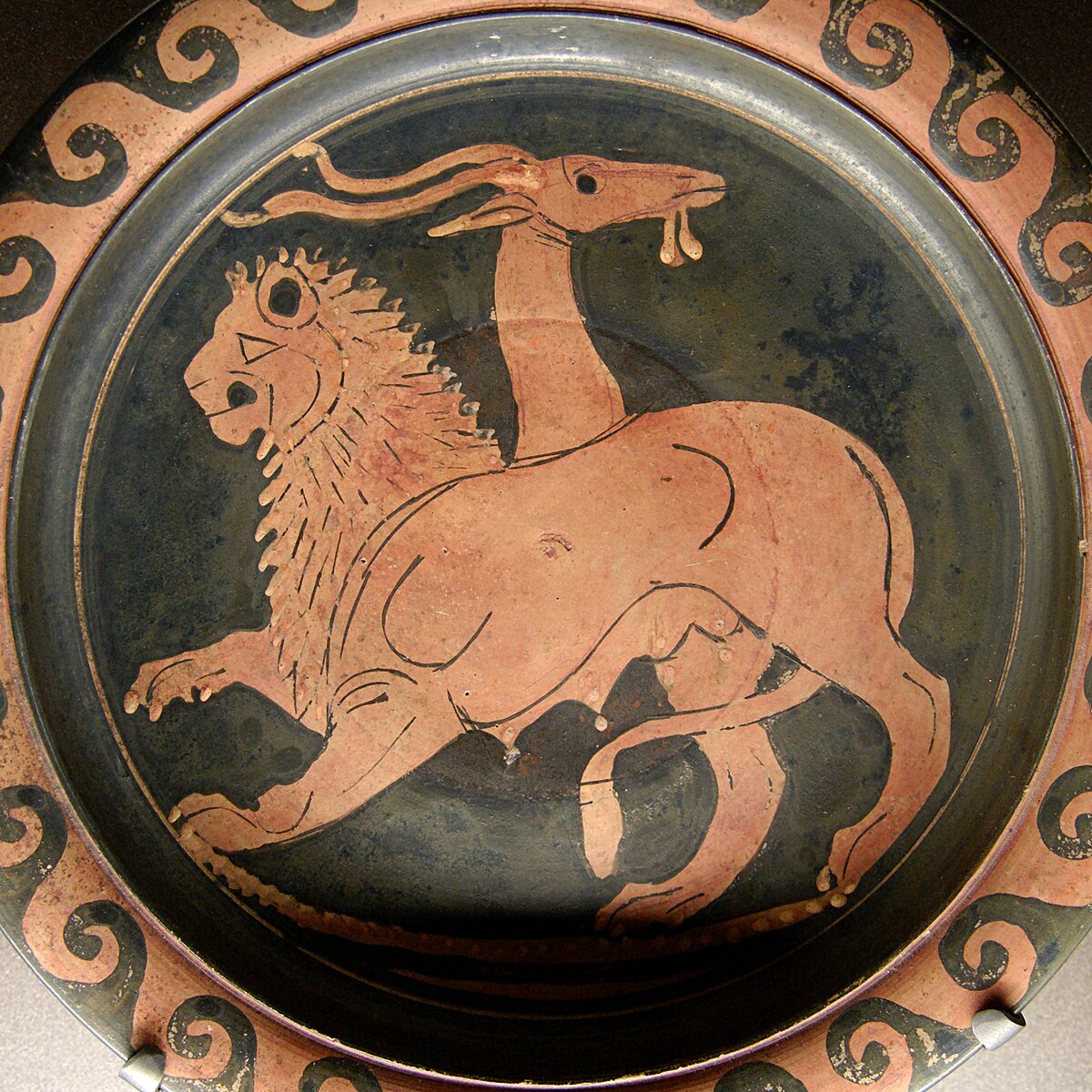
From Heraclitus the Paradoxographer 15 On the Chimaera
“Homer provides an image of the Khimaira when he says that in the front she was a lion, in the rear a serpent and in the middle a goat. This sort of thing could be the truth. A woman who ruled over those places had two brothers who helped her named Leo and Drako. Because she was an oath-breaker and guest-killer, she was killed by Bellerophon.”
From Heraclitus the Paradoxographer 16 Concerning Circe
“Myth has handed down the idea that Kirkê transformed people with a drink. But she was a prostitute and by charming guests at first with every kind of delight she would mold them towards good will, and once they were in a state of passion, she would keep them there by means of their desires as long as they were carried away with pleasures. Odysseus bested even her.”
Plutarch De Garrulitate (On Talkitiveness), 505f-506e
“No word uttered has helped as much as many held in silence. For it is possible to say later what has been kept silent, but certainly not to render silent what has been said—that has been poured out and has wandered far afield. This is why I think that we have men as teachers of speech, but gods as teachers of silence, since we maintain quiet in their sacrifices and rites.
And the poet has made the most capable speaker Odysseus the most silent, along with his son, wife and nurse. For the nurse says “I will keep it as a strong tree or iron would.” (19.494). And Odysseus is described when he sits next to Penelope as “mourning in his heart as he pities his wife, though his eyes stood strong untrembling beneath his brows like horn or iron” (19.210-212). He was so full of self-control throughout his body and reason kept him completely obedient and ready and ordered his eyes not to weep, his tongue not to speak, and his heart neither to tremble nor yelp since his power of reason extended even to the subconscious movements, mastering and softening even his breath and blood.
Many of Odysseus’ companions were similar in character—for they did not turn against Odysseus or reveal the fire-made too prepared for his eye even as the Cyclops was dragging them and smashing them on the ground. Instead, they were willing to be eaten raw rather than disclose any part of the secret, and a better example of self-control and trust does not exist. This is why, when the king of Egypt sent a sacrificial victim to him and ordered him to cut out the best and worst meat, Pittakos did not do badly when he cut out the tongue because it was the organ of the greatest good and evil.
Just so, Euripides’ Ino, when offering a speech about herself, says she knows “how to be silent when it is right and to speak when it is safe.” (fr. 413.2). For those who obtain a noble and royal education learn first to be silent and then to speak.”
Perhaps Plutarch was inspired by the proverb attributed to Zeno: “for this reason we have two ears and one mouth, so that we might hear more and say less…”
“Those light-weight, annoying and pointless talkers who, though they cannot rely on any strong foundation, pour out lolling, liquid words, are correctly believed to draw only as deep as the lips and not the heart. Indeed, most people say that the tongue should not be free but should be guided by lines tied to the deepest part of the chest and the heart, as if by a ship’s captain. But still you may see certain men who toss around words without any semblance of judgment, but instead with a certainty so great and profound that even while they are speaking they do not seem to understand that they speak.
Homer has his Ulysses, however,–a man suffused with wise eloquence–move his voice not from his mouth but from his chest. This depiction is not so much about the sound and style of his voice as it is indicative of the considerable weight of the thoughts conceived within. And Homer also said quite appropriately that teeth are a wall built to contain immature and dangerous words—not just so that the watchful guardian of the heart could restrain them, but that they may be stopped by a guardhouse of sorts positioned at the mouth. The Homeric lines which I mentioned above are: “But when he released the great voice from his chest” (Il.3.221) and “What kind of word has escaped the bulwark of your teeth”? (Il. 4.350)
1 Qui sunt leves et futtiles et inportuni locutores quique nullo rerum pondere innixi verbis uvidis et lapsantibus diffluunt, eorum orationem bene existimatum est in ore nasci, non in pectore; linguam autem debere aiunt non esse liberam nec vagam, sed vinclis de pectore imo ac de corde aptis moveri et quasi gubernari. 2 Sed enim videas quosdam scatere verbis sine ullo iudicii negotio cum securitate multa et profunda, ut loquentes plerumque videantur loqui sese nescire.
3 Ulixen contra Homerus, virum sapienti facundia praeditum, vocem mittere ait non ex ore, sed ex pectore, quod scilicet non ad sonum magis habitumque vocis quam ad sententiarum penitus conceptarum altitudinem pertineret, petulantiaeque verborum coercendae vallum esse oppositum dentium luculente dixit, ut loquendi temeritas non cordis tantum custodia atque vigilia cohibeatur, sed et quibusdam quasi excubiis in ore positis saepiatur. 4 Homerica, de quibus supra dixi, haec sunt:
ἀλλ’ ὅτε δὴ ὄπα τε μεγάλην ἐκ στήθεος εἵη (Il.3.221)
Vergerio, de ingenuis moribus et liberalibus adulescentiae studiis, XIII:
“They should be deterred from this vain mendacity as much as possible. First, because men who became accustomed to lying in youth tend to maintain the habit, and nothing could be more shameful. Second, because almost nothing offends elders more, than the mendacity of youths who try, though just born yesterday, to ensnare old men with deceit. It would be well if our youth were advised to speak little and rarely, unless bid to do so. For, in excessive speech there is always something which can be criticized, and if one is to make a mistake in either direction, it is much safer to be silent than to speak. Indeed, he who is silent at the wrong time, makes only this one mistake, that he is silent: but in speaking, one may make many mistakes. Therefore, we ought to see to it that youths do not become accustomed to base and dishonest talk. For, as was said by a Greek poet and repeated by the Apostle Paul,
“Bad conversations will corrupt good characters.”
Ab hac autem mentiendi vanitate deterrendi sunt maxime. Primum, quod assueti in iuventute mentiri morem hunc viri servant, quo nihil est turpius; deinde, quod prope nihil aeque maiores offendit quam mendacia adulescentium, qui studeant, pridie nati, senes fallaciis circumvenire. Proderit autem si admoneantur parum loqui et raro, nisi iussos, dicere. In multo namque sermone est aliquid semper quod reprehendi possit. Quod si alterutro est peccandum, multo sane tutius est tacere quam loqui. Nam qui intempestive tacet, hoc in unum peccat, quod tacet; loquendo autem, in multis errare contingit. Providendum etiam ne foedis atque inhonestis sermonibus assuescant. Nam, ut est a graeco poeta dictum et ab apostolo Paolo repetitum,
corrumpunt bonos mores colloquia mala.
Aeneas Silvius Piccolomini, de Educatione Liberorum XXXV
“What then should we say, considering that there is great utility in both silence and in speaking? We would have you hold to the middle course, and find yourself neither always speaking nor always quit. I do not demand a five-years silence in the Pythagorean fashion, nor would I recommend the loquacity of a Thersites. The ancients used to say that the tongue should not always be free and wandering, but moved and perhaps even governed by chains rooted deep in the heart and soul. The words of those who speak freely, lightly, aimlessly, and with no sense of timing ought to be considered as springing not from the heart, but from the mouth itself. Homer, however, says that Ulysses – a man endowed with wisdom and eloquence – would speak not from his mouth, but from his heart. Certainly, the ‘bulwark of the teeth’ is placed as a restraint on inconsiderate speech, so that temerity in speaking would not be checked only by the heart’s guardianship, but also be hedged in by guards placed in the mouth. One should take care not to deserve that charge of Epicharmus, of being a man ‘who, although he was unable to speak, yet could not be silent,’ or even that of Sallust, who speaks of one who ‘when he spoke was talkative rather than eloquent.’”
Quid ergo dicemus, cum et silentii et orationis magna utilitas sit? Tenere te medium volumus, neque tacere semper neque loqui semper. Non exigimus Pythagoreum illud quinquennale silentium neque Thersitis loquacitatem. Linguam dicebant veteres debere non esse liberam nec vagam sed vinculis de pectore imo ac de corde aptis moveri et quasi gubernari. Nam qui sunt faciles, leves, futiles et importuni locutores, horum orationem bene aestimatum in ore nasci, non in pectore. Ulixem contra Homerus sapienti facundia praeditum vocem mittere ait non ex ore, sed ex pectore. Nempe verborum coercendae petulantiae vallum positum est dentium, ut loquendi temeritas non cordis tantum custodia cohibeatur, sed et quibusdam quasi excubiis in ore positis saepiatur. Cavendum est, ne obiici possit illud Epicharmi, ‘<qui> cum loqui non posset, tacere non potuit,’ aut Sallustianum: ‘loquax inquit magis quam facundus.’
“A poppy is boiled and consumed for insomnia. The same water is used for the face. Poppies grow best in dry conditions where it does not often rain. When the heads themselves are boiled with the leaves, the juice is called meconium and is a lot less potent than opium.”
decoquitur et bibitur contra vigilias, eademque aqua fovent ora. optimum in siccis et ubi raro pluat. cum capita ipsa et folia decocuntur, sucus meconium vocatur multum opio ignavior.
Aristotle, Historia Animalium 587a 31
“[Newborns] also discharge excrement right away, pretty soon, or at least within the same day. This material is greater than one might expect from the size of the infant and the women call it “poppy-juice” [mêkonion]. Its color is similar to blood but very dark and like pitch. Later on, it is milk-like once the baby immediately eats from the breast. Before it comes out, the newborn does not cry, even if the birth is difficult and the head sticks out while the whole body is inside.”
“Sosikrates in his Successions writes that when Pythagoras was asked by Leon the Tyrant of Plius what he was, he said “A philosopher”. And he was in the custom of comparing life to the Great Games because while some go there to compete, others go there to make money, even as some of the best go to watch. In the same way, in life, some grow up in servile positions, Pythagoras used to say, hunting for fame and profit while the philosopher hunts for the truth. That’s enough of that.”
“This will be enough regarding the stained origin of games in idolatry”
Sed haec satis erunt ad originis de idololatria reatum.
102v
“How many ways have we shown that nothing which has to do with these games pleases god!”
Quot adhuc modis probavimus, nihil ex his quae spectaculis deputantur placitum deo esse!
Plutarch, Progress in Virtue 79F
Once when Aeschylus was watching a boxing match at the Isthmian games, one of the men was hit and the audience screamed out. He elbowed Ion of Chios and said, “Do you see what training is like? The man who was hit stays silent and the spectators yell!”
“The story of deeds lives longer than deeds themselves”
ῥῆμα δ’ ἐργμάτων χρονιώτερον βιοτεύει
Cicero, De Senectute 58
“Let others have weapons, horses, spears, fencing-foils, ball games, swimming competitions, races, and leave to the old men dice and knucklebones for games. Or let that go too since old age can be happy without it.”
Sibi habeant igitur arma, sibi equos, sibi hastas, sibi clavam et pilam, sibi natationes1 atque cursus; nobis senibus ex lusionibus multis talos relinquant et tesseras; id ipsum ut2 lubebit, quoniam sine eis beata esse senectus potest.
Lucretius, De Rerum Natura 4.973-984
“And whenever people for many days in a row
Have given endless attention to games, we see that many
Have stopped actually absorbing these things with their senses
Even though there are paths still open in the mind
By which the representations of things may enter.
For many days in this way the same things are seen
Before their eyes and they stay awake so that they might seem
To see dancers moving their gentle limps
Or brush with their ears the liquid song of the lyre
And the talking chords, and to sense again that same concord
And the wild spectacular with its bright scene.”
Et quicumque dies multos ex ordine ludis
adsiduas dederunt operas, plerumque videmus,
cum iam destiterunt ea sensibus usurpare,
relicuas tamen esse vias in mente patentis,
qua possint eadem rerum simulacra venire.
per multos itaque illa dies eadem obversantur
ante oculos, etiam vigilantes ut videantur
cernere saltantis et mollia membra moventis,
et citharae liquidum carmen chordasque loquentis
auribus accipere, et consessum cernere eundem
scenaique simul varios splendere decores.
Horace, Epistles 1.19.48-9
“Sport tends to give rise to heated strife and anger, anger in turns brings savage feuds and war to the death”.
ludus enim genuit trepidum certamen et iram, ira truces inimicitias et funebre bellum.
Xenophanes, Fragment 2. 16-19
“Swiftness of feet—the thing honored most in all of man’s acts of strength in the contest—could never make a city governed well.”
Plutarch, Fr. 203, recorded in Themistios’ On the Soul (From Stobaeus, iii.13. 68)
“Others will decide whether Diogenes spoke rightly about Plato “What good is a man who has practiced philosophy for a long time and pissed off no one? Perhaps it is right that the philosopher’s speech has a sweetness that wounds like honey.”
“[Epicurus] used to call Nausiphanes an illiterate jellyfish, a cheat and a whore. He used to refer to Plato’s followers as the Dionysus-flatters; he called Aristotle a waste who, after he spent his interitance, fought as a mercenary and sold drugs. He maligned Protagoras as a bellboy, and called Protagoras Democritus’ secretary and a teacher from the sticks. He called Heraclitus mudman, Democritus Lerocritus [nonsense lord].
Antidorus he called Sannidôros [servile-gifter]. He named the Cynics “Greece’s enemies”; he called the dialecticians Destructionists and, according to him, Pyrrho was unlearned and unteachable.”
Nepos Cornelius also writes to the same Cicero thus: it is so far away from me thinking that philosophy is a teacher of life and the guardian of a happy life, that I do not believe that anyone needs teachers of living more than the many men who are dedicated to philosophical debate. I certainly see that a great number of those who rush into speeches about restraint and discipline in the classroom live amidst the desire for every kind of vice.”
Nepos quoque Cornelius ad eundem Ciceronem ita scribit: tantum abest ut ego magistram putem esse vitae philosophiam beataeque vitae perfectricem ut nullis magis existimem opus esse magistros vivendi quam plerisque qui in ea disputanda versantur. video enim magnam partem eorum qui in schola de pudore <et> continentia praecipiant argutissime eosdem in omnium libidinum cupiditatibus vivere. (Lactant. Div. inst. 3.5.10)
On Timon, D. L. 9.12
“Antigonos says that Timon was fond of drinking; and, whenever he had free time from philosophizing, he wrote poems”
“Let young men do these things in the open: Afer,
There is no more hideous a sight than an aged busybody”
haec faciant sane iuvenes: deformius, Afer,
omnino nihil est ardalione sene.
Plutarch, Table Talk III 656b-c
“Therefore, we eagerly welcomed the new-fangled arguments of young men because they did not take recourse to those obvious points of logic but had a wealth of their own attempts. However, there are matters ready and easy to understand: heaviness of the sweet wine, as Aristotle says, smashes through the stomach and there is a great deal of gas and moisture mixed together. On of these, drives through and escapes; the other naturally makes the wine weaker. But aging gives it more power as the water is separated. And the wine, though less in measure, is more forceful in strength.”
And then these shouts came from the senate: “Trajan came to rule as an old man too” they cried ten times. “Hadrian also came to rule as an old man,” they cried ten times. “Antoninus, too, came to power as an old man,” they cried ten times. Then they shouted ten times, “You have also read yourself: “the gray beard of a roman king! Can anyone rule better than an old man?” They asked ten times. “We are making you emperor, not soldier!” They said twenty times, “You order, let soldiers fight.” Then they yelled thirty times, “You have wisdom and a good brother.” Then they said twenty times, “Severus says the head rules, not the feet!” Then they said thirty times, “We are selecting your mind not your body.” And the added twenty times, “Tacitus Augustus, May the gods preserve you!”
Post haec adclamationes senatus haec fuerunt: “Et Traianus ad imperium senex venit.” dixerunt decies. “Et Hadrianus ad imperium senex venit.” dixerunt decies. “Et Antoninus ad imperium senex venit.” dixerunt decies. “Et tu legisti: ‘Incanaque menta regis Romani.’” dixerunt decies. “Ecquis melius quam seneximperat?” dixerunt decies. “Imperatorem te, non militem facimus. dixerunt vicies. “Tu iube, milites pugnent.” dixerunt tricies. “Habes prudentiam et bonum fratrem.” dixerunt decies. “Severus dixit caput imperare non pedes.” dixerunt tricies. “Animum tuum, non corpus eligimus.” dixerunt vicies. “Tacite Auguste, di te servent!”
Cicero, Academica II 28 (fragment from an unknown Latin tragedy)
“I see you, I see you. Live, Ulysses, while you can”
video, video te. vive, Ulixes, dum licet
Cicero, Letters to Friends 10.13 (To Plancus, 11 May 43)
“You must weave an end fit to the beginning. Whoever defeats Marcus Antonius will win the war. That’s why Homer called Ulysses the “city-sacker” instead of Ajax or Achilles”
tu contexes extrema cum primis. qui enim M. Antonium oppresserit, is bellum confecerit. itaque Homerus non Aiacem nec Achillem sed Ulixem appellavit πτολιπόρρθιον.
Tacitus, Germania 3
“But, I digress. Some people believe that Ulysses was taken by that long and fantastic journey and arrived in the German lands. Asciburgium, which is still inhabited on the banks of the Rhine, was founded by Ulysses and named by him. They add too that an altar was built and given the name of his father Laertes, which was found in the same place once. There were also monuments and certain mounds inscribed with Greek letters—these can be found still on the boundary between Germany and Raetia. I do not intend to confirm or refute these things with evidence—let everyone diminish or increase belief from his own inclination.”
ceterum et Ulixen quidam opinantur longo illo et fabuloso errore in hunc Oceanum delatum adisse Germaniae terras, Asciburgiumque, quod in ripa Rheni situm hodieque incolitur, ab illo constitutum nominatumque; aram quin etiam Ulixi consecratam, adiecto Laërtae patris nomine, eodem loco olim repertam, monumentaque et tumulos quosdam Graecis litteris inscriptos in confinio Germaniae Raetiaeque adhuc extare. quae neque confirmare argumentis neque refellere in animo est: ex ingenio suo quisque demat vel addat fidem.
Seneca, Epistulae Morales 88
“You ask, ‘where did Ulysses wander?’ rather than trying to ensure that we are not always wandering? We don’t have the time to listen to whether he was tossed between Italy and Sicily or beyond the world we know—indeed, so long a journey could not happen in such constraint—storms of the spirit toss us daily even as our madness compels us towards Ulysses’ sufferings. We never lack beauty to distract our eyes, nor an enemy; from this side wild monsters delight in human flesh too and from that side evil charms our ears. From another quarter still expect shipwrecks and every kind of evil. Teach me this instead: how I might love my country, my wife, my father, and how I may find my way to these true ports even when shipwrecked?”
Quaeris, Vlixes ubi erraverit, potius quam efficias, ne nos semper erremus? Non vacat audire, utrum inter Italiam et Siciliam iactatus sit an extra notum nobis orbem, neque enim potuit in tam angusto error esse tam longus; tempestates nos animi cotidie iactant et nequitia in omnia Vlixis mala inpellit. Non deest forma, quae sollicitet oculos, non hostis; hinc monstra effera et humano cruore gaudentia, hinc insidiosa blandimenta aurium, hinc naufragia et tot varietates malorum. Hoc me doce, quomodo patriam amem, quomodo uxorem, quomodo patrem, quomodo ad haec tam honesta vel naufragus navigem.