Returning to the Classroom after Leave: Some Ancient Reminders

Is teaching like riding a bicycle? Let’s see what the ancients say…


Pindar, Olympian 8.59-60

  “Teaching is easier for someone who knows; not learning first is stupid. “    

τὸ διδάξασθαι δέ τοι εἰδότι ῥᾴτερον• ἄγνωμον δὲ τὸ μὴ προμαθεῖν•  


Plato, Protagoras, 338e-339a


“I consider facility with poetry the greatest part of a man’s education, that he should be able to understand what the poets have said correctly or incorrectly and to know how to analyze them and provide an explanation when questioned.”

ἡγοῦμαι, ἔφη, ὦ Σώκρατες, ἐγὼ ἀνδρὶ παιδείας μέγιστον μέρος εἶναι περὶ ἐπῶν δεινὸν εἶναι: ἔστιν δὲ τοῦτο τὰ ὑπὸ τῶν ποιητῶν λεγόμενα οἷόν τ᾽ εἶναι συνιέναι ἅ τε ὀρθῶς πεποίηται καὶ ἃ μή, καὶ ἐπίστασθαι διελεῖν τε καὶ ἐρωτώμενον λόγον δοῦναι.


Petronius, Satyricon 1

“And therefore, I reckon that our young men are becoming total fools in our schools, because they neither hear nor see any of the things which we find useful, but rather pirates standing in shackles on the shore, and tyrants issuing decrees ordering that sons decapitate their fathers, and solutions to plagues which urge that three or even more virgins be burned, and those little honey-balls of words, and all things said or done as though sprinkled with poppy and sesame.”


Et ideo ego adulescentulos existimo in scholis stultissimos fieri, quia nihil ex his, quae in usu habemus, aut audiunt aut vident, sed piratas cum catenis in litore stantes, sed tyrannos edicta scribentes quibus imperent filiis ut patrum suorum capita praecidant, sed responsa in pestilentiam data, ut virgines tres aut plures immolentur, sed mellitos verborum globulos, et omnia dicta factaque quasi papavere et sesamo sparsa.


Aristotle, Poetics 1448b5-6

“Imitation is natural in men from childhood and they differ in this from the other animals because it is the most representative and our first education comes from imitation.”

τό τε γὰρ μιμεῖσθαι σύμφυτον τοῖς ἀνθρώποις ἐκ παίδων ἐστὶ καὶ τούτῳ διαφέρουσι τῶν ἄλλων ζῴων ὅτι μιμητικώτατόν ἐστι καὶ τὰς μαθήσεις ποιεῖται διὰ μιμήσεως τὰς πρώτας…


Phocylides (Pseudo-Plutarch, On the Education of Children 5.3f)


“It is right to teach noble things to one who is still a child”


χρὴ παῖδ᾿ ἔτ᾿ ἐόντα / καλὰ διδάσκειν ἔργα


Horace, Ars Poetica 335

“Whatever you are teaching, be brief . . .” quidquid praecipies, esto brevis Quintus Horatius Flaccus  
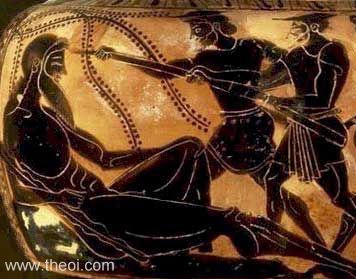
Some notes on Odysseus’ life and death: Forgotten Family and Falling Feces

“No other Odysseus will ever come home to you”


οὐ μὲν γάρ τοι ἔτ’ ἄλλος ἐλεύσεται ἐνθάδ’ ᾿Οδυσσεύς,


Since it seems we have been obsessed with Odysseus for a while, starting with our concern about whether anyone can ever know the real Odysseus (especially his wife if he follows Agamemnon’s advice and thanks to the various disguises facilitated by Athena), we wanted to put some of them together.  Even though we know we shouldn’t repeat ourselves (say something once, why say it again?), we have learned a few delightful things about are favorite (un)hero.


For one, we learned that Odysseus had a sister named Ktimene! And we’re still waiting for news from anyone else about this one.


In his great exploits, satyrs are by his side (according to Euripides, at least). And though Pindar is convinced his Homeric tales are a pack of lies, all of his tales teach us that suffering has meaning and helps to define who we are.


And how we end our lives is probably more important than how they begin. We already knew that death would come to Odysseus from the sea, but who knew that it would involve falling feces?


Any other strange storiesout there?

Pindar, Olympian 8.59-60


“Teaching is easier for someone who knows; not learning first is stupid. ”


τὸ διδάξασθαι δέ τοι εἰδότι ῥᾴτερον• ἄγνωμον δὲ τὸ μὴ προμαθεῖν•


The ancient Greek Laptop

Pindar, Nemean 6. 1-2


“The race of gods and the race of men are separate; but we both breathe thanks to one mother.”


῝Εν ἀνδρῶν, ἓν θεῶν γένος· ἐκ μιᾶς δὲ πνέομεν

ματρὸς ἀμφότεροι·

Pindar, Pythian 4. 247-8


“I have a long road to travel—but when the time comes I know a shortcut.”


μακρά μοι νεῖσθαι κατ’ ἀμαξιτόν· ὥρα

γὰρ συνάπτει καί τινα

οἶμον ἴσαμι βραχύν·


(Sort of changes “…and miles to go before I sleep….”)

Pindar, Nemean 4.4-5


“Hot water can’t make the limbs as limp as praise”


οὐδὲ θερμὸν ὕδωρ τόσον γε μαλθακὰ τεύχει

γυῖα, τόσσον εὐλογία…

Pindar, Olympian 7. 94-5


“In one small bit of time, the winds whirl this way and that.”


ἐν δὲ μιᾷ μοίρᾳ χρόνου

ἄλλοτ’ ἀλλοῖαι διαιθύσσοισιν αὖραι.


(I know, I know: ἄλλοτ’ ἀλλοῖαι διαιθύσσοισιν αὖραι is probably more literally construed as “some winds go one way and other winds go other ways” or “different winds go in different directions” but I went for the simple way…)

Pindar, Isthmian 1. 47


“Men find different payment sweet for different work.”


μισθὸς γὰρ ἄλλοις ἄλλος ἐπ’ ἔργμασιν ἀνθρώποις

     γλυκύς

Pindar, Nemean 4


“Different ages bring different men: but everyone hopes

to claim the things he witnessed were truly exceptional.”


ἄλλοισι δ’ ἅλικες ἄλλοι· τὰ δ’ αὐτὸς ἀντιτύχῃ,

ἔλπεταί τις ἕκαστος ἐξοχώτατα φάσθαι.

Pindar, Nemean 1.26-27

“Strength works through action; intelligence works through plans.”

πράσσει γὰρ ἔργῳ μὲν σθένος,

βουλαῖσι δὲ φρήν,