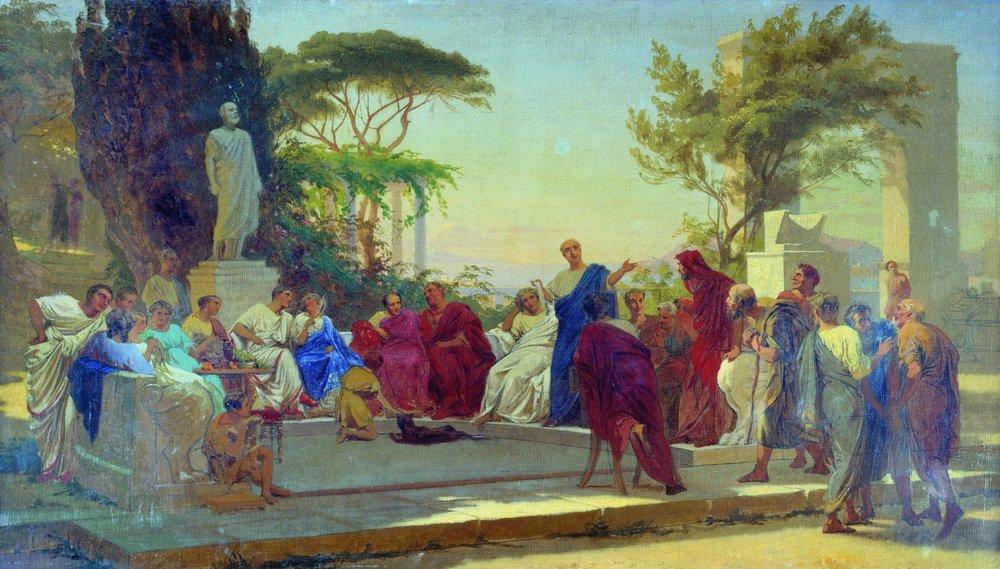
“When I [Hippocrates] was near [Democritus], he happened to be writing something eagerly and forcefully when I arrived. So I said. “First, tell me what you are writing about.” And, after he paused for a bit, said “madness.”
So I said, “But what are you writing about madness?” He responded, “What would I write except what it may be, how it afflicts human beings, and in what way it may be treated. This is why,” he continued, “I cut up all these animals you are looking at. It is not because I hate god’s works, but because I am researching the nature and the function of the bile.
For you know that the bile is the cause of madness in humans most of the time, since it appears naturally in most people, even though some have less of it and others have more. Illnesses emerge from an unbalanced amount, implying that the material is sometimes helpful and sometimes harmful.”
I added, “By Zeus, Democritus, you are speaking truthfully and prudently and this is why I think you are blessed for having achieving such a sense of peace. This has certainly not been allotted to me.”
Then he asked, “Why, Hippocrates, has it not?” I responded, “Because fields, my home, children, debts, illnesses, deaths, servants, marriages and all these kinds of things cut off any chance for it.”
At this, that man fell into his customary behavior—he laughed deeply and mocked me and then was silent for the rest of the time.”
Apollonius Paradoxographus, Historiae Mirabiles 49
“These things are worth knowing. Theophrastos has explained them in is work On Enthusiasm. For he says that music heals when suffering afflicts the soul and the body such as desperation, phobias, and the madnesses of belief which are more serious. For instrumental flute music, he continues, heals both hip pain and epilepsy.
Similarly is the power attributed to Aristoxenos the musician when he came—for he was getting a prophecy from the prophet of his sister Pasiphilê—for resuscitated a person in Thebes who was bewitched by the sound of a trumpet. For when he heard it he yelled out so much that he behaved indecently. If someone at any point even in war should blow the trumpet, then he should suffer much worse in his madness. So, he exposed him bit by bit to the flute—and, as one might say, he used this as an introduction for him to endure the trumpet as well.
The flute heals even if some part of the body is in pain. When the body is subject to flute music, let the instrumental music persist for five days at least. The toil will be surprisingly less on the first day and the second. This application of the flute treatment is common even elsewhere, but especially so in Thebes up to this day.”
There are similar accounts from Pythagorean Traditions
Porphyry, On the Life of Pythagoras
30. “[Pythagoras] healed psychic and bodily sufferings with rhythm, songs, and incantations. He adapted these treatments to his companions, while he himself heard the harmony of everything because he could understand the unity of the spheres and the harmonies of the stars moving with them. It is not our nature to hear this in the least.”
32. “Diogenes says that Pythagoras encouraged all men to avoid ambition and lust for fame, because they especially inculcate envy, and also to stay away from large crowds. He used to convene gatherings at his house at dawn himself, accompanying his singing to the lyre and singing some ancient songs of Thales. And he also sang the songs of Hesiod and Homer, as many as appeared to calm his spirit. He would also dance some dances which he believed brought good mobility and health to the body. He used to take walks himself but not with a crowd, taking only two or three companions to shrines or groves, finding the most peaceful and beautiful places.”
33. “He loved his friends overmuch and was the first to declare that friends possessions are common and that a friend is another self. When they were healthy, he always talked to them; when they were sick, he took care of their bodies. If they were mentally ill, he consoled them, as we said before, some with incantations and spells, others by music. He had songs and paeans for physical ailments: when he sang them, he relieved fatigue. He also could cause forgetfulness of grief, calming of anger, and redirection of desire.”
“Pythagoras believed that music produced great benefits for health, should someone apply it in the appropriate manner. For he was known to use this kind of cleansing and not carelessly. And he also called the healing from music that very thing, a purification. And he used a melody as follows during the spring season. He sat in the middle someone who could play the lyre and settled around him in a circle people who could sing. They would sing certain paeans as he played and through this they seemed to become happy, unified, and directed.
At another time they used music in the place of medicine, and there were certain songs composed against sufferings of the mind, especially despair and bitterness—songs which were created as the greatest aids. He also composed others against rage, desires, and every type of wandering of the soul. There was also another kind of performance he discovered for troubles: he also used dancing.
He used the lyre as an instrument since he considered flutes to induce arrogance as a dramatic sound which had no type of freeing resonance. He also used selected words from Homer and Hesiod for the correction of the soul.”
Empedocles, R88 : (Ps.-?) Hipp. Haer. 7.29.1–3 et 31.2–4
“Markiôn of Pontos was much crazier than these people: after dismissing many of the notions of the majority of people and moving into even more shame, he proposed that there were two principles of everything, claiming there was one good deity and one bad one. Because he thought that he had invented something new, he created his own school filled with madness and a cynic life, since he was something of a bellicose person.
This guy, somehow believing that he would evade most people in failing to be a follower of Christ but really of Empedocles who happened to come from a much earlier period and laid out the belief that there were two causes of the universe, Strife and Attraction…”
“Let’s talk first concerning the disease which is called sacred and paralyzed people and the many anxieties which frighten people seriously enough that they lose their minds and believe that they see evil spirits by night or even at times by die or sometimes on all hours. Many have hanged themselves before because of this kind of vision, more often women than men.
For a woman’s nature is more depressed and sorrowful. And young women, when they are at the age of marriage and without a husband, suffer terribly at the time of their menstruation, which they did not suffer earlier in life. For blood collects later in their uterus so that it may flow out. When, then, the mouth of the exit does not create an opening, the blood pools up more because of food and the body’s growth. When the blood has nowhere to flow, it rises up toward the heart and the diaphragm. When these organs are filled, the heart is desensitized and from this transformation it becomes numb. Madness overtakes women because of this numbness.”
Melancholy here contrasts with “thinking -wrongly” (paraphronein). A scholion to another play by Aristophanes glosses the realms of these types of mental maladies (Schol. ad Plut. 11a ex 20-28)
“He seems to say this because he harmed or helped his master through his own virtue more—and while he disturbed him through prophecy, he made him crazy [melankholan] through medicine and took away his ability to think [phronein] through wisdom, which is the art of thinking. The servant lies. For he does not speak the truth….”
Where melancholy denotes a physical ailment [i.e. biologically caused and treated], paraphrosunê indicates parafunctionality which may be treated without medicine.
μελαγχολάω: to be atrabilious, melancholy-mad.
μελαγχολία: atrabiliousness, melancholy, a disease [atual LSJ definition]
παραφροσύνη, ἡ: wandering of mind, derangment, delirium
παραφρονέω: to be beside oneself, be deranged, or mad.
Lyrica Adespota, fr. 3.9-10
“Lust–that magician–takes me. It descends upon my mind
And makes me crazy!”
“In the same way, ‘truth’ concerning the way things appear has come to some people from their senses. They believe that it is right that truth should be judged neither by the multitude or the scarcity [of those who believe it]; and they believe that the same thing seems sweet to some who taste it and bitter to others with the result that if all men were sick or if they were all insane and two or three were healthy or in their right mind, wouldn’t it seem that these few were sick and crazy and not the rest?”
“Is my mind my own private possession? It is a creator of lies, a founder of wandering, of paranoia, of foolishness, a thing revealed to be the opposite of a mind in its mania and depression and eventual old age.
Is what I say my own private possession or the organs of speech? Isn’t a minor sickness enough to weaken the tongue or to sew up the mouth of even the most articulate? Doesn’t the expectation of terror strike and render most people mute?
And I am not revealed to be master even of my perception—instead, I think I am even its servant following wherever it leads to colors, shapes, sounds, smells, tastes and other corporeal things.”
“Is my mind my own private possession? It is a creator of lies, a founder of wandering, of paranoia, of foolishness, a thing revealed to be the opposite of a mind in its mania and depression and eventual old age.
Is what I say my own private possession or the organs of speech? Isn’t a minor sickness enough to weaken the tongue or to sew up the mouth of even the most articulate? Doesn’t the expectation of terror strike and render most people mute?
And I am not revealed to be master even of my perception—instead, I think I am even its servant following wherever it leads to colors, shapes, sounds, smells, tastes and other corporeal things.”
Earlier posts examine Hippocratic and Galenic takes on different signs of ‘melancholy’, which is generally the ancient diagnosis that best corresponds to madness or depression. In this letter, Hippocrates seems to describe a manic dedication to one thing paired with other antisocial symptoms.
Hippocrates, Epistles 12
“We might encounter good fortune and then we will arrive, as we imagine, with better hopes as was made clear in the letter, if the case is that the man is not displaying madness but instead some overwhelming strength of spirit—this despite the fact that he is considering neither children nor wife nor relatives nor any other thing at all—and he has spent day and night by himself, staying alone for the most part in caves or deserted places or under the shadow of trees or in soft grasses or alongside the quiet flows of water.
It is many times the case for those suffering from melancholy to exhibit these kinds of behaviors. Such people are sometimes quiet and solitary and love isolation too. They keep themselves apart from people and consider their own tribe to be a foreign sight.
But it is not unreasonable for those who have been dedicated to education to shake off other thoughts because of a single category in wisdom. For, just as slaves and slavewomen who are yelling and fighting in their homes, when their mistress suddenly appears, step apart in quiet because they are afraid, in the same way too the rest of the thoughts in human minds are servants of evils; but when the sight of wisdom made itself seen, the rest of the sufferings have retreated like slaves.
It is not only the insane who desire caves and peace at all, but many people who have contempt for human affairs do too because of a desire not to be troubled. For whenever the mind, struck by external thoughts, longs to rest the body, then it returns to peace as soon as possible and, standing straight up, searches in a circle in himself for the land of truth in which there is no father, mother, wife, child, brother, relative, slaves, nor chance, nor at all any of those things which create a disturbance.”
“The story goes that in Abydos there was a man who was afflicted with madness. He went into the theater and watched for many days as if there were actually people acting and applauded. When he had a respite from his affliction, he said that this was the most enjoyable time of his life.”
“Thrasyllos from the deme Aiksône endured an incredible and novel madness. For he left the city and went to the Peiraia and stayed there. He believed that all the ships that sailed in were his and he wrote down their names, checked the list when they left and rejoiced when they returned safely to the harbor again. He spent many years living with this sickness.
When his brother returned from Sicily, he took him to a doctor for treatment and he freed him from that sickness. But he often remembered the avocation of his sickness and used to say that he was never as happy as when he took pleasure at the sight of ships that weren’t his returning safely.”
“This mistake, this minor madness, still possesses
This many advantages—consider them. The poet is
Not one with a greedy heart. He loves his lines, and desires
This alone. He mocks lost money, the flight of slaves and fires
There’s no thought of fraud against his friend or his ward
He lives as well as thin gruel and dry bread can afford.
Although he’s slow and a bad soldier, he’s still of use,
If you believe this: that grand affairs are helped by small matters too.
Hic error tamen et levis haec insania quantas
virtutes habeat, sic collige. vatis avarus
non temere est animus; versus amat, hoc studet unum;
detrimenta, fugas servorum, incendia ridet;
non fraudem socio puerove incogitat ullam
pupillo; vivit siliquis et pane secundo;
militiae quamquam piger et malus, utilis urbi,
si das hoc, parvis quoque rebus magna iuvari.