The starkest of contrasts: an anonymous Hellenistic epigram depicting a grateful slave and his benevolent master, and an Athenian letter recounting a slave’s desperation and his master’s brutality.
Anonymous Epigram 7.179 (Greek Anthology)
Even now from under the earth, master,
I remain obedient to you.
Your kindness I haven’t forgotten:
Three times you saw me from sickness to health;
And now you’ve gone so far as to lay me
Under this sheltering stone, announcing:
Medes, a Persian.
You’ve done right by me.
For that, you’ll have willing slaves in your debt.
In 1972, excavation of the Athenian Agora turned up a unique c.4th-century-BC letter inscribed on a lead tablet: the speaker is an actual slave describing the actual conditions of bondage. (Presumably the letter was dictated to a scribe, and since it was found in a well, presumably it was never delivered.)
As in the fanciful epigram, δεσπότης (“master”) designates the man who command’s the slave’s life. But unlike the fictional δεσπότης whose kindness can never be repaid, the real δεσπότης is a man of limitless brutality.
The letter reads:
“Lesis sends a letter to Xenochles and his mother saying do not overlook that he’s dying in the forge, but come to his masters and find him something better. For I have been handed over to an entirely bad man: I’m dying from the whippings; I’m tied up; I’m horribly abused. And more, more!”
Lead tablet letter from the Athenian agora, c.4th BC. (quoted in Edward Harris, Democracy and the Rule of Law in Classical Athens, page 271)
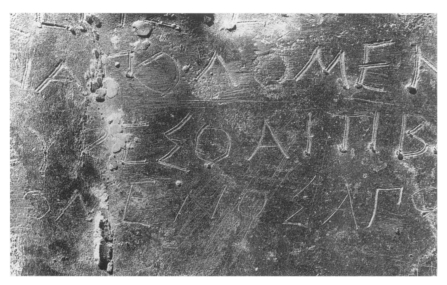
Detail of lines 2-4 of the slave’s lead tablet letter. Reproduced from David Jordan’s “A Personal Letter Found in the Athenian Agora,” Hesperia: The Journal of the American School of Classical Studies at Athens, Vol. 69, No. 1 (Jan. – Mar., 2000), pp. 91-103.
“Previously Homeric grooves [arrows] were sounding out
The master-loving habit of Eumaios on golden tablets,
But now this stone, repeating the unforgetting word,
Will sing your wise wit even into Hades, Inakhos.
Philoskos, who reveres your home, will always increase
The fine gifts and honor you both among the living and the dead—
Along with your wife who honors your son who is weeping,
A young child who draws deep from the spring of her breasts.
O, inescapable Hades, why do you hoard this kind of blessing,
Taking away the famous son of Kleumakhis?”
“They say either the Fates’ thread or some god’s rage
raged terribly at me, Parmonis, and violently
Rushed me out of bed unwillingly
when I was longing for my sweet husband Epitunkhanos.
If there is any memory for the dead, well, I led a blameless life—
Abandoning only my husband, a man I beg to stop
Torturing his heart with terrible grief and the terrible struggle.
For this is nothing more—since nothing wakes the dead—
Than wearing down the soul of those who still live. For there is nothing else.”
Animae sanctae colendae d(is) m(anibus) s(acrum). Furia Spes L(ucio) Sempronio Firmo coniugi carissimo mihi. Ut cognovi puer puella obligati amori pariter. Cum quo vixi tempori minimo et quo tempore vivere debuimus a manu mala diseparati sumus. Ita peto vos manes sanctissimae commendat[um] habeatis meum ca[ru]m et vellitis huic indulgentissimi esse horis nocturnis ut eum videam et etiam me fato suadere vellit ut et ego possim dulcius et celerius aput eum pervenire.
“To a sacred and worshipped spirit: a sacred thing to the spirits of the dead. Furia Spes (made this) for her dearest husband, Lucius Sempronius Firmus. When we met as boy and girl, we were joined in love equally. I lived with him for a short while, and in a time when we should have lived together, we were separated by an evil hand.
So I ask you, most sacred spirits, to protect my dear husband entrusted to you, and that you be willing to be most accommodating to him in the nightly hours, so I may have a vision of him, and so he might wish that I persuade fate to allow me to come to him more sweetly and quickly.”
Clausa iacet lapidi coniunx pia cara Sabina. Artibus edocta superabat sola maritum vox ei grata fuit pulsabat pollice c(h)ordas. Set (sed) cito rapta silpi (silet)…
“My beautiful, faithful wife, Sabina, lies enclosed in stone. Skilled in the arts, she alone surpassed her husband. Her voice was pleasing (as) she plucked the strings with her thumb. But suddenly taken, now she is silent.”
Dis Manibus Flaviae Sophene [Ge]nealis Caesaris Aug(usti) [se]rvos verna dispens(ator) [ad] frumentum carae coniugi et amanti bene merenti fecit [vix(it)] an(nis) XXXII m(ensibus) VII
“To the spirits of the dead. For Flavia Sophe. Genialis, home-born slave of Caesar Augustus, keeper of the grain supply, made this for his loving, dear, well-deserving wife. She lived 32 years, 7 months.”
Iulia Cecilia vicxit annis XLV cui Terensus marit(us) fek(it) dom(um) et(e)r(nalem) f(eci)t
“Julia Caecilia lived 45 years, for whom her husband Terensus made this. He made her an eternal home.”
CIL 13.01983 (EDCS-10500938)
D(is) M(anibus) et memoriae aetern(ae) Blandiniae Martiolae puellae innocentissimae quae vixit ann(os) XVIII m(enses) VIIII d(ies) V. Pompeius Catussa cives Sequanus tector coniugi incomparabili et sibi benignissim(a)e quae mecum vixit an(nos) V m(enses) VI d(ies) XVIII sine ul(l)a criminis sorde. Viv(u)s sibi et coniugi ponendum curavit et sub ascia dedicavit. Tu qui legis vade in Apol(l)inis lavari quod ego cum coniuge feci. Vellem si ad(h)uc possem
“To the spirits of the dead and the eternal memory of Blandinia Martiola, a most innocent girl who lived 18 years, 9 months, 5 days. Pompeius Catussa, a Sequani citizen and plasterer, (made this) for his incomparable and most kind wife, who lived with me 5 years, 6 months, 18 days without any transgressions. While alive, he saw to the building and dedicated this, while under construction, to himself and his wife. You who read this, go and bathe in the bath of Apollo, which I did with my wife. I wish I were still able to do it.”
Hospes quod deico paullum est. Asta ac pellege. Heic est sepulcrum hau(d) pulcrum pulcrai feminae. Nomen parentes nominarunt Claudiam. Suom mareitum corde deilexit souo. Gnatos duos creavit horunc (horum-ce) alterum in terra linquit alium sub terra locat. Sermone lepido tum autem incessu commodo domum servavit lanam fecit dixi abei
“Stranger, what I say is short. Stand and read over it. This is the hardly beautiful tomb of a beautiful woman. Her parents called her Claudia. She loved her husband with all her heart. She had two sons, one of whom she leaves on earth, the other she placed under it. With pleasant conversing but respectable gait she cared for her home and made wool. I have spoken. Move along.”
CIL 06.20307
Iulio Timotheo qui vixit p(lus) m(inus) annis XXVIII vitae innocentissim(a)e decepto a latronibus cum alumnis n(umero) VII. Otacilia Narcisa co(n)iugi dulcissimo
“For Julius Timotheus, who lived around 28 years of a most innocent life, cheated by bandits along with his 7 fostered children. Otacilia Narcisa (made this) for her sweetest husband.”
C(aius) Naevius C(ai) l(ibertus) Phi[lippus] / medicus chirurg(us) / Naevia C(ai) l(iberta) Clara / medica philolog(a) / in fro(nte) ped(es) XI s(emis) / in agr(o) ped(es) XVI
“Gaius Naevius Philippus, freedman of Gaius, doctor and surgeon. Naevia Clara, freedwoman of Gaius, doctor and scholar. (Tomb size) 11.5 feet wide, 16 feet deep.”
“A sacred rite to the spirits of the dead. To Julia Saturnina, age 45, an incomparable wife, the best doctor, the most noble woman. Gaius Philippus, her husband, (made this) for her merits. She is buried here. May the earth be light on you.”
“To the spirits of the dead. To Terentia of Nicaea, freedwoman of the doctor Terentia Prima. Mussius Antiochus and Mussia Dionysia, her children, made this for their well-deserving mother.”
Julia Balbilla is a Roman poet from the time of Hadrian. She composed Greek verse. For more of her poems see Rosenmeyer 2008 below and Brennan 1998 for additional historical context
Julia Balbilla, Two Poems
In Memnonis pede sinistro. C. I. 4727 coll. Add. III p. 1202.
“I, Balbilla, heard from the stone when it spoke
Either the divine voice of Memnon or Phamenoth.
I came here alongside my beautiful queen Sabina,
as the sun kept its course in the first hour.
In the fifteenth year of Hadrian’s reign
When Hathyr had made its twenty-fourth day,
It was on the twenty-fifth day of the month of Hathyr.
In Memnonis crure sinistro. C. I. 4725 coll. Add. III p. 1201 sq.
“Julia Balbilla [wrote this]
When August Hadrian heard Memnon
I’ve learned that the Egyptian Memnon, bronzed by
The bright sun, sounds out from a Theban stone.
When he gazed upon Hadrian, the kingliest king
He addressed him as much as he could before the light of the sun.
But as Titan was driving through the sky on white horses
Holding the second part of the day in shadow,
Memnon’s voice rang out again like struck bronze,
High-pitched: and he let loose a third sound greeting.
And then Lord Hadrian hailed Memnon in return
And left on this column for future generations to see
Inscribed verses telling of everything he saw and heard.
And it was clear to everyone how much the gods love him.
Rosenmeyer, P. (2008). Greek Verse Inscriptions in Roman Egypt: Julia Balbilla’s Sapphic Voice. Classical Antiquity,27(2), 334-358.
Brennan, T. (1998). “The Poets Julia Balbilla and Damo at the Colossus of Memnon”. Classical World,91(4), 215.
Plant, I., & Plant, Ian Michael. (2004). Women writers of ancient Greece and Rome : An anthology (University of Oklahoma Press ed.). Norman: University of Oklahoma Press.
This poem actually inspired me to type “just wow” when I was looking through the PHI Epigraphic Database.
CIRB 130 from the N. Black Sea ca. 50 BC-50 AD — GVI 1989
“Theophilê Hekataiou gives her greeting.
They were wooing me, Theiophilê the short-lived daughter of
Hekataios, those young men [seeking] a maiden for marriage.
But Hades seized me first, since he was longing for me
When he saw a Persephone better than Persephone.
[….]
And when the message is carved on the stone
He weeps for the girl, Theiophilê the Sinopian,
Whose father, Hekataios, gave the torch-holding bride-to-be
To Hades and not a marriage.
[…]
Maiden Theiophilê, no marriage awaits you, but a land
With no return; not as the bride of Menophilos,
But as a partner in Persephone’s bed. Your father Hekataios
Now has only the name of the pitiable lost girl.
And as he looks on your shape in stone he sees
The unfulfilled hopes Fate wrongly buried in the ground.
Theiophilê, a girl allotted beauty envied by mortals,
A tenth Muse, a Grace for marriage’s age,
A perfect example of prudence.
Hades did not throw his dark hands around you.
No, Pluto lit the flames for the wedding torches
With his lamp, welcoming a most desired mate.
Parents, stop your laments now, stop your grieving,
Theiophilê has found an immortal bed.”
Christos Tsagalis talks about inscriptions like this in his 2008 Inscribing Sorrow : Fourth-Century Attic Funerary Epigrams, (Trends in Classics. Suppl. Vol., 1) 2008, although his claim that the ἀντὶ γάμου is “especially suitable for young girls” (280) probably needs a little more nuance (I have found it in inscriptions for many young men too cf. e.g. SEG 42:212).
There are, of course, other expressions for the same idea. For instance, from nearly seven centuries later, the first half of IGBulg V5930 (The PHI link):
“Look at this grave marker, friend, and ask “who made this”?
Hermogenes made me in longing, seeking to honor his own daughter
Well-tressed Theklê, whom strong fate stole away
Before she saw a marriage, before she joined a husband in bed,
Before she suffered anything in her soul, she went unpolluted to god.”
“Traveler, weep for the age of this dead girl—
For she left when she was only twelve, causing her friends much grief
And leaving behind immortal pain. The rest of it
This memorial announces to everyone who passes by.
Much-wept Hades, why did you take Kleoptolemê when she
Was still a girl, at an ill-fated age? Didn’t you feel any shame?
You left for her dear mother Mnêsô everlasting grief
In exchange for mortal misfortune.
Dear Mother and sisters and Meidotelês who fathered you
As a source of pain for himself, Kleoptolemê,–
They look forward only to grief, and not your bed-chamber, now that you’ve died,
but a lament instead of a husband, a funeral instead of a marriage.”

 Detail of lines 2-4 of the slave’s lead tablet letter. Reproduced from David Jordan’s “A Personal Letter Found in the Athenian Agora,” Hesperia: The Journal of the American School of Classical Studies at Athens, Vol. 69, No. 1 (Jan. – Mar., 2000), pp. 91-103.
 Larry Benn has a B.A. in English Literature from Harvard College, an M.Phil in English Literature from Oxford University, and a J.D. from Yale Law School. Making amends for a working life misspent in finance, he’s now a hobbyist in ancient languages and blogs at featsofgreek.blogspot.com.


