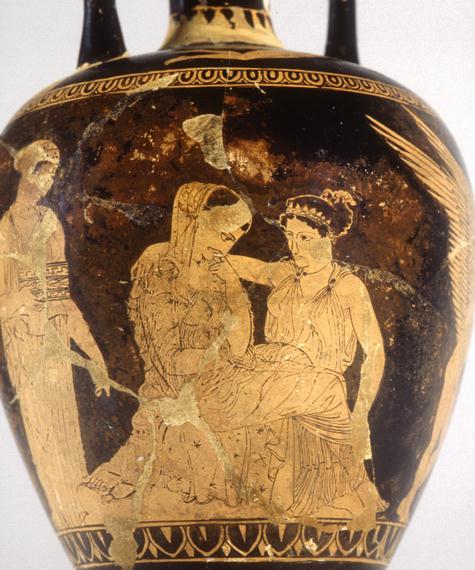
“The land of my father is not nameless,
Sparta, nor my father Tyndareus. And, indeed, there is
a certain story that Zeus flew to my mother Leda
after he took the form of a swan, a bird,
when he completed this ‘bedding’ deceptively
under the pretext of fleeing an eagle, if the story is true.
I am called Helen. And I should tell you the evils
I have suffered. Three goddesses went to the folds
O Mt. Ida to Alexander about their beauty,
Hera, the Kyprian, and the Zeus-born maiden,
Because they wanted him to complete a judgement of their ‘form’.
My beauty–if misfortune is beautiful–
Is what the Kyprian offered, for Alexander to marry,
In order to win. After Idaian Paris left the cow-stall
He went to Sparta seeking my bed.
But Hera, miffed because she did not defeat the goddesses,
Made my bed with Alexander an empty thing.
She did not give me, but instead, she made
A breathing ghost like me, crafting it from the sky,
For tyrant Priam’s son. He seemed to have me,
And it was an empty thing, because he did not have me….”
“This is not the true tale:
You never went in the well-benched ships
You did not go to the towers of Troy…
[It is a fault in Homer that
He put Helen in Troy
And not her image only;
It is a fault in Hesiod
In another: there are two, differing
Recantations and this is the beginning.
Come here, dance loving goddess;
Golden-winged, maiden,
As Khamaileôn put it.
Stesichorus himself says that
an image [eidolon] went to troy
and that Helen stayed back
with Prôteus…”
“Atreus’ war-loving son Menelaos conquered everyone
Because he gave the most gifts. Kheiron took Peleus’ son
of swift feet to wooded Pelion, that most exceptional of men,
when he was still a child. War-loving Menelaos wouldn’t have defeated him
nor would any other Mortal man on the earth who was wooing
Helen if swift Achilles had come upon her when she was still a maiden
As he returned home from Pelion.
But, as it turned out, war-loving Menelaos got her first.”
In other traditions Achilles actually is a suitor. (Pausanias 3.24; Euripides’, Helen 98-99; see Ormand, The Hesiodic Catalogue of Women and Archaic Greece, 2014, 149-150 and 198-201). Hesiod, however, finds it necessary to explain why he is sidelined from this game…
Decorated amphora in the British Museum. Figures suggested to be Achilles and Cheiron. Etruscan 500BC-480BC
“Zeus made himself look like a swan and joined Nemesis near the river Ocean. From this union, she laid an egg which Leda received, warmed, and then bore Helen and the Dioscouri”
“Ramnos is a deme in Attica where Zeus slept with Nemesis who then produced an egg which Leda found, warmed and which produced in turn the Dioscuri and Helen.”
The fragmentary poem from the epic cycle dubbed the Cypria was attributed to lesser known poets like Stasinus and Hegesias by ancient authors. Its name, however, comes from the fact that it was largely believed to be composed in Cyprus (or by a Cypriot poet traveling abroad).
The first fragment of the poem tends to be its most well-known since it places the Trojan War in a context of global discussion and echoes the Iliad in making this all part of Zeus’ plan. But the ninth fragment has some frightening details. First, it alleges that Helen is not the daughter of Zeus and Leda (of the swan scene) but instead is the offspring of Zeus and the unwilling goddess Nemesis. Second, it shows Zeus pursuing her all over the earth no matter what form she took.
Cypria, Fr. 9 Benarbé [fr 10. West 2013]
“After them [he?] bore a wonder to mortals, a third child Helen—
Fine-haired Nemesis gave birth to her after having sex
With Zeus, the king of the gods, under forceful compulsion.
For she was not willing to have sex with Kronos’ son
Father Zeus, since her mind rushed with shame and opposition [nemesis].
She fled over the earth and the dark, barren sea,
But Zeus pursued her—and he longed to catch her in his heart.
At one time along the waves of the much-resounding sea,
He broke through the water as she took the form of a fish—
At another he followed her through the river Ocean to the ends of the earth.
Again, across the much-nourishing land. She became all the terrible
Beasts, the many the land raises up, in trying to escape him.”
As West (2013, 81-83) points out, there is some motif transference going on here in the fragment. For one, in many testimonia Thetis is said to change shapes to elude Peleus. In addition, we know the popular account of Zeus changing into a swan [or goose] to seduce Leda. Finally, Nemesis—as a concept and less as a character—is often associated with Helen’s behavior. She receives “nemesis and shame” for her actions. Much of this may linger in the mythopoetic background when the leaders of the Trojans declare upon seeing her again in the Iliad “there’s no nemesis for the Trojans and Achaeans, that they suffered pain for so long for this kind of woman….” (οὐ νέμεσις Τρῶας καὶ ἐϋκνήμιδας ᾿Αχαιοὺς τοιῇδ’ ἀμφὶ γυναικὶ πολὺν χρόνον ἄλγεα πάσχειν).
But other accounts have Zeus changing to match Nemesis as well. Apollodorus (3.10.7) attempts to harmonize the two accounts:
“Some allege that Helen is the daughter of Nemesis and Zeus and that when she was fleeing Zeus’ sexual advance she changed her shape into a goose and that Zeus matched her and approached her as a swan. She produced an egg from this intercourse—people say that some shepherd found this egg in a thicket, fetched it and gave it to Leda who placed it in a box where she guarded it. When, after some time, it hatched and produced Helen, Leda raised her as her own daughter.”
The Hesiodic Catalogue of Women tells the story of of Helen’s suitors, explaining that Menelaos won Helen’s hand because of the magnitude of his wealth. The fragment, however, does not stop there. No! It has to explain why Achilles didn’t win Helen’s hand:
Fr. 204.86-93
“Atreus’ war-loving son Menelaos conquered everyone
Because he gave the most gifts. Kheiron took Peleus’ son
of swift feet to wooded Pelion, that most exceptional of men,
when he was still a child. War-loving Menelaos wouldn’t have defeated him
nor would any other Mortal man on the earth who was wooing
Helen if swift Achilles had come upon her when she was still a maiden
As he returned home from Pelion.
But, as it turned out, war-loving Menelaos got her first.”
In other traditions Achilles actually is a suitor. (Pausanias 3.24; Euripides’, Helen 98-99; see Ormand, The Hesiodic Catalogue of Women and Archaic Greece, 2014, 149-150 and 198-201). Hesiod, however, finds it necessary to explain why he is sidelined from this game…
eleus (left) entrusts his son Achilles (centre) to Centaur Chiron (right). White-ground black-figured lekythos by the Edinburgh Painter, ca. 500 BC. From Eretria. National Archaeological Museum in Athens, 1150.
Astuanassa: A handmaid of Helen, Menelaos’ wife. She first discovered positions for intercourse and wrote On Sexual Positions. Philainis and Elephantinê rivaled her in this later—they were women who danced out these sorts of wanton acts.
We have learned about this embroidered girdle, that Hera took it from Aphrodite and gave it to Helen. Her handmaid Astuanassa stole it but Aphrodite took it back from her again.
As is largely unsurprising from the perspective of Greek misogyny, excessive interest in sexual behavior is projected a female quality. Expertise beyond interest is made the province of female ‘professionals’ (slaves) who may act as scapegoats and marginal figures for the corruption of both men and women. There is a combination of such interest with an excessive emphasis on eating (and eating really well) in Athenaeus where the pleasures of the body are combined.
Athenaeus, Deipnosophists 8.335c
“Dear men, even though I have great admiration for Chrysippus as the leader of the Stoa, I praise him even more because he ranks Arkhestratos, well-known for his Science of Cooking along with Philainis who is credited with a licentious screed about sexual matters—even though the iambic poet of Samos, Aiskhriôn, claims that Polycrates the sophist started this slander of her when she was really quite chaste. The lines go like this:
“I, Philainis, circulated among men
Lie here thanks to great old age.
Don’t laugh, foolish sailor, as your trace the cape
Nor make me a target of mockery or insult
For, by Zeus and his sons in Hell
I was never a slut with men nor a public whore.
Polykrates, Athenian by birth,
A bit clever with words and with a nasty tongue,
Wrote what he wrote. I don’t know anything about it.”
But the most amazing Chrysippus combines in the fifth book of his On Goodness and Pleasure that both “the books of Philianis and the Gastronomiai of Arkhestratos and forces of erotic and sexual nature, and in the same way slave-girls who are expert at these kinds of movements and positions and who are engaged in their practice.” He adds that they learn this type of material completely and then thoroughly possess what has been written on these topics by Philainis and Arkhestratos and those who have written on similar topics. Similarly, in his seventh book, he says ‘As you cannot wholly learn the works of Philianis and Arkhestratos’ Gastronomia because they do have something to offer for living better.’ “
Apparently there was also a tradition that has Aphrodite pulling a Zeus-Amphitryon trick with Paris and Menelaos.
Nikias of Mallos, BNJ 60 F 2a [=Schol. V ad Od. 23.218]
“Priam’s child Alexander left Asia and went to Sparta with the plan of abducting Helen while he was a guest there. But she, because of her noble and husband-loving character, was refusing him and saying that she would honor her marriage with the law and thought more of Menelaos. Because Paris was ineffective, the story is that Aphrodite devised this kind of a trick: she exchanged the appearance of Alexander for Menelaos’ character to persuade Helen in this way. For, because she believed that this was truly Menelaos, she was not reluctant to leave with him. After she went to the ship before him, he took her inside and left. This story is told in Nikias of Mallos’ first book”
This kind of doubling and uncertainty about identity is certainly at home in any discussion of Euripides’ Helen (well, at least the first third where no one knows who anybody is). But it is also apt for the Odyssey where Odysseus cryptically insists (16.204):
Astuanassa: A handmaid of Helen, Menelaos’ wife. She first discovered positions for intercourse and wrote On Sexual Positions. Philainis and Elephantinê rivaled her in this later—they were women who danced out these sorts of wanton acts.
We have learned about this embroidered girdle, that Hera took it from Aphrodite and gave it to Helen. Her handmaid Astuanassa stole it but Aphrodite took it back from her again.
As is largely unsurprising from the perspective of Greek misogyny, excessive interest in sexual behavior is projected a female quality. Expertise beyond interest is made the province of female ‘professionals’ (slaves) who may act as scapegoats and marginal figures for the corruption of both men and women. There is a combination of such interest with an excessive emphasis on eating (and eating really well) in Athenaeus where the pleasures of the body are combined.
Athenaeus, Deipnosophists 8.335c
“Dear men, even though I have great admiration for Chrysippus as the leader of the Stoa, I praise him even more because he ranks Arkhestratos, well-known for his Science of Cooking along with Philainis who is credited with a licentious screed about sexual matters—even though the iambic poet of Samos, Aiskhriôn, claims that Polycrates the sophist started this slander of her when she was really quite chaste. The lines go like this:
“I, Philainis, circulated among men
Lie here thanks to great old age.
Don’t laugh, foolish sailor, as your trace the cape
Nor make me a target of mockery or insult
For, by Zeus and his sons in Hell
I was never a slut with men nor a public whore.
Polykrates, Athenian by birth,
A bit clever with words and with a nasty tongue,
Wrote what he wrote. I don’t know anything about it.”
But the most amazing Chrysippus combines in the fifth book of his On Goodness and Pleasure that both “the books of Philianis and the Gastronomiai of Arkhestratos and forces of erotic and sexual nature, and in the same way slave-girls who are expert at these kinds of movements and positions and who are engaged in their practice.” He adds that they learn this type of material completely and then thoroughly possess what has been written on these topics by Philainis and Arkhestratos and those who have written on similar topics. Similarly, in his seventh book, he says ‘As you cannot wholly learn the works of Philianis and Arkhestratos’ Gastronomia because they do have something to offer for living better.’ “
Apparently there was also a tradition that has Aphrodite pulling a Zeus-Amphitryon trick with Paris and Menelaos.
Nikias of Mallos, BNJ 60 F 2a [=Schol. V ad Od. 23.218]
“Priam’s child Alexander left Asia and went to Sparta with the plan of abducting Helen while he was a guest there. But she, because of her noble and husband-loving character, was refusing him and saying that she would honor her marriage with the law and thought more of Menelaos. Because Paris was ineffective, the story is that Aphrodite devised this kind of a trick: she exchanged the appearance of Alexander for Menelaos’ character to persuade Helen in this way. For, because she believed that this was truly Menelaos, she was not reluctant to leave with him. After she went to the ship before him, he took her inside and left. This story is told in Nikias of Mallos’ first book”
This kind of doubling and uncertainty about identity is certainly at home in any discussion of Euripides’ Helen (well, at least the first third where no one knows who anybody is). But it is also apt for the Odyssey where Odysseus cryptically insists (16.204):
“[It is clear] that the greatest wars also happened because of women. The Trojan War happened because of Helen; the Plague because of Chryseis; Achilles’ rage because of Briseis; and the War called the Sacred War, as Duris claims in the second book of his histories, by another married woman from Thebes who was kidnapped by some Phocian. This war also lasted ten years and in the tenth when Philip allied himself with the Thebes it ended. Then the Thebans took and held Phokis.”
“This is how the Persians say that Io came to Egypt—and not the story the Greeks tell—and this was the first transgression. After that, they claim some Greeks—and they can’t name them—went to Tyre and kidnapped Europê, the daughter of the king. These men would have been Cretans. At this point, the score was even. But then the Greeks were at fault for a second crime. For the Greeks sailed in a great ship to Aia, the Kolkhian, city and to the river Phasis.
Once they finished why they went there, they left, but they also kidnapped Medea, the king’s daughter. When the king sent a herald to Greece demanding recompense for the abduction and asking for his daughter to be returned, the Greeks answered that they would give nothing to the Kolhkians since they had not received anything for the abduction of Io.
In the next generation after that, they say that Priam’s son Alexandros, once he heard about these things, wanted to steal a wife for himself from Greece because he was absolutely certain he would face no penalties since the earlier men hadn’t. When he kidnapped Helen as he did, it seemed right at first for the Greeks to send messengers to demand her return and recompense for the abduction. When the Greeks made these demands, the Trojans brought up the abduction of Medeia and the fact that the Greeks were demanding from others the very things they themselves were not willing to give or repay.
Up to that point of time, the whole matter was only kidnapping on either side. But the Greeks were more to blame after this since they were the first to lead an army to Asia before anyone led one against Europe. As the Persians claim, they believe it is the work of unjust men to kidnap women, but the act of fools to rush off to avenge women who have been abducted. Wise men have no time for raped women, since it is clear they they would not have been abducted if they had not been willing themselves.
They claim that the men of Asia make no big deal when women are abducted while the Greeks, all because of one Lakedaimonian woman, raised a great army, went to Asia, and destroyed Priam’s power. Since that time, they consider Greece their enemy.”
Note: much of the language in this passage referring to abduction and kidnapping could also be translated as rape. I left the language more anodyne to reflect what seems to be Herodotus’ own dismissal or ignorance of the women’s experience.