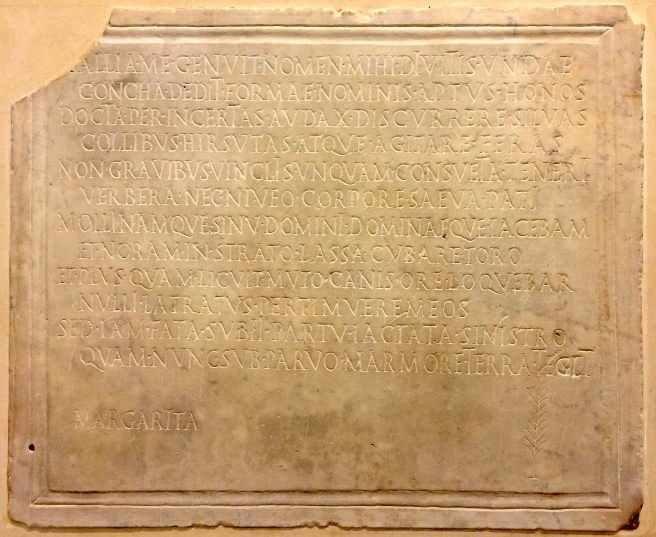
“A dog is interred beneath this marker—
Tauron who was not undone when faced with a killer.
For he encountered a boar in direct combat-
It could not be passed as it puffed out its jaw
And drove a furrow in his chest as it dripped with white foam.
But the dog struck two feet into its back
And grabbed the bristling beast in the middle of its chest
And drove it down into the ground—he made a gift
Of the beast to Hades and died himself, as is the custom for an Indian.
He saved the life of Zenon, the hunter he followed.
So he is buried here beneath this light dust.”
“Previously Homeric grooves [arrows] were sounding out
The master-loving habit of Eumaios on golden tablets,
But now this stone, repeating the unforgetting word,
Will sing your wise wit even into Hades, Inakhos.
Philoskos, who reveres your home, will always increase
The fine gifts and honor you both among the living and the dead—
Along with your wife who honors your son who is weeping,
A young child who draws deep from the spring of her breasts.
O, inescapable Hades, why do you hoard this kind of blessing,
Taking away the famous son of Kleumakhis?”
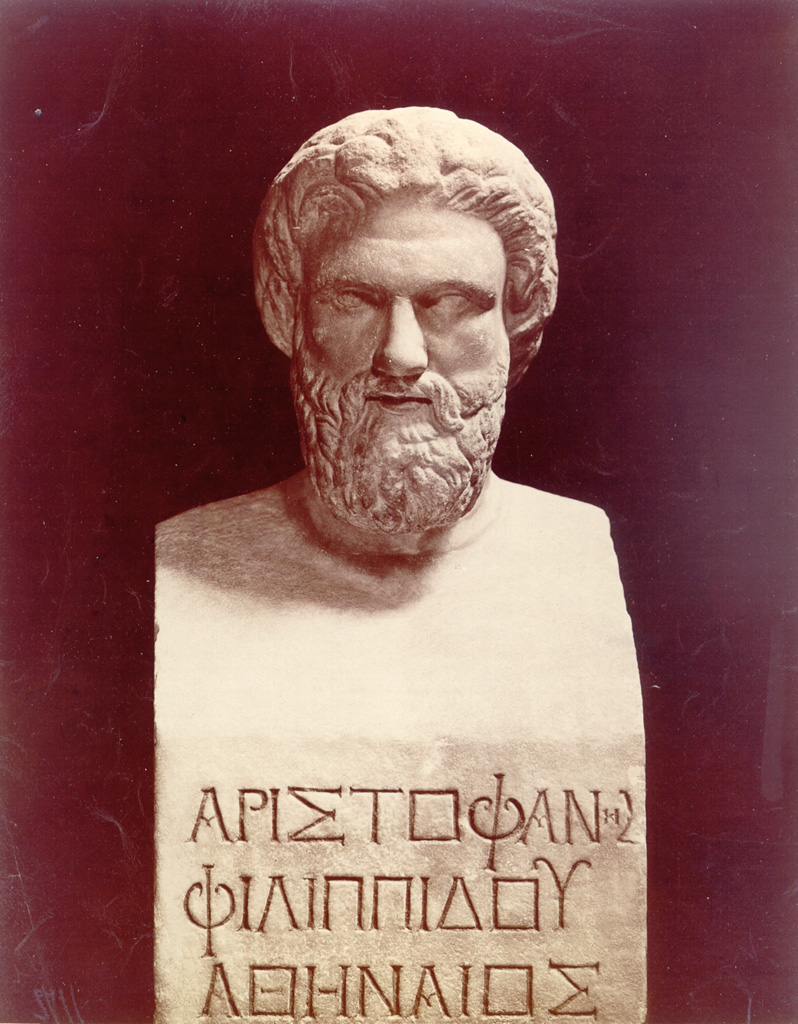
“The books of Aristophanes—divine labor—over which
Archanean ivy dangled its massive green hair.
See how much of Dionysus a page holds, how the stories
Echo, full of frightening charms.
Comic poet, best of heart, equal to the characters of Greece,
You both hated and mocked things that deserved it.”
Some Archaic Latin Inscriptions from the Loeb Classical Library (the LCL numbers are first, translations are mine). There are earlier poetic epitaphs on this site as well, even legendary ones
Epitaphs 14 [CIL 1861]
“Here lies the sweet clown and slave of Clulius
Protogenes, who created many moments of happiness for people with his joking”
Protogenes Cloul[i] | suavis heicei situst | mimus
plouruma que | fecit populo soueis | gaudia nuges.
15 [CIL 1202]
“This monument was erected for Marcus Caecilius
We give you thanks, Friend, since you stopped by this home.
May you have good fortune and be well. Sleep without worry.”
Hoc est factum monumentum | Maarco Caicilio. |
Hospes, gratum est quom apud | meas restitistei seedes. |
Bene rem geras et valeas, | dormias sine qura.
18 [CIL 1211]
“Friend, what is written here is brief—stop and read it all.
This is the unattractive tomb of an attractive woman.
Her parents named her Claudia
She loved her own husband with her whole heart.
She had two sons and leaves one of them
On the earth, but placed the other beneath it.
[She was] charming in conversation; but proper in behavior.
She safeguarded her house. She made wool. I have said it all. Go.”
Hospes, quod deico paullum est; asta ac pellege.
Heic est sepulcrum hau pulcrum pulcrai feminae.
Nomen parentes nominarunt Claudiam.
Suom mareitom corde deilexit souo.
Gnatos duos creavit, horunc alterum
in terra linquit, alium sub terra locat.
Sermone lepido, tum autem incessu commodo.
Domum servavit, lanam fecit. Dixi. Abei.
39 [CIL 1219]
“Here are the bones of Pompeia the first daughter
Fortune promises a lot to many but makes a guarantee for no one.
Live for all days and all hours. For nothing is yours wholly.
Salvius and Heros donated this.”
Primae | Pompeiae | ossua heic.|
Fortuna spondet | multis, praestat nemini;
vive in dies | et horas, nam proprium est nihil. |
Salvius et Heros dant.
The most famous that remains is Thucydides’ version of Perikles’ funeral oration (2.35-46).
Thucydides, 2.35
“Many of those who have spoken here already praised the one who made this speech law, that it is a noble thing to speak over the burials of those who died in war. But honors paid in deeds for deeds performed by good men would seem to be sufficient to me—the acts which you see performed now by the public at this burial. The virtues of many should not be risked by entrusting them to the good or poor speaking of one man alone. “
“If I believed it were possible, men in attendance, to make clear in this speech the virtue of the men who lie here, I would complain to those who summoned me to speak after only a few days.
Plato’s Menexenus (236dff), Socrates recites an epitaphios given by Aspasia:
“In deed, these men have what is required for them materially—now that they have obtained it, they proceed along the fated path: they have been carried out in common by the city and in private by their families. But in speech it is necessary to pay out the remaining rite which custom assigns us.
“Since it seems right to the state to bury those lying in this grave publicly because they proved themselves noble in war and it has been assigned to me to deliver the customary speech on their behalf, I immediately began to examine how others have crafted the appropriate praise. But while I was considering and examining this, I realized that speaking worthily of the dead is one of those things that is impossible for men.”
“They say either the Fates’ thread or some god’s rage
raged terribly at me, Parmonis, and violently
Rushed me out of bed unwillingly
when I was longing for my sweet husband Epitunkhanos.
If there is any memory for the dead, well, I led a blameless life—
Abandoning only my husband, a man I beg to stop
Torturing his heart with terrible grief and the terrible struggle.
For this is nothing more—since nothing wakes the dead—
Than wearing down the soul of those who still live. For there is nothing else.”
The following epigrams are attributed to the poet Anyte of Tegea, one of a handful of Hellenistic women preserved in the Greek Anthology.
Gr. Anth. 7.490
“I mourn for the virgin Antibia, to whose father’s home
Many suitors came longing to marry,
Thanks to the fame of her beauty and wisdom.
But ruinous fate made all their hopes turn in the dust.”
“Dâmis built this grave for his battle-fierce but dead
Horse, after murderous Ares pierce his chest.
The blood spurted black from his thick-hided skin
And he dyed the earth with his painful life’s blood.”
“Your courage, Proarkhos, killed you in the fight and dying
You put the home of your father Pheidias into dark grief.
Yet this rock above you sings out a noble song:
That you died in a struggle for your dear homeland.”
Callimachus and Heraclitus of Halicarnassus, poets of the 3rd Century BC, were friends, as Callimachus’ tribute makes clear in the following poem:
Callimachus 2 (Gow-Page 34)
Someone spoke of your death, Heraclitus,
Moving me to tears.
I remembered how often we, talking,
Made the sun go down.
But now, my Halicarnassian friend,
Somewhere, and for almost too long to count,
You’ve been a pile of ashes.
Yet, your nightingales live on.
Hades, the god who steals everything,
Will not lay his hand on them.
Only one of Heraclitus’ “nightingales” survives, and it is the sepulchral poem below:
Heraclitus 7.465 (Greek Anthology)
Earth just recently dug up.
On the face of the tombstone
Half-green leafy garlands sway.
When the writing’s deciphered,
Traveler, we’ll know whose smooth bones
The stone claims to enclose:
“Stranger, I am Aretemias from Cnidus.
It was with Euphronus that I shared the marriage bed.
Rites of child birth were not denied me, and I bore twins:
One I left as a guide for his father in old age;
One I took with me—a reminder of my husband.”
“Columns, and my Sirens, and you, sorrowful urn
Who holds Hades’ small portion of ash—
Say “hello” to those who walk by my grave,
Whether they happen to be citizens or from another town.
Tell them this too so they may know it:
this grave covered me when I was a bride,
My father used to call me Baukis and Tenos was my land
Tell them also that Erinna, my friend,
Etched this poem on my Tomb.”
“These outlines come from tender hands: noble Prometheus
There are people whose talent is near to yours!
Whoever drew this girl so truly
If he added a voice, she would be Agatharkhis entirely.”
Animae sanctae colendae d(is) m(anibus) s(acrum). Furia Spes L(ucio) Sempronio Firmo coniugi carissimo mihi. Ut cognovi puer puella obligati amori pariter. Cum quo vixi tempori minimo et quo tempore vivere debuimus a manu mala diseparati sumus. Ita peto vos manes sanctissimae commendat[um] habeatis meum ca[ru]m et vellitis huic indulgentissimi esse horis nocturnis ut eum videam et etiam me fato suadere vellit ut et ego possim dulcius et celerius aput eum pervenire.
“To a sacred and worshipped spirit: a sacred thing to the spirits of the dead. Furia Spes (made this) for her dearest husband, Lucius Sempronius Firmus. When we met as boy and girl, we were joined in love equally. I lived with him for a short while, and in a time when we should have lived together, we were separated by an evil hand.
So I ask you, most sacred spirits, to protect my dear husband entrusted to you, and that you be willing to be most accommodating to him in the nightly hours, so I may have a vision of him, and so he might wish that I persuade fate to allow me to come to him more sweetly and quickly.”
Clausa iacet lapidi coniunx pia cara Sabina. Artibus edocta superabat sola maritum vox ei grata fuit pulsabat pollice c(h)ordas. Set (sed) cito rapta silpi (silet)…
“My beautiful, faithful wife, Sabina, lies enclosed in stone. Skilled in the arts, she alone surpassed her husband. Her voice was pleasing (as) she plucked the strings with her thumb. But suddenly taken, now she is silent.”
Dis Manibus Flaviae Sophene [Ge]nealis Caesaris Aug(usti) [se]rvos verna dispens(ator) [ad] frumentum carae coniugi et amanti bene merenti fecit [vix(it)] an(nis) XXXII m(ensibus) VII
“To the spirits of the dead. For Flavia Sophe. Genialis, home-born slave of Caesar Augustus, keeper of the grain supply, made this for his loving, dear, well-deserving wife. She lived 32 years, 7 months.”
Iulia Cecilia vicxit annis XLV cui Terensus marit(us) fek(it) dom(um) et(e)r(nalem) f(eci)t
“Julia Caecilia lived 45 years, for whom her husband Terensus made this. He made her an eternal home.”
CIL 13.01983 (EDCS-10500938)
D(is) M(anibus) et memoriae aetern(ae) Blandiniae Martiolae puellae innocentissimae quae vixit ann(os) XVIII m(enses) VIIII d(ies) V. Pompeius Catussa cives Sequanus tector coniugi incomparabili et sibi benignissim(a)e quae mecum vixit an(nos) V m(enses) VI d(ies) XVIII sine ul(l)a criminis sorde. Viv(u)s sibi et coniugi ponendum curavit et sub ascia dedicavit. Tu qui legis vade in Apol(l)inis lavari quod ego cum coniuge feci. Vellem si ad(h)uc possem
“To the spirits of the dead and the eternal memory of Blandinia Martiola, a most innocent girl who lived 18 years, 9 months, 5 days. Pompeius Catussa, a Sequani citizen and plasterer, (made this) for his incomparable and most kind wife, who lived with me 5 years, 6 months, 18 days without any transgressions. While alive, he saw to the building and dedicated this, while under construction, to himself and his wife. You who read this, go and bathe in the bath of Apollo, which I did with my wife. I wish I were still able to do it.”
Hospes quod deico paullum est. Asta ac pellege. Heic est sepulcrum hau(d) pulcrum pulcrai feminae. Nomen parentes nominarunt Claudiam. Suom mareitum corde deilexit souo. Gnatos duos creavit horunc (horum-ce) alterum in terra linquit alium sub terra locat. Sermone lepido tum autem incessu commodo domum servavit lanam fecit dixi abei
“Stranger, what I say is short. Stand and read over it. This is the hardly beautiful tomb of a beautiful woman. Her parents called her Claudia. She loved her husband with all her heart. She had two sons, one of whom she leaves on earth, the other she placed under it. With pleasant conversing but respectable gait she cared for her home and made wool. I have spoken. Move along.”
CIL 06.20307
Iulio Timotheo qui vixit p(lus) m(inus) annis XXVIII vitae innocentissim(a)e decepto a latronibus cum alumnis n(umero) VII. Otacilia Narcisa co(n)iugi dulcissimo
“For Julius Timotheus, who lived around 28 years of a most innocent life, cheated by bandits along with his 7 fostered children. Otacilia Narcisa (made this) for her sweetest husband.”