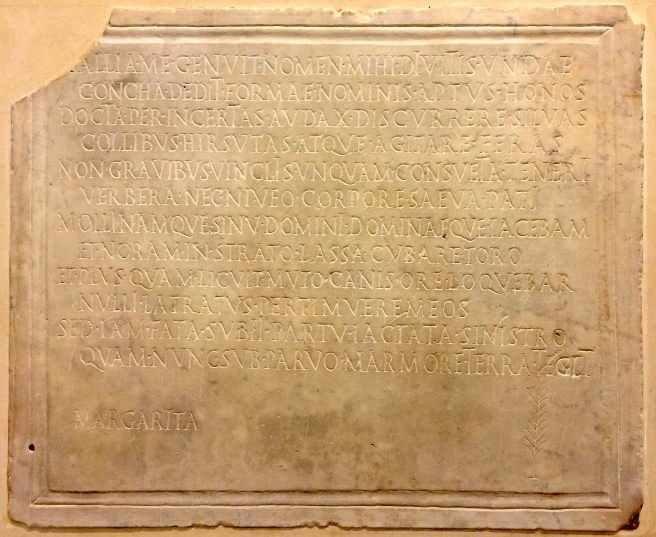
Some Archaic Latin Inscriptions from the Loeb Classical Library (the LCL numbers are first, translations are mine). There are earlier poetic epitaphs on this site as well, even legendary ones
Epitaphs 14 [CIL 1861]
“Here lies the sweet clown and slave of Clulius
Protogenes, who created many moments of happiness for people with his joking”
Protogenes Cloul[i] | suavis heicei situst | mimus
plouruma que | fecit populo soueis | gaudia nuges.
15 [CIL 1202]
“This monument was erected for Marcus Caecilius
We give you thanks, Friend, since you stopped by this home.
May you have good fortune and be well. Sleep without worry.”
Hoc est factum monumentum | Maarco Caicilio. |
Hospes, gratum est quom apud | meas restitistei seedes. |
Bene rem geras et valeas, | dormias sine qura.
18 [CIL 1211]
“Friend, what is written here is brief—stop and read it all.
This is the unattractive tomb of an attractive woman.
Her parents named her Claudia
She loved her own husband with her whole heart.
She had two sons and leaves one of them
On the earth, but placed the other beneath it.
[She was] charming in conversation; but proper in behavior.
She safeguarded her house. She made wool. I have said it all. Go.”
Hospes, quod deico paullum est; asta ac pellege.
Heic est sepulcrum hau pulcrum pulcrai feminae.
Nomen parentes nominarunt Claudiam.
Suom mareitom corde deilexit souo.
Gnatos duos creavit, horunc alterum
in terra linquit, alium sub terra locat.
Sermone lepido, tum autem incessu commodo.
Domum servavit, lanam fecit. Dixi. Abei.
39 [CIL 1219]
“Here are the bones of Pompeia the first daughter
Fortune promises a lot to many but makes a guarantee for no one.
Live for all days and all hours. For nothing is yours wholly.
Salvius and Heros donated this.”
Primae | Pompeiae | ossua heic.|
Fortuna spondet | multis, praestat nemini;
vive in dies | et horas, nam proprium est nihil. |
Salvius et Heros dant.
“Mênodorus and Hêlodôros, the sons of Hêliodôros, greet you
Traveler, beneath me, the words—dear Heliodôros,
Eighteen years old, he had his father’s name.
With him lies his brother on the edge of adulthood,
Mênodorus, who has earned all the pity on Aeida.
Instead of a lovely marriage bed, they get a tomb;
Instead of a bride, a stone, and instead of a wedding, terrible grief for their parents.
I grieve for the pitiable mother who put her hands over their eyes.”
SEG 42:212 Att. — Rhamnous — 4th c. BC — Forteresse, 69
“Death is life’s shared end for everyone. But you leave
Behind you pity for your age and a longing for your wisdom.
Your parents lost you when you were only twenty years old
And when you died they arranged a funeral for you instead of a marriage.”
“Stranger, I am leaving griefs and pains for my father Philiskos
And my pitiful mother, because I went down to Hades’ home—
I lost my life because of a savage bear who violently
Killed me, crushing my flesh with her jaws.
I died at 27 years old. Fate led miserable me
To go to Hades in this way.
My bedchamber is bereft, and I live now
Below the earth, gazing on a dusky bed chamber
Where my wife cannot lie beside me, nor my father
And I don’t look toward hearing my mother’s voice.
A dark cloud covers Timelas.
Ill-fated, I have charged upon this kind of end to life.”
The following epigrams are attributed to the poet Anyte of Tegea, one of a handful of Hellenistic women preserved in the Greek Anthology.
Gr. Anth. 7.490
“I mourn for the virgin Antibia, to whose father’s home
Many suitors came longing to marry,
Thanks to the fame of her beauty and wisdom.
But ruinous fate made all their hopes turn in the dust.”
“Dâmis built this grave for his battle-fierce but dead
Horse, after murderous Ares pierce his chest.
The blood spurted black from his thick-hided skin
And he dyed the earth with his painful life’s blood.”
“Your courage, Proarkhos, killed you in the fight and dying
You put the home of your father Pheidias into dark grief.
Yet this rock above you sings out a noble song:
That you died in a struggle for your dear homeland.”
“Columns, and my Sirens, and you, sorrowful urn
Who holds Hades’ small portion of ash—
Say “hello” to those who walk by my grave,
Whether they happen to be citizens or from another town.
Tell them this too so they may know it:
this grave covered me when I was a bride,
My father used to call me Baukis and Tenos was my land
Tell them also that Erinna, my friend,
Etched this poem on my Tomb.”
“These outlines come from tender hands: noble Prometheus
There are people whose talent is near to yours!
Whoever drew this girl so truly
If he added a voice, she would be Agatharkhis entirely.”
Animae sanctae colendae d(is) m(anibus) s(acrum). Furia Spes L(ucio) Sempronio Firmo coniugi carissimo mihi. Ut cognovi puer puella obligati amori pariter. Cum quo vixi tempori minimo et quo tempore vivere debuimus a manu mala diseparati sumus. Ita peto vos manes sanctissimae commendat[um] habeatis meum ca[ru]m et vellitis huic indulgentissimi esse horis nocturnis ut eum videam et etiam me fato suadere vellit ut et ego possim dulcius et celerius aput eum pervenire.
“To a sacred and worshipped spirit: a sacred thing to the spirits of the dead. Furia Spes (made this) for her dearest husband, Lucius Sempronius Firmus. When we met as boy and girl, we were joined in love equally. I lived with him for a short while, and in a time when we should have lived together, we were separated by an evil hand.
So I ask you, most sacred spirits, to protect my dear husband entrusted to you, and that you be willing to be most accommodating to him in the nightly hours, so I may have a vision of him, and so he might wish that I persuade fate to allow me to come to him more sweetly and quickly.”
Clausa iacet lapidi coniunx pia cara Sabina. Artibus edocta superabat sola maritum vox ei grata fuit pulsabat pollice c(h)ordas. Set (sed) cito rapta silpi (silet)…
“My beautiful, faithful wife, Sabina, lies enclosed in stone. Skilled in the arts, she alone surpassed her husband. Her voice was pleasing (as) she plucked the strings with her thumb. But suddenly taken, now she is silent.”
Dis Manibus Flaviae Sophene [Ge]nealis Caesaris Aug(usti) [se]rvos verna dispens(ator) [ad] frumentum carae coniugi et amanti bene merenti fecit [vix(it)] an(nis) XXXII m(ensibus) VII
“To the spirits of the dead. For Flavia Sophe. Genialis, home-born slave of Caesar Augustus, keeper of the grain supply, made this for his loving, dear, well-deserving wife. She lived 32 years, 7 months.”
Iulia Cecilia vicxit annis XLV cui Terensus marit(us) fek(it) dom(um) et(e)r(nalem) f(eci)t
“Julia Caecilia lived 45 years, for whom her husband Terensus made this. He made her an eternal home.”
CIL 13.01983 (EDCS-10500938)
D(is) M(anibus) et memoriae aetern(ae) Blandiniae Martiolae puellae innocentissimae quae vixit ann(os) XVIII m(enses) VIIII d(ies) V. Pompeius Catussa cives Sequanus tector coniugi incomparabili et sibi benignissim(a)e quae mecum vixit an(nos) V m(enses) VI d(ies) XVIII sine ul(l)a criminis sorde. Viv(u)s sibi et coniugi ponendum curavit et sub ascia dedicavit. Tu qui legis vade in Apol(l)inis lavari quod ego cum coniuge feci. Vellem si ad(h)uc possem
“To the spirits of the dead and the eternal memory of Blandinia Martiola, a most innocent girl who lived 18 years, 9 months, 5 days. Pompeius Catussa, a Sequani citizen and plasterer, (made this) for his incomparable and most kind wife, who lived with me 5 years, 6 months, 18 days without any transgressions. While alive, he saw to the building and dedicated this, while under construction, to himself and his wife. You who read this, go and bathe in the bath of Apollo, which I did with my wife. I wish I were still able to do it.”
Hospes quod deico paullum est. Asta ac pellege. Heic est sepulcrum hau(d) pulcrum pulcrai feminae. Nomen parentes nominarunt Claudiam. Suom mareitum corde deilexit souo. Gnatos duos creavit horunc (horum-ce) alterum in terra linquit alium sub terra locat. Sermone lepido tum autem incessu commodo domum servavit lanam fecit dixi abei
“Stranger, what I say is short. Stand and read over it. This is the hardly beautiful tomb of a beautiful woman. Her parents called her Claudia. She loved her husband with all her heart. She had two sons, one of whom she leaves on earth, the other she placed under it. With pleasant conversing but respectable gait she cared for her home and made wool. I have spoken. Move along.”
CIL 06.20307
Iulio Timotheo qui vixit p(lus) m(inus) annis XXVIII vitae innocentissim(a)e decepto a latronibus cum alumnis n(umero) VII. Otacilia Narcisa co(n)iugi dulcissimo
“For Julius Timotheus, who lived around 28 years of a most innocent life, cheated by bandits along with his 7 fostered children. Otacilia Narcisa (made this) for her sweetest husband.”
Claudia Severa invites her friend Sulpicia Lepidina (wife of the prefect at Vindolanda) to a birthday party. Despite the use of soror, the two women are not believed to be sisters. With part of the document written by Severa herself, this (and the accompanying notes) is believed to be the earliest-known Latin written by a woman.
Side I
Cl(audia) · Seuerá Lepidinae [suae
[sa]l[u]tem
iii Idus Septembr[e]s soror ad diem
sollemnem natalem meum rogó
libenter faciás ut uenias
ad nos iucundiorem mihi
Side II
[diem] interuentú tuo facturá si
…s
Cerial[em t]uum salutá Aelius meus .[
et filiolus salutant … … sperabo te soror uale soror anima mea ita ualeam karissima et haue
(The italicized text was written by Severa herself)
“Claudia Severa to her Lepidina, greetings. On September 11, sister, for my birthday celebration, I ask you sincerely to make sure you come to (join) us, to make the day more fun for me by your arrival…Say hello to your Cerialis. My Aelius and little boy say hello. I await you, sister. Be well, sister, my dearest soul, so I may be well too. Hail.”
A sad text. Also a good one to use in class, it utilizes both Latin and Hebrew, and goes well with a discussion of diversity in the city and empire. It is also one of the latest dated texts in this document.
(H)Ic iacet Gaudi=
osa infantula
qui bissit annoru=
m plus minu(s) tre=
s requiebit in
pacem. שלום
“Here lies the child Gaudiosa, who lived around three years. She will rest in peace. Shalom (in Hebrew)
“Traveler, weep for the age of this dead girl—
For she left when she was only twelve, causing her friends much grief
And leaving behind immortal pain. The rest of it
This memorial announces to everyone who passes by.
Much-wept Hades, why did you take Kleoptolemê when she
Was still a girl, at an ill-fated age? Didn’t you feel any shame?
You left for her dear mother Mnêsô everlasting grief
In exchange for mortal misfortune.
Dear Mother and sisters and Meidotelês who fathered you
As a source of pain for himself, Kleoptolemê,–
They look forward only to grief, and not your bed-chamber, now that you’ve died,
but a lament instead of a husband, a funeral instead of a marriage.”