The many Greek epigrams on martial themes could lead to the belief that the only reaction to grim war was to fight valiantly and kill, kill, kill. That was of course the celebrated option:
Simonides 6.2 (Greek Anthology)
This bow, now retired from tear-filled battle,
Rests under the roof of Athena’s temple.
Often the cause of groans
In the chaos of men’s wars,
It’s been cleansed in the blood of Persian horsemen.
But as Timocreon, a contemporary of Simonides, demonstrated, one might also defect to the enemy, and cheer the exposure of other turncoats:
Timocreon Fr.729
It was not Timocreon alone
Who swore an oath to the Medes.
There were other rogues;
Mine is not the only clipped tail.
There are other foxes.
Archilochus showed yet another alternative to fighting: take the life-preserving coward’s path of dropping your weapons and running away:
Archilochus Fr.5
Some Saion is strutting with my shield,
Pristine gear I dropped by a shrub.
Thoughtless.
But, I did save myself!
What’s that shield to me?
Screw it!
The new one I get will be no worse.
“You lie, I trust you. You recite terrible poems, I praise them.
You sing, I sing. You drink, Pontilianus and I drink too.
You fart, I ignore it. You want to play a board game, I am defeated.
You do one thing without me, I’ll be quiet too.
You do no duty for me at all: You say, “when you’re dead”
I will take good care of you. I don’t want anything, but you can die.”
Mentiris: credo. recitas mala carmina: laudo.
cantas: canto. bibis, Pontiliane: bibo.
pedis: dissimulo. gemma vis ludere: vincor.
res una est sine me quam facis: et taceo.
nil tamen omnino praestas mihi. ‘mortuus’ inquis
‘accipiam bene te.’ nil volo: sed morere.
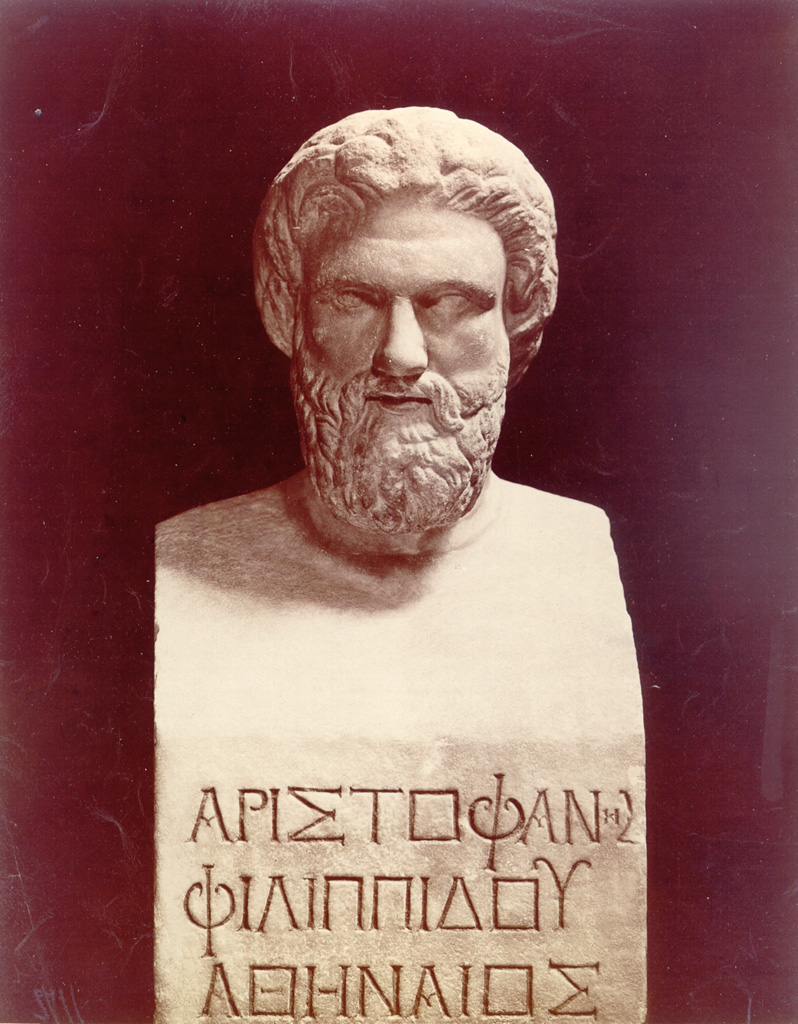
“The books of Aristophanes—divine labor—over which
Archanean ivy dangled its massive green hair.
See how much of Dionysus a page holds, how the stories
Echo, full of frightening charms.
Comic poet, best of heart, equal to the characters of Greece,
You both hated and mocked things that deserved it.”
“Yo, I’ll tell you what I want, what I really, really want”
-Spice Girls, “Wannabe,” 1996 A.D.
Philodemus 11.34 (Greek Anthology)
White violets and songs to the lyre,
Wines from Chios and myrrh from Syria,
Drinking parties and writhing harlots—
No thanks. Not again. I would lose my mind.
But wreaths of narcissus, put ‘em ‘round me.
Give me a taste of what the flute can do.
Rub my limbs with crocus-scented oils,
And soak my pipes with Mytilene wine.
Oh, and bring me a wife, a virgin and shy.
Λευκοΐνους πάλι δὴ καὶ ψάλματα, καὶ πάλι Χίους
οἴνους, καὶ πάλι δὴ σμύρναν ἔχειν Συρίην,
καὶ πάλι κωμάζειν, καὶ ἔχειν πάλι διψάδα πόρνην
οὐκ ἐθέλω: μισῶ ταὺτα τὰ πρὸς μανίην.
ἀλλά με ναρκίσσοις ἀναδήσατε, καὶ πλαγιαύλων
γεύσατε, καὶ κροκίνοις χρίσατε γυῖα μύροις,
καὶ Μυτιληναίῳ τὸν πνεύμονα τέγξατε Βάκχῳ,
καὶ συζεύξατέ μοι φωλάδα παρθενικήν.
A former dean of mine once sent an email to the faculty announcing a large grant to the college by a local business, providing for endowed chairs in the liberal arts. He had the temerity to announce in the very same email that he was giving himself one of these chairs. And he had a chair made with an inscription. The following is a slightly more humble epigraph.
Constantinus of Sicily, Greek Anthology 15.13
“If you are wise, sit on me. But if you’ve tasted the muse
Only with the tip of your finger…..
Move far away and find a different seat.
I am a chair who bears the burden of men who seek wisdom.”
Anonymous epitaph for Democritus, Greek Anthology 7.56
“This was the source of Democritus’ laughter, as he would say immediately:
‘Did I not say, while laughing, that everything is laughter in the end?
For I too, after my boundless wisdom and ranks of
So many books, lie beneath a tomb as a joke.’ ”
Joel sings “love is a battlefield” at every department holiday party, and yet no general ever says at muster, “troops, war is loving.” We don’t, that is, ordinarily reverse the terms of a metaphor. In practice, one term stands still and the other term does the work of elucidating it.
But what if metaphor flowed both ways (metaphorically speaking), such that on one occasion X elucidated Y, and on another occasion Y elucidated X? That is what we find in the Greek Anthology when we compare epigrams across their sepulchral and amatory boundaries.
It’s a dissonant reading, but one we’re justified in making when topoi arranged to make a poem about death are rearranged to make an equally effective poem about love. Furthermore, I think we can say that when responsibility for clarifying terms (love, death) passes back and forth between the terms themselves, the end result is a body of poems whose referents are one another.
Here are two pairings of an amatory and sepulchral epigram. In the first, it is the imagery of the sea, and in the second the imagery of robbery, that are employed to account for the phenomenologically distinct experiences of loving and dying. With each pairing, try to think not only of how death is a metaphor for love, but how love is a metaphor for death:
[1] The Sea
Meleager 5.190
Bitter wave of desire,
Restless winds of jealousy,
And a wintry sea of celebrations:
Where to, am I being carried?
Since my heart’s tiller swings this way and that,
Will I see that tender Scylla again?
Leonidas 5.273
The East wind’s savage, sudden gusts,
Night, and waves from Orion’s dark setting
Did me in: I, Callaeschrus, lost my hold on life
While sailing in the middle of the Libyan sea.
Tumbling about in the water, prey for fish,
I died. And so, this gravestone is a liar.
[2] Robbery
Anonymous 7.737
Here I am, a wretched man three times over:
Overpowered by a thief’s violence,
Prostrate, and wept for by no one.
Diophanes of Myrina 5.309
A thief three times over,
That’s what Desire should really be called:
He’s watchful, he’s brazen, he strips you bare.
Didyme has captured me with her eyes,
Alas! And I melt like wax before a flame
When I behold her beauty.
And if she’s black, so what?
Coals are too, and yet when we heat them
They glow like rose petals.
This epigram owes its fame chiefly to its eroticization of what, based on her/ name and her color, is presumed to be an African woman. But in a poem that is almost wholly conventional, the racialized woman, and the speaker’s justification of her, are poetic conventions too. If anything does distinguish the poem, it might be it’s prurience.
Most of the epigram’s conventional elements are easily identified: the eyes as instruments of bewitchment (Ibycus Fr.287); the lover’s liquefaction in the presence of desire (Alcman Fr.59a and Sappho Fr.112); eroticizing of skin color, albeit white skin (Rufinus 5.60 and Dioscorides 5.56 in the Greek Anthology [GA]); and the lover as inflaming the beloved (Rufinus 5.87 GA), when not the other way around.
Conventional also, though less obviously so, is the beloved’s roseate glow. In 2 epigrams about sexual intercourse (5.54 and 5.55 GA), Dioscorides describes a woman’s buttocks as “rose-like” in color. Rufinus describes the vagina as rose-like in its glow (5.36 GA) and uses “rose” as a euphemism for vagina (5.36 GA). So when Asclepiades suggests that the stimulated woman–and stimulation is what “heat them” references–glows red, the change in coloration is not to her skin in general, but to her sex organs.
What about her African name and dark skin? Scholars have pointed out that the name Didyme was quite common for Egyptian women in the period, and so we can read its use here as stereotypical (i.e., conventional). And as for Didyme’s dark skin, consider these lines by Philodemus (5.132 GA) who worked after Asclepiades:
If she’s Opician, and named Flora, and doesn’t sing Sappho’s songs,
No matter, even Perseus desired Indian Andromeda.
The English might not convey the extent to which the form of these lines–an objection and an answer to the objection–is nearly identical to “And if she’s black, so what? / Coals are too.” What structures the couplet in both Philodemus and Asclepiades is εἰδὲ . . . καὶ (“and if . . . even”, or translated differently, “and if . . . also”). “If she’s Opician” (from Opicia, the area around Naples) is modeled on “if she’s black” in Asclepiades. “Even Perseus” (or “Perseus too”) is modeled on “coals too” (or “even coals”) in Asclepiades. Perseus’ lover is marked as non-Greek and presumably brown just Asclepiades’ lover is non-Greek and black. If Asclepiades ‘invented’ the use of this form for racialized erotic content, then the tradition absorbed it and made it conventional, just as he himself had absorbed the tradition’s conventions.
Fayum mummy portrait. c.100 C.E. Royal Ontario Museum. ROM 918.20.1.
“Lathrian, please take this from the wanderer, the pauper,
The man of little flour, Leonidas, as thanks:
Moist cakes of barely and well-stored olive oil,
Along with this green fig straight from the tree.
Lady, take these five grapes from a cluster good for wine
And this final libation from the bottom of the cup.
And if you save me from hateful poverty as you saved me
From sickness, expect a young goat too.”
“I was struck immobile from my hips to the bottom of my feet
Completely denied my life’s work for so long,
Halfway between life and death, Hades’ neighbor,
Merely breathing, but a corpse in every other way.
But wise Philippos, whom you view in the picture,
Brought me back to life by healing the dread disease.
And Antoninus walks on the earth again as before!
I tread on it with my feet and I feel whole.”
Contemporaneous with any number of erotic epigrams collected in the Greek Anthology are the spells, rituals, and hymns of the Magic Papyri from Greco-Roman Egypt.
As these examples show, the epigrams and magic spells sometimes have nearly identical concerns: disrupting the beloved’s sleep or manipulating her dreams. Both epigram and magic spell seem a form of consolation for the frustrations of unrequited love. Yet I think it can be said of the epigram that it disciplines the sentiment with meter.
The magic spell, in contrast, seems an ongoing and futile acting-out. Also, the magic spell has this contradictory character: the lover bewitched by the beloved’s natural charms (her beauty, mind, character, or what have you) must resort to the supernatural to bewitch her in turn. The supernatural might represent awesome power, but its invocation underscores the insufficiency, the relative poverty, of the lover’s own means (his beauty, mind, character, or what have you). And of course the lover’s overvaluation of the beloved is also on display: he thinks only the gods are a match for her!