“My Soul Tried to Cross Our Lips”: More Platonic Love

Two more love poems attributed to Plato

Diogenes Laertius Vita Phil 1.3 [Plato 31] and Athenaeus 589e

“I have a lover from Kolophôn named Arkheanassa—
Potent lust rests even on her wrinkles
Poor wretches who met her during the first sailing
Of her youth—what a conflagration you passed through!”

Ἀρχεάνασσαν ἔχω τὴν ἐκ Κολοφῶνος ἑταίραν,
ἧς καὶ ἐπὶ ῥυτίδων ἕζετο δριμὺς ἔρως.
ἆ δειλοὶ νεότητος ἀπαντήσαντες ἐκείνης
πρωτοπλόου, δι᾿ ὅσης ἤλθετε πυρκαϊῆς.

The Greek Anth. 7.217 attributes a slightly different version to Asclepiades

“I have Arkheanassa, a lover from Kolophôn—
Sweet lust rests even on her wrinkles
Oh lovers who harvested the fruit of her youth
At first bloom—what a conflagration you passed through!”

Ἀρχεάνασσαν ἔχω, τὰν ἐκ Κολοφῶνος ἑταίραν,
ἇς καὶ ἐπὶ ῥυτίδων ὁ γλυκὺς ἕζετ᾿ Ἔρως.
ἆ νέον ἥβης ἄνθος ἀποδρέψαντες ἐρασταὶ
πρωτοβόλου, δι᾿ ὅσης ἤλθετε πυρκαϊῆς.

D. L = Gr. Anth. 7.78

“When kissing Agathon I felt my soul at my lips.
The wretch—for she was trying to cross between us.”

τὴν ψυχὴν Ἀγάθωνα φιλῶν ἐπὶ χείλεσιν εἶχον·
ἦλθε γὰρ ἡ τλήμων ὡς διαβησομένη.

According to Aelian, Plato’s career as a poet was cut short (Varia Historia 2.30); but note, though there is mention of epic and tragedy, the anecdote makes no claims for lyric and elegy:

“Plato, the son of Ariston, at first pursued poetry and used to write heroic verse. But he soon burned it all because he despised it, since he reckoned that his poetry was far inferior when compared to Homer’s. He then tried tragedy and even completed a tetralogy, and he was about to enter the competition, even to the point of giving the verses to actors. But right before the Dionysia, he went and heard Socrates; and once he was seized by that Siren, he not only withdrew from the competition, but he also gave up the writing of tragedy for good to immerse himself in philosophy.”

Πλάτων ὁ ᾿Αρίστωνος τὰ πρῶτα ἐπὶ ποιητικὴν ὥρμησε, καὶ ἡρωϊκὰ ἔγραφε μέτρα• εἶτα αὐτὰ κατέπρησεν ὑπεριδὼν αὐτῶν, ἐπεὶ τοῖς ῾Ομήρου αὐτὰ ἀντικρίνων ἑώρα κατὰ πολὺ ἡττώμενα. ἐπέθετο οὖν τραγῳδίᾳ, καὶ δὴ καὶ τετραλογίαν εἰργάσατο, καὶ ἔμελλεν ἀγωνιεῖσθαι, δοὺς ἤδη τοῖς ὑποκριταῖς τὰ ποιήματα. πρὸ τῶν Διονυσίων δὲ παρελθὼν ἤκουσε Σωκράτους, καὶ ἅπαξ αἱρεθεὶς ὑπὸ τῆς ἐκείνου σειρῆνος, τοῦ ἀγωνίσματος οὐ μόνον ἀπέστη τότε, ἀλλὰ καὶ τελέως τὸ γράφειν τραγῳδίαν ἀπέρριψε, καὶ ἀπεδύσατο ἐπὶ φιλοσοφίαν.
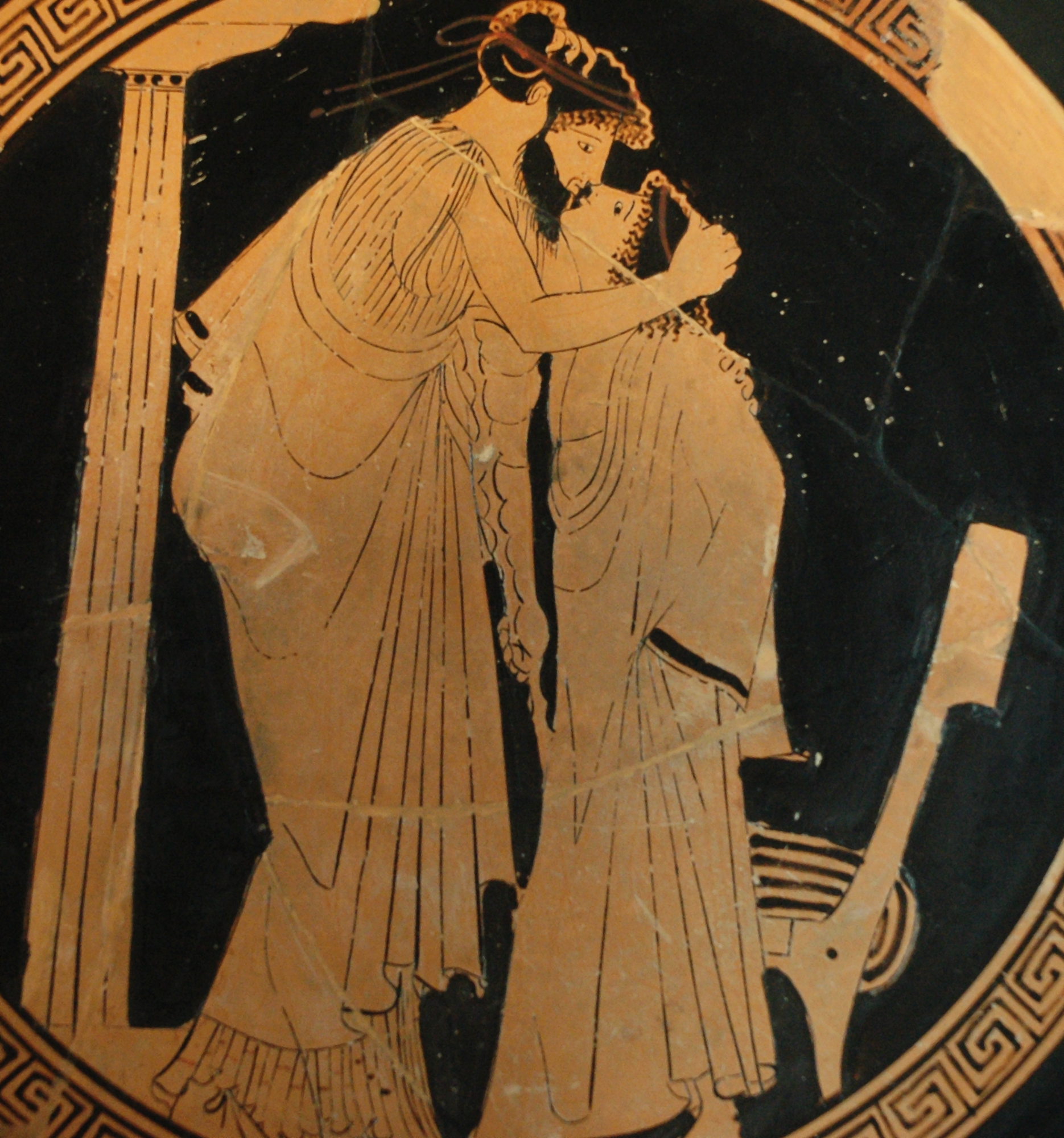
Image result for ancient greek kissing vase
Louvre G 278 Attributed to Briseis Painter

In Anticipation of AP Latin Week: Vergil, In Greek

Schol. In Plato Phaedrus 224b 21

“Virgilios, the poet of the Romans.”

Βιργί*λιος δὲ ὁ ῾Ρωμαίων ποιητὴς…

Greek Anthology: On A statue of the Poet Virgil

“Here stands prominent the clear-voiced swan beloved to Ausonians
Vergil, breathing out beautiful epic, a man whom his paternal Tiber’s
Echoes raised up as a second Homer.”

Εἰς ἄγαλμα τοῦ ποιητοῦ Βιργιλίου

Καὶ φίλος Αὐσονίοισι λιγύθροος ἔπρεπε κύκνος,
πνείων εὐεπίης Βεργίλλιος, ὅν ποτε Ῥώμης
Θυμβριὰς ἄλλον Ὅμηρον ἀνέτρεφε πάτριος ἠχώ.

Gr. Anth 16. 151.—Anonymous: Εἰς εἰκόνα Διδοῦς

“Friend, you are gazing upon an image of that Famous Dido,
An icon shining with her divine beauty.
I looked like this, but I wasn’t the person you hear of,
I have fame for honorable deeds.
For I never gazed on Aeneas nor did I go
To Libya around the time that Troy was sacked.
But I was fleeing the rape of marriage to Iarbas
When I stuck the double-edged sword through my heart.
Muses, why did you station a pure Vergil against me
Who made a lie of my prudence?”

Ἀρχέτυπον Διδοῦς ἐρικυδέος, ὦ ξένε, λεύσσεις,
εἰκόνα θεσπεσίῳ κάλλεϊ λαμπομένην.
τοίη καὶ γενόμην, ἀλλ᾿ οὐ νόον, οἷον ἀκούεις,
ἔσχον, ἐπ᾿ εὐφήμοις δόξαν ἐνεγκαμένη.
οὐδὲ γὰρ Αἰνείαν ποτ᾿ ἐσέδρακον, οὐδὲ χρόνοισι
Τροίης περθομένης ἤλυθον ἐς Λιβύην·
ἀλλὰ βίας φεύγουσα Ἰαρβαίων ὑμεναίων
πῆξα κατὰ κραδίης φάσγανον ἀμφίτομον.
Πιερίδες, τί μοι ἁγνὸν ἐφωπλίσσασθε Μάρωνα
οἷα καθ᾿ ἡμετέρης ψεύσατο σωφροσύνης;

Image result for Ancient Roman Vergil

Epitaphs for Legendary Poets

Greek Anthology 7.7

“Here lies Homer who sang of all Greece,
Born and bred in hundred-gated Thebes”

᾿Ενθάδε θεῖος ῞Ομηρος, ὃς ῾Ελλάδα πᾶσαν ἄεισε,
Θήβης ἐκγεγαὼς τῆς ἑκατονταπύλου.

Greek Anthology 7.8

“Orpheus, you will no longer lead away oaks or stones
Bewitched by your song, or the leaderless herds of beasts.
You will no longer sing the howl of the wind or the hail to sleep
Or calm blizzards of snow or the roaring of the sea.
For you have died. The daughters of memory mourn you
Much, and especially your mother Kalliope.
Why do we weep over our dead sons when not even the gods
Can ward Hades from their children?”

Οὐκέτι θελγομένας, ᾿Ορφεῦ, δρύας, οὐκέτι πέτρας
ἄξεις, οὐ θηρῶν αὐτονόμους ἀγέλας·
οὐκέτι κοιμάσεις ἀνέμων βρόμον, οὐχὶ χάλαζαν,
οὐ νιφετῶν συρμούς, οὐ παταγεῦσαν ἅλα.
ὤλεο γάρ· σὲ δὲ πολλὰ κατωδύραντο θύγατρες
Μναμοσύνας, μάτηρ δ’ ἔξοχα Καλλιόπα.
τί φθιμένοις στοναχεῦμεν ἐφ’ υἱάσιν, ἁνίκ’ ἀλαλκεῖν
τῶν παίδων ᾿Αίδαν οὐδὲ θεοῖς δύναμις.

Image result for ancient greek orpheus

Two For Tawdry Tuesday: A Mom Joke and Salacious Salutations

A girlfriend’s mom joke

Greek Anthology 5.127 (Attributed to Marcus Argentarius)

I was really in love with the maiden Alkippê and once
I persuaded her I took her secretly to bed.
Our chests were pounding over anyone entering—
That someone might see the secrets of excessive desire.
The bed’s chatter didn’t get by her mother— she looked in
And suddenly said: “Daughter, Hermes is shared””

Παρθένον Ἀλκίππην ἐφίλουν μέγα, καί ποτε πείσας
αὐτὴν λαθριδίως εἶχον ἐπὶ κλισίῃ.
ἀμφοτέρων δὲ στέρνον ἐπάλλετο, μή τις ἐπέλθῃ,
μή τις ἴδῃ τὰ πόθων κρυπτὰ περισσοτέρων.
μητέρα δ᾽ οὐκ ἔλαθεν κλίνης λάλον· ἀλλ᾽ ἐσιδοῦσα
ἐξαπίνης· “Ἑρμῆς κοινός,” ἔφη, “θύγατερ.”

A weird salutation of body parts that takes a surprising racist turn

Greek Anthology, 5.132 (Attributed to Philodemus)

“Hello foot and calves, and oh—I should be dying here—thighs
Oh buttocks, Oh pussy, hey ass—
Oh shoulders, Oh breasts, what the slender neck,
The hands, oh—seriously I am losing my mind—eyes,
Oh bedeviled-craft of movement, Oh luxurious
Lickings, oh—come on, kill me now—the sounds from her mouth.
Even if she is Oscan and her name is Phlora and she doesn’t know Sappho,
Well, even Perseus loved Indian Andromeda.”

Ὢ ποδός, ὢ κνήμης, ὢ τῶν (ἀπόλωλα δικαίως)
μηρῶν, ὢ γλουτῶν, ὢ κτενός, ὢ λαγόνων,
ὢ ὤμοιν, ὢ μαστῶν, ὢ τοῦ ῥαδινοῖο τραχήλου,
ὢ χειρῶν, ὢ τῶν (μαίνομαι) ὀμματίων,
ὢ κακοτεχνοτάτου κινήματος, ὢ περιάλλων
γλωττισμῶν, ὢ τῶν (θῦέ με) φωναρίων.
εἰ δ᾽ Ὀπικὴ καὶ Φλῶρα καὶ οὐκ ᾄδουσα τὰ Σαπφοῦς,
καὶ Περσεὺς Ἰνδῆς ἠράσατ᾽ Ἀνδρομέδης.

Image result for Ancient Greek satyr

Tawdry Tuesday, Imperial Edition: F*ck or Fight? (NSFW)

Martial, Epigrams 11.20

“Creep, who looks upon Latin words with sad eyes,
Read by Augustus Caesar these six dirty lines:*

‘Because Antony fucks Glaphyra, Fulvia has assigned
This penality as mine: I need to fuck Fulvia too.
I should fuck Fulvia? What if Manius would beg
That I sodomize him? Would I? Probably not, if I were wise.
“But fuck, or let us fight” she says. But what—is my life
dearer than my dick?** Let the war-trumpets sound.’

Augustus, you endorse these charming little books for me
Since you know how to speak with such Roman honesty.”

Caesaris Augusti lascivos, livide, versus
sex lege, qui tristis verba Latina legis:
‘quod futuit Glaphyran Antonius, hanc mihi poenam
Fulvia constituit, se quoque uti futuam.
Fulviam ego ut futuam? quid si me Manius oret
pedicem? faciam? non puto, si sapiam.
“aut futue; aut pugnemus” ait. quid quod mihi vita
carior est ipsa mentula? signa canant!’
absolvis lepidos nimirum, Auguste, libellos,
qui scis Romana simplicitate loqui.

*There is doubt whether or not Augustus composed these lines. If he did, then, as the speculation goes, someone published them in a collection of Principis Epigrammata.

**I reversed the Latin sense of vita (in the ablative) and mentula (nominative) for what feels to me like a more natural expression in English.

While we are on (a) topic, here are some useful principal parts in Latin and Greek.

futuo, futuere, futui, futatus
βινέω, βινήσω, ἐβίνησα, βεβίνηκα, βεβίνημαι, ἐβινήθην

Image result for Ancient Roman dirty poems
ipsa mentula carior vita est?

Tawdry Tuesday: Zeus, Ganymede, and a Cock

Greek Anthology, Antipater 5.77

“Hera twisted by the beauty of Ganymede once spoke
As she suffered the heart-rending stab of jealousy in her heart:
“Troy ignited a male fire for Zeus—and so I will send
A fire at Troy, a pain bearing Paris.
No eagle will come to Troy again, but vultures
Will go to the feast when the Greeks get the spoils for their toils.”

Πριομένα κάλλει Γανυμήδεος εἶπέ ποθ᾿ Ἥρα,
θυμοβόρον ζάλου κέντρον ἔχουσα νόῳ·
“Ἄρσεν πῦρ ἔτεκεν Τροία Διΐ· τοιγὰρ ἐγὼ πῦρ
πέμψω ἐπὶ Τροίᾳ, πῆμα φέροντα Πάριν·
ἥξει δ᾿ Ἰλιάδαις οὐκ ἀετός, ἀλλ᾿ ἐπὶ θοίναν
γῦπες, ὅταν Δαναοὶ σκῦλα φέρωσι πόνων.”

Sometimes an Eagle Does show up in stories of Zeus and Ganymede. 

Greek Anthology 12.211

“Go to bright heaven, go carrying the child,
Eagle, keep your twin wings spread wide.
Go holding gentle Ganymede and do not drop
Zeus’ wine-bearer of the sweetest cups.
But be careful not to bloody him with your clawed feet
So that Zeus, upset, won’t hurt you.”

Στεῖχε πρὸς αἰθέρα δῖον, ἀπέρχεο παῖδα κομίζων,
αἰετέ, τὰς διφυεῖς ἐκπετάσας πτέρυγας,
στεῖχε τὸν ἁβρὸν ἔχων Γανυμήδεα, μηδὲ μεθείης
τὸν Διὸς ἡδίστων οἰνοχόον κυλίκων·
φείδεο δ᾿ αἱμάξαι κοῦρον γαμψώνυχι ταρσῷ,
μὴ Ζεὺς ἀλγήσῃ, τοῦτο βαρυνόμενος.

MFA #01.8114

Image result for ganymede rooster Zeus
Terracotta of Zeus with Ganymede (LIMC 56; from Olympia)
Image result for ganymede rooster Zeus
Attic red-figured hydria
Attributed to Eupolis P. by Beazley
Approx. 450 -440 BC
This image from the MFA shows Zeus contemplating what to do with his cock.
Image result for ganymede rooster Zeus Black figure
Zeus pursuing Ganymedes, Athenian red-figure kantharos C5th B.C., Museum of Fine Arts Boston

Tawdry Tuesday: Stood Up? Try a Sinister Replacement (Kind of NSFW)

Martial, Epigrams 11.72

“You always swear you will come to me, Lygdus, when I ask
And you promise a time and a place.

When I stretch out tense with prolonged excitement,
Often my left hand rushes in to replace you.

Liar! What should I beg for these deeds, these habits?
Lygdus—may you bear the umbrella of a one-eyed lady.”

Venturum iuras semper mihi, Lygde, roganti
constituisque horam constituisque locum.
cum frustra iacui longa prurigine tentus,
succurrit pro te saepe sinistra mihi.
5quid precer, o fallax, meritis et moribus istis?
umbellam luscae, Lygde, feras dominae.

And, to make this all a little more acceptable, here’s Martial on his choice of dicktion:

Epigrams, 3.69

“Because you write all your verses with nice words
There’s never a cock in your songs.
I admire this, I praise this. Nothing is holier than you alone.
But no page of mine lacks, well, lubrication.

Let nasty boys and easy girls read these poems then;
Let the old man who has a girlfriend to taunt him read them.
But, Cosconius, your holy and venerable words
Ought to be read by young boys and virgins.”

Omnia quod scribis castis epigrammata verbis
inque tuis nulla est mentula carminibus,
admiror, laudo; nihil est te sanctius uno:
at mea luxuria pagina nulla vacat.
haec igitur nequam iuvenes facilesque puellae,
haec senior, sed quem torquet amica, legat.
at tua, Cosconi, venerandaque sanctaque verba
a pueris debent virginibusque legi.

This poem reminds me of another where Martial defends himself by explaining that it is hard to write a poem without a penis. Harvesting from the garden of the Muses….

Bibliothèque nationale de France, Français 25526 (Roman de la Rose, France 14th century), fol. 160r.  What are these women picking?!
Bibliothèque nationale de France, Français 25526 (Roman de la Rose, France 14th century), fol. 160r.

Tawdry Tuesday: More Erectile Dysfunction Poems from Ancient Greece (NSFW)

From the Greek Anthology, 11.29 (Automedon)

“Send, Call for her—everything is ready for you. But when she arrives,
What will you do? Give that some thought, Automedon.
For this, which was tireless before, is now squishier than
A boiled carrot and it has retreated back between your thighs.
They will laugh at you a lot when you set out unarmed
Trying to steer your ship without an oar.”

Πέμπε, κάλει· πάντ’ ἐστὶν ἕτοιμά σοι. ἢν δέ τις ἔλθῃ,
τί πρήξεις; σαυτῷ δὸς λόγον, Αὐτόμεδον.
αὕτη γὰρ λαχάνου σαθρωτέρη ἡ πρὶν ἀκαμπὴς
ζῶσα νεκρὰ μηρῶν πᾶσα δέδυκεν ἔσω.
πόλλ’ ἐπὶ σοὶ γελάσουσιν, ἀνάρμενος ἂν παραβάλλῃ
πλώειν τὴν κώπην μηκέτ’ ἔχων ἐρέτου.

small-bronze
I named this picture “small bronze”, because it is a small picture of a bronze statue

Straton, 12.240

“The hair is already gray on my temples
And my dick hangs slack between my thighs.
My balls are useless: age overcomes me hard.
Alas, I know how to fuck but I can’t.”

῎Ηδη μοι πολιαὶ μὲν ἐπὶ κροτάφοισιν ἔθειραι,
καὶ πέος ἐν μηροῖς ἀργὸν ἀποκρέμαται·
ὄρχεις δ’ ἄπρηκτοι, χαλεπὸν δέ με γῆρας ἱκάνει.
οἴμοι, πυγίζειν οἶδα καὶ οὐ δύναμαι.

πυγίζειν: I have selected the generally vulgar “fuck” for this verb which is likely a denominative from πυγή (variously, “ass”, “anus”, “buttocks”). The Loeb translates this as “sodomize”, which is probably more to the point but misses the inventiveness (“analize” might work).
Here is a perfectly wretched poem by the same author, using some of the same words.

12.245

“All the unthinking animals fuck only; those who think
Have something more than the rest of the animals in this:
We discovered ass-fucking. All the men who are ruled by women
Have nothing more than the rest of the living beasts.”

Πᾶν ἄλογον ζῷον βινεῖ μόνον· οἱ λογικοὶ δὲ
τῶν ἄλλων ζῴων τοῦτ’ ἔχομεν τὸ πλέον
πυγίζειν εὑρόντες. ὅσοι δὲ γυναιξὶ κρατοῦνται,
τῶν ἀλόγων ζῴων οὐδὲν ἔχουσι πλέον.

Not the Least Part of Wisdom

An epigram attributed to Euenus

3 Stob. 2.15.4 Ζήνου (Εὐήνου Bach, Ζηνοδότου Gaisford)

“I believe that a share of wisdom not too small
Is knowing rightly what each person is like”

ἡγοῦμαι σοφίης εἶναι μέρος οὐκ ἐλάχιστον
ὀρθῶς γινώσκειν οἷος ἕκαστος ἀνήρ.

Not too small a measure of wisdom I believe
Is knowing exactly what kind of person each may be.

Come on, play along. Make a better couplet than this!


Image result for Ancient Greek hero vase

“The Rest Can Go to Hell”: Some Funerary Epigrams

Before New Year’s Eve, Palaiophron tweeted the following from Simonides:

In desperation and joy, I scoured book seven of the Greek Anthology looking for more. I did not find any the equal of Simonides’ genius above, but here are some others.

Julian 33

“You died from drinking too much, Anacreon.”
“Yes, it was fun! You’ll die too, even though you didn’t drink”

Πολλὰ πιὼν τέθνηκας, Ἀνάκρεον. β. Ἀλλὰ
τρυφήσας· καὶ σὺ δὲ μὴ πίνων ἵξεαι εἰς Ἀΐδην.

Julian

“I have sung this much and I will sing it from eternal rest:
Drink before you don this dusty dress!”

Πολλάκι μὲν τόδ᾿ ἄεισα, καὶ ἐκ τύμβου δὲ βοήσω·
“Πίνετε, πρὶν ταύτην ἀμφιβάλησθε κόνιν

Antipater 15

“My name is Sappho—and I surpassed women in song
As much as Homer did the men.”

Οὔνομά μευ Σαπφώ. τόσσον δ᾿ ὑπερέσχον ἀοιδὰν
θηλειᾶν, ἀνδρῶν ὅσσον ὁ Μαιονίδας.

Anonymous, 28

‘Stranger going by this tomb of Anakreon,
Pour me some wine as you pass by. For I am a drinker.”

Ὦ ξένε, τόνδε τάφον τὸν Ἀνακρείοντος ἀμείβων,
σπεῖσόν μοι παριών· εἰμὶ γὰρ οἰνοπότης.

Anonymous 63 

“Ferryman of the corpses, take me, the dog Diogenes
Who exposed all of life’s affectations.”

Τὸν κύνα Διογένη, νεκυοστόλε, δέξο με, πορθμεῦ,
γυμνώσαντα βίου παντὸς ἐπισκύνιον.

Anonymous  84

“This grave is small, but its fame is equal to heaven
For this is the memorial of the brilliant Thales”

Ἦ ὀλίγον τόδε σᾶμα, τὸ δὲ κλέος οὐρανόμηκες
τοῦ πολυφροντίστου τοῦτο Θάλητος ὅρη.

Anonymous  134

“Here lies the head of the Cynic Gorgias,
No longer coughing or blowing my nose”

Ἐνθάδε Γοργίου ἡ κεφαλὴ κυνικοῦ κατάκειμαι,
οὐκέτι χρεμπτομένη, οὔτ᾿ ἀπομυσσομένη.

Anonymous 348

“After eating little, drinking little, and being sick a lot
Eventually I died. Go to hell the rest of you too!”

Βαιὰ φαγὼν καὶ βαιὰ πιὼν καὶ πολλὰ νοσήσας,
ὀψὲ μέν, ἀλλ᾿ ἔθανον. ἔρρετε πάντες ὁμοῦ.

Image result for Ancient Greek epitaph

Erycius 377

“Even though he lies in the ground, pour out pitch
In the filthy mouth of Parthenius
Because he puked meaningless myriad floods on the muses
And his refuse of his repugnant poems.
”He was so absolutely crazy that he called
The Odyssey mud and the Iliad a mess.
That’s why he is chained by the dusky Furies
In the middle of hell with a dog collar on his neck”

Εἰ καὶ ὑπὸ χθονὶ κεῖται, ὅμως ἔτι καὶ κατὰ πίσσαν
τοῦ μιαρογλώσσου χεύατε Παρθενίου,
οὕνεκα Πιερίδεσσιν ἐνήμεσε μυρία κεῖνα
φλέγματα καὶ μυσαρῶν ἀπλυσίην ἐλέγων.
ἤλασε καὶ μανίης ἐπὶ δὴ τόσον, ὥστ᾿ ἀγορεῦσαι
πηλὸν Ὀδυσσείην καὶ βάτον Ἰλιάδα.
τοιγὰρ ὑπὸ ζοφίαισιν Ἐρινύσιν ἀμμέσον ἧπται
Κωκυτοῦ κλοιῷ λαιμὸν ἀπαγχόμενος.