As many know and many love, Catullus 51 is a ‘translation’. This poem brought my first exposure to Sappho at the tender age of 16. I can translate it almost without looking at it.
“That man seems to me equal to a gods,
that man, if it is right, surpasses the gods
as he sits opposite you
seeing and hearing you
sweetly laughing; every sense escapes
miserable me: for the same time I see you
Lesbia, nothing is left for me
my tongue grows heavy, and a tender flame
flickers under my limbs, and twin ears
ring with their own sound, my eyes
are shaded by night.
Leisure, Catullus, is your problem:
you revel in leisure and you have done too much.
Leisure has brought kings low,
and destroyed cities once rich.”
Ille mi par esse deo videtur,
ille, si fas est, superare divos,
qui sedens adversus identidem te
spectat et audit
dulce ridentem, misero quod omnis
eripit sensus mihi: nam simul te,
Lesbia, aspexi, nihil est super mi
* * * * * * * *
lingua sed torpet, tenuis sub artus
flamma demanat, sonitu suopte
tintinant aures gemina, teguntur
lumina nocte.
otium, Catulle, tibi molestum est:
otio exsultas nimiumque gestis:
otium et reges prius et beatas
perdidit urbes.
Sappho is pretty amazing. I also love this anecdote from Aelian:
Aelian, Fragment 187/190 (from Stobaeus 3.29.58)
“Solon the Athenian, the son of Eksêkestides, when his nephew sang some song of Sappho at a drinking party, took pleasure in it and asked the young man to teach it to him. When someone asked why he was eager to learn it, he responded: “So, once I learn it, I may die.”
Boccacio, de mulieribus claris/Le livre de femmes nobles et renomées (trad. anonyme), 15-16th century, France (Cognac). Bibliothèque Nationale MS Français 599 fol. 42
“In sum, whatever we do we are compelled to do by either malice or virtue. What controls a body, is corporeal; what gives force to a body is a body. The good of a body is corporeal good; the good of a person is the good of a body—therefore it too is corporeal.
Since I have pursued this custom as you wanted, now I myself will say what I expect you to say: “we have been playing games!” Our wit is worn thing by silly things—they make us learned but not good. To be wise is a more obvious matter—it is much better to use literature to improve the mind, but we waste the rest of our time in empty matters, and so we waste philosophy itself. Just as in all things, so too we labor excessively over literature. We learn not for life but for school. Goodbye.”
Denique quidquid facimus, aut malitiae aut virtutis gerimus imperio. Quod imperat corpori, corpus est, quod vim corpori adfert, corpus. Bonum corporis corporalest,bonum hominis et corporis bonum est; itaque corporale est.
11Quoniam, ut voluisti, morem gessi tibi, nunc ipse dicam mihi, quod dicturum esse te video: latrunculis ludimus. In supervacuis subtilitas teritur; non faciunt bonos ista, sed doctos. Apertior res est sapere, immo simpliciter satius est ad mentem bonam uti litteris, sed nos ut cetera in supervacuum diffundimus, ita philosophiam ipsam. Quemadmodum omnium rerum, sic litterarum quoque intemperantia laboramus; non vitae sed scholae discimus. Vale.
Dirc van Delf, Table of Christian Faith, in Dutch, The Netherlands, Utrecht(?), ca. 1405-10, Illuminated by the Masters of Dirc van Delft (from pinterest)
“Both habits, moreover, should be avoided. Don’t imitate bad people, because there are many of them, nor hate the many, because you aren’t like them. Take shelter in yourself, whenever you can. Spend time with people who will make you a better person. Embrace those whom you can make better. Such improvement is a partnership, for people learn while they teach.”
Utrumque autem devitandum est; neve similis malis fias, quia multi sunt, neve inimicus multis, quia dissimiles sunt. Recede in te ipsum, quantum potes. Cum his versare, qui te meliorem facturi sunt. Illos admitte, quos tu potes facere meliores. Mutuo ista fiunt, et homines, dum docent, discunt.
Seneca, De Beata Vita 17-18
“ ‘This is enough for me: to each day lose one of my vices and recognize my mistakes. I have not perfected my health, nor certainly will I. I hope to relieve my gout rather than cure it, happy if it comes less frequently and cause less pain. But when I compare myself to your feet, I am a sprinter even though crippled.’
I do not say these things for myself—since I am deep in every kind of vice—but for the person who has done something.
You say, “You talk one way but you live another.” This insult, most shameful and hateful friend, was thrown at Plato, tossed at Epicurus, and dropped on Zeno. For all these people were talking not about how they were living themselves but about how they should live. When it comes to virtue, I do not talk about myself, and my fight is with vices, but chiefly my own. When I can, I will live as I should.”
Hoc mihi satis est, cotidie aliquid ex vitiis meis demere et errores meos obiurgare. Non perveni ad sanitatem, ne perveniam quidem; delenimenta magis quam remedia podagrae meae compono, contentus, si rarius accedit et si minus verminatur; vestris quidem pedibus comparatus, debilis1 cursor sum.” Haec non pro me loquor—ego enim in alto vitiorum omnium sum—, sed pro illo, cui aliquid acti est.
“Aliter,” inquis, “loqueris, aliter vivis.” Hoc, malignissima capita et optimo cuique inimicissima, Platoni obiectum est, obiectum Epicuro, obiectum Zenoni; omnes enim isti dicebant non quemadmodum ipsi viverent, sed quemadmodum esset ipsis vivendum. De virtute, non de me loquor, et cum vitiis convicium facio, in primis meis facio. 2Cum potuero, vivam quomodo oportet.
As many people know, the word scholarship is somewhere in the past derived from the Ancient Greek skholê for “leisure” (since literary and linguistic studies were both the sorts of things people did in their leisure time and you had to be a person with leisure time to do them). This also happens to be the word that Woodhouse’s English-Greek Dictionary provides as the translation for English “vacation”.
(also, just ruminate on the Latin etymology of vacation for a minute, the implied emptiness…)
One of the popular—and politically expedient—myths about people who teach (both at the college level and lower) is that we are people of leisure—we have too much idle time to engage in (1) not doing ‘real’ work or (2) brainwashing those naïve children society entrusts to us. The truth—especially for college faculty on contract or in contingent positions, for those early in their career or looking for jobs, or for anyone who teaches elementary through high school—is that the past generation has seen the slow but steady erosion of the boundary between leisure and work.
Seneca, De Brevitate Vitae 7
“When will this year end?” One man gives games and even though he set a great worth on being able to do so, now says, “When will I flee them?” Another lawyer is praised over the whole forum and attracts a great crowd extending farther than they can hear, yet he complains, “When will I get a break?”
Everyone hurries life on and suffers a desire for the future and a weariness from the present. But the one who dedicates all his time to his own use, who orders every day as if it is the last one, neither desires nor fears tomorrow.”
“Quando hic annus praeteribit?” Facit ille ludos, quorum sortem sibi optingere magno aestimavit: “Quando,” inquit, “istos effugiam?” Diripitur ille toto foro patronus et magno concursu omnia ultra, quam audiri potest, complet: “Quando,” inquit, “res proferentur?” Praecipitat quisque vitam suam et futuri desiderio laborat, praesentium taedio. At ille qui nullum non tempus in usus suos confert, qui omnem diem tamquam ultimum ordinat, nec optat crastinum nec timet.
This boundary has moved not in our favor but in the direction of creating an environment in which teachers and academics never stop working. This is true for many fields where technology and the unholy god of efficiency has extended work hours and expected employees to take work home and to answer work communication at all hours. But it is especially damaging for mental health in higher ed and high school where we buy in to the idea of the life of the mind and willingly submit to the elision between our personal and professional selves.
This means that high school teachers grade until 9 or 10 at night (on an early night) because they are with students until almost dinner time. This means that professors teaching adjunct courses still feel compelled to answer emails at 1 AM because they don’t want lower teaching evaluations. This means that early career professors in the tenure track put off having children or being in relationships for decades because they don’t have the time. This means that life passes us by because we are trying so hard to make the most out our lives.
A few years back in Facebook, Dr. S. Culpepper Stroup (a fantastic name of which I am very jealous) makes a great point about the difference between otium (leisure) and negotium (business) in Latin. The long-and-short of it is that the Roman lexicon reflects an inverse relationship between our work and vacation. But, here are her finer words (quoted with permission):
Speaking of *otium* (as I always do) and its centrality to the Roman intellectual sphere, consider its opposite: *negotium*. Latin instructors often team *otium* as “leisure” and *negotium* as “business,” both of which absolutely miss the train in terms of semantic designation.
(Leisure comes from the Latin *licet*, so it indicates a time when one is *allowed* to do a specific activity, which absolutely lacks the strong autonomous sense of *otium*.)
Anyway, *negotium* is—obviously—the privative of *otium* (early on we see it in Plautus as “nec otium mihi”). *Negotium* is the time when you are deprived of *otium*.
The English “vacation” completely reverses that, making work the “full” thing (full of work, that is), and vacation the privative.
I far prefer the Roman sense of *otium*, as a self-owned time that needed no apologies.
Euripides, Hippolytus 383-384
“Life has many pleasures
Long talks and leisure, a pleasant evil…”
Smarter and more well-informed people than I can make the argument about the evils of neo-liberal capitalism and the commodification of everything. They can point out the insidious culture that insists us to see our online persona as our actual selves and to envision the ‘life’ we pursue there as a never ending process of branding and re-branding to ensure that we will never be less than fully commodifiable. I can merely confess that the anxiety, workload, and self-identification has shaped me in such a way that it is really, really hard to take any time off.
I was grading exams the days both of my children were born (and I got reprimanded by my chair for not entering grades soon enough after). When my daughter was learning to walk, I cheered her on as I furiously finished a book and a few articles to ensure I received tenure. I took one week off when my father died suddenly. I have brought sick kids to class repeatedly. I took one day off when my grandmother died.. None of this is necessary, admirable, or worthy of praise; all of it is from guilt, pressure, and our toxic work culture. And I know I don’t have it particularly bad. I have tenure. I have a place in the world, job security, and safety.
But at this point, I am what I do and I do what I am. I take articles to read at the playground. I proof articles while my kids are at swimming lessons. I have dragged work to Italy, India, France, Germany. Somehow I have not totally ruined my relationship with my spouse by slinking out of bed regularly at 5 am or answering emails after the children are asleep. I have lived through my work and despite my work. And I worry about the long-term consequences.
But I keep going because I love my material, because I love my students and my institution, and because of the fear and guilt: I know there are many others who are smarter, who have worked harder, but who have not had some of the dumb luck I have (or the privilege to which I was born) to end up where I am.
Cicero, Pro Murena 28
“No one can be famous for being wise if it is concerning the type of knowledge which is worthless anywhere beyond Rome and even at Rome too during a vacation. No one can be an expert on something which everyone knows because there can’t be any disagreement on the matter. A subject cannot be considered difficult just because it exists in a very few and rather obscure documents.”
Sapiens existimari nemo potest in ea prudentia quae neque extra Romam usquam neque Romae rebus prolatis quicquam valet. Peritus ideo haberi nemo potest quod in eo quod sciunt omnes nullo modo possunt inter se discrepare. Difficilis autem res ideo non putatur quod et perpaucis et minime obscuris litteris continetur.
At the end of the day (and a life!), I cannot be sure that work that I do is worth the emotion I have put into it. But, of course, this does not mean I can or will stop. I can, however, try to reset definitions a bit and remember to enjoy life a little more and take time off.
So, I am not going to go all memento mori and carpe diem today. (My students already think I have some sort of death-obsessed insanity.) And I won’t claim to be especially unlucky when I know the opposite is true. But I will say that we have a problem in education, especially: we spend a lot of time claiming that we can teach about the value of human life even as we fail so terribly at honoring the worth of our own.
So, the next week of posts will be repeats, cleverly repackaged along with a few retrospective posts I threw together earlier. I am going to try not to do work for a week. Again.
“Know well that you are mortal: fill your heart
By delighting in the feasts: nothing is useful to you when you’re dead.
I am ash, though I ruled great Ninevah as king.
I keep whatever I ate, the insults I made, and the joy
I took from sex. My wealth and many blessings are gone.
[This is wise advice for life: I will never forget it.
Let anyone who wants to accumulate limitless gold.]
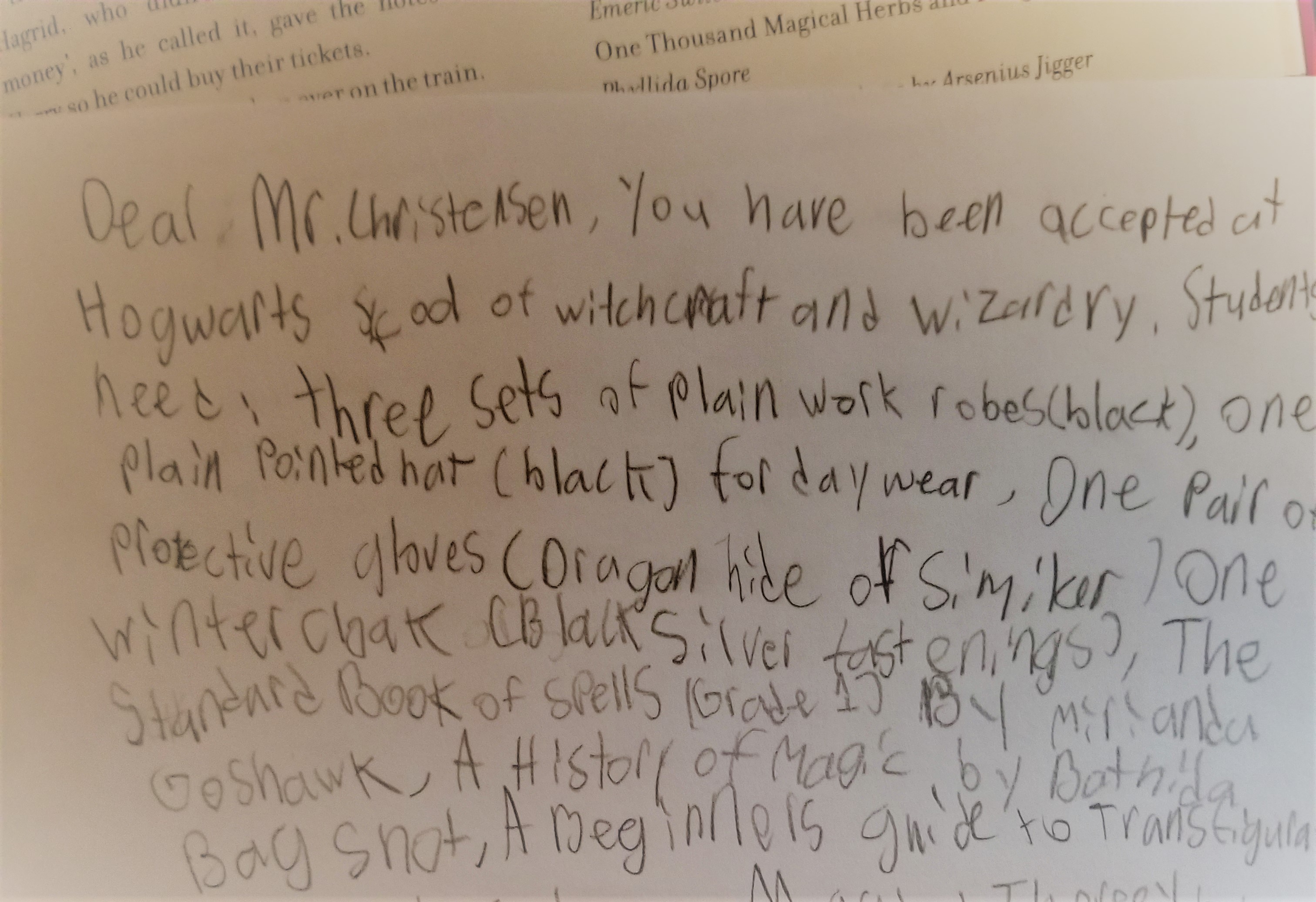
This week, I discovered that my children were secretly making holiday gifts for each other. I walked into the office and found my daughter writing a Hogwarts acceptance letter for her brother, because he wants magic to be real.
The starting address killed me here. But then the level of detail!
Let’s just say that after witnessing this I left the room and had a sudden, prolonged attack of itchy eyes.
I was crying in part because the moment was just so sweet and emerged from a year of the children learning to love the world of Harry Potter. But this was the same day J. K. Rowling was in the news for supporting bigotry, for showing public support of a transphobic UK Academic. (And a lot of analysis online has made it clear that this is not a casual mistake, that she has a pattern of antagonism towards transgender people.) There was a lot of justifiable anger and disappointment online, as several communities wrangled with how to wrangle with this.
This is not, of course, the first time the author of the Harry Potter series has courted controversy. At times she has expressed offensive or poorly nuanced political views; at others, she has seemed to hastily adapt her fictional world to the realities of the contemporary one, claiming, for example, that Dumbledore was always gay.
Euripides, Suppliant Women, 913-917
“For even an infant learns to speak
And listen to things he has no understanding of.
Whatever someone learns, he wants to save
For old age. So, teach your children well.”
As many of my former and current students know, I resisted the whole Harry Potter phenomenon for years because I was already teaching when it started (and was thus too cool for the narrative), because, like others, I was weaned on other narratives which had seemed forgotten, like Lloyd Alexander’s cycle, Susan Cooper’s Dark is Rising Sequence, or the unending Wheel of Time. But I was mostly frustrated that at its core, the Harry Potter books are just the same old heroic narrative recycled
As I have written about before the heroic pattern has a great potential to cause harm. The basic heroic narrative is regressive, heteronormative, male-centered, and often, when realized in a western context, racist. It limits roles, sets people up for severe disappointment, and can also eventuate in violence
I was worried about some of these influences when my kids started reading the books because narratives can have such powerful impact on how we view ourselves in the world. My children are young, already shaped by social expectations for gender. The Potter books don’t really give much space to women, they cast good and evil in a rather stark divide (until near the end), and they tokenize non-white characters. My children are bi-racial and are not Christian.
I was worried they would not see themselves in the books or would simply see themselves as peripheral. When it comes to people who look like them or have names closer to theirs, things get a little bleak: The Indian characters in the book are mere UK colonial props, like chicken curry in a pub.
But oh, whatever my reservations, how they fell in love! My daughter, who had read eagerly for a bit but then got overwhelmed by longer books, started listening to the audiobooks while we were driving and then would immediately go to the book when we got home. Before long, she would listen while reading and made a huge leap in her confidence and comprehension. My son, precocious in the way only younger brothers can be, tore through the books in a few months. And then started again a second time.
Seneca, EM 3.3
“What you see happen to children happens to us, too, who are but slightly greater children.”
quod vides accidere pueris, hoc nobis quoque maiusculis pueris evenit.
Experiencing the books together was something something I will cherish until I die. We all listened together in the car and I cried uncontrollably at their smiles when Gryffindor won the house cup at the end of the first book. I heard the stories through their eyes and listened as they debated who was good and bad, cringed at the burgeoning Romances, and wept when their favorite characters died.
Over six months we listened to all the books together, they read them separately, and they watched the movies. Relatives gave them Harry Potter Legos. A babysitter introduced them to the online House quiz. My daughter has a Ravenclaw Scarf; her brother, like Harry himself, is sometimes Slytherin, sometimes Gryffindor. They are now re-listening to the books any time we drive.
In many ways this is different from the way I experienced narratives with my parents: my father was deaf and we would sometimes talk about what we read, but we rarely ever watched movies together (until closed caption was common) and my mother’s genre interests rarely overlapped with mine. My siblings were almost always a little young for what I was reading. Such a deep, shared experience was new to me.
But as a parent, it was also not free of certain burdens. As someone who studies narrative and myth, moreover, I have been really cautious about the stories we tell them from the beginning. Because I was swept away with them to Wizarding world, I don’t know what they have absorbed and what they haven’t, so the world is theirs now. But when the creator of this series makes pronouncements in public, I hear it, but they do not. They don’t know who JK Rowling is. They know the story and they love it. They remake the stories in their play and they find their own lives within it.
I know from the comments in response to the twitter thread that there is a little too much naivete at work here, that the extent of the damage a story can do is unacknowledged, and that the fame and money our love of narrative bestows on authors gives them outsize power in the world. A boycott makes sense, from this perspective.
Yet, there is some wisdom in the child’s eye view here. As adults, we lionize authors/creators/artists mistakenly, partly because of the author/god metaphor but also because of capitalism and individualism. But this is a backwards way of seeing human creativity and creation. We need to change the way we see what artists do in the world; we need to change the way we talk about it.
As a Homerist I fight the tendency to worship authors and essentialize the relationship between them and their work all the time. I am always asserting that (1) there was no Homer and, at best, the name is a metonym and (2) more importantly, even if there were a Homer or if we could isolate a single singer who put together the Iliad and the Odyssey, Epic and literature are a product of interaction between audiences and performers over time. Everyone always wants to talk about the performer but not the audience. Everyone wants to talk about the author, but it is the reader who matters more.
Languages, story-worlds, plot conventions, and all the other things that make narratives possible are products of groups and multiple creators: even individual poets do what they do by contrasting with what is already there. We have a modern collective insanity when it comes to valuing the contribution of individuals and rewarding them. Let me be clear: I don’t think it is a problem if someone creates something people love and gets rich. I just think it is a problem that they see getting rich as valorizing whatever they do and say apart from the work of art.
Sometimes bad people make good things; other times good people make bad things. But people always change and the work changes too. We face particular problems in our society when someone like Orson Scott Card gets rich from creative work and then uses it to hurt people. Let’s be clear here: the problem is not narrative or even Orson Scott Card, the problem is the cancerous effect that money has on human relationships and identity.
I have two responses to this, one a coward’s and one impractical. First, I don’t believe you can buy your way to or from virtue. Capitalism is so deeply thievery and exploitation that to refuse to spend on one corruption is merely to spend on another one. The choice is illusory agency. Of course, it is probably prevarication to say that how we spend does not matter. So, second, for the bold, infringe on copyright; for the more law-abiding, public libraries weaken the advantages that our passions confer.
Our passions are so often unpredictable. Works that move people, that change their lives, don’t necessarily have to be great pieces of art. As others have said, the Potter books are not terribly well-written and much of it is silly, retrograde, or derivative. But it works as story because young people are so willing to fall deeply, and madly in love with a world with rules, magic, and endings.
This inspiration comes from countless other readers, writers, storytellers, and singers. I think that ‘great’ authors just end up being in the right place and right time and have the privilege and luck to tell their stories and have them heard. They also need the cultural prestige and position to do so.
Because I have read the Homeric epics without author for so long and have spent so many years thinking about orality, authorship, and reader reception, it is easy for me to dismiss all authors. I extend this to musicians all the time and have often found myself arguing with my brother about whether or not it matters what a songwriter says a song is about. When artists release their work into the world it becomes something else. But it was already something different before it left them because our languages, images, and narrative patterns are in every part compressed potentials of meaning we don’t fully comprehend at any given moment.
My favorite metaphor to help me understand this comes from Plato’s dialogue, the Ion. Plato has Socrates provide a simile to the rhapsode Ion in about a magnet: he argues that a singer is like a metal ring which is endowed with magnetic power because from another magnetic ring (poet) touching a magnet (the muse/god). He makes it very clear that the audience is part of this process.
535e-536a
“Do you understand that the audience is the last of the rings which I was describing as transmitting through one another the power from the Herakleian stone and that you are the middle as the rhapsode and interpreter—that the poet himself is the first ring? The god moves the soul of all of these people wherever he wants, stringing the power from one into another.”
This is my favorite way of thinking about artistic creation: imagine if the first ring is not god, but instead human culture in its messiness, in its synchronic and diachronic forms. Authors convey this power and direct it, and audiences transmit it on. I would even argue that magnetism is a good starting metaphor, but it fails to explain the multidirectional network of creative acts, how some nodes can weaken or strengthen their force, how feedback loops from recipient back to speaker can change the force, and how none of us can fully understand the scope of narrative creation because we are inside of not outside of time.
Seneca, De Tranquillitate Animi 8
“Quoting the good words of a bad author will never shame me.”
Numquam me in voce bona mali pudebit auctoris
So, when it comes to the importance of authors, I usually take a pretty hard stance. If JKR wasn’t going to write Harry Potter someone like her would have eventually. Our world was ready for it and the audience was willing to make it real.
When authors turn out to disappoint us—and they always will because they are human and not heroes in their own stories—we can ignore them and detach them from their narratives with no guilt. Perhaps we need to defund them or deplatform them at times, but the story lives beyond the storyteller before the tale is ever told. There’s a larger question here we need to have about loving or praising ‘good’ art from ‘bad’ people.
This doesn’t mean that their stories themselves are innocent. The HP universe has deep body image problems, is certainly ableist, racist and heteronormative. But it is not any of these things because of the author in particular: these stories reflect our world. They reflect us. More progressive authors like Ursula Le Guin or even Robert Heinlein pushed us to rethink our assumptions about gender and sex; and more recently N. K. Jemesin, Ann Leckie, or Ada Palmer help us to see how we are by depicting how we aren’t. And as we grow older and wiser as audiences, we can see these things and make new, better stories.
And I hope to read many of these stories with my children. Unfortunately, many of them also depict sexual acts and I am not ready for that just yet. For now, I am going to just wait to see the look on my son’s face when he gets his acceptance letter. It will destroy me. But, that’s probably because I’m a Hufflepuff, which is something my children, not JKR, taught me.
Strabo 1.8
“Whenever you also consider the amazing and the disturbing, you amplify the pleasure which is a magic charm for learning. In the early years, we must use this sort of thing to entice children, but as their age increases we must lead them to a knowledge of reality as soon as their perception has gotten stronger and they no longer need much cajoling. Every illiterate and ignorant person is in some way a child and loves stories like a child.”
Johnson’s penchant for the Classics and his ability to recite Greek are often mentioned either to illustrate that he might actually be intelligent or to furnish some additional evidence for his winsome quirkiness. This quotation of Simonides is not only not impressive but it is entirely predictable and tiresome.
Sure, memorizing stuff isn’t easy, but it doesn’t mean you understand it or are noble at all. It means you come from a place of privilege where you were given the time and instruction to memorize it.
There’s a lot more to Simonides’ poetry than the muscular epigram in praise of Sparta little BoJo managed to keep in his head when he was failing to learn empathy and how to tell the truth. Memorizing a key bit about Thermopylae just shows you drank int he canon at Boarding school deep and full and you have been trading on shared delirium in your charlatan’s career.
Here are some of our favorites:
Fr. 14
“Weakness is the mortal’s lot,
nor yet does grief avail –
in such truncated time there’s naught
but toil heaped on travail.”
“Human strength is meager
Our plains incomplete
Toil follows toil in our short lives.
Death looms inescapable for all—
Men who are good and bad draw
of that an equal portion.”
“Since you are human, never say what will come tomorrow.
Nor, if you see a fortunate man, how long it will last.
For not even the time of a tender-winged fly
goes as fast.”
As Sarah Bond makes clear, there is more behind the choice of this Simonides: it is about claiming the ever so muscular Spartan mystique. This is all nonsense of course.
“Let the reader not be persuaded as a matter of course that everything the best authors said is perfect. For they slip at times, they give in to their burdens, and they delight in the pleasure of their own abilities. They do not always pay attention; and they often grow tired. Demosthenes seems to doze to Cicero; Homer naps for Horace. Truly, they are great, but they are still mortals and it happens that those who believe that whatever appears in these authors should be laws for speaking often imitate their lesser parts, since this is easier—and they believe they are enough like them if they emulate the faults of great authors.
Still, one must pass judgment on these men with modesty and care to avoid what often happens when people condemn what they do not understand. If it is necessary to err in either part, I would prefer readers to enjoy everything in these authors rather than dismiss much.”
Neque id statim legenti persuasum sit, omnia quae summi auctores dixerint utique esse perfecta. Nam et labuntur aliquando et oneri cedunt et indulgent ingeniorum suorum voluptati, nec semper intendunt animum, nonnumquam fatigantur, cum Ciceroni dormitare interim Demosthenes, Horatio vero etiam Homerus ipse videatur. Summi enim sunt, homines tamen, acciditque iis qui quidquid apud illos reppererunt dicendi legem putant ut deteriora imitentur (id enim est facilius), ac se abunde similes putent si vitia magnorum consequantur. Modesto tamen et circumspecto iudicio de tantis viris pronuntiandum est, ne, quod plerisque accidit, damnent quae non intellegunt. Ac si necesse est in alteram errare partem, omnia eorum legentibus placere quam multa displicere maluerim.
This variation on the put down “those who can, do, those who can’t, teach” does not seem to appear before the last decade or so. It is almost just pointed enough to sound like it might come from Greek, but just clearly superficial enough that it can’t be Aristotle. It does not appear to have multiple attributions, so I had to look. It is fake. Peisistratos Level Fake.
But there may be something to its sense. In the Eudemian Ethics, Aristotle explores how some people are good at things without understanding them and that “those people will succeed even though they are witless and without reason, just as some people sing well enough even though they cannot teach others how to sing” (οὗτοι κατορθώσουσι κἂν τύχωσιν ἄφρονες ὄντες καὶ ἄλογοι, ὥσπερ καὶ εὖ ᾄσονται οὐ διδασκαλικοὶ ὄντες, 1247b). In the Metaphysics, Aristotle elaborates (981b8-12):
“In general, an indication of knowledge or ignorance is whether you can teach a thing. This is why we believe that skill rather than experience is understanding. For, the skilled craftsperson can teach, but others cannot.”
This is, I think, about the fact that some people are just good at certain things while others actually understand the things they do. Someone who just happens to be good at one kind teaching, for example, because they are charismatic, or persuasive, or just really enthusiastic about one discipline, might not be good at teaching people how to teach.
And some people are just wrong, like the quote above.
Aristotle, Nicomachean Ethics 10 (1131a)
“But the sophists who claim that they teach [politics] prove to be quite far off from doing so. They actually don’t know what it is or what it pertains to.”
“But, truly, the knowledge of many disciplines is pleasurable”. Ok, then, let’s keep only what is necessary from these arts. Do you think that the person who considers superficial matters equal to useful ones and for this reason makes his home a museum of expensive products is reprehensible but not the man who is obsessed with the superfluous aspects of academia? To want to know more than is enough is a kind of excessive delusion.
Why? Well, this extreme pursuit of the liberal arts makes people annoying, wordy, bad-mannered, and overly self-satisfied, even though they have not learned the basics because they pursue the useless.
The scholar Didymus wrote four thousand books. I would pity him if had only read that many useless works. In these books he searched for Homer’s homeland, the real mother of Aeneas, whether Anacreon is more licentious or just drunk, whether Sappho was promiscuous and other various questions which, if you learned them, would have been necessarily forgotten. Go on, don’t say life is long. No, when you turn to your own people too, I will show you many things which should be pruned back with an ax.”
“At enim delectat artium notitia multarum.” Tantum itaque ex illis retineamus, quantum necessarium est. An tu existimas reprendendum, qui supervacua usibus conparat et pretiosarum rerum pompam in domo explicat, non putas eum, qui occupatus est in supervacua litterarum supellectile? Plus scire velle quam sit satis, intemperantiae genus est.
Quid? Quod ista liberalium artium consectatio molestos, verbosos, intempestivos, sibi placentes facit et ideo non discentes necessaria, quia supervacua didicerunt. Quattuor milia librorum Didymus grammaticus scripsit. Misererer, si tam multa supervacua legisset. In his libris de patria Homeri quaeritur, in his de Aeneae matre vera, in his libidinosior Anacreon an ebriosior vixerit, in his an Sappho publica fuerit, et alia, quae erant dediscenda, si scires. I nunc et longam esse vitam nega. Sed ad nostros quoque cum perveneris, ostendam multa securibus recidenda.
These are themes close to the old man’s heart, elsewhere too:
Seneca, De Brevitate Vitae 13
“This sickness used to just afflict the Greeks, to discover the number of oars Odysseus possessed, whether the Iliad was written before the Odyssey, whether the poems belong to the same author, and other matters like this which, if you keep them to yourself, cannot please your private mind; but if you publish them, you seem less learned than annoying.”
Graecorum iste morbus fuit quaerere, quem numerum Ulixes remigum habuisset, prior scripta esset Ilias an Odyssia, praeterea an eiusdem essent auctoris, alia deinceps huius notae, quae sive contineas, nihil tacitam conscientiam iuvant sive proferas, non doctior videaris sed molestior.
Seneca, Moral Epistle 108
“But some error comes thanks to our teachers who instruct us how to argue but not how to live; some error too comes from students, who bring themselves to teachers not for the nourishing of the soul, but the cultivation of our wit. Thus what was philosophy has been turned into philology.”
Sed aliquid praecipientium vitio peccatur, qui nos docent disputare, non vivere, aliquid discentium, qui propositum adferunt ad praeceptores suos non animum excolendi, sed ingenium. Itaque quae philosophia fuit, facta philologia est.
ca. 1350 | The Morgan Library & Museum
J.E. Sandys, A History of Classical Scholarship (Ausonius)
“It is difficult to imagine that a man capable of writing such trifles as these (not to mention his lines on the Caesars and on celebrated cities) had some ten years previously (in 378 a.d.) filled the splendid position of praetorian praefect of the provinces of Gaul (an official whose sway extended even over Spain and the opposite coast of Africa, and over the southern part of Britain), and, in the four years between 376 and 380, had seen his father honorary praefect of lllyricum, his son and son-in-law proconsuls of Africa, and his nephew praefect of Rome. It seems as if, on his return to the scenes of his early work as a professor at Bordeaux, the praefect relapsed into the ‘ grammarian ‘, spending his time on learned trifles, which are among the least important products of scholarship, and consoling himself in his tedious task by recalling Virgil’s famous phrase: — ‘in tenui labor, at tenuis non gloria’. We may regret that Ausonius does not appear to have used his great opportunities for reforming the educational system which prevailed in the schools of the Western Empire, and thus rendering a lasting service to the cause of learning; but we may allow him the credit of having possibly inspired the memorable decree promulgated by Gratian in 376, which improved the status of public instructors by providing for the appointment of teachers of rhetoric and of Greek and Latin ‘ grammar ‘ in the principal cities of Gaul, and fixing the amount of their stipends ‘. “
In this week’s Globe Magazine piece “Why Kids Today are So Rude…” by Nicole Graev Lipson, we find a pretty piquant line uncritically attributed to Socrates.
Surprise! This does not actually come from ancient Greece.
After this, it begins to appear widely in educational writing after the 1950s. The phrase certainly has words that occur in English translations of Plato with some frequency (“tyrant, Luxury” etc.). But essential ideas of disrespect in the passage such as crossing legs or not rising to greet parents are wholly modern.
I searched a bit through Plato and there is a chance that something like this is somewhere, but for now this seems to be total nonsense. Bartleby got to that point, but buried the lede.
It is disappointing that there was no fact-checking on this one. The Boston area just might host the greatest density of Classicists in the United States. How hard would it be to reach out to someone about Classical quotations?
h/t to the peerless .@professormortis for pointing this out



 ‘


