“The spirit must be warned that it loves things which will one day leave—no, they are already leaving. Whatever is granted to you by fortune, take it as if it has no guaranty. Seize up the pleasures of your children and allow your children to enjoy you in turn. And drink down every bit of joy without stopping.
Nothing is promised to you for this evening—I have granted too much a pledge—nothing is promised for this hour. You must hurry, we are being chased from behind. Soon this friend will be elsewhere, soon these friendships will be lost lost when the battle’s cry is raised. In truth, everything is stolen away. Poor are you fools who do not know how to live in flight.”
Saepe admonendus est animus, amet ut recessura, immo tamquam recedentia. Quicquid a fortuna datum est, tamquam exempto auctore possideas. Rapite ex liberis voluptates, fruendos vos in vicem liberis date et sine dilatione omne gaudium haurite; nihil de hodierna nocte promittitur—nimis magnam advocationem dedi—, nihil de hac hora. Festinandum est, instatur a tergo. Iam disicietur iste comitatus, iam contubernia ista sublato clamore solventur. Rapina verum omnium est; miseri nescitis in fuga vivere!
“As long as any person holds on to the beloved flower of youth,
Their heart is light, because they imagine many things are endless.
No one young thinks they will grow old and die.
The healthy person doesn’t spare a thought for sickness either.
Fools have minds like this, because they don’t understand
That mortals have only a short time for youth and life too.
You, learn these things and hold on to the end of your time,
Taking pleasure in the good things in your mind.”
N.B.This fragment is preserved in Stobaeus’ Extracts, under a section entitled “Concerning life, that it is brief and cheap and full of worry” ΠΕΡΙ ΤΟΥ ΒΙΟΥ, ΟΤΙ ΒΡΑΧΥΣ ΚΑΙ ΕΥΤΕΛΗΣ ΚΑΙ ΦΡΟΝΤΙΔΩΝ ΑΝΑΜΕΣΤΟΣ.
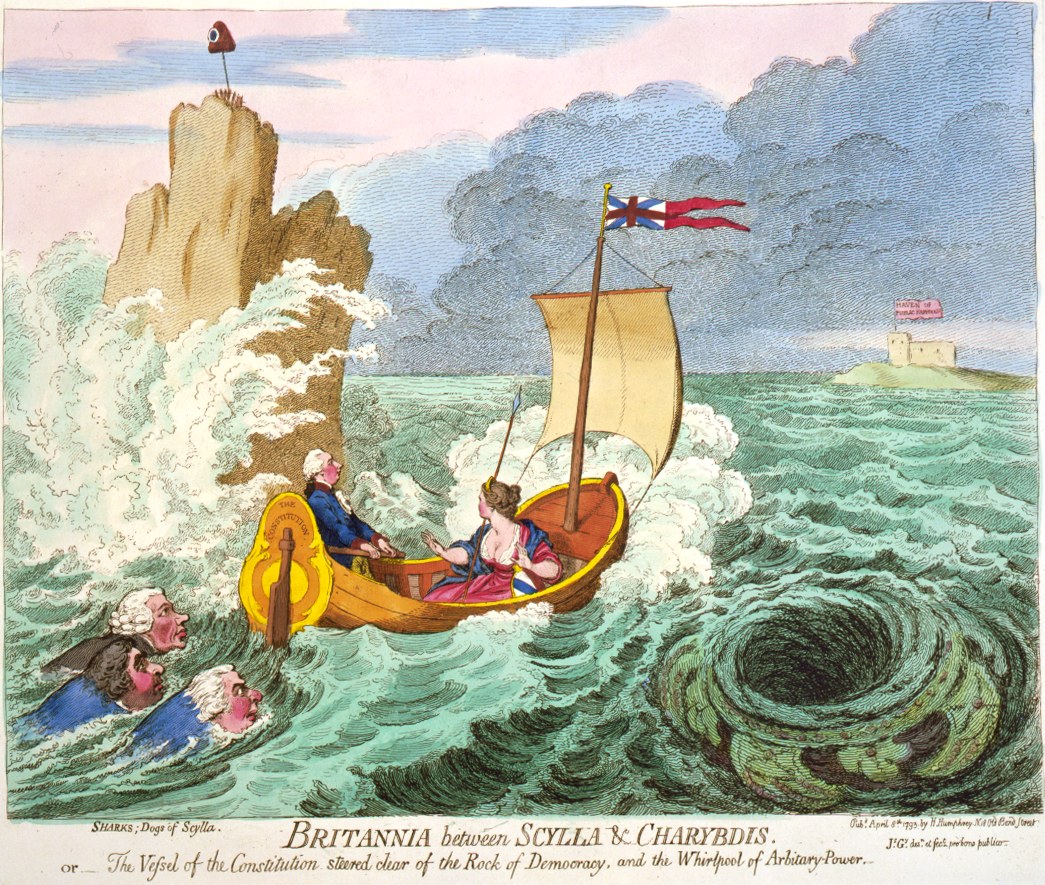
“Avoid Kharybdis and come close to Skyla.” This is similar to the saying, “I avoided it by finding a better evil”
They say about Skyla that she was a Tyrrhenian woman, something if a beast, who was a woman down to the navel but she grew dog heads beneath that point. The rest of her body was a serpent. This kind of a cerature is very silly to imagine. But here is the truth. There were the islands of the Tyrrenians, which used to raid the coasts of Sicily and the Ionian bay. There was a trirereme which had the named Skyla. That trireme used to overtake other ships often and use their food and there was many a story about it. Odysseus fled that ship. trusting a strong and favorable wind and he told this story in Corcyra to Alkinoos, how he was pursued and how he fled and what the shape of the ship was. From these stories, the myth was formed.”
“Charybdis is an obvious name for luxury and endless drinking. Homer has allegorized manifold shamelessness in Skylla, which is why she would logically have a belt of dogs, guardians for her rapacity, daring, and pugnacity. “
“But you, go away from “the smoke and the wave” and depart the ridiculous concerns of mortal life as from that fearsome Charybdis without touching it at all, don’t even, as the people say, brush it with your littlest toe.”
“For satiety seems to be becoming worn out in pleasures from the soul suffering in some way with the body, since the soul does not shirk from its pleasures. But when it is interwoven, as it is said, with the body, it suffers the same things as Odysseus, just as he was held, clinging to the fig tree, not because he desired it or delighted in it, but because he feared Charybdis lurking below him. The soul clings to the body and embraces it in this way not because of goodwill or gratitude but because it fears the uncertainty of death.
As wise Hesiod says, “the gods keep life concealed from human beings.” They have not tied the soul to the body with fleshly bonds, but they have devised and bound around the mind one cell and one guard, our uncertainty and distrust about our end. If a soul had faith in these things—“however so many await men when they die”, to quote Heraclitus—nothing would restrain it at all.”
“You will consider losing any of the people you love the worst evil , even though it is as inappropriate as crying because the leaves of the charming trees that decorate your home have fallen. Treat everything that pleases you like those growing plants: while they live, use them, since different plants wilt and die on different days. Just as the the fall of some leaves is a minor affair because they grow back again, so it is with those come you love and you believe are your life’s happiness–they can be replaced even though they are not reborn.
‘New friends won’t be the same!” one objects. Nope, and you won’t be the same either. Every day, every hour changes you. What time takes is easier to see in others, it is hidden in yourself because it doesn’t happen obviously. Others disappear, but we are stolen from ourselves secretly. You will not consider these problems or find any treatment for the wounds. But you will raise up reasons for anxiety by hoping some days, despairing others. If you are smart, you will mix these two. Don’t hope without despairing or despair without hope.”
Gravissimum iudicabis malum, aliquem ex his, quos amabis, amittere, cum interim hoc tam ineptum erit quam flere, quod arboribus amoenis et domum tuam ornantibus decidant folia. Quicquid te delectat, aeque vide ut flores virides; dum virent, utere; alium alio die casus excutiet. Sed quemadmodum frondium iactura facilis est, quia renascuntur, sic istorum, quos amas quosque oblectamenta vitae putas esse, damnum, quia reparantur, etiam si non renascuntur.
“Sed non erunt idem.” Ne tu quidem idem eris. Omnis dies, omnis hora te mutat; sed in aliis rapina facilius apparet, hic latet, quia non ex aperto fiet. Alii auferuntur, at ipsi nobis furto subducimur. Horum nihil cogitabis nec remedia vulneribus oppones, sed ipse tibi seres sollicitudinum causas alia sperando, alia desperando. Si sapis, alterum alteri misce: nec speraveris sine desperatione nec desperaveris sine spe.
“Why, therefore, the reasoning would go, do you still not believe it when you see that the weaker part still exists after the person has died? Doesn’t it seem to you necessary that the part which lasts long should be preserved still in this time? Think about this when you consider what I am saying. Like Simmias, I guess, I need some kind of an analogy.
It seems to me as if someone is saying similar things when he makes the comparison of an old weaver who has died. He claims that the man is not dead, but is still somewhere safe somehow because he can provide as proof a cloak which the man wove himself and was wearing and is still safe and has not perished. And if someone were skeptical at this, he would ask whether a human being lives longer than a cloak which was used and worn and the when he answered that human beings last longer than cloaks in general, he would think he had proved that the person remains sound since the shorter-lived thing had not withered.
This, Simmias, I do not think is true. Think about what I am saying. Everyone would imagine that it is stupid when someone says this. For this weaver, although he has worn out and then woven many of these kinds of cloaks, died and disappeared long after they did when there were many of them. But he did not before the last one. Even in this the person is no weaker or less complex than the cloak.
I think that the soul responds to the same analogy and anyone who said the same things about it would seem sensible to me. The soul is longer-lived, and the body is weaker and has less time. But if you were to say that each soul wears out many bodies, or something else if it has many years—since the body wears out and could be ruined while the person still lives, but the soul could always reweave what gets worn out—whenever the soul perishes, it would the be necessary for it to have taken on its final garment and to perish before only this one. Once the soul dies then, the body would display the nature of its weakness and disappear by rotting quickly.”
“Previously Homeric grooves [arrows] were sounding out
The master-loving habit of Eumaios on golden tablets,
But now this stone, repeating the unforgetting word,
Will sing your wise wit even into Hades, Inakhos.
Philoskos, who reveres your home, will always increase
The fine gifts and honor you both among the living and the dead—
Along with your wife who honors your son who is weeping,
A young child who draws deep from the spring of her breasts.
O, inescapable Hades, why do you hoard this kind of blessing,
Taking away the famous son of Kleumakhis?”
Here is a portion of Virgil’s account of what happened after Orpheus, escorting his wife from the underworld, turned around to look at her:
Virgil., Georgics, IV. 494-506
She said: “What folly, Orpheus, what terrible folly
Has destroyed me, a wretched woman, and you too?
Look, the hard fates are calling me back again.
And look, sleep is closing my swimming eyes.
Now, farewell! I’m borne away in the vast encircling
Night, and I reach out to you with helpless hands
That, alas, are no longer your hands.”
That’s what she said. Then suddenly, from his sight,
Like smoke amid light breezes, she was gone.
She did not see him vainly clutching shadows
And trying to say ever more things to her.
What’s more, Death’s boatman did not let him cross
The swamp stretched before him.
What could he do? Where was he scrambling to
With his wife snatched away a second time?
With what tears could he move the gods?
Which divinities could he move with words?
No matter. She was afloat the Stygian raft, already cold.
Illa “Quis et me” inquit “miseram et te perdidit, Orpheu,
quis tantus furor? en iterum crudelia retro
fata vocant conditque natantia lumina somnus.
iamque vale: feror ingenti circumdata nocte
invalidasque tibi tendens, heu! non tua, palmas.”
dixit et ex oculis subito, ceu fumus in auras
commixtus tenues, fugit diversa, neque illum
prensantem nequiquam umbras et multa volentem
dicere praeterea vidit; nec portitor Orci
amplius obiectam passus transire paludem.
quid faceret? quo se rapta bis coniuge ferret?
quo fletu manis, quae numina voce moveret?
Illa quidem Stygia nabat iam frigida cumba.
Christian Gottlieb Kratzenstein. Orpheus and Eurydice. 1806. Glyptoteket, Copenhagen.
Plutarch Consolation to Apollonius [Moralia, 115a-c]
“There is also the saying you know has been passed around the mouth of many humans over the years.” “what is that?” he asked. The other one, interrupted, “that it is best of all not to exist and then second it is better to die than to live. This has been demonstrated by many examples from the divine.
For certainly they say this concerning Midas after the hunt when he caught Silenus and was asking him and finding out from him what is best for mortals and what should be most preferred. But Silenus was willing to say nothing, but remained stubbornly silent.
After he tried nearly every kind of approach, he persuaded him to provide some answer—so compelled, he said, “brief-lived offspring of a laboring god and harsh fate, why do you force me to tell you what it is better not to know? A life lived in ignorance of your most intimate griefs is the least painful.
But for humans it is not at all possible to have the best thing of all or to have any share of the best nature—since the best thing for all men and women is not to be born. But the second best thing after this and the first available to mortals, is to die as soon as possible after being born.” It is clear that he said this because the way that exists in death is better than the one in life.”
The passage floats around some. Stobaeus (4.52.22) attributes it to Alcidamas’ Mousaion but the most widely cited source is Theognis. It is listed without attribution by the paroemiographer Michael Apostolos, with the explanation that this is a proverb “[attributed] to people living in misfortune” (ἐπὶ τῶν δυστυχῶς βιούντων, 3.85.3)
Theognis, 425-428
“First, it is best for mortals to not be born. Not to see the rays of the piercing sun
If born, to pass through Hades’ gates as soon as possible. And to lie with a great pile of earth heaped above you.”
The Loeb note to this passage suggest that Theognis is merely adding to the hexameter lines, since the pentameter lines add nothing. But I think this is problematic. Consider the similar doublet to the first 2 lines above in Bacchylides.
Bacchylides 5.159–161
“And answering him, he said:
“It is best for mortals not to be born
Nor to see the sun.”
Note how Bacchylides acknowledges the proverbial–or at least ‘other’–status of these lines by putting it into the mouths of one of his characters. Notice the stability of the infinitive construction μὴ φῦναι with the mobility of the dative θνατοῖσι and the lexical variations of θνατοῖσι instead of ἐπιχθονίοισιν and φέριστον instead of ἄριστον.
Sophocles, Oedipus Colonos 1225–1227
“Not being born conquers
every argument. But, then, if someone does emerge,
to return where you came from as fast as possible
is second best by far.”
Sextus Empiricus (Outlines of Pyrrhonism 3.230–231) compares the Theognis passage to this fragment from Euripides (fr. 449)
“We should have a gathering to mourn
Someone when they are born, when they come to so many evils
And when someone has died and found a break from evils,
We should be happy and bless them as we carry them from their homes.”
Note the different superlative at the beginning of the phrase and the singular βροτῷ. Based on the flexibility of the expression and the riffing on it, I would suggest that this is a broadly dispersed cultural idea that has proverbial status at a very early period. Note how Euripides, in another fragment, toys with the more broadly used phrase:
Euripides, fr. 908
“Not existing is better for mortals than being born.”
Τὸ μὴ γενέσθαι κρεῖσσον ἢ φῦναι βροτοῖς.
Epicurus (Diogenes Laertius, 10.127) thinks that anyone who believes this and says it is a fool since “if he says it because he believes it, how is it he does not just stop living? For this is ready for him to do, if it is completely believed by him.” (εἰ μὲν γὰρ πεποιθὼς τοῦτό φησι, πῶς οὐκ ἀπέρχεται τοῦ ζῆν; ἐν ἑτοίμῳ γὰρ αὐτῷ τοῦτ᾿ ἔστιν, εἴπερ ἦν βεβουλευμένον αὐτῷ βεβαίως).
And there is, of course, the Ancient Near Eastern context to consider!
"happier than either are those who have not yet come into being and have never witnessed the miseries that go on under the sun."– Ecc 4:3






.jpg)
