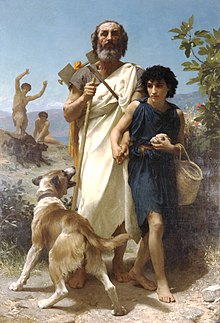
(This is the second half of the so-called Roman Life of Homer)
“Concerning the dates for Homer’s life, the following is reported. Heraclides argues that he is older than Hesiod; Pyrander and Hypsicrates of Amisos claim he was the same age. Krates of Mallos says that he was full-grown sixty years after the end of the Trojan War; but Eratosthenes says it was a hundred years after the Ionian migration; Apollodorus makes it eighty years.
From birth Homer was called Melesigenes or Melesagoras. Later he was called Homer in the Lesbian dialect because of the harm that came to his eyes–the Lesbians call the blind Homeroi. Another account is that the name came because he entrusted to the king as a hostage (Homeros can mean a guarantee).
They say that he was blinded in the following way. When he came to the tomb of Achilles he prayed that he might see the hero as he was when he went into battle arrayed with his second set of arms. When Achilles appeared to him, Homer was blinded by the weapons’ gleam. Because Thetis and the Muses took pity on him, they endowed him with the poetic art.
Others say that he suffered this thanks to to the rage of Helen who was angry at him because he claimed that she abandoned her first husband to follow Alexander. For this reason, the ghost of Helen appeared to him at night and advised him to burn his poems to make himself safe. He could not make himself do this.
People say that he died on the island of Ios when he found himself undone because he could not solve the riddle of the fishing boys. The riddle was: “We left whatever we caught and carry whatever we didn’t”. On his tomb the following epigram is inscribed:
“Here the earth covers the sacred head
of divine Homer, the artist of heroic men”
[For the answer to the Riddle, see below]
περὶ δὲ τῶν χρόνων καθ’ οὓς ἤκουεν ὧδε λέγεται. ῾Ηρακλείδης μὲν οὖν αὐτὸν ἀποδείκνυσι πρεσβύτερον ῾Ησιόδου, Πύρανδρος δὲ καὶ ῾Υψικράτης ὁ ᾿Αμισηνὸς ἡλικιώτην. Κράτης δ’ ὁ Μαλλώτης μεθ’ ἑξήκοντα ἔτη τοῦ ᾿Ιλιακοῦ πολέμου φησὶν ἀκμάσαι, ᾿Ερατοσθένης δὲ μεθ’ ἑκατὸν τῆς ᾿Ιώνων ἀποικίας, ᾿Απολλόδωρος δὲ μετ’ ὀγδοήκοντα.
ἐκαλεῖτο δ’ ἐκ γενετῆς Μελησιγένης ἢ Μελησαγόρας, αὖθις δ’ ῞Ομηρος ἐλέχθη κατὰ τὴν Λεσβίων διάλεκτον, ἕνεκεν τῆς περὶ τοὺς ὀφθαλμοὺς συμφορᾶς, οὗτοι γὰρ τοὺς τυφλοὺς ὁμήρους λέγουσιν, ἢ διότι παῖς ὢν ὅμηρον ἐδόθη βασιλεῖ, ὅ ἐστιν ἐνέχυρον.
τυφλωθῆναι δ’ αὐτὸν οὕτω πως λέγουσιν• ἐλθόντα γὰρ ἐπὶ τὸν ᾿Αχιλλέως τάφον εὔξασθαι θεάσασθαι τὸν ἥρωα τοιοῦτον ὁποῖος προῆλθεν ἐπὶ τὴν μάχην τοῖς δευτέροις ὅπλοις κεκοσμημένος• ὀφθέντος δ’ αὐτῷ τοῦ ᾿Αχιλλέως τυφλωθῆναι τὸν ῞Ομηρον ὑπὸ τῆς τῶν ὅπλων αὐγῆς, ἐλεηθέντα δ’ ὑπὸ Θέτιδος καὶ Μουσῶν τιμηθῆναι πρὸς αὐτῶν τῇ ποιητικῇ.
ἄλλοι δέ φασι τοῦτο αὐτὸν πεπονθέναι διὰ μῆνιν τῆς ῾Ελένης ὀργισθείσης αὐτῷ διότι εἶπεν αὐτὴν καταλελοιπέναι μὲν τὸν πρότερον ἄνδρα, ἠκολου-θηκέναι δ’ ᾿Αλεξάνδρῳ• οὕτως γοῦν ὅτι καὶ παρέστη αὐτῷ φασὶν νυκτὸς ἡ ψυχὴ τῆς ἡρωίνης παραινοῦσα καῦσαι τὰς ποιήσεις αὐτοῦ … εἰ τοῦτο ποιήσοι πρόσχοι. τὸν δὲ μὴ ἀνασχέσθαι ποιῆσαι τοῦτο.
ἀποθανεῖν δ’ αὐτὸν λέγουσιν ἐν ῎Ιῳ τῇ νήσῳ ἀμηχανίᾳ περιπεσόντα ἐπειδήπερ τῶν παίδων τῶν ἁλιέων οὐχ οἷός τ’ ἐγένετο αἴνιγμα λῦσαι• ἔστι δὲ τοῦτο•
ἅσσ’ ἔλομεν λιπόμεσθ’ ἅσσ’ οὐχ ἕλομεν φερόμεσθα.
καὶ αὐτοῦ ἐπὶ τῷ τάφῳ ἐπιγέγραπται ἐπίγραμμα τοῦτο•
ἐνθάδε τὴν ἱερὴν κεφαλὴν κατὰ γαῖα καλύπτει
ἀνδρῶν ἡρώων κοσμήτορα θεῖον ῞Ομηρον.
In case any readers are overwhelmed by the riddle and may suffer faint-hearted Homer’s fate, other Homeric Lives provide an interpretation of the riddle. In the Pseudo-Plutarchean Vita (71) we get the following explanation:
“They were obscuring in riddle the fact they actually had discarded whichever of the lice they had caught and killed; but they would still be carrying the lice they did not catch in their clothing. Because he was not able to interpret this, Homer died because of despair.”
αἰνισσόμενοι ὡς ἄρα οὓς μὲν ἔλαβον τῶν φθειρῶν ἀποκτεί-ναντες κατέλιπον· οὓς δ’ οὐκ ἔλαβον ἐν τῇ ἐσθῆτι φέροιεν. ὅπερ οὐ δυνηθεὶς συμβαλεῖν ῞Ομηρος διὰ τὴν ἀθυμίαν ἐτελεύτησε.
The Vita Herodotea contains a similar explanation but contests the cause of Homer’s death:
“When those who were present were not able to interpret what had been said, the boys explained that they were able to catch nothing while fishing but that they were attacked while sitting on land. And they left behind however many of the lice they caught but were carrying home all those they couldn’t. Homer, when he heard these things, spoke these verses:
You are born from the blood of the kinds of fathers
Who are neither wealthy nor tend numerous flocks.
Then it happened that Homer died because of a sickness on Ios, not because he couldn’t interpret what the children said, as some believe, but because of weakness.”
οὐ δυναμένων δὲ τῶν παρεόντων γνῶναι τὰ ῥηθέντα, διηγήσαντο οἱ παῖδες ὅτι ἁλιεύοντες οὐδὲν ἐδύναντο ἑλεῖν, καθήμενοι δὲ ἐν γῇ ἐφθειρίζοντο, καὶ ὅσους μὲν ἔλαβον τῶν φθειρῶν κατέλιπον· ὅσους δὲ μὴ ἐδύναντο ἐς οἴκους ἀπεφέροντο. ὁ δὲ ῞Ομηρος ἀκούσας ταῦτα ἔλεξε τὰ ἔπεα τάδε·
τοίων γὰρ πατέρων ἐξ αἵματος ἐκγεγάασθε,
οὔτε βαθυκλήρων οὔτ’ ἄσπετα μῆλα νεμόντων.
᾿Εκ δὲ τῆς ἀσθενείας ταύτης συνέβη τὸν ῞Ομηρον τελευτῆσαι ἐν ῎Ιῳ, οὐ παρὰ τὸ μὴ γνῶναι τὸ παρὰ τῶν παίδων ῥηθέν, ὡς οἴονταί τινες, ἀλλὰ τῇ μαλακίῃ.
(There are other versions as well, but all variations on the same idea.)