“Our stupidity is clear from the fact that we think we are purchasing only those things we spend money on. We consider those things free we pay for with our very selves. These are the kind of things we would refuse to buy if our home had to be given in exchange, if some profitable or pricy holding were required, yet we are super eager to acquire them through anxiety, danger, giving up all shame and freedom and our free time–so much so that there’s nothing anyone treats more cheaply than themselves.
So, let us behave this way in all our plans and actions: just as we usually act when we approach some conman for a purchase, let us see how much is asked for what we want. Often the highest price is paid for nothing. I can show you many things for which searching and acquiring takes away our very freedom. We would be our own, if we did not have these things.”
Ex eo licet stupor noster appareat, quod ea sola putamus emi, pro quibus pecuniam solvimus, ea gratuita vocamus, pro quibus nos ipsos inpendimus. Quae emere nollemus, si domus nobis nostra pro illis esset danda, si amoenum aliquod fructuosumve praedium, ad ea paratissimi sumus pervenire cum sollicitudine, cum periculo, cum iactura pudoris et libertatis et temporis; adeo nihil est cuique se vilius.
Idem itaque in omnibus consiliis rebusque faciamus, quod solemus facere, quotiens ad institorem alicuius mercis accessimus; videamus, hoc quod concupiscimus, quanti deferatur. Saepe maximum pretium est, pro quo nullum datur. Multa possum tibi ostendere, quae adquisita acceptaque libertatem nobis extorserint; nostri essemus, si ista nostra non essent.
Hades stole away this pretty girl because of her beauty and form
Suddenly, this girl most desirable to all people alive.
Mattios fathered me and my mother Eutukhia
Nursed me. I have died at twelve years old, unmarried.
My name is Mattia, and now that I have left the light
I lie hidden in the dark chamber of Persephone.
I left a lifetime’s grief for my father and mother
Who will have many tears for the rest of time.”
Claudia Severa invites her friend Sulpicia Lepidina (wife of the prefect at Vindolanda) to a birthday party. Despite the use of soror, the two women are not believed to be sisters. With part of the document written by Severa herself, this (and the accompanying notes) is believed to be the earliest-known Latin written by a woman.
Side I
Cl(audia) · Seuerá Lepidinae [suae
[sa]l[u]tem
iii Idus Septembr[e]s soror ad diem
sollemnem natalem meum rogó
libenter faciás ut uenias
ad nos iucundiorem mihi
Side II
[diem] interuentú tuo facturá si
…s
Cerial[em t]uum salutá Aelius meus .[
et filiolus salutant … … sperabo te soror uale soror anima mea ita ualeam karissima et haue
(The italicized text was written by Severa herself)
“Claudia Severa to her Lepidina, greetings. On September 11, sister, for my birthday celebration, I ask you sincerely to make sure you come to (join) us, to make the day more fun for me by your arrival…Say hello to your Cerialis. My Aelius and little boy say hello. I await you, sister. Be well, sister, my dearest soul, so I may be well too. Hail.”
A sad text. Also a good one to use in class, it utilizes both Latin and Hebrew, and goes well with a discussion of diversity in the city and empire. It is also one of the latest dated texts in this document.
(H)Ic iacet Gaudi=
osa infantula
qui bissit annoru=
m plus minu(s) tre=
s requiebit in
pacem. שלום
“Here lies the child Gaudiosa, who lived around three years. She will rest in peace. Shalom (in Hebrew)
“You are doing the best thing, the heathy thing, for yourself if, as you write, you persist in pursuing a good state of mind. This is something it is foolish to hope for, when you are capable of achieving it on your own. We don’t need to raise our hands to heaven or to go beg in a temple to approach the idol’s ear, as if we can be heard better in this way. No, God is near us, with us, inside us.
I say it this way, Lucilius: a sacred force sits within us as a witness of our good and evil and a guardian. It handles us, the way we handle it. Really, no person is good without God, how else can someone surpass fortune unless god helps them rise up?”
Facis rem optimam et tibi salutarem, si, ut scribis, perseveras ire ad bonam mentem, quam stultum est optare, cum possis a te impetrare. Non sunt ad caelum elevandae manus nec exorandus aedituus, ut nos ad aurem simulacri, quasi magis exaudiri possimus, admittat; prope est a te deus, tecum est, intus est.
Ita dico, Lucili: sacer intra nos spiritus sedet, malorum bonorumque nostrorum observator et custos. Hic prout a nobis tractatus est, ita nos ipse tractat. Bonus vero vir sine deo nemo est; an potest aliquis supra fortunam nisi ab illo adiutus exurgere?
Antiquity has left us only one fragment of the iambic poet Hedyle. It is not iambic!
Athenaeus 7.297b
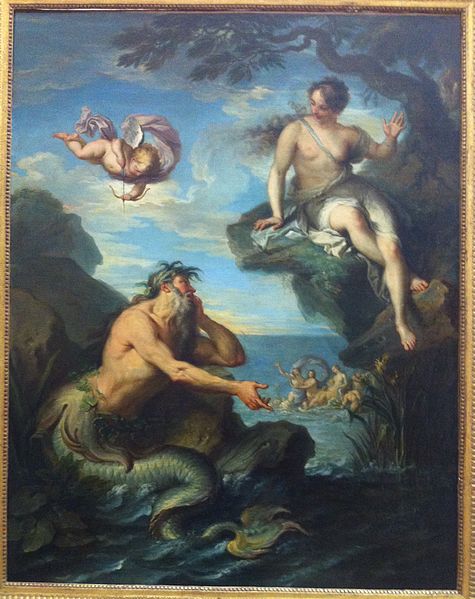
“Hêdulos, the Samian or Athenian, says that Glaukos threw himself in the sea after he fell in love with Melicertes. Hêdulê, his mother and the daughter of the Athenian Moskhinê, was a composer of iambic lines. In her poem called “Skylla”, she records that Glaukos went into his own cave after he fell in love with Skylla
“Either carrying shells as gifts
From the Erythaian cliff
Or halcyon chicks still unwinged
Presents for the girl from an anxious man.
His Siren girl neighbor felt pity
For he was swimming toward that beach
And the regions close to Aitna.”
The following fragment is from a poem whose central conceit is a singing contest between Mt. Kithairon and Mt. Helikon. The former wins; the latter loses. Mountains leave happy and sad….
“…the Kouretes
Sheltered the sacred offspring
Of the goddess in secret
From crooked-monded Kronos
When blessed Rhea stole him
And earned great honor among
The immortal gods….”
He sang those things.
Immediately the Muses told
The gods to cast their secret
Votes into the gold-gleaming urns.
They all rose up at once.
Then Kithairôn took the greater number.
Hermes quickly announced
By shouting that he had won
His longed-for victory
And the gods decorated him
With garlands[…]
And his mind filled with joy.
But the other, Helikon,
Overcome by hard griefs,
Ripped out a smooth rock
and the mountain [shook].
He broke it from on high
Painfully into ten thousand stones…”
“This popular form of speech possesses no truth: it wishes only to move the crowd, to grab ahold of uninformed ears through speed–it does not offer itself for conversation, but discourages it. How can speech like that govern people when it is ungovernable itself? Shouldn’t any kind of speech, moreover, that tries to heal our minds, be able to sink down into them? They cannot offer remedies if they do not linger in our thoughts.
That kind of speech also contains an excess of nonsense and silliness, it makes more noise than impact. The things that scare me should be soothed; the things that irritate, softened; the desires that deceive me, should be inhibited; my greed should be curbed. What of these can be treated quickly? What kind of doctor rushes through a visit with the sick? On top of that, how can such a hodgepodge of poorly chosen sounds bring any kind of pleasure?
It is the same as you find some delight in witnessing tricks you thought were impossible to complete, so too it is possible to hear these word acrobats perform only once. What can someone want to learn or imitate in these people? What could you think of their minds, when their speech rushes out in complete chaos, impossible to keep in control?
Just as when someone is running down the hill, it is impossible to stop where they wanted too, and their steps roll along with the force of their body and are carried beyond where they wanted to stop, so too does speed of speaking operate beyond its own control. It is not right for philosophy, since philosophy should compose words with care, not throwing them around, but moving carefully, step by step.
Haec popularis nihil habet veri; movere vult turbam et inconsultas aures inpetu rapere, tractandam se non praebet, aufertur. Quomodo autem regere potest, quae regi non potest? Quid, quod haec oratio, quae sanandis mentibus adhibetur, descendere in nos debet? Remedia non prosunt, nisi inmorantur.
Multum praeterea habet inanitatis et vani, plus sonat quam valet. Lenienda sunt, quae me exterrent, conpescenda, quae inritant, discutienda, quae fallunt, inhibenda luxuria, corripienda avaritia; quid horum raptim potest fieri? Quis medicus aegros in transitu curat? Quid, quod ne voluptatem quidem ullam habet talis verborum sine dilectu ruentium strepitus? Sed ut pleraque, quae fieri posse non crederes, cognovisse satis est, ita istos, qui verba exercuerunt, abunde est semel audisse. Quid enim quis discere, quid imitari velit? Quid de eorum animo iudicet, quorum oratio perturbata et inmissa est nec potest reprimi? Quemadmodum per proclive currentium non ubi visum est, gradus sistitur, sed incitato corporis pondere se rapit1 ac longius quam voluit effertur; sic ista dicendi celeritas nec in sua potestate est nec satis decora philosophiae, quae ponere debet verba, non proicere, et pedetemptim procedere.
Judging from a lyric fragment on the subject, Simonides (c.556-468 BC) thought goodness was possible (however hard), while Pittacus (c.640-568 BC), whom he references, held the opposing view.
We’ll let Martin Luther (1483-1546), the Reformer, decide between the two positions.
Simonides Fr. 542 (PMG)
It’s hard for a man to be truly good
in hands, feet, and mind,
a square, as it were, drawn without blemish . . .
Yet Pittacus’ maxim does not suit me,
though it was spoken by a wise man:
it’s hard, he said, to be good,
an honor only a god could enjoy . . .
Martin Luther. On Christian Liberty (ed.1521).
The Commandments teach us what is good but we do not straightaway follow their teachings. That is because the Commandments point out what we ought to do, but they do not give us the strength to do it. The Commandments were put in place to reveal an individual to himself: through them he discovers his inability to do good, and he despairs of his own strength . . .
For example, through the Commandment ”You must not covet” we are all heaped together as sinners, for there’s no one who does not have strong desires, whatever his efforts to the contrary. The consequence is this: in order not to be covetous and to satisfy the commandment, an individual learns to despair of himself and looks elsewhere for help.
What this one Commandment accomplishes all the others accomplish too, for all of them are equally impossible for us.
Praecepta docent quidem bona, sed non statim fiunt, quae docta sunt, ostendunt enim, quid facere nos oporteat, sed uirtutem faciendi non donant, in hoc autem sunt ordinata ut hominem sibi ipsi ostendant, per quae suam impotentiam ad bonum cognoscat,et de suis viribus desperet . . . Exempli causa: Non concupisces, praeceptum est, quo nos omnes esse peccatores coniungimur cum nemo possit non concupiscere, quicquid contra molitus fuerit, ut ergo, non concupiscat et praeceptum impleat, cogitur de sese desperare, et alibi ac per alium quarere auxilium, quod in se non invenit . . . Quod autem hoc uno praecepto agitur, idem omnibus agitur, aeque enim sunt impossibila nobis omnia.
“You lie there beneath Aphrodite’s golden ceiling,
Grapes, full with Dionysus’ drink.
Your mother, the vine, will no longer wrap her love branch around you
And protect your head beneath her sweet leaf.”
“Anigrian Nymphs, daughters of the river, you ambrosial
Creatures who always step on the depths with rosy feet.
Say hello to and preserve Kleonymos who set out for you goddesses
These wooden images beneath the pines.”