Wild and Desolate: The True Story of Odysseus’ Journey Home

Joannes Malalas, Chronographia, 5.20, p. 121

“After he left from Circe’s island, Odysseus arrived at another island, tossed up on it by struggling winds. Calypso, Circe’s sister welcomed him there and considered him worthy of a great deal of help. She had sex with him almost as if in marriage.

He went from there to a massive lake near the sea which was called the Nekyopompos. The people who live around that lake are prophets and they told him everything that had happened to him and what would happen in the future. When he left there, he was thrown from the sea when a great storm arose onto “the Sirens,” rocks which have that name from the peculiar sound that comes from waves crashing around them. Once he freed himself from there, he arrived at the place called “Charybdis,” a wild and desolate territory. He lost all his ships and his army here.

Then Odysseus was carried alone on a ship’s plank in the sea, waiting for a death from violence. But some Phoenician sailors passing by saw him swimming in the water and saved him in their pity. They took him to the island Crete to Idomeneus, a leader of the Greeks. When he saw Odysseus naked and impoverished, he sympathetically gave him a great of gifts because he had been a general with him at Troy along with two ships and people to guard him safely home. He sent him back to Ithaka like this. Wise Dictys wrote these details down after he heard them from Odysseus.”

ἀπὸ δὲ τῆς νήσου τῆς Κίρκης ἐξορμήσας ὁ ᾽Οδυσσεὺς ἀνήχθη εἰς τὴν ἄλλην νῆσον, ὑπὸ ἀνέμων ἐναντίων ἐκριφείς. ὅντινα ἐδέξατο καὶ ἡ Καλυψὼ ἡ ἀδελφὴ τῆς Κίρκης καὶ πολλῆς θεραπείας ἠξίωσεν αὐτόν, συμμιγεῖσα αὐτῶι καὶ πρὸς γάμον.

κἀκεῖθεν ἀνήχθη ἔνθα λίμνη ὑπῆρχε μεγάλη πλησίον τῆς θαλάσσης λεγομένη ἡ Νεκυόπομπος, καὶ οἱ οἰκοῦντες ἐν αὐτῆι ἄνδρες μάντεις· οἵτινες ἐξεῖπον αὐτῶι πάντα τὰ συμβάντα αὐτῶι καὶ τὰ μέλλοντα.  καὶ ἀναχθεὶς ἐκεῖθεν χειμῶνος μεγάλου γενομένου θαλάσσης ἐκρίπτεται εἰς τὰς Σειρῆνας, οὕτω καλουμένας πέτρας αἳ ἐκ τῶν κρουσμάτων τῶν κυμάτων ἦχος ἀποτελοῦσιν ἴδιον.  κἀκεῖθεν ἐξειλήσας ἦλθεν εἰς τὴν καλουμένην Χάρυβδιν, εἰς τόπους ἀγρίους καὶ ἀποτόμους· κἀκεῖ πάσας τὰς ὑπολειφθείσας αὐτῶι ναῦς καὶ τὸν στρατὸν ἀπώλεσεν, αὐτὸς δὲ ὁ ᾽Οδυσσεὺς μόνος ἐν σανίδι τοῦ πλοίου ἐν τῶι πελάγει ἐφέρετο, ἀναμένων τὸν μετὰ βίας θάνατον. τοῦτον δὲ ἑωρακότες τινὲς ἀποπλέοντες ναῦται Φοίνικες νηχόμενον ἐν τοῖς ὕδασιν ἐλεήσαντες διέσωσαν, καὶ ἤγαγον αὐτὸν ἐν τῆι Κρήτηι νήσωι πρὸς τὸν ᾽Ιδομενέα, ἔξαρχον ῾Ελλήνων. καὶ ἑωρακὼς τὸν ᾽Οδυσσέα ὁ ᾽Ιδομενεὺς γυμνὸν καὶ δεόμενον, συμπαθῶς φερόμενος <καὶ> δῶρα αὐτῶι πλεῖστα δεδωκὼς ὡς συστρατήγωι αὐτοῦ καὶ δύο νῆας καὶ διασώζοντας αὐτόν τινας, ἐξέπεμψεν αὐτὸν εἰς ᾽Ιθάκην. ἅτινα καὶ ὁ σοφὸς Δίκτυς παρὰ τοῦ ᾽Οδυσσέως ἀκηκοὼς συνεγράψατο.
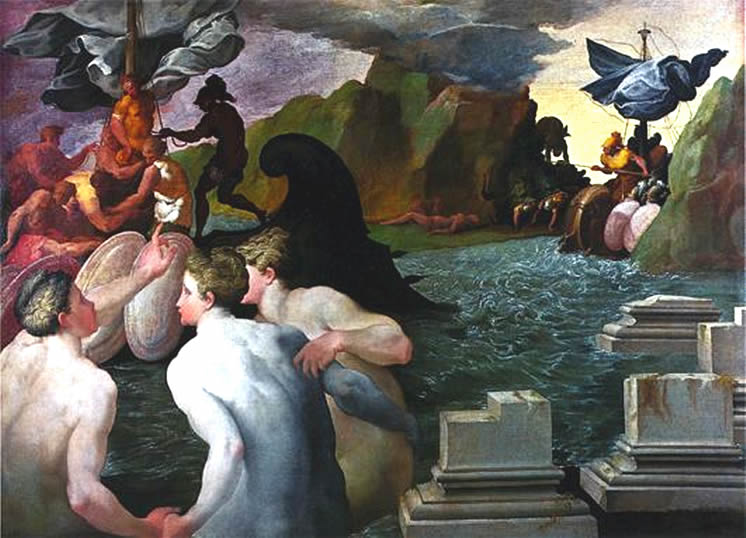
File:Sirens and Odysseus by Francesco Primaticcio.jpg
Sirens and Odysseus by Fracesco Primaticcio, 1560

Sure, Retire; The Universe Has Your Number

Seneca, Moral Epistle 68.1-2

“I agree with your plan: retreat into leisure. But hide your leisure as well. When you do this, you know that you are following the Stoic example if not their command. But, you will be in line with the command too and will earn approval from yourself and anyone you want.

As Stoics, we do not commend public life in every matter, all the time, or without boundaries. In addition, when we have given someone wise to a public life worth their time–by which I mean the whole world–they cannot ever be outside the public realm, even when withdrawn. No, instead someone perhaps has given up one little part of it and has moved on to more important and broader territory. Then, when they have made it to heaven, they understand how humble a place was occupied when they were in the curule chair or on the judge’s bench.

Keep this in your thoughts. The wise person never does more than when divine and human matters appear together in view.”

Consilio tuo accedo; absconde te in otio. Sed et ipsum otium absconde. Hoc te facturum Stoicorum etiam si non praecepto, at exemplo licet scias. Sed ex praecepto quoque facies; et tibi et cui voles adprobabis. Nec ad omnem rem publicam mittimus nec semper nec sine ullo fine.

Praeterea, cum sapienti rem publicam ipso dignam dedimus, id est mundum, non est extra rem publicam, etiam si recesserit, immo fortasse relicto uno angulo in maiora atque ampliora transit et caelo inpositus intellegit, cum sellam aut tribunal ascenderet, quam humili loco sederit. Depone hoc apud te, numquam plus agere sapientem, quam quom in conspectum eius divina atque humana venerunt.

Old man on phone meme with latin "Consilio tuo accedo" which means I agree with your plan

Writing Advice for Thesis Season: Write Drunk, Edit Sober. Rinse and Repeat

Herodotus, Histories 1.133.3-4

“The [Persians] are really fond of wine. It is not permissable to puke or to piss in front of another—these things are guarded against. And they are in the custom of taking counsel about the most important matters while they are drunk. Whatever seems fit to them while they are deliberating, the housemaster of the place where they deliberate proposes to them on the next day when they are sober. If the idea is pleasing to them when they are sober too, then they adopt it. If it is not, they waive it. When they have debated an issue while sober, they make a final decision while drunk.”

οἴνῳ δὲ κάρτα προσκέαται, καί σφι οὐκ ἐμέσαι ἔξεστι, οὐκὶ οὐρῆσαι ἀντίον ἄλλου. ταῦτα μέν νυν οὕτω φυλάσσεται, μεθυσκόμενοι δὲ ἐώθασι βουλεύεσθαι τὰ σπουδαιέστατα τῶν πρηγμάτων:

[4] τὸ δ᾽ ἂν ἅδῃ σφι βουλευομένοισι, τοῦτο τῇ ὑστεραίῃ νήφουσι προτιθεῖ ὁ στέγαρχος, ἐν τοῦ ἂν ἐόντες βουλεύωνται, καὶ ἢν μὲν ἅδῃ καὶ νήφουσι, χρέωνται αὐτῷ, ἢν δὲ μὴ ἅδῃ, μετιεῖσι. τὰ δ᾽ ἂν νήφοντες προβουλεύσωνται, μεθυσκόμενοι ἐπιδιαγινώσκουσι.

Tacitus ascribes a similar process to the northern barbarians, concluding (Germ. 22):

“therefore, the mindset of everyone has been exposed and made clear and on the next day the issue is discussed again, and for each opportunity a resolution and accounting is reached. They deliberate when they are incapable of lying; they make a plan when incapable of messing it up.”

ergo detecta et nuda omnium mens. postera die retractatur, et salva utriusque temporis ratio est. Deliberant dum fingere nesciunt, constituunt dum errare non possunt.


Annibale Carracci, “Boy Drinking” 1582/1583

[Credit to Perseus for having the How and Wells Commentary online]

O Sappho, Who Wrongs You?

Sappho, fr. 1

Many-minded immortal Aphrodite,
Child of Zeus, plot weaver, I implore you:
Don’t with vexations and frustrations break
My heart, O queen.

Instead, come here, if ever in past times
From far off you heard, and heeded, my calls;
And quitting your father’s golden palace,
You came,

After yoking the chariot. Small birds,
Handsome, swift, bore you across the black earth.
Their fast wings whirred from the upper heavens
down through the middle air.

Quick, their arrival. Then you, blessed one,
A smile on your immortal countenance,
Asked: what is it, this time, that’s happened to me;
Why, this time, do I call;

And what does my crazed heart most desire:
“Whom, this time, must I persuade—
Go out, that is, and bring into your love?
O Sappho, who wrongs you?

Even if she’s fleeing, soon she’ll pursue.
If she’s refusing gifts, she’ll give them.
If she’s not in love, soon she’ll be in love—
Even if against her will.”

Come this time too. Release me from hard cares.
Whatever my heart wishes to see done,
Bring about. And you yourself, be my ally
In this fight.

ποικιλόφρον’ ἀθανάτ Ἀφρόδιτα,
παῖ Δίος δολόπλοκε, λίσσομαί σε,
μή μ’ ἄσαισι μηδ’ ὀνίαισι δάμνα,
πότνια, θῦμον,

ἀλλὰ τυίδ’ ἔλθ’, αἴ ποτα κἀτέρωτα
τὰς ἔμας αὔδας ἀίοισα πήλοι
ἔκλυες, πάτρος δὲ δόμον λίποισα
χρύσιον ἦλθες

ἄρμ’ ὐπασδεύξαισα· κάλοι δέ σ’ ἆγον
ὤκεες στροῦθοι περὶ γᾶς μελαίνας
πύκνα δίννεντες πτέρ’ ἀπ’ ὠράνωἴθε-
ρος διὰ μέσσω·

αἶψα δ’ ἐξίκοντο· σὺ δ’, ὦ μάκαιρα,
μειδιαίσαισ’ ἀθανάτωι προσώπωι
ἤρε’ ὄττι δηὖτε πέπονθα κὤττι
δηὖτε κάλημμι

κὤττι μοι μάλιστα θέλω γένεσθαι
μαινόλαι θύμωι· τίνα δηὖτε πείθω
[βαι]σ’ ἄγην ἐς σὰν φιλότατα; τίς σ’, ὦ
Ψάπφ’, ἀδικήει;

καὶ γὰρ αἰ φεύγει, ταχέως διώξει,
αἰ δὲ δῶρα μὴ δέκετ’, ἀλλὰ δώσει,
αἰ δὲ μὴ φίλει, ταχέως φιλήσει
κωὐκ ἐθέλοισα.

ἔλθε μοι καὶ νῦν, χαλέπαν δὲ λῦσον
ἐκ μερίμναν, ὄσσα δέ μοι τέλεσσαι
θῦμος ἰμέρρει, τέλεσον, σὺ δ’ αὔτα
σύμμαχος ἔσσο.

A wayward thought:

The conventional reading of the lyric assumes that the speaker is a lover (name: Sappho) who needs Aphrodite’s help to win (or punish) a reluctant beloved. An alternative interpretation: Sappho is a singer who needs Aphrodite’s help not to win a lover but to compose a persuasive love song. This reading turns first on the summons “come here” and “come”, and then on the god’s epiphany—or rather, the unexpected sounding of the god’s voice.

The temptation is to hear in the call to Aphrodite the traditional summons of lyric hymn. There, the suppliant speaker calls on the god to perform some beneficial task. For example, Anacreon 357:

On my knees I beg you,
Come to me,
Listen to my pleasing prayer:
To Cleobulus be
A good counselor so that he accepts
My love, O Dionysus.

In Sappho 1, things are somewhat different. The call to Aphrodite more resembles an invocation to the muse, the plea to enable song making (not find a lover). We might associate this practice with epic, but of course it exists in Archaic lyric too. Alcman 27:

Come, Muse Calliope, daughter of Zeus—
Begin with lovely verses—
Put charm into our hymn—
And make our dance a graceful one.

In Alcman’s figural language, the muse is to “begin” the very song Alcman himself is beginning to sing. Hesiod says of the muses, “they breathed into me wonderous song,” (Theog. 31-32) and Alcman asks the same of his muse. And so does Sappho. But what’s distinctive about Sappho is that she makes literal what is only metaphorical in the tradition. The voice of her responsive god literally issues from her throat as she sings her song (strophes 5 and 6). This is what it means for the god to have come: it is Aphrodite who “begins” when Sappho sings, enabling her song. The struggle of song-making: That’s the fight in which she needs an ally. In the absence of the allied muse, song-making would be an exercise in “vexations and frustrations.”

Anacreon 357 (excerpt)

γουνοῦμαί σε, σὺ δ’ εὐμενὴς
ἔλθ’ ἡμίν, κεχαρισμένης
δ’ εὐχωλῆς ἐπακούειν·
Κλεοβούλωι δ’ ἀγαθὸς γένεο
σύμβουλος, τὸν ἐμόν γ’ ἔρωτ’,
ὦ Δεόνυσε, δέχεσθαι.

Alcman 27

Μῶσ᾿ ἄγε Καλλιόπα, θύγατερ Διός,
ἄρχ᾿ ἐρατῶν ϝεπέων, ἐπὶ δ᾿ ἵμερον
ὕμνῳ καὶ χαρίεντα τίθη χορόν.

Terra Cotta amphora. Attributed to the Berlin Painter. c.490 BC. Young man singing and playing the Kythera. Metropolitan Museum of Art.

Larry Benn has a B.A. in English Literature from Harvard College, an M.Phil in English Literature from Oxford University, and a J.D. from Yale Law School. Making amends for a working life misspent in finance, he’s now a hobbyist in ancient languages and blogs at featsofgreek.blogspot.com.

My Epistolary Friend

Seneca, Moral Epistles 67.1-2

“I’ll make a common beginning: spring has started to show itself, but even though we are leaning toward summer when it ought to be warm, it is still cold and there’s nothing sure about it. Often, we turn back to winter. Do you want to know how shaky it still is? I don’t yet trust myself in a cold bath since even now I disturb its temperature.

You can say, “This is no way to endure either heat nor cold.” That’s true, Lucilius, but I am of the age happy with its own chill. I barely thaw out in the heat. So, the greater part of the year finds me wrapped in blankets. I am grateful to old age because it keeps me in bed. Why shouldn’t I be thankful to it for this reason? I can’t do the very things I don’t want to do. Most of my conversation is with books. When your letters come, I imagine I am with you and I don’t feel like I am writing to you, but just responding instead. So, let us talk about your question, whatever it is, as if we were together.”

Vt a communibus initium faciam, ver aperire se coepit, sed iam inclinatum in aestatem, quo tempore calere debebat, intepuit nec adhuc illi fides est. Saepe enim in hiemem revolvitur. Vis scire, quam dubium adhuc sit? Nondum me committo frigidae verae, adhuc rigorem eius infringo. “Hoc est,” inquis, “nec calidum nec frigidum pati.” Ita est, mi Lucili; iam aetas mea contenta est suo frigore.

Vix media regelatur aestate. Itaque maior pars in vestimentis degitur. Ago gratias senectuti, quod me lectulo adfixit. Quidni gratias illi hoc nomine agam? Quicquid debebam nolle, non possum. Cum libellis mihi plurimus sermo est. Si quando intervenerunt epistulae tuae, tecum esse mihi videor et sic adficior animo, tamquam tibi non rescribam, sed respondeam. Itaque et de hoc, quod quaeris, quasi conloquar tecum, quale sit, una scrutabimur.

Colo photograph of two figures holding hands. They are visible only from waist to shoulders and are women-presenting, facing each other
Picture from Wikimediacommons, Mathias Klang from Göteborg, Sweden “Friednship

Athetizing a Dream

Homer, Il. 22.199-201

“As in a dream he isn’t able to pursue the one fleeing
Nor in turn is he able to escape him, nor again can the other overtake him
So he can’t catch up to him with his feet and the other can’t get away”

ὡς δ’ ἐν ὀνείρῳ οὐ δύναται φεύγοντα διώκειν·
οὔτ’ ἄρ’ ὃ τὸν δύναται ὑποφεύγειν οὔθ’ ὃ διώκειν·
ὣς ὃ τὸν οὐ δύνατο μάρψαι ποσίν, οὐδ’ ὃς ἀλύξαι.

Schol. A ad Il. 22.199-201

“These three lines are athetized because they are simple in structure and thought and they indicate the uselessness of the chase and its unchangeable nature.”

Ariston. ὡς δ’ ἐν ὀνείρῳ<—οὐδ’ ὃς ἀλύξαι>: ἀθετοῦνται στίχοι τρεῖς, ὅτι καὶ τῇ κατασκευῇ καὶ τῷ νοήματι εὐτελεῖς· καὶ γὰρ ἀπραξίαν δρόμου καὶ τὸ ἀπαράβατον σημαίνουσιν…

Schol T.ad Il. 22.199-201

“The lines are athetized because of the weakness of the thought and because they slight the swift-footedness of Achilles”

ex. (Ariston.?) ἄλλως· ὡς δ’ ἐν ὀνείρῳ<—ἀλύξαι>: ἀθετοῦνται οἱ τρεῖς διὰ τὸ ἀσθενὲς τῆς φράσεως, καὶ ὅτι ὑπεκλύουσι τὴν ποδώκειαν ᾿Αχιλλέως. 

Schol bT ad Il. 22.199-201

“The poet wants to make clear the impossibility of the action, how these things are fantasies and not real, that they are achieving nothing: the first does not escape, the second cannot overtake him.”

ex. ὡς δ’ ἐν ὀνείρῳ<—ἀλύξαι>: τὸ ἄπρακτον θέλει δηλῶσαι· ὡς γὰρ ἐκεῖνα φαντασίαι καὶ οὐκ ἀλήθειαί εἰσιν, οὕτω καὶ οὗτοι οὐδὲν ἤνυον, οὔτε οὗτος τὸ φεύγειν οὔτε οὗτος τὸ καταλαβεῖν·


Achilles doodt Hector (Léonce Legendre, circa 1831 – circa 1893); collection: Musea Brugge – Groeningemuseum

Nothing To Write about: Cicero Gives Up

Cicero to Atticus, 129 (VII.6) Formiae, ca. 18 December 50 (Full Latin text on the Scaife Viewer)

“There’s clearly nothing for me to write to you about. You know everything worth knowing and I have nothing to expect from you. Still, let me keep up our practice so that we don’t let anyone travel near you without a letter.

I am really afraid for our country. I have barely found anyone who doesn’t think we should give Caesar what he wants, rather than fighting with him.”

Plane deest quid ad te scribam. nota omnia tibi sunt, nec ipse habeo a te quod exspectem. tantum igitur nostrum illud sollemne servemus, ut ne quem istuc euntem sine litteris dimittamus.

De re publica valde timeo, nec adhuc fere inveni qui non concedendum putaret Caesari quod postularet potius quam depugnandum.

The Things You Love

Seneca Moral Epistles 66.24-26

“The fact is that friendship among people is like what is sought in things. I think that you would not love a good man who is rich more than a poor one, nor a strong and broad one more than someone with a slight, thin frame; so I don’t think that you will seek or love something that is funny and calming more than something distracting and complex.

Well, if this is the case, then  from two equally good and wise men you are tending more to the one who is clean and well-kempt rather than the dirty, unshaven one. Then you’d proceed so far as to care more about the man with strong limbs and clean skin than one who is weak or nearly blind. If you did this, your attention would eventually get to the point that you would prefer a man with curly hair from two equally just and wise choices.

Whenever the virtue is equal in both, there’s no clear inequality in other characteristics. All the other things are no parts, but additions. For who would judge their children so unequally as to prefer to care more for a healthy child than a sick one, or a tall, huge one over someone who is short or average in height. Wild animals show no favor to their children and nourish them the same. Birds distribute their their food equally.

Odysseus hurries back to the rocks of Ithaca as quickly as Agamemnon rushes home to the walls of Mycenae. No one loves their homeland because it is great, but because it is their own.”

Quod amicitia in hominibus est, hoc in rebus adpetitio. Non, puto, magis amares virum bonum locupletem quam pauperem, nec robustum et lacertosum quam gracilem et languidi corporis; ergo ne rem quidem magis adpetes aut amabis hilarem ac pacatamquam distractam et operosam.

Aut si hoc est, magis diliges ex duobus aeque bonis viris nitidum et unctum quam pulverulentum et horrentem. Deinde hoc usque pervenies, ut magis diligas integrum omnibus membris et inlaesum quam debilem aut luscum. Paulatim fastidium tuum illo usque procedet, ut ex duobus aeque iustis ac prudentibus comatum et crispulum malis. Ubi par in utroque virtus est, non conparet aliarum rerum inaequalitas. Omnia enim alia non partes, sed accessiones sunt. Num quis tam iniquam censuram inter suos agit, ut sanum filium quam aegrum magis diligat, procerumve et excelsum quam brevem aut modicum? Fetus suos non distinguunt ferae et se in alimentum pariter omnium sternunt; aves ex aequo partiuntur cibos. Vlixes ad Ithacae suae saxa sic properat, quemadmodum Agamemnon ad Mycenarum nobiles muros. Nemo enim patriam quia magna est amat, sed quia sua.

Heart shape from hands around sunset near the ocean with text in latin saying "Nemo enim patriam quia magna est amat, sed quia sua." This means: "No one loves their homeland because it is great, but because it is their own."

Debate-Me Guys and the Nature of Bigness

Plato, Phaedo 101 and 102

“But you wouldn’t mix things up like those debate-me guys who talk about a principle and its results at the same time if you really want to discover something real. These guys probably have not one single understanding or concern for the truth.

They’re just good enough to please themselves with their ‘wisdom’, even though they’re mixing everything up.”

ἅμα δὲ οὐκ ἂν φύροιο ὥσπερ οἱ ἀντιλογικοὶ περί τε τῆς ἀρχῆς διαλεγόμενος καὶ τῶν ἐξ ἐκείνης ὡρμημένων, εἴπερ βούλοιό τι τῶν ὄντων εὑρεῖν; ἐκείνοις μὲν γὰρ ἴσως οὐδὲ εἷς περὶ τούτου λόγος οὐδὲ φροντίς· ἱκανοὶ γὰρ ὑπὸ σοφίας ὁμοῦ πάντα κυκῶντες ὅμως δύνασθαι αὐτοὶ αὑτοῖς ἀρέσκειν· σὺ δ’, εἴπερ εἶ τῶν φιλοσόφων, οἶμαι ἂν ὡς ἐγὼ λέγω ποιοῖς.

“Bigness seems to me not only never willing to be big and small at the same time, but the bigness in us is never eager to accept smallness nor to be surpassed, but it does two things: it flees or shrinks whenever the opposite—smallness—is present or, once it has approached, it perishes.”

ἐμοὶ γὰρ φαίνεται οὐ μόνον αὐτὸ τὸ μέγεθος οὐδέποτ’ ἐθέλειν ἅμα μέγα καὶ σμικρὸν εἶναι, ἀλλὰ καὶ τὸ ἐν ἡμῖν μέγεθος οὐδέποτε προσδέχεσθαι τὸ σμικρὸν οὐδ’ ἐθέλειν ὑπερέχεσθαι, ἀλλὰ δυοῖν τὸ ἕτερον, ἢ φεύγειν καὶ ὑπεκχωρεῖν ὅταν αὐτῷ προσίῃ τὸ ἐναντίον, τὸ σμικρόν, ἢ προσελθόντος ἐκείνου ἀπολωλέναι· ὑπομένον δὲ καὶ δεξάμενον τὴν σμικρότητα.

Bigness

Lying about the Self

Augustine, Confessions 10.3

“What is left for me, then, with other people so that they may listen to my confessions as if they would heal all my problems? We are a species desperate to know about other people’s lives but negligent in fixing our own. Why do those who do not want me to say who they are want to ask me who I am?

When they hear from me directly about myself, how can they know whether I speak truly when no one knows what moves another person except for the spirit that moves within them? Yet, if they hear about themselves from you, they cannot say, “The Lord lies.” Since, what is hearing about ourselves from you apart from knowing oneself? Truly, who understands this and says “this is untrue” except for someone who lies.”

(3) Quid mihi ergo est cum hominibus, ut audiant confessiones meas, quasi ipsi sanaturi sint omnes languores meos? curiosum genus ad cognoscendam vitam alienam, desidiosum ad corrigendam suam. quid a me quaerunt audire qui sim, qui nolunt a te audire qui sint? et unde sciunt, cum a me ipso de me ipso audiunt, an verum dicam, quandoquidem nemo scit hominum quid agatur in homine, nisi spiritus hominis qui in ipso est? si autem a te audiant de se ipsis, non poterunt dicere, “mentitur dominus.” quid est enim a te audire de se nisi cognoscere se? quis porro cognoscit et dicit, “falsum est,” nisi ipse mentiatur?