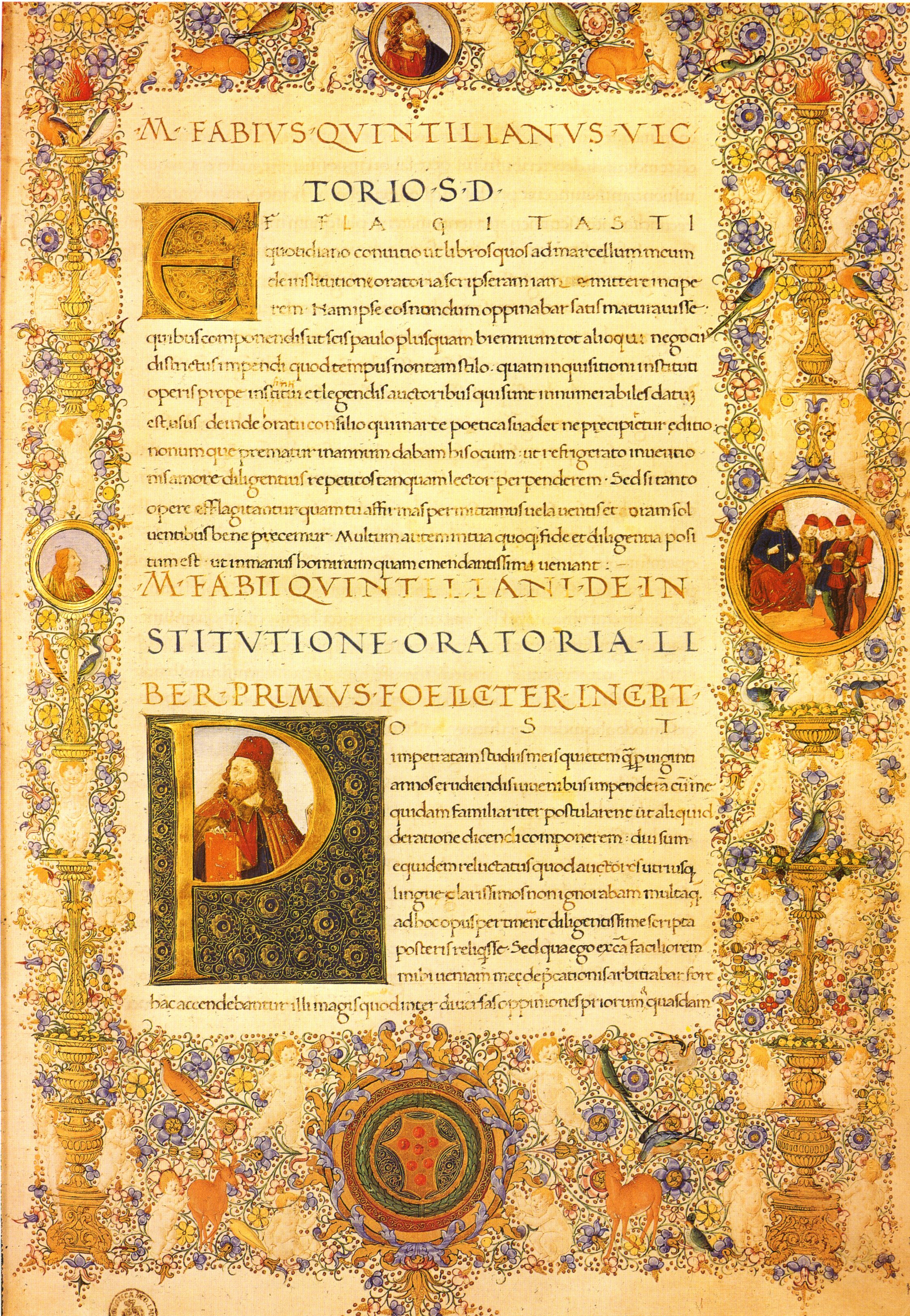
Quintilian’s Reading Recommendations

Quintilian, Institutio Oratoria 1.8.5-6

It was laid down in the best way possible that the student’s reading should begin with Homer and Vergil, although one needs a firmer capacity for judgment to understand their virtues. But there is time remaining for this, since they will not be read only once. For the time being, the mind should rise up from the sublimity of heroic song and draw its breath from the grandeur of the matter and be imbued with the noblest things.

Tragedies are useful: lyric poems will nourish the mind as well, if you carefully select not just the authors but even the parts of the work which are to be read. For the Greeks wrote a lot of things licentiously, and I wouldn’t even want to explain certain parts of Horace. Elegies, especially those about love, and hendecasyllabics, which are parts of Sotadean verse (and one should never teach about these) should be removed from the classroom if they can; if not, they should at least be reserved for a firmer time of life.

File:Quintilian, Institutio oratoria, Florence, Plut. 46.12.jpg - Wikimedia  Commons

Ideoque optime institutum est ut ab Homero atque Vergilio lectio inciperet, quamquam ad intellegendas eorum virtutes firmiore iudicio opus est: sed huic rei superest tempus, neque enim semel legentur. Interim et sublimitate heroi carminis animus adsurgat et ex magnitudine rerum spiritum ducat et optimis inbuatur. Vtiles tragoediae: alunt et lyrici, si tamen in iis non auctores modo sed etiam partes operis elegeris: nam et Graeci licenter multa et Horatium nolim in quibusdam interpretari. Elegia vero, utique qua amat, et hendecasyllabi, qui sunt commata sotadeorum (nam de sotadeis ne praecipiendum quidem est), amoveantur si fieri potest, si minus, certe ad firmius aetatis robur reserventur.

He Sees The Secrets That We Keep

Seneca, Moral Epistles 83.1-3

“You demand that I describe each of my days to you and in their entirety too. If you think that there’s nothing I should hide among these, you have a high opinion of me. Still, this is certainly the way we should live, as if out in front of everyone. This is also how we should think, as if there is someone out there who can see into our deepest heart. And there is. For what is the advantage if something can be kept secret from a person? Nothing is secret from God. He is in our souls and is present among our thoughts. He enters among them, I say, as someone who may leave at any time.

So, I will do what you demand and write you openly what I am doing and in what order. I will observe myself constantly and take stock of every day, which is a very useful practice. This is what makes us the worst: no one examines their own life. We think about only what we are going to do, even though our future plans rely on the past.”

Singulos dies tibi meos et quidem totos indicari iubes; bene de me iudicas, si nihil esse in illis putas, quod abscondam. Sic certe vivendum est, tamquam in conspectu vivamus; sic cogitandum, tamquam aliquis in pectus intimum introspicere possit; et potest. Quid enim prodest ab homine aliquid esse secretum? Nihil deo clusum est. Interest animis nostris et cogitationibus mediis intervenit—sic intervenit, dico, tamquam aliquando discedat. Faciam ergo, quod iubes, et quid agam et quo ordine, libenter tibi scribam. Observabo me protinus et, quod est utilissimum, diem meum recognoscam. Hoc nos pessimos facit, quod nemo vitam suam respicit. Quid facturi simus cogitamus. Atqui consilium futuri ex praeterito venit.

they don't know meme with captions "they don't know how much I have examined my life"

For Those Who Are About to Die

Seneca, Moral Epistles 82. 20-21

When someone is leading an army to die for their wives and children, how should they rally them? I offer to you that Fabius who took the burden of a war for the whole state upon a single household. I show you the Spartans who were placed at the passes of Thermopylae. They could not expect either victory or retreat.

That place was destined to be their grave. How would you rally them so that they would offer up their bodies to receive the ruin meant for the whole people, so that they would leave life instead of their position? Would you say, “What is evil is not glorious; death is glorious, therefore death is not evil?” What a moving speech! Who would hesitate to hurl themselves against the enemy’s spears and die where they stood?

But Leonidas spoke to them more bravely. He said, “Comrades: eat breakfast well, since tonight we dine in hell.”

In aciem educturus exercitum pro coniugibus ac liberis mortem obiturum quomodo exhortabitur? Do tibi Fabios totum rei publicae bellum in unam transferentes domum. Laconas tibi ostendo in ipsis Thermopylarum angustiis positos. Nec victoriam sperant nec reditum. Ille locus illis sepulchrum futurus est. Quemadmodum exhortaris, ut totius gentis ruinam obiectis corporibus excipiant et vita potius quam loco cedant? Dices: “quod malum est, gloriosum non est; mors gloriosa est; mors ergo non malum”? O efficacem contionem! Quis post hanc dubitet se infestis ingerere mucronibus et stans mori! At ille Leonidas quam fortiter illos adlocutus est! “Sic,” inquit, “commilitones, prandete tamquam apud inferos cenaturi.”

Leonidas meme from the movie 300 with the king shouting. Here he is saying tamquam apud inferos cenatur which means "breakfast well, for tonight we dine in hell."

You Have Enough Books Already

Lucian, On the Ignorant Book-Collector 26

“Once a dog has learned to chew leather it can’t stop. Another way is easier: not buying any more books. You are sufficiently educated, you have enough wisdom. You have all of antiquity nearly at the top of your lips.

You know all of history, every art of argumentation including their strengths and weaknesses and how to use Attic words. Your abundance of books has given you a special kind of wisdom and placed you at the peak of learning. Nothing stops me from messing with you since you enjoy being thoroughly deceived.”

οὐδὲ γὰρ κύων ἅπαξ παύσαιτ᾿ ἂν σκυτοτραγεῖν μαθοῦσα. τὸ δ᾿ ἕτερον ῥᾴδιον, τὸ μηκέτι ὠνεῖσθαι βιβλία. ἱκανῶς πεπαίδευσαι, ἅλις σοι τῆς σοφίας. μόνον οὐκ ἐπ᾿ ἄκρου τοῦ χείλους ἔχεις τὰ παλαιὰ πάντα. πᾶσαν μὲν ἱστορίαν οἶσθα, πάσας δὲ λόγων τέχνας καὶ κάλλη αὐτῶν καὶ κακίας καὶ ὀνομάτων χρῆσιν τῶν Ἀττικῶν· πάνσοφόν τι χρῆμα καὶ ἄκρον ἐν παιδείᾳ γεγένησαι διὰ τὸ πλῆθος τῶν βιβλίων. κωλύει γὰρ οὐδὲν κἀμέ σοι ἐνδιατρίβειν, ἐπειδὴ χαίρεις ἐξαπατώμενος.

books

Favorinus, [According to Aulus Gellius]

“It is impossible for someone who has fifteen thousand cloaks not to want more.”

 τὸν γὰρ μυρίων καὶ πεντακισχιλίων χλαμύδων δεόμενον οὐκ ἔστι μὴ πλειόνων δεῖσθαι·

Blaming Odysseus

Why did Agamemnon set aside right and agree to the sacrifice of his daughter?

Aeschylus. Agamemnon. 224-227.

Chorus:
He let himself become
the sacrificer of his daughter
for a war to help avenge a woman,
and as the first rite in launching the ships.

ἔτλα δ οὖν θυτὴρ γενέ-
σθαι θυγατρός, γυναικοποί-
νων πολέμων ἀρωγὰν
καὶ προτέλεια ναῶν.

Jean Racine (1639-1699), in his adaptation of Iphigenia at Aulis, placed the blame for Agamemnon’s moral waywardness squarely on Odysseus. In other words, Odysseus made him do it:

Racine. Iphigenia.

Agamemnon to attendant (70-78):

I wanted to disband the army.
Odysseus seemed to support my wishes;
He let that first rush of words go unchecked.
But soon he marshaled his cruel techniques:
He conjured for me honor and country;
All the people, the kings, who obey my commands;
The Asian empire promised to Greece;
And how, sacrificing the state for my daughter,
A fameless king, I’d grow old in my household.

Je voulais sur-le-champ congédier l’armée.
Ulysse en apparence approuvant mes discours,
De ce premier torrent laissa passer le cours.
Mais bientôt rappelant sa cruelle industrie,
Il me représenta l’honneur et la patrie,
Tout ce peuple, ces rois à mes ordres soumis,
Et l’empire d’Asie à la Grèce promis.
De quel front immolant tout l’État à ma fille,
Roi sans gloire, j’irais vieillir dans ma famille!

Odysseus to Agamemnon (285-296):

Think! You owe your daughter to Greece:
You’ve promised her to us, and on that promise,
Calchas, whom the Greeks consult daily,
Has foretold the return of unfailing winds.
If what comes contradicts his predictions,
Do you think Calchas will stay silent?
That you can blunt his accusations?
That Greeks will say the gods lied, and not blame you?
Deprived of their sacrifice, who knows what Greeks,
Rightly angry, in their view, might do?
Beware of forcing an enraged people,
My lord, to choose between you and the gods.

Songez-y: Vous devez votre fille à la Grèce:
Vous nous l’avez promise; et, sur cette promesse,
Calchas, par tous les Grecs consulté chaque jour,
Leur a prédit des vents l’infaillible retour.
À ses prédictions si l’effet est contraire,
Pensez-vous que Calchas continue à se taire;
Que ses plaintes, qu’en vain vous voudrez apaiser,
Laissent mentir les Dieux, sans vous en accuser?
Et qui sait ce qu’aux Grecs, frustrés de leur victime,
Peut permettre un courroux qu’ils croiront légitime?
Gardez-vous de réduire un peuple furieux,
Seigneur, à prononcer entre vous, et les Dieux.

Roland Barthes characterizes Racine’s representation of Odysseus this way:

Roland Barthes. On Racine (Editions du Seuil. 1963.105).

“He possesses the traits of what Votaire calls with admiration ‘the great politician’: the sense of collective interest, the objective appreciation of facts and their consequences, the lack of self respect; and he shrouds all his pragmatism in windbag rhetoric and continual blackmail styled as high morals [honor and country].”

“Il possède les traits de ce que Voltaire appelait avec admiration le grand politique: le sens de l’intérêt collectif, l’appréciation objective des faits et de leurs conséquences, l’absence d’amour-propre, enveloppant tout ce pragmatisme d’une rhétorique phraseuse et d’un chantage continu à la grande morale.”

black and white photograph of a line drawing or etching of the philosopher and poet Jean Racine.

19th-century portrait of Racine.

Larry Benn has a B.A. in English Literature from Harvard College, an M.Phil in English Literature from Oxford University, and a J.D. from Yale Law School. Making amends for a working life misspent in finance, he’s now a hobbyist in ancient languages and blogs at featsofgreek.blogspot.com.

Kindness is Important–I wrote a Book about It

Seneca, Moral Epistle 81.1-3

“You are complaining that you encountered someone who was ungrateful. If this is the first time, then you should be grateful to your luck or your own care. For this matter, however, care can only make you mean: if you want to avoid this kind of risk, then you won’t do people favors. So, you lose out on them, in order to prevent another wasting them.

It is better to receive no thanks than not to help people. You need to plant even after a bad harvest! Often the long term failure of unfertile soil is overcome by one season’s growth. To find one thankful person, you have to try with many ungrateful ones. No one has so perfect a hand when doing favors that they are not deceived again and again.

People should wander so they can find their way again.. Sailors try the sea after a shipwreck; an investor doesn’t flee the marketplace because of one conman. If we had to give everything up that presented danger, then life would grow boring with meaningless leisure.

But this situation should make you even kinder. For when the outcome of any event is uncertain, you need to try often to finally succeed. Well, I wrote enough about all this already in the books I wrote,  under the title “On Benefits”

Quereris incidisse te in hominem ingratum. Si hoc nunc primum, age aut fortunae aut diligentiae tuae gratias. Sed nihil facere hoc loco diligentia potest nisi te malignum. Nam si hoc periculum vitare volueris, non dabis beneficia; ita ne apud alium pereant, apud te peribunt.

Non respondeant potius quam non dentur. Et post malam segetem serendum est; saepe quicquid perierat adsidua infelicis soli sterilitate, unius anni restituit ubertas. Est tanti, ut gratum invenias, experiri et ingratos. Nemo habet tam certam in beneficiis manum, ut non saepe fallatur; aberrent, ut aliquando haereant. Post naufragium maria temptantur. Faeneratorem non fugat a foro decoctor. Cito inerti otio vita torpebit, si relinquendum est, quicquid offendit; te vero benigniorem haec ipsa res faciat. Nam cuius rei eventus incertus est, id ut aliquando procedat, saepe temptandum est. Sed de isto satis multa in iis libris locuti sumus, qui de beneficiis inscribuntur.

peter parker meme: frame one, man holding book that says "on benefits"; frame two, man reading book that says "gratitude is less important than kindness"


Do You Even Study?

Seneca, Moral Epistles 80.2-3

“I made a huge mistake when I was just promising myself some peace and quiet without interruption. Listen: a huge roar rises out of the stadium and even though it doesn’t precisely distract me, it draws my attention to the difference of this very affair.

How many people, I think, train their bodies and how few exercise their minds! Look at the size of the crowds that rush to games even though they’re silly and a mere diversion, when the classrooms of the noble arts are empty! The minds of those athletes whose thick shoulders we admire are so thin.

But I contemplate this the most: if a body can be developed to such a degree of endurance through exercise that it will face the fists and feet of more than a single opponent at once, and become so disciplined that someone can remain the entire die in the burning sun and roiling dust, yet dripping with with its own blood–well, then, how much easier should it be to strengthen mind to prepare it to face fortune’s attacks unbeaten, so it will stand up again after it is thrown down and trampled?”

Magnum tamen verbum dixi, qui mihi silentium promittebam et sine interpellatore secretum. Ecce ingens clamor ex stadio perfertur et me non excutit mihi, sed in huius ipsius rei contentionem transfert. Cogito mecum, quam multi corpora exerceant, ingenia quam pauci; quantus ad spectaculum non fidele et lusorium fiat concursus, quanta sit circa artes bonas solitudo; quam inbecilli animo sint, quorum lacertos 3umerosque miramur. Illud maxime revolvo mecum: si corpus perduci exercitatione ad hanc patientiam potest, qua et pugnos pariter et calces non unius hominis ferat, qua solem ardentissimum in ferventissimo pulvere sustinens aliquis et sanguine suo madens

still shot from the breakfast club with the words "How many people, I think, train their bodies and how few exercise their minds!"

Seneca’s Spirit in the Sky

Seneca, Moral Epistles 79.11-13

“Much of our work is done–well, if I am willing to tell the truth, it isn’t much. For goodness is not being better than the worst. Who would brag about their eyes after just glimpsing daylight? Someone who has seen the sun shine through a mist may be happy that they have fled the shadows even though they still do not enjoy the light’s benefit.

Our spirits will not have a reason to congratulate themselves until they are freed from the shadows they’re stumbling in and have not glanced at the light with fleeting vision but have exulted in the whole day and have been restored to their own place in the sky–when they return to the place they inhabited before they were born.

Their origins call souls on high–and they can make it back there even before being released from this prison once they abandon their vices and launch purely and lightly into divine contemplation.

It pleases me, dearest Lucilius, that we are doing this,  that we pursue it with all our strength,  even though few people–or none at all–know about it. Fame is virtue’s shadow–it follows even against our will.”

Iam multum operis effecti est; immo, si verum fateri volo, non multum. Nec enim bonitas est pessimis esse meliorem. Quis oculis glorietur, qui suspicetur diem? Cui sol per caliginem splendet, licet contentus interim sit effugisse tenebras, adhuc non fruitur bono lucis. Tunc animus noster habebit, quod gratuletur sibi, cum emissus his tenebris, in quibus volutatur, non tenui visu clara prospexerit, sed totum diem admiserit et redditus caelo suo fuerit, cum receperit locum, quem occupavit sorte nascendi. Sursum illum vocant initia sua. Erit autem illic etiam antequam hac custodia exsolvatur, cum vitia disiecerit purusque ac levis in cogitationes divinas emicuerit.

Hoc nos agere, Lucili carissime, in hoc ire impetu toto, licet pauci sciant, licet nemo, iuvat. Gloria umbra virtutis est; etiam invitam comitabitur.

Lemberg meme from office space saying "if you could just overcome your vices and have pure thoughts, that'd be great"

Best to Write Last? Seneca Breaks ChatGPT

Seneca, Moral Epistle 79.6

“There’s a big difference in whether you write on material that has been thoroughly worked through or on something just breaking. New material expands each day and what you know doesn’t stand in the way of new discoveries. But the best opportunity is to write last: the words are waiting for you and they look different when arranged in a new way. You’re not stealing them as if they belong to someone else–they’re in the public domain!”

Multum interest, utrum ad consumptam materiam an ad subactam accedas; crescit in dies et inventuris inventa non obstant. Praeterea condicio optima est ultimi; parata verba invenit, quae aliter instructa novam faciem habent. Nec illis manus inicit tamquam alienis. Sunt enim publica

kermit d frog at a typewriter meme with the words "the secret to writing is stealing the best words"

Not Fearing to Die with a Little Help from Your Friends

Seneca, Moral Epistles 78.1-5

“It troubles me that you are suffering from sinus infections and fevers which turn into a series of seizures–more so because I know something of this kind of sickness and I minimized it at the beginning. Youth made it possible for me to endure the symptoms to a point and to act bravely towards the disease. But I eventually succumbed and got so sick that I could only cough, stretched as thin as possible.

I frequently planned to end my life, but my most loving father’s old age held me back. I was thinking not about how bravely I was able to face death, but how incapable he was of bravely facing my loss. Sometimes just living is the truly brave deed.

I’ll tell you what brought me comfort in then, if I can say first that these things I used to quiet my mind were as good as medicine. True comfort turns into a cure and whatever strengthens the spirit helps the body too. My studies saved me. I credit philosophy that I got better and became strong again. I owe my life to philosophy and nothing less.

My friends returned me to good health too–I was raised up by their encouragement, long watches over me, and conversation. Lucilius, best of men, nothing heals the sick like the affection of friends; nothing else so undermines anxiety and fear about death. Indeed, I used to believe that I would not die since I would leave them to survive me. I used to believe, I mean, that would continue on not with them, but through them. I figured I wasn’t giving up my soul, but merely handing it over.”

Vexari te destillationibus crebris ac febriculis, quae longas destillationes et in consuetudinem adductas secuntur, eo molestius mihi est, quia expertus sum hoc genus valetudinis, quod inter initia contempsi; poterat adhuc adulescentia iniurias ferre et se adversus morbos contumaciter gerere. Deinde succubui et eo perductus sum, ut ipse destillarem ad summam maciem deductus. Saepe impetum cepi abrumpendae vitae; patris me indulgentissimi senectus retinuit. Cogitavi enim non quam fortiter ego mori possem, sed quam ille fortiter desiderare non posset. Itaque imperavi mihi, ut viverem. Aliquando enim et vivere fortiter facere est.

Quae mihi tunc fuerint solacio dicam, si prius hoc dixero, haec ipsa, quibus adquiescebam, medicinae vim habuisse. In remedium cedunt honesta solacia, et quicquid animum erexit, etiam corpori prodest. Studia mihi nostra saluti fuerunt. Philosophiae acceptum fero, quod surrexi, quod convalui. Illi vitam debeo et nihil illi minus debeo. Multum mihi contulerunt ad bonam valetudinem amici, quorum adhortationibus, vigiliis, sermonibus adlevabar. Nihil aeque, Lucili, virorum optime, aegrum reficit atque adiuvat quam amicorum adfectus; nihil aeque expectationem mortis ac metum subripit. Non iudicabam me, cum illos superstites relinquerem, mori. Putabam, inquam, me victurum non cum illis, sed per illos. Non effundere mihi spiritum videbar, sed tradere.

Final dinner scene from "Don't Look Up": A group of family and friends toast around a dinner table as the world is about to end