“[Zeus] puts mortals on
The journey of comprehension.
And made this the powerful law:
We learn by suffering.
Pain-recalling trouble trickles
Through the heart in sleep—
And wisdom comes just so
To the unwilling.
The gods seated on their sacred seats
Bestow a hard grace I think.”
Ζῆνα δέ τις προφρόνως ἐπινίκια κλάζων
τεύξεται φρενῶν τὸ πᾶν,
Romulus and Romus abandon Alba Longa; the murder of Romus.
Romulus and Romus then gave the throne to their maternal grandfather Numitor, and to their mother they gave an honor which they judged suitable to themselves. For they did not undertake to seize power, and moreover they wished to found a city on the spot where they were nursed. When they set about the task of building the new city, there arose between the brothers a dispute about the city and who would be sovereign, and it came to blows; in this contest, Romus died. Another story has it that as Romulus was digging a trench which was to be the city enclosure, Romus now hindered the work, and now scoffed at it. At last, when Romus leapt over it as if to show how easily it could be attacked, he was killed; some say that this was at Romulus’ hands, and others aver that he was slain by some other man. For this reason, it was enacted that anyone who dared to cross the trench except by the customary paths would be condemned to death.
71.
“Malice attends difficulties.”
<Interpretation>
“Those who rage with insatiable malice fashion envy even for the poor.”
Εἰς ἀπορίαν φθόνος.
<῾Ερμηνεία.>
᾿Απλήστῳ βασκανίᾳ λυσσῶντές τινες
Καὶ τοῖς πένησι τὸν φθόνον ὁπ<λί>ζουσι.
72.
“Never do good, and try not to receive any evil.”
<Interpretation>
“By treating the wicked well, you do not seem to me to be wise. For the most wicked always work the worst evils upon themselves.”
Καλὸν μὴ ποιήσῃς καὶ κακὸν οὐ μὴ ἀπολάβῃς.
<῾Ερμηνεία.>
Κακοὺς εὖ ποιῶν οὔ μοι δόξεις σωφρονεῖν·
Οἱ γὰρ κάκιστοι δρῶ<σιν ἀεί σε κακῶς.>
73.
“The times may lead one up, but they may also lead one down.”
<Interpretation>
“Time will give mortals both the possession of wealth as well as the travails of poverty.”
74.
“The dog who goes to the manger does not eat, and stands in the way of the ass.”
Interpretation
“The display of a shameless man’s wickedness will hinder another from the nourishment which he himself cannot get hold of.”
Κύων ἀναπεσὼν εἰς φάτνην αὐτός τε οὐκ ἐσθίει τῷ τε ὄνῳ
ἐμπ<οδ>ίζει.
῾Ερμηνεία.
Πονηρίας ἔνδειξις ἀνδρὸς ἀναιδοῦς
Τροφῆς κωλύειν ἄλλον, ἧς οὐχ ἅπτεται.
75.
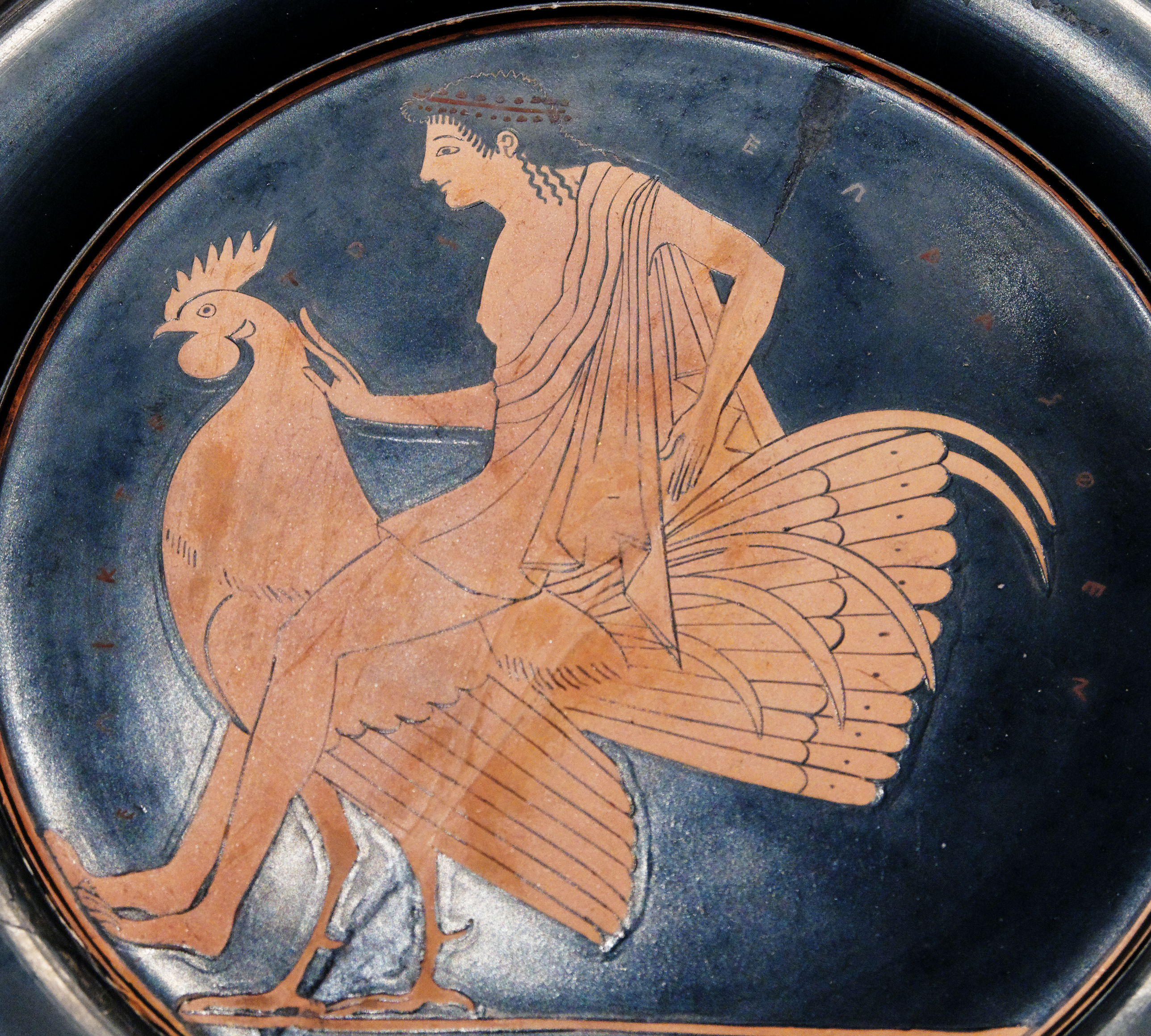
“The words of an orator, the deeds of a rooster.”
Interpretation:
“False people argue their case with empty words, vainly reproaching the words of giants.”
Λόγοι μὲν ῥήτορος, ἔργα δ’ ἀλέκτορος.
῾Ερμηνεία.
Τοῖς <κενοῖς> λόγοις ἐλέγχονται οἱ ψευδεῖς,
Γιγάντων ῥήματα <μάτην προφέροντες>.
76.
< > of your heart.
<Interpretation>
“Willingly escape notice, and do not be too eager to display the particulars of your mind to every man.”
77.
“It is possible to fail, it is not possible to be indifferent.”
Interpretation
“It is proper for a man bearing the outcome of fortune to flee from carelessness of mind.”
᾿Ατυχεῖν ἔξεσ<τιν>, ἀμελεῖν οὐκ ἔξεστιν.
῾Ερμηνεία.
῎Ανδρα φέροντα τῆς τύχης τὸ σύμπτωμα
Τῆς γνώμης τὸ ῥάθυμον ἐκφυγεῖν πρέπει.
78.
< >
Interpretation
“One who wishes to be careless in practical affairs will live a dark and painful life.”
< >
῾Ερμηνείς.
῾Ο ῥαθυμεῖν ἐθέλων ἐν τοῖς πρακτέοις
Σκοτεινὸν ἕξει καὶ λυπηρὸν τὸν βίον.
79.
“The incense does not make its way up to a good god.”
Interpretation
“It is a custom of the wicked not to wish to repay good people with divine honors.”
᾿Αγαθῷ <θε>ῷ λίβανος οὐκ ἀναβαίνει.
῾Ερμηνεία.
Σύνηθές ἐστι τοῖς κακοῖς οὐκ ἐθέλειν
Τοὺς ἀγαθοὺς ἀμείβεσθαι ταῖς θείαις τιμαῖς.
80.
“Repulse them when they begin, and they will not rebel.”
Interpretation
“If you know how to hinder wickedness in its infancy, you will be far from disturbance and wicked wandering.”
᾿Αρχομένους ἀνάστελλε καὶ οὐ μὴ στασιάσουσιν.
῾Ερμηνεία.
᾿Αρχὴν κακὴν μέλλουσαν εἰδὼς κωλύειν
Ταράχου μακρὰν ἔσῃ καὶ κακῆς πλάνης.
“Even though I have a lot more to say about the foolish things the drug-dealer [Aristotle] said, and although I know that Epicurus, who was the most faithful to the truth, said these things about him in his Letter on Lifestyles, that after he consumed his inheritance he first went on a military expedition and when that went badly he moved on to selling drugs. When Plato opened his school, Epicurus says, [Aristotle] traveled there and attended the lectures. Because he was not a moron, bit by bit he pursued a more reflective path.
I know that Epicurus alone said these things against Aristotle: neither Eubulides nor Kêphisodôros dares to say this kind of thing against the Stageirite, even though they published many condemnations of him. In that same letter, Epicurus also claims that Protagaoras the sophist, was a porter and wood-deliverer before he became Democritus’ scribe. According to Epicurus, Democritus was impressed by the particular way Protagoras piled wood—then he took him, taught him how to read and write in some village after which he rose to become a Sophist. Just so, my dinner guests, I am moving from these words now to fill my belly.”
The first Suda entry for Aristotle is something like a soap-opera infused, poorly edited Wikipedia hit piece. And it does not mention the drug dealing:
“Aristotle, the son of Nikomakhos and Phastias. Nikomakhos was a doctor from the tradition of the sons of Asclepias, from Nikomakhos the son of Makhaon. He was from Stageira, a city in Thrace. He was also a philosopher, a student of Plato who had a stuttering voice. His siblings were Arimnestos and Arimnestê. He had a daughter with Pythias the daughter of Hermeias, the eunuch who fathered her even though he was castrated. Aristotle’s daughter married three times and died before her father after labor. He had a son named Nikhomakhos from a concubine named Herpyllis whom he took alongside Pythias, the eunuch’s daughter. (He was the ruler of Atarneus which is near the Troad. Hermeias was a slave of Euboulos of Bithynia and received Atarneus from him.) Aristotle was also a love of Hermeios. For 13 years, he led his [school of ] philosophy which was named peripatetic because he taught in a garden after leaving the Academia where Plato taught. He was born in the 99th Olympiad and died after drinking aconite in Chalkis because he was summoned for punishment after he wrote a Paean for the eunuch Hermeias. There are those who say he died after a disease when he was 70.”
Whoever once is known as a corrupt fake
Even if he tells the truth forfeits all faith.
This short Aesopic tale will prove the case.
A wolf was suing a fox for a sneaky scheme
She was denying she was near the scene.
Then an ape sat between them as a judge,
As both pleaded out their case and argued much.
The ape is said to have handed down this line:
Wolf, you don’t seem to have lost the things you seek.
But fox, I think you stole what you so cleverly deny.
Lupus et vulpes iudice simio.
Quicumque turpi fraude semel innotuit,
Etiam si verum dicit, amittit fidem.
Hoc attestatur brevis Aesopi fabula.
Lupus arguebat vulpem furti crimine;
Negabat illa se esse culpae proximam.
Tunc iudex inter illos sedit simius.
Uterque causam cum perorassent suam,
Dixisse fertur simius sententiam:
Tu non videris perdidisse quod petis;
Te credo surripuisse quod pulchre negas.
Romulus and Romus come of age; their identity is revealed; Amulius is expelled.
When they [Romulus and Romus] grew up, they were both manly and high-spirited. Romulus seemed more distinguished for his intelligence and was more inclined to command than obey. When a dispute arose between the cowherds of Numitor and those of Amulius, the brothers beat them and took a great share of the cattle. The cowherds of Numitor then laid a trap for Romus when he was walking alone with a few others; they captured him and brought him to Numitor. He feared retribution for coming up against Amulius, being his brother and often maltreated by the members of his household. But Amulius gave Romus to Numitor to do with him as he wished. As Numitor was returning home and gazing upon Romus, who was distinguished for his size and strength, he marveled at his boldness and indomitable nature, and then asked him in a low voice who he was and who his parents were. Romus boldly replied, ‘We are twin brothers; our lineage is said to be unspeakable, and our rearing and nursing is even more incredible, since we were nursed by beasts and birds after being set in a tiny cradle next to the great river; indeed, it still exists, with some faint words engraved on the bronze ribs which hold it together.’
Numitor was then led on by both the speech and appearance of Romus to think about the exposure of his daughter’s children. When Faustulus learned of the seizure of Romus, he urged Romulus to help him, and at that time told him clearly about his own lineage which was previously kept secret in order to prevent them from becoming small-minded. He then got the cradle and brought it to Numitor in the full bloom of zeal and anxiety. When he was seen by the guards posted outside the gates of Amulius, and appeared to be anxious under their questioning, it did not escape notice that he was hiding the cradle underneath his mantle. Thinking that he was concealing something which he had stolen, they brought the cradle out into the open. There happened to be present one of the men who had exposed the boys. He recognized the cradle, and ran to tell Amulius. When Faustulus was interrogated by the king, he laid out that the boys were alive, and further were cowherds in Alba Longa. He brought the cradle to Ilia, the mother of the boys, who wanted to see it. Disturbed by all of this, Amulius sent a man to Numitor to find out whether he could learn anything of the boys, since they were still alive. The man who had been sent on this expedition was one of Numitor’s friends. He went away and found Numitor lost in the complicated puzzle about Romus; he then urged Numitor on and counseled that there should be no delay, and he himself helped with the deed. Just then, Romulus arrived with a large band of rustics. A few of the city dwellers had also joined him from hatred of Amulius. Since matters had fallen out those, Amulius – neither doing nor contriving anything – ran away to save his life.
By chance a fox had seen a tragic mask:
What a sight, he has no brains inside!–he gasped.
To whomever fortune grants honor and glory,
It deprives of common sense, as in this story.
Personam tragicam forte vulpes viderat:
O quanta species, inquit, cerebrum non habet!
Hoc illis dictum est, quibus honorem et gloriam
Fortuna tribuit, sensum communem abstulit.
Socrates Historicus, 4.31 – Valentinian’s Two Wives
“When the empress Severa saw Justina bathing, she conceived a desire for the maiden’s beauty. She talked to the emperor about her, telling him that the beauty which the virgin daughter of Justus possessed was so incredible that even she, the empress, (though she was a woman) was smitten by desire for her. The emperor, weighing the empress’ speech, decided to wed Justina while retaining his current wife, who had given birth to Gratian (whom he had just declared co-emperor). He therefore issued a common edict throughout the cities, allowing anyone who so wished to have two wives.”
That old fuddy-duddy Edward Gibbon tries to dismiss this story as fanciful:
“But we may be assured, from the evidence of reason, as well as history, that the two marriages of Valentinian, with Severa, and with Justina, were successively contracted; and that he used the ancient permission of divorce, which was still allowed by the laws, although it was condemned by the church.”
-Decline and Fall of the Roman Empire, Vol. II Chp. 25
Lately we have been posting a lot of fables. Why? Because they are fabulous. But, also, because they are fun, fascinating, and a fine way to seek shelter from current events (while still doing some thinking). Ancient literature does not include a great deal of critical reflection on the Fable, but we do find it prized at the beginning of an education (by Quintilian) and the end of Socrates’ life.
Quintilian, Inst. Orat. 1.9.1-3
“Therefore, let children learn to relay Aesop’s fables—which follow closely the stories of the nursery, in a simple speech and without adding too much and then to write them down in the same unadorned fashion. They should first analyze the verse, then interpret it in their own words, and finally expand it in their own version in which they may either compress some parts or elaborate others with without losing the poet’s meaning.”
[2] igitur Aesopi fabellas, quae fabulis nutricularum proxime succedunt, narrare sermone puro et nihil se supra modum extollente, deinde eandem gracilitatem stilo exigere condiscant; versus primo solvere, mox mutatis verbis interpretari, tum paraphrasi audacius vertere, qua et breviare quaedam et exornare salvo modo poetae sensu permittitur.
Do you think Cheiron taught Achilles fables?
Diogenes Laertius, Vita Philosophorum 2.5.45
“Then they sentenced[Socrates] to death, adding 80 additional votes to this tally. After he was imprisoned for just a few days, he drank the hemlock, but not without having a few exemplary conversations which Plato describes in the Phaedrus. He also composed a paian which begins: “Hail, Delian Apollo, and Artemis, famous children”. Dionysodôros says that this paian is not his. He also composed Aesopic tales in verse, though not completely well, one of which begins:
“Aesop once said to the men who live in Korinth,
Do not judge virtue according to a jury’s opinion”
And then he was taken from the world of men. Soon, the Athenians changed their minds and closed the wrestling floor and gymnasium. They banished the accusers but put Meletos to death. They honored Socrates with a bronze statue which they placed in the Pompeion. It was mad by Lysippos. As soon as Anytos visited Heracleia, the people expelled him. Not only did the Athenians suffer concerning Socrates, but according to Heracleides they fined Homer fifty drachmae because he was insane and they said Tyrtaeus was out of his mind and they even honored Astydamas and others more than Aeschylus with a bronze statue. Euripides rebukes them in his Palamedes when he says:
“You have butchered/ you have butchered
The all-wise nightingale of the muses
Who caused no harm”
This is one story. But Philochorus claims that Euripides died before Socrates.”
Diogenes is not completely fabricating material here. Plato’s Phaedo records that Socrates while imprisoned composed “poems, arranged versions of Aesop’s tales and a prooimon to Apollo” (ποιημάτων ὧν πεποίηκας ἐντείνας τοὺς τοῦ Αἰσώπου λόγους καὶ τὸ εἰς τὸν Ἀπόλλω προοίμιον, 60d). When asked why he was occupying his time in this way, Socrates responds (Phaedo 60e-61a):
“The same dream often come to me in my past life, appearing in different forms from time to time, but saying the same things: “Socrates, make music and work on it.” In earlier time, I believe that it was compelling me and encouraging me to do what I was doing—just as some cheer on runners, in the same way the dream was telling me to do what I was doing, to make music, since philosophy is the greatest music of all and I was working on that. But now that the trial is complete and the festival has delayed my death, it seemed right to me, if the frequent dream really meant for me to make what is normally called music, not to disobey it but to compose.”
I hate cyclic poems, and I certainly don’t enjoy the road which leads many people here and there. I hate the wandering lover, and I never drink from a fountain. I hate all common things. Lysanias, you are beautiful – yes, beautiful! – but before the Echo can even resound clearly, someone says ‘Someone else already possesses him.’