Medieval Scribes’ Complaints: Halloween Edition CONTINUED

[Note: The Fabulous SP Festus provides us with another post about scribal complaints. His two first posts are here and here.]

We left the previous post with some of the comparative evidence for ghosts on the floor. There are certain issues with the concept, easy to enumerate but harder to rationalize. How will ghosts on the floor appear to the living? Slithering like snakes? Just lying there like ill-behaved pets? Again, ghosts are traditionally quick to anger. Given their mortal origins, might they not take offense at having to grub food from the floor as opposed to food politely offered in dishes (cf. pets, above)? Fascinating though such issues be, more important to establish that ghosts were on the floor. The Festus evidence with the gloss does seem to establish it. But is there more? Oh yes. Oh my yes.

roman-death-mosaic

Here’s a passage from the Elder Pliny’s great encyclopedia, first century AD.:

“Also, food which fell from the diner’s hand was returned to the table at least during the courses, and they forbade, for the sake of cleanliness, blowing dirt off it; too, there are auguries connected, i.e. what the diner who dropped the food was saying or thinking would come to pass — the most dire of which would be if this happened to a pontiff at a formal dinner. In all events, putting it back on the table and burning it for the Lar counted as expiation.”

Pliny the Elder, Historia Naturalis, 28.27

cibus etiam e manu prolapsus reddebatur utique per mensas, vetabantque munditiarum causa deflare, et sunt condita auguria, quid loquenti cogitantive id acciderit, inter execratissima, si pontifici accidat dicis causa epulanti. in mensa utique id reponi adolerique ad Larem piatio est.

This passage gives us two important pieces of information. Burning it on the table solves the issue of ghosts annoyed by eating it on the floor.  And the Lar, more usually known in the plural Lares was provably a family ancestor as the Lar familiaris.

Armed with this information we can examine a classic ghost festival, the Lemuria, which took place on three days: May 9, 11, 13. It appears in the oldest Roman calendars, meaning it originally was rural and may even predate the traditional founding of Rome (753 BC). The early first century AD poet Ovid in his incomplete Fasti, a descriptive poem of the Roman calendar, offers this:

“When midnight has come and lends silence to sleep, and dogs and all ye varied fowls are hushed, the worshipper who bears the olden rite in mind and fears the gods arises; no knots constrict his feet; and he makes a sign with his thumb in the middle of his closed fingers,a lest in his silence an unsubstantial shade should meet him. And after washing his hands clean in spring water, he turns, and first he receives black beans and throws them away with face averted; but while he throws them, he says: “These I cast; with these beans I redeem me and mine.” This he says nine times, without looking back: the shade is thought to gather the beans, and to follow unseen behind. Again he touches water, and clashes Temesan bronze, and asks the shade to go out of his house. When he has said nine times, “Ghosts (Manes) of my fathers, go forth!” he looks back, and thinks that he has duly performed the sacred rites.”

Ovid, Fasti, 5.429-44, Frazer translation.

nox ubi iam media est somnoque silentia praebet,
et canis et variae conticuistis aves,
ille memor veteris ritus timidusque deorum
surgit (habent gemini vincula nulla pedes)
signaque dat digitis medio cum pollice iunctis,
occurrat tacito ne levis umbra sibi.
cumque manus puras fontana perluit unda,
vertitur et nigras accipit ante fabas
aversusque iacit; sed dum iacit, ‘haec ego mitto,
his’ inquit ‘redimo meque meosque fabis.’
hoc novies dicit nec respicit: umbra putatur
 colligere et nullo terga vidente sequi.
rursus aquam tangit Temesacaque concrepat aera
et rogat, ut tectis exeat umbra suis.
cum dixit novies ‘Manes exite paterni,’
respicit et pure sacra peracta putat.

He throws the beans, which will land on the floor which the ghosts will eat. It all fits together so far…hungry ghosts hanging (slithering?) about on the floor, waiting for food. The passage is not without problems. For example, the black beans. Impossible.  The black bearn, Phasellus niger, is a New World plant and also an India plant. Roman beans were Vicia faba, a creamy white color. Black is known to occur, but it is a recessive trait. Hence black beans would not be nearly common enough for the widespread and long-term practice of this festival. This problem can be solved, but we need to stay on track here.

What about that word for ghosts Manes? “Houston, we have a problem.” The Romans had multiple names for ghosts which overlapped and didn’t overlap all at the same time. Manes appear on literally thousands of tombstones, and usually are taken to mean “ancestral spirits”. It’s far more complex than that; see my article on same in the Oxford Classical Dictionary, third edition and later.

It puzzled the ancients too. Here is a selection from the second century AD author Apuleius:

“here is also another species of daemons, according to a second signification, and this is a human soul, which, after its departure from the present life, does not enter into another body. I find that souls of this kind are called in the ancient Latin tongue Lemures. Of these Lemures, therefore, he who, being allotted the guardianship of his posterity, dwells in a house with an appeased and tranquil power, is called a familiar [or domestic] Lar. But those are for the most part called Larvae, who, having no proper habitation, are punished with an uncertain wandering, as with a certain exile, on account of the evil deeds of their life, and become a vain terror to good, and are noxious to bad men. And when it is uncertain what the allotted condition is of any one of these, they call the God by the name of Manes; the name of God being added for the sake of honour. For they alone call those Gods, who being of the same number of Lemures, and having governed the course of their life justly and prudently, have afterwards been celebrated by men as divinities, and are every where worshipped in temples, and honoured by religious rites; such for instance as Amphiaraus in Boeotia, Mopsus in Africa, Osiris in Egypt, and some other in other nations, but Esculapius every where.

Apuleius, De Deo Socratis 14

Est et secundo significatus species daemonum animus humanus emeritis stipendiis vitae corpore suo abiurans. Hunc vetere Latina lingua reperio Lemurem dictitatum. Ex hisce ergo Lemuribus qui posterorum suorum curam sortitus placato et quieto numine domum possidet, Lar dicitur familiaris; qui vero ob adversa vitae merita nullis (bonis) sedibus incerta vagatione ceu quodam exilio punitur, inane terriculamentum bonis hominibus, ceterum malis noxium, id genus plerique Larvas perhibent. Cum vero incertum est, quae cuique eorum sortitio evenerit, utrum Lar sit an Larva, nomine Manem deum nuncupant: scilicet et honoris gratia dei vocabulum additum est; quippe tantum eos deos appellant, qui ex eodem numero iuste ac prudenter curriculo vitae gubernato pro numine postea ab hominibus praediti fanis et caerimoniis vulgo advertuntur, ut in Boeotia Amphiaraus, in Africa Mopsus, in Aegypto Osiris, alius alibi gentium, Aesculapius ubique.

But moderns are no better. In English we have, among other words, ghost, spirit, wraith, ghoul, revenant…the list seems endless.

Finally, I would be remiss if I didn’t mention a fragment of Maecenas, the emperor Augustus’ pal and literary adviso, no great fan of the Lemures:

“An unregenerate crew, they search out people at feasts, and assail households with the wine-cup, and, by hope, exact death.”

Maecenas, ap. Seneca, Letters 114.5

Inremediabilis factio rimantur epulis lagonaque temptant domos et spe mortem exigunt

Our concluding post will show you why the Lemuria in May has everything to do with Halloween in October. Be safe…watch where you step. Your feet are not alone on the floor.

Werewolf Week: Augustine on Arcadian Werewolf Legends

From Augustine’s City of God XVIII.17

“Varro adds to this by relating other things no less incredible about that most renowned witch Circe, who changed the companions of Ulysses into beasts, and about the Arcadians, who after drawing lots would swim across a certain pool and there be turned into wolves; they would then live with similar wild beasts in the deserts of that region. If, however, after nine years they had not tasted of human flesh, they would be turned back into humans if they swam back across the pond. He also mentions that a certain Demaenetus had tasted a part of the sacrifice in the form of a burnt boy which the Arcadians used to offer to their god Lycaeus; he was turned into a wolf and after ten years restored to his human form. He then practiced boxing and won that contest in the Olympics. The same historian thinks that such a name was not given to Pan Lycaeus and Jupiter Lycaeus for any other reason than this transformation into wolves, which they used to think could not happen but by divine influence. (For, a wolf is called a lykos in Greek, from which it appears that the name of Lycaeus is derived. He also says that the Romans were called Luperci as though derived from the seed of those mystery rites.)”

Hoc Varro ut astruat, commemorat alia non minus incredibilia de illa maga famosissima Circe, quae socios quoque Vlixis mutauit in bestias, et de Arcadibus, qui sorte ducti tranabant quoddam stagnum atque ibi conuertebantur in lupos et cum similibus feris per illius regionis deserta uiuebant. Si autem carne non uescerentur humana, rursus post nouem annos eodem renatato stagno reformabantur in homines. Denique etiam nominatim expressit quendam Demaenetum gustasse de sacrificio, quod Arcades immolato puero deo suo Lycaeo facere solerent, et in lupum fuisse mutatum et anno decimo in figuram propriam restitutum pugilatum sese exercuisse et Olympiaco uicisse certamine. Nec idem propter aliud arbitratur historicus in Arcadia tale nomen adfictum Pani Lycaeo et Ioui Lycaeo nisi propter hanc in lupos hominum mutationem, quod eam nisi ui diuina fieri non putarent. Lupus enim Graece *lu/kos dicitur, unde Lycaei nomen apparet inflexum. Romanos etiam Lupercos ex illorum mysteriorum ueluti semine dicit exortos.

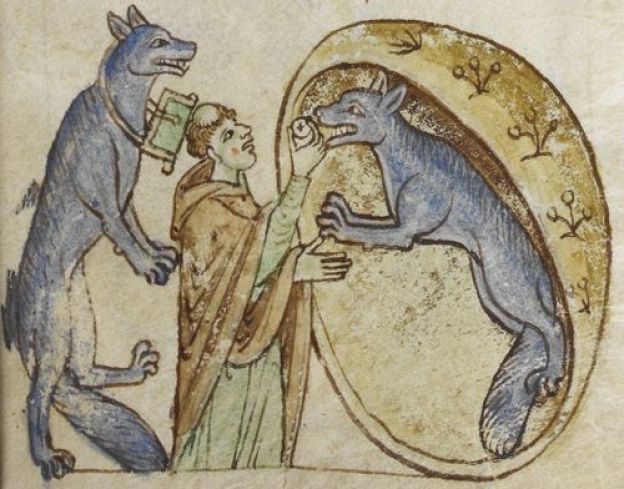
Werewolf Week, Therapeutic Edition: Diagnosing and Treating Lycanthropy

This week in honor of Halloween we are returning to an obsession with lycanthropy. There is a trove of ancient Greek medical treatises on the diagnosing and treatment of the disease.

wolfbyz

Oribasius (Pergamum, c. 4th Century CE)

Oribasius is said to have studied medicine in Alexandria; he later served as the court doctor to Julian the Apostate. He wrote several encyclopedic summaries of medical knowledge at the time. The text produced for a friend’s son (Synopsis ad Eustathium) is identical to that attributed to Paulus of Aegina and seems to form the core of medical treatises on lycanthropy.

On Lycanthropy:

“Men who are afflicted with lycanthropy go out at night and imitate wolves in every way, spending time until daybreak among the gravestones. You will recognize that someone is suffering from this by the following symptoms. They appear pale and look weak; they have dry eyes and cannot cry. You may observe that their eyes are hollow and their tongue is especially dry: they cannot really produce saliva. They are thus thirsty and in addition they have wounded shins from scraping the ground frequently.

These are the symptoms; for treatment it is important to recognize that this is a type of melancholy which you may treat at the time the disease is noticed by cutting open the veins and draining blood until the patient almost passes out. Let him be washed in a sweet bath. After rubbing him down with milk-whey for three days, apply a pumpkin salve* to him on the second and third day. Following these cleansings, anoint him with the antidote for viper-venom and do the rest of the things prescribed for melancholy. When they disease has already come over those who are accustomed to sleepwalk, anoint them with lotion. And rub opium on their ears and nostrils when they are ready to sleep.”

Περὶ λυκανθρωπίας.

Οἱ τῇ λυκανθρωπίᾳ κατεχόμενοι νυκτὸς ἐξίασι τὰ πάντα λύκους μιμούμενοι καὶ μέχρις ἡμέρας περὶ μνήματα διατρίβουσιν. γνωριεῖς δὲ τὸν οὕτω πάσχοντα διὰ τῶνδε· ὠχροὶ τυγχάνουσι καὶ ὁρῶσιν ἀδρανὲς καὶ ξηροὺς τοὺς ὀφθαλμοὺς ἔχουσι καὶ οὐδὲ δακρύουσιν· θεάσῃ δ’αὐτῶν κοίλους τοὺς ὀφθαλμοὺς καὶ τὴν γλῶσσαν ξηροτάτην, καὶ σίελον οὐδ’ ὅλως προχωροῦν αὐτοῖς· εἰσὶ δὲ καὶ διψώδεις καὶ τὰς κνήμας διὰ τὸ πολλάκις προσπταίειν ἀνιάτως ἡλκωμένας ἴσχουσιν.

τοιαῦτα μὲν αὐτῶν τὰ γνωρίσματα· γινώσκειν δὲ χρὴ εἶδος μελαγχολίας εἶναι τὴν λυκανθρωπίαν, ἣν θεραπεύσεις κατὰ τὸν χρόνον τῆς ἐπισημασίας τέμνων φλέβα καὶ κενῶν τοῦ αἵματος ἄχρι λειποθυμίας καὶ διαιτῶν τὸν κάμνοντα εὐχύμοις τροφαῖς. κεχρήσθω δὲ τοῖς λουτροῖς γλυκέσιν· εἶτ’ ὀρῷ γάλακτος χρησάμενος ἐπὶ τρεῖς ἡμέρας κάθαιρε τῇ διὰ τῆς κολοκυνθίδος ἱερᾷ, καὶ δεύτερον καὶ τρίτον· μετὰ δὲ τὰς καθάρσεις καὶ τῇ διὰ τῶν ἐχιδνῶν θηριακῇ χρήσῃ καὶ τὰ ἄλλα παραλήψῃ ὅσα ἐπὶ τῆς μελαγχολίας εἴρηται. ἐπερχομένης δ’ ἤδη τῆς νόσου τοῖς ὕπνους ἐμποιεῖν εἰωθόσιν ἐπιβρέγμασι χρήσῃ· καὶ ὀπίῳ δὲ χρῖσον ὦτα καὶ μυκτῆρας εἰς ὕπνον τρεπομένοις.

* The pumpkin or gourd (Gr. kolokunthos) was associated with life and health due to its “juicy nature”; see LSJ s.v. This may explain its ritual/therapeutic use both in cleansing an association with death and with treating a patient exhibiting extreme symptoms of dryness.

Dolon the Trojan Wears a Wolf Skin on a Red Figure Vase...His 'treatment' was less than therapeutic...
Dolon the Trojan Wears a Wolf Skin on a Red Figure Vase…His ‘treatment’ was less than therapeutic…

Continue reading “Werewolf Week, Therapeutic Edition: Diagnosing and Treating Lycanthropy”

“A Seminary of Folly”

From Robert Burton’s Anatomy of Melancholy:

“They dote all, but not alike, Μανία γαρ πᾶσιν ὁμοια, not in the same kind, One is covetous, a second lascivious, a third ambitious, a fourth envious, &c. as Damasippus the Stoic hath well illustrated in the poet,

Desipiunt omnes aeque ac tu.
And they who call you fool, with equal claim
May plead an ample title to the name.

‘Tis an inbred malady in every one of us, there is seminarium stultitiae, a seminary of folly, which if it be stirred up, or get ahead, will run in infinitum, and infinitely varies, as we ourselves are severally addicted, saith Balthazar Castilio: and cannot so easily be rooted out, it takes such fast hold, as Tully holds, altae radices stultitiae, so we are bred, and so we continue. Some say there be two main defects of wit, error and ignorance, to which all others are reduced; by ignorance we know not things necessary, by error we know them falsely. Ignorance is a privation, error a positive act. From ignorance comes vice, from error heresy, &c. But make how many kinds you will, divide and subdivide, few men are free, or that do not impinge on some one kind or other. Sic plerumque agitat stultos inscitia, as he that examines his own and other men’s actions shall find.”

A Pleasing Word for Any Audience

Aeneas Silvius Piccolomini, de Educatione Liberorum XXXII:

“There is however a pestilential class of humanity, who will praise those things which they hear praised, and will censure when they hear someone else doing it. They deny if someone else denies, and they affirm when they hear someone else affirm. Just as the octopus changes its color to match the appearance of the soil beneath it, so do these people alter their thoughts to please their audience; they are prepared to swear against justice and even against God if they should think it pleasing to the listener. Let this plague be banished from your house! You should keep true and chaste boys with you, cultivators of modesty and sanctity; not those false, lying, wine-drinking, unjust debauchees.”

Est autem pestiferum genus hominum, qui laudant quaecumque audiunt laudari, et rursus cum vituperante vituperant: negant si quis mehat, et affirmant ubi audiunt affirmantem; atque ut polypus ad speciem subiecti soli colorem mutat, ita et isti ad voluptatem audientium sententias variant, parati et adversus iustitiam et adversus Deum testificari, si placitum esse putarint audienti. Abigatur ex tuis aedibus haec pestis! Sint veraces tecum pueri, verecundi, pudici, modestiae cultores et sanctitatis; non ficti, non fallaces, non pertinaces, non vinolenti, non crapulosi, non iniurii.

Werewolf Week, Religious Returns: St. Augustine on Lycanthropy

In discussing tales of Diomedes’ companions being turned into birds, Augustine in De Civitate Dei (City of God) discusses werewolves (18.17, the full text):

“In order to make this seem more likely, Varro reports other fantastic tales concerning the infamous witch Circe, who transformed Odysseus’ companions into beasts, and concerning the Arcadians, who were by chance transformed when they swam across a certain lake in which they were turned into wolves. Then, they lived as wolves in the same region. If they did not eat human flesh, then they would be returned to human form after swimming across the same lake again.

werewolf-histories

And he also specifies that a certain Demanaetus tasted of the sacrifice which the Arcadians used to make to the Lycaean god, after the child was burned on the altar, and that he transformed into a wolf and, once he became a man again, competing in boxing at the Olympian games and achieved a victory. Varro does not believe for this reason that Pan or Jupiter were given the name “Lykaios” in Arcadia for any other reason than their ability to turn men into wolves, since they did not believe that this could happen except through divine power. As you know, a wolf is called lykos in Greek, and this is where the name Lykaian comes from. Varro adds that the Roman Luperci arose from their own mysteries similarly.

But what can we who talk about these things say about this kind of deceit by the devil’s forces?”

Augustine goes on to object to these tales and discuss Apuleius’ Golden Ass. I started translating this, but it is a bit of a Halloween buzzkill..

No Room For Werewolves in this city...
No Room For Werewolves in this city…

[XVII] Hoc Varro ut astruat, commemorat alia non minus incredibilia de illa maga famosissima Circe, quae socios quoque Vlixis mutauit in bestias, et de Arcadibus, qui sorte ducti tranabant quoddam stagnum atque ibi conuertebantur in lupos et cum similibus feris per illius regionis deserta uiuebant. Si autem carne non uescerentur humana, rursus post nouem annos eodem renatato stagno reformabantur in homines.

Denique etiam nominatim expressit quendam Demaenetum gustasse de sacrificio, quod Arcades immolato puero deo suo Lycaeo facere solerent, et in lupum fuisse mutatum et anno decimo in figuram propriam restitutum pugilatum sese exercuisse et Olympiaco uicisse certamine. Nec idem propter aliud arbitratur historicus in Arcadia tale nomen adfictum Pani Lycaeo et Ioui Lycaeo nisi propter hanc in lupos hominum mutationem, quod eam nisi ui diuina fieri non putarent. Lupus enim Graece *lu/kos dicitur, unde Lycaei nomen apparet inflexum. Romanos etiam Lupercos ex illorum mysteriorum ueluti semine dicit exortos.

Sed de ista tanta ludificatione daemonum nos quid dicamus…

Werewolf Week, Ritual Edition: Pausanias on Human Sacrifice and Lycanthropy

In the second century CE, Pausanias composed ten books on the sights and wonders of ancient Greece. His text provides some of the only accounts of architecture, art and culture that have been lost in intervening centuries.  In his eighth book, he turns to Arcadia and starts by discussing the rituals performed in honor of Lykian Zeus.

The story, mentioned by Plato too, is one of those ‘original sin’ tales from Greek myth–like the story of Tantalos and Pelops, it hearkens back to a golden age when gods and men hung out together. Its details about werewolves are similar to those offered by Pliny (especially the 9-10 year period as a wolf).

It turns out that recent archaeological studies may support human sacrifice at the site!

Hendrik Goltzius' 1589 engraving of Lycaon
Hendrik Goltzius’ 1589 engraving of Lycaon

Pausanias, 8.2.3-7

“Cecrops was the first to declare Zeus the Highest god and he thought it wrong to sacrifice anything that breathed, so he burned on the altar the local cakes which the Athenians call pelanoi even today. But Lykaon brought a human infant to the altar of Lykaian Zeus, sacrificed it, spread its blood on the altar, and then, according to the tale, turned immediately from a man into a wolf.

This tale convinces me for the following reasons: it has circulated among the Arcadians since antiquity and it also seems probable. For in those days men were guests and tablemates of the gods because of their just behavior and reverence. Those who were good received honor openly from the gods; divine rage fell upon the unjust—then, truly, gods were created from men, gods who have rites even today such as Aristaios, Britomartis the Cretan, Herakles the son of Alkmene, Amphiaros the son of Oicles and, finally, Kastor and Polydeukes.

For this reason we should entertain that Lykaon was turned into a beast and that Niobe became a stone. In our time, when wickedness has swelled to its greatest size and looms over every land and city, no god can come from men, except in the blandishment offered to rulers. Today, divine rage lies in wait for the wicked when they leave for the lower world.

In every age many ancient events—and even those that are current—end up disbelieved because of those who create lies by using the truth. Men report that since the time of Lykaon a man always transforms from a human into a wolf at the sacrifice of Lykaian Zeus, but that he doesn’t remain a wolf his whole life.  Whenever someone turns into a wolf, if he refrains from human flesh, people say he can become a man again ten years later. But if he does taste it, he will always remain a beast.”

ὁ μὲν γὰρ Δία τε ὠνόμασεν ῞Υπατον πρῶτος, καὶ ὁπόσα ἔχει ψυχήν, τούτων μὲν ἠξίωσεν οὐδὲν θῦσαι, πέμματα δὲ ἐπιχώρια ἐπὶ τοῦ βωμοῦ καθήγισεν, ἃ πελάνους καλοῦσιν ἔτι καὶ ἐς  ἡμᾶς ᾿Αθηναῖοι· Λυκάων δὲ ἐπὶ τὸν βωμὸν τοῦ Λυκαίου Διὸς βρέφος ἤνεγκεν ἀνθρώπου καὶ ἔθυσε τὸ βρέφος καὶ ἔσπεισεν ἐπὶ τοῦ βωμοῦ τὸ αἷμα, καὶ αὐτὸν αὐτίκα ἐπὶ τῇ θυσίᾳ γενέσθαι λύκον φασὶν ἀντὶ ἀνθρώπου.

καὶ ἐμέ γε ὁ λόγος οὗτος πείθει, λέγεται δὲ ὑπὸ ᾿Αρκάδων ἐκ παλαιοῦ, καὶ τὸ εἰκὸς αὐτῷ πρόσεστιν. οἱ γὰρ δὴ τότε ἄνθρωποι ξένοι καὶ ὁμοτράπεζοι θεοῖς ἦσαν ὑπὸ δικαιοσύνης καὶ εὐσεβείας, καί σφισιν ἐναργῶς ἀπήντα παρὰ τῶν θεῶν τιμή τε οὖσιν ἀγαθοῖς καὶ ἀδικήσασιν ὡσαύτως ἡ ὀργή, ἐπεί τοι καὶ θεοὶ τότε ἐγίνοντο ἐξ ἀνθρώπων, οἳ γέρα καὶ ἐς τόδε ἔτι ἔχουσιν ὡς ᾿Αρισταῖος καὶ Βριτόμαρτις ἡ Κρητικὴ καὶ ῾Ηρακλῆς ὁ ᾿Αλκμήνης καὶ ᾿Αμφιάραος ὁ ᾿Οικλέους, ἐπὶ δὲ αὐτοῖς Πολυδεύκης τε καὶ Κάστωρ.

οὕτω πείθοιτο ἄν τις καὶ Λυκάονα θηρίον καὶ τὴν Ταντάλου Νιόβην γενέσθαι λίθον. ἐπ’ ἐμοῦ δὲ—κακία γὰρ δὴ ἐπὶ πλεῖστον ηὔξετο καὶ γῆν τε ἐπενέμετο πᾶσαν καὶ πόλεις πάσας—οὔτε θεὸς ἐγίνετο οὐδεὶς ἔτι ἐξ ἀνθρώπου, πλὴν ὅσον λόγῳ καὶ κολακείᾳ πρὸς τὸ ὑπερέχον, καὶ ἀδίκοις τὸ μήνιμα τὸ ἐκ τῶν θεῶν ὀψέ τε καὶ ἀπελθοῦσιν ἐνθένδε ἀπόκειται. ἐν δὲ τῷ παντὶ αἰῶνι πολλὰ μὲν πάλαι συμβάντα, <τὰ> δὲ καὶ ἔτι γινόμενα ἄπιστα εἶναι πεποιήκασιν ἐς τοὺς πολλοὺς οἱ τοῖς ἀληθέσιν ἐποικοδομοῦντες ἐψευσμένα. λέγουσι γὰρ δὴ ὡς Λυκάονος ὕστερον ἀεί τις ἐξ ἀνθρώπου λύκος γίνοιτο ἐπὶ τῇ θυσίᾳ τοῦ Λυκαίου Διός, γίνοιτο δὲ οὐκ ἐς ἅπαντα τὸν βίον· ὁπότε δὲ εἴη λύκος, εἰ μὲν κρεῶν ἀπόσχοιτο ἀνθρωπίνων, ὕστερον ἔτει δεκάτῳ  φασὶν αὐτὸν αὖθις ἄνθρωπον ἐκ λύκου γίνεσθαι, γευσάμενον δὲ ἐς ἀεὶ μένειν θηρίον.

Medieval Scribes’ Complaints: Halloween Edition

The medieval scribes aren’t done. Before their next regular appearance, here’s their special edition on this year’s Day of the Dead, aka Halloween. What do medieval scribes have to do with Halloween? Everything. Be patient, be very patient (some groundwork is needed; it will be worth it) and read on….

First up, an entry from Sextus Pompeius Festus’ De Significatu Verborum (About Words’ Meanings):
Euerriator: he who, after receiving an inheritance, must do the funeral rites for the dead person according to the proper legal formalities; if he does not do it, or if anything interferes with his performance, he must pay with his life (or: “lose his social status”). The word [Euerriator] comes from “sweeping”(uerrendo). For sweeping (exuerriae) is a particular kind of cleaning the house from which the dead person has been taken to burial. This cleaning is done by the euerriator with a special kind of broom, so named because of the sweeping out.”
Festus 68 Lindsay
Everriator vocatur, qui iure accepta hereditate iusta facere
defuncto debet; qui si non fecerit, seu quid in ea re turbaverit, suo capite luat. Id nomen ductum a verrendo. Nam exverriae sunt purgatio quaedam domus, ex qua mortuus ad sepulturam ferendus est, quae fit per everriatorem certo
genere scoparum adhibito, ab extra verrendo dictarum.

Okay, the Latin can be kind of nasty. This isn’t a great prose stylist who writes relatively easy Latin like Caesar or Cicero. This is a pedant, probably second century AD, doing an epitiome of Verrius Flaccus’ enormous, not preserved work of the same title from the first century BC. But it gets worse. In the Middle Ages, Festus’ Latin was a heavy lift for, gasp, medieval scribes and others. So in the eighth century AD, Paul the Deacon did an epitome of Festus’ epitome. Why on earth do we care? Because the oldest Festus manuscript from which all others are descended got caught in a fire, and a big chunk is no more. So we have to rely on Paul for that which was burned. But better, we can compare Paul with Festus for the chunk which the Festus manuscripts have preserved to get some idea of how much Paul could have omitted. The answer: a lot. The payoff? Our Everriator passage must have been significantly longer in Festus (I’d guess two more paragraphs) and downright Long Read in Flaccus’ original  (I’d guess at least ten more paragraphs).

But where are the ghosts? Am I leading you down the garden path? No way. We’re getting there. Read on!

The passage is about funeral rites. In a majority of societies, the dead are considered unclean; in pedantic terms, a religious pollution. Consider, for example, the washing of the corpse (common in earlier USA and elsewhere), the preparation of the corpse (ditto), the mourning period, the rituals of the funeral, the special status of cemeteries (if the society has them) and graves.
Our passage deals with a part of the Roman funeral rites, the Denicales. On first glance, it looks like sweeping out the pollution, and sweeping out pollution was common in ancient Greece and many other archaic societies including India of the Vedas and a substantial part of the Pacific Rim even today.

But was that all? Maybe not. Everriator is known only from Festus & Company. A rare word. And thus….

Stage Left: Enter Medieval Scribes!

Rare words gave the scribes fits. They researched, they speculated. Their notes are preserved in an enormous number of marginalia, and whole works, Glossaries. Mind-numbing stuff even for scholars unless they specialize in glossaries…believe it nor not, some do.
Lo and behold, Everriator turns up once in the glossaries:

“Euerriator. He who tends to (or: “collects” ) the spirits of the departed.”
Lindsay Glossaria Latina  4.192
everriatores: qui defunctorum umbras colunt (or colligunt)

Either verb works. The manuscript gives colunt, but for palaeographic reasons of the Carolingian Miniscule script, it could easily be a misreading of an original colligunt. But the big news is the object of the verb, the spirits of the departed. They’re on the floor. They’re getting swept out. That’s one really bad-ass kind of pollution. Hah!

Now it gets really interesting. Ghosts on the floor are prominent in very traditional European folklore, especially from the Tyrol. And ancient Greece. And India. They’re none too friendly, and they’re very hungry. Clearly it’s going to take more than an Everriator with a laser-guided Swiffer. They’ve got to be fed, or the results could be very bad.

So, thanks to the Medieval Scribes, we’ve gained a whole lot. Ghosts on the floor were a regular matter in Roman funeral rites. And, it turns out, there was a very neat way to deal with that.

Coming in the followup post. In the meantime, be very careful walking in your abode this Halloween. And especially be careful about dropping any food on the floor. Ghosts are hungry and often really seriously pissed.


Werewolf Week Continues: A Ghost Story from Petronius

Earlier this week we saw how Plato makes being a tyrant equivalent to a type of lycanthropy. The Romans were also into that kind of thing. One of our oldest werewolf tales comes from Petronius’ Satyricon (61-62):

“Trimalchio turned to Niceros and said: “You used to be more pleasant company—I don’t know why you are now so quiet and subdued. If you want to make me happy, please tell us what happened to you.

Niceros, excited at his friend’s request, replied: “May all profit escape me, if I cannot deflate your joy—when I see how you are. Nevertheless, may happiness be ours, even if I am afraid that these scholars will laugh at me. Let them look on: I will tell the story nonetheless, what difference is it to me? It is better to tell a joke than be one.”

werewolf

Once he had uttered these words, he began the following tale:

‘When I was a slave, we were living in a narrow street where the home of Gavus is now. There is was where the gods decided I would fall in love with the wife of Terence the Innkeeper. You do remember Melissa from Tarentum—that most beautiful little package? By god, I loved her less for her body and sexcapades than I did for her fine morals. She didn’t deny me anything I sought. She made a penny, I got half! I put everything I had into her lap, and I was never cheated.

Her husband passed away at the inn one day. As you can imagine, I risked Skylla and Charybdis so I could get to her: for, as they say, Friends are present in times of need.

By chance, my master was visiting Capua in pursuit of some business. I took my chance and compelled a guest to accompany me to the fifth milestone. He was a soldier and as strong as Orcus. We blundered off around the time of the cock’s crow while the moon was shining as bright as midday. We went among the graves and my friend went among the stones to defecate. I sat singing and counting gravemarkers. And then, as I looked for my companion, he appeared and placed all his clothes near the road.

My breath nearly jumped out my nose—I was standing like a corpse. But he pissed around his clothes and suddenly became a wolf! Don’t you dare imagine I am joking, that I am lying. I make up nothing for such an inheritance as this! But, back to what I started to say, after he turned into a wolf, he began to howl and fled into the forest. At first, I didn’t remember where I was: then I went to gather up his clothes, but they had transformed into stones! What could I do but die from fear?

I drew my sword and struck all the shadows before me until I made it to my girlfriend’s home. I entered as pale as a ghost with sweat rushing down to my groin, my eyes nearly dead. I could hardly regain myself. My Melissa was at first surprised because I had gone out so late. And then she said “I wish you had come earlier, you could have helped us: a wolf entered the house and loosed more blood from the ship than a butcher! He escaped, but he didn’t laugh: an older slave tore his throat with a spear.”

Once I heard these words, I could not sleep any longer. At first light I fled the home of Gaius like an angry landlord. But once I came to the place where his clothing had turned into stone, I found nothing but blood. Honestly, I went home and my soldier was lying like a bull on his bed as a doctor was tending to his neck. I knew that he was a shapeshifter* then, and I wouldn’t have been able to share a meal with him even if you threatened to kill me. Let these men believe what they want about this, but if I am lying, let the gods hate me.”

*”shapeshifter”: Latin, versipellis (lit. “pelt-changer”) is used several times for form-changing in Latin literature. Often, this example and that of Pliny EN 8.80 (cf. LSJ s.v.) are translated as “werewolf”. I chose the more general sense.

[LXI] … Trimalchio ad Nicerotem respexit et: “Solebas, inquit, suavius esse in convictu; nescio quid nunc taces nec muttis. Oro te, sic felicem me videas, narra illud quod tibi usu venit.” Niceros delectatus affabilitate amici: “Omne me, inquit, lucrum transeat, nisi iam dudum gaudimonio dissilio, quod te talem video. Itaque hilaria mera sint, etsi timeo istos scolasticos ne me rideant. Viderint: narrabo tamen, quid enim mihi aufert, qui ridet? satius est rideri quam derideri.”

Haec ubi dicta dedit talem fabulam exorsus est:

“Cum adhuc servirem, habitabamus in vico angusto; nunc Gavillae domus est. Ibi, quomodo dii volunt, amare coepi uxorem Terentii coponis: noveratis Melissam Tarentinam, pulcherrimum bacciballum. Sed ego non mehercules corporaliter aut propter res venerias curavi, sed magis quod benemoria fuit. Si quid ab illa petii, nunquam mihi negatum; fecit assem, semissem habui; in illius sinum demandavi, nec unquam fefellitus sum. Huius contubernalis ad villam supremum diem obiit. Itaque per scutum per ocream egi aginavi, quemadmodum ad illam pervenirem: nam, ut aiunt, in angustiis amici apparent.
[LXII] “Forte dominus Capuae exierat ad scruta scita expedienda. Nactus ego occasionem persuadeo hospitem nostrum, ut mecum ad quintum miliarium veniat. Erat autem miles, fortis tanquam Orcus. Apoculamus nos circa gallicinia; luna lucebat tanquam meridie. Venimus inter monimenta: homo meus coepit ad stelas facere; sedeo ego cantabundus et stelas numero. Deinde ut respexi ad comitem, ille exuit se et omnia vestimenta secundum viam posuit. Mihi anima in naso esse; stabam tanquam mortuus. At ille circumminxit vestimenta sua, et subito lupus factus est. Nolite me iocari putare; ut mentiar, nullius patrimonium tanti facio. Sed, quod coeperam dicere, postquam lupus factus est, ululare coepit et in silvas fugit. Ego primitus nesciebam ubi essem; deinde accessi, ut vestimenta eius tollerem: illa autem lapidea facta sunt. Qui mori timore nisi ego? Gladium tamen strinxi et umbras cecidi, donec ad villam amicae meae pervenirem. In larvam intravi, paene animam ebullivi, sudor mihi per bifurcum volabat, oculi mortui; vix unquam refectus sum. Melissa mea mirari coepit, quod tam sero ambularem, et: ‘Si ante, inquit, venisses, saltem nobis adiutasses; lupus enim villam intravit et omnia pecora tanquam lanius sanguinem illis misit. Nec tamen derisit, etiamsi fugit; senius enim noster lancea collum eius traiecit’. Haec ut audivi, operire oculos amplius non potui, sed luce clara Gai nostri domum fugi tanquam copo compilatus; et postquam veni in illum locum, in quo lapidea vestimenta erant facta, nihil inveni nisi sanguinem. Vt vero domum veni, iacebat miles meus in lecto tanquam bovis, et collum illius medicus curabat. Intellexi illum versipellem esse, nec postea cum illo panem gustare potui, non si me occidisses. Viderint quid de hoc alii exopinissent; ego si mentior, genios vestros iratos habeam.”

“They Write the Books Which People Read While Shitting”

From Robert Burton’s Anatomy of Melancholy:

‘Tis most true, tenet insanabile multos scribendi cacoethes, and there is no end of writing of books, as the wiseman found of old, in this scribbling age, especially wherein the number of books is without number, (as a worthy man saith,) presses be oppressed, and out of an itching humour that every man hath to show himself, desirous of fame and honour (scribimus indocti doctique——) he will write no matter what, and scrape together it boots not whence. Bewitched with this desire of fame, etiam mediis in morbis, to the disparagement of their health, and scarce able to hold a pen, they must say something, and get themselves a name, saith Scaliger, though it be to the downfall and ruin of many others. To be counted writers, scriptores ut salutentur, to be thought and held polymaths and polyhistors, apud imperitum vulgus ob ventosae nomen artis, to get a paper-kingdom: nulla spe quaestus sed ampla famae, in this precipitate, ambitious age, nunc ut est saeculum, inter immaturam eruditionem, ambitiosum et praeceps (’tis Scaliger’s censure); and they that are scarce auditors, vix auditores, must be masters and teachers, before they be capable and fit hearers. They will rush into all learning, togatam armatam, divine, human authors, rake over all indexes and pamphlets for notes, as our merchants do strange havens for traffic, write great tomes, Cum non sint re vera doctiores, sed loquaciores, whereas they are not thereby better scholars, but greater praters. They commonly pretend public good, but as Gesner observes, ’tis pride and vanity that eggs them on; no news or aught worthy of note, but the same in other terms. Ne feriarentur fortasse typographi vel ideo scribendum est aliquid ut se vixisse testentur. As apothecaries we make new mixtures everyday, pour out of one vessel into another; and as those old Romans robbed all the cities of the world, to set out their bad-sited Rome, we skim off the cream of other men’s wits, pick the choice flowers of their tilled gardens to set out our own sterile plots. Castrant alios ut libros suos per se graciles alieno adipe suffarciant(so Jovius inveighs.) They lard their lean books with the fat of others’ works. Ineruditi fures, &c. A fault that every writer finds, as I do now, and yet faulty themselves, Trium literarum homines, all thieves; they pilfer out of old writers to stuff up their new comments, scrape Ennius’ dunghills, and out of Democritus’ pit, as I have done. By which means it comes to pass, that not only libraries and shops are full of our putrid papers, but every close-stool and jakes, Scribunt carmina quae legunt cacantes; they serve to put under pies, to lap spice in, and keep roast meat from burning. With us in France, saith Scaliger, every man hath liberty to write, but few ability. Heretofore learning was graced by judicious scholars, but now noble sciences are vilified by base and illiterate scribblers,that either write for vainglory, need, to get money, or as Parasites to flatter and collogue with some great men, they put out burras, quisquiliasque ineptiasque. Amongst so many thousand authors you shall scarce find one, by reading of whom you shall be any whit better, but rather much worse, quibus inficitur potius, quam perficitur, by which he is rather infected than any way perfected.