Epic and Empire: Aeneid 6 for AP Latin Week

Velleius Paterculus, History of Rome 2.16.4

“Gradually, then, by granting citizenship to those who had not carried arms or had put them down rather late, the population was rebuilt as Pompeius, Sulla and Marius restored the flagging and sputtering power of the Roman people.”

Paulatim deinde recipiendo in civitatem, qui arma aut non ceperant aut deposuerant maturius, vires refectae sunt, Pompeio Sullaque et Mano fluentem procumbentemque rem populi Romani restituentibus.

wolfboys

Any student of Roman history understands that Rome’s expansion and strength relied in part on its ability to absorb and assimilate hostile populations. Today we often forget that the Italian peninsula was far from a uniform culture. (And a tour through modern Italy will confirm the persistence of many differences).  The process, of course, was not without pain and hard compromises, as Vergil echoes in Aeneid 6 during Anchises’ prophecy to Aeneas (851-3):

tu regere imperio populos, Romane, memento
(hae tibi erunt artes), pacique imponere morem,
parcere subiectis et debellare superbos.

“Roman, remember that your arts are to rule
The nations with your empire, to enforce the custom of peace,
To spare the conquered and to subjugate the proud.”

There is of course a different imperial model mentioned at the end of the Aeneid when Zeus decides the fate of the Trojans exiles

“When they make peace through joyful weddings,
(May it happen), when the laws and treaties have joined them,
Do not allow the Latins to change their ancient name
either in becoming Trojans or being called Teucrians.
Don’t let them change their language or their clothing,
may it be Latium, may there be Alban kings for generations;
may the Roman race be strong through Italian power.
It fell: let Troy perish with its name.”

Laughing, the master of man and creation responded:
“Truly you are the sister of Jove and Saturn’s other child:
Such waves of rage turn within your chest.
But come, put down your rage conceived in vain—
I grant what you want, and, overcome, I willingly give in.
The Ausonians will preserve their inherited tongue and customs,
The name will stay as it is—the Teucrians will fade into the land
Once they have shared their blood. I will provide their sacred rites
And will unite all the Latins in a single tongue.
You will see a race mixed with Ausonian blood rise up
And outpace all men, even the gods in devotion,
No other race will perform your honors the same.”

cum iam conubis pacem felicibus, esto,
component, cum iam leges et foedera iungent,
ne vetus indigenas nomen mutare Latinos
neu Troas fieri iubeas Teucrosque vocari
aut vocem mutare viros aut vertere vestem.
Sit Latium, sint Albani per saecula reges,
sit Romana potens Itala virtute propago:
occidit, occideritque sinas cum nomine Troia.”
Olli subridens hominum rerumque repertor
“Es germana Iovis Saturnique altera proles:
irarum tantos volvis sub pectore fluctus.
Verum age et inceptum frustra submitte furorem
do quod vis, et me victusque volensque remitto.
Sermonem Ausonii patrium moresque tenebunt,
utque est nomen erit; commixti corpore tantum
subsident Teucri. Morem ritusque sacrorum
adiciam faciamque omnis uno ore Latinos.
Hinc genus Ausonio mixtum quod sanguine surget,
supra homines, supra ire deos pietate videbis,
nec gens ulla tuos aeque celebrabit honores.”

I suspect that Roman conceptions of empire were also involved in the expansion of the idea of world citizenship (the recently maligned cosmopolitanism). Although the following are attractive sentiments, with the exception of Diogenes and Epictetus, the speakers claim world citizenship from a position of power.


Diogenes Laertius, 6.63, on Diogenes the Cynic (4th Century BCE)

“When asked where he was from, he said “I am a world-citizen.”

ἐρωτηθεὶς πόθεν εἴη, “κοσμοπολίτης,” ἔφη.

Diogenes Jules Batien-Lepage

Cicero is one of the earliest sources attributing the sentiment to Socrates.

Cicero, Tusculan Disputations 5.108

“Socrates, when he was asked what state was his, used to say “the world”. For he judged himself an inhabitant and citizen of the whole world.”

Socrates cum rogaretur, cujatem se esse diceret, Mundanum, inquit. Totius enim mundi se incolam et civem arbitrabatur.”

Seneca, Epictetus, and Marcus Aurelius articulate different versions of what becomes a central part of Stoic philosophy.

Seneca, De vita beata, 20.5

“I know that my country is the world and that the gods are guardians, those judges of my deeds and words above and beyond me.”

Patriam meam esse mundum sciam et praesides deos, hos supra circaque me stare factorum dictorumque censores.

Seneca, De Otio, 4.1

“We encounter two republics with our mind–one is great and truly public, by which gods and men are contained and in which we may not gaze upon this corner or that one, but we measure the boundaries of our state with the sun; the other we enter by the fact of being born. This will be the state of Athens or Carthage or of any other city at all. It does not extend to all people but to certain ones. Some people serve the good of both republics at the same time, the greater and the lesser, some serve only the lesser or only the greater.”

Duas res publicas animo complectamur, alteram magnam et vere publicam, qua dii atque homines continentur, in qua non ad hunc angulum respicimus aut ad illum, sed terminos civitatis nostrae cum sole metimur; alteram, cui nos adscripsit condicio nascendi. Haec aut Atheniensium erit aut Carthaginiensium,aut alterius alicuius urbis, quae non ad omnis pertineat homines sed ad certos. Quidam eodem tempore utrique rei publicae dant operam, maiori minorique, quidam tantum minori, quidam tantum maiori.

Epictetus, Dissertationes 1.9.1

“If what is said about the kinship of humans and god by the philosopher is true, what is left for all people other than that advice of Socrates never to say when someone asks where you are from that you are Athenian or Corinthian but that you are a citizen of the world?”

εἰ ταῦτά ἐστιν ἀληθῆ τὰ περὶ τῆς συγγενείας τοῦ θεοῦ καὶ ἀνθρώπων λεγόμενα ὑπὸ τῶν φιλοσόφων, τί ἄλλο ἀπολείπεται τοῖς ἀνθρώποις ἢ τὸ τοῦ Σωκράτους, μηδέποτε πρὸς τὸν πυθόμενον ποδαπός ἐστιν εἰπεῖν ὅτι Ἀθηναῖος ἢ Κορίνθιος, ἀλλ᾽ ὅτι κόσμιος;

Tawdry Tuesday, Sacred Object Edition (NSFW?)

Pliny the Elder, Natural History 36.4 (21)

“Later, Nicomedes the king wanted to buy the statue from the Knidians, promising to unburden the state of its public debt, which was immense. They preferred to live with this and not without good reason—for Praxiteles ennobled Knidos with this sculpture. Its temple is open all around so that it is possible to see the goddess’ image from every direction. The goddess favors this herself, as the story goes. There is no less sense of wonder from any direction. They report that a certain man was taken with love for it and, once he had hidden himself for the night, he let himself loose upon the image, and there is a stain to show his desire.”

voluit eam a Cnidiis postea mercari rex Nicomedes, totum aes alienum, quod erat ingens, civitatis dissoluturum se promittens. omnia perpeti maluere, nec inmerito; illo enim signo Praxiteles nobilitavit Cnidum. aedicula eius tot aperitur, ut conspici possit undique effigies deae, favente ipsa, ut creditur, facta. nec minor ex quacumque parte admiratio est. ferunt amore captum quendam, cum delituisset noctu, simulacro cohaesisse, eiusque cupiditatis esse indicem maculam.

Valerius Maximus, Memorable Deeds and Sayings 8.2 ext 3

“Praxiteles centered the wife of Vulcan in marble in the Knidians’ temple as if she were breathing—and she was barely safe from a lustful embrace because of the beauty of the work. In this, a mistake is rather excusable for a horse who, when he sees the picture of a mare is compelled to utter a neigh; or when a dog is excited by the sight of a painted dog to bark; or the bull in Syracuse who was compelled to lust after and mount a bronze cow that was just too close to real. Why, then, should we be amazed that animals who lack reason are deceived by art, when we see a man’s sacrilegious desire elicited by the shape of silent stone?”

Cuius coniugem Praxiteles in marmore quasi spirantem in templo Cnidiorum collocavit, propter pulchritudinem operis a libidinoso cuiusdam complexu parum tutam. quo excusabilior est error equi, qui visa pictura equae hinnitum edere coactus est, et canum latratus aspectu picti canis incitatus, taurusque ad amorem et concubitum aeneae vaccae Syracusis nimiae similitudinis irritamento compulsus: quid enim vacua rationis animalia arte decepta miremur, cum hominis sacrilegam cupiditatem muti lapidis liniamentis excitatam videamus?

Image result for knidian venus

What is ValMax’s tone here–is he completely sanguine about this anecdote? How might our current, pornographically advanced society strike him? How would he feel about the ethics of sex with robots and its threat against the future of humanity?  Feel like hearing more about masturbation in Ancient Greek? Yeah, we’ve got that. More than once.

yes, there is a Greek Epigram on this (Plato, Epigram XXV Page):

“Paphian Aphrodite once came across the sea to Knidos, hoping to see a statue of herself. After gazing at it in a spot seen from all sides , she said, ‘When did Praxiteles see me naked?’ Praxiteles never saw what it was not right to see – his tool carved out an Aphrodite that Ares would like.”

῾Η Παφίη Κυθέρεια δι’ οἴδματος ἐς Κνίδον ἦλθε
βουλομένη κατιδεῖν εἰκόνα τὴν ἰδίην.
πάντῃ δ’ ἀθρήσασα περισκέπτῳ ἐνὶ χώρῳ
φθέγξατο· „Ποῦ γυμνὴν εἶδέ με Πραξιτέλης;”
Πραξιτέλης οὐκ εἶδεν, ἃ μὴ θέμις, ἀλλ’ ὁ σίδηρος
ἔξεσεν, οἷά γ’ ῎Αρης ἤθελε, τὴν Παφίην.

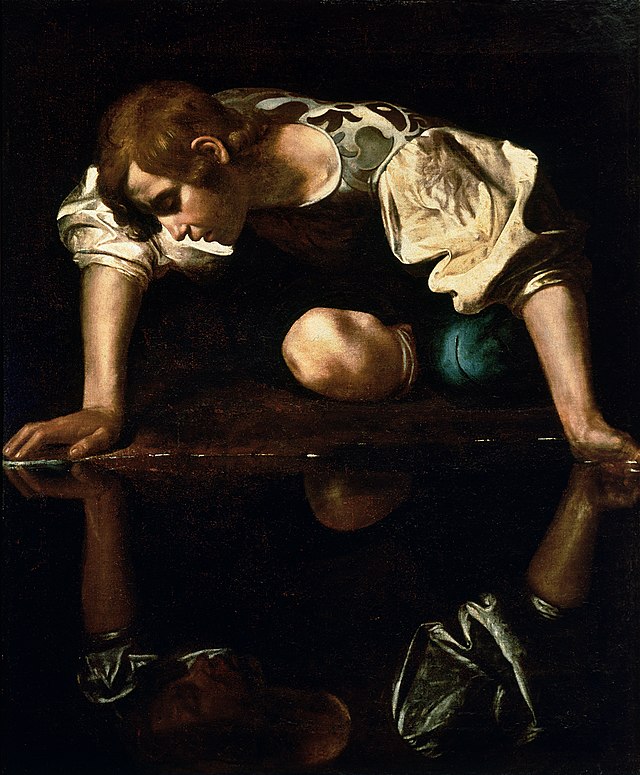
Each of us a Narcissus

Herman Melville, Moby Dick:

“But here is an artist. He desires to paint you the dreamiest, shadiest, quietest, most enchanting bit of romantic landscape in all the valley of the Saco. What is the chief element he employs? There stand his trees, each with a hollow trunk, as if a hermit and a crucifix were within; and here sleeps his meadow, and there sleep his cattle; and up from yonder cottage goes a sleepy smoke. Deep into distant woodlands winds a mazy way, reaching to overlapping spurs of mountains bathed in their hill-side blue. But though the picture lies thus tranced, and though this pine-tree shakes down its sighs like leaves upon this shepherd’s head, yet all were vain, unless the shepherd’s eye were fixed upon the magic stream before him. Go visit the Prairies in June, when for scores on scores of miles you wade knee-deep among Tiger-lilies—what is the one charm wanting?—Water—there is not a drop of water there! Were Niagara but a cataract of sand, would you travel your thousand miles to see it? Why did the poor poet of Tennessee, upon suddenly receiving two handfuls of silver, deliberate whether to buy him a coat, which he sadly needed, or invest his money in a pedestrian trip to Rockaway Beach? Why is almost every robust healthy boy with a robust healthy soul in him, at some time or other crazy to go to sea? Why upon your first voyage as a passenger, did you yourself feel such a mystical vibration, when first told that you and your ship were now out of sight of land? Why did the old Persians hold the sea holy? Why did the Greeks give it a separate deity, and own brother of Jove? Surely all this is not without meaning. And still deeper the meaning of that story of Narcissus, who because he could not grasp the tormenting, mild image he saw in the fountain, plunged into it and was drowned. But that same image, we ourselves see in all rivers and oceans. It is the image of the ungraspable phantom of life; and this is the key to it all.”

Image result for narcissus
Caravaggio, ‘Narcissus’

AP Latin Week: Let Aeneas Bee Worne in the Tablet of Your Memorie

Philip Sydney, Defence of Poesie: 

“The incomparable Lacedemonians, did not onelie carrie that kinde of Musicke ever with them to the field, but even at home, as such songs were made, so were they all content to be singers of them: when the lustie men were to tell what they did, the old men what they had done, and the yoong what they would doo. And where a man may say that Pindare many times praiseth highly Victories of small moment, rather matters of sport then vertue, as it may be answered, it was the fault of the Poet, and not of the Poetrie; so indeed the chiefe fault was, in the time and custome of the Greekes, who set those toyes at so high a price, that Philip of Macedon reckoned a horse-race wonne at Olympus, among his three fearfull felicities. But as the unimitable Pindare often did, so is that kind most capable and most fit, to awake the thoughts from the sleepe of idlenesse, to embrace honourable enterprises. Their rests the Heroicall, whose verie name I thinke should daunt all backbiters. For by what conceit can a tongue bee directed to speake evil of that which draweth with him no lesse champions then Achilles, Cirus, Aeneas, Turnus, Tideus, Rinaldo, who doeth not onely teache and moove to a truth, but teacheth and mooveth to the most high and excellent truth: who maketh magnanimitie and justice, shine through all mistie fearfulnesse and foggie desires.

Who if the saying of Plato and Tully bee true, that who could see vertue, woulde be woonderfullie ravished with the love of her bewtie. This man setteth her out to make her more lovely in her holliday apparell, to the eye of anie that will daine, not to disdaine untill they understand. But if any thing be alreadie said in the defence of sweete Poetrie, all concurreth to the mainteining the Heroicall, which is not onlie a kinde, but the best and most accomplished kindes of Poetrie. For as the Image of each Action stirreth and instructeth the minde, so the loftie Image of such woorthies, moste enflameth the minde with desire to bee woorthie: and enformes with counsaile how to bee woorthie. Onely let Aeneas bee worne in the Tablet of your memorie, how hee governeth himselfe in the ruine of his Countrey, in the preserving his olde Father, and carrying away his religious Ceremonies, in obeying Gods Commaundment, to leave Dido, though not onelie all passionate kindeness, not even the humane consideration of vertuous gratefulnesse, would have craved other of him: how in stormes, how in sports, how in warre, how in peace, how a fugitive, how victorious, how besieged, how beseiging, how to straungers, how to Allies, how to enemies, how to his owne. Lastly, how in his inwarde selfe, and how in his outwarde government, and I thinke in a minde moste prejudiced with a prejudicating humour, Hee will bee founde in excellencie fruitefull.”

Sir Philip Sidney from NPG.jpg

AP Latin Week: F**k Caesar! (And Cicero Too!)

Alston Hurd Chase, Time Remembered 2.1:

“Another change which I introduced was a widening of the number of authors read in the second and third years of Latin. In Greek there is a perfect text for beginning consecutive reading after the basics have been learned. This is the Anabasis of Xenophon which is at once easy and lively. In the third year, students read some of the very greatest Greek in Homer. But in Latin II, the traditional curriculum presented the boring, repetitious military annals of Caesar which, I am sure, were in part responsible for the very large number who bade Latin farewell after the second year. The third year was almost as bad with the windy, egotistic orations of Cicero which had no appeal to a generation who were talked to death and distrusted all rhetoric.”

Don’t lump me in with him!

Eyes on the Skies!

Iamblichus, Protrepticus 51:

“Humans are the most noble of the animals, as is clear from the fact that they are born both from and directed toward nature. This it is for the sake of which nature and god made us. When Pythagoras was asked about the purpose for which humans were created, he said, ‘To look upon the heavens’, and he said that he himself was an observer of nature, and had come into life for that purpose. They also say that Anaxagoras was asked for what reason someone might choose to be born and to go on living, and he responded, ‘in order to watch the heavens, and the stars and moon and sun’, as though nothing else in the world were worth consideration.”

τιμιώτατον δέ γε τῶν ἐνταῦθα ζῴων ἄνθρωπός ἐστιν, ὥστε δῆλον ὅτι φύσει τε καὶ κατὰ φύσιν γέγονε. καὶ τοῦτό ἐστι τῶν ὄντων οὗ χάριν ἡ φύσις ἡμᾶς ἐγέννησε καὶ ὁ θεός. τί δὴ τοῦτό ἐστι Πυθαγόρας ἐρωτώμενος, ‘τὸ θεάσασθαι’ εἶπε ‘τὸν οὐρανόν’, καὶ ἑαυτὸν δὲ θεωρὸν ἔφασκεν εἶναι τῆς φύσεως καὶ τούτου ἕνεκα παρεληλυθέναι εἰς τὸν βίον. καὶ ᾿Αναξαγόραν δέ φασιν εἰπεῖν ἐρωτηθέντα τίνος ἂν ἕνεκα ἕλοιτο γενέσθαι τις καὶ ζῆν, ἀποκρίνασθαι πρὸς τὴν ἐρώτησιν· ὡς ‘τοῦ θεάσασθαι [τὰ περὶ] τὸν οὐρανὸν καὶ <τὰ> περὶ αὐτὸν ἄστρα τε καὶ σελήνην καὶ ἥλιον’, ὡς τῶν ἄλλων γε πάντων οὐδενὸς ἀξίων ὄντων.

Growing Old In The Classroom

Some passages after graduation weekend….

Solon, fr. 18

“I grow old, always learning many things.”

γηράσκω δ’ αἰεὶ πολλὰ διδασκόμενος·

Kim Stanley Robinson The Years of Rice and Salt (2003: 758)

“Over time, Bao came to understand that teaching too was a kind of reincarnation, in that years passed and students came and went, new young people all the time, but always the same age, taking the same class; the class under the oak trees, reincarnated. He began to enjoy that aspect of it. He would start the first class by saying, “Look, here we are again.” They never knew what to make of it; same response, every time.

He learned, among other things, that teaching was the most rigorous form of learning. He learned to learn more from his students than they did from him; like so many other things, it was the reverse from what it seemed to be, and colleges existed to bring together groups of young people to teach some chosen few of their elders the things that they knew about life, that the old teachers had been in danger of forgetting.”

Seneca, Moral Epistles 76.3-5

“People of every age enter this classroom. “Do we grow old only to follow the young?” When I go into the theater as an old man and I am drawn to the racetrack and no fight is finished without me, shall I be embarrassed to go to a philosopher?

You must learn as long as you are ignorant—if we may trust the proverb, as long as you live. And nothing is more fit to the present than this: as long as you live you must learn how to live. Nevertheless, there is still something which I teach there. You ask, what may I teach? That an old man must learn too.”

Omnis aetatis homines haec schola admittit. “In hoc senescamus, ut iuvenes sequamur?” In theatrum senex ibo et in circum deferar et nullum par sine me depugnabit ad philosophum ire erubescam?

Tamdiu discendum est, quamdiu nescias; si proverbio credimus, quamdiu vivas. Nec ulli hoc rei magis convenit quam huic: tamdiu discendum est, quemadmodum vivas, quamdiu vivas. Ego tamen illic aliquid et doceo. Quaeris, quid doceam? Etiam seni esse discendum.

Image result for ancient greek old age

AP Latin Week: Teachers Trample Upon His Work with Unwashed Feet

Macrobius, Saturnalia I.XXIV 10-15

“Symmachus then said, ‘If you are of the opinion that Vergil knew nothing but poetics, then it is clear that you would begrudge him the title of orator: but listen to what he himself proclaims about the vast learning of his own work. The letter of Vergil himself, in which he makes a plea to Augustus, begins thus: I have received frequent letters from you. Below that, he adds, ­Indeed, I would gladly send you something about my Aeneid, if I had anything worthy of your ears. Yet such a great work has been begun, that I seem to myself to have been almost out of my senses when I undertook it, especially since (as you well know) I must communicate into it many other, more serious types of learning. These words of Vergil are not contradicted by the poem’s tremendous supply of learning, which almost all teachers pass over with unwashed feet, as though a grammarian were allowed to know nothing but the explanations of words. Therefore, those learned swells have fixed the limits of learning, as though they were sacred boundaries, and if anyone should venture beyond them, he should be censured as though he had looked into the temple of a goddess from which men are banned entirely. But we, who are endowed with a fuller understanding, should not allow the inner sanctum of this sacred poem to be left hidden from human sight – we should investigate the hallways of arcane knowledge and offer up the hidden, inner sancta of thought to be celebrated by the cultivation of the learned.’”

10 Si in hac opinione es, inquit Symmachus, ut Maro tibi nihil nisi poeticum sensisse aestimetur, licet hoc quoque eidem nomen invideris: audi, quid de operis sui multiplici doctrina ipse pronuntiet. Ipsius enim Maronis epistola, qua conpellat Augustum, ita incipit: 11 Ego vero frequentes a te litteras accipio, et infra: De Aenea quidem meo, si mehercle iam dignum auribus haberem tuis, libenter mitterem: sed tanta inchoata res est, ut paene vitio mentis tantum opus ingressus mihi videar, cum praesertim, ut scis, alia quoque studia ad id opus multoque potiora inpertiar. 12 Nec his Virgilii verbis copia rerum dissonat, quam plerique omnes litteratores pedibus inlotis praetereunt, tamquam nihil ultra verborum explanationem liceat nosse grammatico. Ita sibi belli isti homines certos scientiae fines et velut quaedam pomeria et effata posuerunt, ultra quae si quis egredi audeat, introspexisse in aedem deae a qua mares absterrentur existimandus sit. 13 Sed nos, quos crassa Minerva dedecet, non patiamur abstrusa esse adyta sacri poematis, sed archanorum sensuum investigato aditu doctorum cultu celebranda praebeamus reclusa penetralia.

AP Latin Week: F**k The Aeneid!

Augustine, Confessions 1.13:

“Even now I have not yet sufficiently explored why I then hated the Greek literature on which with which I was glutted as a little boy. Indeed, I loved Latin literature – not the stuff which our elementary teachers taught us, but the stuff that we learned from the philologists. To tell the truth, I considered those first readings, where one learns to read and write and count, almost as burdensome and punishing as all of Greek literature. But what caused this, except the sinfulness and vanity of life, which made me nothing but flesh, a passing wind which never returned. Surely those first readings were better, because they were more certain; by their aid it was happening – has happened – that I am able to read if I come across some writing and I myself am able to write if I please. They were better, I say, than those in which I was compelled to remember the wanderings of some Aeneas, while forgetting of my own wanderings, and to bewail Dido’s death because she committed suicide, while in the midst of these trifles I, wretched as could be, allowed myself to die away from you with dry eyes.

For what could be more wretched than a wretch not pitying himself as he cries about the death of Dido, which came about from loving Aeneas, all the while not crying over his own death, which happens from not loving you, God, the light of my heart and the bread of the internal mouth of my soul and the virtue marrying together my mind and the breast of my thoughts? I did not love you, and I was fornicating away from you, and as I fornicated everyone shouted, ‘Great job, great job!’ The friendship of this world is a kind of fornication away from you, and the phrase ‘Great job, great job!’ is spoken so that one might feel shame if he does not conform. I did not weep over all of these things. Instead, I wept over Dido, now dead after seeking her end with the sword, while I myself followed the lowest things which you created as I, no more than dirt, hastened to the dirt myself. Were I prevented from reading those things, I would have grieved, because I had no reading material to grieve over. With such madness did I think that literature more noble and fruitful than the things which taught me to read and write.”

Sandro Botticelli 050.jpg
Sandro Botticelli, St. Augustine in His Study

quid autem erat causae cur graecas litteras oderam, quibus puerulus imbuebar? ne nunc quidem mihi satis exploratum est. adamaveram enim latinas, non quas primi magistri sed quas docent qui grammatici vocantur. nam illas primas, ubi legere et scribere et numerare discitur, non minus onerosas poenalesque habebam quam omnes graecas. unde tamen et hoc nisi de peccato et vanitate vitae, qua caro eram et spiritus ambulans et non revertens? nam utique meliores, quia certiores, erant primae illae litterae quibus fiebat in me et factum est et habeo illud ut et legam, si quid scriptum invenio, et scribam ipse, si quid volo, quam illae quibus tenere cogebar Aeneae nescio cuius errores, oblitus errorum meorum, et plorare Didonem mortuam, quia se occidit ab amore, cum interea me ipsum in his a te morientem, deus, vita mea, siccis oculis ferrem miserrimus.
quid enim miserius misero non miserante se ipsum et flente Didonis mortem, quae fiebat amando Aenean, non flente autem mortem suam, quae fiebat non amando te, deus, lumen cordis mei et panis oris intus animae meae et virtus maritans mentem meam et sinum cogitationis meae? non te amabam, et fornicabar abs te, et fornicanti sonabat undique: ‘euge! euge!’ amicitia enim mundi huius fornicatio est abs te et ‘euge! euge!’ dicitur ut pudeat, si non ita homo sit. et haec non flebam, et flebam Didonem extinctam ferroque extrema secutam, sequens ipse extrema condita tua relicto te et terra iens in terram. et si prohiberer ea legere, dolerem, quia non legerem quod dolerem. tali dementia honestiores et uberiores litterae putantur quam illae quibus legere et scribere didici.

Tremellius Scropha, Chauvinist Pig?

Macrobius, Saturnalia 1.6.30

“Tremellius Scropha received his cognomen in this way. At one time, Tremellius was at home with his family and children. When a neighbor’s sow (scropha) wandered onto the property, Tremellius’ slaves caught and killed it. The neighbor called his guards and surrounded the villa, so that the sow could not be taken away, and he ordered Tremellius to return the sow. Tremellius, learning the details of the matter from his estate-manager, hid the sow’s body under the blanket on which his wife was lying down, and allowed his neighbor to search the property. When they came to the bedroom, Tremellius pointed to the bed and swore a solemn oath: that there was no sow in the entire house except for that one which lay in the sheets. This exceptionally witty oath earned Tremellius the cognomen of ‘Scropha’ (‘the sow’).”

Tremellius vero Scropha cognominatus est eventu tali. Is Tremellius cum familia atque liberis in villa erat. Servi eius, cum de vicino scropha erraret, subreptam conficiunt: vicinus advocatis custodibus omnia circumvenit, ne qua ecferri possit: isque ad dominum appellat restitui sibi pecudem. Tremellius, qui ex vilico rem conperisset, scrophae cadaver sub centonibus conlocat super quos uxor cubabat: quaestionem vicino permittit. Cum ventum est ad cubiculum, verba iurationis concipit: nullam esse in villa sua scropham nisi istam, inquit, quae in centonibus iacet: lectulum monstrat. Ea facetissima iuratio Tremellio Scrophae cognomentum dedit.