To His Own Drunk Self, a Song

Anacreonta 9: To His Own Drunk Self [εἰς ἑαυτὸν μεμεθυσμένον]

“Dear gods, let me drink,
Let me drink without pausing.
I want to go crazy, I do.

Alkmaion went crazy
And so did white-footed Orestes,
After they killed their mothers.

I haven’t killed anyone
drinking my red wine
I want to go crazy, I do.

Herakles went crazy once
Shaking his awful quiver
And Iphitus’ bow.
Ajax went crazy too
Holding up Hektor’s sword
With his shield.

I have this little cup
And this crown on my hair.
Not a bow or a sword.
I want to go crazy, I do.”

ἄφες με, τοὺς θεούς σοι,
πιεῖν, πιεῖν ἀμυστί·
θέλω, θέλω μανῆναι.
ἐμαίνετ᾿ Ἀλκμαίων τε
χὠ λευκόπους Ὀρέστης
τὰς μητέρας κτανόντες·
ἐγὼ δὲ μηδένα κτάς,
πιὼν δ᾿ ἐρυθρὸν οἶνον
θέλω, θέλω μανῆναι.

ἐμαίνετ᾿ Ἡρακλῆς πρὶν
δεινὴν κλονῶν φαρέτρην
καὶ τόξον Ἰφίτειον.
ἐμαίνετο πρὶν Αἴας
μετ᾿ ἀσπίδος κραδαίνων
τὴν Ἕκτορος μάχαιραν·

ἐγὼ δ᾿ ἔχων κύπελλον
καὶ στέμμα τοῦτο χαίτης,
οὐ τόξον, οὐ μάχαιραν,
θέλω, θέλω μανῆναι.

Drunken Hercules. A detail from the Baccanalia mosaic, Tsipory.

Lost Treasures Department: Mother with Baby Centaurs

Lucian, Zeuxis or Antiochus 4

“I want now to explain about this painter too. That Zeuxis was the best painter at the time and didn’t illustrate common and cliched things or did make heroes, gods, and wars as little as possible. Instead he was always trying to make something new and whenever he conceived of something different or odd, he demonstrated the brilliance of his skill in its execution. Among his many audacious images, that Zeuxis painted a female Hippocentaur and depicted her feeding twin Hippocentaur babies.

There’s a copy of that image precisely modeled on the original in Athens. The first copy, however, the general Sulla selected to send to Italy with other things, but I guess that the ship carrying it sank outside of Malea, destroying the painting and everything else.”

Ἐθέλω γοῦν ὑμῖν καὶ τὸ τοῦ γραφέως διηγήσασθαι. ὁ Ζεῦξις ἐκεῖνος ἄριστος γραφέων γενόμενος τὰ δημώδη καὶ τὰ κοινὰ ταῦτα οὐκ ἔγραφεν, ἢ ὅσα πάνυ ὀλίγα, ἥρωας ἢ θεοὺς ἢ πολέμους, ἀεὶ δὲ καινοποιεῖν ἐπειρᾶτο καί τι ἀλλόκοτον ἂν καὶ ξένον ἐπινοήσας ἐπ᾿ ἐκείνῳ τὴν ἀκρίβειαν τῆς τέχνης ἐπεδείκνυτο. ἐν δὲ τοῖς ἄλλοις τολμήμασι καὶ θήλειαν Ἱπποκένταυρον ὁ Ζεῦξις οὗτος ἐποίησεν, ἀνατρέφουσάν γε προσέτι παιδίω Ἱπποκενταύρω διδύμω κομιδῇ νηπίω. τῆς εἰκόνος ταύτης ἀντίγραφός ἐστι νῦν Ἀθήνησι πρὸς αὐτὴν ἐκείνην ἀκριβεῖ τῇ στάθμῃ μετενηνεγμένη. τὸ ἀρχέτυπον δὲ αὐτὸ Σύλλας ὁ Ῥωμαίων στρατηγὸς ἐλέγετο μετὰ τῶν ἄλλων εἰς Ἰταλίαν πεπομφέναι, εἶτα περὶ Μαλέαν οἶμαι καταδύσης τῆς ὁλκάδος ἀπολέσθαι ἅπαντα καὶ τὴν γραφήν.

A bare-chested centaur woman (long blond hair, motley brown hair on horse body) breastfeeding a centaur toddler (same coloring except for short hair) she holds to her human chest while a centaur man (short black hair and beard, grey hair on horse body) is sneaking under her and looking intently up at the two breasts on her horse hindquarters

Are You Down with O.P.P. (Other Peoples’ Pimples)?

Seneca, De Vita Beata 27

“You have the free time to track down everyone else’s faults and pass judgment on anyone you please? ‘Why does this philosopher have such a big home? Why does that one eat so richly?’ These are the things you say. You stare at other people’s pimples when you’re afflicted with oozing sores!

This is the same thing as if someone who is covered by a gross disease points and laughs at blemishes and warts on the most beautiful bodies. Attack Plato because he looked for money, Aristotle because he took it, Democritus because he ignored it, and Epicurus because he spent it all!

Sure, yell at me about Alcibiades and Phaedrus even though it would be the happiest day in your life if you copied my vices!”

Vobis autem vacat aliena scrutari mala et sententias ferre de quoquam? “Quare hic philosophus laxius habitat? Quare hic lautius cenat?” Papulas observatis alienas, obsiti plurimis ulceribus. Hoc tale est, quale si quis pulcherrimorum corporum naevos aut verrucas derideat, quem foeda scabies 5depascitur. Obicite Platoni, quod petierit pecuniam Aristoteli, quod acceperit, Democrito, quod neglexerit, Epicuro, quod consumpserit; mihi ipsi Alcibiadem et Phaedrum obiectate, evasuri maxime felices, cum primum vobis imitari vitia nostra contigerit!

Paolo Veronese, “Young Man between Vice and Virtue” c. 1581

Stacks of Cash from the Lecture Circuit

Dio Chrysostom, The Fifty-Fourth Discourse: On Socrates 1

“Hippias of Elis, Gorgias of Leontini, along with the sophists Polos and Prodikos were prominent in Greece at a certain time and earned a fantastic reputation, not merely in the rest of the cities, but in Sparta and Athens too. They made a lot of money, both at public expense in some states and from certain aristocrats, kings, and private citizens, to the extent that each was able.

Yet, they gave many public presentations that didn’t have the smallest shred of thought to them, but were the kinds of words from which one can harvest money from fools. There was another man from Abdera, who was so far from gaining wealth from others was not only destroying his own inheritance bit by bit, but he eventually lost all his wealth pursuing philosophy. It is clear that he was foolishly searching for something that brought him no advantage.

Ἱππίας ὁ Ἠλεῖος καὶ Γοργίας ὁ Λεοντῖνος καὶ Πῶλος καὶ Πρόδικος οἱ σοφισταὶ χρόνον τινὰ ἤνθησαν ἐν τῇ Ἑλλάδι καὶ θαυμαστῆς ἐτύγχανον φήμης, οὐ μόνον ἐν ταῖς ἄλλαις πόλεσιν, ἀλλὰ καὶ ἐν τῇ Σπάρτῃ καὶ παρ᾿ Ἀθηναίοις, καὶ χρήματα πολλὰ συνέλεξαν, δημοσίᾳ τε παρὰ τῶν πόλεων1 καὶ παρὰ δυναστῶν τινων καὶ βασιλέων καὶ ἰδιωτῶν, ὡς ἕκαστος ἔχοι δυνάμεως. ἔλεγον δὲ πολλοὺς μὲν λόγους, νοῦν δὲ οὐκ ἔχοντας οὐδὲ βραχύν· ἀφ᾿ ὧν ἔστιν, οἶμαι, χρήματα πορίζειν καὶ ἀνθρώπους ἠλιθίους ἀρέσκειν.

ἄλλος δέ τις ἀνὴρ Ἀβδηρίτης οὐχ ὅπως ἀργύριον παρ᾿ ἑτέρων ἐλάμβανεν, ἀλλὰ καὶ διέφθειρε τὴν οὐσίαν τὴν αὑτοῦ συχνὴν οὖσαν καὶ ἀπώλεσε φιλοσοφῶν, ἀναισθήτως δῆλον ὅτι, καὶ ζητῶν ὧν οὐδὲν ὄφελος αὐτῷ.

Plato, Hippias Major. 282d–e

“If you knew how much money I made, you’d freak out. This one time, I went to Sicily when Protagoras was visiting–he was well-known then and older than me–and while I was less experienced, I made more than 150 minas in a little time. In one small town alone–Inukon–I made over 20!

When I went home with that much I shocked and awed my father and the rest of our neighbors. I think I made more cash than any other two sophists put together.”

[ΙΠ.] εἰ γὰρ εἰδείης ὅσον ἀργύριον εἴργασμαι ἐγώ, θαυμάσαις ἄν· καὶ τὰ μὲν ἄλλα ἐῶ, ἀφικόμενος δέ ποτε εἰς Σικελίαν Πρωταγόρου αὐτόθι ἐπιδημοῦντος καὶ εὐδοκιμοῦντος καὶ πρεσβυτέρου ὄντος πολὺ νεώτερος ὢν ἐν ὀλίγῳ χρόνῳ πάνυ πλέον ἢ πεντήκοντα καὶ ἑκατὸν μνᾶς εἰργασάμην, καὶ ἐξ ἑνός γε χωρίου πάνυ σμικροῦ Ἰνυκοῦ πλέον ἢ εἴκοσι μνᾶς· καὶ τοῦτο ἐλθὼν οἴκαδε φέρων τῷ πατρὶ ἔδωκα, ὥστε ἐκεῖνον καὶ τοὺς ἄλλους πολίτας θαυμάζειν τε καὶ ἐκπεπλῆχθαι. καὶ σχεδόν τι οἶμαι ἐμὲ πλείω χρήματα εἰργάσθαι ἢ ἄλλους σύνδυο οὕστινας βούλει τῶν σοφιστῶν.

According to this estimate, a mina in modern terms would be around $500.00 USD. So, Hippias may have made c. $75,000.00 on his Sicilian tour.

Death Takes No Bribes

Anacreonta 36

“If wealth could give mortals life
in exchange for gold,
I would work hard on saving it,
So when Death came for me,
It could take payment and move on.

But if it is impossible for mortals
To purchase any more of life,
Why do I groan pointlessly?
And why do I mourn out loud?

Since death cannot be bought,
What use is gold to me?

I want to drink,
To drink sweet wine,
To spend time with my friends
And to honor Aphrodite
On downy beds.”

ὁ Πλοῦτος εἴ γε χρυσοῦ
τὸ ζῆν παρεῖχε θνητοῖς,
ἐκαρτέρουν φυλάττων,
ἵν᾿, ἂν Θάνατος ἐπέλθῃ,
λάβῃ τι καὶ παρέλθῃ.
εἰ δ᾿ οὖν μὴ τὸ πρίασθαι
τὸ ζῆν ἔνεστι θνητοῖς,
τί καὶ μάτην στενάζω;
τί καὶ γόους προπέμπω;
θανεῖν γὰρ εἰ πέπρωται,
τί χρυσὸς ὠφελεῖ με;
ἐμοὶ γένοιτο πίνειν,
πιόντι δ᾿ οἶνον ἡδὺν
ἐμοῖς φίλοις συνεῖναι,
ἐν δ᾿ ἁπαλαῖσι κοίταις
τελεῖν τὰν Ἀφροδίταν.

A still life oil painting. There is a skull prominently in the center, on top of money bags with documents protuding from below. on the left is a violin
N. L. Peschier, “Skull, Money Bags, and Documents” 1661

A Safeguard Against Grief

Anacreonta 56

“The one who strengthens someone in pain,
Who comforts a young one in love,
Who makes the dancer beautiful over drinks,
That god has descended to the ground,
Offering a calming lovespell for mortals,
A medicine against grief,
The vine’s child, wine.

He is guarding it safe,
Within the vines’ bunches of grapes,
So, whenever they cut the fruit,
Everyone remains free of sickness,
Healthy with shining skin
And a sweet-hearted mind,
Until the passing of another year.”

ὁ τὸν ἐν πόνοις ἀτειρῆ,
νέον ἐν πόθοις ἀταρβῆ,
καλὸν ἐν πότοις χορευτὴν
τελέων θεὸς κατῆλθε,
ἁπαλὸν βροτοῖσι φίλτρον,
πότον ἄστονον κομίζων,
γόνον ἀμπέλου, τὸν οἶνον,
ἐπὶ κλημάτων ὀπώραις
πεπεδημένον φυλάττων,
ἵν᾿, ὅταν τέμωσι βότρυν,
ἄνοσοι μένωσι πάντες,
ἄνοσοι δέμας θεητόν,
ἄνοσοι γλυκύν τε θυμὸν
ἐς ἔτους φανέντος ἄλλου.

still life oil painting. striped table cloth, plate with pears, wine jug and glass.
Adolphe Joseph Thomas Monticelli, “Still Life with Food and Wine” 1874

Like Blood Poured Over Milk: It Gets Worse When Achilles Dies


Quintus, Posthomerica 3.551-573

“Of all the women, Briseis felt the most terrible grief
in her heart within, the companion of warring Achilles.
She turned over his corpse and tore at her fine skin
With both hands and from her delicate chest
Bloody bruises rose up from the force of her blows—
You might even say it was like blood poured over milk.
Yet she still shined even as she mourned in pain
And her whole form exuded grace.
This is the kind of speech she made while mourning:

“Oh what endless horror I have suffered.
Nothing that happened to me before this was so great
Not the death of my brothers nor the loss of my country,

Nothing exceeds your death. You were my sacred day
And the light of the sun and the gentle life,
My hope for good and tireless defense against pain—
You were better by far than any gift, than my parents even—
You were everything alone for me even though I was enslaved.

You took me as your bedmate and seized me from a slave’s labor.
But now? Some other Achaean will take me away in his ships
To fertile Sparta or dry and thirsty Argos
Where I will again suffer terrible things working away,
Apart from you and miserable. I only wish that
The earth had covered over me before I saw your death.”

πασάων δ’ ἔκπαγλον ἀκηχεμένη κέαρ ἔνδον
Βρισηὶς παράκοιτις ἐυπτολέμου Ἀχιλῆος
ἀμφὶ νέκυν στρωφᾶτο καὶ ἀμφοτέρῃς παλάμῃσι
δρυπτομένη χρόα καλὸν ἀύτεεν· ἐκ δ’ ἁπαλοῖο
στήθεος αἱματόεσσαι ἀνὰ σμώδιγγες ἄερθεν
θεινομένης· φαίης κεν ἐπὶ γλάγος αἷμα χέασθαι
φοίνιον. ἀγλαΐη δὲ καὶ ἀχνυμένης ἀλεγεινῶς
ἱμερόεν μάρμαιρε, χάρις δέ οἱ ἄμπεχεν εἶδος.
τοῖον δ’ ἔκφατο μῦθον ὀιζυρὸν γοόωσα·
“Ὤ μοι ἐγὼ πάντων περιώσιον αἰνὰ παθοῦσα·
οὐ γάρ μοι τόσσον περ ἐπήλυθεν ἄλλό τι πῆμα,
οὔτε κασιγνήτων οὔτ’ εὐρυχόρου περὶ πάτρης,
ὅσσον σεῖο θανόντος· ἐπεὶ σύ μοι ἱερὸν ἦμαρ
καὶ φάος ἠελίοιο πέλες καὶ μείλιχος αἰὼν
ἐλπωρή τ’ ἀγαθοῖο καὶ ἄσπετον ἄλκαρ ἀνίης
πάσης τ’ ἀγλαΐης πολὺ φέρτερος ἠδὲ τοκήων
ἔπλεο· πάντα γὰρ οἶος ἔης δμωῇ περ ἐούσῃ,
καί ῥά με θῆκας ἄκοιτιν ἑλὼν ἄπο δούλια ἔργα.
νῦν δέ τις ἐν νήεσσιν Ἀχαιῶν ἄξεται ἄλλος
Σπάρτην εἰς ἐρίβωλον ἢ ἐς πολυδίψιον Ἄργος·
καί νύ κεν ἀμφιπολεῦσα κακὰς ὑποτλήσομ’ ἀνίας
σεῦ ἀπονοσφισθεῖσα δυσάμμορος. ὡς ὄφελόν με
γαῖα χυτὴ ἐκάλυψε πάρος σέο πότμον ἰδέσθαι.”

17th Century Tapestry based on Rubens’ “Briseis Returned to Achilles?

The Difference Between Life and Death

Diogenes Laertius, Lives of the Eminent Philosophers: Thales 1.35-37

“These sayings are also attributed to him:

God is the oldest of all things in existence, since god* was never born.

The most beautiful thing is the universe, since it is god’s creation and it contains everything.

Mind is the fastest thing since it runs through everything.

Compulsion is the strongest thing, since it overpowers everything.

The wisest thing is time, since it uncovers all.

Thales claimed that there was no difference between death and being alive. When someone asked why he didn’t die then, he said “because it would make no difference.”


φέρεται δὲ καὶ ἀποφθέγματα αὐτοῦ τάδε· πρεσβύτατον τῶν ὄντων θεός· ἀγένητον γάρ. κάλλιστον κόσμος· ποίημα γὰρ θεοῦ. μέγιστον τόπος· ἅπαντα γὰρ χωρεῖ. τάχιστον νοῦς· διὰ παντὸς γὰρ τρέχει. ἰσχυρότατον ἀνάγκη· κρατεῖ γὰρ πάντων. σοφώτατον χρόνος· ἀνευρίσκει γὰρ πάντα.
οὐδὲν ἔφη τὸν θάνατον διαφέρειν τοῦ ζῆν. σὺ οὖν, ἔφη τις, διὰ τί οὐκ ἀποθνήσκεις; ὅτι, ἔφη, οὐδὲν διαφέρει.


* god appears to be gendered neuter here.


Spaces and Scripts: The Dynamic of Reading in Ancient Texts


image and transcription of graffiti from vergil 1.1

Source: Vergil at Pompeii.”[1]

In the ancient city of Pompeii, the ruins are adorned with various lines from Vergil’s Aeneid, revealing an anomaly: a misspelling and the absence of word separation. While modern readers may find this puzzling, ancient Latin readers, depending on their education and social class, would have immediately noticed the misspelling and intuitively separated the words in their pronunciation of the famous line “Arma virumque cano.” This graffiti in Pompeii, summarized by classical scholar James Franklin in his article “Vergil at Pompeii: A Teacher’s Aid,” offers valuable insights into the connection between writing and reading practices. It highlights the ways in which different scripts and writing techniques shaped the technologies of reading.

The Pompeii graffiti are among the most famous examples of everyday ancient Latin script.[2] However, they vary in readability and may have been created for different reasons, including the scribbling of bored schoolboys or as commentary on social situations and advertisements for local plays or productions. Interestingly, similar to the texts of that time, the Pompeii graffiti lacked spaces between words, indicating a more significant trend in spacing and lettering in ancient Latin and other languages.image of graffiti from vergil
Source: Vergil at Pompeii.”

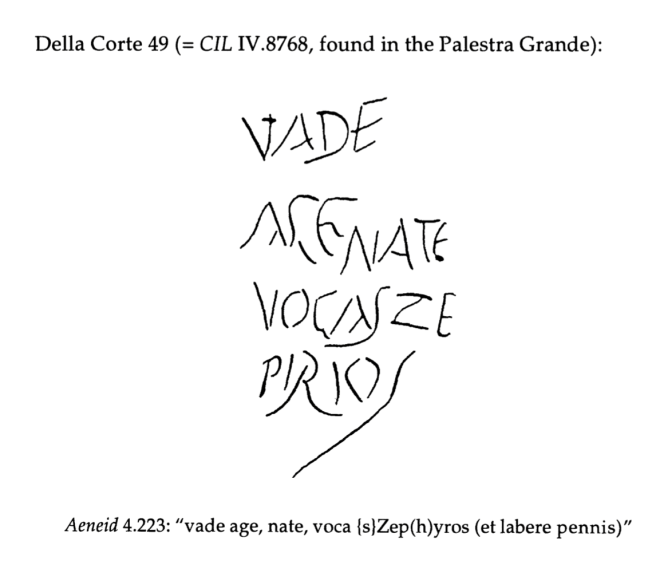
Another more ambiguous example would be this inscription, where the words are separated. The original author of this engraving knew that if the words were not distinct, then the average Roman might have confused the phrase. Even in the caption down at the bottom, the editor had to place in commas and other markers to help the English readers decipher what was written. If read without the word breaks, this small piece of poetry would have a lot more ambiguity surrounding it. “Age” and “Nate” are combined in the second line, this combination could be misconstrued as the Latin word for “advocate,” which is a different word and not what it is supposed to mean.

The absence of spaces in ancient script is a characteristic not exclusive to Latin but also found in other ancient languages, including Greek. Among the various intriguing patterns of Greek script, one that stands out is known as “boustrophedon.” The term “boustrophedon” originates from the Greek words “bous,” meaning “ox,” and “strephein,” meaning “to turn.” Thus, it translates to “turning as an ox in plowing,” a fitting name for the complex and multi-directional nature of this script.

Boustrophedon was employed during certain time periods in ancient Greece, adding a unique and fascinating dimension to the reading experience. In the early periods of Greek history, precisely during the Geometric Period (circa 9th to 8th century BCE) and the Archaic Period (circa 7th to 6th century BCE), boustrophedon script was commonly used for inscriptions on various materials, such as stone stelae and pottery.

When encountering a boustrophedon text, readers would follow a pattern reminiscent of an ox plowing a field. They began reading from the left, progressing from left to right until the end of the line. At that point, instead of continuing from left to right on the next line as one would do in modern scripts, they turned around, just like an ox at the end of a row, and read from right to left on the next line. This alternating back-and-forth directionality provided a unique challenge to readers, requiring them to adapt to a different mode of reading.

screen shot from Wachter's Non Attic Vase inscriptions with Boeotian text

Source: Non-Attic Greek Vase Inscriptions”[3]

Early on, Greek and Latin scripts lacked spaces or any indication to separate words, placing the burden on the reader to determine word boundaries. Beginning in the 600-700 CE, monks in northern Europe introduced spaces into the Latin texts they were studying, mirroring the spaces we see in modern books, to enhance reading speed.

Similarly, in the written form of Akkadian, distinct glyphs separated words, resembling the hieroglyphics of ancient Egyptian. Outlined boxes provided further spacing by delineated separate sentences. However, these different methods of separation present a challenge for modern researchers trying to translate these ancient texts. Without cultural context or other indications, researchers had to resort to trial and error to determine the reading direction. Eventually, it was established that Akkadian written in cuneiform should be read from left to right.

Paul Saenger, in his monograph Space Between Words: The Origins of Silent Reading, explores the writing and reading practices of ancient languages, with a focus on Latin. He traces the gradual separation of words and their connection to evolving reading practices. Saenger describes how ancient Roman scholars such as Livy (d. 17 CE)[4] used “Scriptura Continua,” a form of writing without punctuation marks, diacritics, or distinguished letter cases. Scriptura Continua created a more dramatic and theatrical reading experience but also slowed down the reading process and made comprehension difficult. Over time, Scriptura Continua gave way to the current reading system, which allows for silent reading at a faster pace. Saenger emphasizes that the absence of spaces between words in ancient texts required readers to exert more effort and engage in more eye movements to ensure accurate word separation.

In modern curriculum, Latin is taught with spaces between words, as this is what contemporary readers are accustomed to. However, it is worth noting that aristocratic students who read Latin in ancient times would have encountered texts without word spacing. They were expected to decipher the different words as part of their curriculum.

While the addition of spaces in ancient scripts has undoubtedly made reading easier, it raises the question: What might be lost when spaces are inserted? The breaking up of Scriptura Continua potentially obscures certain nuances in the text. For instance, certain lines in the Aeneid, consisting entirely of diphthongs and long syllables, were meant to be read slowly and dramatically, evoking strong and intense emotions for the reader or speaker.

When reading texts with spaces or in translation, there is always a degree of nuance lost from the original language. Much like a perfect translation does not exist, developments in script and how one reads marks a departure from the original text, making its essence nearly impossible to capture.

In conclusion, the graffiti in Pompeii and the study of ancient scripts shed light on the interplay between writing and reading practices. The absence of spaces between words in ancient Latin and other languages, such as Greek and Akkadian, required readers to possess a deep understanding of the language and context to decipher and interpret the text accurately. The gradual introduction of word spacing in Latin and the current reading system has undoubtedly made reading more efficient and accessible. However, the insertion of spaces may also obscure certain nuances and the original dramatic impact intended by the ancient authors.

Understanding the historical development of script and reading practices enhances our appreciation of ancient texts and the challenges faced by ancient readers. It reminds us that language is a dynamic and evolving system shaped by cultural and societal factors and that the conventions and norms of our time influence the way we read and interpret texts.


 Hunter MacArthur is a junior at St. Sebastian’s in Needham. He can be reached at huntermac999@gmail.com

Sources

[1] James L. Franklin Jr., “Vergil at Pompeii: A Teacher’s Aid,” The Classical Journal 92(2): 1996-7, pp. 175-184. See also Kristina Milnor, Graffiti and the Literary Landscape in Roman Pompeii (Oxford; New York: Oxford University Press, 2014).

[2] Kristina Milnor, Graffiti and the Literary Landscape in Roman Pompeii (Oxford; New York: Oxford University Press, 2014).

[3] Wachter, Rudolf. Non-Attic Greek Vase Inscriptions. Oxford, Oxford University Press, 2001.

[4] Paul Saenger, Space Between Words: The Origins of Silent Reading (Stanford: Stanford University Press, 2001), 5.

Think You’re Done with that Pee? Wait, There’s More!

Marcus Cato, On Agriculture 157.10-11

“Wait, there’s more: save the urine of someone who eats cabbage all the time, warm it, bathe your patient in it, you will heal them! This has been tested. As a bonus, if you wash a babies in this urine, they will never be unhealthy. If someone’s eyes are a little weak, work that potion into them and they will see more! Head pain or neck pain will also lessen when treated with re-heated urine.

If a woman heats her private parts with this urine, they will suffer no disease. Here’s what you do: warm the urine in a pain and place it on a chair with a cut-out cushion. Have the woman sit on it; cover her; and put clothes over her.”

Et hoc amplius lotium conservato eius qui brassicam essitarit, id calfacito, eo hominem demittito, cito sanum facies hac cura; expertum hoc est. Item pueros pusillos si laves eo lotio, numquam debiles fient. Et quibus oculi parum clari sunt, eo lotio inunguito, plus videbunt.

Si caput aut cervices dolent, eo lotio caldo lavito, desinent dolere. Et si mulier eo lotio locos fovebit, numquam miseri fient, et fovere sic oportet: ubi in scutra fervefeceris, sub sellam supponito pertusam. Eo mulier adsidat, operito, circum vestimenta eam dato.