Tragedy and the Mind: Some Thoughts on Sophocles and Psychology

A few years ago, in the early months of the COVID pandemic, Reading Greek Tragedy Online explored the Trachinian Women as one of its early experiments.


RGTO has inspired a lot of conversation and engagement. Here is a response from a viewer in the wider world.

Psychological, non-Freudian look at the plays of Sophocles:
Allegories of current political events in ancient Athens

by psychologist and psychotherapist Klaus Schlagmann, klausschlagmann@t-online.de, Costa Rica

I first read “Oedipus the King” in the original more than 25 years ago when I had to grapple with Freud’s concept of the “Oedipal conflict”.

According to Freud, every boy between the ages of 1 and 7 wants to have a sexual relationship with his mother and therefore wants to get rid of his father. This is the “positive” Oedipus complex. Likewise, every boy wants to have a sexual relationship with his father and therefore wants to get rid of his mother (“negative” Oedipus complex). The same applies to girls by analogy.

Reading the Sophocles play made me realize how much Freud is turning reality into its opposite: at the end of the play, Oedipus wants to kill his mother – in honor of his father, whose death he wants to atone for on the basis of Apollo’s revelation. If Jocasta had not committed suicide beforehand, he would have murdered her. He wants to carry out this matricide with the same justification that is used to justify and demand other matricides in Greek mythology: because the mothers are responsible for the death of their respective fathers.

Over time I have studied all the great Sophocles pieces that have survived. In a discussion of such texts, I would like to bring a psychologist’s reasonable, non-Freudian perspective. As a psychologist, I pay attention to whether there are contradictions between what someone says and what he does. In general, I’m more trained to pay attention to the “action messages” of the actors instead of just listening to what they say. Or I pay attention to what someone does not say, although it should actually be addressed. I may question whether the emotions or insights presented are really real. Perhaps they are only pretended and played. Maybe I come across completely illogical points of view – and then try to be particularly attentive here and to interpret them meaningfully. Sometimes I’m probably more willing to judge certain statements as “outrageous” and rather to pillory them. All in all, in this job I have learned to pay attention to contradictions, to take them seriously and to try to resolve them. Having worked with dream interpretation, I am familiar with symbolism and allegory.

I want to briefly tie this to the great “Antigone”. It is probably the oldest, most impressive plea for a democratic society. That’s why it’s still relevant today. These values are fully represented by Antigone (and Haimon). Creon – that is important to recognize from my point of view! – embodies exactly the opposite: an arbitrary, brutal, unreasonable, godless, unjust dictatorship. From the beginning he successfully reduced the council of elders to the role of a vicarious agent. Through his brutality, he has the majority of the population and his henchmen firmly under control.

Here is an example for each of the features mentioned above:

Contradiction between what someone says and does: Creon praises the council of elders for having served so well for three generations of rulers – but it is clear that his decision not to bury Polynices presents this body with a fait accompli. He never dreamed of discussing this with his “council” in advance. The Athenians of that time must have experienced this as an immediate affront: a decision is not even discussed with a few select advisors – it is made by Creon all by himself. This corresponds to the state model of absolutism: “L’État, c’est moi.”

Noting what someone is NOT saying: When Creon talks about what happened at the end, he laments that he killed his son, but that he explicitly did this to Antigone and that he ordered Polynices to be punished completely inappropriately as well, he says NOT A SINGLE word about it.

Feigning insight: Obviously the play itself is about acting as if in a theater. For example, Creon ends up pretending to show remorse and heed the advice that was given to him. Free Antigone and bury Polynices. But Creon reverses the order! What an infamy! He excludes from the funeral the person who stood up for it from the beginning and would have been most worthy to officiate this ceremony! Whether he just wanted to increase the likelihood of Antigone’s death by delaying her liberation through a very elaborate burial, or even quickly instructed his bodyguard to break into Antigone’s dungeon during the burial and kill her, but make it look like suicide, that remains open to me. In any case, at this point he PROVES that he is in no way interested in the divine revelations.

Making sense of illogical points of view: Antigone claims that she would never have broken a burial law for her children or a husband. From my point of view, this emphasizes the special meaning of a – symbolically meant – “sibling” relationship, i.e. an obligation that Athens has towards a community that originates from its own “motherland” – i.e. towards Sparta. Comparatively fewer obligations to colonies (“children”) or other distant allies (“husband”).

There are a number of other things I would like to draw your attention to. Also, for example, that from my point of view Sophocles is a deeply democratic-minded author who brings allegories to the stage in all of his plays that confront his compatriots with political events that happened not too long ago.

I have now translated two essays from the last few years into English for the dramas “The Trachinian Women” (https://oedipus-online.de/wp-content/uploads/2023/08/Cultivated-Blindness.pdf) and “Antigone” (https://oedipus-online.de/wp-content/uploads/2023/08/Renunciation-of-Tyranny.pdf). I will be doing that for “Oedipus the King” in the near future. “Philoctetes” and “Ajax” are also on the program for this project. Here, too, clear allegorical references to the current political events in Athens at that time can be demonstrated.

About Klaus:  Born in 1960, I studied psychology at the University of Saarbrücken (Diploma, 1988). Since 1993 I worked in my own psychotherapeutic practice (katathymic-imaginative psychotherapy, behavioral therapy, NLP, hypnosis and psych-analysis according to Josef Breuer). Since 1995 I have been researching the history of psychoanalysis and therefore came to study especially the stories of Narcissus and Oedipus, which were incorporated into Freud’s theory. I look at those ancient tales from a completely new perspective. In 2012 I published Sigmund Freud’s long-lost letters to the writer Wilhelm Jensen. Since 2022 I’m living in Costa Rica.

Color Photograph of Narcissus reclining, a Pompeiian Wall Painting

Isolation and Self-Sufficiency

Aristotle, Nicomachean Ethics 1. 6-9

“We use ‘self-sufficient’ not to mean a person alone—someone living in isolation—but to include one’s parents, children, spouse, friends, and even fellow citizens, since a human being is a social creature by nature. Now, some limit needs to be observed in these ties—for it will go on endlessly if you extend it to someone’s ancestors and descendants.  But that’s a problem for another time.

We posit that self-sufficiency is something which in itself makes life attractive and lacks nothing and for this reason we think it is happiness, since we imagine that happiness is the most preferable of all things when it is not counted with others. It is clear that it is desirable even with the least of the goods—the addition of goods increases the total, since the greater good is always desirable.”

τὸ δ᾿ αὔταρκες λέγομεν οὐκ αὐτῷ μόνῳ, τῷ ζῶντι βίον μονώτην, ἀλλὰ καὶ γονεῦσι καὶ τέκνοις καὶ γυναικὶ καὶ ὅλως τοῖς φίλοις καὶ πολίταις, ἐπειδὴ φύσει πολιτικὸν ὁ ἄνθρωπος. τούτων δὲ ληπτέος ὅρος τις· ἐπεκτείνοντι γὰρ ἐπὶ τοὺς γονεῖς καὶ τοὺς ἀπογόνους καὶ τῶν φίλων τοὺς φίλους εἰς ἄπειρον πρόεισιν. ἀλλὰ τοῦτο μὲν εἰσαῦθις ἐπισκεπτέον, τὸ δ᾿ αὔταρκες τίθεμεν ὃ μονούμενον αίπετὸν ποιεῖ τὸν βίον καὶ μηδενὸς ἐνδεᾶ· τοιοῦτον δὲ τὴν εὐδαιμονίαν οἰόμεθα εἶναι. ἔτι δὲ πάντων αἱρετωτάτην μὴ συναριθμουμένην—συναριθμουμένην γὰρ δῆλον ὡς αἱρετωτέραν μετὰ τοῦ ἐλαχίστου τῶν ἀγαθῶν, ὑπεροχὴ γὰρ ἀγαθῶν γίνεται τὸ προστιθέμενον, ἀγαθῶν δὲ τὸ μεῖζον αἱρετώτερον

John Donne, Meditation 17

No man is an Iland, intire of itselfe; every man
is a peece of the Continent, a part of the maine;
if a Clod bee washed away by the Sea, Europe
is the lesse, as well as if a Promontorie were, as
well as if a Manor of thy friends or of thine
owne were; any mans death diminishes me,
because I am involved in Mankinde;
And therefore never send to know for whom
the bell tolls; It tolls for thee.

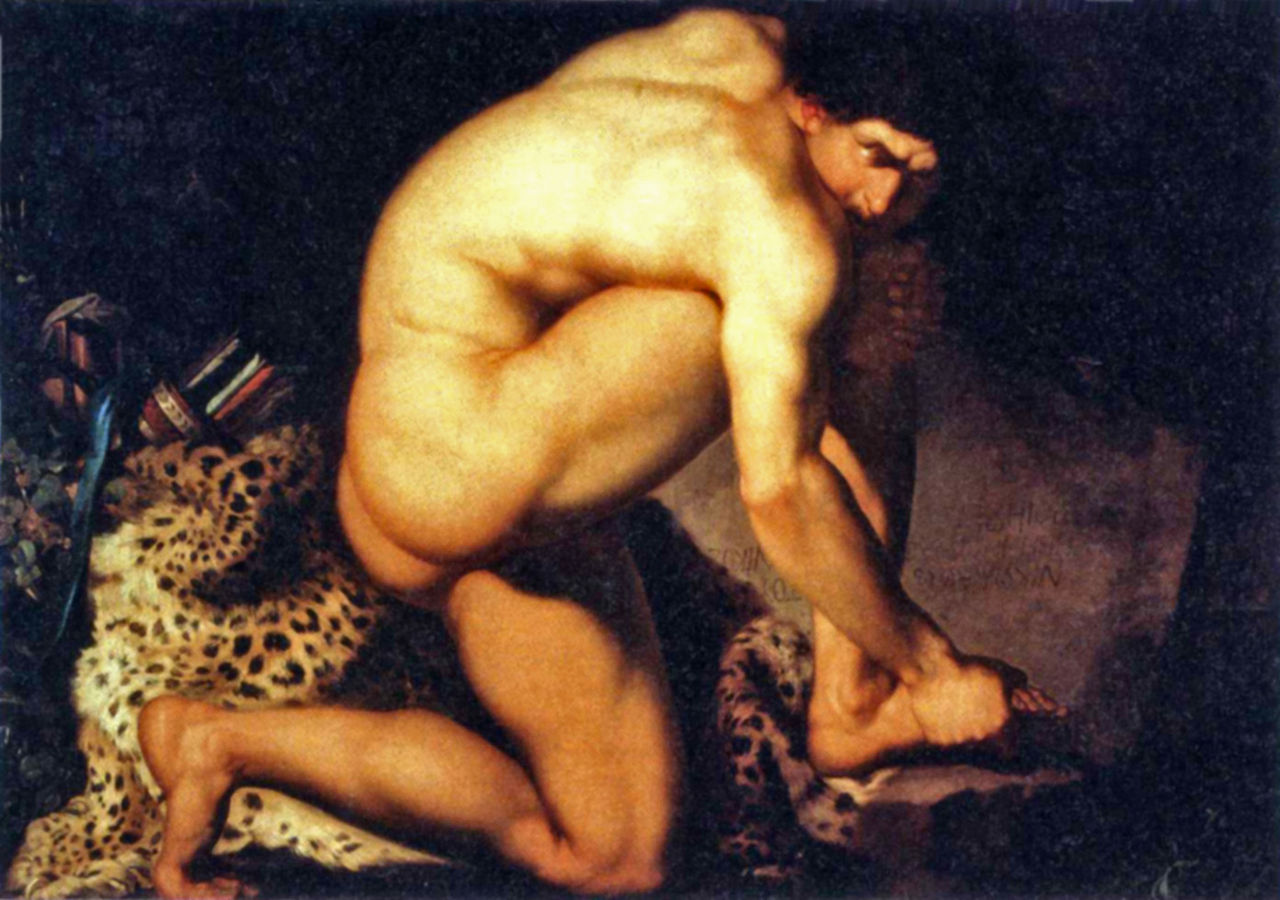
Wounded Philoctetes by Nicolai Abildgaard

A Dream to Remember, Repeat

Anacreonta 37

“As I slept through the night
Under sea-purple blankets,
Stretched out, drunk,
I was dreaming I stretched out
Mid-run on a fast course,
On the very tips of my toes.
I was enjoying myself with the girls
But some boys younger
Than Luaios were mocking me,
Teasing me harshly,
Because of those pretty girls.

Then, they all ran away from my dream
When I reached out to kiss them.
They left me alone and poor me,
I only wanted to sleep again.”

διὰ νυκτὸς ἐγκαθεύδων
ἁλιπορφύροις τάπησι
γεγανυμένος Λυαίῳ,
ἐδόκουν ἄκροισι ταρσῶν
δρόμον ὠκὺν ἐκτανύειν
μετὰ παρθένων ἀθύρων,
ἐπεκερτόμουν δὲ παῖδες
ἁπαλώτεροι Λυαίου
δακέθυμά μοι λέγοντες
διὰ τὰς καλὰς ἐκείνας.

ἐθέλοντα δ᾿ ἐκφιλῆσαι
φύγον ἐξ ὕπνου με πάντες·
μεμονωμένος δ᾿ ὁ τλήμων
πάλιν ἤθελον καθεύδειν.

a knight dozes at a table on the left. An angel looks at him. in the center and the right lies a table cluttered with objects, including coins, books, and a skull
Antonio de Pereda “The Knight’s Dream” 1650

Did He Die or Not?

Homer. Iliad. 11.349-360.

. . . [Diomedes] hurled his long-shadowed spear
at Hector’s head and did not miss: he hit
his helmet’s tip. But bronze deflected bronze
from fair skin: the spear failed on Hector’s headpiece
(three layers, cone shaped, Phoebus Apollo’s gift).
Hector scurried back and blended with the pack,
fell to his knee and stayed there, thick hand bracing
the ground. Black night blanketed his eyes.
But while Tydeus’s son tracked his spear’s woosh
to where it fell far beyond the first fighters,
Hector revived, scuttered into his car,
and off he drove, into the crush of men.
He’d given black fate the slip.

ἦ ῥα, καὶ ἀμπεπαλὼν προΐει δολιχόσκιον ἔγχος
καὶ βάλεν, οὐδʼ ἀφάμαρτε τιτυσκόμενος κεφαλῆφιν,
ἄκρην κὰκ κόρυθα· πλάγχθη δʼ ἀπὸ χαλκόφι χαλκός,
οὐδʼ ἵκετο χρόα καλόν· ἐρύκακε γὰρ τρυφάλεια
τρίπτυχος αὐλῶπις, τήν οἱ πόρε Φοῖβος Ἀπόλλων.
Ἕκτωρ δʼ ὦκʼ ἀπέλεθρον ἀνέδραμε, μίκτο δʼ ὁμίλῳ,
στῆ δὲ γνὺξ ἐριπὼν καὶ ἐρείσατο χειρὶ παχείῃ
γαίης· ἀμφὶ δὲ ὄσσε κελαινὴ νὺξ ἐκάλυψεν.
ὄφρα δὲ Τυδεΐδης μετὰ δούρατος ᾤχετʼ ἐρωὴν
τῆλε διὰ προμάχων, ὅθι οἱ καταείσατο γαίης
τόφρʼ Ἕκτωρ ἔμπνυτο, καὶ ἂψ ἐς δίφρον ὀρούσας
ἐξέλασʼ ἐς πληθύν, καὶ ἀλεύατο κῆρα μέλαιναν.

11.355-356.[F]ell to his knee and stayed there . . . Black night blanketed his eyes” (στῆ δὲ γνὺξ ἐριπὼν . . . ἀμφὶ δὲ ὄσσε κελαινὴ νὺξ ἐκάλυψεν): 

The controversy in the scholia:

One scholiast says of Homer and these verses:  

“The blind one is fond of lies, and he is the perfect liar. For first, Hector was not wounded, as he himself says, and then there’s the scurrying [ἀνέδραμε] of a man who has his strength (11.354). Isn’t an account of why he fell to his knees and died of something insignificant missing?  

ώς φιλοψευδής ό τυφλός,  ότι και άριστα ψεύδεται· πρώτον μέν γάρ ούκ έτρώθη ó “Εκτωρ, ώς αύτός φησιν, . . . είτα δέ καί τό άναδραμεϊν (cf. Λ 354) πολύ έρρωμένου τινός έστιν. πώς ούν καί έπεσεν έπί γούνατα καί απέθανε μικρού δεΐν; (Schol. A. ad Il. 11.355c. ex vel. Porph.)

This scholiast and others, as well as the poem’s ancient editors, were vexed by the formular indication of Hector’s death (“black night blanketed his eyes”) when Hector obviously survived Diomedes’ spear. 

The scholia explains the seemingly inappropriate use of the formula in 11.355-356 by offering that it was improperly transferred from the 5.309-310 account of Aeneas (Schol. A. 356a. and T. 356c).

An alternative theory:

In Book 5, Apollo’s actions saved Aeneas following a boulder’s blow to the warrior’s hip  (5.343-346).  

In Book 11, Apollo’s action saved Hector from a spear’s assault: he had gifted Hector a spear-stopping helmet. 

The Cambridge Commentary says that the ascription of the helmet to Apollo is only an idiom for the gear’s strength and good construction. 

I’m not sure that’s right. It seems to me the helmet is in fact a metonym for Apollo’s intervention. That is to say, it is through the helmet that Apollo saved Hector. I’m building on what an insightful scholiast says: 

“He [Hector] would have died, were it not for the divinity of the helmet” ( . . . άπέθανεν αν, εί μή διά την θειότητα τοϋ so κράνους [Schol. T. 353b]). 

It is divinity itself, not good metalworking, which saved Hector. The divinity is an emanation from Apollo.  

In both the Aeneas and Hector episodes, (1) it is Diomedes who attempts a kill, (2) he only just fails, and that’s thanks to (3) Apollo’s intervention. Perhaps we can say that the formular verses “[he] fell to his knee and stayed there . . . black night blanketed his eyes” belong to a larger formula whose elements are Diomedes, a warrior’s near death at his hand, and Apollo’s saving intervention.

color photograph of pallbearers carrying a white coffin
Not a scene from the extant Iliad.

Larry Benn has a B.A. in English Literature from Harvard College, an M.Phil in English Literature from Oxford University, and a J.D. from Yale Law School. Making amends for a working life misspent in finance, he’s now a hobbyist in ancient languages and blogs at featsofgreek.blogspot.com.

Pain-Relieving Dance

Anacreonta 49

“When Zeus’ child, Bacchus,
That pain-reliever Luaios,
That giver of wine, joins my thoughts
He teaches me how to dance.

I get a bit of pleasure too,
As a lover of drinking:
With the dances and the songs
Aphrodite makes me happy.
I want to dance again.”

τοῦ Διὸς ὁ παῖς ὁ Βάκχος,
ὁ λυσίφρων ὁ Λυαῖος,
ὅταν εἰς φρένας τὰς ἐμὰς
εἰσέλθῃ μεθυδώτας,
διδάσκει με χορεύειν.

ἔχω δέ τι καὶ τερπνὸν
ὁ τᾶς μέθας ἐραστάς·
μετὰ κρότων, μετ᾿ ᾠδᾶς
τέρπει με κἀφροδίτα·
πάλιν θέλω χορεύειν.

Anacreonta 43

Let’s get drunk and giggle,
Once we’ve fastened
Rose garlands to our heads.

Have a girl with cute ankles
Dance to the lyre, carrying
A thyrsus with ivy braids.

Have a soft-haired boy
Play alongside her, letting
A clear voice free
from a sweet smelling mouth.

Then golden-haired Love
Along with pretty Luaios
And pretty Aphrodite
Will join the party
An old man might enjoy.”

στεφάνους μὲν κροτάφοισι
ῥοδίνους συναρμόσαντες
μεθύωμεν ἁβρὰ γελῶντες.

ὑπὸ βαρβίτῳ δὲ κούρα
κατακίσσοισι βρύοντας
πλοκάμοις φέρουσα θύρσους
χλιδανόσφυρος χορεύῃ.

ἁβροχαίτας δ᾿ ἅμα κοῦρος
στομάτων ἁδὺ πνεόντων
κατὰ πηκτίδων ἀθύρῃ
προχέων λίγειαν ὀμφάν.

ὁ δ᾿ Ἔρως ὁ χρυσοχαίτας
μετὰ τοῦ καλοῦ Λυαίου
καὶ τῆς καλῆς Κυθήρης
τὸν ἐπήρατον γεραιοῖς
κῶμον μέτεισι χαίρων.

Oil on wood painting, a crowded barn with men and women dancing, drinking and dining
Peter Brueghel the Younger, “The Wedding Dance in a Barn” 1610

No Bull, Just Zeus

Anacreonta 54

“Child, this bull
Looks a bit like Zeus to me.
Since he is carrying on his back
A Sidonian lady.

He is crossing the broad sea!
He carves the waves with his feet!

No other bull could
Separate himself from the herd and
Sail across the sea except
this bull alone.”

ὁ ταῦρος οὗτος, ὦ παῖ,
δοκεῖ τις εἶναί μοι Ζεύς·
φέρει γὰρ ἀμφὶ νώτοις
Σιδωνίαν γυναῖκα·
περᾷ δὲ πόντον εὐρύν,
τέμνει δὲ κῦμα χηλαῖς.
οὐκ ἂν δὲ ταῦρος ἄλλος
ἐξ ἀγέλης λιασθεὶς
ἔπλευσε τὴν θάλασσαν,
εἰ μὴ μόνος ἐκεῖνος.

Segment of a fresco (wall painting). Woman, half-clothed, sits on bull while friends calm him. The bull looks suspicious.
Wall painting from pompeii, Europa already sitting on the back of the bull (Zeus)

“Covered in Flames and Sorrowful Ash”: Martial on Vesuvius

Alexey Bogolyubov, Eruption of Vesuvius

Today is, according to many, the anniversary of the eruption of Vesuvius in the Bay of Naples in 79 CE. Pliny’s account is the most famous, but Martial had his say too (Epigrams, 4.4):

“Here is Vesuvius, just yesterday green with shading vines–
here the noble grape made filled deep pools:
these were the hills Bacchus loved more than Nysae.
On this mountain the Satyrs not so long ago led their dance.
Here was the home Venus considered more pleasing than Sparta.
This place was famous because of its Herculean name.
All of this lies covered in flames and sorrowful ash.
Not even the gods wished for this to be their right.”

Hic est pampineis uiridis modo Vesbius umbris,
presserat hic madidos nobilis uua lacus:
haec iuga quam Nysae colles plus Bacchus amauit;
hoc nuper Satyri monte dedere choros;
haec Veneris sedes, Lacedaemone gratior illi;              5
hic locus Herculeo nomine clarus erat.
Cuncta iacent flammis et tristi mersa fauilla:
nec superi uellent hoc licuisse sibi.


Get Sh*T Ready and Drink

songs and thoughts well-fit to birthdays

Anacreonta 48

“When Bacchus visits,
My worries slumber:
I dream I have Elon-wealth.

I want to sing prettily,.
But I’m stretched out with an ivy crown,
And I mock everything in my heart.

Get shit ready and let me drink.
Bring me a cup, son:
It is far better for me to lie here
Drunk instead of dead.”

ὅταν ὁ Βάκχος ἔλθῃ,
εὕδουσιν αἱ μέριμναι,
δοκῶ δ᾿ ἔχειν τὰ Κροίσου.
θέλω καλῶς ἀείδειν,
κισσοστεφὴς δὲ κεῖμαι,
πατῶ δ᾿ ἅπαντα θυμῷ.

ὅπλιζ᾿, ἐγὼ δὲ πίνω.

φέρε μοι κύπελλον, ὦ παῖ·
μεθύοντα γάρ με κεῖσθαι
πολὺ κρεῖσσον ἢ θανόντα.

Anacreonta 52a

“Why do you teach me laws
And rhetoricians’ customs?
What’s the use of so many speeches
That bring no help at all?

Teach me instead
To drink Dionysus’ subtle draught.
Teach me instead
To play with golden Aphrodite.”

τί με τοὺς νόμους διδάσκεις
καὶ ῥητόρων ἀνάγκας;
τί δέ μοι λόγων τοσούτων
τῶν μηδὲν ὠφελούντων;

μᾶλλον δίδασκε πίνειν
ἁπαλὸν πῶμα Λυαίου,
μᾶλλον δίδασκε παίζειν
μετὰ χρυσῆς Ἀφροδίτης.

Anacreonta 52b

“The hair is gray on my head.
Boy, give me water, add some wine
Make my heart numb.
Soon you will cover me, no longer alive.
You want nothing when you’re dead.”

πολιαὶ στέφουσι κάραν·
δὸς ὕδωρ, βάλ᾿ οἶνον, ὦ παῖ·
τὴν ψυχήν μου κάρωσον.
βραχὺ μὴ ζῶντα καλύπτεις.
ὁ θανὼν οὐκ ἐπιθυμεῖ.

a group of revelers from the 17th century, men and women drinking. There is a dog in the front listening to a bow play the violin
Jan Steen, “A Merry Party” 1660

Honoring the Dead with the Dead

Euripides, Hecuba 303-316

“I will not deny what I said to everyone:
Now that Troy has been taken we should give your child
To be sacrificed to the first man of the army when he asks it.

Here is where many cities start to stumble—
When there is some excellent and willing man
Who earns no greater than the lesser mob.
Achilles is worthy of our honor, Ma’am,
Because he died most nobly for Greece.

Wouldn’t it be shameful if we used him as a friend
When he was watching but stopped when he was dead?
What would someone say if there was some new reason
To gather an army and lead it against an enemy?
Will we fight or will we worry about our lives
Once we see that the dead are not honored?”

ἃ δ᾿ εἶπον εἰς ἅπαντας οὐκ ἀρνήσομαι,
Τροίας ἁλούσης ἀνδρὶ τῷ πρώτῳ στρατοῦ
σὴν παῖδα δοῦναι σφάγιον ἐξαιτουμένῳ.
ἐν τῷδε γὰρ κάμνουσιν αἱ πολλαὶ πόλεις,
ὅταν τις ἐσθλὸς καὶ πρόθυμος ὢν ἀνὴρ
μηδὲν φέρηται τῶν κακιόνων πλέον.
ἡμῖν δ᾿ Ἀχιλλεὺς ἄξιος τιμῆς, γύναι,
θανὼν ὑπὲρ γῆς Ἑλλάδος κάλλιστ᾿ ἀνήρ.
οὔκουν τόδ᾿ αἰσχρόν, εἰ βλέποντι μὲν φίλῳ
χρώμεσθ᾿, ἐπεὶ δ᾿ ὄλωλε μὴ χρώμεσθ᾿ ἔτι;
εἶἑν· τί δῆτ᾿ ἐρεῖ τις, ἤν τις αὖ φανῇ
στρατοῦ τ᾿ ἄθροισις πολεμίων τ᾿ ἀγωνία;
πότερα μαχούμεθ᾿ ἢ φιλοψυχήσομεν,
τὸν κατθανόνθ᾿ ὁρῶντες οὐ τιμώμενον;

Sebastiano Ricci (Belluno 1659-Venice 1734) – The Sacrifice of Polyxena –

It’s Tuesday: An Eternal Death Awaits, No Matter What

Lucretius, De Rerum Natura 3.1076-1094

“Finally, what great and vile desire for life compels us
To quake so much amidst doubts and dangers?
Mortals have an absolute end to our lives:
Death cannot be evaded—we must leave.

Nevertheless, we move again and still persist—
No new pleasure is procured by living;
But while what we desire is absent, that seems to overcome
All other things; but later, when we have gained it, we want something else—

An endless thirst for life grips us as we gasp for it.
It remains unclear what fortune life will offer,
What chance may bring us and what end awaits.
But by extending life we do not subtract a moment
Of time from death nor can we shorten it
So that we may somehow have less time after our ends.

Therefore, you may continue as living as many generations as you want,
But that everlasting death will wait for you still,
And he will be there for no less a long time, the man who
Has found the end of life with today’s light, than the man who died
Many months and many years before.”

Denique tanto opere in dubiis trepidare periclis
quae mala nos subigit vitai tanta cupido?
certe equidem finis vitae mortalibus adstat
nec devitari letum pote, quin obeamus.
praeterea versamur ibidem atque insumus usque
nec nova vivendo procuditur ulla voluptas;
sed dum abest quod avemus, id exsuperare videtur
cetera; post aliud, cum contigit illud, avemus
et sitis aequa tenet vitai semper hiantis.
posteraque in dubiost fortunam quam vehat aetas,
quidve ferat nobis casus quive exitus instet.
nec prorsum vitam ducendo demimus hilum
tempore de mortis nec delibare valemus,
quo minus esse diu possimus forte perempti.
proinde licet quod vis vivendo condere saecla,
mors aeterna tamen nihilo minus illa manebit,
nec minus ille diu iam non erit, ex hodierno
lumine qui finem vitai fecit, et ille,
mensibus atque annis qui multis occidit ante.

Color photo of a plaster Roman death mask, mostly brown and orange with eyes visible and striking
https://www.metmuseum.org/art/collection/search/547853