Practice Makes Perfect?

Anacreonta 60a

“I will let my lyre sing.
There’s no contest now,
But practice is important for
Everyone who has seen
a flowering of their art.

I will play with my ivory pick,
Shouting along in a Phrygian measure,
Crooning a clear melody
Like some swan from the Kaustros,
Sounding a complex beat
along with the rushing wind.

Muse, dance with me:
For the kithara is Apollo’s sacred thing,
Like the bay and the tripod too.

My gossip is Apollo’s love,
That unrequited compulsion:
The girl remains safe.
She fled his weapons
And changed the nature of her form,
Rooting herself in the ground to grow.

Phoebus? Well, Phoebus arrived,
Imagining that he ruled the girl,
But he merely picked young leaves,
acting out the mysteries of Aphrodite.”

ἀνὰ βάρβιτον δονήσω·
ἄεθλος μὲν οὐ πρόκειται,
μελέτη δ᾿ ἔπεστι παντὶ
σοφίης λαχόντ᾿ ἄωτον.

ἐλεφαντίνῳ δὲ πλήκτρῳ
λιγυρὸν μέλος κροαίνων
Φρυγίῳ ῥυθμῷ βοήσω,
ἅτε τις κύκνος Καΰστρου
ποικίλον πτεροῖσι μέλπων
ἀνέμου σύναυλος ἠχῇ.

σὺ δέ, Μοῦσα, συγχόρευε·
ἱερὸν γάρ ἐστι Φοίβου
κιθάρη, δάφνη τρίπους τε.
λαλέω δ᾿ ἔρωτα Φοίβου,
ἀνεμώλιον τὸν οἶστρον·

σαόφρων γάρ ἐστι κούρα·
τὰ μὲν ἐκπέφευγε κέντρα,
φύσεως δ᾿ ἄμειψε μορφήν,
φυτὸν εὐθαλὲς δ᾿ ἐπήχθη·

ὁ δὲ Φοῖβος ᾖε, Φοῖβος,
κρατέειν κόρην νομίζων,
χλοερὸν δρέπων δὲ φύλλον
ἐδόκει τελεῖν Κυθήρην.

Fragment of mosaic. Daphne is running towards a laurel tree, parly close. Apollo is pursuing, but only his head is visible
Antakya Archaeological Museum Apollo and Daphne mosaic

Greek Studies

Some reflections from a student who took Greek for the first time this summer

“The roots of education are bitter, but the fruit is sweet.” –Aristotle


We’ve all experienced times throughout when education feels simply bitter, with the fruits that are promised to come not even on the horizon. In other words, any time a test rolls around or a paper is due. And yet, nearly every time, the relief of being done is a sweet enough fruit, and the realization that at least some significant learning was done is just a cherry on top. In no other area of study have I experienced feelings of bitterness towards education followed by enjoyment of its fruits in such rapid succession than in learning Ancient Greek. 

As a lifelong Latin student, I admittedly thought that the first few classes, and even weeks, of my Ancient Greek course would be a breeze. Sure Latin and Greek were different languages, but they both fell under the Classics umbrella and used similar grammatical structures that are now second nature to my Latin oriented brain. However, I failed to account for a primary aspect of Greek: its alphabet. Most people, especially Classics students, know some of the Greek letters, like alpha, beta, or delta. Those in particular are familiar to English and Latin speakers, given that they closely resemble A, B, and D. It’s the rest of the alphabet that gave me, and most of my classmates, fits. 

Many of the letters were completely foreign shapes that represented unfamiliar sounds. Some contracted sounds, such as ‘th’ and ‘ps’ are simply one letter, with many letters out of order from our standard English alphabet, and some letters like ‘h’ even being shown by an accent mark rather than a letter. So when we were asked to read aloud and translate Greek words, I found myself first transforming the characters into their approximate English counterparts to read them aloud, and then translating them into their English definitions. Not only is pronunciation not stressed at all in Latin, the altered alphabet made each word feel like an enormous hurdle. 

However, as is Aristotle’s golden rule of education, the sweet fruits came not far behind. After a few hours of dutiful practice, both with classmates and alone, I became well acquainted with the formerly alien Ancient Greek letters. I can’t say it has become second nature, because to be frank I’m not sure if it ever will, but my fear of reading Greek words aloud has reduced dramatically. Unfortunately, that relief has been short lived, as our course has carried on to the minutiae of the language: declensions, conjugations, and articles. Yet, the immediate swing from bitterness to sweetness gives hope for further enjoyment of the Greek language. 

“The happy man is the one with a healthy body, a wealthy soul and a well-educated nature” –Thales

Many philosophers throughout human history have spoken to the joy that is necessary to properly learn and live, and that the happiest people are those who are the most educated. While this notion feels at times preposterous, I find that it is especially true when students are allowed to thoroughly learn the material that interests them at their own speed. 

picture of the greek alphabet with upper and lower case letters

By choosing an Ancient Greek course for the first time this summer, I have gone back to the basics of any language: vocabulary, grammar, and pronunciation. And while I have little memory of doing similar exercises to learn English, I can remember building the foundations of Latin nearly six years ago. However, I have now reached the Latin stage where classes and homeworks are dominated solely by translations– I have a dictionary on hand, because at this point there’s no time to study more vocab, and whenever I see an infinitive verb, I just assume that the author is using some form of indirect speech. To be frank, I don’t think I’ve seen any form of “esse” in years. This ease I feel with Latin has helped me read increasingly complex texts and perform more adept analysis, but the fundamentals of the language have certainly been a bit lost. 

During my experiences with Greek this summer, however, I have made a genuine commitment to understanding each and every aspect of the sentences I translate. I, of course, want to be precise with my vocabulary translations, but rather than simply trying to get through as many sentences as possible, and half-heartedly moving on from any phrases that don’t quite make sense, I’m trying to actually figure out what I don’t quite understand. While these goals have certainly made learning Greek more time consuming than I originally anticipated, it has actually brought considerable joy to me. For the first time in years I feel less of a time crunch to get through material, and therefore increased enjoyment and fulfillment in learning the material.


I’ve often heard people discuss the extreme difficulty of the English language, and that, most of the time, it simply makes very little sense. From the spelling of our words to the grammatical structure of our sentences, English is often considered one of the hardest languages to learn. However, I don’t think that I personally understood why that was until I returned to the fundamentals of Ancient Greek.

stylized head of greek philosopher

Latin and Greek are the two foreign languages I have studied the most, and both have a calculated, almost mathematical, structure. Since the case of a noun or adjective determines what the word’s role in the sentence is, we as readers can identify each word’s job purely by looking at the ending. The same is true for verbs, as the ending tells us the person, number, tense, and mood of the verb all within a few letters at the end of the word. And while these rules, of course, have many exceptions, even those exceptions have trends that can be studied and then identified when looking at a sentence. In general, one can learn the languages by studying paradigms and grammar charts, in addition to practicing translating sentences. These paradigms are so accurate, in fact, that often personal pronouns and “to be” verbs can be omitted. The ancient Latin and Greek texts even had no spaces between words, punctuation, or capital letters; however, readers could still understand the material because of the steadfast rules of the languages. 

These immovable, easily explainable rules seem to be what’s missing from English. Most of the reasoning behind why certain words look the way they do or function in a particular manner is because that’s just the way it works (in word order). There’s not a easy declension or case system for all English nouns and adjectives, verbs don’t share common endings that allow one to identify their syntax, and spelling feels, at times, completely arbitrary. We have so many words that are spelled the same with different meanings or have the same pronunciation with different meanings that we categorize them: homographs and homophones. While not everyone has a mathematically-oriented brain, the calculated approach Latin and Greek take to grammar certainly makes them easier to wrap our heads around, in addition to highlighting the outright confusing nature of English. 
screen shot of a greek exercise

screen shot of a greek exercise

Having now completed my Introductory Greek summer course, I am able to reflect on the most impactful aspects that I took away from the class. While learning a new language always provides a new window into how we think about various dialects, grammar, and vocabulary, I find that learning a Classical language gives an additional perspective that modern languages cannot supply. By learning a dead language, I, and all Classics students, are forced to examine how life was when Ancient Greek was the common denominator. I briefly took a Spanish course in middle school, and I recall the translation passages consisting of dialogue between people getting food at a market, or walking down a city street; however, the Greek passages consist of philosophical debates between philosophers of the time, or strenuous journeys across dangerous seas in triremes. In uncovering these events that are so foreign to the modern eye, I am truly taking a history course along with a language course. This multifaceted learning experience certainly gives me genuine interest and enjoyment in translating large volumes of text. 

In addition, as I made my way through the unique, and admittedly odd, stories, I was forced to make somewhat of a human connection with the characters. For example, many of our passages involved a character who lived his life as Homer would, and frequently quoted the great poet. While his antics were at times confusing, I would always become a little more alert and absorbed in the text when he, and his Homeric philosophies, appeared in the passages. These little nuances, that can really be found only in the texts of Classical, dead languages, showcase the human interest that learning Ancient Greek provides. Looking forward, such connections to the text has greatly heightened my fascination with the Classics as a whole, and encouraged me to dive deeper into the field. 

Stylized painting of the ruins of the Parthenon emerging into the sun

My name is Matthew Abati, and I am a rising high school senior at Milton Academy just outside of Boston. I have been a Classics lover since middle school and am very excited to share some of my thoughts on the Classics here on Sententiae Antiquae! When I’m not in school, I love to read all types of books and play all types of sports.

Of Fish & Men

Septuagint. Book of Habakkuk. 1.13-16.

Does your pure eye not see wrong? Can’t it see suffering? Why do you look on the deceitful and stay silent while the ungodly devour the righteous?

You’ve made humans like the fish of the sea, and like beasts without a master.  

He [the enemy] pulls up the lot of them with his fish-hook, hauls them out with his net, and collects them in his seine.  This makes him glad; his heart rejoices. 

And so he makes offerings to his seine, and he burns incense to his net. For after all, thanks to them he has bettered his portion and his victuals are excellent.

Philo. On the Creation. XXI. 65-66.

Of the forms of life, the most undeveloped and least formed is the race of fish, and the most complete and the best in all respects is the race of humans . . .

Of living things, God created fish first. Their essence, however, is more that of a body than a living thing. In a way they are alive and not alive. They are capable of movement yet lacking in life. The principle of life is scattered in them as if by chance and solely for the preservation of their bodies–just as they say salt is put on meat to prevent it easily spoiling.

Habakkuk.

καθαρὸς ὀφθαλμὸς τοῦ μὴ ὁρᾶν πονηρά, καὶ ἐπιβλέπειν ἐπὶ πόνους οὐ δυνήσῃ: ἵνα τί ἐπιβλέπεις ἐπὶ καταφρονοῦντας; παρασιωπήσῃἐν τῷ καταπίνειν ἀσεβῆ τὸν δίκαιον; καὶ ποιήσεις τοὺς ἀνθρώπους ὡς τοὺς ἰχθύας τῆς θαλάσσης καὶ ὡς τὰ ἑρπετὰ τὰ οὐκ ἔχοντα ἡγούμενον.  συντέλειαν ἐν ἀγκίστρῳ ἀνέσπασεν καὶ εἵλκυσεν αὐτὸν ἐν ἀμφιβλήστρῳ καὶ συνήγαγεν αὐτὸν ἐν ταῖς σαγήναις αὐτοῦ: ἕνεκεν τούτου εὐφρανθήσεται καὶ χαρήσεται ἡ καρδία αὐτοῦ: ἕνεκεν τούτου θύσει τῇ σαγήνῃ αὐτοῦ καὶ θυμιάσει τῷ ἀμφιβλήστρῳ αὐτοῦ ὅτι ἐναὐτοῖς ἐλίπανεν μερίδα αὐτοῦ καὶ τὰ βρώματα αὐτοῦ ἐκλεκτά.

Philo.

φυχής γάρ ή μέν άργοτάτη καΐ ήκιστα τετυπωμένη τω γένει τών Ιχθύων προσκεκλήρωται, ή δ ‘ ακριβέστατη και κατά πάντα άριστη τω τών ανθρώπων . . . διό τών έμφύχων πρώτους έγέννησεν ιχθύας, πλέον μετέχοντας σωματικής ή φυχικής ουσίας, τρόπον τινά ζώα καΐ ού ζώα, κινητά άφυχα, προς αυτό μόνον τήν τών σωμάτων διαμονήν παρασπαρέντος αύτοΐς του φυχοειδοΰς, καθάπερ φασι τούς άλας τοις κρέασιν, Ινα μή ραδίως φθείροιντο.

  1. Black and white photograph of a young girl looking down at a fish, vertical in her hands
    Ingar Krauss. Untitled (Hannah with Fish). 2001

    Larry Benn has a B.A. in English Literature from Harvard College, an M.Phil in English Literature from Oxford University, and a J.D. from Yale Law School. Making amends for a working life misspent in finance, he’s now a hobbyist in ancient languages and blogs at featsofgreek.blogspot.com.

“The Cheapness of Our Tongue”: Three Latin Passages on Translation

Seneca the Elder, Contr. 9.14

“People who teach translation have never made a lot of money”

numquam magnas mercedes accepisse eos qui hermeneumata docerent.

Pliny, Letters C. Plinius Arrio Antonino Suo S.

“How could I give you a greater sign of how much I want to copy you and admire you than the fact that I am trying to translate your Greek epigrams to Latin? Still, this is a decline. I bring to it the feebleness of my own ability, and add to this the poverty, or what Lucretius calls “the cheapness of our own language.” Nevertheless, if these Latin translations of mine seem at all charming to you, you will know how much pleasure your Greek originals brought me! Farewell.”

Quemadmodum magis adprobare tibi possum, quanto opere mirer epigrammata tua Graeca, quam quod quaedam Latine aemulari et exprimere temptavi? in deterius tamen. Accidit hoc primum imbecillitate ingenii mei, deinde inopia ac potius, ut Lucretius ait, egestate patrii sermonis. Quodsi haec, quae sunt et Latina et mea, habere tibi aliquid venustatis videbuntur, quantum putas inesse iis gratiae, quae et a te et Graece proferuntur! Vale.

Cicero, de optime genere oratorum 18

“Two kinds of objections are possible for this task. The first is: “It is better in Greek.” One can answer such people by asking if they can make anything better in Latin. Another is: “Why should I read this translation rather than the Greek?” Well, the same people often embrace a Latin Andria, Synephebi, and even an Andromache, Antiope and Epigonoi. Why is there so much intolerance for speeches translated from Greek when there is none for translated poems?

Huic labori nostro duo genera reprehensionum opponuntur. Unum hoc: “Verum melius Graeci.” A quo quaeratur ecquid possint ipsi melius Latine? Alterum: “Quid istas potius legam quam Graecas?” Idem Andriam et Synephebos nec minus Andromacham aut Antiopam aut Epigonos Latinos recipiunt. Quod igitur est eorum in orationibus e Graeco conversis fastidium, nullum cum sit in versibus?

Painting of a mouth with a tongue and an alien figure pointing to it
Life & Death at the Tip of the Tongue (painting) by Omer Toledano, 2001

Tragedy and the Mind: Some Thoughts on Sophocles and Psychology

A few years ago, in the early months of the COVID pandemic, Reading Greek Tragedy Online explored the Trachinian Women as one of its early experiments.


RGTO has inspired a lot of conversation and engagement. Here is a response from a viewer in the wider world.

Psychological, non-Freudian look at the plays of Sophocles:
Allegories of current political events in ancient Athens

by psychologist and psychotherapist Klaus Schlagmann, klausschlagmann@t-online.de, Costa Rica

I first read “Oedipus the King” in the original more than 25 years ago when I had to grapple with Freud’s concept of the “Oedipal conflict”.

According to Freud, every boy between the ages of 1 and 7 wants to have a sexual relationship with his mother and therefore wants to get rid of his father. This is the “positive” Oedipus complex. Likewise, every boy wants to have a sexual relationship with his father and therefore wants to get rid of his mother (“negative” Oedipus complex). The same applies to girls by analogy.

Reading the Sophocles play made me realize how much Freud is turning reality into its opposite: at the end of the play, Oedipus wants to kill his mother – in honor of his father, whose death he wants to atone for on the basis of Apollo’s revelation. If Jocasta had not committed suicide beforehand, he would have murdered her. He wants to carry out this matricide with the same justification that is used to justify and demand other matricides in Greek mythology: because the mothers are responsible for the death of their respective fathers.

Over time I have studied all the great Sophocles pieces that have survived. In a discussion of such texts, I would like to bring a psychologist’s reasonable, non-Freudian perspective. As a psychologist, I pay attention to whether there are contradictions between what someone says and what he does. In general, I’m more trained to pay attention to the “action messages” of the actors instead of just listening to what they say. Or I pay attention to what someone does not say, although it should actually be addressed. I may question whether the emotions or insights presented are really real. Perhaps they are only pretended and played. Maybe I come across completely illogical points of view – and then try to be particularly attentive here and to interpret them meaningfully. Sometimes I’m probably more willing to judge certain statements as “outrageous” and rather to pillory them. All in all, in this job I have learned to pay attention to contradictions, to take them seriously and to try to resolve them. Having worked with dream interpretation, I am familiar with symbolism and allegory.

I want to briefly tie this to the great “Antigone”. It is probably the oldest, most impressive plea for a democratic society. That’s why it’s still relevant today. These values are fully represented by Antigone (and Haimon). Creon – that is important to recognize from my point of view! – embodies exactly the opposite: an arbitrary, brutal, unreasonable, godless, unjust dictatorship. From the beginning he successfully reduced the council of elders to the role of a vicarious agent. Through his brutality, he has the majority of the population and his henchmen firmly under control.

Here is an example for each of the features mentioned above:

Contradiction between what someone says and does: Creon praises the council of elders for having served so well for three generations of rulers – but it is clear that his decision not to bury Polynices presents this body with a fait accompli. He never dreamed of discussing this with his “council” in advance. The Athenians of that time must have experienced this as an immediate affront: a decision is not even discussed with a few select advisors – it is made by Creon all by himself. This corresponds to the state model of absolutism: “L’État, c’est moi.”

Noting what someone is NOT saying: When Creon talks about what happened at the end, he laments that he killed his son, but that he explicitly did this to Antigone and that he ordered Polynices to be punished completely inappropriately as well, he says NOT A SINGLE word about it.

Feigning insight: Obviously the play itself is about acting as if in a theater. For example, Creon ends up pretending to show remorse and heed the advice that was given to him. Free Antigone and bury Polynices. But Creon reverses the order! What an infamy! He excludes from the funeral the person who stood up for it from the beginning and would have been most worthy to officiate this ceremony! Whether he just wanted to increase the likelihood of Antigone’s death by delaying her liberation through a very elaborate burial, or even quickly instructed his bodyguard to break into Antigone’s dungeon during the burial and kill her, but make it look like suicide, that remains open to me. In any case, at this point he PROVES that he is in no way interested in the divine revelations.

Making sense of illogical points of view: Antigone claims that she would never have broken a burial law for her children or a husband. From my point of view, this emphasizes the special meaning of a – symbolically meant – “sibling” relationship, i.e. an obligation that Athens has towards a community that originates from its own “motherland” – i.e. towards Sparta. Comparatively fewer obligations to colonies (“children”) or other distant allies (“husband”).

There are a number of other things I would like to draw your attention to. Also, for example, that from my point of view Sophocles is a deeply democratic-minded author who brings allegories to the stage in all of his plays that confront his compatriots with political events that happened not too long ago.

I have now translated two essays from the last few years into English for the dramas “The Trachinian Women” (https://oedipus-online.de/wp-content/uploads/2023/08/Cultivated-Blindness.pdf) and “Antigone” (https://oedipus-online.de/wp-content/uploads/2023/08/Renunciation-of-Tyranny.pdf). I will be doing that for “Oedipus the King” in the near future. “Philoctetes” and “Ajax” are also on the program for this project. Here, too, clear allegorical references to the current political events in Athens at that time can be demonstrated.

About Klaus:  Born in 1960, I studied psychology at the University of Saarbrücken (Diploma, 1988). Since 1993 I worked in my own psychotherapeutic practice (katathymic-imaginative psychotherapy, behavioral therapy, NLP, hypnosis and psych-analysis according to Josef Breuer). Since 1995 I have been researching the history of psychoanalysis and therefore came to study especially the stories of Narcissus and Oedipus, which were incorporated into Freud’s theory. I look at those ancient tales from a completely new perspective. In 2012 I published Sigmund Freud’s long-lost letters to the writer Wilhelm Jensen. Since 2022 I’m living in Costa Rica.

Color Photograph of Narcissus reclining, a Pompeiian Wall Painting

Isolation and Self-Sufficiency

Aristotle, Nicomachean Ethics 1. 6-9

“We use ‘self-sufficient’ not to mean a person alone—someone living in isolation—but to include one’s parents, children, spouse, friends, and even fellow citizens, since a human being is a social creature by nature. Now, some limit needs to be observed in these ties—for it will go on endlessly if you extend it to someone’s ancestors and descendants.  But that’s a problem for another time.

We posit that self-sufficiency is something which in itself makes life attractive and lacks nothing and for this reason we think it is happiness, since we imagine that happiness is the most preferable of all things when it is not counted with others. It is clear that it is desirable even with the least of the goods—the addition of goods increases the total, since the greater good is always desirable.”

τὸ δ᾿ αὔταρκες λέγομεν οὐκ αὐτῷ μόνῳ, τῷ ζῶντι βίον μονώτην, ἀλλὰ καὶ γονεῦσι καὶ τέκνοις καὶ γυναικὶ καὶ ὅλως τοῖς φίλοις καὶ πολίταις, ἐπειδὴ φύσει πολιτικὸν ὁ ἄνθρωπος. τούτων δὲ ληπτέος ὅρος τις· ἐπεκτείνοντι γὰρ ἐπὶ τοὺς γονεῖς καὶ τοὺς ἀπογόνους καὶ τῶν φίλων τοὺς φίλους εἰς ἄπειρον πρόεισιν. ἀλλὰ τοῦτο μὲν εἰσαῦθις ἐπισκεπτέον, τὸ δ᾿ αὔταρκες τίθεμεν ὃ μονούμενον αίπετὸν ποιεῖ τὸν βίον καὶ μηδενὸς ἐνδεᾶ· τοιοῦτον δὲ τὴν εὐδαιμονίαν οἰόμεθα εἶναι. ἔτι δὲ πάντων αἱρετωτάτην μὴ συναριθμουμένην—συναριθμουμένην γὰρ δῆλον ὡς αἱρετωτέραν μετὰ τοῦ ἐλαχίστου τῶν ἀγαθῶν, ὑπεροχὴ γὰρ ἀγαθῶν γίνεται τὸ προστιθέμενον, ἀγαθῶν δὲ τὸ μεῖζον αἱρετώτερον

John Donne, Meditation 17

No man is an Iland, intire of itselfe; every man
is a peece of the Continent, a part of the maine;
if a Clod bee washed away by the Sea, Europe
is the lesse, as well as if a Promontorie were, as
well as if a Manor of thy friends or of thine
owne were; any mans death diminishes me,
because I am involved in Mankinde;
And therefore never send to know for whom
the bell tolls; It tolls for thee.

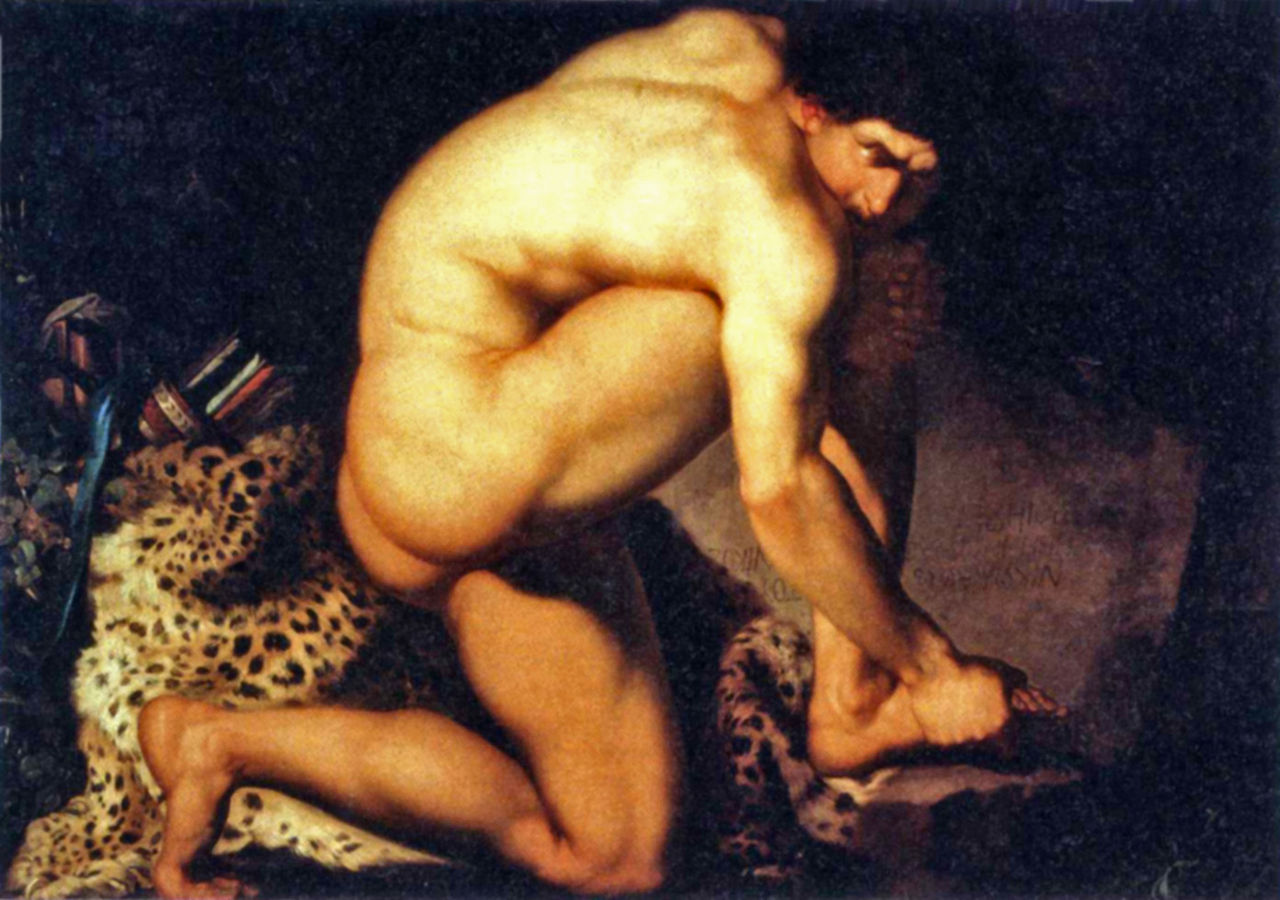
Wounded Philoctetes by Nicolai Abildgaard

A Dream to Remember, Repeat

Anacreonta 37

“As I slept through the night
Under sea-purple blankets,
Stretched out, drunk,
I was dreaming I stretched out
Mid-run on a fast course,
On the very tips of my toes.
I was enjoying myself with the girls
But some boys younger
Than Luaios were mocking me,
Teasing me harshly,
Because of those pretty girls.

Then, they all ran away from my dream
When I reached out to kiss them.
They left me alone and poor me,
I only wanted to sleep again.”

διὰ νυκτὸς ἐγκαθεύδων
ἁλιπορφύροις τάπησι
γεγανυμένος Λυαίῳ,
ἐδόκουν ἄκροισι ταρσῶν
δρόμον ὠκὺν ἐκτανύειν
μετὰ παρθένων ἀθύρων,
ἐπεκερτόμουν δὲ παῖδες
ἁπαλώτεροι Λυαίου
δακέθυμά μοι λέγοντες
διὰ τὰς καλὰς ἐκείνας.

ἐθέλοντα δ᾿ ἐκφιλῆσαι
φύγον ἐξ ὕπνου με πάντες·
μεμονωμένος δ᾿ ὁ τλήμων
πάλιν ἤθελον καθεύδειν.

a knight dozes at a table on the left. An angel looks at him. in the center and the right lies a table cluttered with objects, including coins, books, and a skull
Antonio de Pereda “The Knight’s Dream” 1650

Did He Die or Not?

Homer. Iliad. 11.349-360.

. . . [Diomedes] hurled his long-shadowed spear
at Hector’s head and did not miss: he hit
his helmet’s tip. But bronze deflected bronze
from fair skin: the spear failed on Hector’s headpiece
(three layers, cone shaped, Phoebus Apollo’s gift).
Hector scurried back and blended with the pack,
fell to his knee and stayed there, thick hand bracing
the ground. Black night blanketed his eyes.
But while Tydeus’s son tracked his spear’s woosh
to where it fell far beyond the first fighters,
Hector revived, scuttered into his car,
and off he drove, into the crush of men.
He’d given black fate the slip.

ἦ ῥα, καὶ ἀμπεπαλὼν προΐει δολιχόσκιον ἔγχος
καὶ βάλεν, οὐδʼ ἀφάμαρτε τιτυσκόμενος κεφαλῆφιν,
ἄκρην κὰκ κόρυθα· πλάγχθη δʼ ἀπὸ χαλκόφι χαλκός,
οὐδʼ ἵκετο χρόα καλόν· ἐρύκακε γὰρ τρυφάλεια
τρίπτυχος αὐλῶπις, τήν οἱ πόρε Φοῖβος Ἀπόλλων.
Ἕκτωρ δʼ ὦκʼ ἀπέλεθρον ἀνέδραμε, μίκτο δʼ ὁμίλῳ,
στῆ δὲ γνὺξ ἐριπὼν καὶ ἐρείσατο χειρὶ παχείῃ
γαίης· ἀμφὶ δὲ ὄσσε κελαινὴ νὺξ ἐκάλυψεν.
ὄφρα δὲ Τυδεΐδης μετὰ δούρατος ᾤχετʼ ἐρωὴν
τῆλε διὰ προμάχων, ὅθι οἱ καταείσατο γαίης
τόφρʼ Ἕκτωρ ἔμπνυτο, καὶ ἂψ ἐς δίφρον ὀρούσας
ἐξέλασʼ ἐς πληθύν, καὶ ἀλεύατο κῆρα μέλαιναν.

11.355-356.[F]ell to his knee and stayed there . . . Black night blanketed his eyes” (στῆ δὲ γνὺξ ἐριπὼν . . . ἀμφὶ δὲ ὄσσε κελαινὴ νὺξ ἐκάλυψεν): 

The controversy in the scholia:

One scholiast says of Homer and these verses:  

“The blind one is fond of lies, and he is the perfect liar. For first, Hector was not wounded, as he himself says, and then there’s the scurrying [ἀνέδραμε] of a man who has his strength (11.354). Isn’t an account of why he fell to his knees and died of something insignificant missing?  

ώς φιλοψευδής ό τυφλός,  ότι και άριστα ψεύδεται· πρώτον μέν γάρ ούκ έτρώθη ó “Εκτωρ, ώς αύτός φησιν, . . . είτα δέ καί τό άναδραμεϊν (cf. Λ 354) πολύ έρρωμένου τινός έστιν. πώς ούν καί έπεσεν έπί γούνατα καί απέθανε μικρού δεΐν; (Schol. A. ad Il. 11.355c. ex vel. Porph.)

This scholiast and others, as well as the poem’s ancient editors, were vexed by the formular indication of Hector’s death (“black night blanketed his eyes”) when Hector obviously survived Diomedes’ spear. 

The scholia explains the seemingly inappropriate use of the formula in 11.355-356 by offering that it was improperly transferred from the 5.309-310 account of Aeneas (Schol. A. 356a. and T. 356c).

An alternative theory:

In Book 5, Apollo’s actions saved Aeneas following a boulder’s blow to the warrior’s hip  (5.343-346).  

In Book 11, Apollo’s action saved Hector from a spear’s assault: he had gifted Hector a spear-stopping helmet. 

The Cambridge Commentary says that the ascription of the helmet to Apollo is only an idiom for the gear’s strength and good construction. 

I’m not sure that’s right. It seems to me the helmet is in fact a metonym for Apollo’s intervention. That is to say, it is through the helmet that Apollo saved Hector. I’m building on what an insightful scholiast says: 

“He [Hector] would have died, were it not for the divinity of the helmet” ( . . . άπέθανεν αν, εί μή διά την θειότητα τοϋ so κράνους [Schol. T. 353b]). 

It is divinity itself, not good metalworking, which saved Hector. The divinity is an emanation from Apollo.  

In both the Aeneas and Hector episodes, (1) it is Diomedes who attempts a kill, (2) he only just fails, and that’s thanks to (3) Apollo’s intervention. Perhaps we can say that the formular verses “[he] fell to his knee and stayed there . . . black night blanketed his eyes” belong to a larger formula whose elements are Diomedes, a warrior’s near death at his hand, and Apollo’s saving intervention.

color photograph of pallbearers carrying a white coffin
Not a scene from the extant Iliad.

Larry Benn has a B.A. in English Literature from Harvard College, an M.Phil in English Literature from Oxford University, and a J.D. from Yale Law School. Making amends for a working life misspent in finance, he’s now a hobbyist in ancient languages and blogs at featsofgreek.blogspot.com.

Pain-Relieving Dance

Anacreonta 49

“When Zeus’ child, Bacchus,
That pain-reliever Luaios,
That giver of wine, joins my thoughts
He teaches me how to dance.

I get a bit of pleasure too,
As a lover of drinking:
With the dances and the songs
Aphrodite makes me happy.
I want to dance again.”

τοῦ Διὸς ὁ παῖς ὁ Βάκχος,
ὁ λυσίφρων ὁ Λυαῖος,
ὅταν εἰς φρένας τὰς ἐμὰς
εἰσέλθῃ μεθυδώτας,
διδάσκει με χορεύειν.

ἔχω δέ τι καὶ τερπνὸν
ὁ τᾶς μέθας ἐραστάς·
μετὰ κρότων, μετ᾿ ᾠδᾶς
τέρπει με κἀφροδίτα·
πάλιν θέλω χορεύειν.

Anacreonta 43

Let’s get drunk and giggle,
Once we’ve fastened
Rose garlands to our heads.

Have a girl with cute ankles
Dance to the lyre, carrying
A thyrsus with ivy braids.

Have a soft-haired boy
Play alongside her, letting
A clear voice free
from a sweet smelling mouth.

Then golden-haired Love
Along with pretty Luaios
And pretty Aphrodite
Will join the party
An old man might enjoy.”

στεφάνους μὲν κροτάφοισι
ῥοδίνους συναρμόσαντες
μεθύωμεν ἁβρὰ γελῶντες.

ὑπὸ βαρβίτῳ δὲ κούρα
κατακίσσοισι βρύοντας
πλοκάμοις φέρουσα θύρσους
χλιδανόσφυρος χορεύῃ.

ἁβροχαίτας δ᾿ ἅμα κοῦρος
στομάτων ἁδὺ πνεόντων
κατὰ πηκτίδων ἀθύρῃ
προχέων λίγειαν ὀμφάν.

ὁ δ᾿ Ἔρως ὁ χρυσοχαίτας
μετὰ τοῦ καλοῦ Λυαίου
καὶ τῆς καλῆς Κυθήρης
τὸν ἐπήρατον γεραιοῖς
κῶμον μέτεισι χαίρων.

Oil on wood painting, a crowded barn with men and women dancing, drinking and dining
Peter Brueghel the Younger, “The Wedding Dance in a Barn” 1610

No Bull, Just Zeus

Anacreonta 54

“Child, this bull
Looks a bit like Zeus to me.
Since he is carrying on his back
A Sidonian lady.

He is crossing the broad sea!
He carves the waves with his feet!

No other bull could
Separate himself from the herd and
Sail across the sea except
this bull alone.”

ὁ ταῦρος οὗτος, ὦ παῖ,
δοκεῖ τις εἶναί μοι Ζεύς·
φέρει γὰρ ἀμφὶ νώτοις
Σιδωνίαν γυναῖκα·
περᾷ δὲ πόντον εὐρύν,
τέμνει δὲ κῦμα χηλαῖς.
οὐκ ἂν δὲ ταῦρος ἄλλος
ἐξ ἀγέλης λιασθεὶς
ἔπλευσε τὴν θάλασσαν,
εἰ μὴ μόνος ἐκεῖνος.

Segment of a fresco (wall painting). Woman, half-clothed, sits on bull while friends calm him. The bull looks suspicious.
Wall painting from pompeii, Europa already sitting on the back of the bull (Zeus)