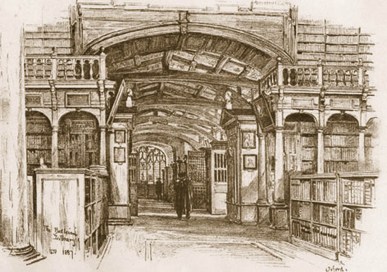
R.R. Bolgar, The Classical Heritage and Its Beneficiaries (p. 9):
The works of a number of major writers have been examined from this point of view, and we are in a position to form a clear picture of the classical reading of Alcuin, John of Salisbury, Dante, Chaucer, Rabelais, Ronsard, Spenser, Shakespeare, and Ben Jonson, to name only a few. Caution, however, is very necessary. If a man quotes a passage, he has read it; but we must not assume that he has read the work in which it occurs. Quotations were often taken second-hand from grammar books. The researches of C.K. Ullman have revealed that anthologies contributed largely to the classical knowledge of medieval scholars; and everybody has been aware for a long time now that many of the Renaissance pundits, like Rabelais and Ben Jonson, similarly derived the greater part of their erudition from popular handbooks. Nor can we accept without reserve the claims made by individuals that they or others had read certain classical authors, for no medieval or Renaissance writer is altogether free from the minor vice of exaggeration.
“Remember that you are an actor in a drama, whatever kind the playwright desires. If he wishes it to be short, it is short. If he wants it to be long, it is long.
If he wants you to act as a beggar, act even that part seriously. And the same if you are a cripple, a ruler, or a fool. This is your role: to play well the part you were given. It is another’s duty to choose.”
Teles the Philosopher, On Self-Sufficiency (Hense, 5)
“Just as a good actor will carry off well whatever role the poet assigns him, so too a good person should manage well whatever chance allots. For chance, as Biôn says, just like poetry, assigns the role of the first speaker and the second speaker, now a king and then a vagabond. Don’t long to be the second speaker when you have the role of the first. Otherwise, you will create disharmony.”
“There will soon be a time when the tragic actors will believe that their masks and costumes are their real selves. You have these things as material and a plot. Say something so we may know whether you are a tragic actor or a comedian. For they have the rest of their material in common [apart from the words]. If one, then, should deprive the actor of his buskins and his masks and introduce him to the stage as only a ghost, has the actor been lost or does he remain? If he has a voice, he remains.”
“Emanuel Chrysoloras, who first brought Greek literature back to Italy seven hundred years after it had been driven out by various barbarian invasions, was endowed with such humanity of liberal intellect in his teaching, that his famous image seems worthy of being placed first among the images of Greeks of exceptional merit, although no monuments of his weighty learning remain except some rules on the art of grammar. He was an indefatigable teacher, but he is open to the charge of having been lazy in writing, since the other part of the glory which we have chosen was sought by his useful profession.
He was sent from Byzantium by the emperor John to seek aid for Greece, which was on the verge of collapse, by pleading with all of the kings of Europe. He completed this task with such diligent traveling that he finally stopped in Italy when Greece was liberated from fear, since Tamerlane – the terror of the East – had captured alive near Mount Stella the Ottoman sultan Bayezid I (who had received the epithet of “Lightning” from the incredible swiftness of his movements). And so Chrysoloras, delighted that Greece had been freed from such an awful enemy, first in Venice, then in Florence, Rome, and finally in Pavia, which was under the rule of Giangaleazzo Visconti, managed to excite such a zeal for Greek literature that there sprang from his school minds worthy of the highest honor which on that account will never perish. Among these were Leonardo Bruni, Francesco Barbaro, Francesco Filelfo, Guarino Veronese, and Poggio Bracciolini. Later, when the synod which was called for resolving the controversy surrounding the pseudo-pontificate roused with desire to see such a spectacle, when Baldassare Cossa was deposed. Chrysoloras died in Constance. Poggio Bracciolini decorated his tomb with these lines:
‘Here lies Manuel Chrysoloras, the ornament of the Attic tongue, who came here to seek help for his afflicted country. Italy, this was a fortunate event for you, for he restored to you the grace of the Greek language, so long hidden. This was a fortunate event for you, Emanuel, for you found on Italian soil the honor which Greece never gave you – Greece, ruined in war.'”
“That man did not have this kind of strength and proud spirit
As I learn from those who came before me
Who saw him turning back the Lydian cavalry’s teeming ranks
On the Hermion plan, a man with an ash-spear in his hand.
Pallas Athena never carped at his heart’s
Rushing strength when he sped into the front-fighters,
In the clash of the bloody war,
Disappointing his enemies’ bitter bolts.
For not one of his opponents was a better man
At facing the work of powerful war,
When he [went] like the rays of the sun…”
This poem is not one of the best attributed to Mimnermus, but it has an a few interesting images and some instructive hapax legomena [“words that occur only once”]
1. A hapax legomenon [word only occuring once]: φερεμμελίην, “ash-spear” wielding”
2. ἀμεινότερος: a double formation, adding the comparative suffix –oter– to the irregular comparative ameinôn
3. Most editions have ὠκέος ἠελίοιο in the final line. I prefer εἴκελος because it works better with the dative αὐγῆισιν
“You know how I eat, and even how I sleep – no fortune could ever persuade me to add anything to these. Rather, I subtract a little every day, and it has reached the point now that only a little bit can be subtracted. Even if some royal fortune befell me, it could not drive frugality from my table or drive me to look for more sleep at night. My bed never holds me if I am healthy and awake, and I never toss in the sheets unless I am sick or sleeping. As soon as sleep departs from me, I depart from the bed, and I will lie enough or even more than enough on a bed of earth or rock.
Thinking about it, I hate my bed and I never return to it but at the urging of necessity, but soon I sense that I am freed from it as from the chains of nature, and without delay I rip myself out of it and flee to the closest library as though it were a citadel. This divorce occurs between me and my bed in the middle of the night: if by chance a shorter night or some late hours drag on, yet certainly dawn never sees us together. Finally, I strive with all my heart to prevent anything from coming between me and my more pleasant concerns, except that which the necessity of nature extracts from me in an imperious way – I mean things like sleep, food, and the short and honorable solace which is just enough for relaxing the body and replenishing the spirit.”
Victum meum nosti, somnum quoque; his ut addam, nulla michi unquam fortuna suaserit; demo potius aliquid in dies, iamque eo perventum est ut modicum demi possit; denique non si regie opes advenerint, aut e mensa frugalitatem pellere poterunt aut in cubiculum longos somnos arcessere. Nunquam me sanum ac vigilem lectus habet, nunquam nisi eger aut dormiens stratis versor; simul et me somnus et ego lectum desero, et somnum morti et lectulum busto simillimum duco. Cum supremus sopor obrepserit, satis superque satis in cubiculo terreo seu saxeo iacebimus; id meditans lectulum meum odi et ad illum nisi urgente necessitate non redeo, sed ab illo mox ut me nature vinclis explicitum sentio, incuntanter avellor inque bibliothecam illi proximam velut in arcem fugio. Fit hoc inter nos media nocte divortium, quod siquando forte vel nox brevior vel vigilie longiores traxerint, at profecto nunquam simul aurora nos invenit; postremo modis omnibus nitor nequid melioribus curis interveniat, preter id solum quod imperiose necessitas nature exigit, somnum dico et cibum et breve honestumque solatium vegetando corpori refovendoque animo duntaxat ydoneum. Id enimvero quia pro varietate temporum ac locorum variari oportet, et quale michi nunc sit nisi audias nosse non potes, dicam. Amo solitudinem ut soleo sectorque silentium nisi inter amicos, inter quos nemo me loquacior, hanc reor ob causam quod amicorum presentia solito rarior nunc est; raritas autem desiderium accendit. Sepe igitur annuum silentium diurna loquacitate compenso rursumque amicis abeuntibus mutus fio; importunum negotium cum vulgo loqui aut omnino cum homine quem non amor tibi seu doctrina conciliet.
“The things that Homer says about Kirkê contain a wonderful theory about the soul. The interpretation runs as follows:
Some have the heads, voice, head and skin of swine, but the mind remains constant as it was before. This myth is similar to the riddle about the soul presented by Pythagoras and Plato, that it is indestructible in nature and unseen but that it is not safe from harm or unchangeable. In what is called its destruction or death, it undergoes a change and then a transference into different kinds of bodies pursuing an appearance and fit according to pleasure, by similarity and practice to how it lived life. In this, each person draws a great advantage from education and philosophy, since the soul has a memory of noble things, judges the shameful harshly, and is able to overcome the unnatural pleasures. This soul can pay attention to itself, and guard that it might not accidentally become a beast because it has grown attracted to an hideously shaped, unclean body regarding virtue, a body that excites and nourishes uncultured and unreasoning nature rather than increasing and nourishing thought.
“Once the soul is translated, that which is fated and nature, which Empedocles named the divine force that “wraps us in a foreign robe of flesh”, also re-fits the soul. Homer has named this circular journey and return of rebirth Kirkê, the child of the sun because the sun binds every destruction to birth and every birth in turn to destruction, always weaving them together. The Island Aiaia is also that place allotted to receive one who dies—where the souls first arrive as they wander, and suffer alienation as they mourn and they do not know which way is west nor “where the sun which brings mortals light comes upon the earth”.
As they long for their habits of pleasure—their shared life in the flesh and their way of life with the flesh—they provide the draught with its character again: it is the drink where birth is mixed and stirs together what is truly immortal and mortal, the thoughts and sufferings, the ethereal and the earthbound. The souls are enchanted and weakened by the pleasures that will lead them back to birth again. At this time, souls require great luck and great wisdom in order to avoid pursuing their worst aspects or passions and dedicate themselves to a cursed and beastly life”.
For it is right that it is called and considered a crossroad in the underworld around which the parts of the soul split: the rational, the emotional, and the desirous. Each of these produces a force or an inducement to the life appropriate to itself. This is no longer myth or poetry but truth and a story of nature. In this transformation and rebirth, when the aspect of desire overpowers and takes control, [Homer] is claiming that because of the dominance of pleasure and gluttony, they transform into the bodies of donkeys and pigs and receive unclean lives on the ground. The interpretation runs as follows.
Whenever a soul has an emotional component that has grown completely savage because of harsh rivalries or murderous savagery developing from some disagreement or vendetta, that soul finds a second birth which is full of bitterness and angry thoughts and falls into the shape of a wolf or a lion, embracing this body as if it were a tool of vengeance for his controlling passion. For this reason, one must keep clean when near death as if for a religious rite and restrain from every kind of base pleasure, put every harsh emotion to bed, and to withdraw from the body by suppressing envies, enmities, and rages down deep. This “Hermes of the golden-staff” happens to be that very reasoning which indicates clearly the good and either wholly restrains or saves it from the deadly draught should it drink—it preserves the soul in a human life and character for as long a time as is possible.”
Isaac Casaubon, Letter to Claude Saumaise (DXLIII)
“I received your letters, and the ancient epigrams which you added. How can I show my gratitude for these? To be sure, you can guess how grateful I am from my almost shameless petition for them. So, I’m ashamed of myself for giving you so much vexation. I do not understand the method and aim of your studies. And so, believe me, I am concerned about you and your health – I think of you as a brother. I exceed you in age, but you have outstripped me with the miraculous gifts which instilled in me long ago a marvelous expectation for you. Just spare your intellect, have some concern for your health, enjoy the joy of your age and preserve yourself in this, your youth, so that you can when you are older complete those studies which cannot be completed except by you.
I seem to see you like Tantalus in the middle of the water, for you cannot enjoy all of the riches of the Palatine Library. I can sense your avidity from your letters, and I also know with what violent force you are driven on to your studies. This makes me fear for your little body. Otherwise, I will write at another time about the poems which you sent – now I am extremely busy. If you see the [???] of Bongars, you will know from it what my cares are. For I have set aside my Polybius for the meantime. Farewell, my dearest friend.”
“Helios was allotted labor for all days–
He and his horse never have
A break after rosy-toed Dawn
Leaves Ocean and ascends the Sky.
A curved, much-loved bed carries him
Across the waves, crafted by Hephaestus’ hands
Made of dear gold, with wings, he deeply sleeps
Above the water’s surface, from the land of the Hesperides
To the Ethiopians’ home, where his chariot and horses
Wait until dawn arrives, newly-born,
When Hyperion’s son climbs into his second car…
“The fact is that if you remove the ties of goodwill from our world, no house or city can stand tall nor can even agriculture persist! If this is less intelligible, one can perceive how powerful friendship and harmony are from the impact of disagreements and disharmony. What house is so stable or what state is so strong that it cannot be upended by hatred and division?”
Quod si exemeris ex rerum natura benevolentiae coniunctionem, nec domus ulla nec urbs stare poterit, ne agri quidem cultus permanebit. Id si minus intellegitur, quanta vis amicitiae concordiaeque sit, ex dissensionibus atque discordiis percipi potest. Quae enim domus tam stabilis, quae tam firma civitas est, quae non odiis et discidiis funditus possit everti?
Plato, Euthyphro 7c
“So if we were disagreeing about whether something was bigger or smaller, we’d turn to actual measurement to resolve our disagreement?”
“If we dispute about a fact, Cato, you and I can have no disagreement! There’s no difference between what you believe and I do when we compare the facts themselves once the words have been changed.”
Si de re disceptari oportet, nulla mihi tecum, Cato, potest esse dissensio; nihil est enim de quo aliter tu sentias atque ego, modo commutatis verbis ipsas res conferamus
Pindar, Dirges Fr. 131b [= Plut. consol. ad Apoll. 35.120C]
“Every human’s body is a servant to death–
Yet a shadow of life goes on living still.
This part alone
Comes from the gods. It sleeps while our limbs move
But when we sleep it shows us
in multiple dreams a choice of things to come,
Some of pleasure, some of pain.”
“When Persephone has taken the payment for that ancient pain,
From people, after nine years she gives their souls back
To the light of the sun above and from them come
Proud kings and men fast in strength and best in mind
And people call them holy heroes
for all that remains of time.”