“Antonius was an Egyptian by birth, of good parents who had gotten hold of enough wealth to make them self-sufficient, and since they were Christians, he himself was brought up as a member of that sect. Being a child, he was brought up by his parents, not knowing anything except them and their household. But when the boy was growing, and on the verge of leaving his youth, he did not suffer to learn his letters, with the intention of remaining estranged even to the other children. He possessed an all-consuming passion, as was written of Jacob, to live wholly uncultured in his own house. He was, to be sure, raised with his parents in the Lord’s House. And he did not simply play around as a child, nor as he advanced through his youth did he grow haughty; rather, he always obeyed his parents and attended to their lessons, and paid careful attention to the profit which he received from them. Nor again, as a child brought up in a fairly rich family, did he bother his parents for fancy and expensive food, nor did he seek pleasure from it. He was satisfied with what he came upon, and sought nothing more.”
“’Jerome was, in addition to the merit of his faith and the gift of his virtues, educated not just in Latin and Greek, but even in Hebraic literature, to such an extent that no one would dare to compare themselves to him in any field of knowledge. I would be surprised if he is not known to you through the many works which he has written, since he is read all around the world.’
The Gaul responded to me, ‘Oh, he is all too well known to us. About five years ago I read a certain little book of his, in which the whole nation of our monks is hassled and reproved by him. And a Belgian friend of mine often gets angry because Jerome said that we are accustomed to feed until we vomit. I would give him a pass on it, however, and I think that he was talking more about eastern monks than those in the west, since a fondness for eating is considered gluttony among the Greeks, but among us Gauls it is just nature.’”
uir enim praeter fidei meritum dotemque uirtutum non solum Latinis atque Graecis, sed et Hebraeis litteris ita institutus est, ut se illi in omni scientia nemo audeat conparare. Miror autem, si non et uobis per multa quae scripsit opera conpertus est, cum per totum orbem legatur.
Nobis uero, Gallus inquit,nimium nimiumque conpertus est. nam ante hoc quinquennium quendam illius libellum legi, in quo tota nostrorum natio monachorum ab eo uehementissime uexatur et carpitur. unde interdum Belgicus noster ualde irasci solet, quod dixerit, nos usque ad uomitum solere satiari. ego autem illi uiro ignosco, adque ita sentio, de orientalibus illum potius monachis quam de occidentalibus disputasse. nam edacitas in Graecis gula est, in Gallis natura.
“Listen, put your mind now on true reason.
For a new matter rises fiercely to meet your ears
and a new image of the universe strives to show itself.
Nothing is so simple that at first sight
it is not rather difficult to believe;
and in the same way nothing is so great or miraculous
that over time we don’t slowly fail to behold it with wonder.
Consider first the clear and pure color of the sky
and everything it holds, the wandering stars
the moon and the gleam of the sun with its bright light;
If suddenly mortals now saw all these things
for the first time with no prior experience of them,
could anything possibly be said to be more wondrous
or would the races of men have dared to believe they existed?
Nothing. I believe that is how striking the sight would be.
But now, since we are so used to seeing them,
no one thinks it worthwhile to gaze at heaven’s bright splendor.”
Nunc animum nobis adhibe veram ad rationem.
nam tibi vehementer nova res molitur ad auris
accedere et nova se species ostendere rerum.
sed neque tam facilis res ulla est, quin ea primum
difficilis magis ad credendum constet, itemque
nil adeo magnum neque tam mirabile quicquam,
quod non paulatim minuant mirarier omnes,
principio caeli clarum purumque colorem
quaeque in se cohibet, palantia sidera passim,
lunamque et solis praeclara luce nitorem;
omnia quae nunc si primum mortalibus essent
ex improviso si sint obiecta repente,
quid magis his rebus poterat mirabile dici,
aut minus ante quod auderent fore credere gentes?
nil, ut opinor; ita haec species miranda fuisset.
quam tibi iam nemo fessus satiate videndi,
suspicere in caeli dignatur lucida templa.
Cicero, Oratore II 14 (Cicero is not the speaker here…)
“What, then? There is something else still, I will admit, that, as when I walk in the sun—even if I am doing so for some other reason—I still grow darker by nature. Something similar happens when I eagerly read those books at Misenum—for Rome scarcely allows it. I sense that my own speaking takes own a new appearance from this contact. But, so that this does not seem too general to you, I understand only those things contained within Greek works which their very authors conceded the common people to understand.
When by chance I come upon your philosophers, led astray by the titles of their books which are titled with common and famous names—on virtue, justice, goodness, pleasure—I do not understand any word: they are so bound up in precise and abbreviated argumentation. I don’t even try to manage the Greek poets at all since they speak an entirely different language. No, I lose myself, as I have said, with those who write histories or present speeches which they wrote, or who speak in a what that they don’t seem to wish that we be the most well educated men, but merely conversant.”
Quid ergo? Est, fatebor, aliquid tamen: ut, cum in sole ambulem, etiamsi aliam ob causam ambulem, fieri natura tamen, ut colorer: sic, cum istos libros ad Misenum (nam Romae vix licet) studiosius legerim, sentio illorum tactu orationem meam quasi colorari. Sed ne latius hoc vobis patere videatur, haec duntaxat in Graecis intellego, quae ipsi, qui scripserunt, voluerunt vulgo intellegi. In philosophos vestros si quando incidi, deceptus indicibus librorum, quod sunt fere inscripti de rebus notis et illustribus, de virtute, de iustitia, de honestate, de voluptate, verbum prorsus nullum intellego: ita sunt angustis et concisis disputationibus illigati. Poetas omnino, quasi alia quadam lingua locutos, non conor attingere: cum his me (ut dixi) oblecto, qui res gestas, aut qui orationes scripserunt suas, aut qui ita loquuntur, ut videantur voluisse nobis, qui non sumus eruditissimi, esse familiars…
Philodemos, On Piety (ed. Gompertz), 92, 24; p. 43
“Epimenides also says that the Sirens were born from Okeanos and Gê. He adds that Proteus once prophesied to them that if anyone was not enchanted by them, then it would be their death. When Odysseus sailed past them, they threw themselves from a cliff and died.”
This is actually more complicated than it seems. What does “come sail away mean?” Is it a command? Is it to one person or many. To one, ἄγε τ᾿ ἀπόπλει ἄγετε τ᾿ἀποπλεῖτε
(I put an “epic te” in there to avoid elision. I wanted a δή for assertion)#ComeSailAway 2/
[I kept the uncontracted form to stay Homeric and because the contraction sucks]
I actually think that the hortatory subjunctive is what's called for in the song. Right, "Come, sail away with me" It is a plea, not a demand…#ComeSailAway 4/
“The Sirens were some Greek women with beautiful voices in ancient Greek myth who sat on some island and so delighted passers-by with their euphony that they stayed there until death. From the chest up they had the shape of sparrows but their lower halves were woman.
The mythographers claim that they were small birds with female faces who deceived passers-by, beguiling the ears of those who heard them with pornographic songs. And the song of pleasure has no end that is good, only death.
But the true story is this: there are certain places in the sea, narrowed between hills, which release a high song when the water is compressed into them. When people who sail by hear them they entrust their souls to the water’s swell and they die along with their ships.
The creatures who are called Sirens and Donkey-centaurs in Isaiah are some kind of demons who are foretold for abandoned cities which fall under divine wrath. The Syrians say they are swans. For after swans bathe, they fly from the water and sing a sweet melody in the air. This is why Job says, “I have become the Sirens’ brother, the companion of ostriches. This means that I sing my sufferings just like the ostriches.”
He calls the Sirens strouthoi, but he means what we call ostriches [strouthokamêmlos: “sparrow-camel”]. This is a bird which has the feet and neck of a donkey. There is a saying in the Epigrams “that chatter is sweeter than the Sirens’”. The Sirens were named Thelksiepeia, Peisinoê, and Ligeia. The Island they inhabited was called Anthemousa.”
“The Sirens were either loud-voiced birds on the shore or bewitching and deceptive women; or this is flattery. For they bewitched, deceived, and drove many to death.”
Editorial note: in response to an earlier post about the exclusionary character of the history of Classical Studies several people commented that the views were almost exclusively Anglo-American. This is the first of hopefully several posts addressing that narrow perspective. –JPC
Dimonisos, the Halkedonian island, took its name from Dimonisos, the first one who worked there; the place has mines of steel and malachite. The best from this mine commands prices comparable with gold; for it is a drug for the eyes. There is also copper to be dived for, two fathoms in the depth of the sea; from there is made the statue in the ancient temple of Apollo in Sicyon, and also those in Pheneus, called from yellow-copper. On them there’s an inscription: “Heracles, son of Amphitryon, dedicated these on capturing Elis.” He captured it under the guidance of a woman, whose father Augeas he had killed, in accordance with the oracle. Those who dig for copper become very able-sighted, and those who have no eyelashes grow them; therefore doctors also use the blossom of copper and Phrygian ash for the eyes.
Pseudo-Aristotle, de Mirabilibus Auscultationibus, 58 (Loeb)
A recent post on the blog, discussed at length (once again) the efforts of decolonization in the field of Classics, a conversation that, though not as widespread as we would like, has occupied some of us for a while. There is an ongoing debate on the use of Western civilization and its relationship to Classics—why is an area study of a rather small part of the ancient world even called classical? Is it about class?—that has indeed traveled far this year, all the way to the darkest corners of the alt-web.
But one of the main caveats in this complex, longer-than-a single-life task, has been in my opinion, the heavy reliance on Anglo-Saxon sources and discourse; I pointed this out to Rebecca Futo Kennedy about her blog post on the history of Western civ, and more recently, to that post on this blog. There’s a wealth of sources in other European languages that we can turn to, in order to understand better the symbolic violence of the Western historical discourse. So, on this occasion I want to turn your attention to an “imperialist other”, a territory (and today a national state) outside of the Western world, but yet at its very borders and part of the geography of the ancient world, to further complicate the relationship between westernization, classical culture and imperialism.
In the Turkish Republic (1923-present), classical culture never played the same kind of pivotal role that it plays in European public life, but its emergence in the early days of the republic (and subsequent eclipse) provides an idea of the depth of interactions between modernization, westernization, archaeology, classical culture and nationalism that shaped the world between the world wars.
As the Turkish Republic emerged from a War of Independence in the course of which the Christian minorities of Anatolia (including its Greek speakers, dating back to the archaic period) were forcibly deported or murdered with the nodding approval of the Western powers wishing to draw a new map of the post-Ottoman Middle East (Muslims, on the other direction, were also murdered and deported in a series of population exchanges between Turkey and Greece), the Greek presence in Anatolia came to an abrupt end. At the same time, however, that the young republic was looking West and not to the “Middle East” (considered backward, ‘Arab’, Islamic) in order to disavow its Ottoman heritage. Modernization is in full force for Turkey to join the community of European nations, and many reforms in the field of education, language and heritage take place. Soon we will find out what Classics has to do with this.
In what follows I will share some anecdotes, documents and sources that are more or less scattered, as the research is still very preliminary, and since Classics and Turkish modern history (not exactly my field) are not necessarily contiguous, I am venturing here into unknown territory; but it will be enough to give an idea of a process that needs to be studied more closely (I wonder for example about the modern reception of Classics in Israel, or the Arab world). I apologize in advance for my incomplete ideas.
The Princes Islands, 2015
As a resident of the Princes Islands, Istanbul’s most remote neighborhood in the Marmara Sea, a group of nine islands known to be inhabited by Greek-speaking population since at least the 4th century BCE (attested in a pseudo-Aristotle), and still one of the very last pockets of a ghostly Greek presence in Anatolia, it has become almost a matter of necessity to dig out these submerged histories, to see if they can shed some light on the absurdities of the present. As the ‘Rums’—the Romans or Greeks of the Eastern Roman Empire—were being driven out (see the novel ‘Farewell, Anatolia!’ by Dido Sotiriou, a moving but by no means objective account of this period), Turks would travel far back in history, seeking for a new mythology once the owl of Minerva had flown away.
Greek during the Ottoman Empire
It is traditionally argued that the end of the Byzantine Empire translated into a death sentence for Greek culture in the Near East, but this was hardly the case. As many historical studies show, though Greeks were a minority, they were ubiquitous throughout the new empire, and adapted rapidly to the sloppy, chaotic and often inefficient Ottoman rule.
We don’t know so much about the Greek educational institutions of the early Ottoman empire, but some schools are thought to have transitioned from one rule to another and survived, and the Phanar Greek School, for example, was founded in 1454. A number of Greek libraries were founded under Ottoman rule, but most remarkable was the library of the Holy Trinity monastery of Halki (our island, known in Turkish as Heybeliada) founded by Metrophanes III in the early 16th century with the donation of 300 books, to be found today in the library of the Ecumenical Patriarchate. A French research project is centered on the history of the library and a critical edition of the manuscripts of the library has been published in French just last month. The Greek scholarship of this long period is rich and vibrant, and most literature of importance written in Greek in this period was written outside of Greece: Istanbul, Venice, Alexandria, Smyrna.
Holy Trinity of Halki, 2019
Knowledge of Ottoman would be handy here, but we know from the writer and translator Yasmine Seale’s piece on the reception and translation of Homer in Turkey that the first translation of the Iliad into Ottoman Turkish was done in 1886 by Naim Frashëri. A relatively recent text on the history of classical philology in Turkey (Turkish) puts us in the context of what took place in Istanbul University (founded in 1453) in the 19th century: With the reforms of 1869, arrived in the university courses in Greek, Latin, archaeology, numismatics and Roman law, and then followed by more offerings in Greek and Latin literature, mythology and archaeology in 1874.
This wasn’t haphazard: As the colonial powers began their journey into the collapsing empire through technology and education, German professors of classics arrived in Istanbul University at the same time that authorized European excavations in all the Ottoman lands would begin a frenzy of looting and exporting that not only would enable some of the most groundbreaking discoveries in Near Eastern studies, but would also solidify the modern Western museum, where vast holdings from the region still sit today. The redistribution as appropriation began with the past, and then expanded to the denizens of the present.
The Turkish History Thesis and the Early Republic
The early history of the Turkish Republic presents a picture of confusion. Being a late comer in a world of (already fading) nation states, it was necessary to produce not only a myth that could unify them but also a grand(iose) narrative that would smooth out any gaps, and it is here that archaeology proves useful. As Turkish scholar Tugba Tanyeri-Erdemir argues, “archaeological knowledge was used to create citizens out of subjects of the fallen Ottoman Empire. […] Under the leadership of Mustafa Kemal Atatürk, the founder and first president of the Republic, the intelligentsia of this newly formed Turkish nation embarked on a quest to discover its ancient history.”
This discovery, known as the Turkish History Thesis and the basis of official historiographical ideology, would of course inevitably lead back to the Hittites: “According to the thesis, the Turks were believed to be the direct ancestors of the Hittites and the Sumerians, and were also thought to have influenced native peoples living in the Aegean Basin, this contributing significantly to the development of Greek civilization. This theory allowed the Turks to claim to be the legitimate heirs (and indeed, practically the progenitors) of all civilizations that had existed previously on the soil of the new Turkish Republic.” (Tanyeri-Erdemir)
It would be of course impossible to travel back into the 2nd millennium BCE without a fair amount of conspiracy. Pan-Turanism, appears in the 19th century as a theory, largely discredited, that all Turkic and Uralic peoples descend from a pre-historic common ancestor in Turkestan, who in the modified republican version, migrated to Anatolia in the 2nd millennium. The typology is interesting because of a detail highlighted by Tanyeri-Erdemir: Between the first and second Turkish historical congress (attended by Atatürk) there’s a shift in mood and audience, from nationalistic archaeology to professional archaeology. In the years between these meetings, there was also a language congress during which Turkish linguists presented the Sun-Language Theory, with the thesis that many languages descended from Turkish after a series of migrations from Central Asia, and their mythical proto-language was severely criticized by the international audience.
The relationship with the Turkish History Thesis is here crystal clear, and though the focus moved to archaeology’s modernization, the discourse had already penetrated the Turkish historiographical consciousness. The thesis of the Altaic languages, encompassing Turkic, Mongolian and Manchu-Tungus, has also been discredited since then.
Another Turkish scholar, Can Erimtan, has written an incredible account (and I strongly advise you to read all of it) of the propaganda tract “Pontus Meselesi” (1922), by Ağaoğlu Ahmet Bey, a Turkish politician and publicist of Azeri background, dealing with the (argument against) establishment of a Greek state in the Pontus region, combined with nationalist propaganda about the grand narrative of the Turkish presence in Anatolia, as follows: “[Anatolia] has been the Turk’s home country, the Turk’s homeland for thousands of years. […] As a matter of fact, the Turks did not arrive in Anatolia with Ertugrul Gazi or even with those who constituted the Seljuk governments. The Turkish race has been present in Anatolia since the oldest and most unknown of times. As has been illustrated by history the first inhabitants of Anatolia were Turanians.”
Ataturk and the Sumerians, 2012
There’s so much one would like to say here. Archaeology is deeply embedded in the political geography of Turkey, but the readings are currently ambiguous. There’s still a large apparatus of scholarship on Near Eastern studies in the Turkish language, particularly in Hittite. Nazif Aydin published in 2017 a Hammurabi lexicon and a book by Assyriologist Muazzez İlmiye Çığ, “Ataturk and the Sumerians”, was published as late as 2012.
Classical Philology in Turkey
Textbook for learning Classical Greek in Turkish, first published in 2006
The nationalist narrative obviously couldn’t easily disassociate between Classical Greece, the Greece of Anatolia and the newly emptied out and newly mythical Anatolia. According to Bedia Dirimiş‘s text (Turkish) on the history of classical philology in Istanbul University, Classics is defined as such: “The main purpose of classical philology is Ancient Greek and Roman civilization, paleography, grammar and rhetoric. On the basis of reinterpreting ancient texts from a linguistic and literary point of view, there is a perfect reconstruction of these texts.”
Written only in 2009, this reveals the European bias of the discipline, not only as an apparatus of knowledge, but one strictly separated from the historical continuity of Anatolia. In her account, classical philology as a department appears in Turkey with the university reform of 1933, overseen by Atatürk himself (just like the history and linguistics conference, he’s always at the helm of historiographical ideology), after his first visit on January 15, 1930. Here the young republic’s leader reveals the extent to which the history of the region had been permeated by the question of Anatolia’s past. Atatürk asked a question (recorded in the writings of Mehmet Uysal, 1981): Why is it important to study classical philology in Turkey?
After he wasn’t satisfied with the answer, he asked a different question: Who are the first people of the Aegean, the bearers of the Aegean civilization? Fazil Nazmi Bey (probably a teacher in the department) answered the question with a legend. Atatürk replied: “History is based on the findings of archaeology, paleography, and philology, not myths. I think history shows that the first Aegean people, the bearers of the Aegean civilization came from Anatolia to the Aegean islands.”
With this, the agenda for classical philology in Turkey was set, so that Dirimiş reports in her brief history that as late as 2005, in an academic conference, a professor confirmed this thesis by means of philological and paleographic evidence. And here comes the bomb: “Since the Tanzimat, we have adopted Western civilization as the basis of humanism, human beings at the center of the world, rather than merely imitating the discipline of classical philology.” It has been a long way from pre-historic Turan, to humanism. The humanism of the Enlightenment that whitewashed the ancient world, and provided ample legal justification for the plunder of the earth, so that all universal treasures are kept in one place, for all the universals to see, except when you’re not universal enough.
It is also hard to assess the larger meaning of civilization in a country such as Turkey, living in the no-longer-and-not-yet of globalization, and adopting a postcolonial identity while at the same time remaining an expansionist state, actively engaged in soft power and economic colonization. The depoliticization of the Greek tradition (and the Romans, almost accidentally) is only matched by the hyper-politicization of remote antiquity, from a time when Hittite hadn’t been more fully deciphered, therefore it was possible to make all kind of questionable speculations.
The classical philology, however, that Dirimiş posits as “an education that provides an awareness of the process of spiritual evolution through its history”, is however no longer a part of the grand narrative of the republic. In what follows in her history, there’s a long list of professors, from the first German appointees (including Jews who sought refuge in Turkey during the war and later returned to Europe; this is also discussed in Seale‘s account) through the later Turkification of the department as they received training from earlier teachers. Seale also speaks about Azra Erhat, an early republican translator of Homer, whose life seems fascinating and about whom I haven’t been able to dig anything but vague references. It is also interesting to notice that at least one academic employed by Ankara University was also an instructor of Latin at the Atatürk Lise (high school) during the early republic but I have no evidence at the moment of when this began or ended, or whether it also took place in other public high schools.
Decolonization of Classical Greek in Turkey
A question needs to be posed before it can be answered. Broadly speaking, Turkish academia is not thinking about decolonization of Classics. Still, there are some interesting examples of decolonization practices happening outside of the academia. The Theological School of Halki, an Orthodox seminary shut down by the Turkish state in 1970s (this has been long disputed and is a frequent topic of Turkish-Greek relations) but it still houses the library founded by Metrophanes III (although the original 300 manuscripts are elsewhere in Istanbul), that is open to researchers and contains thousands of volumes in philosophy, history and theology, mostly in Greek but also in other languages.
Despite the enforced closure, the building (located also in Heybeliada) hosts events and academic conferences regularly. The Greek-language publishing house Istos, founded in 2012 in Istanbul (as the local Greek newspaper was disappearing) and the first Greek-language publisher in Turkey in half a century, publishes books in Greek and Turkish, including history books dealing with the history of Greeks in Anatolia and books aimed for a younger audience introducing them to classical Greek literature in Turkish. Recently Istos published an English translation of Skarlatios Byzantios 19th century book, “Constantinople”, topographical, historical and archaeological description of the city.
From “The Land Across the Blind”, Galeri Mana, 2014
Greek-Armenian artist Hera Büyüktaşçıyan, herself an islander, has been engaged in decolonization throughout her practice. In her work, largely informed by Classical and Byzantine eras, she has used visual compelling storytelling, iconography, and deep memory-time and traces, to parse fragile moments in the history of the region and reveal the continuity between text and image, past and present, in different contexts that go beyond the boundaries of the city: an aqueduct in Naples, a cave in Athens, or bringing metaphorically the city of Bergama to an exhibition space Berlin, questioning the Pergamon museum, engaged in extended contemporary readings of Greek (and other languages) across eras.
In an exhibition from 2014, “The Land Across the Blind”, the artist creates a magical journey between the Princes Islands—traditionally places of exile— and the San Lazzaro degli Armeni in Venice (another island), traveling between centuries of displacements. The land across the blind is Byzantion, the city founded by Byzas of Megara, lying across from Khalkedon, the place that Persian general Megabazos is recorded to have said that they had to be blind to settle there: “Must we not be blind not to see this? This is the land across the blind. This place that we see every day is the point at which Byzas begins to see!” (Buyuktasciyan)
The Greek-Armenian artist is also responsible for the programming of the Galata Greek Primary School in the central district of Beyoglu, a building now empty as the student population disappeared already decades ago, now being used as cultural institution hosting exhibitions and cultural events; a last attempt to keep alive the faint memory of the long Greek presence in Istanbul. Most recently, Buyuktasciyan opened an exhibition at the IFA Gallerie in Berlin, “Neither on the Ground nor in the Sky”, making reference to the mosaic of an Alexandrine parakeet from Pergamon, held at the museum in Berlin. In the exhibition, the artist created a historical bridge between different historical periods, from the famous Library of Pergamon once at the Acropolis, to the final exile of the Anatolian Greeks. As a part of the public program of the exhibition I gave a lecture/performance in April in Berlin, during which I read poetry of Seferis in both Modern Greek and English, in reference to ruins and the life of stones.
From “Neither on the Ground nor in the Sky”, IFA Gallery, 2019
Classical culture does have its representatives in Turkey, for example the very active department of Classics at Istanbul University regularly hosting events and talks, the Twitter account of a young classics lecturer, Cengiz Cevik, tweeting in Turkish about classical literature and ancient philosophy, or the Ancient Greek/Latin recitation competition held at Koc University. All of the above of course deeply embedded in the paradigm of white European humanism. The cultural programming of Türkiye Bankasi, includes a series devoted to translations of classical literature into Turkish, but with a very small pool of translators and a large yearly output, it still remains to be seen if the quality matches the expectations.
And the future isn’t quite looking bright. As the Turkish state turns more and more erratic and isolationist, recently the use of Greek or “Rum” as an insult has reappeared in public life in light of the convoluted Istanbul election, as the opposition candidate has been labelled a Pontus Greek in a propaganda effort to smear his name. A journey through the country’s provincial archaeological museums reveals the dismal picture of the current state of antiquities (where there’s any left, that is), and the neglect of Turkey’s Byzantine and Early Modern Greek heritage, crumbling in front of your eyes, like the Greek Orthodox Orphanage on the island of Büyükada, the largest wood structure in Europe and now at risk of collapse. The most apt metaphor I could find is that of a ruined ruin, based on a fragment of a poem by Seferis:
These stones that sink into the years, how far will they
drag me with them?
The sea, the sea, who can ever drain it dry?(*)
G. Seferis, Mythistorima, XX. (*) the poet translates into Modern Greek line 958 of Aeschylus’ Agamemnon, spoken to Clytemnestra as she lures her husband to death. (R. Beaton, 2016)
Αυτές οι πέτρες που βουλιάζουν μέσα χρόνια ως που
θα με παρασύρουν;
Τη θάλασσα τη θάλασσα, ποιος θα μπορέσει να την εξαν-
τλήσει;
Greek Orthodox Orphanage, Büyükada, 2019
Arie Amaya-Akkermans is a writer and art critic based on the Princes Islands of Istanbul. He is interested in the Greek heritage of the Asia Minor and the relationship between (pseudo)archaeology and nationalism in the Eastern Mediterranean. He’s also tweeting about Classics, Byzantium, contemporary art and Turkey/Greece.
This is a kind of argument deduced from connected notions: “If the highest praise must be given to piety, then you should be moved when you see Quintus Metellus grieving so dutifully”. And, as for a deduction from generalities, “if magistrates owe their power to the Roman people, then why impeach Norbanus when he depends on the will of the citizenry?”
Ex coniunctis sic argumenta ducuntur: ‘si pietati summa tribuenda laus est, debetis moveri, cum Q. Metellum tam pie lugere videatis.’ Ex genere autem: ‘si magistratus in populi Romani potestate esse debent, quid Norbanum accusas, cuius tribunatus voluntati paruit civitatis?’
Suetonius, Julius Caesar 1.30
“Others claim that he feared being compelled to provide a defense for the things he had done in his first consulate against auspices, laws, and legislative actions. For Marcus Cato often announced with an oath that he would impeach Caesar by name, as soon as he dismissed his army.”
Alii timuisse dicunt, ne eorum, quae primo consulatu adversus auspicia legesque et intercessiones gessisset, rationem reddere cogeretur; cum M. Cato identidem nec sine iure iurando denuntiaret delaturum se nomen eius, simul ac primum exercitum dimisisset
Accius, Fr. 598 (From Oedipus)
TEIRESIAS
“They impeach him voluntarily and they separate him
From his good fortune and all his wealth,
A man isolated, bereft, depressed and tortured”
Incusant ultro, a fortuna opibusque omnibus
desertum abiectum adflictum exanimum expectorant.
“Meanwhile in parts of Africa, Firmus made himself the king of the provoked tribes of the Moors and laid waste to Africa and Mauretania. He gave Caesarea, the noblest city of Mauretania which had been taken by fraud and then filled with murder and flames, to the barbarians as a prize. Then count Theodosius, the father of the Theodosius who later ruled as emperor, was sent by Valentinian and broke the tribes of the Moors, who were scattered after many battles. He drove Firmus, now afflicted and oppressed, to death. Afterward, when he had with the most knowing foresight returned all of Africa with Mauretania to their previous states, he received the order (thanks to provoking and clamoring envy) that he was to be executed. He chose to be baptized in Carthage in order to remit his sins, and after he attained the sacrament of Christ which he had sought, he cheerfully offered his neck to the executioner following a glorious life, and secure of the life hereafter.”
Interea in Africae partibus Firmus sese excitatis Maurorum gentibus regem constituens Africam Mauretaniamque uastauit; Caesaream urbem nobilissimam Mauretaniae dolo captam, deinde caedibus incendiisque conpletam barbaris in praedam dedit. igitur comes Theodosius, Theodosii qui post imperio praefuit pater, a Valentiniano missus effusas Maurorum gentes multis proeliis fregit, ipsum Firmum afflictum et oppressum coegit ad mortem. post cum experientissima prouidentia totam cum Mauretania Africam meliorem pristinis reddidisset, instimulante et obrepente inuidia iussus interfici, apud Carthaginem baptizari in remissionem peccatorum praeoptauit ac postquam sacramentum Christi quod quaesierat adsecutus est, post gloriosam saeculi uitam etiam de uitae aeternitate securus percussori iugulum ultro praebuit.
Edward Gibbon, The Decline and Fall of the Roman Empire XXXIII:
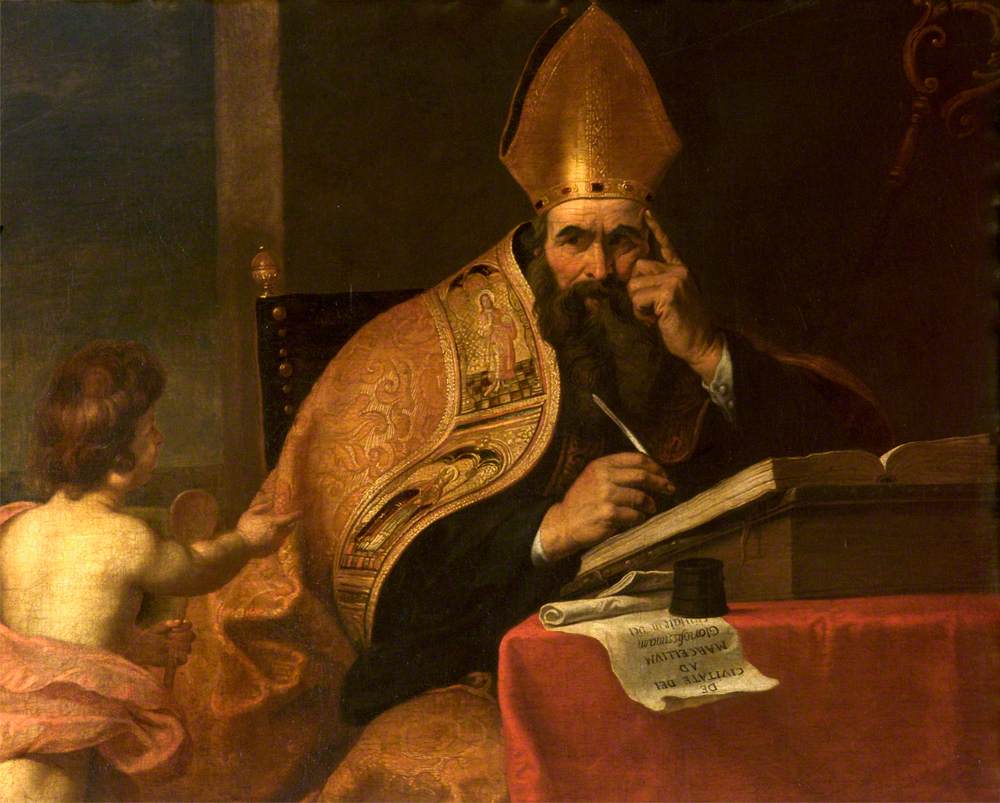
“The youth of Augustin had been stained by the vices and errors which he so ingenuously confesses; but from the moment of his conversion to that of his death, the manners of the bishop of Hippo were pure and austere: and the most conspicuous of his virtues was an ardent zeal against heretics of every denomination; the Manichaeans, the Donatists, and the Pelagians, against whom he waged a perpetual controversy. When the city, some months after his death, was burnt by the Vandals, the library was fortunately saved, which contained his voluminous writings; two hundred and thirty-two separate books or treatises on theological subjects, besides a complete exposition of the psalter and the gospel, and a copious magazine of epistles and homilies. According to the judgment of the most impartial critics, the superficial learning of Augustin was confined to the Latin language; and his style, though sometimes animated by the eloquence of passion, is usually clouded by false and affected rhetoric. But he possessed a strong, capacious, argumentative mind; he boldly sounded the dark abyss of grace, predestination, free will, and original sin; and the rigid system of Christianity which he framed or restored, has been entertained, with public applause, and secret reluctance, by the Latin church.”
From the Historia Augusta, on the two Maximini, IX
“In order to hide his low birth, he had everyone who knew about it killed—not a few of them were friends who had often given him much because of his pitiable poverty. And there was never a crueler animal on the earth, placing all in his strength as if he could not be killed. Finally, when he believed that he was nearly immortal because of the magnitude of his body and bravery, there was a certain actor whom they report recited some Greek lines when he was present in the theater which had this Latin translation:
Even he who cannot be killed by one is killed by many
The elephant is large and he is killed.
The lion is brave and he is killed
The tiger is brave and he is killed.
Beware the many if you do not fear the one.
And these words were recited while the emperor was there. But when he asked his friends what the little clown had said, they claimed he was singing some old lines written against mean men. And, since he was Thracian and barbarian, he believed this.”
IX. nam ignobilitatis tegendae causa omnes conscios generis sui interemit, nonnullos etiam amicos, qui ei saepe misericordiae paupertatis causa pleraque donaverant. neque enim fuit crudelius animal in terris, omnia sic in viribus suis ponens quasi non posset occidi. denique cum immortalem se prope crederet ob magnitudinem corporis virtutisque, mimus quidam in theatro praesente illo dicitur versus Graecos dixisse, quorum haec erat Latina sententia:
“Et qui ab uno non potest occidi, a multis occiditur.
elephans grandis est et occiditur,
leo fortis est et occiditur,
tigris fortis est et occiditur;
cave multos, si singulos non times.”
et haec imperatore ipso praesente iam dicta sunt. sed cum interrogaret amicos, quid mimicus scurra dixisset, dictum est ei quod antiquos versus cantaret contra homines asperos scriptos; et ille, ut erat Thrax et barbarus, credidit.
I am big. Really big. Everyone is saying that, not me. I mean, look how big I am.