War Crimes

Iliad 6, Infanticide, and the Mykonos Vase

Reminder: all proceeds from the substack are donated to classics adjacent non-profits on a monthly basis.

CW: Infanticide, Sexual Violence. Reference to current events.

Iliad 6 picks up at the end of book 5, where Diomedes enjoyed his aristeia. The audience witnesses a series of Achaean kills, before focusing on an exchange between Menelaos and Agamemnon. Menelaos has captured the Trojan Adrastus alive and was about to send him to the ships to be ransomed later. Agamemnon intervenes:

Homer, Iliad 6.53-62

“And then [Menelaos] was intending to give Adrastus
To an attendant to take back to the Achaeans’ swift ships
But Agamemnon came rushing in front of him and spoke commandingly
“Oh my fool Menelaos, why do you care so much about people?
Did your house suffer the best treatment by the Trojans?
Let none of them flee dread death at our hands,
Not even  a mother who carries in her womb
a child that will be a boy, let not one flee, but instead
Let everyone at Troy perish, unwept and unseen.”

The hero spoke like this and changed his brother’s mind,

καὶ δή μιν τάχ᾽ ἔμελλε θοὰς ἐπὶ νῆας Ἀχαιῶν
δώσειν ᾧ θεράποντι καταξέμεν: ἀλλ᾽ Ἀγαμέμνων
ἀντίος ἦλθε θέων, καὶ ὁμοκλήσας ἔπος ηὔδα:
‘ὦ πέπον ὦ Μενέλαε, τί ἢ δὲ σὺ κήδεαι οὕτως
ἀνδρῶν; ἦ σοὶ ἄριστα πεποίηται κατὰ οἶκον
πρὸς Τρώων; τῶν μή τις ὑπεκφύγοι αἰπὺν ὄλεθρον
χεῖράς θ᾽ ἡμετέρας, μηδ᾽ ὅν τινα γαστέρι μήτηρ
κοῦρον ἐόντα φέροι, μηδ᾽ ὃς φύγοι, ἀλλ᾽ ἅμα πάντες
Ἰλίου ἐξαπολοίατ᾽ ἀκήδεστοι καὶ ἄφαντοι.

ὣς εἰπὼν ἔτρεψεν ἀδελφειοῦ φρένας ἥρως

Share

I have always struggled with how to understand the rally for widespread infanticide in this scene. On one level, we can see it as typical of Agamemnon: he refused the convention of supplication and ransom in book 1 and refuses to honor a similar supplication by twins in book 11 (122-147). Or, we could imagine that the extremity of the war and Achilles’ rage has upended convention. According to the latter argument, these kinds of violence may be seen as exceptional consequences of enmity and anger. In support of this, consider how Achilles also refuses to honor a suppliant in book 221 (Lykaon) and proceeds to capture 12 Trojan youths alive in order to sacrifice them at Patroklos’ pyre. One of the main thematic arcs of the Iliad is the reaffirmation of social conventions of exchange (ransom/xenia) and the rites of the dead, resolved powerfully in book 24.

But there’s something else going on throughout the Iliad too: an exploration of the limits of violence. Agamemnon does not just advocate for the killing of an armed combatant, he announces a strategy that we might call genocidal today. Indeed, if we look at it carefully, the Iliad is rather clear about what the Trojans can expect at the end of the war. Earlier, Nestor makes it clear that sexual assault is an incentive for his soldiers and a punishment for the Trojan women:

Homer, Iliad 2.354–356

“So let no one be compelled to return home,
Before each one has taken a Trojan wife to bed
As payback for the struggles and moans of Helen”

τὼ μή τις πρὶν ἐπειγέσθω οἶκον δὲ νέεσθαι
πρίν τινα πὰρ Τρώων ἀλόχῳ κατακοιμηθῆναι,
τίσασθαι δ’ ῾Ελένης ὁρμήματά τε στοναχάς τε.

Much later in the epic, Priam lets Hektor know what he expects to see when the city falls:

Homer, Iliad 22.59-65

“Pity your unlucky father as he still ponders his
Misfortune., a man father Zeus ruins with harsh fate
Just on the threshold of old age, watching so many evils:
Sons murdered and daughters dragged off,
Bedrooms plundered, and infant children
Hurled to the ground in the awful violence,
While their mothers are hauled away in the Achaeans’ ruinous hands.”

πρὸς δ’ ἐμὲ τὸν δύστηνον ἔτι φρονέοντ’ ἐλέησον
δύσμορον, ὅν ῥα πατὴρ Κρονίδης ἐπὶ γήραος οὐδῷ
αἴσῃ ἐν ἀργαλέῃ φθίσει κακὰ πόλλ’ ἐπιδόντα
υἷάς τ’ ὀλλυμένους ἑλκηθείσας τε θύγατρας, 
καὶ θαλάμους κεραϊζομένους, καὶ νήπια τέκνα
βαλλόμενα προτὶ γαίῃ ἐν αἰνῇ δηϊοτῆτι,
ἑλκομένας τε νυοὺς ὀλοῇς ὑπὸ χερσὶν ᾿Αχαιῶν. 

Agamemnon’s words in book 6 are especially powerful because the invocation of killing infants sets the audience up, in a way, for seeing Astyanax at the end of the book. Hektor’s young son, who had to be conceived and born during the siege and who has likely never left the confinements of his city, is famously killed by either Neoptolemus or Odysseus, dashed to the ground or hurled from the city walls.

A scholiast sees Priam’s words as directly evoking the scenes of the end of Troy:

Schol bT ad Il. 22.61-5a ex.

“And even though he does not describe the sack of Troy, he still makes its suffering clear by summarizing what an entire generation experiences in war.

The outrage against women’s bodies is greater. The poet sublimely offers these things to see only briefly, using the words together and simply. For he doesn’t call the bedrooms “high roofed” or “well-made” or call the daughters “fine-haired” or “nice-ankled”. Instead he [communicates their] misfortune by refraining from the epithets.”

καὶ μὴ γράψας δὲ τὴν ᾿Ιλίου πόρθησιν ὅμως ἐδήλωσεν αὐτῆς τὰ παθήματα, πᾶσανἡλικίαν τὴν ἐν πολέμῳ τι πάσχουσαν παραλαβών·  ταῖς δὲ γυναιξὶν ἡ εἰς τὸ σῶμα ὕβρις μείζων. δαιμονίως δὲ ταῦτα ὑπ’ὄψιν ἤγαγεν ἐν βραχεῖ, χρησάμενος ἅμα καὶ ἀπεριέργως ταῖς λέξεσιν·οὐ γὰρ ὑψορόφους ἢ δαιδαλέους θαλάμους λέγει (cf. 63) οὐδὲ θύγατραςκαλλικόμους ἢ καλλισφύρους ἀλλ’ ἀπήλλακται τῶν ἐπιθέτων αὐτῷ τὰ δυστυχοῦντα τῶν σωμάτων. 

Subscribe now

The knowledge of the end of the city and Astyanax’s fate shapes our reception of book 6 and makes the pathos of Hektor’s prayer for his future even harder to handle. How should feel about Agamemnon is contained in the structure of Iliad 6:.his desire to kill all the babies is individualize in one we can understand, similar to the catalogs of obituaries but different: Astyanax is a metonym for all the babies who die at the fall of Troy. Our pity for him should help us to frame and reject Agamemnon’s bloodlust.  But my concern here is less the narrative structures than on the reflection on the realities of violence. The Iliad is often hard to read when it comes to its violence: the death scenes in particular are vivid and at times even amusingly over-the-top, to my taste more akin to the excess of a Quentin Tarantino movie than the brutal realism of the opening sequence of Saving Private Ryan.

But my thinking about the relationship between the way we talk about Homeric heroes without fully acknowledge the damage they do has changed after spending the last two decades watching bloody conflicts unfold on television and social media.

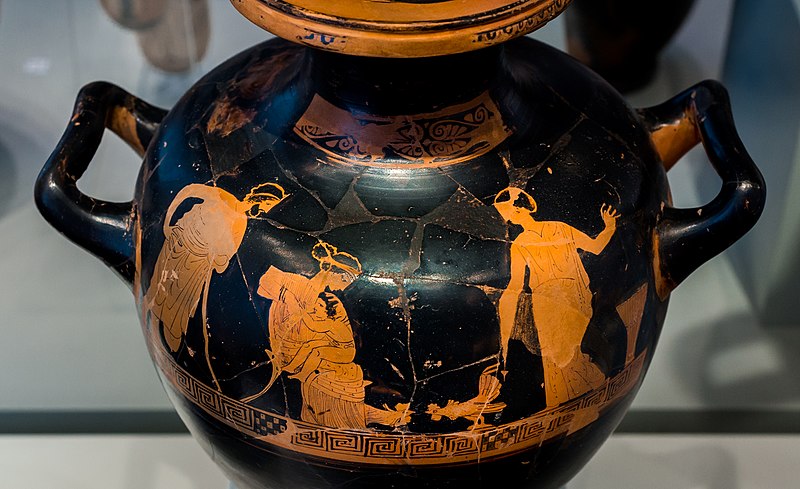
The End of Troy on the Mykonos Vase

As I was reading through book 6, I went to do an image search for the death of Astyanax.  In the worst version of this motif, the infant child is used to beat his grandfather Priam to death.

BM 1842,0314.3 c. 550BC-540BC

I then was wondering about the iconography of this scene and googled infanticide and found this on Wikimedia commons:

Photograph of a figured panel from a clay vase showing a warrior swinging an infant
from the Mykonos Vase

I was somewhat shocked that I had never seen this image from a Greek vase before. I then realized that it was part of a series of panels that tell the story of this child, a warrior, and his mother. It may be different scenes of an attack, or a sequence telling a story.

Photograph of a figured panel from a clay vase showing a warrior swinging an infant in a sequence

What seems to happen in this sequence is that  the small child tries to intervene when the soldier approaches his mother.

Then the soldier sees the child and grabs him.

And runs him through with his sword.

Due in part to the news and being a parent, I found this series really upsetting. But what upset me more was when I looked at the whole vase. I have shown pictures of the top portion of this vessel dozens of times in my career because it is the oldest known image of the Trojan horse. I always used to make jokes about the soldiers looking out the windows. How could the Trojans be so dumb as to let them in?!

The terrible violence on the lower part of the vase seems a consequence of the actions of the warriors inside the horse. But the relationship between how we treat that amusing image and the violence below is a close analogy for what we do with the Iliad by focusing on its heroic veneer without really dwelling enough on the horrors of the world it depicts.

Michael Anderson (1997, 183-191) discusses the pithos in detail as an example of the plot of the lost poem the Iliou Persis. According to Anderson (see also Ervin 1963), the panels follow the action of a single warrior and woman with a male child in different poses, indicating a narrative. He summarizes “This conglomeration of panels exposes an operation of mass enslavement and extermination.” He compares the panels to Priam imagining the future death of his sons and enslavement of daughters in book 22 (62-65). He adds “But the massacre on the pithos need not be limited to a single family, and the multiplication of scenes may be read as an attempt to represent all the women and children of the city” (186) and adds “… the warriors on the pithos are determined to eradicate the entire race of Trojans, and all the male children must die, even the sons still in the womb, as Agamemnon coldly threatens in Iliad 6” (187).

But I fear that the relegation of these images to a particular story tradition does not help us understanding what audiences did with them. As Kathy Gaca shows in her article “The Andrapodizing of War Captives in Greek Historical Memory,” the act of killing those who know how to fight and enslaving/taking those who do not (women and children) was a practice observed in many different ways in Ancient Greece. Agamemnon’s words and the Mykonos vase must surely reflect these practices. I don’t think they are celebrating them, but the tone is far too unclear.

A coda

The Iliad is in part the story of ‘civilizing’ conventions of wars dismissed. What we learn from the beginning is that political institutions are not strong enough to enforce the maintenance of normative behaviors. The personal decisions of individuals–Paris before the war, Agamemnon at the beginning of the Iliad–run roughshod across principles of ransom in exchange for life that the assembled Greeks cheer for in book 1.

The story of excessive violence in the Iliad is that of the rejection of conventions meant to make war in some way predictable and ‘acceptable’ to the combatants. The planned sexual violence of the Achaeans, the rejection of ransom-exchange, and the promotion of infanticide all come within the frame of the breakdown of political control over individual behavior. ‘Rage’ is the break from limitations enforced by social conventions; it unleashes the true hell of war and unveils the brutal, dehumanizing violence pulsating beneath the service of ‘civilization’.

Even the epic’s conclusion is compromised: the cessation of Achilles’ rage only comes through monstrous behavior (corpse-disfigurement and human sacrifice) and occurs at the personal level between a bereft father and a surrogate son whose potential for violence has ebbed through exhaustion and divine intervention. It thematically seals the epic’s arc: book 1 saw the breakdown in social convention thanks to the whims of an angry king; book 24 sees the conventions briefly reinforced, thanks to the needs of two kings in despair. Yet their attitude is not one of rejection violence or rehabilitation, but resignation to the continuing war that will take both of their lives.

For a marginally more explicit take on current events, see here.

Some things to read

n.b this is not an exhaustive bibliography. If you’d like anything else included, please let me know.

Anderson, Michael J. 1997 The Fall of troy in Early Greek Poetry and Art Oxford

Ebbinghaus, Susanne. “Protector of the City, or the Art of Storage in Early Greece.” The Journal of Hellenic Studies 125 (2005): 51–72. http://www.jstor.org/stable/30033345.

M. Ervin, “A relief pithos from Mykonos”, Archaiologikon Deltion 18 (1963), pp. 37-75.

Gaca, Kathy L. “Reinterpreting the Homeric Simile of ‘Iliad’ 16.7-11: The Girl and Her Mother in Ancient Greek Warfare.” The American Journal of Philology 129, no. 2 (2008): 145–71. http://www.jstor.org/stable/27566700.

GACA, KATHY L. “The Andrapodizing of War Captives in Greek Historical Memory.” Transactions of the American Philological Association (1974-) 140, no. 1 (2010): 117–61. http://www.jstor.org/stable/40652052.

Gaca, Kathy L. “MARTIAL RAPE, PULSATING FEAR, AND THE SEXUAL MALTREATMENT OF GIRLS (Παῖδες), VIRGINS (Παρθένοι), AND WOMEN (Γνναῖκες) IN ANTIQUITY.” The American Journal of Philology 135, no. 3 (2014): 303–57. http://www.jstor.org/stable/24560257.

Sparkes, B. A. “The Trojan Horse in Classical Art.” Greece & Rome 18, no. 1 (1971): 54–70. http://www.jstor.org/stable/642388.

Structure and Stories

Reading Iliad 6

This post is a basic introduction to reading Iliad 6. Here is a link to the overview of book 5 and another to the plan in general. As a reminder, these posts will remain free, but there is an option to be a financial supporter. All proceeds from the substack are donated to classics adjacent non-profits on a monthly basis.

Book 6 of the Iliad may be one of the most carefully structured, most dynamic books of the epic. (And likely one of the most read books as well.) It is also crucial for fleshing out the world within which the Iliadic conflicts unfolds: it provides a rare view into the city of Troy, lets us hear the voices of the women in the city, and takes “man-slaughtering” Hektor out of combat and close to his home. There are three major scenes to consider: (1) the scenes of violence prior to Hektor’s return to the city; (2) the famous exchange between Glaukos and Diomedes that runs while Hektor is going to Troy; (3) the exchanges between Hektor and the people in the city, including Hekuba, Paris, Helen, and Andromache. 

Close up of a Red figure vase with a woman on the left holding a child in her lap looking at his father on the right holding a helmet
Hector’s last visit to his family before his duel with Achilles: Astyanax, on Andromache’s knees, stretches to touch his father’s helmet. Apulian red-figure column-crater, ca. 370–360 BC. From Ruvo. Stored in the Museo Nazionale of the Palazzo Jatta in Ruvo di Puglia (Bari)

Interlocking Themes and Structures in Iliad 6

One of the things that makes this sequence really effective is how moments in each scene anticipate the contents of what follows. For instance, the catalogue of deaths to start the book provide “obituaries” of Trojan warriors that contain some curious detail and Agamemnon’s promise to kill even male Trojans in the womb echoes poignantly when we see (and hear about) Hektor’s son Astyanax at the end of the book. Consider as well, the narrative Diomedes provides at 6.130-140. He explains that it is dangerous to rival gods, but uses a strange narrative of how Lykourgos opposed an infant Dionysus and drove the baby god to the sea. Zeus punishes Lykourgos with blindness.

In this tale, Dionysus is rescued by Thetis, and summarizes that no one lasts long, “once they have become hateful to the gods” (ἦν, ἐπεὶ ἀθανάτοισιν ἀπήχθετο πᾶσι θεοῖσιν, 6.140). This theme is echoed later when Glaukos summarizes the later days of Bellerophon, wandering the Aleian plain after he also “became hateful to the gods” (6.200). And details from this scene may also anticipate what follows: Christos Tsagalis has argued that the invocation of the Maenads and Dionysus in Diomedes’ speech foreshadows Andromache being compared to a mad-woman in Troy and the odd inclusion of an infant Dionysus, saved here and only here by Thetis, may also prime audiences to think about infants on the coast of Asia Minor who survive and those who don’t.

These thematic interconnections are joined by a surprising structure in book 6.  Hektor’s brother, Helenos, instructs him to go tell the Trojan women to sacrifice to Athena. Hektor leaves to do so at 6.116 but he does not arrive there until 6.237. As an audience, we are supposed to imagine that the intervening conversation between Glaukos and Diomedes takes place while Hektor travels through Troy. This is interesting in part because it is fairly unique in Homer, although it is not entirely strange. Often actions are delayed to create suspense, as when Patroklos waits several books to return to tell Achilles who is wounded (from book 11 until 16). But at this scale, this scene has interesting consequences for thinking about Homeric narrative structure.

There is an phenomenon described by “Zielinski’s Law” that suggests that Homeric poetry can only move forward and does not have flashbacks or show simultaneous action. The structure of this book certainly complicates this observation. At one level, it is clear that in real time performance, a poet cannot literally depict two scenes at the same time (although two poets could!). But, at another, the “law” (which really isn’t binding) implies a misunderstanding of the limits of epic art. Homeric poetry tends not to show simultaneous action, but it is certainly capable of doing so. Book 6 has multiple instances of simultaneous action: pay close attention as well to Paris’ departure from his abode and when Hektor catches up with him. 


Homeric ‘Obituaries’

As you can observe from the catalogue of deaths that tends to accompany the aristeia of individual heroes, there’s a connection between the glory attached to a hero and ‘fame’ or at least naming of his victim. Indeed, as Hektor puts it in book 7, there is some connection between the fame of the victor and the vanquished:

Homer, Iliad 7.89-91

“…They will heap up a mound [sêma] on the broad Hellespont
And someone of the men who are born in the future may say
As he says over the wine-faced sea in his many-benched ship:
This is the marker [sêma] of a man who died long ago,
A man whom shining Hektor killed when he was at his best”
So someone someday will say. And my glory will never perish”

σῆμά τέ οἱ χεύωσιν ἐπὶ πλατεῖ ῾Ελλησπόντῳ.
καί ποτέ τις εἴπῃσι καὶ ὀψιγόνων ἀνθρώπων
νηῒ πολυκλήϊδι πλέων ἐπὶ οἴνοπα πόντον·
ἀνδρὸς μὲν τόδε σῆμα πάλαι κατατεθνηῶτος,
ὅν ποτ’ ἀριστεύοντα κατέκτανε φαίδιμος ῞Εκτωρ.
ὥς ποτέ τις ἐρέει· τὸ δ’ ἐμὸν κλέος οὔ ποτ’ ὀλεῖται.

=

Share

Peter Gainsford has done an analysis of all of the named killings in the Iliad and it provides two really important observations: first, far more Trojan dead are named than Achaean and, second, despite that imbalance, Hektor kills the most named people in the Iliad, followed closely by Patroklos and Achilles. The ‘obituaries’ of these heroes, how they die and who they are, can be said to increase the glory or at least magnify the accomplishments of the chief warriors.

But I think there’s more to it than that. Book 6 starts with a series of Trojan Deaths at the hands of the Achaeans. The stories increase in length and provide interesting detail

Homer, Iliad 6.20-28

“Euryalos killed Dresos and Opheltios.

Then he went after Aisēpos and Pēdasos, whom once

The water nymph Abarbareē bore to blameless Boukolion.

Boukolion was a son of noble Laomedon,

The oldest by birth, but his mother gave birth to him in secret.

He had sex with the nymph while shepherding the sheep.

She became pregnant and gave birth to twin boys.

Euryalos, the son of Mekistes, undid their lives and shining limbs

And then stripped the weapons from their shoulders.”

   Δρῆσον δ’ Εὐρύαλος καὶ ᾿Οφέλτιον ἐξενάριξε·

βῆ δὲ μετ’ Αἴσηπον καὶ Πήδασον, οὕς ποτε νύμφη

νηῒς ᾿Αβαρβαρέη τέκ’ ἀμύμονι Βουκολίωνι.

Βουκολίων δ’ ἦν υἱὸς ἀγαυοῦ Λαομέδοντος

 πρεσβύτατος γενεῇ, σκότιον δέ ἑ γείνατο μήτηρ·

 ποιμαίνων δ’ ἐπ’ ὄεσσι μίγη φιλότητι καὶ εὐνῇ,

ἣ δ’ ὑποκυσαμένη διδυμάονε γείνατο παῖδε.

καὶ μὲν τῶν ὑπέλυσε μένος καὶ φαίδιμα γυῖα

Μηκιστηϊάδης καὶ ἀπ’ ὤμων τεύχε’ ἐσύλα.

 In their commentary on book 6, Barbara Graziosi and Johannes Haubold write on the Boukolion passage:

“The poet provides recondite information on Boukolion’s family and draws attention to this fact: Boukolion and his sons are born in obscure circumstances and marginal settings…Commentators debate whether the genealogy should be considered ‘conscious fiction’ or whether it reflects a local tradition…. The text, however, does not encourage us to view these options as alternatives: the poet tells us about a family that would otherwise remain obscure, and its history has a strong local flavour, rather than enjoying Panhellenic fame. ”

As they put it, just as with the catalogue of ships and other seeming digressions, the death scenes provide an opportunity for acknowledging local traditions by integrating their stories into the Homeric narrative. Given some of the details of this passage, however, such as the names “Cowherd” (Boukolion) and “Mud-woman” or “Not-foreigner” (Abarbareē), this passage could be seen as “improvised” for the context.

I think the somewhat legendary story here–a herdsman having a tryst with a divine woman–both echoes other Trojan stories (like the affair of Aphrodite and Anchises) while also preparing us for the actions of book 6 that, in sequence, show us (1) Agamemnon threatening to kill even infants in the womb; (2) Diomedes and Glaukos finding common ground across the war because of their genealogical narratives; and (3) the women and families of Troy, centered around a warriors brief return home. There’s a kind of anticipation in the themes of the initial deaths in this book, differing in an important way from the theomachy of book 5.

Some guiding questions for Book 6

What is the effect of the exchange between Diomedes and Glaukos on book 6 and on the whole?

How do Hektor’s conversations with Helen, Hecuba, and Andromache serve to characterize him and what impact do they have on the larger narrative?

What is Andromache’s advice for Hektor and why doesn’t he take it?

Red figure vase: Side A: Scene of fighting from the Trojan War; Achilles dismounts from his chariot to kill the fallen Eurymachus. Side B: Scenes of fighting from the Trojan War, with Glaucus (frontal, centre) and Menestheus. Subsidiary decoration: rays from the base and a lotus/palmette band above the panel. Much added red and white for details. There are holes at the base of the handles and a channel/drain hole in the base, suggesting the vessel was used for cooling wine.
From National Gallery of Victoria, Melbourne: ca. 540 BCE from Chalkis, Greece. Lidded belly amphora, black-glazed with figure panels.

On Zielinski’s Law and Book 6 in general

n.b this is not an exhaustive bibliography. If you’d like anything else included, please let me know. I will have a separate list for posts on Agamemnon’s violence and the Diomedes/Glaukos episode

Arthur, M. B.. “The divided world of Iliad VI.” Reflections of women in antiquity. Ed. Foley, Helene Peet. New York: Gordon & Breach Science Publ., 1981. 19-44.

Bowie, Angus. “Narrative and emotion in the « Iliad »: Andromache and Helen.” Emotions and narrative in ancient literature and beyond: studies in honour of Irene de Jong. Eds. De Bakker, Mathieu, Van den Berg, Baukje and Klooster, Jacqueline. Mnemosyne. Supplements; 451. Leiden ; Boston (Mass.): Brill, 2022. 48-61. Doi: 10.1163/9789004506053_004

Carbon, Jan. Mathieu. “Zielinski’s Law and Its Validity.” Diss. 2003.

Frazer, Richard McIlwaine. “Hesiod’s Titanomachy as an illustration of Zielinski’s law.” Greek, Roman and Byzantine Studies, vol. XXII, 1981, pp. 5-9.

Barbara Graziosi, Johannes Haubold, Homer. Iliad, Book VI. Cambridge Greek and Latin classics. Cambridge; New York: Cambridge University Press, 2010.

Griffin, Jasper. “Homeric Pathos and Objectivity.” The Classical Quarterly 26, no. 2 (1976): 161–87. http://www.jstor.org/stable/638263.

Nünlist, René. “Der Homerische Erzähler Und Das Sogenannte Sukzessionsgesetz.” Museum Helveticum 55, no. 1 (1998): 2–8. http://www.jstor.org/stable/24821098.

Pratt, Louise Harrison. “The parental ethos of the « Iliad ».” Constructions of childhood in ancient Greece and Italy. Eds. Cohen, Ada and Rutter, Jeremy B.. Hesperia. Supplement; 41. Princeton (N. J.): American School of Classical Studies at Athens, 2007. 25-40.

Purves, Alex C. “HOMER AND THE ART OF OVERTAKING.” The American Journal of Philology 132, no. 4 (2011): 523–51. http://www.jstor.org/stable/41415775.

Scodel, Ruth. “Zielinski’s Law Reconsidered.” Transactions of the American Philological Association (1974-) 138, no. 1 (2008): 107–25. http://www.jstor.org/stable/40212076.

Slater, W. J. “Lyric Narrative: Structure and Principle.” Classical Antiquity 2, no. 1 (1983): 117–32. https://doi.org/10.2307/25010788.

Tsagalis, Christos. 2008. The Oral Palimpsest: Exploring Intertextuality in the Homeric Epics. Hellenic Studies Series 29. Washington, DC: Center for Hellenic Studies.

Vergados, Athanassios. “Rethinking Zieliński’s law and its application on Hesiod’s « Theogony ».” Paideia, vol. 74, no. 2, 2019, pp. 1239-1257.

Preparatory Posts

Reading and Teaching Homer

Five Major Themes to Follow in the Iliad

Book-by-book posts

Introduction to Iliad 1

The Plan: Zeus’ Plan in the Iliad

Prophet of Evils: Reading Iphigenia in and out of the Iliad

Speaking of Centaurs: Paradigmatic Problems in book 1

Introduction to Iliad 2

Thersites’ Body: Description, Characterization, and Physiognomy in book 2

Introduction to Iliad 3

Heroic Appearances: What Did Helen Look Like?

Sources for Helen in Early Greek Poetry

Introduction to Iliad 4

Long Ago, Far Away: Iliad and the Epic Cycle

Introduction to Iliad 5

All About Athena

Populist Politics and Savage Consensus

During the Peloponnesian War, the Athenian Democracy deliberated on and voted for the killing of men and the enslavement of women and children. To ask why is not an idle historical musing.

Thucydides, 5.116.4

“The [Athenians] killed however many of the Melian men were adults, and made the women and children slaves. Then they settled the land themselves and later on sent five hundred colonists.”

οἱ δὲ ἀπέκτειναν Μηλίων ὅσους ἡβῶντας ἔλαβον, παῖδας δὲ καὶ γυναῖκας ἠνδραπόδισαν. τὸ δὲ χωρίον αὐτοὶ ᾤκισαν, ἀποίκους ὕστερον πεντακοσίους πέμψαντες.

5.32

“Around the same period of time in that summer, the Athenians set siege to the Scionaeans and after killing all the adult men, made the women and childen into slaves and gave the land to the Plataeans.”

Περὶ δὲ τοὺς αὐτοὺς χρόνους τοῦ θέρους τούτου Σκιωναίους μὲν Ἀθηναῖοι ἐκπολιορκήσαντες ἀπέκτειναν τοὺς ἡβῶντας, παῖδας δὲ καὶ γυναῖκας ἠνδραπόδισαν καὶ τὴν γῆν Πλαταιεῦσιν ἔδοσαν νέμεσθαι·

This was done by vote of the Athenian democracy led by Cleon: Thucydides 4.122.6. A similar solution was proposed during the Mytilenean debate. Cleon is described by Thucydides as “in addition the most violent of the citizens who also was the most persuasive at that time by far to the people.” (ὢν καὶ ἐς τὰ ἄλλα βιαιότατος τῶν πολιτῶν τῷ τε δήμῳ παρὰ πολὺ ἐν τῷ τότε πιθανώτατος, 3.36.6)

3.36

“They were making a judgment about the men there and in their anger it seemed right to them not only to kill those who were present but to slay all the Mytileneans who were adults and to enslave the children and women.”

περὶ δὲ τῶν ἀνδρῶν γνώμας ἐποιοῦντο, καὶ ὑπὸ ὀργῆς ἔδοξεν αὐτοῖς οὐ τοὺς παρόντας μόνον ἀποκτεῖναι, ἀλλὰ καὶ τοὺς ἅπαντας Μυτιληναίους ὅσοι ἡβῶσι, παῖδας δὲ καὶ γυναῖκας ἀνδραποδίσαι.

In his speech in defense of this policy, Cleon reflects on the nature of imperialism and obedience. Although he eventually failed to gain approval for this vote which was overturned, his arguments seem to have worked on later occasions.

Thucydides, 3.37

“The truth is that because you live without fear day-to-day and there is no conspiring against one another, you think imagine your ‘allies’ to live the same way. Because you are deluded by whatever is presented in speeches you are mistaken in these matters or because you yield to pity, you do not not realize you are being dangerously weak for yourselves and for some favor to your allies.

You do not examine the fact that the power you hold is a tyranny and that those who are dominated by you are conspiring against you and are ruled unwillingly and that these people obey you not because they might please you by being harmed but because you are superior to them by strength rather than because of their goodwill.

The most terrible thing of all is  if nothing which seems right to us is established firmly—if we will not acknowledge that a state which has worse laws which are unbendable is stronger than a state with noble laws which are weakly administered, that ignorance accompanied by discipline is more effective than cleverness with liberality, and that lesser people can inhabit states much more efficiently than intelligent ones.

Smart people always want to show they are wiser than the laws and to be preeminent in discussions about the public good, as if there are no more important things where they could clarify their opinions—and because of this they most often ruin their states. The other group of people, on the other hand, because they distrust their own intelligence, think that it is acceptable to be less learned than the laws and less capable to criticize an argument than the one who speaks well. But because they are more fair and balanced judges, instead of prosecutors, they do well in most cases. For this reason, then, it is right that we too, when we are not carried away by the cleverness and the contest of intelligence, do not act to advise our majority against our own opinion.”

διὰ γὰρ τὸ καθ᾿ ἡμέραν ἀδεὲς καὶ ἀνεπιβούλευτον πρὸς ἀλλήλους καὶ ἐς τοὺς ξυμμάχους τὸ αὐτὸ ἔχετε, καὶ ὅ τι ἂν ἢ λόγῳ πεισθέντες ὑπ᾿ αὐτῶν ἁμάρτητε ἢ οἴκτῳ ἐνδῶτε, οὐκ ἐπικινδύνως ἡγεῖσθε ἐς ὑμᾶς καὶ οὐκ ἐς τὴν τῶν ξυμμάχων χάριν μαλακίζεσθαι, οὐ σκοποῦντες ὅτι τυραννίδα ἔχετε τὴν ἀρχὴν καὶ πρὸς ἐπιβουλεύοντας αὐτοὺς καὶ ἄκοντας ἀρχομένους, οἳ οὐκ ἐξ ὧν ἂν χαρίζησθε βλαπτόμενοι αὐτοὶ ἀκροῶνται ὑμῶν, ἀλλ᾿ ἐξ ὧν ἂν ἰσχύι μᾶλλον ἢ τῇ ἐκείνων εὐνοίᾳ περιγένησθε.

πάντων δὲ δεινότατον εἰ βέβαιον ἡμῖν μηδὲν καθεστήξει ὧν ἂν δόξῃ πέρι, μηδὲ γνωσόμεθα ὅτι χείροσι νόμοις ἀκινήτοις χρωμένη πόλις κρείσσων ἐστὶν ἢ καλῶς ἔχουσιν ἀκύροις, ἀμαθία τε μετὰ σωφροσύνης ὠφελιμώτερον ἢ δεξιότης μετὰ ἀκολασίας, οἵ τε φαυλότεροι τῶν ἀνθρώπων πρὸς τοὺς ξυνετωτέρους ὡς ἐπὶ τὸ πλέον ἄμεινον οἰκοῦσι τὰς πόλεις.

οἱ μὲν γὰρ τῶν τε νόμων σοφώτεροι βούλονται φαίνεσθαι τῶν τε αἰεὶ λεγομένων ἐς τὸ κοινὸν περιγίγνεσθαι, ὡς ἐν ἄλλοις μείζοσιν οὐκ ἂν δηλώσαντες τὴν γνώμην, καὶ ἐκ τοῦ τοιούτου τὰ πολλὰ σφάλλουσι τὰς πόλεις· οἱ δ᾿ ἀπιστοῦντες τῇ ἐξ ἑαυτῶν ξυνέσει ἀμαθέστεροι μὲν τῶν νόμων ἀξιοῦσιν εἶναι, ἀδυνατώτεροι δὲ τὸν1 τοῦ καλῶς εἰπόντος μέμψασθαι λόγον, κριταὶ δὲ ὄντες ἀπὸ τοῦ ἴσου μάλλον ἢ ἀγωνισταὶ ὀρθοῦνται τὰ πλείω. ὣς οὖν χρὴ καὶ ἡμᾶς ποιοῦντας μὴ δεινότητι καὶ ξυνέσεως ἀγῶνι ἐπαιρομένους παρὰ δόξαν τῷ ὑμετέρῳ πλήθει παραινεῖν.

description: father Amphiaraos (bearded man in mantle) standing, leaning on his stick, mother Eriphyle sitting in a chair, suckling her baby son Alkmaion, their elder daughter Domonassa spinning wool from a baske
ca. 450-440 BC – material: pottery (clay) – height: 27 cm – findspot: Attica – museum / inventory number: Berlin, Altes Museum (Antikensammlung) F 2395

Poison Proofs

Aelian (Claudius Aelianus), On the Nature of Animals, 16, 27 (= BNJ 86F 21b)

“Agatharkhides claims that there is a group of people in Libya–and that they are also called the Psylli–in most ways they aren’t really different from the rest of humankind in their lifestyle except that their body has a strange and incredible quality that sets them apart. You see, creatures that sting as part of attacking don’t harm these people at all!

Indeed, they don’t even notice a snakebite or a spider-bite that might be fatal to other people, nor even a scorpion’s sting. When one of the creatures gets near them and touches them, it acts like it has taken some sleep-causing drug as soon as it smells them! They contract a kind of drowsiness or drugged state and become weak and slow until the person walks away.

Also, when they want to test whether their babies are trueborn or bastards, they leave them in the middle of snakes just as I said above, the way gold-workers test metal in fire.”

᾽Αγαθαρχίδης φησὶν εἶναι γένος ἐν τῆι Λιβύηι τινῶν ἀνθρώπων καὶ μέντοι καὶ καλεῖσθαι αὐτοὺς Ψύλλους. καὶ ὅσα μὲν κατὰ τὸν ἄλλον βίον τῶν λοιπῶν ἀνθρώπων διαφέ̣ρειν οὐδὲ ἕν, τὸ δὲ σῶμα ἔχειν ξένον τε καὶ παράδοξον ὡς πρὸς τοὺς ἑτεροφύλους ἀντικρινόμενον. τὰ γάρ τοι ζῶια τὰ δακετὰ καὶ τὰ ἐγχρίμπτοντα πάμπολλα ὄντα μηδὲν αὐτοὺς μόνους ἀδικεῖν. οὐτε γοῦν ὄφεως δακόντος ἐπαίουσιν οὐτε φαλαγγίου νύξαντος [ὡς] τοὺς ἄλλους ἐς θάνατον οὐτε μὴν σκορπίου κέντρον ἀπερείσαντος. ἐπὰν δὲ ἄρα τούτων προσπελάσηι τι καὶ παραψαύσηι τοῦ σώματος καὶ ἅμα καὶ τῆς ὀσμῆς τῆς ἐκείνων [ψαύσηι ἢ] σπάσηι, ὥσπερ οὖν φαρμάκου γευσάμενον ὑπνοποιοῦ κάρωσίν τινα ἑλκτικὴν ἐς ἀναισθησίαν ἐμποιοῦντος, ἐξασθενεῖ καὶ παρεῖται, ἔστ᾽ ἂν παραδράμηι ὁ ἄνθρωπος. ὅπως δὲ ἐλέγχουσι τὰ ἑαυτῶν βρέφη εἴτε ἐστὶ γνήσια εἴτε καὶ νόθα, ἐν τοῖς ἑρπετοῖς βασανιζοντες ὡς ἐν τῶι πυρὶ τὸν χρυσὸν οἱ βάναυσοι χρυσουργοί, ἀνωτέρω εἶπον.

This is one of several scenes in the Church of Ura Kidane Mihret depicting snake-like creatures. In this panel, the snake appears to have gotten out of hand, and the man on the right is in the process of lopping off the snake’s head with what look like metal shears.
Zeghie Peninsula, Lake Tana, Ethiopia.

Two Ways to Decline Zeus: Paradigm, Text, and Story in Iliad 5

Book 5 contains several speeches that engage with themes of theomachy and the Iliad’s relationship with the past. A few of them also can help us think about the poem’s composition and its relationship to other poetic traditions. One speech where many of these issues emerge is Dione’s speech to Aphrodite after Diomedes wounds her.

Aphrodite rescuing her son Aeneas wounded in fight, scene from The Iliad. Shoulder of an Etruscan black-figure amphora, ca. 480 BC
Aphrodite rescuing her son Aeneas wounded in fight, scene from The Iliad. Shoulder of an Etruscan black-figure amphora, ca. 480 BC. Martin-von-Wagner-Museum, L 793 (work on display in the Staatliche Antikensammlungen, room 3, as of Februar 2007).

Homer, Iliad 5. 381-416

“Dione, the shining goddess, answered her then: ‘Endure my child, and restrain yourself even though you are grieving. For many of us who have Olympian homes have caused each other hard pains because of humans. Ares once endured when Otos and strong Ephialtes, The children of Aloes, chained him in a powerful bond. He was tied down for thirteen months in a bronze jar. And then Ares, insatiate of war, would have perished there If their step-mother, the super pretty Eeriboia Had not informed Hermes. He freed Ares Who was in a lot of pain, since his bonds were hurting him. And Hera endured, when the powerful son of Amphitryon Struck her in the right breast with a three-barbed arrow. Then untreatable pain overtook her indeed. And huge Hades endured when the same son of Aegis-bearing Zeus Gave him pain by shooting him among the corpses. Then he went to great Olympos to Zeus’ home, Grieving that he had been allotted pain. That arrow Was lodged in his massive shoulder, and suffered in his heart. Paeon relieved his pains by applying medicine, Since he wasn’t mortal in any way at all. The one who doesn’t hesitate at doing sacrilegious things Is a violence-doing criminal, that guy who harms the gods with arrows. Athena the grey-eyed goddess sent him against you. The fool. Doesn’t Tydeus’ son recognize in his thoughts That someone who fights the gods doesn’t live very long, He won’t ever have children saying “daddy” at his needs When he comes home from war and the terrible battle. So now the son of Tydeus, even if he is super strong, Let him not even think about fighting someone better than you, Lest prudent Aigialeia Adrastus’ daughter Should wake her dear servants from sleep, weeping, Longing for her wedded husband, the best of the Achaeans, That strong wife of horse-taming Diomedes.” 

This passage has a few interesting things in it. First, while there is some evidence for Dione as a goddess outside of the Iliad, in Hesiod and her Homeric Hymn she is the product of Ouranos’ castrated testicles. By having a mother in Homer, Aphrodite is more neatly fit into an Olympian pantheon as a child of Zeus rather than a goddess from an earlier generation. Dione, coincidentally, has been seen as a feminine version of the alternate root for Zeus, Dios.

A short digression, one of the features of the flexibility of Homeric verse is that it admits formal variants that other dialects would tend to reduce. So, for convenience of metrical shape, there are two ways to decline Zeus:

Zeus/ Zēnos / Zēni /Zēna
Zeus / Dios / Dii / Dia

For those who don’t know an inflected language, the declension of a noun is the set of the forms needed to communicate their grammatical function in the sentence. So, Homeric Greek provides two ways to say “of Zeus” (Zēnos/Dios) or “to/for Zeus”(Zēni/Dii). The rhythmic shape of each pair differs long/short vs. short/short; and, further, the initial consonants can change the length of final vowels that precede them. Complex consonants like zeta (closer to the sound ds) can make short vowels that precede them (what we call “long by position” in contrast to “long by nature”).

Back to Dione’s speech: this is a good example of what I have mentioned before, a paradeigma, an example from the past used to persuade someone in the poem’s presence. This one provides a catalogue of divine suffering at the hands of humans to ‘console’ Aphrodite. Each of these examples have story traditions that are explained in the scholia (on which see below) or appear in other extant texts.

Beyond the details, this passage is also often compared for its structure to an epic fragment ascribed to the poet Panyasis in the 5th century BCE:

Panyasis Herakleia fr. 3 Benarbé = 16 K

“Demeter endured; the famous Lame-god endured; 

Poseidon endured; and silver-bowed Apollo endured

to serve a mortal human being for one year 

and even Ares strongheart endured under his father’s compulsion,” 


τλῆ μὲν Δημήτηρ, τλῆ δὲ κλυτὸς ᾿Αμφιγυήεις,

τλῆ δὲ Ποσειδάων, τλῆ δ’ ἀργυρότοξος ᾿Απόλλων 

ἀνδρὶ παρὰ θνητῷ θητευσέμεν εἰς ἐνιαυτόν, 

τλῆ δὲ καὶ ὀβριμόθυμος ῎Αρης ὑπὸ πατρὸς ἀνάγκῃ 

Note the repetitions in structures (τλῆ μὲν…τλῆ δὲ), themes (immortals harmed by mortals), and even diction (ὀβριμόθυμος in Panyasis is parallel to ὀβριμοεργὸς in Homer).  The similarity between this passage and the longer speech in Homer has led to much speculation as to the cause: is this catalogue a common structuring motif in early Greek poetry or is it a case of Panyasis imitating Homer (or Homer imitating Panyasis) or something more complex.

(Elton Barker and I have written about this a little: See our discussion in Homer’s Thebes).

An Issue of Texts

Iliad 5.403 reads σχέτλιος ὀβριμοεργὸς ὃς οὐκ ὄθετ’ αἴσυλα ῥέζων but there is a scholion that notes that the Hellenistic editor Aristarchus read αἰσυλοεργός. 

That would give us a different line σχέτλιος *αἰσυλοεργός ὃς οὐκ ὄθετ’ αἴσυλα ῥέζων (Schol. T ad Il. 5.403).. The difference is minor: σχέτλιος ὀβριμοεργὸς is something like a “violence-doing criminal” while σχέτλιος *αἰσυλοεργός is something closer to a “sacrilege-committing criminal”. My guess is that other editors preferred ὀβριμοεργὸς because it is not a hapax legomenon (a word said only once) and because the compound αἰσυλοεργός (aisuloergos) has its sense repeated at the end of the line with αἴσυλα ῥέζων (aisula rezôn). 

These two aesthetic criteria–uniqueness of words, close repetition–are not necessarily at home with the basic aesthetics of Greek poetry. Our scholia–the collection of marginal comments culled from centuries of scholarly editing of and commentary on ancient texts–preserve layers of different approaches to Homer. The editor Aristarchus, one of Homer’s earliest editors, is criticized by some modern authors for preserving unique or otherwise uncommon readings. (See this review by Gregory Nagy of Martin West’s edition of the Iliad for more.) My personal take on this is that the kind of repetition in this line is characteristic of something like an intentional archaism, a  close repetition that hearkens back to the legendary era the speaker is evoking. While the repetition and unique diction may seem odd from Hellenistic and modern aesthetic perspectives, I think it rings better for the context and is truer to the complexity of Homeric poetry.

I have discussed similar textual differences before in an article about a later scene in book 5, centering around Ares where our common text preserves rather bland vocabulary in preference to exceptional diction.

A World of Stories: Mythographical scholia

Another kind of material preserved in the scholia includes additional information about myth from outside Homer. There are several versions of the story of Diomedes’ wife, Aigialeia, in the scholia to Homer. The scholion in this case seems to read Dione’s comment’s as an allusion or even a coded threat about the impact of Athena’s anger on Diomedes in the long run.

Schol. T Ad Hom. Il. 5.512ex

“They say that Aigialeia, the youngest of the daughters of Adrastus, was Diomedes’ wife and really longed for him and troubled herself over him through the nights as well. But later, thanks to the rage of Aphrodite, she slept with a band of Argive youths and later on, Kometes, the son of Sthenelos, to whom Diomedes had entrusted the affairs of his household. Although she was planning to kill him when he returned home, she spared Diomedes because he fled to the altar of Athena. People say that when he left there he went to Iberia, as some claim, and that he was deceitfully killed by the king Daunus. Others claim that he was killed by Iounios the son of Daunos during a hunt. For this reason, Athena turned him into a god and changed his companions into herons.

The poet does not know of the desire of Kometes and Aigialeia.”

μὴ δὴν Αἰγιάλεια: φασὶν Αἰγιάλειαν τὴν νεωτέραν τῶν᾿Αδρηστίδων γυναῖκα Διομήδους οὖσαν σφόδρα αὐτὸν ἐπιποθεῖν καὶ ἀπολοφύρεσθαι καὶ κατὰ τὰς νύκτας. ὕστερον δὲ κατὰ μῆνιν ᾿Αφροδίτης πάσῃ τῇ νεολαίᾳ τῶν ᾿Αργείων αὐτὴν συγκωμάσαι, ἔσχατον δὲ καὶ †σθενέλῳ τῷ κομήτου†, ὃς ἦν ὑπὸ Διομήδους πιστευθεὶς τὰ κατ’ οἶκον. ἥκοντα δὲ αὐτὸν μέλλων ἀνελεῖν ἐφείσατο διὰ τὸ καταφυγεῖν εἰς τὸν τῆς ᾿Αθηνᾶς βωμόν· ὅθεν αὐτὸν φυγόντα φασὶν ἥκειν εἰς †ἰβηρίαν† κἀκεῖ, ὡς μέν τινες, δολοφονηθῆναι ὑπὸ Δαύνου τοῦ βασιλέως, ὡς δὲ ἔνιοι, ἀπολέσθαι ὑπὸ ᾿Ιουνίου τοῦ Δαύνου παιδὸς ἐν κυνηγεσίοις· ὅθεν αὐτὸν μὲν ἀπεθέωσεν ᾿Αθηνᾶ, τοὺς δὲ ἑταίρους εἰς ἐρωδιοὺς μετέβαλεν. 

τὸν Κομήτου πόθον καὶ Αἰγιαλείας οὐκ οἶδεν ὁ ποιητής. 

There is no way of knowing if this account was written into our out of our Iliad. By which I mean: we can’t really know if ancient audiences had access to this story and part of this is because we don’t have evidence of whether this story was told to flesh out what is said in the speech or if the speech reflects stories that were well known.

The scholiast’s notion that the “poet did not know this story” is a problematic one and one that reflects misunderstanding about Homeric poetic strategy.  Homeric narrative tends to suppress stories that don’t support its local and general aims, something I discuss elsewhere in reference to the Homeric treatment of Cassandra.

 It does seem peculiar that Dione would bring up Diomedes’ wife as all–but it is likely that she was a well-known part of his story as one of the Epigonoi. Actual evidence from early Greek poetry is limited. As far as I can see (and this is more or less confirmed by Timothy Gantz’s Early Greek Myth, 1993: 699), the story is later than the classical period, although a much later scholion to Lykophron suggests the story was told by the archaic poet Mimnermus:

Schol. To Lykophron, Alexandra 610

“Aphrodite, according to Mimnermus, was wounded by Diomedes and caused Aigialeia to sleep with many adulterers and to be loved by Kometes the son of Sthenelos. When he returned to Argos, she plotted against him. Then he fled to the altar of Hera and left with his companions in the night. Then he went to Italy to King aunos who killed him with a trick.”

 ἡ δὲ ᾿Αφροδίτη, καθά φησιν Μίμνερμος (F 22 Bgk), ὑπὸ Διομήδους τρωθεῖσα παρεσκεύασε τὴν Αἰγιαλείαν πολλοῖς μὲν μοιχοῖς συγκοιμηθῆναι, ἐρασθῆναι δὲ καὶ [῾Ιππολύτου] Κομήτου τοῦ Σθενέλου υἱοῦ. τοῦ δὲ Διομήδους παραγενομένου εἰς τὸ ῎Αργος, ἐπιβουλεῦσαι αὐτῶι· τὸν δὲ καταφυγόντα εἰς τὸν βωμὸν τῆς ῞Ηρας, διὰ νυκτὸς φυγεῖν σὺν τοῖς ἑταίροις, καὶ ἐλθεῖν εἰς ᾿Ιταλίαν πρὸς Δαῦνον βασιλέα, ὅστις αὐτὸν <δόλωι> ἀνεῖλεν. 

Some things to read

n.b this is not an exhaustive bibliography. If you’d like anything else included, please let me know.

BOUCHARD, ELSA. “APHRODITE ‘PHILOMMÊDÊS’ IN THE ‘THEOGONY.’” The Journal of Hellenic Studies 135 (2015): 8–18. http://www.jstor.org/stable/44157344.

Contzen, Eva von. “The Limits of Narration: Lists and Literary History.” Style 50, no. 3 (2016): 241–60. https://doi.org/10.5325/style.50.3.0241.

Cook, Arthur Bernard. “Who Was the Wife of Zeus?” The Classical Review 20, no. 7 (1906): 365–78. http://www.jstor.org/stable/695286.

Hadzsits, George Depue. “Aphrodite and the Dione Myth.” The American Journal of Philology 30, no. 1 (1909): 38–53. https://doi.org/10.2307/288458.

Pratt, Louise. “The Parental Ethos of the Iliad.” Hesperia Supplements 41 (2007): 25–40. http://www.jstor.org/stable/20066781.

Sale, W. Merritt. “Aphrodite in the Theogony.” Transactions and Proceedings of the American Philological Association 92 (1961): 508–21. https://doi.org/10.2307/283834.

Willcock, M. M. “Mythological Paradeigma in the Iliad.” The Classical Quarterly 14, no. 2 (1964): 141–54. http://www.jstor.org/stable/637720.


All About Athena

Some additional texts for book 5

Reminder: all proceeds from the substack are donated to classics adjacent non-profits on a monthly basis.

Athena in Epic

Athena is one of the most important divinities in Homeric epic, perhaps not reflecting her ritual roles in Greece (outside of Athens). Her primary role in myth, after her birth, is as her father’s right-hand among mortals. She has a special role in aiding and assisting heroes. In myth, she was at times alongside heroes like Herakles. In the Iliad, she is one of the goddesses who is opposed to Troy but specifically acts as a special sponsor of heroes like Diomedes in book 5.

This post is a collection of resources about Athena to help understand her position in Greek epic a little more.

Photograph of the reconstruction of the statue of Athena from the Parthenon currently in Nashville TN

Homeric Hymn to Athena 1 (Allen 11)
The shorter of the extant Homeric hymns focuses on Athena’s connection with war and heroes

“I begin to sing of Pallas Athena the dread
defender of cities, to whom the acts of war are a concern with Ares:
the cities sacked, the shrill sound, and the battles,
She rescues the host when it leaves and when it returns”

Παλλάδ’ ᾿Αθηναίην ἐρυσίπτολιν ἄρχομ’ ἀείδειν
δεινήν, ᾗ σὺν ῎Αρηϊ μέλει πολεμήϊα ἔργα
περθόμεναί τε πόληες ἀϋτή τε πτόλεμοί τε,
καί τ’ ἐρρύσατο λαὸν ἰόντα τε νισόμενόν τε.
Χαῖρε θεά, δὸς δ’ ἄμμι τύχην εὐδαιμονίην τε.

Homeric Hymn to Athena, 2 (Allen, 28)
The longer of the extant Homeric Hymns to Athena tells the story of her birth (but not her conception) perhaps reflecting the war-dances done in her honor

“I begin to sing the honored goddess, Pallas Athena,
The grey-eyed, very-clever one with a relentless heart,
A city-defending, revered and courageous maiden
Tritogeneia, whom counselor Zeus himself gave birth to
from his sacred head, already holding her weapons,
all gold and shining. Then awe took all the immortals
who looked on. And she rose from the immortal head
of aegis-bearing Zeus immediately in front of them
shaking her sharp spear. And great Olympos shook
terribly beneath the fury of the grey-eyed goddess
as the ground echoed frightfully around. Even the sea
was churned up with its dark waves and the brine seized
suddenly. The glorious son of Hyperion brought his
swift-footed steeds to rest for a long time until
the maiden Pallas Athena took the divine weapons
from her immortal shoulders. And counselor Zeus laughed.
Hail to you, then, child of aegis-bearing Zeus.
And I will also praise you with yet another song still.”

Παλλάδ’ ᾿Αθηναίην κυδρὴν θεὸν ἄρχομ’ ἀείδειν
γλαυκῶπιν πολύμητιν ἀμείλιχον ἦτορ ἔχουσαν
παρθένον αἰδοίην ἐρυσίπτολιν ἀλκήεσσαν
Τριτογενῆ, τὴν αὐτὸς ἐγείνατο μητίετα Ζεὺς
σεμνῆς ἐκ κεφαλῆς, πολεμήϊα τεύχε’ ἔχουσαν
χρύσεα παμφανόωντα• σέβας δ’ ἔχε πάντας ὁρῶντας
ἀθανάτους• ἡ δὲ πρόσθεν Διὸς αἰγιόχοιο
ἐσσυμένως ὤρουσεν ἀπ’ ἀθανάτοιο καρήνου
σείσασ’ ὀξὺν ἄκοντα• μέγας δ’ ἐλελίζετ’ ῎Ολυμπος
δεινὸν ὑπὸ βρίμης γλαυκώπιδος, ἀμφὶ δὲ γαῖα
σμερδαλέον ἰάχησεν, ἐκινήθη δ’ ἄρα πόντος
κύμασι πορφυρέοισι κυκώμενος, ἔσχετο δ’ ἅλμη
ἐξαπίνης• στῆσεν δ’ ῾Υπερίονος ἀγλαὸς υἱὸς
ἵππους ὠκύποδας δηρὸν χρόνον εἰσότε κούρη
εἵλετ’ ἀπ’ ἀθανάτων ὤμων θεοείκελα τεύχη
Παλλὰς ᾿Αθηναίη• γήθησε δὲ μητίετα Ζεύς.
Καὶ σὺ μὲν οὕτω χαῖρε Διὸς τέκος αἰγιόχοιο•
αὐτὰρ ἐγὼ καὶ σεῖο καὶ ἄλλης μνήσομ’ ἀοιδῆς.

Birth of Athena

As Lenny Muellner talks about in his analysis of the structure of Hesiod’s Theogony, Athena is born in part of Zeus’ attempt to resolve various tensions in the creation of the Universe including gender binaries, intelligence/strength, and age/youth. By giving birth on his own after consuming his first ‘wife’ Metis, he resolves these conflicts and gives birth to a somewhat androgynous daughter who is, in a way, a mirror of himself.

The following fragment of Hesiod (343 MW) is preserved by Galen and appears to come out of a tradition presenting a catalog of Zeus’ wives.  In this is overlaps in content with Hesiod’s Theogony (806-901 and following) which has a similar order.  Some of the details, however, are a bit different.  Of special notice is the description of Metis’ hanging out in Zeus’ entrails or the creation of the Aegis.

Galenus, De placitis Hippocr. et Plat. iii. 8 p. 318 Müller
(=Chrysippus fr. 908, Stoic. Vet. Fr. 11. 256 v. Arnim)

“Because of that rivalry, [Hera] bore a famous son,
Hephaistos, on her own without aegis-bearing Zeus,
A son who surpassed all of the gods with his hands.
But [Zeus] stretched out next to the daughter of
Ocean and well-tressed Tethys apart from fair-cheeked Hera,
As he surprised Metis, even though she knows much.
He grabbed her with his hands and put her in his belly,
Because he feared that she might bear something stronger than lightning.
This is the reason that Kronos’ royal son who lives in the sky
Suddenly swallowed her whole. She was immediately pregnant
With Pallas Athena, whom the father of men and gods produced
Through his head near the banks of the river Tritôn.
Mêtis sat hidden beneath Zeus’ entrails,
That mother of Athena, creator of just affairs,
The one who knows most of gods and mortal men.
Then the goddess Themis stretched out beside him,
She surpassed all gods who have Olympian homes with her skilled handsl
She made the aegis, that army-routing armor of Athena,
Alongside the one who bore her, Athena dressed in warrior’s arms.”

ἐκ ταύτης ἔριδος ἣ μὲν τέκε φαίδιμον υἱὸν
῞Ηφαιστον †τέχνηισιν ἄνευ Διὸς αἰγιόχοιο
ἐκ πάντων παλάμηισι κεκασμένον Οὐρανιώνων·
αὐτὰρ ὅ γ’ ᾿Ωκεανοῦ καὶ Τηθύος ἠυκόμοιο
κούρηι νόσφ’ ῞Ηρης παρελέξατο καλλιπαρήου
ἐξαπαφὼν Μῆτιν καίπερ πολύιδριν ἐοῦσαν·
συμμάρψας δ’ ὅ γε χερσὶν ἑὴν ἐγκάτθετο νηδύν,
δείσας μὴ τέξηι κρατερώτερον ἄλλο κεραυνοῦ·
τούνεκά μιν Κρονίδης ὑψίζυγος αἰθέρι ναίων
κάππιεν ἐξαπίνης. ἣ δ’ αὐτίκα Παλλάδ’ ᾿Αθήνην
κύσατο· τὴν μὲν ἔτικτε πατὴρ ἀνδρῶν τε θεῶν τε
πὰρ κορυφήν, Τρίτωνος ἐπ’ ὄχθηισιν ποταμοῖο.
Μῆτις δ’ αὖτε Ζηνὸς ὑπὸ σπλάγχνοις λελαθυῖα
ἧστο, ᾿Αθηναίης μήτηρ, τέκταινα δικαίων,
πλεῖστα θεῶν εἰδυῖα καταθνητῶν τ’ ἀνθρώπων.
†ἔνθα θεὰ παρέλεκτο Θέμις† παλάμαις περὶ πάντων
ἀθανάτων ἐκέκασθ’ οἳ ᾿Ολύμπια δώματ’ ἔχουσιν,
αἰγίδα ποιήσασα φοβέστρατον ἔντος ᾿Αθήνης·
σὺν τῆι ἐγείνατό μιν, πολεμήϊα τεύχε’ ἔχουσαν.

Solon, fr. 4.4-5 (6th Century BCE)
Solon emphasizes Athena’s power as a protector and connection with Zeus

“This sort of a great-hearted overseer, a daughter of a strong-father
Holds her hands above our city, Pallas Athena”

τοίη γὰρ μεγάθυμος ἐπίσκοπος ὀβριμοπάτρη
Παλλὰς ᾿Αθηναίη χεῖρας ὕπερθεν ἔχει•

Euripides, Heracleidae 770-72 (5th Century BCE)
Euripides echoes Solon but also refers to Athena as a maternal figure

“Queen, the foundation of the land
and the city is yours, you are its mother,
mistress and guardian..”

ἀλλ’, ὦ πότνια, σὸν γὰρ οὖ-
δας γᾶς καὶ πόλις, ἆς σὺ μά-
τηρ δέσποινά τε καὶ φύλαξ…

Aristophanes, Knights 581-585 (5th Century BCE)
Aristophanes echoes the defender motif and connects it with the glory of Athens as a martial and creative center (perhaps under influence of a more robust Panathenaia)

“O Pallas, protector of the city,
The most sacred city-
and defender of a land
that surpasses all others
in war and poetry.”

῏Ω πολιοῦχε Παλλάς, ὦ
τῆς ἱερωτάτης ἁπα-
σῶν πολέμῳ τε καὶ ποη-
ταῖς δυνάμει θ’ ὑπερφερού-
σης μεδέουσα χώρας,

Birth of Athena, Full-Armed, from Zeus' Head (Ouch!)
Birth of Athena, Full-Armed, from Zeus’ Head (Ouch!)

Here, for your pleasure, a symptom of a particular kind of madness. The wide range of epithets, cult-names and geographical associations for Athena presents us with a rather different idea of the goddess from what we get in conventional summaries.

Athena Ageleiê (“bringer of Spoils”), epithet

Athena Aglauros (“Shining, Bright, Noble”) epithet, Athens (also a daughter of Cecrops)

Athena Agoraia (“The Assembly Goddess”) cult-name, Sparta

Athena Aithuia (“The Diver”; “Sea-Gull”) cult-name, Megara

Athena Alea (“warmth”), cult-name, Arcadia (Tegea)

Athena Akria (“On High”) cult-name, various

Athena Alalkomenêis: (“defender”), epithet and cult-name, Boeotia

Athena Amaria (“Bright Sky”), cult-name in Achaea

Athena Amboulia: (“Without Council”) cult-name, Sparta

Athena Anemôtis (“Windy”?), cult-name, Messenia

Athena Arkhêgetis (“Founder”) cult-name, Athens

Athena Atrutônê (“Tireless”), epithet

Athena Boarmia (the “yoker of Oxen”; worshipped in Athens)

Athena Eilenia/Ellênia (Uncertain, “Warmth”; “Light”), cult-name, Metapontum

Athena Erganê: (“Craftswoman”) cult-name, Athens

Athena Ergatis (“Craftsman”) cult-name, Samos

Athena Glaukôpis (“bright-eyed”; “grey-eyed”; “owl-eyed”), epithet

Athena Gorgonophonos (“Gorgon-slayer”) epithet, Euripides Ion 987

Athena Hygeia (“Health”; “Cleansing”)

Athena Hellôtis (unclear, “Capture” or named for a maiden) Cult-name, Corinth and Marathon

Athena Hephaistia, cult-name, Athens

Athena Hippia (“Horsewoman”), Cult-name, Corinth (perhaps associated with the yoking of Pegasos)

Athena Homolôis (“The Constant”; “Concord”) cult-name, Boeotia

Athena Itonia (Toponym) cult-name, Boeotia

Athena Keleutheia (“Of the Roads”) cult-name, Sparta

Athena Kalliergos (“Fine-worker”), cult-name, Epidauros

Athena Ktêsia: (“Founding Goddess”) cult-name, various

Athena Korêsia (Toponym, near lake Korêsia?), cult-name

Athena Kranaia (“On the Top of the Hill”) cult-name, Elatea

Athena Khalinîtis (“The Bridle-Goddess”), cult-name, Corinth (associated with the yoking of Pegasos)

Athena Kissaia (“Ivy”) cult-name, Epidauros

Athena Mêter (“Mother”) Athens, Crete

Athena Mêkhanîtis (“Diviser”) cult-name, Megalopolis

Athena Narkaia (dubious: “Cold”; “Lightning”; “The goddess who petrifies”), cult-name in Elis

Athena Nedousia (Toponym, “near the river Nedôn”) cult-name, Laconia

Athena Nikê: (“Victory”) cult-name, Athens

Athena Oksuderkês (“keen-eyed”) cult-name, Argos

Athena Ophthalmîtis (“Sharp-eyed”) cult-name, Sparta

Athena Onga, Ogkaiê (Unclear: “Bellowing”; “Stately”, of oxen) cult-name, Thebes

Athena Pandrosos (“All-doer”) epithet, Athens (also a daughter of Cecrops)

Athena Parthenos (“The Virgin”), cult-name, Athens

Athena Phratria/Apatouria (“Tribal God”) cult-name, Ionian states, Athens, Cos

Athena Polias (“Guardian of the City”), cult-name, Athens

Athena Promakhos (“The Fore-fighter”) cult-name, Troezen, Athens

Athena Pronoias (“Fore-thought”) cult-name, Delphi

Athena Skiras (Toponym, old name at Salamis; also “Sun-Shade”) cult-name, Athens, Salamis

Athena Salpingks (“Trumpeter”) cult-name, Argos

Athena Stoikheia (“Marshaller of Ranks”)

Athena Tritogeneia (Homer, other poetry, rarely in ritual): false-etymology: “head-born”; more likely: “water-born”; perhaps a toponym (e.g. Triton a river; cf. Cyprogenes)

Athena Tritônia (Toponym, “Near the River Tritonis) cult-name

Athena Zôstêria (“Girder”) cult-name, Thebes and Athens

Sources:

OCD3

Walter Burkert. Greek Religion. Cambridge, 1985.

Clay, J. S. 1983. The Wrath of Athena: Gods and Men in the Odyssey. Princeton.

———. 1989. The Politics of Olympus: Form and Meaning in the Major Homeric Hymns. Princeton.

L. R. Farnell. The Cults of the Greek City States. 1895.

Herington, C. J. “Athena in Athenian Literature and Cult.” Greece & Rome 10 (1963): 61–73. http://www.jstor.org/stable/826896.

Pope, M. W. M. “Athena’s Development in Homeric Epic.” The American Journal of Philology 81, no. 2 (1960): 113–35. https://doi.org/10.2307/292327.

Timothy Gantz. Early Greek Myth. Baltimore, 1993.

Simon Price. Religions of the Ancient Greeks. Cambridge, 1999.

Preparatory Posts

Reading and Teaching Homer

Five Major Themes to Follow in the Iliad

Book-by-book posts

Introduction to Iliad 1

The Plan: Zeus’ Plan in the Iliad

Prophet of Evils: Reading Iphigenia in and out of the Iliad

Speaking of Centaurs: Paradigmatic Problems in book 1

Introduction to Iliad 2

Thersites’ Body: Description, Characterization, and Physiognomy in book 2

Introduction to Iliad 3

Heroic Appearances: What Did Helen Look Like?

Sources for Helen in Early Greek Poetry

Introduction to Iliad 4

Long Ago, Far Away: Iliad and the Epic Cycle

Introduction to Iliad 5

Seeing (and Wounding) the Gods

Reading Iliad 5

This post is a basic introduction to reading Iliad 5. Here is a link to the overview of book 4 and another to the plan in general. As a reminder, these posts will remain free, but there is an option to be a financial supporter. All proceeds from the substack are donated to classics adjacent non-profits on a monthly basis.

Book 5 presents the first full aristeia of the Iliad as Athena supports Diomedes’ destruction of the Trojan lines and opposition to the gods. Athena provides Diomedes the ability to see the gods and points him directly at Aphrodite. Diomedes and Athenelos are pitted against Aeneas and Pandaros–in the first of two significant testings of Aeneas in the Iliad–and Diomedes prevails. He wounds Aphrodite when she appears to rescue her son (Aeneas), replacing him with a fake version. To balance this weighing of different heroic traditions, Sarpedon, a son of Zeus, encounters Herakles’ son Tlepolemos. Sarpedon wins but is wounded and has to be saved. The flow of the action angers Athena and Hera who prepare to battle Ares. Zeus permits them to harry him and Diomedes wounds Ares as well. The book ends with the gods pulling back from the battle field, leaving space for the more human plots of book 6.

Aphrodite rescuing her son Aeneas wounded in fight, scene from The Iliad. Shoulder of an Etruscan black-figure amphora, ca. 480 BC
Aphrodite rescuing her son Aeneas wounded in fight, scene from The Iliad. Shoulder of an Etruscan black-figure amphora, ca. 480 BC. Martin-von-Wagner-Museum, L 793 (work on display in the Staatliche Antikensammlungen, room 3, as of Februar 2007).

Each of the major scenes in book 5 contributes critically to some of the major themes I have noted to follow in reading the Iliad: (1) Politics, (2) Heroism; (3) Gods and Humans; (4) Family & Friends; (5) Narrative Traditions. But the central themes I emphasize in reading and teaching book 5 are narrative traditions, heroism, and gods and humans. The paradigmatic consolation Dione offers Aphrodite when she is injured is structurally and thematically interesting, but the primary narrative entanglements of book 6 involve (1) Theomachy and (2) the characterization of Diomedes.

Theomachy and Homeric Gods

One of the chief themes of Book 5 is deferred theomachy. The gods engage in direct conflict elsewhere in the epic (most notably in books 13-15 and 20), but here we get a mix of theomachy by proxy (Diomedes wounding Aphrodite at Athena’s urging) and direct conflict (Athena vs. Ares) with Zeus intervening. The behavior of the gods in Homer, however, is crucial to understanding the epic’s messages about human beings.

The theme of theomachy (“war among the gods”) is integrated into the epic both to engage with its place in cosmic history and to appropriate themes from other traditions. For the latter, we have multiple echoes of earlier conflicts between the gods: the apostasy of Poseidon and Apollo that led to their service to build the walls of Troy (see books 7 and 12), reminders from Zeus of how powerful he is and how he punished them before (books 4, 8, 15) and reflections from other gods of how they settled and distributed their rights, alluding to moments that could be (but aren’t) represented in Hesiod’s Theogony

While the Iliad is not explicit about it, divine-conflict deferred or avoided is central to the Trojan War myth writ large, especially around the character of Achilles and his mother Thetis (on which, no one has yet improved upon Laura Slatkin’s elegant The Power of Thetis). The story is deep, but easy to summarize: Prometheus had the secret knowledge of a nymph who would bear a son greater than his father, endangering the cosmos if Zeus or one of his brothers ended up the daddy in question. Zeus releases Prometheus from his bondage and torture in exchange for this information, leading to the arranged marriage of Thetis and Peleus.

So, at the center of Achilles’ apostasy from Agamemnon and his mother’s intervention on his behalf (triggering even more conflict among the gods) is the traditional threat that Achilles’ birth averted: upheaval among the gods. Nevertheless, as a narrative tradition seeking to encompass if not surpass all others, the Iliad still tries to include themes and motifs that would be proper both to the story that was never told (Zeus overthrown by a son) and those that were (Gigantomachies, Titanomachies, etc.)

Book 5 is the first time the gods really get into the action in the Iliad. They stage manage it in books 3 and 4, but finally get their hands dirty here. And a lot of what they do seems pretty embarrassing or even sacrilegious to modern audiences. This connects with the other main function of the gods and theomachy in the Iliad: to elevate the human condition.

Thank you for reading Painful Signs, Or, Joel’s Substack. This post is public so feel free to share it.

Share

Xenophanes, fragments 10-11

“Homer and Hesiod have attributed everything to the gods
that is shameful and reprehensible among men:
theft, adultery and deceiving each other

*      *      *

How they have sung the most the lawless deeds of the gods!
That they steal, commit adultery and deceive one another…

Fr. 10

πάντα θεοῖσ’ ἀνέθηκαν ῞Ομηρός θ’ ῾Ησίοδός τε,
ὅσσα παρ’ ἀνθρώποισιν ὀνείδεα καὶ ψόγος ἐστίν,
κλέπτειν μοιχεύειν τε καὶ ἀλλήλους ἀπατεύειν.

Fr. 11

ὡς πλεῖστ’ ἐφθέγξαντο θεῶν ἀθεμίστια ἔργα,
κλέπτειν μοιχεύειν τε καὶ ἀλλήλους ἀπατεύειν.

Heraclitus, fr. 42

“He used to say that Homer was worthy of being expelled from the contests and whipped along with Archilochus too.”

— —τόν τε ῞Ομηρον ἔφασκεν ἄξιον ἐκ τῶν ἀγώνων ἐκβάλλεσθαι καὶ ῥαπίζεσθαι καὶ ᾿Αρχίλοχον ὁμοίως

Diogenes Laertius, 8.21 (Lives of the Sophists)

“Hieronymos says that when Pythagoras went down into Hades he saw the ghost of Hesiod bound to a bronze pillar, squeaking, and that Homer’s ghost was hanging from a tree surrounded by snakes. They were being punished for the things they said about the gods. And in addition he saw men who were not willing to have sex with their own wives. This is the reason, that Pythagoras was honored by the inhabitants of Croton. Aristippos of Cyrene in his work Peri Physiologoi says that Pythagoras was given his name because he spoke the truth publically [agoreuô] no less than the Pythian oracle.”

φησὶ δ’ ῾Ιερώνυμος (Hiller xxii) κατελθόντα αὐτὸν εἰς ᾅδου τὴν μὲν ῾Ησιόδου ψυχὴν ἰδεῖν πρὸς κίονι χαλκῷ δεδεμένην καὶ τρίζουσαν, τὴν δ’ ῾Ομήρου κρεμαμένην ἀπὸ δένδρου καὶ ὄφεις περὶ αὐτὴν ἀνθ’ ὧν εἶπον περὶ θεῶν, κολαζομένους δὲ καὶ τοὺς μὴ θέλοντας συνεῖναι ταῖς ἑαυτῶν γυναιξί· καὶ δὴ καὶ διὰ τοῦτο τιμηθῆναι  ὑπὸ τῶν ἐν Κρότωνι. φησὶ δ’ ᾿Αρίστιππος ὁ Κυρηναῖος ἐν τῷ Περὶ φυσιολόγων Πυθαγόραν αὐτὸν ὀνομασθῆναι ὅτι τὴν ἀλήθειαν ἠγόρευεν οὐχ ἧττον τοῦ Πυθίου.

There’s a tension between comments like those of Xenophanes and Heraclitus and the assertion by Herodotus (in book 2 of the Histories) that Homer and Hesiod Olympian Pantheon. I think a lot of this tension is a misunderstanding of what the gods in Homer are doing. They are simultaneously representations of divine beings (although not universal) and characters in a story. They do and do not reflect shared Greek beliefs about the gods. In addition, they serve as inducement for audiences to think about things like ‘fate’ and human agency. But they also serve to contrast with humans. The gods can do whatever they please because they face no consequences and live forever; by contrast, human beings face consequences for their actions and have a limited lifespan. The value of human life is thus actually increased by its scarcity and the importance of human choice and agency is all the more elevated by the fact that we can lose something so preciously limited at any moment. The gods end up looking somewhat distant and pathetic by comparison–but this is part of a general cosmic goal of justifying the separation between the worlds of gods and men.

People who focus on epic narrative have noted that the narrative worlds of gods and men overlap but are not coterminous.  Divine players can learn about everything that goes on in the mortal realm, but mortals know only what is directly revealed to them. The external audience witnesses everything. 

color photograph of an oil painting with three main figures in the center: a winged goddess rescuing a semi nude Aphrodite from a warrior in arms
Venus, Wounded by Diomedes, is Saved by Iris by Joseph-Marie Vien

Why Diomedes?

Diomedes is a central figure in book 5’s allusions to theomachy and he helps defer these themes from god-on-god violence to god-by-proxy violence. Part of the reason Diomedes can function as a Theomahkos (on which, see Zoe Stamatopoulou’s great article cited below) is because he is also a substitute Achilles. But, because he is wholly mortal, he does not represent the same threat to the cosmic order. As covered a bit in posts on book 4, Diomedes is an important figure because of his place as a hero who was part of both the Theban and Trojan War traditions. 

In the Iliad, his character is adapted to tell a different story about the way a young hero might be part of a larger coalition. There is of course a lot going on with Diomedes from a mythographical tradition, and he channels that as the Athena-aided hero who does great things in book 5; but he follows an important pattern in the development of his political acumen.

I have written several times on the importance of Diomedes in the Iliad’s political arc (sorry to be obnoxious, but Christensen 2009, 2015, and 2018 below). Here’s a table of his political/forensic actions in the epic.

(1)             Diomedes (implicitly) witnesses the actions and speeches of Iliad 1-3

(2)             Diomedes shows he knows the appropriate parameters for political and martial speech (Il. 4)

(3)             Diomedes practices public speech and is acclaimed by all the Achaians in his refusal of Paris’ offer to return the gifts but not Helen (7.400-2). Acclamation (7.403-4):

(4)             Diomedes practices public speech in criticizing Agamemnon and is acclaimed by all (9.50-1) but is criticized by Nestor for not reaching the télos múthôn (9.53-62). Acclamation (9.50-1)

(5)             Diomedes practices public speech in reaction to Achilles’ rejection of the assembly (9.697-709) and is acclaimed by all the kings.

(6)             Diomedes volunteers to go on a nocturnal spying mission during the council of kings and is encouraged by Agamemnon to choose any companion he wants regardless of nobility (10.219-39)

(7)             Diomedes executes public speech at a critical moment and offers a plan (14.110-32). He is obeyed by all the kings and departs from the epic as a speaker. 

Book 5, of course, stands outside of this narrative arc. Here, he carries out the ideal actions of a god-aided hero, fully replacing Achilles in the ranks of the Achaean warriors, but only for a short time. As you follow Diomedes throughout the epic, note that as soon as Achilles returns, Diomedes recedes from the stage entirely. 

Some guiding questions

What is the relationship between Diomedes and Athena like in book 5?

How does the depiction of the gods in Book 5 contribute to their overall presentation in the Iliad?

How are stories outside the Iliad used in Book 5?

What is the impact of the violence in book 5?

Bibliography on Diomedes

n.b this is not an exhaustive bibliography. If you’d like anything else included, please let me know.

Andersen, Ø. 1978. Die Diomedesgestalt in der Ilias. Oslo.

Christensen, J. P. 2009. “The end of speeches and a speech’s end: Nestor, Diomedes, and the telos muthôn.”’ in K. Myrsiades, ed. Reading Homer: Film and Text. Farleigh.

Christensen, J. P. 2015. “Diomedes’ Foot-wound and the Homeric Reception of Myth.” In Diachrony, Jose Gonzalez (ed.). De Gruyter series, MythosEikonPoesis. 2015, 17–41.

Christensen, J. P. 2018. “Speech Training and the Mastery of Context: Thoas the Aitolian and the Practice of Múthoi for Homer in Performance: Rhapsodes, Narrators and Characters, Christos Tsagalis and Jonathan Ready (eds.). University of Texas Press, 2018: 255–277.

Christensen, Joel P., and Elton T. E. Barker. “On Not Remembering Tydeus: Agamemnon, Diomedes and the Contest for Thebes.” Materiali e Discussioni per l’analisi Dei Testi Classici, no. 66 (2011): 9–43. http://www.jstor.org/stable/41415488.

Griffin, Jasper. 1986. “Homeric Words and Speakers.” JHS 106: 36–57.

Harries, Byron. “‘Strange Meeting’: Diomedes and Glaucus in ‘Iliad’ 6.” Greece & Rome 40, no. 2 (1993): 133–46. http://www.jstor.org/stable/643154.

HIGBIE, CAROLYN. “DIOMEDES’ GENEALOGY AND ANCIENT CRITICISM.” Arethusa 35, no. 1 (2002): 173–88. http://www.jstor.org/stable/44578455.

Martin 1989, R. The Language of Heroes, Ithaca 1989.

Morrison, James V. “The Function and Context of Homeric Prayers: A Narrative Perspective.” Hermes 119, no. 2 (1991): 145–57. http://www.jstor.org/stable/4476812.

Scodel, Ruth. “Homeric Attribution of Outcomes and Divine Causation.” Syllecta Classica 29 (2018): 1-27. https://doi.org/10.1353/syl.2018.0001.

Stagakis, George. “DOLON, ODYSSEUS AND DIOMEDES IN THE ‘DOLONEIA.’” Rheinisches Museum Für Philologie 130, no. 3/4 (1987): 193–204. http://www.jstor.org/stable/41233632.

Stamatopoulou, Zoe. “Wounding the Gods: The Mortal Theomachos in the Iliad and the Hesiodic Aspis.” Mnemosyne 70, no. 6 (2017): 920–38. https://www.jstor.org/stable/26572880

Stamatopoulou, Zoe. “Wounding the Gods: The Mortal Theomachos in the Iliad and the Hesiodic Aspis.” Mnemosyne 70, no. 6 (2017): 920–38. https://www.jstor.org/stable/26572880

Turkeltaub, Daniel. “Perceiving Iliadic Gods.” Harvard Studies in Classical Philology 103 (2007): 51–81. http://www.jstor.org/stable/30032218.

Some more on the Gods in Homer and Theomachy

A W. H. Adkins. ”Homeric Gods and the Values of Homeric Society.” JHS 92 (1972) 1-19.

W. Allan. “Divine Justice and Cosmic Order in Early Greek Epic” JHS 126 (2006) 1–35.

Burkert, Walter.1986. Greek Religion. 119-125.

G. M. Calhoun. “Homer’s Gods: Prolegomena”.  TAPA 68 (1937) 24-25.

Jenny Strauss Clay. The Wrath of Athena: Gods and Men in the Odyssey. Princeton: Princeton  University Press, 1983.

—,—. The Politics of Olympus: Form and Meaning in the Major Homeric Hymns. Princeton: Princeton University Press, 1989.

Erbse, Hartmut (1986). Untersuchungen zur Funktion der Götter im homerischen Epos. Berlin: de Gruyter

Friedman, Rachel. 2001. “Divine Dissension and the Narrative of the Iliad.” Helios 28:–118.

Griffin, Jasper. “The Divine Audience and the Religion of the Iliad.” The Classical Quarterly 28, no. 1 (1978): 1–22. http://www.jstor.org/stable/638707.

Emily Kearns. “The Gods in the Homeric Epics.” In Robert Fowler (ed.). The Cambridge Companion to Homer. Cambridge: Cambridge University Press, 2004, 59-73.

Lamberton, Robert. 1986. Homer the Theologian: Neoplatonist Allegorical reading and the Growth of the Epic Tradition. Berkeley and Los Angeles.

W. F. Otto. 1954. The Homeric Gods The Spiritual Significance of Greek Religion. Trans. M, Hadas.

Pietro Pucci. “Theology and Poetics in the Iliad.” Arethusa 35 (2002) 17-34

Turkeltaub, Daniel. “Perceiving Iliadic Gods.” Harvard Studies in Classical Philology 103 (2007): 51–81. http://www.jstor.org/stable/30032218.

Preparatory Posts

Reading and Teaching Homer

Five Major Themes to Follow in the Iliad

Book-by-book posts

Introduction to Iliad 1

The Plan: Zeus’ Plan in the Iliad

Prophet of Evils: Reading Iphigenia in and out of the Iliad

Speaking of Centaurs: Paradigmatic Problems in book 1

Introduction to Iliad 2

Thersites’ Body: Description, Characterization, and Physiognomy in book 2

Introduction to Iliad 3

Heroic Appearances: What Did Helen Look Like?

Sources for Helen in Early Greek Poetry

Introduction to Iliad 4

Long Ago, Far Away: Iliad and the Epic Cycle

War, Some Proverbs

Arsenius 7.16n

“In war, iron is stronger for safety than gold;
But for living, reason is better than wealth.”

᾿Εν μὲν πολέμῳ πρὸς ἀσφάλειαν σίδηρος χρυσοῦ κρείττων,
ἐν δὲ τῷ ζῆν ὁ λόγος τοῦ πλούτου [Socrates]

“You can’t fuck-up twice in a war
Οὐκ ἔστιν ἐν πολέμῳ δὶς ἁμαρτάνειν

Zenobius

“War is tear-free” A proverb applied to those who succeed easily through every danger and beyond expectations.”

῎Αδακρυς πόλεμος: ἐπὶ τῶν ἔξω κινδύνου παντὸς ῥᾷστα δὲ καὶ παρ’ ἐλπίδα τὰ πράγματα κατορθούντων.

Michael Apostolios

“Beginning of wars”: A proverb applied to those who try to do wrong
᾿Αρχὴ πολέμων: ἐπὶ τῶν ἀδικεῖν ἐπιχειρούντων.

“Endless War is Sweet”: A proverb applied to those who throw themselves into dangers because of inexperience

Γλυκὺς ἀπείρων πόλεμος: ἐπὶ τῶν ὑπ’ ἀπειρίας ἑαυτοὺς καθιέντων εἰς κινδύνους.

Gregorius

“War is sweet for someone with no experience of it”

Γλυκὺς ἀπείρῳ πόλεμος

[A variation on the line above]

Heraclitus, D64

“war is father of everything; war is king of everything.”

πόλεμος πάντων μὲν πατήρ ἐστι, πάντων δὲ βασιλεύς


Heraclitus, R53

“Heraclitus claims that Zeus and war are the same thing.”

καὶ | τὸν π̣όλεμο̣[ν] καὶ | τὸν Δ[ί]α τὸν αὐ̣τὸν | εἶν[αι, κα]θάπερ καὶ | τὸν [Ἡ]ράκλειτον λέ|γειν

Xenophon, Hiero 2

“If war is a terrible evil, then tyrants receive its greatest portion.”

εἰ δὲ πόλεμος μέγα κακόν, τούτου πλεῖστον μέρος οἱ τύραννοι μετέχουσιν.


Diogenes Laertius [Demetrius 82]

“Speech can win in politics however much iron can gain in War.”

ὅσον ἐν πολέμῳ δύνασθαι σίδηρον, τοσοῦτον ἐν πολιτείᾳ ἰσχύειν λόγον

Diogenes Laertius [Diogenes 50]

“Alliances come after war.”

μετὰ τὸν πόλεμον ἡ συμμαχία

Qajar-era Iranian court painter Mirza Baba’s depiction of Fath Ali Shah’s victory over the Russians at Yerevan (Siege of Erivan), part of the Russo-Persian War of 1804–1813. The painting is kept at the National Museum of Iran in Tehran.

Our Bias Toward Shared Beliefs

Seneca, Moral Epistles 117.6-7

“We are accustomed to lean toward the assumptions of all people and treat as proof of truth that something seems likely to everyone. So, among other things, we gather that there are gods, that there is some opinion about gods implanted in us, that there is no nation anywhere so alien to law and custom that they don’t believe in gods.

When we talk about the immortality of our souls, the beliefs of people who worship or fear the underworld gods has no minor impact on us. I make use of public persuasion: you will find know one who doesn’t think that wisdom–and being wise–are good. I won’t act the way that defeated fighters do and beg the people for pardon: let’s start to fight with our own weapons.”

Multum dare solemus praesumptioni omnium hominum, et apud nos veritatis argumentum est aliquid omnibus videri. Tamquam deos esse inter alia hoc colligimus, quod omnibus insita de dis opinio est nec ulla gens usquam est adeo extra leges moresque proiecta, ut non aliquos deos credat.

Cum de animarum aeternitate disserimus, non leve momentum apud nos habet consensus hominum aut timentium inferos aut colentium. Utor hac publica persuasione: neminem invenies, qui non putet et sapientiam bonum et sapere. Non faciam, quod victi solent, ut provocem ad populum; nostris incipiamus armis confligere.

An image generated by DALL•E of an ancient mosaic of comic masks. There are three masks. The left and right are partially cut off. The background is red. The masks have pale skin, wide-open mouths, big noses, and piercing eyes.

Better than our Fathers!

Theban Epic Fragments and the Homeric Iliad

This post provides some additional information for thinking about Iliad book 4, in particular references to Thebes and Tydeus. As a reminder, these posts will remain free, but there is an option to be a financial supporter. All proceeds from the substack are donated to classics adjacent non-profits on a monthly basis.

As Elton Barker and I emphasize in our work on Homer, we think poetic rivalry was a formative feature of the generation of epic poetry in performance over time.  The culture projected within the Homeric world is deeply competitive and rivalry between the Homeric poems through the main figures Achilles and Odysseus is clear as well. But we also argue that agonism should be seen as a primary force in the way Homeric poems relate to other traditions as well, particularly those surrounding Thebes. 

(See this recent video we participated in on The Story of Thebes.)

Thebes comes to the fore in book 4 when Agamemnon reviews his troops and exhorts them to battle in the so-called Epipolesis. By the time he gets to Diomedes, he leans a little more into the language of reproach and attempts to shame Diomedes by comparing him to his father.

Hom. Il. 4.387-393; 396-400

There, stranger though he was, horse-driver Tydeus was not frightened, alone among many Cadmeans. But he challenged them to contests and won victory in all easily. Such a guardian was Athena for your father! But the Cadmeans, drivers of horses, were angered and, as he departed from the city, they set up a close ambush of fifty youths; there were two leaders…. But Tydeus let loose on them a unseemly fate: he slew them all and only one man he sent to return home: he sent Maion, trusting in the signs of the gods. Such a man was Aitolian Tydeus; but he fathered a son weaker than he in battle, but better in the assembly

ἔνθ᾿ οὐδὲ ξεῖνός περ ἐὼν ἱππηλάτα Τυδεὺς

τάρβει, μοῦνος ἐὼν πολέσιν μετὰ Καδμείοισιν,

ἀλλ᾿ ὅ γ᾿ ἀεθλεύειν προκαλίζετο, πάντα δ᾿ ἐνίκα

ῥηϊδίως· τοίη οἱ ἐπίρροθος ἦεν Ἀθήνη.

οἱ δὲ χολωσάμενοι Καδμεῖοι, κέντορες ἵππων,

ἂψ ἄρ ᾿ ἀνερχομένῳ πυκινὸν λόχον εἷσαν ἄγοντες,

κούρους πεντήκοντα· δύω δ᾿ ἡγήτορες ἦσαν…

Τυδεὺς μὲν καὶ τοῖσιν ἀεικέα πότμον ἐφῆκε·

πάντας ἔπεφν᾿, ἕνα δ᾿ οἶον ἵει οἶκόν δὲ νέεσθαι·

Μαίον᾿ ἄρα προέηκε, θεῶν τεράεσσι πιθήσας.

τοῖος ἔην Τυδεὺς Αἰτώλιος· ἀλλὰ τὸν υἱὸν

γείνατο εἷο χέρεια μάχῃ, ἀγορῇ δέ τ᾿ ἀμείνω

After he does this, Sthelenos, the Patroklos to Diomedes’ Achilles, objects strongly. Asserting that he and Diomedes actually sacked a city when their fathers failed to do so.

Homer, Iliad. 4.404-110

Son of Atreus, don’t lie when you know how to speak clearly. We claim to be better than our fathers: we took the foundation of seven-gated Thebes though we led a smaller army before better walls because we were relying on the signs of the gods and Zeus’ help. Those men perished because of their own recklessness. Don’t put our fathers in the same honour’’

Ἀτρεΐδη, μὴ ψεύδε ᾿ ἐπιστάμενος σάφα εἰπεῖν·

ἡμεῖς τοι πατέρων μέγ᾿ ἀμείνονες εὐχόμεθ᾿ εἶναι·

ἡμεῖς καὶ Θήβης ἕδος εἵλομεν ἑπταπύλοιο

παυρότερον λαὸν ἀγαγόνθ᾿ ὑπὸ τεῖχος ἄρειον,

πειθόμενοι τεράεσσι θεῶν καὶ Ζηνὸς ἀρωγῇ·

κεῖνοι δὲ σφετέρῃσιν ἀτασθαλίῃσιν ὄλοντο·

τὼ μή μοι πατέρας ποθ᾿ ὁμοίῃ ἔνθεο τιμῇ.»

This response contains a few curiosities for Homeric epic. For one, instead of valuing the past, it directly contests the past as matching up to the present. For another, it assumes audience knowledge of a multigenerational war tradition around the city of Thebes to make sense of this. As we talk about in our book, Homer’s Thebes, the sacks of Thebes and Troy are positioned as a cosmic pair in ending the race of Heroes. For the particular stance of the Iliad, however, it is important to raise up the heroes of its epic: Diomedes and Sthenelos were heroic enough to take care of Thebes when their fathers could not; and yet, despite that, Troy is so much of a bigger deal that Diomedes and Sthenelos are merely role players on a much larger team.

But what of the tradition they are referring to? We have broad and deep evidence for narratives around Thebes from early iconography (8th century BCE) through extant and fragmentary dramas on the Athenian stage. But there is also a tradition of epic poetry more-or-less contemporaneous with Homer and Hesiod. Pausanias, the later travel writer,  even claims that the Thebais was best, after the Iliad and the Odyssey (see below). The primary texts that may be targets of Homeric play here, are the Thebais and the Epigonoi

Take these fragments with healthy skepticism, however. It is likelier that Homeric poetry was competing with Theban narratives in general rather than particular poems. And, of course, we always run the risk of a scholarly circularity with these fragments as well: they have been largely preserved in scholarly traditions commenting on and explaining the canonized texts of Homer and the Greek Tragedians. In our work, Elton and I don’t believe that we can accurately reconstruct Theban narratives from extant Homeric poetry, since the Iliad and the Odyssey strive so far to establish themselves as authoritative narratives.

The remains of an ancient epic called the Thebais that was attributed to ‘Homer’ by multiple sources in antiquity (although most scholars today, following Aristotle, agree that ‘Homer’ = Iliad and Odyssey or something like that). This epic seems to have told the Theban tale from the cursing of Polyneices and Eteocles by Oedipus through the events of the Seven Against Thebes.

Thank you for reading Painful Signs, Or, Joel’s Substack. This post is public so feel free to share it.

Share

Pausanias, IX 9.5

“The epic called Thebais was composed about this war. Kallinos, when he comes to mention this epic, says that Homer composed it. Many authors of considerable repute have believed the same thing. And I like this poem especially, after the Iliad and Odyssey at least.”

ἐποιήθη δὲ ἐς τὸν πόλεμον τοῦτον καὶ ἔπη Θηβαΐς• τὰ δὲ ἔπη ταῦτα Καλλῖνος ἀφικόμενος αὐτῶν ἐς μνήμην ἔφησεν ῞Ομηρον τὸν ποιήσαντα εἶναι, Καλλίνῳ δὲ πολλοί τε καὶ ἄξιοι λόγου κατὰ ταὐτὰ ἔγνωσαν• ἐγὼ δὲ τὴν ποίησιν ταύτην μετά γε ᾿Ιλιάδα καὶ τὰ ἔπη τὰ ἐς ᾿Οδυσσέα ἐπαινῶ μάλιστα.

Photograph of an oil painting of seven warriors reaching out their swords in pledge to one
The Seven Chiefs against Thebes, 1826, history painting by Angélique Mongez

Fragments of the Thebais

Fr. 1 (found in The Contest of Homer and Hesiod)

“Goddess, sing of very-thirsty Argos, from where the Leaders [departed for Thebes]”

῎Αργος ἄειδε, θεά, πολυδίψιον, ἔνθεν ἄνακτες

Fr. 2 (Found in Athenaeus’ Deipnosophists)

“Then the god-bred hero, blond Polyneices,
First placed before Oedipus a fine silver platter,
A thing of god-minded Kadmos. And then
He filled a fine golden cup with sweet wine.
But when he noted that lying before him were the
Honored gifts of his own father, a great evil filled his heart.
Quickly he uttered grievous curses against both
Of his own sons—and he did not escape the dread Fury’s notice—
That they would not divide their inheritance in friendship
But that they would both have ceaseless war and battles.”

αὐτὰρ ὁ διογενὴς ἥρως ξανθὸς Πολυνείκης
πρῶτα μὲν Οἰδιπόδηι καλὴν παρέθηκε τράπεζαν
ἀργυρέην Κάδμοιο θεόφρονος• αὐτὰρ ἔπειτα
χρύσεον ἔμπλησεν καλὸν δέπας ἡδέος οἴνου.
αὐτὰρ ὅ γ’ ὡς φράσθη παρακείμενα πατρὸς ἑοῖο
τιμήεντα γέρα, μέγα οἱ κακὸν ἔμπεσε θυμῶι,
αἶψα δὲ παισὶν ἑοῖσιν ἐπ’ ἀμφοτέροισιν ἐπαρὰς
ἀργαλέας ἠρᾶτο• θοὴν δ’ οὐ λάνθαν’ ᾿Ερινύν•
ὡς οὔ οἱ πατρώϊ’ ἐνηέι φιλότητι
δάσσαιντ’, ἀμφοτέροισι δ’ ἀεὶ πόλεμοί τε μάχαι τε

Fr.4 (Found in Scholion to Sophocles’ Oedipus at Colonus, 1375)

“When [Oedipus] noticed the cut of meat, he hurled it to the ground and spoke:
‘Alas, my children have sent this as a reproach to me…’
He prayed to King Zeus and the other gods
That they would go to Hades’ home at each other’s hands.

ἰσχίον ὡς ἐνόησε, χαμαὶ βάλεν εἶπέ τε μῦθον•
‘ὤ μοι ἐγώ, παῖδες μέγ’ ὀνειδείοντες ἔπεμψαν …’
*
εὖκτο Διὶ βασιλῆϊ καὶ ἄλλοις ἀθανάτοισι
χερσὶν ὑπ’ ἀλλήλων καταβήμεναι ῎Αιδος εἴσω.

Close uup of the Francois vase, a black figure vase. The second band on side A shows the chariot race which is part of the funeral games for Patroclus, instituted by his friend Achilles, in the last year of the Trojan War. Here, Achilles is standing in front of a bronze tripod, which would have been one of the prizes, while the participants include the Greek heroes Diomedes and Odysseus.
François vase

Fragments of the Epigonoi

As early as Herodotus (4.32) it was doubted that the epic that told the story of the sons of the Seven Against Thebes was by Homer. Instead, it was attributed later to a man named Antimachus from Teios. We have two lines most people agree on, and a handful of uncertain lines.

Fr. 1 (From the Contest of Homer and Hesiod)

“Now, Muses, let us sing in turn of the younger men”
Νῦν αὖθ’ ὁπλοτέρων ἀνδρῶν ἀρχώμεθα, Μοῦσαι

Fr. 4 (From Clement of Alexandria)

“Many evils come to men from gifts”

ἐκ γὰρ δώρων πολλὰ κάκ’ ἀνθρώποισι πέλονται.

Fr. 6 (Dub. from the Contest of Homer and Hesiod)

“So then they divided the meat of bulls and wiped clean
The sweat-covered necks of horses, since they had their fill of war.”

ὣς οἱ μὲν δαίνυντο βοῶν κρέα, καὐχένας ἵππων
ἔκλυον ἱδρώοντας, ἐπεὶ πολέμοιο κορέσθην.

Fr. 7 (Dub. From Scholia to Aristophanes’ Peace)

“They girded themselves for war once they stopped….
And they poured out of the towers as an invincible cry arose.”

θωρήσσοντ’ ἄρ’ ἔπειτα πεπαυμένοι
πύργων δ’ ἐξεχέοντο, βοὴ δ’ ἄσβεστος ὀρώρει.

Bibliography on rivalry and Thebes

n.b this is not an exhaustive bibliography. If you’d like anything else included, please let me know. If there is anything you’d like to read that you don’t have free access to, let me know.

Barker, E.T.E. . 2009. Entering the Agon: Dissent and Authority in Homer, Historiography and Tragedy. Oxford.

Barker, E. T. E., and J. P. Christensen. 2006. “Flight Club: The New Archilochus Fragment and its Resonance with Homeric Epic.” Materiali e Discussioni per l’Analisi dei Testi Classici 57:19–43.

———. 2008. “Oedipus of Many Pains: Strategies of Contest in Homeric Poetry.” Leeds International Classical Studies 7.2. (http://www.leeds.ac.uk/classiscs/lics/)

———. 2011. “On Not Remembering Tydeus: Diomedes and the Contest for Thebes.” Materiali e discussioni per l’analisi dei testi classici 66:9–44.

———. 2014. “Even Herakles Had to Die: Epic Rivalry and the Poetics of the Past in Homer’s Iliad.” Trends in Classics: Homer and the Theban Tradition, ed. Christos Tsagalis, 249–277.

Christensen, Joel. 2018. “Eris and Epos: Composition, Competition and the ‘Domestication’ of Strife.” YAGE.

Cingano, E. 1992. “The Death of Oedipus in the Epic Tradition.” Phoenix 46:1–11.

———. 2000. “Tradizioni su Tebe nell’epica e nella lirica greca arcaica.” In La città di Argo: Mito, storia, tradizioni poetiche, ed. P. A. Bernardini, 59–68. Rome.

———. 2004. “The Sacrificial Cut and the Sense of Honour Wronged in Greek Epic Poetry: Thebais frgs. 2-3D.” In Food and Identity in the Ancient World, ed. C. Grotanelli and L. Milano, 269–279. Padova.

Collins, Derek. . 2004. Master of the Game: Competition and Performance in Greek Poetry. Hellenic Studies 7. Washington DC.

Davies, Malcolm.  2014. The Theban Epics. Hellenic Studies 69. Washington, DC.

Elmer, D. 2013. The Poetics of Consent: Collective Decision-Making and the Iliad. Baltimore.

Griffith, M. 1990. “Contest and Contradiction in Early Greek Poetry.” In Griffith and Mastronade 1990:185–207.

Irwin, Elizabeth. 2005. “Gods Among Men? The Social and Political Dynamics of the Hesiodic Catalogue of Women.” In Hunter 2005: 35–84.

Martin, Richard. 1989. The Language of Heroes: Speech and Performance in the Iliad. Ithaca.

Nagy, Gregory. 1979/1999. The Best of the Achaeans: Concepts of the Hero in Archaic Greek poetry. Baltimore.

Pucci, Pietro. 1987. Odysseus Polutropos: Intertextual Readings in the Iliad and the Odyssey. Ithaca.

Scodel, Ruth. 2008. Epic Facework. Swansea. 

Tsagalis, C. 2008. The Oral Palimpsest: Exploring Intertextuality in the Homeric Epics. Washington, DC.