Pondering the Past

James Bryce,

Letter from A Symposium on the Value of Humanistic, Particularly Classical, Studies as a Training for Men of Affairs:

“I do not say that the classics will make a dull man bright, nor that a man ignorant of them may not display the highest literary or the highest practical gifts, as indeed many have done. Natural genius can overleap all deficiencies of training. But a mastery of the literature and history of the ancient world makes every one fitter to excel than he would have been without it, for it widens the horizon, it sets standards unlike our own, it sharpens the edge of critical discrimination, it suggests new lines of constructive thought. It is no doubt more directly helpful to the lawyer or the clergyman or the statesman than it is to the engineer or the banker. But it is useful to all, for the man of affairs gains, like all others, from whatever enables him better to comprehend the world of men around him and to discern the changes that are passing on in it.

Without disparaging the grammatical and philological study of Greek and Latin, the highest value a knowledge of these languages contains seems to me to lie less in familiarity with their forms than in a grasp of ancient life and ancient thought, in an appreciation of the splendor of the poetry they contain, in a sense of what human nature was in days remote from our own. It is for all of us necessary to live for the present and the immediate future. But it is a mistake to live so entirely in the present as we are apt to do in these days, for the power of broad thinking suffers. It is not only the historian who ought to know the past, nor only the philosopher and the statesman who ought to ponder the future and endeavor to divine it by filling his mind with the best thought which the men of old have left to us.”

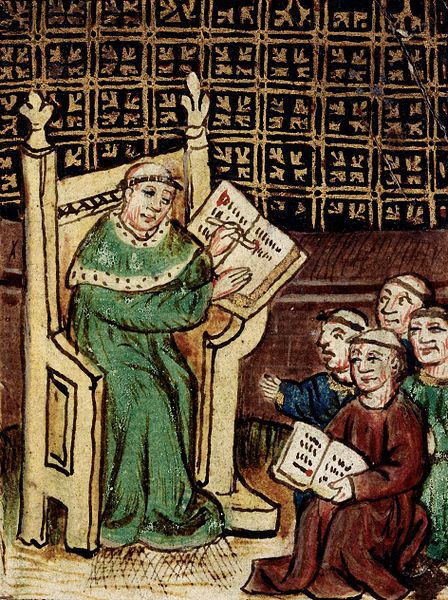
This famous illustration for which the manuscript is named has been the subject of numerous scholarly interpretations.

Cicero On Using “Leftover Time” for Writing Projects

Cicero, Laws 1.8-10

M. I do understand that I have been promising this work for a long time now, Atticus. It is something I would not refuse if any bit of open and free time were allotted to me. A work as momentous as this cannot be taken up when one’s efforts are occupied and his mind is elsewhere. It is really necessary to be free from worry and business.

A. What about the other things you have written more of than any of our people? What free time did you have set aside then?

M. These ‘leftover moments’ occur and I will not suffer wasting them—as when there are some days set aside for going to the country, I write something equal to what the number of days allow. But a history cannot be begun unless there is dedicated time and it can’t be completed in a short time. I habitually weigh down my thought when, once I have started, I am distracted by something else. And once a project is interrupted, I do not finish what was started easily.”

M. Intellego equidem a me istum laborem iam diu postulari, Attice; quem non recusarem, si mihi ullum tribueretur vacuum tempus et liberum; neque enim occupata opera neque inpedito animo res tanta suscipi potest; utrumque opus est, et cura vacare et negotio.

A. Quid ad cetera. quae scripsisti plura quam quisquam e nostris? quod tibi tandem tempus vacuum fuit concessum?

M. Subsiciva quaedam tempora incurrunt, quae ego perire non patior, ut, si qui dies ad rusticandum dati sint, ad eorum numerum adcommodentur quae scribimus. historia vero nec institui potest nisi praeparato otio nec exiguo tempore absolvi, et ego animi pendere soleo, cum semel quid orsus sum,1 si traducor alio, neque tam facile interrupta contexo quam absolvo instituta.

I encourage everyone to copy “Intellego equidem a me istum laborem iam diu postulari” and paste it liberally into emails explaining why you have yet to complete that review, abstract, etc. etc. Take a break for a day or a nap for an hour. Let Cicero speak for you!


Image result for ancient scholars writing
Image taken from this blog

The Soul of Genius

John Snelling Popkin, Three Lectures on Liberal Education:

“The rules and observations of the rhetorical art are highly useful, if they are sound, to lead the mind to perceive and feel the inspirations of genius, and the corrections of judgment; and to show the correct, and check the perverted use of its own faculties. But it must not stop there. It must go to the fountains; it must learn of the original masters; it must peruse the great authors and there it must be nourished, and cherished, and replenished, invigorated, and stimulated to exert its own powers, and put forth its own productions. From them the laws of Rhetoric were first derived. This art was not first formed as a mould, in which their works might be cast. It may well assist to form the taste and direct the judgment of the aspirant. But it is not enough for him to have studied the art; he must also, and chiefly, find the materials and their use m the best authors, and in his own mind. And in these sources, with his art, he may by habit acquire both matter and form.

The soul of genius works its own way, and makes its own laws, and gives laws to others. It may be corrected; it may be improved. But, I imagine, it was hardly conscious to itself of half the principles and purposes, which are ascribed to it by the critical reader. Yet it had them, and it used them, and produced the effects, and sent them forth to the world, by the spontaneous operation of the .mysterious powers of the human mind. If the superiority of the earlier over the later poets, in point of genius, be justly asserted, one great cause may have been, that they wrought fervently in liberty and passion; but their successors labored humbly and timidly in chains and fetters under a severe dominion. Yet Homer was not the first of his line, but the acme of an ascending order of poets, as Olen, and Linus, and Orpheus, and others known and unknown. It is said, there were schools in his day, and chiefly schools of poetry, and he was a Master. Every palace of Homer, or of Homer’s kings, had its divine poet, θεῖος ἀοιδός; and Achilles in his tent and in his wrath sang the glories of men to his harp. The dawn and the morning precede the rising sun; and the light arose on the darkness of chaos, before the central orb shone forth from the heavens.”

After the Body, The Mind Fades Away

Seneca, Moral Epistle 26.1-3

“I was recently explaining to you that I am in sight of my old age—but now I fear that I have put old age behind me! There is some different word better fit to these years, or at least to this body, since old age seems to be a tired time, not a broken one. Count me among the weary and those just touching the end.

Despite all this, I still am grateful to myself, with you to witness it. For I do not sense harm to my mind from age even though I feel it in my body. Only my weaknesses—and their tools—have become senile. My mind is vigorous and it rejoices that it depends upon the body for little. It has disposed of the greater portion of its burden. It celebrates and argues with me about old age. It says that this is its flowering. Let’s believe it, let it enjoy its own good.

My mind commands that I enter into contemplation and I think about what debt I owe to wisdom for this tranquility and modesty of ways and what portion is due to my age. It asks that I think about what I am incapable of doing in contrast to what I do not wish to do, whether I am happy because I don’t want something or I don’t want something because I lack the ability to pursue it.

For, what complaint is there or what problem is it if something which was supposed to end has ended? “But,” you interject, “it is the worst inconvenience to wear out, to be diminished, or, if I can say it properly, to dissolve. For we are not suddenly struck down and dead, we are picked away at! Each individual day subtracts something from our strength!”

But, look, is there a better way to end than to drift off to your proper exit as nature itself releases you? There is nothing too bad in a sudden strike which takes life away immediately, but this way is easy, to be led off slowly.”

Modo dicebam tibi, in conspectu esse me senectutis; iam vereor, ne senectutem post me reliquerim. Aliud iam his annis, certe huic corpori, vocabulum convenit, quoniam quidem senectus lassae aetatis, non fractae, nomen est; inter decrepitos me numera et extrema tangentis.

Gratias tamen mihi apud te ago; non sentio in animo aetatis iniuriam, cum sentiam in corpore. Tantum vitia et vitiorum ministeria senuerunt; viget animus et gaudet non multum sibi esse cum corpore. Magnam partem oneris sui posuit. Exultat et mihi facit controversiam de senectute. Hunc ait esse florem suum. Credamus illi; bono suo utatur. Ire in cogitationem iubet et dispicere, quid ex hac tranquillitate ac modestia morum sapientiae debeam, quid aetati, et diligenter excutere, quae non possim facere, quae nolim †prodesse habiturus ad qui si nolim quidquid non posse me gaudeo.† Quae enim querella est, quod incommodum, si quidquid debebat desinere, defecit? “Incommodum summum est,” inquis, “minui et deperire et, ut proprie dicam, liquescere. Non enim subito inpulsi ac prostrati sumus; carpimur. Singuli dies aliquid subtrahunt viribus.”

Ecquis exitus est melior quam in finem suum natura solvente dilabi? Non quia aliquid mali est ictus et e vita repentinus excessus, sed quia lenis haec est via, subduci.

seneca strength

“Well, Actually, None IS”: Seneca the Elder on Grammatical Pedantry

Seneca the Elder, Suasoriae 2.13, 540 M

“The grammarian Procellus used to claim that [Severus’] line was a solecism because, although he indicated many were speaking, he used to say “this is my day” instead of “this is our day”. And in this he was carping at the best part of a great poem. For, it is feeble if you make it “our” instead of my—all of the verse’s elegance will disappear.

For its greatest decorum is in this line and it comes from the vernacular (for, “this is my day” is something like a proverb). If, in addition, you reconsider the sense, then the grammarian’s pedantry—which should be kept away from all of the better minds—has no place at all. For, they did not all speak together as a chorus might with a leader guiding them, but each one spoke individually, “this is my day.”

Illud Porcellus grammaticus arguebat in hoc versu quasi soloecismum quod, cum plures induxisset, diceret: “hic meus est dies,” non: “hic noster est,” et in sententia optima id accusabat quod erat optimum. Muta enim ut “noster” sit: peribit omnis versus elegantia, in quo hoc est decentissimum, quod ex communi sermone trahitur; nam quasi proverbii loco est: “hic dies meus est”; et, cum ad sensum rettuleris, ne grammaticorum quidem calumnia ab omnibus magnis ingeniis summovenda habebit locum; dixerunt enim non omnes simul tamquam in choro manum ducente grammatico, sed singuli ex iis: “hic meus est dies.”

this is my day, punk.

Latin vs. Philology, Part XV:

Francesco Filelfo, Letter to Lorenzo Medici (Part 15)

As it was, among the Athenians, one thing to speak Attic and another to speak grammatically, so too the same difference may be observed among the Romans, that there is one mode for Latinity, and another for literature, but it is nevertheless a small distinction. This is obvious from the nouns which are found in both the fourth and second declensions.

For, words like ornatus, tumultus, senatus, victus, and many others of this sort have genitives, grammatically speaking, which end in –us, as huius ornatus, huius tumultus, huius senatus, huius victus, though they are declined in Latin as ornatus ornati, tumultus tumulti, senatus senati, and victus victi.

In the same way, nouns of the fifth declension will for the most part take, according to the grammarians, nominatives in –es and genitives in –ei, as for example barbaries barbariei, segnities segnitiei, duricies duriciei, mollicies molliciei, but in actual Latin use, the nominative ends in –a and the genitive in the diphthong –ae, as barbaria barbariae, segnitia segnitiae, duricia duriciae, mollicia molliciae.

Bearing on this, one may observe in actual Latin the use of the word nex in the nominative, which the rules of the grammarians prohibit.

The grammarians would also argue that the word sponte is in the ablative and lacking all of the other cases. But Cornelius Celsus shows that actual Latin uses the word differently, when he writes in the first book of his Art of Medicine, ‘A healthy person, who is in good health and in possession of their own will, should bind himself to no set rules.’

So, I say, Latin speech is common and known to all, but literary speech is not so. But while it is primarily restricted to the educated and the learned, yet it is such that it can correct and nourish Latin speech which has become degraded.”

File:Master and scholars - 1464 - L'image du Monde.jpg

Et ut apud Athenienses aliud erat attice loqui, aliud grammatice, eadem quoque differentia fuit apud Romanos, ut alia esset latinitatis ratio, et litteraturae alia, sed ea tamen admodum parva: quod patet in iis nominibus quae et in quarta reperiuntur et in secunda declinatione.

Nam ornatus, tumultus, senatus, victus multaque huiusmodi emittunt grammatice genitivos in – us, ut huius ornatus, huius tumultus, huius senatus, huius victus, cum latine declinentur ornatus -ti, tumultus -ti, senatus -ti et victus victi.

Et eodem modo quintae declinationis nomina secundum grammaticos emittunt, maiore ex parte, rectos in -es et genitivos in -ei, ut barbaries barbariei, segnities segnitiei, duricies duriciei, mollicies molliciei, quae in recto, secundum latinitatem, desinunt in -a et in genitivo in -ae diphtongon, ut barbaria barbariae, segnitia segnitiae, duricia duriciae, mollicia molliciae.

Ad haec latine reperitur nex in casu nominativo, quod grammaticorum praecepta prohibent.

Et sponte grammatice ablativum habere volunt, caeteris autem casibus carere. At latinitatem aliter eo uti ostendit Cornelius Celsus, qui libro primo suae artis medicae ita ait: “Sanus homo, qui et bene valet et suae spontis est, nullis obligare se legibus debet”.
Latinus, inquam, sermo et vulgaris erat et omnibus cognitus, litteralis vero non ita prorsus, sed viris peritis ac doctis duntaxat, caeterum talis qui depravatam latinitatem et emendaret et aleret.

Telling Teacher about Groin Pain

Marcus Aurelius to Fronto, 148–149 a.d. 

“I have learned that you have pain in your groin, my teacher. Because I remember how much trouble this pain usually gives you, I myself am suffering the worst worry. But my hope that in the time it took for this news to come to me that pain has potentially given in to applications and treatments lessons my worry. We are at this point enduring the summer heat, but our little girls—may it be permitted to say—are growing well. We suspect we are enduring healthy weather and spring temperatures. Goodbye, best of teachers.”

Magistro meo salutem.

Doluisse te inguina cognosco, mi magister, et quom recordor quantam vexationem tibi iste dolor adferre soleat, gravissimam sollicitudinem patior. Sed me levat quod spero illo spatio, quo perferebatur huc1 nuntius, potuisse cedere fomentis et remediis illam vim doloris. Nos aestivos calores adhuc experimur, sed quom parvolae nostrae, dixisse liceat, commode valeant, mera salubritate et verna temperie frui existimamus. Vale mi optime magister.


For the second part we have the better translation from Marius Ivașcu  “We are still experiencing the scorching heat of summer, but as long as our little ones – if we may say so – are feeling comfortable – we reckon we are enjoying pure health and springly mildness.” 

Image result for marcus aurelius

Philology is Not Enough

Henry Wright, Preface to Maxime Collignon’s A Manual of Greek Archaeology 

“MODERN culture owes to the civilisation of the ancient Greeks a profound debt, which is at once direct and indirect. The direct debt has arisen principally from the place long held by Greek studies in our system of education. The indirect debt, which is more subtle and less easily recognised, is that of many forces, inspirations, and models, in art, literature, and science, that have been transmitted to us from a remote past, through various peoples and through diverse civilisations. In our schools, and to a certain extent still in our colleges and universities, we understand by Greek studies almost exclusively the study of the language and literature of the ancient Hellenes. But the Hellenic spirit and it is this only that gives life to these studies has revealed itself in a novel and distinctly different manner, and with equal if not with greater vividness, delicacy, and force, in the manifold remains of Greek art, from the rudest specimens of the potter’s industry, up to the glorious monuments due to the genius of the sculptor and architect in the service of religion. Greek studies, then, that leave out of view the art of the ancient Greeks, are one-sided, fragmentary, and essentially defective.”

“I Always Wondered About Horse-Sodomites”

The word ‘hippopornos’, which appears to be a straightforward compound noun meaning either ‘horse-prostitute’ or ‘horse-sodomite’ does not, on the face of it, appear to make much sense. The word is not well-attested, surviving primarily in late lexica and commentaries. The Greek sources seem confused about its meaning as well, and two threads of explanation are offered. According to one line of thought, ‘horse’ was used as an intensifier indicating an excessive degree of something. (If this seems puzzling, one may consider the use of ‘ass’ as an intensifier in colloquial English of phrases like, ‘I just saw this big-ass dog down the street’ or ‘That was a lame-ass joke.’) Accordingly, a hippopornos was someone given over to prostitution (or sodomy, in the last two sources cited). The other, less lexically imaginative explanation, holds that it is a simple compound meaning, ‘a prostitute/sodomite on a horse.’ Read further for the details!

Suda:

“Hippoporne: Used in place of megaloporne (one excessively given over to sodomy). This is a rare word.”

῾Ιππόπορνε: ἀντὶ τοῦ μεγαλόπορνε· σπανίως. ᾿

Scholia to Aristophanes’ Frogs, 429:

“This of Hippobinus (Horsefucker): He has playfully emended the name on account of Hipponikos’ licentious proclivity for prostitution. They often use the word ‘horse’ (hippos) to mean ‘of a great degree.’
‘Hippoporne’: Kallias is mocked as squandering his patrimony, especially as he is mad for women. Or it is used of bestiality.”

(τουτονὶ τὸν ῾Ιπποβίνου: Παρεγραμμάτισε διὰ τὴν ἀσέλγειαν παρὰ τὸ ῾Ιππονίκου εἰς πορνομανῆ. τὸ δὲ ἵππος πολλαχοῦ ἐπὶ τοῦ μεγάλου λαμβάνουσιν· ἱππόπορνε. κωμῳδεῖται δὲ καὶ ὁ Καλλίας ὡς σπαθῶν τὴν πατρικὴν οὐσίαν, καὶ μάλιστα ἐπὶ γυναιξὶ μεμηνώς. ἢ τοῦ κτηνοβάτου).


Alciphron, Epistles 3.14:

“I cannot bear seeing Zeuxippe the horse-prostitute so cruelly using the young man. He is not only having to pay her gold and silver, but his houses and fields too. She, mainly contriving to light a slow fire of love in his heart, pretends to love the young Euboeus, so that once she has gone through his possessions, she can turn to another love.”

Οὐκ ἀνέχομαι ὁρῶν Ζευξίππην τὴν ἱππόπορνον ἀπηνῶς τῷ μειρακίῳ χρωμένην. οὐ γὰρ δαπανᾶται εἰς αὐτὴν χρυσίον μόνον καὶ ἀργύριον, ἀλλὰ καὶ συνοικίας καὶ ἀγρούς. ἡ δέ, ἐπὶ πλέον ἐκτύφεσθαι τὸν ἔρωτα τούτῳ μηχανωμένη, τοῦ Εὐβοέως ἐρᾶν προσποιεῖται [τοῦ] νεανίσκου, ἵνα <τὰ> τούτου κατασπαθήσασα οὕτως ἐπ’ ἄλλον τρέψῃ τὸν ἔρωτα.


Athenaeus, Deipnosophistae 13.18:

“Diogenes, seeing a man who had shaved his beard off, said, ‘Surely you are not able to accuse nature for making you a man and not a woman?’ Seeing another man on a horse, in roughly the same state, rubbed down with ointment and accordingly dressed up, he said that he was earlier wondering what the horse-sodomite might be, and that he had now found it.”

‘Διογένης δὲ ἰδών τινα οὕτως ἔχοντα τὸ γένειον ἔφησεν· ‘μή τι ἔχεις ἐγκαλεῖν τῇ φύσει, ὅτι ἄνδρα σὲ ἐποίησε καὶ οὐ γυναῖκα;’ ἕτερον δέ τινα ἐπὶ ἵππου ἰδὼν παραπλησίως ἔχοντα καὶ μεμυρισμένον καὶ τούτοις ἀκολούθως ἠμφιεσμένον, πρότερον μὲν ἔφησε ζητεῖν τί ἐστιν ὁ ἱππόπορνος, νῦν δ’ εὑρηκέναι. ἐν ῾Ρόδῳ δὲ νόμου ὄντος μὴ ξύρεσθαι οὐδ’ ὁ ἐπιληψόμενος οὐδείς ἐστιν διὰ τὸ πάντας ξύρεσθαι. ἐν Βυζαντίῳ δὲ ζημίας ἐπικειμένης τῷ ἔχοντι [κουρεῖ] ξυρὸν οὐδὲν ἧττον πάντες χρῶνται αὐτῷ.’ καὶ ταῦτα μὲν ὁ θαυμάσιος εἴρηκε Χρύσιππος.

Eustathius, Commentaries on The Odyssey, 2.260

“Mention should be made about Diogenes coining the word ‘horse-sodomite’ by analogy with ‘horse-centaur.’ For, when he saw a man who has disfigured his beard and was riding, smeared with oil, upon a horse, he said that he was wondering who a horse-sodomite was, and that he had now found it. Clearly, the word ‘horse-sodomite’ was meaningless until that time, much like tragelaphos (goat-stag) and other such words. The fact that scorn of the beard was a subject of reproach to the ancients is clear from many examples.”

᾿Ενταῦθα δὲ μνεία ληπτέον Διογένους ὀνοματοποιήσαντος ἱππόπορνόν τινα πρὸς ἀναλογίαν τοῦ ἱπποκένταυρον. ἰδὼν γάρ, φασι, τινὰ κατῃκισμένον τὸ γένειον καὶ μεμυρισμένον ἐπὶ ἵππου, πρότερον μὲν ἔφη ζητεῖν τίς ἐστιν ὁ ἱππόπορνος, νῦν δ’ εὑρηκέναι, ὡς δηλαδὴ ἀνυποστάτου φωνῆς μέχρι τότε οὔσης τῆς κατὰ τὸν ἱππόπορνον, ὁποία καὶ ἡ κατὰ τὸν τραγέλαφον καὶ τὰ τοιαῦτα. ὅτι δὲ ἡ τῶν γενείων ἐξαθέρισις ἐπονείδιστος ἦν τοῖς παλαιοῖς, ἐκ πολλῶν δηλοῦται.


Persius Addresses a Petulant Man-Baby

Persius, Satires 3.15-19

“Fool, more foolish with each passing day,
Is this what we’ve come to? Ah, why not just be like
A little pigeon or a baby prince and insist on eating chopped up food
Or stop your mom from singing to you because you’re so angry?”

“o miser inque dies ultra miser, hucine rerum
venimus? a, cur non potius teneroque columbo
et similis regum pueris pappare minutum
poscis et iratus mammae lallare recusas?”

Livre d’astrologie, France, XIVe siècle
Paris, BnF, département des Manuscrits, Latin 7344, fol. 7v.