Ancient Oratory and Large Mantles

Laurence Sterne

The Life and Opinions of Tristram Shandy, Gentleman (3.14):

It is a singular stroke of eloquence (at least it was so, when eloquence flourished at Athens and Rome, and would be so now, did orators wear mantles) not to mention the name of a thing, when you had the thing about you in petto, ready to produce, pop, in the place you want it. A scar, an axe, a sword, a pink’d doublet, a rusty helmet, a pound and a half of pot-ashes in an urn, or a three-halfpenny pickle pot—but above all, a tender infant royally accoutred.—Tho’ if it was too young, and the oration as long as Tully’s second Philippick—it must certainly have beshit the orator’s mantle.—And then again, if too old,—it must have been unwieldy and incommodious to his action—so as to make him lose by his child almost as much as he could gain by it.—Otherwise, when a state orator has hit the precise age to a minute——hid his BAMBINO in his mantle so cunningly that no mortal could smell it——and produced it so critically, that no soul could say, it came in by head and shoulders—Oh Sirs! it has done wonders—It has open’d the sluices, and turn’d the brains, and shook the principles, and unhinged the politicks of half a nation.

These feats however are not to be done, except in those states and times, I say, where orators wore mantles——and pretty large ones too, my brethren, with some twenty or five-and-twenty yards of good purple, superfine, marketable cloth in them—with large flowing folds and doubles, and in a great style of design.—All which plainly shews, may it please your worships, that the decay of eloquence, and the little good service it does at present, both within and without doors, is owing to nothing else in the world, but short coats, and the disuse of trunk-hose.——We can conceal nothing under ours, Madam, worth shewing.

Leave Your Homework to Sunday Night? Philo has Some Words for You

Philo, The Preliminary studies 29.166–7

There are those who, when they encounter the frights and horrors of the wilderness with total endurance and strength, finish the contest of life. They preserve life unsullied and unconquered, holding fast against the compulsions of nature like poverty, so that they can subdue hunger, thirst, cold, and heat and all the things which enslaves other people through the great abundance of their strength.

The cause of this is not simple toil but toil with a certain sweetening. For he says “the water is sweetened” and the work that is sweet and attractive is also called “love of labor” (philoponia). For in work the desire and longing and and love of finer things is sweet. Let no one turn away from this kind of suffering, nor let anyone believe that when the table of the feast and happiness is called “bread of suffering” it is for its harm rather than profit. For the soul which is chastened is fed by the instructions of education.”

οἱ δὲ τὰ φοβερὰ καὶ δεινὰ τῆς ἐρήμης πάνυ τλητικῶς καὶ ἐρρωμένως ἀναδεχόμενοι τὸν ἀγῶνα τοῦ βίου διήθλησαν ἀδιάφθορον καὶ ἀήττητον φυλάξαντες καὶ τῶν τῆς φύσεως ἀναγκαίων κατεξαναστάντες, ὡς πεῖναν, δίψος, [ῥῖγος,] κρύος, θάλπος, ὅσα τοὺς ἄλλους εἴωθε δουλοῦσθαι, κατὰ πολλὴν ἰσχύος περιουσίαν ὑπάγεσθαι. αἴτιον δὲ ἐγένετο οὐ ψιλὸς ὁ πόνος, ἀλλὰ σὺν τῷ γλυκανθῆναι· λέγει γάρ· “ἐγλυκάνθη τὸ ὕδωρ,” γλυκὺς δὲ καὶ ἡδὺς πόνος ἑτέρῳ ὀνόματι φιλοπονία καλεῖται. τὸ γὰρ ἐν πόνῳ γλυκὺ ἔρως ἐστὶ καὶ πόθος καὶ ζῆλος καὶ φιλία τοῦ καλοῦ. μηδεὶς οὖν τὴν τοιαύτην κάκωσιν ἀποστρεφέσθω, μηδ᾿ “ ἄρτον κακώσεως” νομισάτω ποτὲ λέγεσθαι τὴν ἑορτῆς καὶ εὐφροσύνης τράπεζαν ἐπὶ βλάβῃ μᾶλλον ἢ ὠφελείᾳ· τρέφεται γὰρ τοῖς παιδείας δόγμασιν ἡ νουθετουμένη ψυχή.

PhiloThevet.jpg
Enter a caption

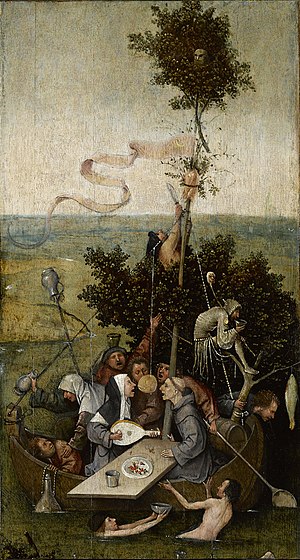
Choosing a Captain on the Ship of Fools

Plato, Republic 6 488a7-89a2

[This was inspired by a”Ship of Fools” post at LitKicks]

Consider this how this could turn out on many ships or even just one: there is a captain of some size and strength beyond the rest of the men in the ship, but he is deaf and similarly limited at seeing, and he knows as much about sailing as these qualities might imply. So, the sailors are struggling with one another about steering the ship, because each one believes that he should be in charge, even though he has learned nothing of the craft nor can indicate who his teacher was nor when he had the time to learn. Some of them are even saying that it is not teachable, and that they are ready to cut down the man who says it can be taught.

They are always hanging all over the captain asking him and making a big deal of the fact that he should entrust the rudder to them. There are times when some of them do not persuade him, and some of them kill others or kick them off the ship, and once they have overcome the noble captain through a mandrake, or drugs, or something else and run the ship, using up its contents drinking, and partying, and sailing just as such sort of men might. In addition to this, they praise as a fit sailor, and call a captain and knowledgeable at shipcraft the man who is cunning at convincing or forcing the captain that they should be in charge. And they rebuke as useless anyone who is not like this.

Such men are unaware what a true helmsman is like, that he must be concerned about the time of year, the seasons, the sky, the stars, the wind and everything that is appropriate to the art, if he is going to be a leader of a ship in reality, how he might steer the ship even if some desire it or not, when they believe that it is not possible to obtain art or practice about how to do this, something like an art of ship-steering. When these types of conflicts are occurring on a ship, don’t you think the one who is a true helmsman would be called a star-gazer, a blabber, or useless to them by the sailors in the ships organized in this way?


νόησον γὰρ τοιουτονὶ γενόμενον εἴτε πολλῶν νεῶν πέρι εἴτε μιᾶς· ναύκληρον μεγέθει μὲν καὶ ῥώμῃ ὑπὲρ τοὺς ἐν τῇ νηὶ πάντας, ὑπόκωφον δὲ καὶ ὁρῶντα ὡσαύτως βραχύ τι καὶ γιγνώσκοντα περὶ ναυτικῶν ἕτερα τοιαῦτα, τοὺς δὲ ναύτας στασιάζοντας πρὸς ἀλλήλους περὶ τῆς κυβερνήσεως, ἕκαστον οἰόμενον δεῖν κυβερνᾶν, μήτε μαθόντα πώποτε τὴν τέχνην μέτε ἔχοντα ἀποδεῖξαι διδάσκαλον ἑαυτοῦ μηδὲ χρόνον ἐν ᾧ ἐμάνθανεν, πρὸς δὲ τούτοις φάσκοντας μηδὲ διδακτὸν εἶναι, ἀλλὰ καὶ τὸν λέγοντα ὡς διδακτὸν ἑτοίμους κατατέμνειν, αὐτοὺς δὲ αὐτῷ ἀεὶ τῷ ναυκλήρῳ περικεχύσθαι δεομένους καὶ πάντα ποιοῦντας ὅπως ἂν σφίσι τὸ πηδάλιον ἐπιτρέψῃ, ἐνίοτε δ’ ἂν μὴ πείθωσιν ἀλλὰ ἄλλοι μᾶλλον, τοὺς μὲν ἄλλους ἢ ἀποκτεινύντας ἢ ἐκβάλλοντας ἐκ τῆς νεώς, τὸν δὲ γενναῖον ναύκληρον μανδραγόρᾳ ἢ μέθῃ ἤ τινι ἄλλῳ συμποδίσαντας τῆς νεὼς ἄρχειν χρωμένους τοῖς ἐνοῦσι, καὶ πίνοντάς τε καὶ εὐωχουμένους πλεῖν ὡς τὸ εἰκὸς τοὺς τοιούτους, πρὸς δὲ τούτοις ἐπαινοῦντας ναυτικὸν μὲν καλοῦντας καὶ κυβερνητικὸν καὶ ἐπιστάμενον τὰ κατὰ ναῦν, ὃς ἂν συλλαμβάνειν δεινὸς ᾖ ὅπως ἄρξουσιν ἢ πείθοντες ἢ βιαζόμενοι τὸν ναύκληρον, τὸν δὲ μὴ τοιοῦτον ψέγοντας ὡς ἄχρηστον, τοῦ δὲ ἀληθινοῦ κυβερνήτου πέρι μηδ’ ἐπαΐοντες, ὅτι ἀνάγκη αὐτῷ τὴν ἐπιμέλειαν ποιεῖσθαι ἐνιαυτοῦ καὶ ὡρῶν καὶ οὐρανοῦ καὶ ἄστρων καὶ πνευμάτων καὶ πάντων τῶν τῇ τέχνῃ προσηκόντων, εἰ μέλλει τῷ ὄντι νεὼς ἀρχικὸς ἔσεσθαι, ὅπως δὲ κυβερνήσει ἐάντε τινες βούλωνται ἐάντε μή, μήτε τέχνην τούτου μήτε μελέτην οἰόμενοι δυνατὸν εἶναι λαβεῖν ἅμα καὶ τὴν κυβερνητικήν. τοιούτων δὴ περὶ τὰς ναῦς γιγνομένων τὸν ὡς ἀληθῶς κυβερνητικὸν οὐχ ἡγῇ ἂν τῷ ὄντι μετεωροσκόπον τε καὶ ἀδολέσχην καὶ ἄχρηστόν σφισι καλεῖσθαι ὑπὸ τῶν ἐν ταῖς οὕτω κατεσκευασμέναις ναυσὶ πλωτήρων;

Image result for ship of fools
Hieronymus Bosch, “Ship of Fools”
  • Aulus Gellius, Attic Nights 4.8:
  • Fabricius Luscinus was a man of great glory and great accomplishments. Publius Cornelius Rufinus worked hard with his hands, was a good warrior, and was extremely skilled in military discipline, but he was a thief and given to bitter avarice. Fabricius hated him and was certainly not a friend, but hated him on account of his characteristics. But when consuls needed to be created in the republic‘s most difficult times, Rufinus sought the consulship. His competitors were useless and incompetent, and Fabricius exerted himself to get the consulship given to Rufinus. Everyone wondered why he would wish to have made consul a man who was not just greedy, but also his personal enemy. Fabricius told them that he would rather be fleeced by a fellow citizen than sold by an enemy.

    Fabricius Luscinus magna gloria vir magnisque rebus gestis fuit. P. Cornelius Rufinus manu quidem strenuus et bellator bonus militarisque disciplinae peritus admodum fuit, sed furax homo et avaritia acri erat. Hunc Fabricius non probabat neque amico utebatur osusque eum morum causa fuit. Sed cum in temporibus rei difficillimis consules creandi forent et is Rufinus peteret consulatum competitoresque eius essent inbelles quidam et futtiles, summa ope adnixus est Fabricius, uti Rufino consulatus deferretur. Eam rem plerisque admirantibus, quod hominem avarum, cui esset inimicissimus, creari consulem vellet, “malo,” inquit “civis me compilet, quam hostis vendat”.

    A Hydrophilic High: The Effects of Medicinal Seahorse

    Aelian, De Natura Animalium 14.20

    “Some people who know a lot about fishing claim that the stomach of a sea-horse—if someone dissolves it in wine after boiling it and gives it to someone to drink—is an extraordinary potion combined with wine, when compared to other medicines. For, at first, the most severe retching overcomes anyone who drinks it and then a dry coughing fit takes over even though he vomits nothing at all, and then: the upper part of his stomach grows and swells; warm spells roll over his head; and, finally, snot pours from his nose and releases a fishy smell. Then his eyes turn blood-red and heated while his eye-lids swell up.

    They claim that a desire to vomit overwhelms him but that he can bring nothing up. If nature wins, then he evades death and slips away into forgetfulness and insanity. But if the wine permeates his lower stomach, there is nothing to be done, and the individual dies eventually. Those who do survive, once they have wandered into insanity, are gripped by a great desire for water: they thirst to sea water and hear it splashing. And this, at least, soothes them and makes them sleep. Then they like to spend their time either by endlessly flowing rivers or near seashores or next to streams or some lakes. And even though they don’t want to drink, they love to swim, to put their feet in the water, and to wash their hands.”

    1. Λέγουσι δὲ ἄνδρες ἁλιείας ἐπιστήμονες, τὴν τοῦ ἱπποκάμπου γαστέρα εἴ τις ἐν οἴνῳ κατατήξειενἕψων καὶ τοῦτον δοίη τινὶ πιεῖν, φάρμακον εἶναι τὸν οἶνον ἄηθες ὡς πρὸς τὰ ἄλλα φάρμακα ἀντικρινόμενον· τὸν γάρ τοι πιόντα αὐτοῦ πρῶτον μὲν καταλαμβάνεσθαι λυγγὶ σφοδροτάτῃ, εἶτα βήττειν ξηρὰν βῆχα, καὶ στρεβλοῦσθαι μέν, ἀναπλεῖν δὲ αὐτῷ οὐδὲ ἕν, διογκοῦσθαι δὲ καὶ διοιδάνειν τὴν ἄνω γαστέρα, θερμά τε τῇ κεφαλῇ ἐπιπολάζειν ῥεύματα, καὶ διὰ τῆς ῥινὸς κατιέναι φλέγμα καὶ ἰχθυηρᾶς ὀσμῆς προσβάλλειν· τοὺς δὲ ὀφθαλμοὺς ὑφαίμους αὐτῷ γίνεσθαι καὶ πυρώδεις, τὰ βλέφαρα δὲ διογκοῦσθαι. ἐμέτων δὲ ἐπιθυμίαι ἐξάπτονταί φασιν, ἀναπλεῖ δὲ οὐδὲ ἕν. εἰ δὲ ἐκνικήσειεν ἡ φύσις, τὸν μὲν <τὸ> ἐς θάνατον σφαλερὸν παριέναι, ἐς λήθην δὲ ὑπολισθαίνειν καὶ παράνοιαν. ἐὰν δὲ ἐς τὴν κάτω γαστέρα διολίσθῃ, μηδὲν ἔτι εἶναι, πάντως δὲ ἀποθνήσκειν τὸν ἑαλωκότα. οἱ δὲ περιγενόμενοι ἐς παράνοια ἐξοκείλαντες ὕδατος ἱμέρῳ πολλῷ καταλαμβάνονται, καὶ ὁρᾶν διψῶσιν ὕδωρ καὶ ἀκούειν λειβομένου· καὶ τοῦτό γε αὐτοὺς καταβαυκαλᾷ καὶ κατευνάζει. καὶ διατρίβειν φιλοῦσιν ἢ παρὰ τοῖς ἀενάοις ποταμοῖς ἢ αἰγιαλῶν πλησίον ἢ παρὰ κρήναις ἢ λίμναις τισί, καὶ πιεῖν μὲν οὐ πάνυ <τι>7 γλίχονται, ἐρῶσι δὲ νήχεσθαι καὶ τέγγειν τὼ πόδε ἢ ἀπονίπτειν τὼ χεῖρε.

    One horse makes you smaller….

    By Nhobgood Nick Hobgood – Own work, CC BY-SA 3.0, https://commons.wikimedia.org/w/index.php?curid=5693729


    Sh*tting The Bed in Ancient Greek

    “Does anyone know the ancient Greek for shitting the bed?”

    It is a sign of the high rhetoric of our sophisticated era that this (perhaps rhetorical) question was posed in Marina Hyde’s Guardian opinion piece on the befuddled blond-con PM Boris Johnson who just happens to have a Classical education.* It is perhaps also a sign of my esteemed place in this ecology of elevated discourse that multiple people tweeted me the question. And, finally, it is a sign of my own academic training that I resisted the urge initially because my first thought was “well, now, Ancient Greek just does not have that idiom.”

    But, if it did, well, it might look like one of these:

    “to shit the bed,” κλινοχέζειν

    “bed-shitter,” κλινοχέστης

    “to recline in dung,” κοπροκλίνειν

    “shit-sleeper,” σκατοκαθεύδων

    (for Ancient Greek students, we have two compound infinitives, a compound agentive noun, and a compound participle!)

    There are many Greek words for bed apart from klinê. One could also select koitê, strômnê, lektron, or lekhos. I chose klinê because it may be familiar from the English clinomania. I avoided koitê because it has a sexual use in English and the last thing I would want to do is imply that we are talking about a shit-fucking politician. I chose khezein for the verb because it is, according to Henderson’s Maculate Muse, the “standard term” (188). The ending χέστης is a totally made-up agentive from khezein. The participle  χέσας appears for the “shitter”  at Aristophanes Birds 790.

    Based on the parallel βορβορκοίτης (“lying in filth,” Batrakh 220) we could have σκατοκοίτης / κοπροκοίτης (“lying in shit”) but I don’t think this compound gets to the sense of the English idiom which is, essentially, to fuck up so completely that you might as well be lying in a post-mortem pile of shit.

    If you want to play along, here’s an earlier post about various words for excrement and here’s another with compounds for beds. Apparently this is a “chiefly US expression” reddit is divided on the origin of the phrase, one person asserting that it has to do with bowel evacuation after death.

    Ancient Greek seems sadly deficient in scatological proverbs. I found only one:

    Arsenius, 6.70c

    “You have fallen into Augeus’ dung: this means “you are immersed in filth”

     Εἰς τὴν Αὐγέου κόπρον ἐμπέπτωκας: ἤγουν ἐβορβορώθης.

    *”happens to have” is perhaps unfair and untrue. He has this education because he is part of a moneyed elite who use education as one of many tools to decorate the facade of their elitist pillaging of their country and blithe assumption to the privilege of rule.

    h/t @brixtandrew and the others who brought this to my attention

    I found this while searching:

    Sophron, fr. 11

    “They filled their bedroom with shit while dancing”

    βαλλίζοντες τὸν θάλαμον σκάτους ἐνέπλησαν

    Damox, fr. 2. 15-16

    “Rub him down with shit / and expel him from school”

    μινθώσας ἄφες / ὡς ἐκ διατριβῆς

    Image result for shit the bed
    Someone made this. It seemed appropriate

    Plato, Patriotism, Prejudice

    E.M. Forster, The Longest Journey (Chp. 4):

    “Now we must complete the chapel.” He paused reverently, and said, “And here is a fragment of the original building.” Rickie at once had a rush of sympathy. He, too, looked with reverence at the morsel of Jacobean brickwork, ruddy and beautiful amidst the machine-squared stones of the modern apse. The two men, who had so little in common, were thrilled with patriotism. They rejoiced that their country was great, noble, and old.

    “Thank God I’m English,” said Rickie suddenly.

    “Thank Him indeed,” said Mr. Pembroke, laying a hand on his back.

    “We’ve been nearly as great as the Greeks, I do believe. Greater, I’m sure, than the Italians, though they did get closer to beauty. Greater than the French, though we do take all their ideas. I can’t help thinking that England is immense. English literature certainly.”

    Mr. Pembroke removed his hand. He found such patriotism somewhat craven. Genuine patriotism comes only from the heart. It knows no parleying with reason. English ladies will declare abroad that there are no fogs in London, and Mr. Pembroke, though he would not go to this, was only restrained by the certainty of being found out. On this occasion he remarked that the Greeks lacked spiritual insight, and had a low conception of woman.

    “As to women—oh! there they were dreadful,” said Rickie, leaning his hand on the chapel. “I realize that more and more. But as to spiritual insight, I don’t quite like to say; and I find Plato too difficult, but I know men who don’t, and I fancy they mightn’t agree with you.”

    “Far be it from me to disparage Plato. And for philosophy as a whole I have the greatest respect. But it is the crown of a man’s education, not the foundation. Myself, I read it with the utmost profit, but I have known endless trouble result from boys who attempt it too soon, before they were set.”

    “But if those boys had died first,” cried Rickie with sudden vehemence, “without knowing what there is to know—”

    “Or isn’t to know!” said Mr. Pembroke sarcastically.

    “Or what there isn’t to know. Exactly. That’s it.”

    “My dear Rickie, what do you mean? If an old friend may be frank, you are talking great rubbish.” And, with a few well-worn formulae, he propped up the young man’s orthodoxy. The props were unnecessary. Rickie had his own equilibrium. Neither the Revivalism that assails a boy at about the age of fifteen, nor the scepticism that meets him five years later, could sway him from his allegiance to the church into which he had been born. But his equilibrium was personal, and the secret of it useless to others. He desired that each man should find his own.

    “What does philosophy do?” the propper continued. “Does it make a man happier in life? Does it make him die more peacefully? I fancy that in the long-run Herbert Spencer will get no further than the rest of us. Ah, Rickie! I wish you could move among the school boys, and see their healthy contempt for all they cannot touch!” Here he was going too far, and had to add, “Their spiritual capacities, of course, are another matter.” Then he remembered the Greeks, and said, “Which proves my original statement.”

    Submissive signs, as of one propped, appeared in Rickie’s face. Mr. Pembroke then questioned him about the men who found Plato not difficult. But here he kept silence, patting the school chapel gently, and presently the conversation turned to topics with which they were both more competent to deal.

    Related image


    A Brother or a Counterfeit: Theognis on Friendship

    Theognis, 93-100

    “If someone praises you for as long as you see him
    But lashes you with an evil tongue when you are apart,
    That kind of man is not a very good friend at all.
    He’s the kind who speaks smoothly with his tongue, but harbors different thoughts.

    Let me have that kind of friend who knows his companion
    And puts up with him when he’s mean or in a rage,
    Like a brother. But you, friend, keep these things your heart
    And you will remember me in future days.”

    ἄν τις ἐπαινήσῃ σε τόσον χρόνον ὅσσον ὁρῴης,
    νοσφισθεὶς δ᾿ ἄλλῃ γλῶσσαν ἱῇσι κακήν,
    τοιοῦτός τοι ἑταῖρος ἀνὴρ φίλος οὔ τι μάλ᾿ἐσθλός.
    ὅς κ᾿ εἴπῃ γλώσσῃ λεῖα, φρονῇ δ᾿ ἕτερα.
    ἀλλ᾿ εἴη τοιοῦτος ἐμοὶ φίλος, ὃς τὸν ἑταῖρον
    γινώσκων ὀργὴν καὶ βαρὺν ὄντα φέρει
    ἀντὶ κασιγνήτου. σὺ δέ μοι, φίλε, ταῦτ᾿ ἐνὶ θυμῷ
    φράζεο, καί ποτέ μου μνήσεαι ἐξοπίσω.

    117-118

    “Nothing is harder than recognizing a counterfeit.
    But, Kurnos, there is nothing more urgent than guarding against one.”

    κιβδήλου δ᾿ ἀνδρὸς γνῶναι χαλεπώτερον οὐδέν,
    Κύρν᾿, οὐδ᾿ εὐλαβίης ἐστὶ περὶ πλέονος.

    119-128

    “One can survive the ruin from counterfeit silver and gold
    Kurnos—and a wise person can easily discover it.
    But if a dear friend’s mind is hidden in his chest
    When he is false and he has a deceptive heart,
    Well this the most counterfeit thing god has made for mortals
    And it is the most painful thing of all to recognize.
    For you cannot know the mind of a man or a woman
    Before you investigate them, like an animal under a yoke—
    And you cannot imagine what they are like at the right time
    Since the outer image often misleads your judgment.”

    Χρυσοῦ κιβδήλοιο καὶ ἀργύρου ἀνσχετὸς ἄτη,
    Κύρνε, καὶ ἐξευρεῖν ῥάιδιον ἀνδρὶ σοφῶι.
    εἰ δὲ φίλου νόος ἀνδρὸς ἐνὶ στήθεσσι λελήθηι
    ψυδρὸς ἐών, δόλιον δ’ ἐν φρεσὶν ἦτορ ἔχηι,
    τοῦτο θεὸς κιβδηλότατον ποίησε βροτοῖσιν,
    καὶ γνῶναι πάντων τοῦτ’ ἀνιηρότατον.
    οὐδὲ γὰρ εἰδείης ἀνδρὸς νόον οὐδὲ γυναικός,
    πρὶν πειρηθείης ὥσπερ ὑποζυγίου,
    οὐδέ κεν εἰκάσσαις ὥσπερ ποτ’ ἐς ὥριον ἐλθών·
    πολλάκι γὰρ γνώμην ἐξαπατῶσ’ ἰδέαι.

    1318a-b

    “Alas, I am a wretch: because of the terrors I have suffered
    I bring pleasure to my enemies and toil to my friends”

    ῎Ωιμοι ἐγὼ δειλός· καὶ δὴ κατάχαρμα μὲν ἐχθροῖς,
    τοῖσι φίλοις δὲ πόνος δεινὰ παθὼν γενόμην.

    1079-80

    “I’ll fault no enemy when he is noble,
    nor will I praise a friend when he is wrong”

    Οὐδένα τῶν ἐχθρῶν μωμήσομαι ἐσθλὸν ἐόντα,
    οὐδὲ μὲν αἰνήσω δειλὸν ἐόντα φίλον.

    1151–52

    “Never dismiss a present friend and seek another
    Because you are persuaded by the words of cowardly people.”

    μήποτε τὸν παρεόντα μεθεὶς φίλον ἄλλον ἐρεύνα
    δειλῶν ἀνθρώπων ῥήμασι πειθόμενος.

     595-598

    “Dude, let’s be friends with each other at a distance.
    With the exception of wealth, there’s too much of any good thing.
    But we can be friends for a long time, just spend time with different men
    Who have a better grasp of your mind.”

    ἄνθρωπ᾿, ἀλλήλοισιν ἀπόπροθεν ὦμεν ἑταῖροι·
    πλὴν πλούτου παντὸς χρήματός ἐστι κόρος.
    δὴν δὴ καὶ φίλοι ὦμεν· ἀτάρ τ᾿ ἄλλοισιν ὁμίλει
    ἀνδράσιν, οἳ τὸν σὸν μᾶλλον ἴσασι νόον.

    1219-1220

    “It is difficult for an enemy to deceive
    But it is easy for a friend to fool a friend.”

    ᾿Εχθρὸν μὲν χαλεπὸν καὶ δυσμενεῖ ἐξαπατῆσαι,
    Κύρνε· φίλον δὲ φίλωι ῥάιδιον ἐξαπατᾶν.

    Friendship
    Royal 19 C II  f. 59v

    Deep Thoughts with Aristotle

    Aristotle, Problems 885b

    “Why does sitting make some people fat while it makes others thin?”

    Διὰ τί ἡ καθέδρα τοὺς μὲν παχύνει τῶν ἀνθρώπων, τοὺς δὲ ἰσχναίνει

    886a

    “Why do people yawn when they see others yawn? Is it because they desire something if they are reminded of it, especially with things that are easily encouraged, like urination?”

    Διὰ τί τοῖς χασμωμένοις ἀντιχασμῶνται ὡς ἐπὶ τὸ | πολύ; ἢ διότι, ἐὰν ἀναμνησθῶσιν ὀργῶντες, ἐνεργοῦσιν, μάλιστα δὲ τὰ εὐκίνητα, οἷον οὐροῦσιν;

    […]

    “is it because every voice and sound is actually breath?”

    ἢ διότι φωνὴ μὲν πᾶσα καὶ ψόφος πνεῦμά ἐστιν;

    887a

    “Why when we see someone being cut or burned or harmed or suffering any other terror do we feel grief in our minds?”

    Διὰ τί, ἐπειδὰν τεμνόμενόν τινα ἴδωμεν ἢ καιόμενον ἢ στρεβλούμενον ἢ ἄλλο τι τῶν δεινῶν πάσχοντα, συναλγοῦμεν τῇ διανοίᾳ;

    888b

    “Why do we shiver after we’ve finished peeing?”

    Διὰ τί ἐν τῇ τελευταίᾳ προέσει τοῦ οὔρου φρίττομεν;

    889a

    “Why don’t angry people feel the cold?”

    Διὰ τί οἱ ὀργιζόμενοι οὐ ῥιγῶσιν;

    Image result for Aristotle

    On Drinking and Sex

    872b

    “Why can’t drunk people have sex?”

    Διὰ τί οἱ μεθύοντες ἀφροδισιάζειν ἀδύνατοί εἰσιν;

    874b

    “Why are the drunk more prone to tears?”

    Διὰ τί οἱ μεθύοντες ἀριδάκρυοι μᾶλλον;

    “Why is it hard to sleep when you’re drunk?”

    Διὰ τί τοῖς μεθύουσιν οὐκ ἐγγίνεται ὕπνος

    “Why does someone who is buzzed act more inebriated than either the drunk or the sober?”

    Διὰ τί ὁ ἀκροθώραξ μᾶλλον παροινεῖ τοῦ μᾶλλον μεθύοντος καὶ τοῦ νήφοντος;

    876b

    “Why does a drinker’s tongue stumble?”

    Διὰ τί τῶν μεθυόντων ἡ γλῶττα πταίει;

    877a

    “Why is being barefoot not an advantage for sex?”

    Διὰ τί ἡ ἀνυποδησία οὐ συμφέρει πρὸς ἀφροδισιασμούς;

    “Why does sex wear humans out more than other animals?”

    Διὰ τί ἐκλύεται μάλιστα τῶν ζῴων ἀφροδισιάσας ἄνθρωπος;

    877b

    “Why do people fasting have sex so quickly?”

    Διὰ τί νήστεις θᾶττον ἀφροδισιάζουσιν;

    878a

    “Why is it harder for people for have sex in water?”

    Διὰ τί ἐν τῷ ὕδατι ἧττον δύνανται ἀφροδισιάζειν οἱ ἄνθρωποι;

    880b

    “Why does a person’s eyes weaken if they have sex?”

    Διὰ τί, ἐὰν ἀφροδισιάζῃ ὁ ἄνθρωπος, οἱ ὀφθαλμοὶ ἀσθενοῦσι μάλιστα;

    882b

    “Why do people fall more while running than walking?”

    Διὰ τί μᾶλλον θέοντες ἢ βαδίζοντες πίπτουσιν;

    883b

    “Why does the road seem longer when we don’t know how far we are walking than when we do, even if everything else is the same?”

    Διὰ τί πλείων δοκεῖ ἡ ὁδὸς εἶναι, ὅταν μὴ εἰδότες βαδίζωμεν πόση τις, ἢ ὅταν εἰδότες, ἐὰν τἆλλα ὁμοίως | ἔχοντες τύχωμεν;

    883b

    “Why is running harder than walking?”

    Διὰ τί χαλεπώτερον θεῖν ἢ βαδίζειν;

    884a

    “Why do short walks wear us out?”

    Διὰ τί κοπώδεις οἱ βραχεῖς τῶν περιπάτων;

    885b

    “Why do those on horses fall less frequently? Is it because they are more afraid?”

    Διὰ τί οἱ ἀφ᾿ ἵππων ἧττον πίπτουσιν; ἢ διὰ τὸ φοβεῖσθαι φυλάττονται μᾶλλον;

    “Why do some of us feel numb?”

    Διὰ τί ναρκῶσιν;

    Frightfully Stupid Classics

    E.M. Forster, The Longest Journey (Chp. 17):

    Mr. Pembroke was silent. Then he observed, “There is, as you say, a higher attitude and a lower attitude. Yet here, as so often, cannot we find a golden mean between them?”

    “What’s that?” said a dreamy voice. They turned and saw a tall, spectacled man, who greeted the newcomer kindly, and took hold of his arm. “What’s that about the golden mean?”

    “Mr. Jackson—Mr. Elliot: Mr. Elliot—Mr. Jackson,” said Herbert, who did not seem quite pleased. “Rickie, have you a moment to spare me?”

    But the humanist spoke to the young man about the golden mean and the pinchbeck mean, adding, “You know the Greeks aren’t broad church clergymen. They really aren’t, in spite of much conflicting evidence. Boys will regard Sophocles as a kind of enlightened bishop, and something tells me that they are wrong.”

    “Mr. Jackson is a classical enthusiast,” said Herbert. “He makes the past live. I want to talk to you about the humdrum present.”

    “And I am warning him against the humdrum past. That’s another point, Mr. Elliot. Impress on your class that many Greeks and most Romans were frightfully stupid, and if they disbelieve you, read Ctesiphon with them, or Valerius Flaccus.”

    Intertextuality in Valerius Flaccus' Argonautica