Forget Literary Fame

Petrarch, de sua ipsius multorumque ignorantia (III):

So things go: my studies, labors, and late nights have come to this point, that I who as a young man was accustomed to be called learned by some people, shall be found by deeper judgment to be an idiot as an old man. Perhaps I should grieve about it – but I must bear it. Perhaps I shouldn’t grieve about it, but I nevertheless must bear it, as one must bear everything which happens in human life: loss, poverty, labor, sorrow, tedium, death, exile, disgrace. Which, if it be false, is to be condemned: for it will find people to contradict it, and will fail as it goes. If however the disgrace is true, it should not be refused, as are other punishments invented for human faults. Indeed, I for my part will laugh if the true ornament of knowledge is taken away from me with words. But if the glory is false, I will not only bear the loss, but rejoice in it, being freed from my baggage and the laborious preservation of undeserved fame. It is better with the robber, when he puts off his unjust spoils, than when he enjoys his theft unpunished. One who deprives others of unjust possession can be more unjust, even if the repossession itself is just. As I said, for what bears on me, I approve not only the just sentence but also the unjust one, nor do I refuse any judge or thief.

Fame is a laborious and difficult thing, especially in literature. Everyone is vigilant and armed against it. Even those who are unable to hope for it themselves strive to take it away from others who possess it. One must ever have a pen in one’s hands. One must ever stand with an intent mind and erect ears. Whoever liberates me from this cares and this office with any proposition will earn my gratitude as my champion. Gratefully do I set aside the title of man of letters, whether it be true or false (certainly it was laborious and full of anxiety), because I remember the words of Seneca: this praise is garnered from a great expense of time and the horrible vexation of others’ ears: ‘O, man of letters!’ I should instead be content with this slightly more rustic title: ‘O, good man!’

Sic res eunt: huc et studia, et labores nostri, nostreque vigilie pervenere, ut qui iuvenis doctus a quibusdam dici soleo, profundiore iudicio senex ydiota reperiar. Dolendum forsitan, sed ferendum; forsitan nec dolendum, ferendum sane, ut reliqua omnia que hominibus accidunt: damnum, pauperies, labor, dolor, tedium, mors, exilium, infamia. Que si falsa est, spernenda est; nam et contradictores inveniet, et eundo deficiet; si vera autem, recusanda non est, ut nec alia culpis hominum inventa supplitia. Equidem, si scientie verum decus michi verbis eripitur, ridebo. At si falsum, non feram modo, sed gaudebo, non meis sarcinis excussus et indebite fame laboriosa custodia liberatus. Melius cum predone agitur, dum iniustis spoliis exuitur, quam dum impune furto utitur. Iniusti possessoris exclusor iniustius esse potest, at exclusio utique iusta est. Quod ad me attinet, ut dixi, non iustam modo sententiam, sed iniustam probo, nec iudicem quemlibet nec raptorem renuo. Operosa ac difficilis res est fama, et precipue literarum. Omnes in eam vigiles atque armati sunt; etiam qui sperare illam nequeunt habentibus nituntur eripere; habendus calamus semper in manibus; intento animo erectisque auribus semper in acie standum est. Quisquis quocunque proposito me his curis atque hoc fasce liberaverit, assertori meo gratiam habeo, et seu falsum seu verum, certe laboriosum ac solicitum literati nomen, quietis atque otii avidus, libens pono, memorans illud Annei: magno impendio temporum, magna alienarum aurium molestia laudatio hec constat. O hominem literatum! simus hoc titulo rusticiore contenti: o virum bonum!

Tawdry Tuesday: The First Greek Sex Manual

From the Suda

Astuanassa: A handmaid of Helen, Menelaos’ wife. She first discovered positions for intercourse and wrote On Sexual Positions. Philainis and Elephantinê rivaled her in this later—they were women who danced out these sorts of wanton acts.

Ἀστυάνασσα, Ἑλένης τῆς Μενελάου θεράπαινα: ἥτις πρώτη τὰς ἐν τῇ συνουσίᾳ κατακλίσεις εὗρε καὶ ἔγραψε περὶ σχημάτων συνουσιαστικῶν: ἣν ὕστερον παρεζήλωσαν Φιλαινὶς καὶ Ἐλεφαντίνη, αἱ τὰ τοιαῦτα ἐξορχησάμεναι ἀσελγήματα.

Photius Bibl. 190.149a 27-30

We have learned about this embroidered girdle, that Hera took it from Aphrodite and gave it to Helen. Her handmaid Astuanassa stole it but Aphrodite took it back from her again.

Περὶ τοῦ κεστοῦ ἱμάντος ὡς λάβοιμὲν αὐτὸν ῞Ηρα παρὰ ᾿Αφροδίτης, δοίη δ’ ῾Ελένῃ, κλέψοι δ’ αὐτὸν ἡ ῾Ελένης θεράπαινα ᾿Αστυάνασσα, ἀφέλοι δ’ αὐτὸν ἐξ αὐτῆς πάλιν ᾿Αφροδίτη.

Hesychius, sv. Astuanassa

Astuanassa: A handmaiden of Helen and the first to discover Aphrodite and her licentious positions.

᾿Αστυάνασσα· ῾Ελένης θεράπαινα ἥτις πρώτη ἐξεῦρεν ᾿Αφροδίτην καὶ ἀκόλαστα σχήματα

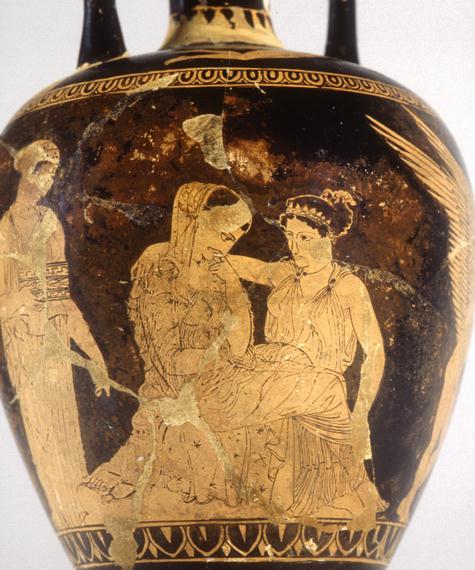
Image result for Ancient Greek Helen vase

As is largely unsurprising from the perspective of Greek misogyny, excessive interest in sexual behavior is projected a female quality. Expertise beyond interest is made the province of female ‘professionals’ (slaves) who may act as scapegoats and marginal figures for the corruption of both men and women. There is a combination of such interest with an excessive emphasis on eating (and eating really well) in Athenaeus where the pleasures of the body are combined.

Athenaeus, Deipnosophists 8.335c

“Dear men, even though I have great admiration for Chrysippus as the leader of the Stoa, I praise him even more because he ranks Arkhestratos, well-known for his Science of Cooking along with Philainis who is credited with a licentious screed about sexual matters—even though the iambic poet of Samos, Aiskhriôn, claims that Polycrates the sophist started this slander of her when she was really quite chaste. The lines go like this:

“I, Philainis, circulated among men
Lie here thanks to great old age.
Don’t laugh, foolish sailor, as your trace the cape
Nor make me a target of mockery or insult
For, by Zeus and his sons in Hell
I was never a slut with men nor a public whore.
Polykrates, Athenian by birth,
A bit clever with words and with a nasty tongue,
Wrote what he wrote. I don’t know anything about it.”

But the most amazing Chrysippus combines in the fifth book of his On Goodness and Pleasure that both “the books of Philianis and the Gastronomiai of Arkhestratos and forces of erotic and sexual nature, and in the same way slave-girls who are expert at these kinds of movements and positions and who are engaged in their practice.” He adds that they learn this type of material completely and then thoroughly possess what has been written on these topics by Philainis and Arkhestratos and those who have written on similar topics. Similarly, in his seventh book, he says ‘As you cannot wholly learn the works of Philianis and Arkhestratos’ Gastronomia because they do have something to offer for living better.’ “

Χρύσιππον δ᾿, ἄνδρες φίλοι, τὸν τῆς στοᾶς ἡγεμόνα κατὰ πολλὰ θαυμάζων ἔτι μᾶλλον ἐπαινῶ τὸν πολυθρύλητον ἐπὶ τῇ Ὀψολογίᾳ Ἀρχέστρατον αἰεί ποτε μετὰ Φιλαινίδος κατατάττοντα, εἰς ἣν ἀναφέρεται τὸ περὶ ἀφροδισίων ἀκόλαστον cσύγγραμμα, ὅπερ φησὶ | ποιῆσαι Αἰσχρίων ὁ Σάμιος ἰαμβοποιὸς Πολυκράτη τὸν σοφιστὴν ἐπὶ διαβολῇ τῆς ἀνθρώπου σωφρονεστάτης γενομένης. ἔχει δὲ οὕτως τὰ ἰαμβεῖα·

ἐγὼ Φιλαινὶς ἡ ᾿πίβωτος ἀνθρώποις
ἐνταῦθα γήρᾳ τῷ μακρῷ κεκοίμημαι.
μή μ᾿, ὦ μάταιε ναῦτα, τὴν ἄκραν κάμπτων
χλεύην τε ποιεῦ καὶ γέλωτα καὶ λάσθην.
ὐ γὰρ μὰ τὸν Ζῆν᾿, οὐ μὰ τοὺς κάτω κούρους, |
dοὐκ ἦν ἐς ἄνδρας μάχλος οὐδὲ δημώδης.
Πολυκράτης δὲ τὴν γενὴν Ἀθηναῖος,
λόγων τι παιπάλημα καὶ κακὴ γλῶσσα,
ἔγραψεν οἷ᾿ ἔγραψ᾿· ἐγὼ γὰρ οὐκ οἶδα.

ἀλλ᾿ οὖν ὅ γε θαυμασιώτατος Χρύσιππος ἐν τῷ πέμπτῳ Περὶ τοῦ Καλοῦ καὶ τῆς Ἡδονῆς φησι· καὶ βιβλία τά τε Φιλαινίδος καὶ τὴν τοῦ Ἀρχεστράτου Γαστρονομίαν καὶ δυνάμεις ἐρωτικὰς καὶ συνουσιαστικάς, ὁμοίως δὲ καὶ τὰς θεραπαίνας ἐμπείρους τοιῶνδε κινήσεών τε καὶ σχημάτων καὶ περὶ τὴν eτούτων μελέτην γινομένας. καὶ πάλιν· ἐκμανθάνειν | τ᾿ αὐτοὺς τὰ τοιαῦτα καὶ κτᾶσθαι τὰ περὶ τούτων γεγραμμένα Φιλαινίδι καὶ Ἀρχεστράτῳ καὶ τοῖς τὰ ὅμοια γράψασιν. κἀν τῷ ἑβδόμῳ δέ φησι· καθάπερ γὰρ οὐκ ἐκμανθάνειν τὰ Φιλαινίδος καὶ τὴν Ἀρχεστράτου Γαστρονομίαν ἔστιν ὡς φέροντά τι πρὸς τὸ ζῆν ἄμεινον.

Are YOU Like Tiberius?

Suetonius, Life of Tiberius 70

“He pursued the liberal arts of both languages most seriously. He was a follower of Messala Corvinus when it came to Latin oratory, a man whom he had observed while an adolescent. But he used to confuse his style with such excessive affectation and officiousness that he was considered more effective as an extemporaneous speaker than a prepared one.

He also wrote a lyric poem which had the title “A Lament on the Death of Lucius Caesar.” When he composed Greek poems, he imitated Euphorion, Rhianus, and Parthenius, those poets whose writing he liked most of all, and he placed their portraits in the public libraries among the older, famous authors. For this reason, many of the learned men of the time were in a competition dedicating many books about these men to Tiberius.

Still, he took the greatest care in knowledge of the stories of myth, to the point of absurdity and silliness. For he even used to quiz the grammarians, a class of men whom, as I said, he was really preoccupied with, posing questions like: “Who was the mother of Hecuba?” “What name did Achilles have among the girls?” “What were the Sirens accustomed to singing?”

LXX. Artes liberales utriusque generis studiosissime coluit. In oratione Latina secutus est Corvinum Messalam, quem senem adulescens observarat. Sed adfectatione et morositate nimia obscurabat stilum, ut aliquanto ex tempore quam a cura praestantior haberetur. Composuit et carmen lyricum, cuius est titulus “Conquestio de morte L. Caesaris.” Fecit et Graeca poemata imitatus Euphorionem et Rhianum et Parthenium, quibus poetis admodum delectatus scripta omnium et imagines publicis bibliothecis inter veteres et praecipuos auctores dedicavit; et ob hoc plerique eruditorum certatim ad eum multa de his ediderunt.3Maxime tamen curavit notitiam historiae fabularis usque ad ineptias atque derisum; nam et grammaticos, quod genus hominum praecipue, ut diximus, appetebat, eius modi fere quaestionibus experiebatur: “Quae mater Hecubae, quod Achilli nomen inter virgines fuisset, quid Sirenes cantare sint solitae.”


 Kongelige Bibliotek, Gl. kgl. S. 3466 8º, Folio 37r

F**k Aristotle

Petrarch, de sua multorumque ignorantia:

I think that Aristotle was a great and learned man, but also that he was just a human, and for that reason I think that there are some things – nay, many things, which he was unable to know. I would say a little more if it be allowed by those who are better friends to sects than to the truth. I believe, and by Hercules I don’t doubt it, that he went totally off the rails not only in small matters (in which a mistake is a small and hardly dangerous thing), but even in the greatest things which bear upon the key point of our health. And though he may have discussed many things concerning felicity in the beginning and in the end of his Ethics, I will dare to say – and my detractors may shout as they like – that he was so deeply ignorant of true happiness that any pious old lady, or fisherman, or faithful pastor, or farmer would be happier, and perhaps even more subtle, in their knowledge of it.

Ego vero magnum quendam virum ac multiscium Aristotilem, sed fuisse hominem, et idcirco aliqua, imo et multa nescire potuisse arbitror; plus dicam, si per istos liceat non tam veri amicos quam sectarum: credo hercle, nec dubito, illum non in rebus tantum parvis, quarum parvus et minime periculosus est error, sed in maximis et spectantibus ad salutis summam aberrasse tota, ut aiunt, via. Et licet multa Ethicorum in principio et in fine de felicitate tractaverit, audebo dicere — clament ut libuerit censores mei — veram illum felicitatem sic penitus ignorasse, ut in eius cognitione, non dico subtilior, sed felicior fuerit vel quelibet anus pia, vel piscator pastorve fidelis, vel agricola.

The Inhuman Lust for Civil War

Homer Iliad 9.63–64

“Brotherless, lawless, and homeless is that man,
Who desires ruinous civil war.”

ἀφρήτωρ ἀθέμιστος ἀνέστιός ἐστιν ἐκεῖνος
ὃς πολέμου ἔραται ἐπιδημίου ὀκρυόεντος.

Schol. A ad Il. 9.63a

“Brotherless: commonly, one who takes no part of his tribe or kin, inhuman.”

<ἀφρήτωρ:> κοινῶς <ὁ> φρατρίας καὶ συγγεν<ε>ίας μὴ μετέχων,ἀπάνθρωπος.

Schol. bT ad Il. 9.63

“Athemistios: like wild beasts, lawless, the way the Kyklopes distribute laws to only their children and wives—they preserve what is just for those related to them.

ἀθέμιστος: θηριώδης, ἄνομος, ὅπου καὶ Κύκλωπες θεμιστεύουσι „παίδων ἠδ’ ἀλόχων” (ι 115), οἱονεὶ τὸ περὶ τὴν συγγένειαν φυλάσσουσι δίκαιον.

Schol. bT ad Il. 9.63c

“hearthless: for one who cares for a hearth and honors a stable life restrains himself from conflict against his neighbors”

ex. ἀνέστιος: ὁ γὰρ ἑστίαν νέμων καὶ βίον ἑδραῖον τιμῶν τῆς πρὸς τοὺς οἰκείους ἀπέχεται στάσεως·

Words for Civil Conflict:

ἔρις: “strife, conflict”

στάσις: “civil strife, conflict”

διχοστασίη: “split-strife; civil strife”

Zenobius, 3.77 (h/t Matt Simonton @profsimonton)

“In a time of civil strife, even a complete bastard gets ahead”

᾿Εν δὲ διχοστασίῃ καὶ ὁ πάγκακος ἔμμορε τιμῆς

Michael Apostolius, 17.74

“The boar surges up”: A proverb applied to violent [people] and competitive [people or circumstances]”

῟Υς ὀρίνει: ἐπὶ τῶν βιαίων λέγεται καὶ ἐριστικῶν.

Aristotle, Constitution of the Athenians

“Because [Solon] noticed that his city was often breaking out into civil strife and that some of the citizens welcomed the results because of ambivalence, he made a law particularly aimed at these people: whoever did not pick up arms for one side or the other during a time of civil conflict was to be disenfranchised and have no part of the state.”

ὁρῶν δὲ τὴν μὲν πόλιν πολλάκις στασιάζουσαν, τῶν δὲ πολιτῶν ἐνίους διὰ τὴν ῥᾳθυμίαν [ἀγα]πῶντας τὸ αὐτόματον, νόμον ἔθηκεν πρὸς αὐτοὺς ἴδιον, ὃς ἂν στασιαζούσης τῆς πόλεως μ[ὴ] θῆται τὰ ὅπλα μηδὲ μεθ’ ἑτέρων, ἄτιμον εἶναι καὶ τῆς πόλεως μὴ μετέχειν.

Giorgio Agamben, Stasis: Civil War as a Political Paradigm. Stanford, 2015, 16:

“The stasis…takes place neither in the oikos nor in the polis, neither in the family nor in the city; rather, it constitutes a zone of indifference between the unpolitical space of the family and the political space of the city. In transgressing the threshold, the oikos is politicized; conversely, the polis is ‘economised’, that is, it is reduced to an oikosThis means that in the system of Greek politics civil war functions as a threshold of politicisation and depoliticisation, through which the house is exceeded in the city and the city is depoliticized in the family.”

In book 18 of the Iliad, when Achilles laments the events that led to the death of Patroklos, he also makes an impossible wish for the gods to erase conflict from the lives of men. Rather than seeing this as an emotional–and somewhat reasonable–desire on Achilles’ part, the presocratic philosopher Heraclitus is alleged to have taken issue.

The comments appear in two traditions of Scholia to the Iliad. Both attempt to explain Heraclitus’ mistakes.

Homer, Iliad 18.107: “I wish that the gods would erase strife from men”

Schol A ad Iliad 18.107: “Heraclitus criticizes Homer because he believes that the nature of things as they are depends upon strife, and here Achilles then seems to be praying for the collapse of the cosmos. To this someone might reply that he is not saying here that strife is something in opposition but rather that it is hateful—this is the reason he adds in the next line “and anger as well” [kholos]. For, the opposition of things [e.g. Heraclitus’ principle of nature] does not drive prudent men out of their powers of reason.”

Schol T. “Heraclitus says that Achilles is praying for the collapse of everything, since all things depend upon their opposites. But Achilles means that this strife is has led to worse affairs. Otherwise [if he doesn’t mean this], this should be allowed, since he is afire with suffering [over the death of Patroklos]”

ex. ὡς ἔρις ἔκ τε θεῶν :

῾Ηράκλειτος (fr. 28 p. 133 M.; Vors. 6 A 22) τὴν τῶν ὄντων φύσιν κατ’ ἔριν συνεστάναι νομίζων μέμφεται ῞Ομηρον, σύγχυσιν κόσμου δοκῶν αὐτὸν εὔχεσθαι. πρὸς ὃν ἄν τις εἴποι ὅτι οὐ λέγει νῦν τὴν ἐναντίωσιν ἔριν, ἀλλὰ τὴν ἔχθραν· ὅθεν ἐπιφέρει „καὶ χόλος” (Σ 108)· οὐ γὰρ ἡ τῶν πραγμάτων ἐναντίωσις τοὺς φρονίμους ἐξίστησι τῶν λογισμῶν. A
ὡς ἔρις ἔκ τε θεῶν: ῾Ηράκλειτος σύγχυσιν αὐτὸν εὔ-
χεσθαι ἁπάντων φησί· κατὰ γὰρ ἐναντίωσιν τὰ πάντα συνέχεσθαι. ἀλλὰ τὴν ἐπὶ τὸ χεῖρον ἄγουσαν ἔριν νῦν φησιν. ἄλλως τε δοτέον τοῦτο, φλεγμαίνοντος τοῦπάθους


I published a paper on Strife in the epic poetic tradition last year: Christensen, J. P. (2018). “Eris and Epos Composition, Competition, and the Domestication of Strife” , Yearbook of Ancient Greek Epic Online, 2(1), 1-39. doi: https://doi.org/10.1163/24688487-00201001. Email if you want a copy.

Apion’s a Racist Buffoon, But People Listen to Him

Josephus, Against Apion 2

“I will turn now to refuting the remaining authors who have written against us. I really don’t know if it is worth my time to respond seriously to the attacks of Apion the grammarian. Some of what he has written is similar to what other people claim; things which he added are rather weak, and most of it is complete absurdity which, to speak truthfully, exposes the author for a scoundrel and a fraud right to the end of his life.

But since many people tend because of ignorance to be attracted by these kinds of arguments rather than those of a serious nature and they take pleasure in slander while finding praise annoying, I believe I am compelled to not to leave this person unexamined since he has composed an indictment of us direct enough for a courtroom.

This is because I have also noticed that people are especially pleased when someone who started to slander others first is refuted through his own vices. Now, Apion’s argument is not easy to sum up or to understand clearly what he wants to say. But—as far as is pack of disordered lies can be analyzed—some of his words are like those already examined, related to how our people departed from Egypt; another category is the accusation against the Jewish residents of Alexandria; and the third is mixed up among those with claims against our temple rites and general practices.”

ἄρξομαι δὲ νῦν τοὺς ὑπολειπομένους τῶν γεγραφότων τι καθ᾿ ἡμῶν ἐλέγχειν. καίτοι περὶ τῆς πρὸς Ἀπίωνα τὸν γραμματικὸν ἀντιρρήσεως ἐπῆλθέ μοι διαπορεῖν, εἰ χρὴ σπουδάσαι· τὰ μὲν γάρ ἐστι τῶν ὑπ᾿ αὐτοῦ γεγραμμένων τοῖς ὑπ᾿ ἄλλων εἰρημένοις ὅμοια, τὰ δὲ λίαν ψυχρῶς προστέθεικεν, τὰ πλεῖστα δὲ βωμολοχίαν ἔχει καὶ πολλήν, εἰ δεῖ τἀληθὲς εἰπεῖν, ἀπαιδευσίαν, ὡς ἂν ὑπ᾿ ἀνθρώπου συγκείμενα καὶ φαύλου τὸν τρόπον καὶ παρὰ πάντα τὸν βίον ὀχλαγωγοῦ γεγονότος. ἐπεὶ δ᾿ οἱ πολλοὶ τῶν ἀνθρώπων διὰ τὴν αὐτῶν ἄνοιαν ὑπὸ τῶν τοιούτων ἁλίσκονται λόγων μᾶλλον ἢ τῶν μετά τινος σπουδῆς γεγραμμένων, καὶ χαίρουσι μὲν ταῖς λοιδορίαις, ἄχθονται δὲ τοῖς ἐπαίνοις, ἀναγκαῖον ἡγησάμην εἶναι μηδὲ τοῦτον ἀνεξέταστον καταλιπεῖν, κατηγορίαν ἡμῶν ἄντικρυς ὡς ἐν δίκῃ γεγραφότα. καὶ γὰρ αὖ κἀκεῖνο τοῖς πολλοῖς ἀνθρώποις ὁρῶ παρακολουθοῦν, τὸ λίαν ἐφήδεσθαι ὅταν τις ἀρξάμενος βλασφημεῖν ἕτερον αὐτὸς ἐλέγχηται περὶ τῶν αὐτῷ προσόντων κακῶν. ἔστι μὲν οὖν οὐ ῥᾴδιον αὐτοῦ διελθεῖν τὸν λόγον οὐδὲ σαφῶς γνῶναι τί λέγειν βούλεται, σχεδὸν δ᾿, ὡς ἐν πολλῇ ταραχῇ καὶ ψευσμάτων συγχύσει, τὰ μὲν εἰς τὴν ὁμοίαν ἰδέαν πίπτει τοῖς προεξητασμένοις περὶ τῆς ἐξ Αἰγύπτου τῶν ἡμετέρων προγόνων μεταναστάσεως, τὰ δ᾿ ἐστὶ κατηγορία τῶν ἐν Ἀλεξανδρείᾳ κατοικούντων Ἰουδαίων. τρίτον δ᾿ ἐπὶ τούτοις μέμικται περὶ τῆς ἁγιστείας τῆς κατὰ τὸ ἱερὸν ἡμῶν καὶ τῶν ἄλλων νομίμων κατηγορία.

Happy Monday! Some Proverbs for Bad Things

Arsenius 3.64c

“All these evils are the responsibility of nature.”

ἅπαντα ταῦτ’ ἐπίθετα τῇ φύσει κακά


Appendix Proverbium 2.22

“You’re burning incense over bullshit”: a proverb for those who are trying to change evil things”

Εἰς κόπρον θυμιᾷς: ἐπὶ τῶν τὰ κακὰ μεταβαλεῖν ἐπιχειρούντων.


Arsenius 7.7a

“People suffer less because of their enemies than their friends. For they guard against their enemies because they fear them while they remain open to their friends. They too are slippery and likely to conspire.”

᾿Ελάσσω κακὰ πάσχουσιν οἱ ἄνθρωποι ὑπὸ τῶν ἐχθρῶν ἢ ὑπὸ τῶν φίλων· τοὺς μὲν γὰρ ἐχθροὺς δεδιότες φυλάσσονται, τοῖς δὲ φίλοις ἀνεῳγμένοι εἰσί. καὶ γίνονται σφαλεροὶ καὶ εὐεπιβούλευτοι


Zenobius 4.43

“An Iliad of Evils”: this proverb is uses for great evils. This is because there were myriad evils in Ilium”

᾿Ιλιὰς κακῶν: ἀπὸ παροιμίας τοῦτο ἐλέγετο ἐπὶ τῶν μεγάλων κακῶν· παρόσον ἐν ᾿Ιλίῳ μυρία κακὰ συνέβη γενέσθαι.

Image result for medieval manuscript evils
Mouth of Hell: MS Tanner 184

Shaking Us Down

Latin Trag. Adesp. = Ps-Cicero, Ad. Herenn. 2.26

“I cannot think…or figure out any reason why
I might impeach him. What would let you accuse someone
Who is honorable, if he is good? And if he is not honorable
What would let you impeach him if he thinks it is but a
Minor thing?”

Nequeo . . .
qua causa accusem hunc exputando evolvere.
Nam si veretur quid eum accuses qui est probus?
Sin inverecundum animi ingenium possidet,
quid autem accuses qui id parvi auditum
aestimet? . . .

Aristophanes fr 228 = Suda sigma 290

“Shaking-down”: Blackmail, this is a metaphor from people who shake trees: “I was shaking them down, I demanded money, I was threatening them and was extorting them again and again.”

σεῖσαι· τὸ συκοφαντῆσαι, ἀπὸ τῶν τὰ ἀκρόδρυα σειόντων· ἔσειον, ᾔτουν χρήματ᾿, ἠπείλουν, ἐσυκοφάντουν πάλιν

Mycenaean Goat and Tree Vase at the British Museum

Living Too Long

Petrarch, On His Own Ignorance and the Ignorance of Others (III):

And alas, my friend! What suffering does an extended life not bring upon us? Whose prosperity was ever so firm that it did not occasionally change and, so to speak, grow old throughout their life? People grow old, their fortunes grow old, their reputations grow old – in short, all human things grow old. I never believed it, but in the end even our souls grow old, and the Cordovan poet’s line comes true: ‘A longer life destroys great souls.’ This is not because death follows the old age of the soul – its departure and loosening from the body, which we see and which is commonly called death, is certainly just the death of the body, not the soul.

Behold, my soul has bristled and grown old! Now I experience as an old man what, as an inexperienced youth I spoke of singing my pastorals: ‘What does long life bring to a person?’ With what soul would I have born this a few years earlier! With what efforts would I have resisted it? Believe me, it would have been a difficult war between my ignorance and the ignorance of my enemies. But to enter the contest now is as much more disgraceful as it is safer. I raise my hand, and my ignorance yields to theirs.

To be sure, I never read (perhaps conjecturing what remained to me) that story of Laberius without a certain compassion. When he had conducted his entire life in honest military service, he was led onto the stage by Julius Caesar’s prayers and flattery (which come forth armed from the mouths of princes), and he was degraded from a knight to an actor. He did not bear it in silence, but among his many other complaints, he lamented in these words: ‘I having lived sixty years without a fault, left my home a knight and will return an actor; indeed, I have lived longer than I should have by this one day.’

Image result for petrarch

Et heu! amice, quid non mali affert vita longior? Cui unquam tam firma prosperitas fuit, ut non quandoque variaverit et quasi vivendo senuerit? Senescunt homines, senescunt fortune, senescunt fame hominum, senescunt denique humana omnia; quodque aliquando non credidi, ad extremum animi senescunt, quamvis immortales, verumque fit illud Cordubensis: «Longius evum destruit ingentes animos». Non quod animi senium mors sequatur, sed discessus a corpore resolutioque illa, quam cernimus et que vulgo mors dicitur, et est mors corporis profecto, non animi. Senuit ecce refrixitque animus meus. Nunc experior senex quod iuvenis inexpertus et pastorium canens dixi: «Quid vivere longum fert homini?». Quo enim ante hos non multos annos hec tulissem animo? quibus nisibus obstitissem? Crede michi, bellum grave inter ignorantiam et ignorantiam fuisset. Nunc senem invadere eo turpius quo tutius; tollo manum, et mea illorum cedit ignorantie. Certe ego, quasi presagiens quid michi restaret, nunquam sine compassione quadam Laberii historiam legi; qui, cum vitam omnem honesta militia exegisset, sexagenarius ad extremum, Iulii Cesaris blanditiis ac precibus, que de ore principum armate prodeunt, productus in scenam, de romano equite factus est mimus. Quam iniuriam ipse quidem non tacitus tulit, imo multis interque alia his questus est verbis: «Ergo, bis tricenis annis actis sine nota, eques romanus lare egressus meo, domum revertar mimusque: nimirum hoc die uno plus vixi, michi quam vivendum fuit!».

The Sad Death of Hesiod and His Body’s Afterlife

According to the following account, Hesiod died for another man’s crimes. His corpse was moved by dolphins. 

Plutarch, Dinner of the Seven Wise Men 19 (= Moralia 162d-e)

“Hesiod’s misfortune was rather human and like our own—you have probably heard the story”

‘No, I have not’, I said.

‘Well, it is really worth hearing. It seems that Hesiod was sharing hospitality and a place with a man from Miletus when they were in Lokris. When the other guy was secretly having sex with their host’s daughter and was caught, he had suspicion that Hesiod knew from the beginning and conspired to hide the offense—even though he was responsible for nothing, he wrongly encountered untimely rage and slander. For the brothers of the girl killed him after they ambushed him near the Nemeion in Lokris, and they killed his servant, named Troilos, too.

After the bodies were pushed out into the river Daphnos, Troilos’ was carried to a boulder washed by water, positioned a little bit out into the sea. And to this day the boulder is called Troilos. A pod of dolphins took Hesiod’s body right away and conveyed it first to Rhion and Molykria. It just happened that the Lokrian sacrifice at Rhion and their assembly, which they hold occasionally even to our time in that place, was in progress at that time. When the body showed up, carried as it was, they were amazed at the chance and they ran down and, when they recognized the corpse since it was still rather fresh, they considered everything secondary to investigating the murder, all because of Hesiod’s fame

They accomplished this quickly by discovering the murderers [a dog went barking and hunting the murderers with a shout]. They put them still alive in the sea and destroyed their homes. Hesiod was then buried near Nemeia. Many people foreign to the region do not know where the grave is. It is hidden because, as they claim, it was sought by the people of Orkhomenos who wanted to transfer the remains to their vicinity in accordance with an oracle.”

Image result for Ancient Greek dolphin vase

.

Plutarchi sept. sap. conv. 19 (Hercher): ἀνθρώπινον δὲ καὶ πρὸς ἡμᾶς τὸ τοῦ ῾Ησιόδου πάθος· ἀκήκοας γὰρ ἴσως τὸν λόγον. Οὐκ ἔγωγε, εἶπον. ᾿Αλλὰ μὴν ἄξιον πυθέσθαι.

Μιλησίου γὰρ ὡς ἔοικεν ἀνδρός, ᾧ ξενίας ἐκοινώνει ὁ ῾Ησίοδος καὶ διαίτης ἐν Λοκροῖς, τῇ τοῦ ξένου θυγατρὶ κρύφα συγγενομένου καὶ φωραθέντος, ὑποψίαν ἔσχεν ὡς γνοὺς ἀπ’ ἀρχῆς καὶ συνεπικρύψας τὸ ἀδίκημα, μηδενὸς ὢν αἴτιος ὀργῇ δ’ ἀκαίρῳ καὶ διαβολῇ περιπεσὼν ἀδίκως. ἀπέκτειναν γὰρ αὐτὸν οἱ τῆς παιδίσκης ἀδελφοὶ περὶ τὸ Λοκρικὸν Νέμειον ἐνεδρεύσαντες καὶ μετ’ αὐτοῦ τὸν ἀκόλουθον ᾧ Τρωίλος ἦν ὄνομα. τῶν δὲ σωμάτων εἰς τὸν Δάφνον ποταμὸν ὠσθέντων τὸ μὲν τοῦ Τρωίλου εἰς τὴν θάλασσαν ἔξω φορούμενον ἐπεσχέθη περικλύστῳ χοιράδι  μικρὸν ὑπὲρ τὴν θάλασσαν ἀνεχούσῃ· καὶ μέχρι νῦν Τρωίλος ἡ χοιρὰς καλεῖται. τοῦ δ’ ῾Ησιόδου τὸν νεκρὸν εὐθὺς ἀπὸ γῆς ὑπολαβοῦσα δελφίνων ἀγέλη πρὸς τὸ ῾Ρίον ἐκόμιζε καὶ τὴν Μολυκρίαν. ἐτύγχανε δὲ Λοκροῖς ἡ τῶν ῾Ρίων καθεστῶσα θυσία καὶ πανήγυρις, ἣν ἄγουσιν ἔτι νῦν περιφανῶς περὶ τὸν τόπον ἐκεῖνον. ὡς δ’ ὤφθη προσφερόμενον τὸ σῶμα, θαυμάσαντες ὡς εἰκὸς ἐπὶ τὴν ἀκτὴν κατέδραμον καὶ γνωρίσαντες ἔτι πρόσφατον τὸν νεκρόν, ἅπαντα δεύτερα τοῦ ζητεῖν τὸν φόνον ἐποιοῦντο διὰ τὴν δόξαν τοῦ ῾Ησιόδου. καὶ τοῦτο μὲν ταχέως ἔπραξαν εὑρόντες τοὺς φονέας (add. Plut. de soll. an. 36: τοῦ κυνὸς ὑλακτοῦντος καὶ μετὰ βοῆς ἐπιφερομένου τοῖς φονεῦσιν)· αὐτούς τε γὰρ κατεπόντισαν ζῶντας καὶ τὴν οἰκίαν κατέσκαψαν. ἐτάφη δ’ ὁ ῾Ησίοδος πρὸς τῷ Νεμείῳ· τὸν δὲ τάφον οἱ πολλοὶ τῶν ξένων οὐκ ἴσασιν, ἀλλ’ ἀποκέκρυπται, ζητούμενος ὑπ’ ᾿Ορχομενίων, ὥς φασι, βουλομένων κατὰ χρησμὸν ἀνελέσθαι τὰ λείψανα καὶ θάψαι παρ’ αὑτοῖς.

The Certamen of Homer and Hesiod has a similar account but with some differences

“After the contest [with Homer] was over, Hesiod went to Delphi to get an oracle and to make a thanks-offering for the victory to the god. When he arrived at the shrine, people claim that the prophetess was inspired and said:

“This lucky man who travels to my home
Is Hesiod, honored by the divine Muses.
His fame will spread as far as the sun shines.
But guard against the gorgeous grove of Nemeian Zeus.
It is there where your fated death will come.”

Hesiod, after he heard this oracle, went retreating from the Peloponnese because he believed  that the god meant the oracle there. He went to Oinoê in Lokris and rested with Amphiphanes and Ganuktôr, the children of Phêgeus,  and he really did not understand the oracle. For this place was called the shrine of Zeus Nemeios. After he spent a period of time with the Oineans, the youths, because they suspected that Hesiod fornicated with their sister, killed him and through hem into the sea between Euboia and Lokris.

When the abandoned corpse was carried by dolphins to land, there was some local festival happening and everyone ran to the shore. Once they recognized who this was, they grieved and buried him—and then they began to seek his murderers. The brothers, because they feared the rage of the citizens, made off with a fishing skiff and sailed toward Krêtê. Zeus struck that vessel in the middle with lightening and submerged them in the sea, as Alkidamas says in the Mouseion.

Eratosthenes says in his epode that Ktimenos and Antiphon, the sons of Ganuktôr, were arrested for the aforementioned reason and sacrificed to the gods of hospitality by Eurukles the prophet. According to the same author, The virgin sister of these men hanged herself after she was raped—and Eratosthenes says she was raped by some stranger on the road who was named Hesiod, the son of Dêmades. He was also killed by the same men. Later, the Orkhomenians, in accordance with an oracle, transferred Hesiod and buried them in their land….”

Cert. Hom. et Hes. v. 214 West. (unde eadem Tzetzes

 τοῦ δὲ ἀγῶνος διαλυθέντος διέπλευσεν ὁ ῾Ησίοδος εἰς Δελφοὺς χρησόμενος καὶ τῆς νίκης ἀπαρχὰς τῷ θεῷ ἀναθήσων. προσερχομένου δὲ αὐτοῦ τῷ ναῷ ἔνθεον γενομένην τὴν προφῆτίν φασιν εἰπεῖν

ὄλβιος οὗτος ἀνήρ, ὃς ἐμὸν δόμον ἀμφιπολεύει,

῾Ησίοδος Μούσῃσι τετιμένος ἀθανάτῃσι·

τοῦ δή τοι κλέος ἔσται ὅσην τ’ ἐπικίδναται ἠώς.

ἀλλὰ Διὸς πεφύλαξο Νεμείου κάλλιμον ἄλσος·

κεῖθι δέ τοι θανάτοιο τέλος πεπρωμένον ἐστίν.

ὁ δὲ ῾Ησίοδος ἀκούσας τοῦ χρησμοῦ τῆς Πελοποννήσου μὲν ἀνεχώρει νομίσας τὴν ἐκεῖ Νεμέαν τὸν θεὸν λέγειν, εἰς δὲ  Οἰνόην τῆς Λοκρίδος ἐλθὼν καταλύει παρὰ ᾿Αμφιφάνει καὶ Γανύκτορι, τοῖς Φηγέως παισίν, ἀγνοήσας τὸ μαντεῖον· ὁ γὰρ τόπος οὗτος ἐκαλεῖτο Διὸς Νεμείου ἱερόν. διατριβῆς δ’ αὐτῷ πλείονος γενομένης ἐν τοῖς Οἰνεῶσιν, ὑπονοήσαντες οἱ νεανίσκοι τὴν ἀδελφὴν αὐτῶν μοιχεύειν τὸν ῾Ησίοδον, ἀποκτείναντες εἰς τὸ μεταξὺ τῆς Εὐβοίας καὶ τῆς Λοκρίδος πέλαγος κατεπόντισαν.

τοῦ δὲ νεκροῦ τριταίου πρὸς τὴν γῆν ὑπὸ δελφίνων προσενεχθέντος, ἑορτῆς τινὸς ἐπιχωρίου παρ’ αὐτοῖς οὔσης ἀριαδνείας πάντες ἐπὶ τὸν αἰγιαλὸν ἔδραμον καὶ τὸ σῶμα γνωρίσαντες ἐκεῖνο μὲν πενθήσαντες ἔθαψαν, τοὺς δὲ φονεῖς ἀνεζήτουν. οἱ δὲ φοβηθέντες τὴν τῶν πολιτῶν ὀργήν, κατασπάσαντες ἁλιευτικὸν σκάφος διέπλευσαν εἰς Κρήτην. οὓς κατὰ μέσον τὸν πλοῦν ὁ Ζεὺς κεραυνωθεὶς κατεπόντωσεν, ὥς φησιν ᾿Αλκιδάμας ἐν μουσείῳ φησιν ᾿Αλκιδάμας ἐν Μουσείῳ.

᾿Ερατοσθένης δέ φησιν ἐν † ἐνηπόδω † Κτίμενον καὶ ῎Αντιφον τοὺς Γανύκτορος ἐπὶ τῇ προειρημένῃ αἰτίᾳ ἀνελόντας σφαγιασθῆναι θεοῖς τοῖς  ξενίοις ὑπ’ Εὐρυκλέους τοῦ μάντεως. τὴν μέντοι παρθένον τὴν ἀδελφὴν τῶν προειρημένων μετὰ τὴν φθορὰν ἑαυτὴν ἀναρτῆσαι, φθαρῆναι δὲ ὑπό τινος ξένου συνόδου τοῦ ῾Ησιόδου Δημώδους ὄνομα· ὃν καὶ αὐτὸν ἀναιρεθῆναι ὑπὸ τῶν αὐτῶν φησιν. ὕστερον δὲ ᾿Ορχομένιοι κατὰ χρησμὸν μετενέγκαντες αὐτὸν παρ’ αὑτοῖς ἔθαψαν καὶ ἐπέγραψαν ἐπὶ τῷ τάφῳ·