A Plague of Gout on Goats

Athenaeus, Deipnosophists 2.52

“Puthermos asserts, as Hêgêsandros claims, that during his time the mulberry trees did not bear fruit for 20 years and produced an epidemic of gout so badly that it affected not only men but also boys and girls, eunuchs, and women too. The plague hit a herd of goats so badly that two thirds of them died because of that same sickness”

Πύθερμος δὲ ἱστορεῖ, ὥς φησιν Ἡγήσανδρος, καθ᾿ αὑτὸν τὰς συκαμίνους οὐκ ἐνεγκεῖν καρπὸν ἐτῶν εἴκοσι καὶ γενέσθαι ἐπιδημίαν ποδαγρικὴν τοσαύτην ὥστε μὴ μόνον ἄνδρας τῷ πάθει ἐνσχεθῆναι, ἀλλὰ καὶ παῖδας καὶ κόρας καὶ εὐνούχους, ἔτι δὲ γυναῖκας. περιπεσεῖν δὲ οὕτω τὸ δεινὸν καὶ αἰπολίῳ ὡς τὰ δύο μέρη τῶν προβάτων ἐνσχεθῆναι τῷ αὐτῷ πάθει.

Wild Goat Style

Alex, Don’t Be A Plague

Aelian, Varia Historia 14.11

“Philiskos said to Alexander at some point, “Think about your reputation. Don’t be a plague or some great disease, but peace and health instead.” In saying plague he meant ruling violently and cruelly, seizing cities, and destroying peoples. In mentioning health, he meant planning for the safety of his constituents. These goods can come from peace.”

Φίλισκος πρὸς Ἀλέξανδρον ἔφη ποτέ· “δόξης φρόντιζε, ἀλλὰ μὴ ἔσο λοιμὸς [καὶ μὴ μεγάλη νόσος],ἀλλὰ [εἰρήνη καὶ]ὑγεία,” λέγων τὸ μὲν βιαίως ἄρχειν καὶ πικρῶς καὶ αἱρεῖν πόλεις καὶ ἀπολλύειν δήμους λοιμοῦ εἶναι, τὸ δὲ ὑγιῶς, προνοεῖσθαι τῆς σωτηρίας τῶν ἀρχομένων· εἰρήνης ταῦτα ἀγαθά.

File:Cades, Giuseppe - Alexander the Great Refuses to Take Water - 1792.jpg
Alexander the Great Refuses to Take Water by Giuseppe Cades

Study Languages to Foil Satan’s Plans!

Moses Coit Tyler, A History of American Literature:

In its inception New England was not an agricultural community, nor a manufacturing community, nor a trading community: it was a thinking community; an arena and mart for ideas; its characteristic organ being not the hand, nor the heart, nor the pocket, but the brain. The proportion of learned men among them in those early days was extraordinary. It is probable that between the years 1630 and 1690 there were in New England as many graduates of Cambridge and Oxford as could be found in any population of similar size in the mother- country. At one time, during the first part of that period, there was in Massachusetts and Connecticut a Cambridge graduate for every two hundred and fifty inhabitants, besides sons of Oxford not a few. Among the clergy in particular were some men of a scholarship accounted great even by the heroic standard of the seventeenth century, — John Cotton, John Davenport, Richard Mather, Eliot, Norton, Hooker, Roger Williams, Stone, Bulkley, Nathaniel Ward, Thomas Shepard, Dunster, Chauncey; while the laity had among them several men of no inconsiderable learning,—the elder and the younger Winthrop, Thomas Dudley, Simon Bradstreet, William Brewster, William Bradford, Pynchon, Daniel Gookin, John Haynes.

Probably no other community of pioneers ever so honored study, so reverenced the symbols and instruments of learning. Theirs was a social structure with its cornerstone resting on a book. Universal education seemed to them to be a universal necessity; and they promptly provided for it in all its grades. By the year 1649 every colony in New England, except Rhode Island, had made public instruction compulsory; requiring that in each town of fifty householders there should be a school for reading and writing, and in each town of a hundred householders, a grammar school with a teacher competent “to fit youths for the University;” and they did this, as their old law frankly stated it, in order that “ learning may not be buried in the grave of our fathers,” and especially in order to baffle “that old deluder Sathan,” “one chief project” of whose dark ambition it is “ to keep men from the knowledge of the Scriptures” by persuading them “from the use of tongues.”’ Only six years after John Winthrop’s arrival in Salem harbor the people of Massachusetts took from their own treasury the funds with which to found a university; so that while the tree-stumps were as yet scarcely weather-browned in their earliest harvest fields, and before the nightly howl of the wolf had ceased from the outskirts of their villages, they had made arrangements by which even in that wilderness their young men could at once enter upon the study of Aristotle and Thucydides, of Horace and Tacitus, and the Hebrew Bible.

Dr. Faustus in Counsel with the Devil, from Gent's translation of 'Dr. Faustus' by Christopher Marlowe (1564-93) 1648 from a collection of chapbooks on esoterica (woodcut)

Harming the Athenians

Thanks to Dimitri Nakassis for sending me this passage

Thucydides. 7.27

“Thirteen hundred peltasts, Thracian swordsmen from the Dii tribe, also came to Athens the same summer. They were supposed to have traveled to Sicily with Demosthenes. Because they were rather late, the Athenians decided to send them back to Thrace where they came from. For it seemed too expense to retain them for the Decelean War since they each were earning a drachma a day.

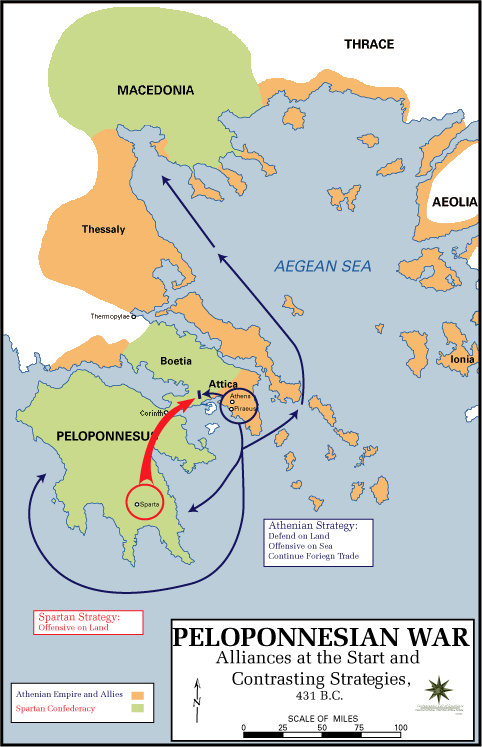
Since Decelea was first invested by the whole enemy army in that summer and later was held by the garrisons coming from different cities coming in turn to ravage the land, it was causing great harm to the Athenians. Indeed, this undermined Athenian affairs first by loss of property and then by the death of men.

Previous attacks were brief and did not keep the Athenians from deriving benefit from their land the rest of the time. But once they were continually invested in Attica and they were sometimes attacking in force and at other times using a single garrison attacking the country and pillaging to supply itself. The Spartan king Agis was also present and he was no slacker in prosecuting the war.

The Athenians were greatly harmed; they were deprived of their whole land. More than twenty thousand slaves freed themselves and a great number of these were craftspeople. All of the sheep and pack animals perished. And the Athenian horses, because the cavalry was deploying every day to attack Decelea and guard the land, either went lame because of working on rocky ground or they were wounded.

ἀφίκοντο δὲ καὶ Θρᾳκῶν τῶν μαχαιροφόρων τοῦ Διακοῦ γένους ἐς τὰς Ἀθήνας πελτασταὶ ἐν τῷ αὐτῷ θέρει τούτῳ τριακόσιοι καὶ χίλιοι, οὓς ἔδει τῷ Δημοσθένει ἐς τὴν Σικελίαν ξυμπλεῖν. [2] οἱ δ᾽ Ἀθηναῖοι, ὡς ὕστεροι ἧκον, διενοοῦντο αὐτοὺς πάλιν ὅθεν ἦλθον ἐς Θρᾴκην ἀποπέμπειν. τὸ γὰρ ἔχειν πρὸς τὸν ἐκ τῆς Δεκελείας πόλεμον αὐτοὺς πολυτελὲς ἐφαίνετο: δραχμὴν γὰρ τῆς ἡμέρας ἕκαστος ἐλάμβανεν. [3] ἐπειδὴ γὰρ ἡ Δεκέλεια τὸ μὲν πρῶτον ὑπὸ πάσης τῆς στρατιᾶς ἐν τῷ θέρει τούτῳ τειχισθεῖσα, ὕστερον δὲ φρουραῖς ἀπὸ τῶν πόλεων κατὰ διαδοχὴν χρόνου ἐπιούσαις τῇ χώρᾳ ἐπῳκεῖτο, πολλὰ ἔβλαπτε τοὺς Ἀθηναίους, καὶ ἐν τοῖς πρῶτον χρημάτων τ᾽ ὀλέθρῳ καὶ ἀνθρώπων φθορᾷ ἐκάκωσε τὰ πράγματα. [4] πρότερον μὲν γὰρ βραχεῖαι γιγνόμεναι αἱ ἐσβολαὶ τὸν ἄλλον χρόνον τῆς γῆς ἀπολαύειν οὐκ ἐκώλυον: τότε δὲ ξυνεχῶς ἐπικαθημένων, καὶ ὁτὲ μὲν καὶ πλεόνων ἐπιόντων, ὁτὲ δ᾽ ἐξ ἀνάγκης τῆς ἴσης φρουρᾶς καταθεούσης τε τὴν χώραν καὶ λῃστείας ποιουμένης, βασιλέως τε παρόντος τοῦ τῶν Λακεδαιμονίων Ἄγιδος, ὃς οὐκ ἐκ παρέργου τὸν πόλεμον ἐποιεῖτο, μεγάλα οἱ Ἀθηναῖοι ἐβλάπτοντο. [5] τῆς τε γὰρ χώρας ἁπάσης ἐστέρηντο, καὶ ἀνδραπόδων πλέον ἢ δύο μυριάδες ηὐτομολήκεσαν, καὶ τούτων τὸ πολὺ μέρος χειροτέχναι, πρόβατά τε πάντα ἀπωλώλει καὶ ὑποζύγια: ἵπποι τε, ὁσημέραι ἐξελαυνόντων τῶν ἱππέων πρός τε τὴν Δεκέλειαν καταδρομὰς ποιουμένων καὶ κατὰ τὴν χώραν φυλασσόντων, οἱ μὲν ἀπεχωλοῦντο ἐν γῇ ἀποκρότῳ τε καὶ ξυνεχῶς ταλαιπωροῦντες, οἱ δ᾽ ἐτιτρώσκοντο.

It would be edifying to write a history of the Peloponnesian War from the perspective of the slaves on either side. At the very least, a selection of all the passages which mentioned slavery and enslaved peoples would change the way we think of the war.

Note from Charles F. Smith on perseus.edu

πλέον  δύο μυριάδες : Boeckh, P. E. p. 55, reckons the number of slaves in Athens in the most flourishing period at 365,000, so that the number here given does not seem incredible.

From wikipedia


Taking Extreme Measures

Erasmus, Adagia 25:

Diogenianus thinks that this has the same force: Κινῶ τὸν ἀφ᾽ ἱερᾶς, that is, I move the die from the sacred line. This is said of those who are about to undertake the most extreme measures. Julius Pollux, laying this out in his ninth book, says that the adage derives from a certain kind of dice game, and that the game was of this sort: for each of the players, there were five little stones placed upon the same number of lines, from which Sophocles said πεσσὰ πεντέγραμμα, that is, the dice of the five lines. Between those lines (five on each side) there was one in the middle, which they called sacred. Whoever moved the die past that point was said to have moved the die of the sacred line. But that never happened except when the game demanded it, when the player needed to flee to their last resort.

Plato employs this adage in the fifth book of his Laws: Καθάπερ πεττῶν ἀφ᾽ ἱεροῦ, that is, As if from the sacred die. Plutarch, in his book, Whether the Republic Should Be Run by an Old Man, writes: Τελευταίαν ὥσπερ τὴν ἀφ᾽ ἱερᾶς ἐπάγουσιν ἡμῖν τὸ γῆρας, that is, they charge us with senility as if moving the die from the sacred line, which is to say, this is the gravest charge. Plutarch also says in his Comparison of Terrestrial and Marine Things: Φέρε κινήσαντες τὴν ἀφ᾽ ἱερᾶς βραχέα περὶ θειότητος αὐτῶν καὶ μαντικῆς εἴπωμεν, that is, Come on, let’s move the die from the sacred line and talk a little about their divinity and divination. And again he writes in his essay Against Colotes: Εὐθὺς οὖν τὸν ἀφ᾽ ἱερᾶς κεκίνηκεν ὁ Κολώτης, that is, Colotes straightaway moved the die from the sacred line, which is to say that he immediately proceeded to the most extreme measure, so that he could attack the judgment of Apollo concerning Socrates. Plutarch also writes in the life of Martius Coriolanus, about the Roman people being disturbed by Coriolanus’ threats, Ἄρα τὴν ἀφ᾽ ἱερᾶς ἀφῆκεν, that is, he tossed away the die taken from the sacred line, because the Romans, with all hope of success having been lost, fleed to the religion of the gods and sent priests, temple custodians, initiators, and augurs to supplicate the gods. Theocritus alludes to this in his Bucolics: Καὶ τὸν ἀπὸ γραμμᾶς κινεῖ λίθον, that is, and he moves the stone from the little line, which I have mentioned elsewhere.

Mosaic of Gamblers

MOVEBO TALVM A SACRA LINEA

Idem pollere putat Diogenianus: Κινῶ τὸν ἀφ᾽ ἱερᾶς, id est Sacrae lineae talum moueo. De iis, qui extrema parant experiri. Id Iulius Pollux libro nono exponens ait a ludo quopiam tesserarum natum esse adagium. Lusum autem fuisse huiusmodi, vt vtrique ludentium essent calculi quinque totidem impositi lineis; vnde et Sophocles dixerit πεσσὰ πεντέγραμμα, id est tesserae quinque linearum. Inter eas lineas, vtrinque quinas, vnam fuisse mediam, quam sacram vocabant; vnde qui talum mouisset, is sacrae lineae calculum mouere dicebatur. Id vero non fiebat, nisi cum res posceret, vt ludens ad extrema confugeret auxilia. Vsurpat hoc adagium Plato libro De legibus quinto: Καθάπερ πεττῶν ἀφ᾽ ἱεροῦ, id est Tanquam a sacra tessera. Plutarchus in libro, qui inscribitur An seni sit gerenda respublica: Τελευταίαν ὥσπερ τὴν ἀφ᾽ ἱερᾶς ἐπάγουσιν ἡμῖν τὸ γῆρας, id est Postremam nobis tanquam a sacra linea senectam allegant, hoc est veluti causam grauissimam. Idem commentario De comparatione terrestrium ac marinorum: Φέρε κινήσαντες τὴν ἀφ᾽ ἱερᾶς βραχέα περὶ θειότητος αὐτῶν καὶ μαντικῆς εἴπωμεν, id est Age moto talo a sacra linea paucis de diuinitate eorum et diuinatione dicamus. Rursum idem Aduersus Colotam Epicureum: Εὐθὺς οὖν τὸν ἀφ᾽ ἱερᾶς κεκίνηκεν ὁ Κολώτης, id est Protinus igitur talum a sacra mouit Colotes, hoc est statim id quod est grauissimum aggressus est, vt impugnaret Apollinis de Socrate iudicium. Idem in vita Martii Coriolanide ciuitate Romana ob Coriolani minas perturbata: Ἄρα τὴν ἀφ᾽ ἱερᾶς ἀφῆκεν, id est Sublatam a sacra linea tesseram misit. Desperatis enim rebus ad deorum religionem confugiebat supplicatum missis sacrificis, aedituis, initiatoribus, auguribus etc. Huc allusit et Theocritus in Bucoliastis: Καὶ τὸν ἀπὸ γραμμᾶς κινεῖ λίθον, id est Atque a lineola lapidem mouet, de quo nobis et alias facta mentio.

The Ruin Exceeding our Stockpiles

Ovid, Metamorphoses 7.523–528

“A terrible disease came over our people thanks to angry Juno
Who hated us because our land was named after her husband’s mistress.
As long as the evil was hidden because it seemed of mortal cause,
We tried to fight it with the art of medicine.
But the destruction was exceeding our stockpiles, which lay there open, conquered.”

dira lues ira populis Iunonis iniquae
incidit exosae dictas a paelice terras.
dum visum mortale malum tantaeque latebat
causa nocens cladis, pugnatum est arte medendi:
exitium superabat opem, quae victa iacebat.

Minos, Aeacus and Rhadamanthys by Ludwig Mack, Bildhauer

In Support of Killing Student Loans: Make Like Solon and Shake it Off

Suda, Sigma 289

“Seisakhtheia: Shaking off burdens. The abolition of public and private debts which Solon introduced. Its name comes from the Athenian habit of having the poor work with their bodies for their creditors. When they finished the debt it was like “shaking [aposeisasthai] off the burden” [akhthos]. For this situation, as Philokhoros sees it, the burden was really “voted off”.

Σεισάχθεια: χρεωκοπία δημοσίων καὶ ἰδιωτικῶν, ἣν εἰσηγήσατο Σόλων. εἴρηται δέ, παρ’ ὅσον ἔθος ἦν ᾿Αθήνησι τοὺς ὀφείλοντας τῶν πενήτων σώματι ἐργάζεσθαι τοῖς χρήσταις· ἀποδόντας δὲ οἱονεὶ τὸ ἄχθος ἀποσείσασθαι· ὡς Φιλοχόρῳ δὲ δοκεῖ, ἀποψηφισθῆναι τὸ ἄχθος.

Suda, Sigma 779

“Solon the law-giver of the Athenians, persuaded by friends who were in debt, introduced the cancellation of debts.”

Σόλων: ὅτι Σόλων ὁ νομοθέτης Ἀθηναίων, φίλων ἡττώμενος ὀφειλόντων, χρεῶν εἰσηγήσατο ἀποκοπάς.

File:Solon, the wise lawgiver of Athens.jpg - Wikimedia Commons

Diogenes Laertius, Lives of the Eminent Philosophers 1.2. 45

“Solon the son of Exekestides, born at Salamis, was the first to introduce the Abolition of Debts for the Athenians. This was a release of bodies and property. For people used to borrow money with their bodies as collateral and many were compelled to work as servants because of poverty. Indeed, he rejected a debt of seven talents due to him because of his father and advised the rest to do what he did. The law is called shaking-off-the-burden for obvious reasons.

Σόλων Ἐξηκεστίδου Σαλαμίνιος πρῶτον μὲν τὴν σεισάχθειαν εἰσηγήσατο Ἀθηναίοις· τὸ δὲ ἦν λύτρωσις σωμάτων τε καὶ κτημάτων. καὶ γὰρ ἐπὶ σώμασιν ἐδανείζοντο καὶ πολλοὶ δι᾿ ἀπορίαν ἐθήτευον. ἑπτὰ δὴ ταλάντων ὀφειλομένων αὐτῷ πατρῴων συνεχώρησε πρῶτος καὶ τοὺς λοιποὺς τὸ ὅμοιον προὔτρεψε πρᾶξαι. καὶ οὗτος ὁ νόμος ἐκλήθη σεισάχθεια· φανερὸν δὲ διὰ τί.

or, just collect the balance in hell

Valerius Maximus, Wondrous Deeds and Sayings 2.6.10

“This ancient custom of the Gauls returns to my mind as I leave their walls: The story goes that they used to loan money which was scheduled to be repaid in the underworld, because they considered human souls to be immortal. I would call them fools if they didn’t believe the same thing wearing pants as Pythagoras did wrapped in his cloak.”

Horum moenia egresso vetus ille mos Gallorum occurrit,quo[s] memoria proditum est pecunias mutuas, quae iis apud inferos redderentur, da<ri soli>tas,  quia persuasum habuerint animas hominum immortales esse. dicerem stultos, nisi idem bracati sensissent quod palliatus Pythagoras credidit.

Sacrifice and Plagues

Clement, First Letter to the Corinthians 55

“Let’s offer some examples from other peoples as well. Many kings and people in charge, have given themselves to death after listening to an oracle, so that they might save their citizens with their own blood. And many private citizens have exiled themselves in order to decrease civil strife.”

Ἵνα δὲ καὶ ὑποδείγματα ἐθνῶν ἐνέγκωμεν· πολλοὶ βασιλεῖς καὶ ἡγούμενοι, λοιμικοῦ τινος ἐνστάντος καιροῦ χρησμοδοτηθέντες παρέδωκαν ἑαυτοὺς εἰς θάνατον, ἵνα ῥύσωνται διὰ τοῦ ἑαυτῶν αἵματος τοὺς πολίτας· πολλοὶ ἐξεχώρησαν ἰδίων πόλεων, ἵνα μὴ στασιάζωσιν ἐπὶ πλεῖον.

Stobaios, Florilegium  3.7.69

“When a plague was afflicting the Spartans because of the murder of the heralds sent by Xerxes—because he demanded earth and water as signs of servitude—they received an oracle that they would be saved if some Spartans would be selected to be killed by the king. Then Boulis and Sperkhis came forward to the king because they believed they were worthy to be sacrificed. Because he was impressed by their bravery he ordered them to go home.”

Τοῦ αὐτοῦ. λοιμοῦ κατασχόντος τὴν Λακεδαίμονα διὰ τὴν ἀναίρεσιν τῶν κηρύκων τῶν ἀπεσταλέντων παρὰ Ξέρξου αἰτοῦντος γῆν καὶ ὕδωρ ὥσπερ ἀπαρχὰς δουλείας, χρησμὸς ἐδόθη ἐπαλλαγήσεσθαι αὐτούς, εἴ γέ τινες ἕλοιντο Λακεδαιμονίων παρὰ τοῦ βασιλέως ἀναιρεθῆναι. τότε Βοῦλις καὶ Σπέρχις ἀφικόμενοι πρὸς βασιλέα ἠξίουν ἀναιρεθῆναι· ὁ δὲ θαυμάσας αὐτῶν τὴν ἀρετὴν ἐπανιέναι προσέταξεν.

Plague of Athens - Wikipedia
The Plague of Athens, Michiel Sweerts, c. 1652–1654

Building a Lyre and Playing Sappho

My name is Mary McLoughlin, and I am the creator of the Playing Sappho project (and of many lyres). Playing Sappho is both the name of my project, and my website where I have a blog and YouTube page dedicated to helping people re-create the music of Sappho, through How-To guides on building lyres, and signing in Ancient Greek, as well as some overall background for Sappho and her context.

I designed this project in fulfillment of my Senior Independent Study at the College of Wooster. I deeply love Sappho’s work, but I did not feel like I could add anything significant to the current scholarly debate surrounding her. So, I thought it would be worthwhile to design a project of public history and accessibility. One of the problems with classics, and the study of Sappho, is that it happens almost exclusively at a level of academic discourse (which is what makes websites like Sententiae Antiquae so cool!).

I wanted to make Sappho’s music more accessible, in its entirety. Which meant also helping people build lyres on the cheap, and figuring out how to sing in ancient Greek. I have greatly enjoyed the opportunity to do this work, and post-graduation intend to keep the project going (and building better lyres). It’s important to understand my re-creation of Sappho’s performance is far from ‘accurate’. Today, not much is known about what her performance would have looked like (though I do agree with scholarship suggesting it was public and choral).

I do the best I can, but I am just one person, now in quarantine, as we all are. When I sing in ancient Greek I am trying to make it sound good to a modern ear, Sappho probably would have thought it sounded ridiculous. This project is a love letter to Sappho, and in a lot of ways I feel as though I’m a little kid putting on a grown woman’s appearance and mimicking her work. I am ‘playing’ at Sappho. I believe the beauty of her work is enough; and I hope to share it with others and encourage them to re-create it themselves.

All that being said, I made my fair share of mistakes. I had a ton of issues making different lyres. Bending wood/ other materials was a consistent problem for me in lyre building, as was my final design shape (my final lyre looks more like a lyra than a barbitos). I had issues sourcing materials, and had to compromise on my final lyre by using a turtle shell, rather than a tortoise shell. This lead to its own issues and challenges. I am by no means a skilled craftsman, and my inexperience lead to a lot of mistakes. I am very lucky I still have all my fingers after building several prototypes and my final lyre. I’m also not a great videographer, which is clear from my many videos of my project and process.

My biggest issue in this whole project is that I would often not refer back to my source material as often as I should have – which resulted in my final lyre being the wrong shape, and essentially looking like a different type of instrument (a good way to conceptualize this is that it’s as if I was trying to build a bass guitar, and I have an instrument that sounds like a bass guitar, but looks more like a really big guitar, rather than a bass one). I made the errors of someone unfamiliar with this sort of research and execution, which I am. Though I am fortune in that I did succeed, I have a final lyre which looks cool, and a functional website to showcase my platform.

I also want to make it clear that whatever success I did have is due to the tremendously skilled people that helped me throughout this entire process. I was really lucky to have amazing people help me (Such as Stefan Hagel, Michael Girbal, the creators of Lyreavlos, Sententiae Antiquae, my advisors, my parents, different technology experts and the wood shop technician at my college, to say nothing of all my friends and family who encouraged me). Overall, I was challenged by my absolute lack of knowledge and experience but I never let that hold me back. That doesn’t mean that I was successful or courageous, I just had a good idea which I felt could back up my lack of know-how. How well I executed that is up to debate, but I’m proud of the work I did. I truly hope other people can enjoy it.8D7E63DA-DC37-448C-BBD6-7DBEEEBB7949

An Oenophile’s Nightmare or Dream? The Liquid Cure for a Disease

Lucian, The Skythian or the Consul 2 (go here for the full text)

“During the great plague, the wife of Arhkiteles the Areopagite had a dream that a Skythian named Toxaris appeared to her and said that the Athenians could stop the plague if they sprinkled wine all over their sidewalks.

Once this was done with some frequency—for they Athenians did not neglect the advice once they heard it—either the wine dispelled some of the airborne sickness with its own smell or that hero Toxaris knew something special when he advised them, since he was actually a doctor.

For this reason the payment for his healing is offered even to this day in the form of a white horse sacrificed on his grave.”

Κατὰ τὸν λοιμὸν τὸν μέγαν ἔδοξεν ἡ Ἀρχιτέλους γυνή, Ἀρεοπαγίτου ἀνδρός, ἐπιστάντα οἱ τὸν Σκύθην κελεῦσαι εἰπεῖν Ἀθηναίοις ὅτι παύσονται τῷ λοιμῷ ἐχόμενοι, ἢν τοὺς στενωποὺς οἴνῳ πολλῷ ῥαίνωσι. τοῦτο συχνάκις γενόμενον—οὐ γὰρ ἠμέλησαν οἱ Ἀθηναῖοι ἀκούσαντες—ἔπαυσε μηκέτι λοιμώττειν αὐτούς, εἴτε ἀτμούς τινας πονηροὺς ὁ οἶνος σβέσας τῇ ὀδμῇ, εἴτε ἄλλο τι πλέον εἰδὼς ὁ ἥρως ὁ Τόξαρις, ἅτε ἰατρικὸς ὤν, συνεβούλευσεν. ὁ δ᾿ οὖν μισθὸς τῆς ἰάσεως ἔτι καὶ νῦν ἀποδίδοται αὐτῷ λευκὸς ἵππος καταθυόμενος ἐπὶ τῷ μνήματι

Lucian?