“Nothing More than Ghosts”: Reading Sophocles’ “Ajax” Online

Sophokles, Ajax 79

“Isn’t laughing at our enemies the sweetest laugh of all?”

οὔκουν γέλως ἥδιστος εἰς ἐχθροὺς γελᾶν;

Sophocles Ajax

I have been helping  the Center for Hellenic Studies , the Kosmos Society and Out of Chaos Theatre to present scenes from Greek tragedy on the ‘small screen’  in our time of isolation. As Paul O’Mahony, whose idea this whole thing was said in an earlier blog post, Since we are “unable to explore the outside world, we have no option but to explore further the inner one.

Each week we select scenes from a play, actors and experts from around the world, and put them all together for 90 minutes or so to see what will happen. This process is therapeutic for us; and it helps us think about how tragedy may have had similar functions in the ancient world as well.

Sophokles, Ajax 121-126

“I know nothing more—but I pity him
Now that he suffers, even if he hates me,
Since this evil ruin has him bound.
Really, I am looking no more at his fate than my own.
For I see that those of us alive are nothing
More than ghosts or empty shadows.”

ἐγὼ μὲν οὐδέν᾿ οἶδ᾿· ἐποικτίρω δέ νιν
δύστηνον ἔμπας, καίπερ ὄντα δυσμενῆ,
ὁθούνεκ᾿ ἄτῃ συγκατέζευκται κακῇ,
οὐδὲν τὸ τούτου μᾶλλον ἢ τοὐμὸν σκοπῶν.
ὁρῶ γὰρ ἡμᾶς οὐδὲν ὄντας ἄλλο πλὴν

Today at 3 PM we turn to Sophokles’ Ajax. This play may not be his best known, but it has gained a lot of attention over the past few years as a play deeply concerned with psychological issues, especially those of trauma at war. It is clear from the play’s ruminations, that issues of madness and sense are central to the play as well as those of the caprice of the gods, but the play also has deep political concerns. In the abstract, it looks at the aftermath of unexpected distribution of goods. It echoes the very conflict that causes the rupture between Agamemnon and Achilles at the beginning of the Iliad: fury when expected honors and goods are given to someone else.

Scenes (Using Ian Johnston’s translation)

1-71 (Odysseus, Athena
464-698 (Ajax, Tecmessa, Chorus)
764-820 (Ajax)
973-1024 (Ajax)
1470-1740 (Agamemnon, Odysseus, Teucer, Chorus)

Sophokles, Ajax 265-3

“If you had the choice, would you
Cause your friends pain while you enjoyed pleasure?
Or be a partner in grief, to share with your friends?”

πότερα δ᾿ ἄν, εἰ νέμοι τις αἵρεσιν, λάβοις,
φίλους ἀνιῶν αὐτὸς ἡδονὰς ἔχειν,
ἢ κοινὸς ἐν κοινοῖσι λυπεῖσθαι ξυνών;

Actors and Crew

Athena – Anne Mason
Odysseus – Paul O’Mahony
Ajax – Tim Delap
Tecmessa – Evelyn Miller
Agamemnon – Argyris Xafis
Teucer – Brian Nelson
Chorus – Patrick Walshe McBride

Special Guest: Bruce King

Dramaturgical assistance: Emma Pauly

Direction: Paul O’Mahony

Posters: John Koelle

Technical, Moral, Administrative Support: Lanah Koelle, Allie Mabry, Janet Ozsolak, Helene Emeriaud, Sarah Scott, Keith DeStone

The Suicide of Ajax

Sophokles, Ajax 640-645

“Someone who is pointlessly sick
Is better when lying in Hades.
Look—one who came from one of the best lines
Of the much suffering Achaeans
Is no longer secure
In his childhood’s mind.
He wanders outside of it.
Miserable parent, what kind of a fate
remains for you to learn of your child,
the kind of life no other the descendants of Aiakos
faced before now.”

κρείσσων γὰρ Ἅιδᾳ κεύθων ὁ νοσῶν
μάταν,
ὃς εἷς πατρῴας ἥκων γενεᾶς ἄρι-
στα πολυπόνων Ἀχαιῶν,
οὐκέτι συντρόφοις
ὀργαῖς ἔμπεδος, ἀλλ᾿ ἐκτὸς ὁμιλεῖ.
ὦ τλᾶμον πάτερ, οἵαν σε μένει πυθέσθαι
παιδὸς δύσφορον ἄταν,
ἃν οὔπω τις ἔθρεψεν
αἰὼν Αἰακιδᾶν ἄτερθε τοῦδε.

Upcoming Readings (Go here for the project page)

Sophocles, Oedipus Tyrannos, June 10th

Euripides, Ion, June 17th[10 AM EDT/3PM GMT]

Euripides, Hecuba, June 24th

Aeschylus, Prometheus Bound, July 1st

Sophokles, Ajax 1185-1191

“What is left, what will be the final number
For the years of wandering lost?
This count piling up an endless
Ruin of battle’s toils,
The Greeks’ sorrowful insult,
Wide-wayed Troy.”

τίς ἄρα νέατος, ἐς πότε λή-
ξει πολυπλάγκτων ἐτέων ἀριθμός,
τὰν ἄπαυστον αἰὲν ἐμοὶ δορυσσοήτων
μόχθων ἄταν ἐπάγων
ἂν τὰν εὐρώδη Τροΐαν,
δύστανον ὄνειδος Ἑλλάνων;

Videos of Earlier Sessions (Go here for the project page)
Euripides’ Helen, March 25th
Sophocles’ Philoktetes, April 1st
Euripides’ Herakles, April 8th 
Euripides’ Bacchae, April 15th
Euripides’ Iphigenia , April 22nd
Sophocles, Trachinian Women, April 29th
Euripides, Orestes  May 6th
Aeschylus, Persians, May 13th
Euripides, Trojan Women May 20th


Two For Tawdry Tuesday: A Mom Joke and Salacious Salutations

A girlfriend’s mom joke….

Greek Anthology 5.127 (Attributed to Marcus Argentarius)

“I was really in love with the maiden Alkippê and once
I persuaded her I took her secretly to bed.
Our chests were pounding over anyone entering—
That someone might see the secrets of excessive desire.
The bed’s chatter didn’t get by her mother— she looked in
And suddenly said: “Daughter, Hermes is shared” “

Παρθένον Ἀλκίππην ἐφίλουν μέγα, καί ποτε πείσας
αὐτὴν λαθριδίως εἶχον ἐπὶ κλισίῃ.
ἀμφοτέρων δὲ στέρνον ἐπάλλετο, μή τις ἐπέλθῃ,
μή τις ἴδῃ τὰ πόθων κρυπτὰ περισσοτέρων.
μητέρα δ᾽ οὐκ ἔλαθεν κλίνης λάλον· ἀλλ᾽ ἐσιδοῦσα
ἐξαπίνης· “Ἑρμῆς κοινός,” ἔφη, “θύγατερ.”

A weird salutation of body parts that takes a surprising racist turn

Greek Anthology, 5.132 (Attributed to Philodemus)

“Hello foot and calves, and oh—I should be dying here—thighs
Oh buttocks, Oh pussy, hey ass—
Oh shoulders, Oh breasts, what the slender neck,
The hands, oh—seriously I am losing my mind—eyes,
Oh bedeviled-craft of movement, Oh luxurious
Lickings, oh—come on, kill me now—the sounds from her mouth.
Even if she is Oscan and her name is Phlora and she doesn’t know Sappho,
Well, even Perseus loved Indian Andromeda.”

Ὢ ποδός, ὢ κνήμης, ὢ τῶν (ἀπόλωλα δικαίως)
μηρῶν, ὢ γλουτῶν, ὢ κτενός, ὢ λαγόνων,
ὢ ὤμοιν, ὢ μαστῶν, ὢ τοῦ ῥαδινοῖο τραχήλου,
ὢ χειρῶν, ὢ τῶν (μαίνομαι) ὀμματίων,
ὢ κακοτεχνοτάτου κινήματος, ὢ περιάλλων
γλωττισμῶν, ὢ τῶν (θῦέ με) φωναρίων.
εἰ δ᾽ Ὀπικὴ καὶ Φλῶρα καὶ οὐκ ᾄδουσα τὰ Σαπφοῦς,
καὶ Περσεὺς Ἰνδῆς ἠράσατ᾽ Ἀνδρομέδης.

Image result for Ancient Greek satyr

Greek Studies vs. Intemperate Drink

J.E. Sandys, A History of Classical Scholarship Vol. III

“Fabricius counted among his correspondents the leading scholars of his age. He was assisted in the compilation of the Bibliotheca Latina by the Danish scholar, Christian Falster; and, in that of the Bibliotheca Graeca, by Kiister. He was also largely aided in the latter by Stephan Bergler (c. 1680 c. 1746), who, by his knowledge of Greek, might have attained a place among the foremost scholars of his time, but was reduced to the level of a literary hack by an insatiable craving for drink. Early in the century he was a corrector of proofs at Leipzig; in 1705 he left for Amsterdam, where he produced indices to the edition of Pollux begun by Lederlin and continued by Hemsterhuys, and himself completed Lederlin’s edition of Homer (1707). We next find him helping Fabricius at Hamburg and elsewhere. During his second stay at Leipzig, he produced an excellent edition of Alciphron (1715); his edition of Aristophanes was published after his death by the younger Burman (1760) ; his work on Herodotus is represented only by some critical notes in the edition of Jacob Gronovius (1715); while his Latin translation of Herodian was not published until 1789. His rendering of a modern Greek work on moral obligations led to, his being invited to undertake the tuition of the author’s sons at Bucharest, a position for which his intemperate habits made him peculiarly unfit. However, he was thus enabled to send Fabricius a few notes on the Greek MSS in his patron’s library. After this he disappears from view. On his patron’s death in 1730, he is said to have left for Constantinople, and to have adopted the religion of Islam. If so, he probably ended his days in perfect sobriety.”

Such Unexpected Pain

Aeschylus Persians, 93-100

“What mortal person will escape
A god’s crooked deception?
Who steps with a light enough foot
To leap away through the air?
For destruction is at first friendly, even fawning
As it draws someone aside into a trap
From which it is impossible for any mortal to escape
Or even avoid.”

δολόμητιν δ᾿ ἀπάταν θεοῦ
τίς ἀνὴρ θνατὸς ἀλύξει;
τίς ὁ κραιπνῷ ποδὶ πηδή-
ματος εὐπετέος ἀνάσσων;
φιλόφρων γὰρ ποτισαίνουσα τὸ πρῶτον παράγει
βροτὸν εἰς ἀρκύστατ᾿ Ἄτα,
τόθεν οὐκ ἔστιν ὑπὲκ θνατὸν ἀλύξαντα φυγεῖν.

167-166

“Light does not shine on the poor no matter how strong they are
Nor do the masses honor undefended wealth.”

μήτ᾿ ἀχρημάτοισι λάμπειν φῶς, ὅσον σθένος πάρα,
μήτε χρημάτων ἀνάνδρων πλῆθος ἐν τιμῇ σέβειν

290-295

“I have been silent for a while, struck with pains
By these evils. The disaster runs over all bounds
of speaking or asking about its suffering.
Still, necessity forces mortals to endure the pains
The gods send us. Pull yourself together,
Tell us everything that happened…”

σιγῶ πάλαι δύστηνος ἐκπεπληγμένη
κακοῖς· ὑπερβάλλει γὰρ ἥδε συμφορά,
τὸ μήτε λέξαι μήτ᾿ ἐρωτῆσαι πάθη.
ὅμως δ᾿ ἀνάγκη πημονὰς βροτοῖς φέρειν
θεῶν διδόντων· πᾶν δ᾿ ἀναπτύξας πάθος
λέξον καταστάς, κεἰ στένεις κακοῖς ὅμως·

262-264

“This old life has seemed
to have run too long,
To witness such unexpected pain.”

ἦ μακροβίοτος ὅδε γέ τις αἰ-
ὼν ἐφάνθη γεραιοῖς, ἀκού-
ειν τόδε πῆμ᾿ ἄελπτον.

588-603

“Friends, whoever gains some practice in troubles
Understands that when a wave of troubles come
We mortals tend to fear everything.
But when a god makes things easy, you think
You’ll always sail under the same favorable wind.”

φίλοι, κακῶν μὲν ὅστις ἔμπειρος κυρεῖ,
ἐπίσταται βροτοῖσιν ὡς ὅταν κλύδων
κακῶν ἐπέλθῃ, πάντα δειμαίνειν φιλεῖ,
ὅταν δ᾿ ὁ δαίμων εὐροῇ, πεποιθέναι
τὸν αὐτὸν αἰὲν ἄνεμον οὐριεῖν τύχης.

Rock Relief of Xerxes

Hegel and Pythagorean Penis Mysticism

Edmund Wilson, To the Finland Station (Chp. 11):

The abstractions of German philosophy, which may seem to us unmeaning or clumsy if we encounter them in English or French, convey in German, through their capitalized solidity, almost the impression of primitive gods. They are substantial, and yet they are a kind of pure beings; they are abstract, and yet they nourish. They have the power to hallow, to console, to intoxicate, to render warlike, as perhaps only the songs and the old epics of other peoples do. It is as if the old tribal deities of the North had first been converted to Christianity, while still maintaining their self-assertive pagan nature; and as if then, as the Christian theology became displaced by French eighteenth-century rationalism, they had put on the mask of pure reason. But for becoming less anthropomorphic, they were not the less mythopoeic creations. The Germans, who have done so little in the field of social observation, who have produced so few great social novels or dramas, have retained and developed to an amazing degree the genius for creating myths. The Ewig-Weibliche of Goethe, the kategorische Imperativ of Kant, the Weltgeist with its Idee of Hegel—these have dominated the minds of the Germans and haunted European thought in general like great hovering legendary divinities.

Karl Marx, in the passage I have quoted above, described the Idea of Hegel as a “demiurge”: this demiurge continued to walk by his side even after he imagined he had dismissed it. He still believed in the triad of Hegel: the These, and Antithese and the Synthese; and this triad was simply the old Trinity, taken over from the Christian theology, as the Christians had taken it over from Plato. It was the mythical and magical triangle which from the time of Pythagoras and before had stood as a symbol for certainty and power and which probably derived its significance from its correspondence to the male sexual organs. “Philosophy,” Marx once wrote, “stands in the same relation to the study of the actual world as onanism to sexual love”; but into his study of the actual world he insisted on bringing the Dialectic. Certainly the one-in-three, three-in- one of the Thesis, the Antithesis and the Synthesis has had upon Marxists a compelling effect which it would be impossible to justify through reason. (It is almost a wonder that Richard Wagner never composed a music-drama on the Dialectic: indeed, there does seem to be something of the kind implied in the Nibelungen cycle by the relations between Wotan, Brunhilde and Siegfried.)

pythagoras1
“Behold, the symbolic dong.”

Have You Tried Stabbing the Coronavirus?

Pliny the Elder, Natural History 34.151

“There are other medicinal applications of iron beyond surgery. For when a circle is drawn around both adults and infants—or of they carry a sharp iron weapon with them—it is useful against poisonous drugs. Iron nails which have been taken out of tombs are useful protections against nightmares if they are hammered down before a threshold.

A small penetration with an iron weapon which has wounded a man is effective against sudden side and chest pains. Some afflictions are treated by cauterization, especially true for the bite of a rabid dog, since even when the disease has advanced and those afflicted are starting to exhibit fear of water, they experience relief at cauterization. The drinking of water which has been heated with burning iron is good for many symptoms, but especially for dysentery.”

XLIV. Medicina e ferro est et alia quam secandi. namque et circumscribi circulo terve circumlato mucrone et adultis et infantibus prodest contra noxia medicamenta, et praefixisse in limine evulsos sepulchris clavos adversus nocturnas lymphationes, pungique leviter mucrone, quo percussus homo sit, contra dolores laterum pectorumque subitos, qui punctionem adferant. quaedam ustione sanantur, privatim vero canis rabidi morsus, quippe etiam praevalente morbo expaventesque potum usta plaga ilico liberantur. calfit etiam ferro candente potus in multis vitiis, privatim vero dysentericis.

Bodleian Library, MS. Ashmole 1462, Folio 16r

Teaching the Feeling of the Classics

Gilbert Murray, The Interpretation of Ancient Greek Literature

“I remember about twenty years ago reading an obituary notice of Bohn, the editor of the library of translations, written by Mr. Labouchere. The writer attributed to Bohn the signal service to mankind of having finally shown up the Classics. As long as the Classics remained a sealed book to him, the ordinary man could be imposed upon. He could be induced to believe in their extraordinary merits. But when, thanks to Mr. Bohn, they all lay before him in plain English prose, he could estimate them at their proper worth and be rid for ever of a great incubus. Take Bohn’s translation of the Agamemnon, as we may presume it appeared to Mr. Labouchere, and take the Agamemnon itself as it is to one of us: there is a broad gulf, and the bridging of that gulf is the chief part of our duty as interpreters. We have of course another duty as well — our duty as students to know more and improve our own understanding. But as interpreters, as teachers, our main work is to keep a bridge perpetually up across this gulf. On the one side of it is Aeschylus as Bohn revealed him to Mr. Labouchere, Plato as he appeared to John Bright, Homer as he still appears to Mr. Carnegie; I will go much further and take one who is not only a man of genius, like Bright, but a great poet and a Greek scholar, Euripides as he appears to Mr. Swinburne; on the other side is the Aeschylus, the Plato, the Homer, the Euripides, which we, at the end of much study, have at last seen and realized, and which we know to be among the highest influences in our lives. This is not a matter of opinion or argument. What we have felt we have felt. It is a question of our power to make others, not specialists like us, feel the same. It is no impossible task. Like most others, it is one in which a man sometimes succeeds and sometimes fails, and in which he reaches various degrees of comparative success. There is not a classical tutor in this room who does not know that it can be done, and that he can himself do it.”

Image result for bohn's classical library

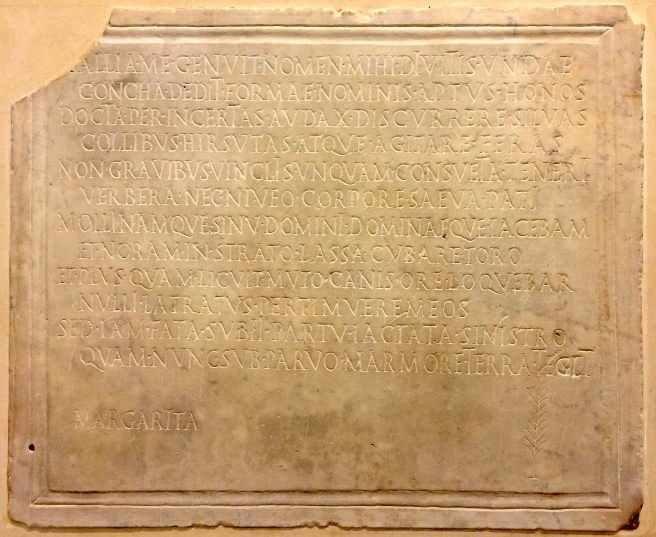
“What is Written Here is Brief”: Some Roman Memorials for Memorial Day

Some Archaic Latin Inscriptions from the Loeb Classical Library (the LCL numbers are first, translations are mine). There are earlier poetic epitaphs on this site as well, even legendary ones

Epitaphs 14 [CIL 1861]

“Here lies the sweet clown and slave of Clulius
Protogenes, who created many moments of happiness for people with his joking”

Protogenes Cloul[i] | suavis heicei situst | mimus
plouruma que | fecit populo soueis | gaudia nuges.

15 [CIL 1202]

“This monument was erected for Marcus Caecilius
We give you thanks, Friend, since you stopped by this home.
May you have good fortune and be well. Sleep without worry.”

Hoc est factum monumentum | Maarco Caicilio. |
Hospes, gratum est quom apud | meas restitistei seedes. |
Bene rem geras et valeas, | dormias sine qura.

18 [CIL 1211]

“Friend, what is written here is brief—stop and read it all.
This is the unattractive tomb of an attractive woman.
Her parents named her Claudia
She loved her own husband with her whole heart.
She had two sons and leaves one of them
On the earth, but placed the other beneath it.
[She was] charming in conversation; but proper in behavior.
She safeguarded her house. She made wool. I have said it all. Go.”

Hospes, quod deico paullum est; asta ac pellege.
Heic est sepulcrum hau pulcrum pulcrai feminae.
Nomen parentes nominarunt Claudiam.
Suom mareitom corde deilexit souo.
Gnatos duos creavit, horunc alterum
in terra linquit, alium sub terra locat.
Sermone lepido, tum autem incessu commodo.
Domum servavit, lanam fecit. Dixi. Abei.

39 [CIL 1219]

“Here are the bones of Pompeia the first daughter
Fortune promises a lot to many but makes a guarantee for no one.
Live for all days and all hours. For nothing is yours wholly.
Salvius and Heros donated this.”

Primae | Pompeiae | ossua heic.|
Fortuna spondet | multis, praestat nemini;
vive in dies | et horas, nam proprium est nihil. |
Salvius et Heros dant.

Image result for ancient roman epitaph

The Idle Vanity of Knowing Classical Passages

George Eliot, Middlemarch:

“Certainly this affair of his marriage with Miss Brooke touched him more nearly than it did any one of the persons who have hitherto shown their disapproval of it, and in the present stage of things I feel more tenderly towards his experience of success than towards the disappointment of the amiable Sir James. For in truth, as the day fixed for his marriage came nearer, Mr. Casaubon did not find his spirits rising; nor did the contemplation of that matrimonial garden scene, where, as all experience showed, the path was to be bordered with flowers, prove persistently more enchanting to him than the accustomed vaults where he walked taper in hand. He did not confess to himself, still less could he have breathed to another, his surprise that though he had won a lovely and noble-hearted girl he had not won delight,—which he had also regarded as an object to be found by search. It is true that he knew all the classical passages implying the contrary; but knowing classical passages, we find, is a mode of motion, which explains why they leave so little extra force for their personal application.

Poor Mr. Casaubon had imagined that his long studious bachelorhood had stored up for him a compound interest of enjoyment, and that large drafts on his affections would not fail to be honored; for we all of us, grave or light, get our thoughts entangled in metaphors, and act fatally on the strength of them. And now he was in danger of being saddened by the very conviction that his circumstances were unusually happy: there was nothing external by which he could account for a certain blankness of sensibility which came over him just when his expectant gladness should have been most lively, just when he exchanged the accustomed dulness of his Lowick library for his visits to the Grange. Here was a weary experience in which he was as utterly condemned to loneliness as in the despair which sometimes threatened him while toiling in the morass of authorship without seeming nearer to the goal. And his was that worst loneliness which would shrink from sympathy. He could not but wish that Dorothea should think him not less happy than the world would expect her successful suitor to be; and in relation to his authorship he leaned on her young trust and veneration, he liked to draw forth her fresh interest in listening, as a means of encouragement to himself: in talking to her he presented all his performance and intention with the reflected confidence of the pedagogue, and rid himself for the time of that chilling ideal audience which crowded his laborious uncreative hours with the vaporous pressure of Tartarean shades.”

Image result for scholar reading

Memorials of Eternal Words

Demosthenes, Funeral Oration, 35

“It is a hard thing for a mother and father to lose their children and to be deprived of their loved ones’ care in their old age; but it is a sacred comfort to see their offspring earn ageless honors and a public memorial of their virtue, when they are considered worthy of immortal sacrifices and contests. It is painful for children to become orphaned from their father; but it is ennobling to receive a share of their parent’s glory.”

χαλεπὸν πατρὶ καὶ μητρὶ παίδων στερηθῆναι καὶ ἐρήμοις εἶναι τῶν οἰκειοτάτων γηροτρόφων· σεμνὸν δέ γ᾿ ἀγήρως τιμὰς καὶ μνήμην ἀρετῆς δημοσίᾳ κτησαμένους ἐπιδεῖν, καὶ θυσιῶν καὶ ἀγώνων ἠξιωμένους ἀθανάτων. λυπηρὸν παισὶν ὀρφανοῖς γεγενῆσθαι πατρός· καλὸν δέ γε κληρονομεῖν πατρῴας εὐδοξίας.

Plutarch, Sayings of the Spartans, 251 Agesliaos

“When he was sailing back from Egypt, he began to die. He was telling those near him that a painting, or picture, or any statue of his body was not to be made, saying, “if I have accomplished anything good, let that be my memorial. If I have not, all the statues and the works of craftsmen will be worth nothing at all.”

Κατὰ δὲ τὸν Αἰγύπτου1ἀπόπλουν ἀποθνῄσκων ἐνετείλατο τοῖς περὶ αὐτὸν μήτε πλαστὰν μήτε γραπτὰν μήτε μιμηλὰν τοῦ σώματος εἰκόνα ποιήσασθαι, “εἰ γάρ τι καλὸν ἔργον πεποίηκα, τοῦτό μου μνημεῖον ἔσται· εἰ δὲ μή, οὐδ᾿ οἱ πάντες ἀνδριάντες, βαναύσων καὶ οὐδενὸς ἀξίων ἔργα ὄντες.”

Seneca, De Consolatione ad Polybium 2

“Extend the memory of your brother with some memorial of your writing: this is the only thing in human affairs which no storm can weaken and no expanse of time can consume. The rest—those made through the mounding of marble and stones or building up tombs of earth—they don’t last beyond a long day, since they will perish too. But creativity’s memory meets no death.”

Fratris quoque tui produc memoriam aliquo scriptorum monimento tuorum; hoc enim unum est in rebus humanis opus, cui nulla tempestas noceat, quod nulla consumat vetustas. Cetera, quae per constructionem lapidum et marmoreas moles aut terrenos tumulos in magnam eductos altitudinem constant, non propagant longam diem, quippe et ipsa intereunt; immortalis est ingeni memoria.

Dalí-Pitxot. The Allegory of Memory | Exhibitions | Fundació Gala ...
La llegenda del violoncel·lista i del paravent daurat