Distracted from Justice by Profit

Plutarch, Life of Brutus 29

“Faith in his sense of principle provided was the foundation of his great good will and fame. For Pompey the Great was not expected—should he overcome Caesar—to put down his power in deference to the laws, but people thought he would keep his political control, smooth-talking the people with the name of consulship or dictator or some other more palatable office.

Now it was imagined that Cassius, an eager and emotional man often distracted from justice by profit, was pursuing war and adventure to create some dynasty for himself rather than freedom for his fellow citizens. For in an earlier time than that, people like Cinna, Marius, and Carbo, even though they made their own country their victory prize and source for spoils, they warred by their own confession for tyranny alone.”

καὶ μέγιστον ὑπῆρχεν αὐτῷ πρὸς εὔνοιαν καὶ δόξαν ἡ τῆς προαιρέσεως πίστις, οὔτε γὰρ ἐκεῖνος ὁ μέγας Πομπήϊος, εἰ Καίσαρα καθεῖλεν, ἠλπίζετο βεβαίως προήσεσθαι τοῖς νόμοις τὴν δύναμιν, ἀλλ᾿ ἀεὶ τὰ πράγματα καθέξειν, ὑπατείας ὀνόματι καὶ δικτατορίας ἤ τινος ἄλλης μαλακωτέρας ἀρχῆς παραμυθούμενος τὸν 5δῆμον· Κάσσιον δὲ τοῦτον, σφοδρὸν ἄνδρα καὶ θυμοειδῆ καὶ πολλαχοῦ πρὸς τὸ κερδαλέον ἐκφερόμενον τοῦ δικαίου, παντὸς μᾶλλον ᾤοντο πολεμεῖν καὶ πλανᾶσθαι καὶ κινδυνεύειν αὑτῷ τινα δυναστείαν κατασκευαζόμενον, οὐκ ἐλευθερίαν 6τοῖς πολίταις. τὰ μὲν γὰρ ἔτι τούτων πρεσβύτερα, Κίνναι καὶ Μάριοι καὶ Κάρβωνες, ἆθλον ἐν μέσῳ καὶ λείαν προθέμενοι τὴν πατρίδα, μονονουχὶ ῥητῶς ὑπὲρ τυραννίδος ἐπολέμησαν.


File:Crassus Kopenhagen.jpg

Chief Minister of Bullsh*t

Cicero, Letters to Atticus 92 (4.18) October or November 54

You may ask me “how are you handling these things?” By god, pretty damn well and I love myself for doing so. My friend, we have not only lost the marrow and blood of a just state, but we’ve lost its decoration and facade too.

There is no Republic where I might find happiness or comfort. You may ask, “Can you really take this well?” Yes. That’s it. I recall how well the state thrived when I was governing it and the gratitude it gave me. No grief touches me at all at seeing one person capable of everything. Those who were upset that I had any power are wrecked by it.

No, I have many things to bring me solace. But I do not move from where I am, instead I return to that way of life which is most natural, to my books and my research.”

Dices ‘tu ergo haec quo modo fers?’ belle mehercule et in eo me valde amo. amisimus, mi Pomponi, omnem non modo sucum ac sanguinem sed etiam colorem et speciem pristinae civitatis. nulla est res publica quae delectet, in qua acquiescam. ‘idne igitur’ inquies ‘facile fers?’ id ipsum. recordor enim quam bella paulisper nobis gubernantibus civitas fuerit, quae mihi gratia relata sit. nullus dolor me angit unum omnia posse; dirumpuntur ii qui me aliquid posse doluerunt. multa mihi dant solacia, nec tamen ego de meo statu demigro, quaeque vita maxime est ad naturam, ad eam me refero, ad litteras et studia nostra.

Carved bust of Cicero 

Dictatorships, Tyrants, and Kings

Hannah Arendt, Personal responsibility Under a Dictatorship 36

“Politically, the weakness of the argument has always been that those who choose the lesser evil forget very quickly that they chose evil.”

Call witnesses or live in a dictatorship.

Cicero, Letters to Quintus 19

“We have no small hope in our elections, but it is still uncertain. There is some suspicion of a dictatorship. We have peace in public but it is the calm of an old and tired state, not one giving consent.”

erat non nulla spes comitiorum sed incerta, erat aliqua suspicio dictaturae, ne ea quidem certa, summum otium forense sed senescentis magis civitatis quam acquiescentis

Philo, On Dreams 12.78

“Indeed, just as frightened horses raise their necks up high, in the same way all those devotees of empty glory raise themselves above everything else, above cities, laws, ancestral custom, and the affairs of individual citizens. As they move from demagoguery to dictatorship, they subdue some of their neighbors as they try to make themselves superior and upright–and then they plan to enslave however so many minds remain naturally free and unenslaved.”

τῷ γὰρ ὄντι καθάπερ οἱ γαῦροι τῶν ἵππων τὸν αὐχένα μετέωρον ἐξάραντες, ὅσοι θιασῶται τῆς κενῆς δόξης εἰσίν, ἐπάνω πάντων ἑαυτοὺς ἱδρύουσι, πόλεων, νόμων, ἐθῶν πατρίων, τῶν παρ᾿ ἑκάστοις πραγμάτων· εἶτα ἀπὸ δημαγωγίας ἐπὶ δημαρχίαν βαδίζοντες καὶ τὰ μὲν τῶν πλησίον καταβάλλοντες, τὰ δὲ οἰκεῖα διανιστάντες καὶ παγίως ὀρθοῦντες, ὅσα ἐλεύθερα καὶ ἀδούλωτα φύσει φρονήματα,

Zonaras, 7.13

“So, the dictatorship, as has been reported, was pretty much the same thing as a kingship, except that the dictator could not go on horseback…”

ἦν μὲν οὖν, ὡς εἴρηται, ἡ δικτατορία κατά γε τὴν ἐξουσίαν τῇ βασιλείᾳ ἰσόρροπος, πλὴν ὅτι μὴ ἐφ᾿ ἵππον ἀναβῆναι…

Cicero, Letters to Atticus

“This is no minor stink of dictatorship…”

et est non nullus odor dictaturae

Hannah Arendt, Personal responsibility Under a Dictatorship 45

“The dividing line between those who want to think and therefore have to judge by themselves, and those who do not, strikes across all social and cultural or educational differences. In this respect, the total moral collapse of respectable society during the Hitler regime may teach us that under such circumstances those who cherish values and hold fast to moral norms and standards are not reliable: we now know that moral norms and standards can be changed overnight, and that all that then will be left is the mere habit of holding fast to something. Much more reliable will be the doubters and skeptics, not because skepticism is good or doubting wholesome, but because they are used to examine things and to make up their own minds. Best of all will be those who know only one thing for certain: that whatever else happens, as long as we live we shall have to live together with ourselves.”

From the Suda:

“Tyrannos: The poets before the Trojan War used to name kings (basileis) tyrants, but later during the time of Archilochus, this word was transferred to the Greeks in general, just as the sophist Hippias records. Homer, at least, calls the most lawless man of all, Ekhetos, a king, not a tyrant. Tyrant is a a name that derives from the Tyrrenians because these men were quite severe pirates.* None of the other poets uses the name tyrant in any of their works. But Aristotle in the Constitution of the Cumaeans says that tyrants were once called aisumnêtai, because this name is a bit of a euphemism.”

Τύραννος: οἱ πρὸ τῶν Τρωϊκῶν ποιηταὶ τοὺς βασιλεῖς τυράννους προσηγόρευον, ὀψέ ποτε τοῦδε τοῦ ὀνόματος εἰς τοὺς Ἕλληνας διαδοθέντος κατὰ τοὺς Ἀρχιλόχου χρόνους, καθάπερ Ἱππίας ὁ σοφιστής φησιν. Ὅμηρος γοῦν τὸν πάντων παρανομώτατον Ἔχετον βασιλέα φησί, καὶ οὐ τύραννον. προσηγορεύθη δὲ τύραννος ἀπὸ Τυρρηνῶν: χαλεποὺς γὰρ περὶ λῃστείας τούτους γενέσθαι. οὐδεὶς δὲ οὐδὲ ἄλλος τῶν ποιητῶν ἐν τοῖς ποιήμασιν αὐτοῦ μέμνηται τὸ τοῦ τυράννου ὄνομα. ὁ δὲ Ἀριστοτέλης ἐν Κυμαίων πολιτείᾳ τοὺς τυράννους φησὶ τὸ πρότερον αἰσυμνήτας καλεῖσθαι. εὐφημότερον γὰρ ἐκεῖνο τὸ ὄνομα. ὅτι καὶ ἕτεροι ἐτυράννησαν, ἀλλ’ ἡ τελευταία καὶ μεγίστη κάκωσις πάσαις ταῖς πόλεσιν ἡ Διονυσίου τυραννὶς ἐγένετο.

For Aristotle’s distinctions, see Politics, book 3 (1285a)

*According to Louise Hitchcock and Aren Maeir (“Yo-ho, Yo-ho: A Seren’s Life For me.” World Archaeology 46:4, 624-640) the Philistines used the word seren to mean leader; this word may have been related to Hittite tarwanis and was possibly circulated by the ‘sea peoples’. Greek tyrannos may have developed from this. Chaintraine notes that the etymology of turannos is unclear but that it may be related to Etruscan turan or Hittite tarwana.

Etymologicum Magnum

“This is likely formed from Tursennians*. Or it derives from Gyges who was from a Turran city in Lykia, and he was the first one who was a tyrant. Others claim it is from truô [“to distress, wear out, afflict”], that it was truanos and that the rho and nu switched places through pleonasm. Ancients used to use the word Turannos for kings. There was a time when they used a call the tyrant ‘king’.

Τύραννος: ῎Ητοι ἀπὸ τῶν Τυρσηνῶν· ὠμοὶ γὰρ οὗτοι· ἢ ἀπὸ Γύγου, ὅς ἐστιν ἀπὸ Τύρρας πόλεως Λυκιακῆς, τυραννήσαντος πρῶτον. ῎Αλλοι δὲ ἀπὸ τοῦ τρύω, τὸ καταπονῶ, τρύανος· καὶ ὑπερβιβασμῷ τοῦ ρ, τύραννος, κατὰ πλεονασμὸν τοῦ ν. Τύραννον δὲ οἱ ἀρχαῖοι καὶ ἐπὶ βασιλέως ἔτασσον· ἔσθ’ ὅτε δὲ καὶ τὸν τύραννον βασιλέα ἔλεγον.

*A name for Etruscans

s.v. Αἰσυμνητήρ

“An aisiomêtês is one who has proper plans. A tyrant is the opposite.”

ὁ αἰσιομήτης, ὁ αἴσια βουλευόμενος· ὁ γὰρ τύραννος τοὐναντίον.

What’s the difference between a king and a tyrant?

s.v. Βασιλεύς

“For, a king must truly do noble things. One who does evil, he’s a tyrant.”

δεῖ γὰρ ἀληθῶς βασιλέα καλοποιεῖν· ὁ δὲ κακοποιῶν, τύραννος

Etymologicum Gudianum

“Tyranny: It differs from a kingship and a tyrant is different from a king. For a kingship is something that exercises power according the law. But a tyranny is a force without reason, following its own law. A king is someone who rules according to just laws; but a tyrant, who can never rule justly nor without the boundaries of the law, he steps outside of the laws.”

Tyrannos: from some tyrant, the one who first ruled badly, from the city of Tyre. It means two things: a kind and the man as a tyrant.”

Τυραννὶς, βασιλείας διαφέρει, καὶ τύραννος βασιλέως· βασιλεῖα μὲν γάρ ἐστι κατὰ νόμους ἄρχουσα ἐξουσία τίς· τυραννὶς δὲ ἡ ἄλογος ἐξουσία, αὐτωνομίᾳ χρωμένη· βασιλεύς ἐστιν ὁ κατὰ νόμους δικαίους ἄρχων· τύραννος δὲ, ὁ μήτε δικαίως ἄρχων, μήτε νομίμως, ἀλλὰ καὶ τοὺς νόμους ἐκπατῶν.

Τύραννος, ἀπὸ τυράννου τινὸς, πρώτου κακῶς διακειμένου, ἀπὸ Τύρου τῆς πόλεως· σημαίνει δὲ δύο, τὸν βασιλέα καὶ τὸν ἄνθρωπον τύραννον.

arrogant finger

Aristotle, Politics 1285a

“Citizens guard their kings with arms; foreigners protect tyrants. This is because kings rule according to the law and with willing citizens while tyrants rule the unwilling. As a result, kings have guards from their subjects and tyrants keep guards against them.”

οἱ γὰρ πολῖται φυλάττουσιν ὅπλοις τοὺς βασιλεῖς, τοὺς δὲ τυράννους ξενικόν: οἱ μὲν γὰρ κατὰ νόμον καὶ ἑκόντων οἱ δ᾽ ἀκόντων ἄρχουσιν, ὥσθ᾽ οἱ μὲν παρὰ τῶν πολιτῶν οἱ δ᾽ ἐπὶ τοὺς πολίτας ἔχουσι τὴν φυλακήν.

Philanthropy or Fine Sniffing

Scholion to Iliad 1.50:

[1.50: “First he set upon the mules and the swift dogs.“]

The god, being a lover of humans, first did away with the mules and the dogs and the other unreasoning beasts, so that, leading the Greeks to fear through their example, he could turn their minds to piety. Or it may be that asses and dogs have a more powerful sense of smell. For dogs often perceive animals from the smell of their tracks, while quite often mules who have been left behind by people have found their routes from their sense of smell.

a

* Peacocks! * Pythagoras! * Homer! * Ennius! * (Featuring the Loser Euphorbus)

Cornutus, Commentary on Persius 6.10:

Thus writes Ennius in the beginning of his Annals, where he says that in a dream he saw Homer claiming that he had once been a peacock, and that his soul had been transferred from there into Ennius according to the doctrine of Pythagoras, who said that human souls, through a process of palingenesis (that is, a repeated birth) are able to enter new bodies as they leave their old ones behind. He used the phrase ‘the fifth’ in accordance with the opinion that the soul of Pythagoras was moved into a peacock, from the peacock to Euphorbius, from Euphorbius to Homer, and from Homer to Ennius. Or, to be sure, he said ‘the fifth’ because Ennius was named Quintus.

A large presence of the peacock in Roman mosaics

sic Ennius in Annalium suorum principio, ubi se dicit vidisse in somnis Homerum dicentem fuisse quondam pavonem et ex eo translatam in se animam esse secundum Pytagorae philosophi definitionem, qui dicit animas humanas per palingenesiam, id est per iteratam generationem, exeuntes de corporibus in alia posse corpora introire. ideo autem, “quintus” dixit propter eam opinionem quae dicit animam Pytagorae in pavonem translatam, de pavone vero ad Euphorbium, de Euphorbio ad Homerum, de Homero autem ad Ennium. vel certe quod cognomento Ennius dicitur.

Dishonoring the Gods

Sophocles, Antigone 280–288

“Stop speaking before you fill me with rage!
And you’re revealed as a fool as well as an old man.

You speak of unendurable things, claiming that the gods
Have some plan for this corpse.
Did they do it to honor him so greatly for his fine work,
Concealing him, the man who came here
To burn their temples and their statutes,
To ruin their land and their laws?
Do you see the gods honoring evil people?”

παῦσαι, πρὶν ὀργῆς καί με μεστῶσαι λέγων,
μὴ ᾿φευρεθῇς ἄνους τε καὶ γέρων ἅμα.
λέγεις γὰρ οὐκ ἀνεκτὰ δαίμονας λέγων
πρόνοιαν ἴσχειν τοῦδε τοῦ νεκροῦ πέρι.
πότερον ὑπερτιμῶντες ὡς εὐεργέτην
285ἔκρυπτον αὐτόν, ὅστις ἀμφικίονας
ναοὺς πυρώσων ἦλθε κἀναθήματα
καὶ γῆν ἐκείνων καὶ νόμους διασκεδῶν;
ἢ τοὺς κακοὺς τιμῶντας εἰσορᾷς θεούς;

 Sophocles, Antigone 72–77

“It is noble for me to do this and then die.
I will lie with him because I belong to him, with him,
Once I have completed my sacred crimes. There’s more time
When I must please those below than those here,
Since I will lie there forever. You? Go head,
Dishonor what the gods honor if it seems right.”

… καλόν μοι τοῦτο ποιούσῃ θανεῖν.
φίλη μετ᾿ αὐτοῦ κείσομαι, φίλου μέτα,
ὅσια πανουργήσασ᾿· ἐπεὶ πλείων χρόνος
ὃν δεῖ μ᾿ ἀρέσκειν τοῖς κάτω τῶν ἐνθάδε·
ἐκεῖ γὰρ αἰεὶ κείσομαι. σὺ δ᾿ εἰ δοκεῖ
τὰ τῶν θεῶν ἔντιμ᾿ ἀτιμάσασ᾿ ἔχε.

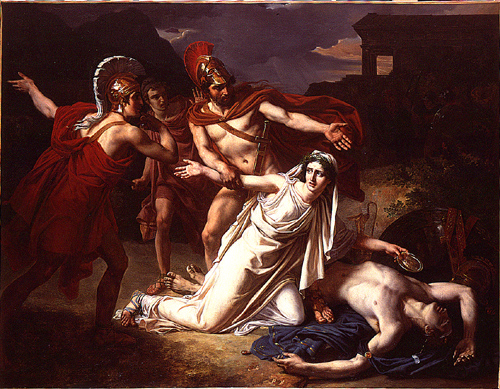
Sébastien Norblin, Antigone donnant la sépulture à Polynice

Reasons for Revolutions: Wanting To Be Equal Vs. Wanting Just More

Aristotle, Politics 1302 a

“We have already happened to discuss the reason why people are predisposed towards a revolution. People who desire equality rise up in strife when they believe that they have less even though they are allegedly equal to those they oppose. But those who want inequality or their own superiority imagine that even though they are unequal that don’t have more but merely an equal amount. (Of course, these feelings may exist both justly and unjustly. People who are in a lesser position engage in strife in order to become equal; those who are merely equal, do it to become superior.”

Τοῦ μὲν οὖν αὐτοὺς ἔχειν πως πρὸς τὴν μεταβολὴν αἰτίαν καθόλου μάλιστα θετέον περὶ ἧς ἤδη τυγχάνομεν εἰρηκότες. οἱ μὲν γὰρ ἰσότητος ἐφιέμενοι στασιάζουσιν ἂν νομίζωσιν ἔλαττον ἔχειν ὄντες ἴσοι τοῖς πλεονεκτοῦσιν, οἱ δὲ τῆς ἀνισότητος καὶ τῆς ὑπεροχῆς ἂν ὑπολαμβάνωσιν ὄντες ἄνισοι μὴ πλέον ἔχειν ἀλλ᾿ ἴσον ἢ ἔλαττον (τούτων δ᾿ ἔστι2 μὲν ὀρέγεσθαι δικαίως, ἔστι δὲ καὶ ἀδίκως)· ἐλάττους 30τε γὰρ ὄντες ὅπως ἴσοι ὦσι στασιάζουσι, καὶ ἴσοι ὄντες ὅπως μείζους. πῶς μὲν οὖν ἔχοντες στασιάζουσιν, εἴρηται.


Plutarch, Solon 94

“The city was following the laws, but they were already expecting a revolution and longing for a different kind of government, not because they were hoping for equality, but because they would have more in a revolution and they would rule over their opposition in every way.”

ὥστε χρῆσθαι μὲν ἔτι τοῖς νόμοις τὴν πόλιν, ἤδη δὲ πράγματα νεώτερα προσδοκᾶν καὶ ποθεῖν ἅπαντας ἑτέραν κατάστασιν, οὐκ ἴσον ἐλπίζοντας, ἀλλὰ πλέον ἕξειν ἐν τῇ μεταβολῇ καὶ κρατήσειν παντάπασι τῶν διαφερομένων.

An Assessment of Byzantine Scholars

Ulrich von Wilamowitz-Moellendorff,

History of Classical Scholarship (trans. Alan Harris):

“John Tzetzes, that most unpleasant man, pretended to wider reading than he possessed and was a complete failure as a critic; but he had some advantages that we have not. The three princes of the church, Eustathius of Thessalonica, Michael Choniates of Athens and Gregory of Corinth (c. 1200), rank much higher. From Acominatus we learn that, apart from the Acropolis, the ancient monuments of Athens were already in his day as ruined, and her ancient traditions as forgotten, as when exploration began in the seventeenth century. The amount of material on Homer amassed by Eustathius is astounding, and his commentary, one of the first printed books, dominated Homeric studies for years; we possess it in the author’s own hand. At home it would not have found a public, even if the disastrous Fourth Crusade had not brought about a general decline and made havoc of the still ample heritage of ancient literature.

The damage was irreparable. Henceforth it was only small groups, mostly in monasteries, who exerted themselves to save the last remains.”

Image result for john tzetzes

Laws and Fear of the State

Sophocles, Ajax 1071-1086

“The laws are never taken well in a city
Where fear has not been planted too.
Nor can any army be ruled wisely
If it has no foundation of fear and shame.

But even if someone has a powerful body
He can seem to fall because of some minor evil.
Understand this: whoever has shame and fear
That’s the person who has safety.

But wherever it is that someone can be outrageous and do what they want
Know that this city eventually will sink to the depth
Even if it was running smoothly for years.

Let me have some fear then at the right time
And let us not imagine that if we do what makes us happy
We won’t pay the penalty of grief in turn.”

οὐ γάρ ποτ᾿ οὔτ᾿ ἂν ἐν πόλει νόμοι καλῶς
φέροιντ᾿ ἄν, ἔνθα μὴ καθεστήκοι δέος,
οὔτ᾿ ἂν στρατός γε σωφρόνως ἄρχοιτ᾿ ἔτι,
μηδὲν φόβου πρόβλημα μηδ᾿ αἰδοῦς ἔχων.
ἀλλ᾿ ἄνδρα χρή, κἂν σῶμα γεννήσῃ μέγα,
δοκεῖν πεσεῖν ἂν κἂν ἀπὸ σμικροῦ κακοῦ.
δέος γὰρ ᾧ πρόσεστιν αἰσχύνη θ᾿ ὁμοῦ,
σωτηρίαν ἔχοντα τόνδ᾿ ἐπίστασο·
ὅπου δ᾿ ὑβρίζειν δρᾶν θ᾿ ἃ βούλεται παρῇ,
ταύτην νόμιζε τὴν πόλιν χρόνῳ ποτὲ
ἐξ οὐρίων δραμοῦσαν ἐς βυθὸν πεσεῖν.
ἀλλ᾿ ἑστάτω μοι καὶ δέος τι καίριον,
καὶ μὴ δοκῶμεν δρῶντες ἃν ἡδώμεθα
οὐκ ἀντιτείσειν αὖθις ἃν λυπώμεθα.

Sophocles


Want to Read Thucydides? Get Yourself a Commentary!

Dionysius of Halicarnassus, On Thucydides 51:

“Against those who think that it is reserved for the well-educated alone to make sense of and understand the words of Thucydides, I am able to say this, that they take the part of the work which is necessary and beneficial to all (indeed, nothing could be more necessary or beneficial) away from common life by thus making it the province of a few men, as happens in oligarchic and tyrannical states. One could easily count the number of people who are able to understand all of Thucydides, and even these people need to rely on a commentary from time to time.”

   Πρὸς μὲν οὖν τοὺς οἰομένους μόνων εἶναι τῶν εὐπαιδεύτων ἀναγνῶναί τε καὶ συνεἷναι τὴν Θουκυδίδου διάλεκτον ταῦτα λέγειν ἔχω, ὅτι τὸ τοῦ πράγματος ἀναγκαῖόν τε καὶ χρήσιμον ἅπασιν (οὐδὲν γὰρ <ἂν> ἀναγκαιότερον γένοιτο οὐδὲ πολυωφελέστερον) ἀναιροῦσιν ἐκ τοῦ κοινοῦ βίου, ὀλίγων παντάπασιν ἀνθρώπων οὕτω ποιοῦντες, ὥςπερ ἐν ταῖς ὀλιγαρχουμέναις ἢ τυραννουμέναις πόλεσιν· εὐαρίθμητοι γάρ τινές εἰσιν οἷοι πάντα τὰ Θουκυδίδου συμβαλεῖν, καὶ οὐδ’ οὗτοι χωρὶς ἐξηγήσεως γραμματικῆς ἔνια.