On the Advantages and Disadvantages of Literature (Part II):
“Therefore, turning over many things in my mind both for my own sake and that of my friends, I was meditating in what worthy endeavor I might test the strength of my intellect, and then – with the encouragement of my friends – I might test whether it was in me. Nothing ever came to my mind during this investigation which itself had not already been taken up beautifully by those divine ancient writers, and so it seemed that it was not left for the most learned man of this age to speak upon a matter better than the ancients did themselves, nor was it left to me to do anything similar to them in a fitting or worthy way. The ancients themselves embraced all serious and trivial subjects so thoroughly, and they left for us only the opportunity and the necessity of reading and admiring them.
Then, in our time, those who are of an older age seized, for the sake of their praise and reputation, upon some things which had perhaps been lying neglected by the ancient authors. For those who desired glory thought rightly that it was much better to attempt something even if it be not entirely perfect and absolute, than simply to grow old from silence in the study of letters. What then about us? Will we to no good end imitate that orator Isocrates, who is said to have praised the most worthless tyrant Busiris and heaped scorn upon Socrates, the best and holiest philosopher, in his celebrated speeches? To be sure, here is what I think: I have conceded many things to us especially as we exercised our talents in youth, which otherwise are denied to us as mature men in the perfection of our erudition.”
Itaque et mea et meorum causa sepe ac multum animo et cogitatione plurima ipse mecum versans meditabar quidnam possem dignum adinvenire in quo vires ingenii mei periclitarer, tum meis iubentibus, si quid in me esset, obtemperarem. Nihil mihi unquam pervestiganti in mentem subiit, quod ipsum a priscis illis divinis scriptoribus non pulchre esset occupatum, ut neque eam rem viro hac etate doctissimo quam iidem illi melius dicere neque mihi similia illis apte et condigne agere relictum sit; ita et seria omnia et iocosa veteres ipsi complexi sunt, nobis tantum legendi atque admirandi sui facultatem et necessitatem dimiserunt.
Tum hac etate qui maiores adsunt natu nonnulla que fortassis a superioribus scriptoribus neglecta latitabant laudis et nominis gratia deprehenderunt. Nam prestantius esse recte opinantur ii qui laudem cupiant quippiam etsi non omni ex parte perfectum atque absolutum conari, quam in litteris silentio consenescere. Quid igitur nos? Num parum commode Isocratem illum rhetorem imitabimur qui Busiridem nequissimum tyrannum laudasse ac Socratem optimum et sanctissimum philosophum conditis orationibus vituperasse fertur? Sane sic censeo: multa ingenium exercentibus nobis presertim iuvenibus concedi, que alioquin maturis et perfecte eruditis viris denegarentur.
N.B This is a different Pythagoras from the one with the theorem.
Suda, s.v. Pythagoras of Ephesos
“Pythagoras of Ephesos. Once he overthrew the government called the reign of the Basilidai, Pythagoras became the harshest tyrant. He seemed and sometimes was very kind to the people and the masses, increasing their hopes, but under-delivering on their profits. Because he despoiled those in high esteem and power and liquidated their property, he was not at all tolerable.
He did not hesitate to impose the harshest punishments or to mercilessly kill those who had done no wrong—for he had gotten just this crazy. His lust for money was endless. He was also quickest to anger in response to any insults to those near to him. On their own, these things would have been enough reason for people to kill him in the worst way, but he also was contemptuous of the divine. Indeed, many of his previously mentioned victims he actually killed in temples.
When the daughters of one man took refuge in a temple, he did not dare to extract them forcefully, but he waited them out so long that the girls resolved their hunger with a rope. A plague then afflicted the people along with a famine and Pythagoras, who was worried for himself, sent representatives to Delphi, requesting relief from these sufferings. She said that he needed to build temples and take care of the dead. He lived before Cyrus of Persia, according to Batôn.”
I hear that Dionysius of Heraclea, the son of Chlearchus the tyrant, was unaware of the fact that he was becoming a bit fleshy and fat from his daily gluttony. The punishment attending this corpulence and protuberance of flesh was difficulty in breathing. They say that the doctors prescribed for this ailment thin and tiny needles which they then drove through his ribs and belly, whenever he happened to be drifting off into a deep sleep. Their concern was to do this until the whole needle went through the whole of the outer part of his skin. But he lay unmoved like a stone. If the needle came to the point where the rest of his healthy and personal body was, and not the external part of the excessive fat, he then perceived it, and was awoken from his sleep. He fabricated oracular responses to those who wished to enter his presence after putting a chest in front of his body. Some say that it was not a chest, but a cupboard, fashioned such that the rest of his body would be hidden while his face remained visible, having – o gods – girded himself with that vexatious outfit, a cage for a beast more than clothing for a human.
“Note that the most terrible man has laid hold of tyranny. He started with demagoguery, and then he feigned some injury to himself. He then ran to the courts and shouted, saying that he had suffered at the hands of his enemies, and thought that he should be provided with a guard of four hundred men. They paid no heed to my warnings, and gave him the men. These men were club-bearers. After that, he subjugated the people. In vain did I strive to free the poor from servitude – they are all Peisistratus’ slaves now.”
Benjamin Rush, Letter to John Adams, December 21 1810:
“You have made no impression upon me by your arguments in favor of the dead languages. Napoleon would have been just what he is, had he never read a page of ancient history. Rulers become tyrants and butchers from instinct, much oftener than from imitation. As well might we suppose the human race would have been extinct, had not Ovid bequeathed to modern nations his “arte amandi,” as suppose that modern Villains, are made by ancient examples. Royal Crimes, like yellow fevers spring up spontaneously under similar circumstances in every Country, and in every age. The adoption of the former from Antiquity, is as contrary to truth & reason as the importation of the latter from foreign Countries.”
Jordan, Borimir. “The Honors for Themistocles after Salamis.” The American Journal of Philology, vol. 109, no. 4, 1988, pp. 547–571. JSTOR, http://www.jstor.org/stable/295081.
Who knows what Pindar poem this may have come from or what the context was–chances are it cannot be taken too seriously considering the on-again-off-again relationship between Sparta and Thebes and the fact that everything Pindar composed has to be understood from the perspective of the goal of the overall poem, to praise someone in particular by praising their country, their family, and their patron gods. (See Elroy Bundy’s Studia Pindarica for the clearest explanation of this.)
“Let’s offer some examples from other peoples as well. Many kings and people in charge, have given themselves to death after listening to an oracle, so that they might save their citizens with their own blood. And many private citizens have exiled themselves in order to decrease civil strife.”
“When a plague was afflicting the Spartans because of the murder of the heralds sent by Xerxes—because he demanded earth and water as signs of servitude—they received an oracle that they would be saved if some Spartans would be selected to be killed by the king. Then Boulis and Sperkhis came forward to the king because they believed they were worthy to be sacrificed. Because he was impressed by their bravery he ordered them to go home.”
Diogenes Laertius, Vitae philosophorum 1.110 [Epimenides]
“Epimenides was known among the Greeks and was thought to be extremely beloved to the gods. For this reason, when the Athenians were once afflicted by a plague and the Pythian oracle prophesied that they should cleanse their city, they sent a ship along with Nikias the son of Nikêratos, summoning Epimenides.
He made it to Athens at the time of the 46th Olympiad [c. 596 BCE] and cleansed the city. He stopped it in the following manner. After obtaining white and black sheep, he led them to the Areopagos and then allowed them to go wherever they wanted there. He ordered the people following them to sacrifice the sheep to whichever god was proper to the place where each sheep laid down.
This is how the plague stopped. For this reason it is still even today possible to find altars without names in certain Athenian neighborhoods as a commemoration of that ancient cleansing. Some people report that Epimenides indicated the pollution from the Kylon scandal as the cause of the plague along with a resolution for it. For this reason, they killed two youths, Kratinos and Ktêsibios and the suffering was relieved.”
“Kuanippos, a Syracusan by birth, did not sacrifice to Dionysus alone. In rage over this, the god caused him to become drunk and then he raped his daughter Kuanê in some shadowy place. She took his ring and gave it to her nurse as to be proof of what had happened in the future.
When they were later struck by a plague and Pythian Apollo said that they had to sacrifice the impious person to the Gods-who-Protect, everyone else was uncertain about the oracle. Kuanê understood it. She grabbed her father by the hair and sacrificed herself over him once she’d butchered him on the altar.
That’s the story Dositheos tells in the third book of his Sicilian Tales.”
“The whole state often suffers because of a wicked man
Who transgresses the gods and devises reckless deeds.
Kronos’ son rains down great pain on them from heaven:
Famine and plague and the people start to perish.
[Women don’t give birth and households waste away
Thanks to the vengeance of Olympian Zeus.] And at other times
Kronos’ son ruins their great army or their wall
Or he destroys their ships on the the sea.”
“When a plague struck the Selinuntians thanks to the pollution from a nearby river causing people to die and the women to miscarry, Empedocles recognized the problem and turned two local rivers at his own expense. They sweetened the streams by mixing in with them.
Once the plague was stopped in this way, Empedocles appeared while the Selinuntines were having a feast next to the river. They rose and bowed before him, praying to him as if he were a god. He threw himself into a fire because he wanted to test the truth of his divinity.”
“He had banquet and bedroom furniture made from silver. He often ate camel-heels and cock’s combs removed from birds who were still alive to imitate Apicius, as well as the tongues of peacocks and nightingales because it was said that whoever ate them was safe from the plague.
He also gave the the Palace visitors enormous serving dishes piled with the innards of mullets, flamingo-brains, partridge eggs, the brains of thrushes, and the whole heads of parrots, pheasants, and peacocks.”
Hic solido argento factos habuit lectos et tricliniares et cubiculares. comedit saepius ad imitationem Apicii calcanea camelorum et cristas vivis gallinaceis demptas, linguas pavonum et lusciniarum, quod qui ederet a pestilentia tutus diceretur. exhibuit et Palatinis lances ingentes extis mullorum refertas et cerebellis phoenicopterum et perdicum ovis et cerebellis turdorum et capitibus psittacorum et phasianorum et pavonum.
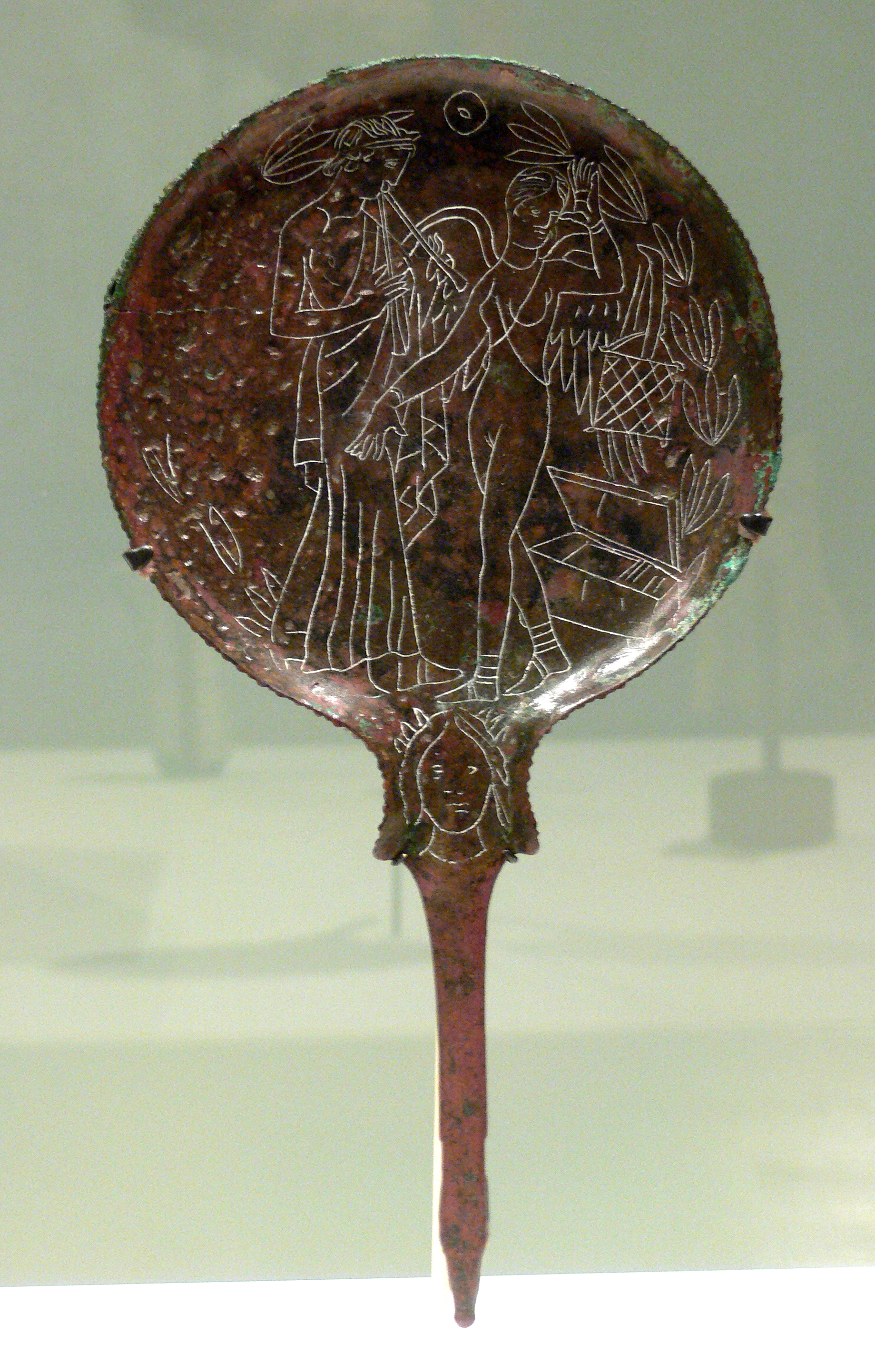
“When we are sent back there, love does not come near our soul through its own devising but through the body. Just so, teachers of geometry, when their students are not yet capable of comprehending thoughts of the incorporeal or the concepts of immutable essence, they make shapes, manipulable and visible representations of spheres, cubes, and dodecahedrons to give them. In this way, heavenly love creates beautiful mirrors of the beautiful things, mortal versions of the divine, changeable manifestations of the unchanging, and merely sensible representations of pure thought.
By creating these things in the shape and color and image of the beautiful people in their youth, Love moves our memory carefully, and it is kindled first by these things.”
From Porphyry’s onStyx [Fragments preserved in Stobaeus 1.49.50]
“The notion explored is that the souls [of the dead] are like images which appear in mirrors or those on the surface of water which appear to resemble us completely and imitate our movements but have no solid matter for grasping or touching. This is why he calls them “images of exhausted men” (11.476).”
de ingenuis moribus et liberalibus adulescentiae studiis, XXXII & XXXIII:
“At these times, when we are unable to employ our leisure outside, reading and books come to our aid. That is, unless we wish to indulge in sleep or to waste away in idle leisure, or even to imitate the custom of the Roman emperor Domitian, who on some days, at certain hours, would withdraw from the company of the world and hunt flies with his iron pen.”
[…]
“One of the imperial domestic servants once commented upon the madness of Domitian with a witty joke. At one time, when he was asked whether anyone was in the room with Domitian, the servant responded, ‘Not even a fly,’ as though the emperor had managed to kill them all with his pen.”
in hoc igitur tempus, cum nihil nobis per otium agere foris licebit, lectio librique succurrent. Nisi prorsus somno indulgere aut inerti otio tabescere volemus aut morem imitari Domitiani principis qui singulis diebus, certis horis, secretus ab omnibus stilo ferreo muscas insectabatur.
[…]
… eius ipsius Domitiani dementiam e cubiculariis unus urbano scommate notavit. Aliquando enim interrogatus, essetne quisquam cum Domitiano intus, respondit, ‘Ne musco quidem,’ quasi ille stilo suo omnes sustulisset.




 Image from:


.jpg)
