“History, Stephen said, is a nightmare from which I am trying to awake.”
James Joyce, Ulysses
Every American schoolchild learns about the founding generation (or “the Founding Fathers”) from an early age. Much of what we learn is obviously mythical, as in the story of George Washington chopping down the cherry tree. Other early lessons involve some real history run through the filter of selectively patriotic distortion, which frames the Boston Massacre as the obvious first step in King George’s iron-heeled march toward a kind of colonial totalitarianism. There are also the sins of omission and denial, as in the long silence in American classrooms about the brutality of men like Jefferson who, for all of their Enlightenment rhetoric, were despotic tyrants over people whom they regarded as their property.
There are also misconceptions about the founding generation which partake of all three of these elements. One of these misconceptions is the idea that the founding generation represented a unique intellectual pinnacle in American life, and that the men who crafted our country’s political system were singularly imbued with a classical education. In many ways, this myth parallels the myth that the founders were all Christians, despite notable deistic (and even atheistic) tendencies among them, and despite their often spotty record of church attendance. In both cases, people want to project a set of values or qualities back upon idealized fictions bearing the names of men who lived through and participated in an inflection point in the nation’s history.
We will take a closer look at the classical attainments of the founding generation, and I hope that by the end of this essay it will be clear that the founders’ knowledge of the classics was not especially advanced in comparison to other people of their time; that in fact, many men of their generation displayed a hostility toward the study of ancient languages and literature which prefigures a broad trend of anti-intellectualism and hard-headed, efficiency-minded practicality in this country; that, while it is indeed true that the founders drew upon their classical learning to shape the political framework of this country, much of this rested upon selective and creative appropriation of classical history and thought; and finally, that many of America’s most dangerous and dysfunctional tendencies, in particular its inability to function collectively for civic good, can be attributed to the founders’ creative but fundamentally flawed reception of the classical past.
Founders vs. Scholars
It is often observed that the founders were steeped in classical learning, and that their reading of ancient history was the primary impetus for instituting a mixed form of government as described by Aristotle and Polybius. While there can be no doubt that the founders talked about classics all the time, it is not clear that many of them possessed much deep knowledge of antiquity. Indeed, many of them were familiar with all of the canonical works, but this was to be expected of anyone who had progressed through the classically-based educational system which prevailed at the time. Their knowledge was chiefly of the contents of ancient books, and reflects less serious engagement with the scholarly humanistic tradition than was characteristic of their counterparts across the Atlantic.
In order to better understand the extent of the founders’ classical knowledge, we may consider the example of their rough contemporaries. English classical scholarship in the generation immediately preceding that of the founders was dominated by Richard Bentley. While famous among Classical scholars, Bentley is largely forgotten to the broader intellectual world, except to those who recall him as the butt of the joke in Pope’s Dunciad and Swift’s Battle of the Books. Bentley, a graduate of St. John’s College, Oxford, spent much of the 1680s in the household of Edward Stillingfleet before rolling on to the scholarly scene in the 1690s with two works which display what Gibbon would call “a stock of erudition which would have puzzled a doctor.”
Bentley’s early scholarly fame was established by two immensely erudite treatises published toward the end of the 17th century, which received some impetus from the fashionable intellectual controversy known as The Battle of the Books (or The Quarrel Between Ancients and Moderns). The controversy itself has been forgotten by the public at large, perhaps because the debate has been so firmly settled on the side of modernity, but it was still capable of exciting tempers at the end of the 17th century, and served as the foundation for Bentley’s famous Dissertation Upon the Epistles of Phalaris. The epistles were literary forgeries (or playful literary exercises) written in the persona of Phalaris, the tyrant of Akragas, who cooked his enemies inside a brazen bull which he kept at his court. Many astute readers had long seen that the Epistles were not actually written by the tyrant himself, but that did not prevent Sir William Temple from blundering his way into citing them as proof for his claim that the achievements of antiquity far surpassed those of the modern world. Temple described the Epistles as having “more Race, more Spirit, more Force of Wit and Genius than any others I have ever seen, either antient or modern.” William Wotton, one of Bentley’s friends, penned a response to Temple arguing for the superiority of modern achievement, and published it along with the 78 page first edition of the Dissertation, composed by Bentley, which showed that the Epistles were neither original, nor as ancient as Temple had supposed. This led to a counterattack by Francis Atterbury, which in turn drove Bentley to publish a substantially enlarged, 540 page edition of the Dissertation. Unsurprisingly, the second edition of the Dissertation was far more diffuse and digressive than the first, and it does more than simply prove its point about the Epistles – it provides commentary upon and solutions to a wide range of textual and chronographic problems which are tangentially related to issues suggested by the Epistles themselves.
The example of Bentley is important because his work explored the deep arcana of classical reading. Many of his gentlemanly contemporaries faulted him for compiling indexes out of obscure (i.e. non-canonical) authors, and sifting through masses of Byzantine lexicography to illustrate and resolve textual difficulties in both major and minor works of classical literature. Bentley was a genius, and even when he applied himself to correcting some apparently small and well-defined textual problem, his method for solving the difficulty often led him to correct several other errors in other texts along the way, as though they were wholly accidental scholarly parerga.
Beyond England, Classical scholarship was alive and well on the continent, too, and one of history’s most renowned and important classical scholars, F.A. Wolf, was active during the same period as the founders. Consider the high level of classical education which Wolf achieved even as a very young man:
Towards the end of his school-days he became his own teacher. Starting once more with the declensions, he ‘read with new eyes the Latin and Greek Classics, some carefully, others more cursorily; learnt by heart several books of Homer, and large portions of the Tragedians and Cicero, and went through Scapula’s Lexicon and Faber’s Thesaurus’. During this time of strenuous study, ‘he would sit up the whole night in a room without a stove, his feet in a pan of cold water, and one of his eyes bound up to rest the other’. Happily this severe ordeal ended with his removal to the university of Gottingen.” [Sandys, A History of Classical Scholarship VOL. 3]
The founders may have been drilled in the classics as schoolboys, but it does not appear that any of them could match this kind of ardor for classical knowledge. Nor could they even hope to approximate the depth of the scholarship exemplified by those lights of the 18th century, Bentley and Wolf. They were perfectly happy to read from the classical canon, but even in that narrow context, their focus was primarily on the historical and political aspects of ancient writings. The founders made the mistake of treating antiquity not as an object for study and scholarship, but as a set of exempla for emulation and revivification.
One may object that the founders were men of action, not cloistered pedants, and so could not hope to rival the bibliomania and scholarly exactitude of real scholars. Gibbon was, for all of his scribbling, but a gentleman amateur, and yet the range of classical reading which he conducted in writing his Decline and Fall of the Roman Empire far outstrips that which can be gleaned from anything the founders wrote. Even as a young man, he was dipping into the more recondite parts of classical literature:
My first introduction to the historic scenes, which have since engaged so many years of my life, must be ascribed to an accident. In the summer of 1751, I accompanied my father on a visit to Mr. Hoare’s, in Wiltshire; but I was less delighted with the beauties of Stourhead, than with discovering in the library a common book, the Continuation of Echard’s Roman History, which is indeed executed with more skill and taste than the previous work. To me the reigns of the successors of Constantine were absolutely new; and I was immersed in the passage of the Goths over the Danube, when the summons of the dinner-bell reluctantly dragged me from my intellectual feast. This transient glance served rather to irritate than to appease my curiosity; and as soon as I returned to Bath I procured the second and third volumes of Howel’s History of the World, which exhibit the Byzantine period on a larger scale. Mahomet and his Saracens soon fixed my attention; and some instinct of criticism directed me to the genuine sources. Simon Ockley, an original in every sense, first opened my eyes; and I was led from one book to another, till I had ranged round the circle of Oriental history. Before I was sixteen, I had exhausted all that could be learned in English of the Arabs and Persians, the Tartars and Turks; and the same ardour urged me to guess at the French of D’Herbelot, and to construe the barbarous Latin of Pocock’s Abulfaragius. Such vague and multifarious reading could not teach me to think, to write, or to act; and the only principle that darted a ray of light into the indigested chaos, was an early and rational application to the order of time and place. The maps of Cellarius and Wells imprinted in my mind the picture of ancient geography: from Stranchius I imbibed the elements of chronology: the Tables of Helvicus and Anderson, the Annals of Usher and Prideaux, distinguished the connection of events, and engraved the multitude of names and dates in a clear and indelible series. But in the discussion of the first ages I overleaped the bounds of modesty and use. In my childish balance I presumed to weigh the systems of Scaliger and Petavius, of Marsham and Newton, which I could seldom study in the originals; and my sleep has been disturbed by the difficulty of reconciling the Septuagint with the Hebrew computation. I arrived at Oxford with a stock of erudition, that might have puzzled a doctor, and a degree of ignorance, of which a school-boy would have been ashamed. (Gibbon, Memoirs of My Life)
The mind aches just from reading the catalogue of this reading, but it is a testament to the kind of intellectual activity which was occurring in the English-speaking world contemporary with the founders, and tends to make their own experience with the classics look a bit provincial.
The tendency to exaggerate the attainments of the founders is a well-established part of mythologizing the American past. Even in other matters, it is hard not to see that they have been given more credit than is properly their due. To take one example, Jefferson is often praised as an English prose stylist, and yet his initial draft of the Declaration of Independence was improved by committee editing. Moreover, Jefferson only strikes us as a great prose stylist by comparison with other American writers of his time, but does he bear any real comparison with the other 17th century prose writers across the Atlantic, such as Addison, Hume, Johnson, Gibbon, or Burke? Benjamin Franklin is celebrated for his science, but does he really bear comparison with Isaac Newton or Joseph Priestly?
Antipathy to Classical Education
Naturally, not all of the founding generation held the same attitude toward the study of the classics, and some were positively opposed to retaining the old classical curriculum in the newly founded country. Benjamin Rush was one of the most virulent critics of the classics:
The study of the Latin and Greek languages is improper in the present state of society and government in United States. While Greek and Latin are the only avenues to science, education will always be confined to a few people. It is only by rendering knowledge universal, that a republican form of government can be preserved in our country. (Rush, Essays: Moral, Literary, and Political 10)
Elsewhere, Rush conceded that students may do something in the ancient languages, but argued that it should be strictly limited:
No more Latin should be learned in these schools than is necessary to translate that language into English, and no more Greek than is necessary to read the Greek Testament. (Rush, Letter to Ashbel Green, May 22 1807)
Rush is emblematic of the hard-headed practicality (some might even call it utilitarian provincialism) which to many people seems an integral part of the American spirit.
In a letter to Benjamin Rush in 1810, well after he had left politics behind, John Adams wrote to condemn Rush’s antipathy toward classical learning:
I deceived you a little by an Inference of my own from what The Edinborough Reviewers had written. I know not that they have mentioned you by Name or your Works by their Titles: but I read in them “If every Thing which has ever been written in America (if you except perhaps the Works of Franklin) were annihilated the Sum total of human Knowledge would in no degree be lessened.” I draw the Inference, for Dr Rush’s Works have been written and printed in America. I have felt as well as you The Odium Theologicum; the Odium Politicum, and The Odium Mercatorium. Happily I have escaped as far as I know The Odium Philologium, The Odium Medicum and The Odium Sanguiphobium. I have escaped these Hatreds because I never knew enough about any of them to excite any other Mans Jealousy or Envy.
But now I must tell you a great and grave Truth. I am one among your most Serious haters of the Philological Species. I do most cordially hate you for writing against Latin Greek and Hebrew. I never will forgive you untill you repent, retract and reform. No Never! It is impossible.”
Rush was not the only member of the founding generation to feel some doubts about the value of classical languages. In his Autobiography, Benjamin Franklin argues that the traditional Latin curriculum is of doubtful utility:
I would therefore offer it to the consideration of those who superintend the education of our youth, whether, since many of those who begin with the Latin quit the same after spending some years without having made any great proficiency, and what they have learnt becomes almost useless, so that their time has been lost, it would not have been better to have begun with the French, proceeding to the Italian, etc.; for, tho’, after spending the same time, they should quit the study of languages and never arrive at the Latin, they would, however, have acquired another tongue or two, that, being in modern use, might be serviceable to them in common life.
Classics and Class: Luxury vs. Utility
Thomas Jefferson was, like John Adams, one of the keener enthusiasts for classical learning, but even he would limit it to the early years of education. In a letter to John Brazier (August 24th, 1819), Jefferson frames classical education as something ideally suited to form the writing style of the young, and delight old men in retirement:
I estimate the luxury of reading the Greek and Roman authors in all the beauties of their originals. And why should not this innocent and elegant luxury take its preeminent stand ahead of all those addressed merely to the senses? I think myself more indebted to my father for this than for all the other luxuries his cares and affections have placed within my reach; and more now than when younger, and more susceptible of delights from other sources.
[…]
But to whom are these things useful? Certainly not to all men. There are conditions of life to which they must be forever estranged, and there are epochs of life too, after which the endeavor to attain them would be a great misemployment of time. Their acquisition should be the occupation of our early years only, when the memory is susceptible of deep and lasting impressions, and reason and judgment not yet strong enough for abstract speculations.
Nearly two decades earlier, Jefferson had written to Joseph Priestly (January 27th, 1800) to praise the ‘luxury’ of classical reading:
To read the Latin and Greek authors in their original, is a sublime luxury; and I deem luxury in science to be at least as justifiable as in architecture, painting, gardening, or the other arts. I enjoy Homer in his own language infinitely beyond Pope’s translation of him, and both beyond the dull narrative of the same events by Dares Phrygius; and it is an innocent enjoyment. I thank on my knees, him who directed my early education, for having put into my possession this rich source of delight; and I would not exchange it for anything which I could then have acquired, and have not since acquired.
John Adams was not born into the same life of privilege was Jefferson was, and he recounts that his father made him dig in a ditch as a way of punishing him for failing to apply himself to his Latin lessons. Adams’ father understood that knowledge of the classics could lead to social advancement, and thought that the drudgery of the ditch would contrast favorably to the drudgery of declension. While Jefferson occasionally mentions the utility of classical education, as an aristocrat he clearly conceives of it as something like his birthright – a luxury available to a select few, and one which is chiefly a source of recreational delight. Adams had to suffer more for his education, and seems as a result to value its utility more. Consider their different attitudes toward reading classical political histories in retirement:
I have read Thucidides and Tacitus, So often, and at Such distant Periods of my Life, that elegant, profound and enchanting as is their Style, I am weary of them. When I read them I Seem to be only reading the History of my own Times and my own Life. I am heartily weary of both; i.e. of recollecting the History of both: for I am not weary of Living. Whatever a peevish Patriarch might Say, I have never yet Seen the day in which I could Say I have had no Pleasure; or that I have had more Pain than Pleasure. (John Adams, Letter to Thomas Jefferson, 3 February 1812)
—
The problem you had wished to propose to me was one which I could not have solved; for I knew nothing of the facts. I read no newspaper now but Ritchie’s, and in that chiefly the advertisements, for they contain the only truths to be relied on in a newspaper. I feel a much greater interest in knowing what has passed two or three thousand years ago, than in what is now passing. I read nothing, therefore, but of the heroes of Troy, of the wars of Lacedaemon and Athens, of Pompey and Caesar, and of Augustus too, the Bonaparte and parricide scoundrel of that day. I have had, and still have, such entire confidence in the late and present Presidents, that I willingly put both soul and body into their pockets. While such men as yourself and your worthy colleagues of the legislature, and such characters as compose the executive administration, are watching for us all, I slumber without fear, and review in my dreams the visions of antiquity. (Thomas Jefferson to Nathaniel Macon, January 12, 1819)
Jefferson and Adams were divided by geography and social class, and their views on their own classical learning reflect that. Nevertheless, it is also clear that their classical education provided a shared cultural reference point between them. Yet, despite their manifest enthusiasm for the classics, their justifications either strike the classist and elitist note (Jefferson) or emphasize the utility of learning (Adams), and this is characteristic of much of the debate among the founding generation. Compare this to the simple, democratic, and universalizing humanism of Samuel Johnson:
On Saturday, July 30, Dr. Johnson and I took a sculler at the Temple-stairs, and set out for Greenwich. I asked him if he really thought a knowledge of the Greek and Latin languages an essential requisite to a good education. JOHNSON. ‘Most certainly, Sir; for those who know them have a very great advantage over those who do not. Nay, Sir, it is wonderful what a difference learning makes upon people even in the common intercourse of life, which does not appear to be much connected with it.’ ‘And yet, (said I) people go through the world very well, and carry on the business of life to good advantage, without learning.’ JOHNSON. ‘Why, Sir, that may be true in cases where learning cannot possibly be of any use; for instance, this boy rows us as well without learning, as if he could sing the song of Orpheus to the Argonauts, who were the first sailors.’ He then called to the boy, ‘What would you give, my lad, to know about the Argonauts?’ ‘Sir, (said the boy,) I would give what I have.’ Johnson was much pleased with his answer, and we gave him a double fare. Dr. Johnson then turning to me, ‘Sir, (said he) a desire of knowledge is the natural feeling of mankind; and every human being, whose mind is not debauched, will be willing to give all that he has to get knowledge.’
Classical Errors:
The easy superficiality of the founders’ classical reading can be detected in some of the elementary errors which they committed to writing. In a letter to Christopher Gadsden in December 1766, Samuel Adams wrote, “The Stamp Act was like the sword that Nero wishd for, to have decollated the Roman people at a stroke…” Perhaps Samuel Adams thought that one tyrant was like every other, but he has misattributed this quotation to Nero, when in fact it is one of the more memorable sayings of Caligula, as recorded by Suetonius.
Samuel Adams’ more famous and ostensibly more erudite cousin, John Adams, was guilty of a similar lapse. Writing to Benjamin Rush in October 1810, Adams defended the study of the classics against Rush’s assault:
Hobbes calumniated the Classicks, because they filled young Mens heads with Ideas of Liberty, and excited them to rebellion against Leviathan.
Suppose We Should agree to Study the oriental Languages especially the Arabic, instead of Greek and Latin. This would not please the Ladies So well, but it would gratify Hobbes much better. According to many present appearances in the World many useful Lessons and deep Maxims might be learned from the Asiatic Writers. There are great Models of Heroes and Conquerors fit for the Imitation of the Emperors of Britain and France. For Example in the Life of Timur Bec, or Tamerlane the great We read vol. 1. p. 202. “It was Timurs Ambition of Universal Empire which caused him to undertake Such glorious Actions. He has been often heard to Say, that it was neither agreable nor decent, that the habitable World Should be governed by two Kings: according to the Words of the Poet, ‘as there is but one God, there ought to be but one King, all the Earth being very Small in Comparison of the Ambition of a great Prince” Where can you find in any Greek or Roman Writer a Sentiment so Sublime and edifying for George and Napoleon. There are Some faint Traces of it in the Conduct of Alexander and Cæsar but far less frank and noble, and these have been imprudently branded with Infamy by Greek and Roman orators and Historians. There is an Abundance more of Such profound Instruction in the Life of this Tamerlane as well as in that of Gengizcan, both of which I believe Napoleon has closely Studied. With Homer in one Pocket Cæsars Commentaries in the other Quintus Curtius under his Pillow, and the Lives of Mahomet Gengizcan, and Tamerlane in his Port Folio, and Polybius Folard, Montecucculi, Charlemagne, Charles twelfth Charles 5th cum multis aliis among his Baggage this Man has formed himself: but the Classics among them have damped his ardor and prevented his rising as yet to the lofty Heights of the Asiatic Emperors.
Where can you find in any Greek or Roman Writer a Sentiment so Sublime and edifying for George and Napoleon? One can find it in Homer, the author whom Adams cites as having a tempering influence on the tyrannical impulse in Napoleon. In the Iliad, when Agamemnon makes a trial of the Achaeans under his command, he finds that – contrary to his expectation – all are eager to abandon the field and head home after years of fruitless war. Odysseus rallies round and attempts to stop the men by doubling down on this cheerfully antidemocratic sentiment:
Let there be one ruler, one king…
…εἷς κοίρανος ἔστω, εἷς βασιλεύς… [Iliad 2.204-5]
My citation of these surprising lapses on the part of Samuel and John Adams is not mere pedantry. These are not deep scholarly arcana. Homer and Suetonius were very much a part of the classical curricular canon which any student would have been exposed to and expected to internalize. The episode in the Iliad in which Odysseus checks the flight of the troops is a famous scene, and yet Adams seems to have forgotten entirely that Odysseus advocates not just for monarchy, but for absolute monarchy. All of the Greek heroes are kings in their own right, but Agamemnon is to be the king of kings – much more of a Cyrus than a George Washington. It is convenient enough for Adams’ purpose to suggest that the classics are conducive to the spirit of liberty, but while the classical canon may feature plenty of approving uses of the word liberty and much scorn heaped on the evils of tyranny, there is almost nothing in the classics which is truly libertarian in spirit or subversive of unequal civic power structures. ‘Tyrant’ is often just a pleasing substitute for an enemy who has the power which you consider properly your own.
One cannot deny that many of the founders felt an enthusiasm for ancient models, but this was primarily because they served as internalized and self-justifying propaganda. Moreover, with the exception of Christianity, there was no other fixed cultural reference point for well-educated Europeans and their provincial satellites. Indeed, the classics made up something close to the sum total of educational curriculum at the time. Henry Steele Commager claimed that the founders knew more about the ancient world than they knew about America and contemporary Europe, but this should hardly be surprising. Rapid travel and communication were not yet possible, while America and contemporary Europe weren’t on the syllabus; the classics, however, were studied for years and good chunks of them were memorized by rote.
Thus, we ought not to read too much into the apparent classical enthusiasm of the founders when there was no real alternative for meaningful and universalized cultural reference. The classical knowledge possessed by the founders may have been greater than that possessed by most American politicians today, but the classical attainments of any person who had been to a grammar school in the 18th century would have been greater than the classical attainments of the average schoolchild in our own time. This is nothing more than an accident of curricular focus.
Classical Role-Playing
In his book, The Founders and the Classics, Carl Richard argues that the apparently novel idealism of the American Revolution was in fact a deeply reactionary project to re-stage the political and ideological struggles of antiquity:
The founders were thrilled by the belief that they were beginning anew the work of the ancient republicans, only this time with an unprecedented chance of success. Cato and Cicero had lost the first round of combat against the tyranny of Caesar and Augustus, but the founders, starting afresh in a virgin country with limitless resources, could pack the punch that would win the second and decisive round. (Richard, The Founders and the Classics 84)
There is something fundamentally deluded and dangerous about this urge to play at ancient heroism. Indeed, it may be that the urge to role-play and reenact classical history reflects an infantilizing tendency in the human imagination, not entirely different from the urge to make-believe about superheroes or monsters. At any rate, if Richard is right, then the founders become the Don Quixotes of American history, so hopped up on exciting tales from Livy and Plutarch that they go off in search of adventure in defense of classical republicanism.
Classical quotation produces the same result as most effective rhetoric does: it insensibly lulls the mind into a state of accepting passivity, and prepares it to assent to ideas which would not pass muster if they were not so elegantly phrase. In a letter to William Tudor in September 1774, John Adams approvingly quoted Horace’s phrase dulce et decorum est pro patria mori, “It is sweet and becoming to die for one’s country.” One can hear Horace’s audience exclaiming pulchre, bene, recte in their adulatory way, but is it really sweet to die for one’s country? Perhaps it is far sweeter to live in a time of relative peace and prosperity. Horace himself knows this, given that he beat an ignominious retreat at Philippi, and was happy to live a life of quiet ease on his farm. But how many young and promising people have been sent to their deaths in war under the banner of this quotation? Surely, no corpse lying on the battlefield senses anything sweet. But the quote does its job, and inflames the mind with a sense of spiritual grandeur and world-shaking righteousness which no one could feel if some more prosaic phrase were the pretext for their departure. When John F. Kennedy told us not to ask what our country could do for us, it is because the answer is, really, not much. But the elegant parallelism in his phrase inspires the listener to make a sacrifice of themselves for the sake of a patriotic abstraction, and it works because it sounds good.
This Catonian Republic
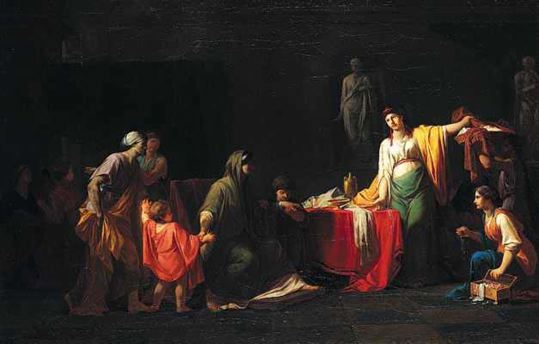
Following a brutal winter encamped at Valley Forge, George Washington decided to raise the spirits of his troops with a theatrical production. His choice of entertainment, Joseph Addison’s Cato: A Tragedy, may strike the contemporary reader as something less than an ideal choice. Though it enjoyed considerable popularity in the 18th century, Addison’s Cato is by now largely relegated to the inconspicuous curio cabinet of academic interest. The reasons for this are sufficiently plain to anyone who has read the text of the play: it consists largely of stilted and high-flown rhetorical exchanges which, while perfectly concordant with the Neoclassical taste of Addison’s day, strike a somewhat preening and pompous (not to mention boring) note today.
Set in Utica immediately after the Battle of Thapsus (46 BC), where the forces of Cato and his senatorial ally Scipio were defeated by the army of Julius Caesar, Cato and his surviving cronies are confronted with the choice of surrendering to their conqueror or attempting to sustain their fight against him. Among Cato’s counselors is the villainous Sempronius, who intends to betray Cato to Caesar in a ploy to take Cato’s daughter Marcia as a captive following her father’s defeat. Cato is supported by the Numidian king Juba, who also has his eyes on Marcia, but loves her for her virtue rather than her looks. Juba in turn has a treacherous counselor, the aged Syphax, who despises the Romans for their degenerate hypocrisy. Syphax hopes that Caesar, being less ideological and self-assuredly virtuous than Cato, will make a more favorable leader of the Roman state than Cato.
Addison’s Cato presents us with implausibly balanced moral antitheses in its dramatis personae. Juba and Marcia are both paragons of virtue, while Sempronius and Syphax are vice incarnate. (Indeed, the word virtue appears 46 times within the short span of the play.) Juba pronounces this encomium on the man he hopes to claim as his father-in-law:
Turn up thy eyes to Cato;
There may’st thou see to what a godlike height
The Roman virtues lift up mortal man.
While good, and just, and anxious for his friends,
He’s still severely bent against himself;
And when his fortune sets before him all
The pomps and pleasures that his soul can wish,
His rigid virtue will accept of none.
Witness, too, this exchange between Cato and Decius, as the latter attempts to convince Cato to accept terms from Caesar:
Cato. Nay, more, though Cato’s voice was ne’er employ’d
To clear the guilty, and to varnish crimes,
Myself will mount the rostrum in his favour,
And strive to gain his pardon from the people.
Dec. A style like this becomes a conqueror.
Cato. Decius, a style like this becomes a Roman.
Dec. What is a Roman, that is Cæsar’s foe?
Cato. Greater than Cæsar: he’s a friend to virtue.
If one can see past the heavy handed rhetorical construction of the play, it becomes more apparent why it gained such popularity: as a convenient sourcebook for self-congratulatory quotes and tags. America’s founding generation provides clear examples of this. Nathan Hale’s famous line, “I only regret that I have but one life to lose for my country”, is a reference to Cato’s speech (Act IV Scene 4), “What a pity it is that we can die but once to serve our country.” In their letters, both John Adams and George Washington both quoted Portius’ line, “’Tis not in mortals to command success, but we’ll do more, Sempronius—we’ll deserve it.” (Act I Scene 1)
Conveniently for the reader or audience member who would pilfer the play for justificatory tags, Addison does not deal with the messy social and political details of Rome’s late Republican period. From a dispassionate historical perspective, one can see that Cato’s talk of preserving Roman liberty was colossally self-aggrandizing: he identified the cause of liberty with himself, and Caesar, who never appears as anything but an off-stage threat throughout the play, is simply a metonym for the enslavement of the Roman people and the death of the Roman state. Yet it is not clear that life for the average Roman not involved in the military conflict would have differed much had either side prevailed. Would it have mattered to the people in the street whether Rome were governed by one rich man instead of a few rich men? The talk of despotism is all very frightening, but when men like Cato spoke of being deprived of liberty, they meant that they were going to be deprived of the ability to keep their own hands on the levers of governmental power. Moreover, we can see in retrospect that Cato’s suicide, while earning him a posthumous reputation as a martyr for the republic, nevertheless precluded the possibility of his leading the senate following Caesar’s assassination two years later.
But Addison’s aims are limited, and he does not touch upon any of this. Consequently, his play is an empty mold of rhetorical antithesis into which one might inject their own favorite cause. Elizabeth Inchbald explained the play’s popularity with both Whigs and Tories:
The most fortunate of all occurrences took place, from the skill with which Addison drew this illustrious Roman—he gave him so much virtue, that both Whigs and Tories declared him of their party; and instead of any one, on either side, opposing his sentences in the cause of freedom, all strove which should the most honour him.
Both auditors and readers, since that noted period, much as they may praise this tragedy, complain that it wants the very first requisite of a dramatic work—power to affect the passions. This criticism shows, to the full extent, how men were impassioned, at that time, by their political sentiments. They brought their passions with them to the playhouse, fired on the subject of the play; and all the poet had to do was to extend the flame.
It is for this same reason that the bigwigs of the American Revolution could earnestly frame themselves as a group of virtuous Catonians struggling against the malice and the manacles of that Caesarian villain, George III. Similarly, it is why the Koch Brothers’ propaganda operation can be called, without a hint of irony, The Cato Institute – for some reason, The Self-Righteous Reactionary Oligarch Institute simply doesn’t have the same ring.
What accounts for all of this Catonian posturing? Is this virtue signaling? That phrase is typically directed from the right to the left as a pejorative meant to discredit a person’s statements or actions for being obnoxiously righteous and largely ineffective in the real world. Yet what better example of virtue signaling can one find than the suicide of Cato, which did little for “republican liberty,” but turned Cato into a celebrity paragon of libertarian virtue?
The term ‘virtue signaling’ is particularly noxious and loaded, in part because its aim is to discredit the notion that causes associated with ‘wokeness’ (most of them centered upon advocacy for empathy and social justice, i.e. basic human decency) are little more than bespoke ideology tags which can enhance the social prestige of their users, as would fashionable accessories or perfectly filtered and curated Instagram accounts. According to this cynical worldview, people cannot feel genuine moral outrage about deep systemic injustice in the world and simultaneously find themselves unable to do anything substantial about it. But this misses the point entirely, given that many of the world’s most egregious and imminent problems could largely be obviated if a few hundred of its obscenely rich and powerful citizens could simply stop being evil. Gibbon was able to describe history as little more than the record of the crimes and follies of mankind because human affairs have almost always been horribly mismanaged by the powerful, if for no other reason than because one has to be at least a little evil to gain such power in the first place. Lord Acton’s old line about absolute power corrupting absolutely had it entirely backwards: only an absolutely corrupt person gets hold of absolute power.
Amidst all of the talk of ‘virtue signaling’, we never hear of its opposite: vice dissimulation. Among the Roman emperors, those like Augustus, who managed to keep their vices largely private, were often respected far more than those like Commodus, who made an open display of their criminality. The Koch brothers put money into “libertarian think tanks,” because such institutions serve as a palatable and attractive front for pre-emptive criminal apologetics. Other billionaires pretend to donate apparently large sums (which represent insignificant fractions of their wealth) to charities (which are really just shell operations which they managed) in order to make themselves appear to be relatively benign and decent people, and to distract us from the fact that their own abuse of capital and power has ruined life for countless people on this planet now and in the future. Yet, when an ordinary citizen with no effectual power but their own voice and some minimal capital to spend upon small indulgences takes to complaining about the state of the world, it is deemed intolerably self-righteous.
Of course, the reactionary right has embraced the Trump era with such enthusiasm because he has almost single-handedly eliminated the need for vice dissimulation. Criminality is now front-and-center as an agenda item, and all of the suppurating evil of the Republican soul can be given a fresh airing. When he falls, Donny T. will be hailed by his acolytes as a modern Cato saving us from the Caesarian tyranny of Obama’s deep state. Dirty, fundamentally oligarchic power politics will proceed in their same corrupt fashion, and the continued onslaught against ‘virtue signaling,’ led by villainy’s chief propagandists, will attempt to deprive us of the only remaining powers we have: our voice and our conscience.
But let’s return to the founders’ reception of this idea. The examples of classical republican liberty which the founders so admired are not harmless. Their enthusiasm for the Catonian ideal has fostered in America a dangerous attitude toward liberty and civil government. The popularity of Addison’s Cato in itself reflects the superficiality of their understanding of even the strictly historical and political parts of the classics. Addison’s Cato is really just a piece of puffery, an overblown rhetorical exercise, and a disingenuous rehabilitation of the real Cato’s reputation for meanness and intoxication. The real Cato was no hero waging a war for liberty, and it could be argued that social and economic conditions for the average Roman would have been worse if the stubborn and viciously reactionary Cato had prevailed. He was the one, along with his reactionary oligarchic faction in the senate, who was staunchly opposed to agrarian reform, resettlement of veterans, and other popular measures. Yet somehow, Cato has become the emblem of libertarian virtue, despite defending an obviously broken political system in which he and his friends exercised considerable power. Meanwhile, Caesar is represented as the villain in the minds of the revolutionary generation, despite the fact that he was the one who was working to subvert an entrenched system of power. This is not to say that Caesar was operating from noble motives, nor is it do deny that Caesar was hungry for power. All of these men were engaged in a contest of brutal power politics, and Cato lost. He ought not to be lionized as a hero for liberty simply for losing.
Indeed, Cato was not fighting for liberty – he would have had that under Caesar. Cato killed himself because he could not countenance the thought of a life without power. Lest anyone think that this is too grim and cynical a view of Cato, I would invite the reader to consider his portrayal in Sallust’s Bellum Catilinae, where he calls for the summary execution of the conspirators in direct contravention of established law and precedent, and against the comparatively liberal, sane, and humane objections of Caesar. Cato did not need to become dictator to reveal himself as the tyrant. His eagerness for extrajudicial murder should indeed make us hesitant to champion him as a hero just because he killed himself after reading a bit of Plato.
Role-Playing Republic:
However impressive their classical attainments may appear today, we must concede that the founders were not, by the standards of their time, great scholars of antiquity. They were enthusiasts, and enthusiasm has its perks, but it also has its dangers. Like many before and after them, the founding generation saw in the stories of ancient history a cheerful and salutary set of exempla well-adapted to their own world view. Study can be dull, but action is always action; yet that action gains an extra veneer of respectability when it it is framed as a continuation of an ancient struggle. We look back upon those heady days in the late 18th century and find, not a group of scholars drawn reluctantly from their desks, but a gang of provincial Don Quioxtes hopped up on some half-considered ideas from a few of their favorite books. The role-player superceded the reader, and our burly bearded brethren in their μολὼν λαβέ shirts are gratifying the same urge to stop studying antiquity and start reviving it. Maybe we would have a happier and more just society if they could just leave Lacedaemon in the library.

Like this:
Like Loading...