“Zeus! Why have you settled women, a curse for mortals
To live among us in the light of the sun?
If you wanted to sow the mortal race
You didn’t need to procure it from women!
But mortals could have placed purchase weights
Of bronze or gold or iron in your temples
To purchase the seed of children, each price
Equal to the worth of the man, and then we
Could live free of women in our homes!”
Valerius Maximus, Memorable Words and Deeds 9.3. Praef.
“Anger, also, or hatred may inspire great waves of emotion in human hearts. The onset of the first is faster, but the second is more lasting in the desire to cause harm. Either feeling is full of turbulence and is never violent without some self-torture because it suffers pain when it wants to cause it, anxious from its bitter obsession that it might not win vengeance.
But there are the most clear examples of the particular property of these emotions which the gods themselves have desired be evident in famous individuals through something said or done rather rashly. Think of how great Hamilcar’s hate for the Roman people was! When he was gazing at his four sons when they were boys, he used to say that he was raising lion cubs of that number for the ruin of our empire! Instead, they converted their upbringing to the destruction of their own country, as it turned out.
That is how great the hate was in a boy’s heart, but it was equally fierce in a woman’s too. For the Queen of the Assyrians, Semiramis, when it was announced to her that Babylon was in rebellion as she was having her hair done, went out right away to put down the revolt with part of her hair still undone and she did not put her hair back in order before she regained power over the city. This is why there is a statue of her in Babylon where she is shown reaching for vengeance in wild haste.”
Ira quoque aut odium in pectoribus humanis magnos fluctus excitant, procursu celerior illa, nocendi cupidine hoc pertinacius, uterque consternationis plenus adfectus ac numquam sine tormento sui violentus, quia dolorem, cum inferre vult, patitur, amara sollicitudine ne non contingat ultio anxius. sed proprietatis eorum certissimae sunt imagines, quas <di> ipsi in claris personis aut dicto aliquo aut facto vehementiore conspici voluerunt.
Quam vehemens deinde adversus populum Romanum Hamilcaris odium! quattuor enim puerilis aetatis filios intuens, eiusdem numeri catulos leoninos in perniciem imperii nostri alere se praedicabat. digna nutrimenta quae in exitium patriae suae, ut evenit, <se> converterent!
ext. In puerili pectore tantum vis odii potuit, sed in muliebri quoque aeque multum valuit: namque Samiramis, Assyriorum regina, cum ei circa cultum capitis sui occupatae nuntiatum esset Babylona defecisse, altera parte crinium adhuc soluta protinus ad eam expugnandam cucurrit, nec prius decorem capillorum in ordinem quam urbem in potestatem suam redegit. quocirca statua eius Babylone posita est, illo habitu quo ad ultionem exigendam celeritate praecipiti tetendit.
These sayings [‘Apophthegmata’] are drawn from the Gnomologium Vaticanum. Most are apocryphal.
24: “Aristippos used to say the he took money from students not in order to straighten their lives but how so they might learn to spend their money on fine things.”
87: “When he was asked whom he loved more, Phillip or Aristotle, Alexander said “both the same—for the first gave me the gift of life and the second taught me to live well.”
In the tradition of Greek Myth, Hektor’s son Astyanax is well-known for being killed during the sack of the city. Other traditions weren’t having this. To wit, Servius:
Servius Danielis on Vergil, Aeneid, 9.264
devicta genitor (sc. Aeneas) quae cepit Arisba]
“Which his father took once Arisba was conquered…”
“(And yet, according to Homer, Arisba sent aid to the Trojans and was overcome by Achilles)…the city is called Arisba after the daughter of Merpos or Macareus who was the first wife of Paris. According to some authors, Abas, who wrote the Troika, related that after the Greeks left Troy, the rule of this city was given to Astyanax. Antenor expelled him once he had allied himself with the states neighboring where Arisba’s location. Aeneas took this badly and took up arms for Astyanax; once the expedition was prosecuted successfully, he returned the kingdom to Astyanax.”
[[atqui secundum Homerum Arisba Troianis misit auxilia et ab Achille subversa est …]] dicta est Arisba ab Meropis vel Macarei filia, quam primum Paris in coniugio habuit. quidam ab Abante, qui Troica scripsit, relatum ferunt, post discessum a Troia Graecorum Astyanacti ibi datum regnum. hunc ab Antenore expulsum sociatis sibi finitimis civitatibus, inter quas et Arisba fuit. Aeneam hoc aegre tulisse et pro Astyanacte arma cepisse, ac prospere gesta re Astyanacti restituisse regnum.
Romulus became more harshly disposed toward the senate, and was inclined to act rather tyrannically toward it. He returned the hostages to the people of Veii of his own accord, and not with common consent, as was the common practice. When he perceived that they were irritated by this, he said a lot of harsh things, and finally told them, ‘O fathers, I did not select you so that you could rule over me, but so that I could command you.’
I think that Aristotle was a great and learned man, but also that he was just a human, and for that reason I think that there are some things – nay, many things, which he was unable to know. I would say a little more if it be allowed by those who are better friends to sects than to the truth. I believe, and by Hercules I don’t doubt it, that he went totally off the rails not only in small matters (in which a mistake is a small and hardly dangerous thing), but even in the greatest things which bear upon the key point of our health. And though he may have discussed many things concerning felicity in the beginning and in the end of his Ethics, I will dare to say – and my detractors may shout as they like – that he was so deeply ignorant of true happiness that any pious old lady, or fisherman, or faithful pastor, or farmer would be happier, and perhaps even more subtle, in their knowledge of it.
Ego vero magnum quendam virum ac multiscium Aristotilem, sed fuisse hominem, et idcirco aliqua, imo et multa nescire potuisse arbitror; plus dicam, si per istos liceat non tam veri amicos quam sectarum: credo hercle, nec dubito, illum non in rebus tantum parvis, quarum parvus et minime periculosus est error, sed in maximis et spectantibus ad salutis summam aberrasse tota, ut aiunt, via. Et licet multa Ethicorum in principio et in fine de felicitate tractaverit, audebo dicere — clament ut libuerit censores mei — veram illum felicitatem sic penitus ignorasse, ut in eius cognitione, non dico subtilior, sed felicior fuerit vel quelibet anus pia, vel piscator pastorve fidelis, vel agricola.
It was hardly worth being born if I were not admitted to these things. For, what reason is there that I should be glad to be placed among the number of the living? So that I can swallow food and drink? So that I can stuff this needy and languid body which will perish if it doesn’t get filled? So that I can live as a minister to my own sick self? So that I can spend my time fearing the death for which all of us are born? Take away this inestimable good: life is not worth so much that I should sweat for it, that I should work myself into a heat for it.
Nisi ad haec admitterer, non fuerat nasci. Quid enim erat, cur in numero uiuentium me positum esse gauderem? an ut cibos et potiones percolarem? ut hoc corpus causarium ac fluidum, periturumque nisi subinde impleatur, sarcirem, et uiuerem aegri minister? ut mortem timerem, cui omnes nascimur? Detrahe hoc inaestimabile bonum, non est uita tanti, ut sudem, ut aestuem.
“But what were sunsets to us, with the wild excitement upon us of approaching the most renowned of cities! What cared we for outward visions, when Agamemnon, Achilles, and a thousand other heroes of the great Past were marching in ghostly procession through our fancies? What were sunsets to us, who were about to live and breathe and walk in actual Athens; yea, and go far down into the dead centuries and bid in person for the slaves, Diogenes and Plato, in the public market-place, or gossip with the neighbors about the siege of Troy or the splendid deeds of Marathon? We scorned to consider sunsets.
We arrived, and entered the ancient harbor of the Piraeus at last. We dropped anchor within half a mile of the village. Away off, across the undulating Plain of Attica, could be seen a little square-topped hill with a something on it, which our glasses soon discovered to be the ruined edifices of the citadel of the Athenians, and most prominent among them loomed the venerable Parthenon. So exquisitely clear and pure is this wonderful atmosphere that every column of the noble structure was discernible through the telescope, and even the smaller ruins about it assumed some semblance of shape. This at a distance of five or six miles. In the valley, near the Acropolis, (the square-topped hill before spoken of,) Athens itself could be vaguely made out with an ordinary lorgnette. Every body was anxious to get ashore and visit these classic localities as quickly as possible. No land we had yet seen had aroused such universal interest among the passengers.”
“So they were saying these kinds of things to one another. And a dog who was lying there raised his head and ears. It was Argos, enduring Odysseus’ dog the man himself Had raised but never used before he went to sacred Ilion. In earlier years young men used to lead him to hunt Wild goats and hares and deer. But now he was lying there, put aside in his master’s absence on a pile of manure heaped up from mules and oxen right in front of the door waiting for the slaves to take it away to fertilize Odysseus’ great dominion. There Argos the dog was lying full of ticks and fleas”
I have always had mixed feelings about this very famous passage from the Odyssey. I side in part with Plutarch who notes that Odysseus seems to shed more tears (one) for his dog than he does his wife. And I also bristle at how much empathy people seem to be able to generate for the aged hunting dog when they can muster so little for the mutilated Melanthios or the hanged enslaved women at the epic’s end.
If I have to be honest with myself, this scene does not inspire contempt in me as much as a deep sorrow. We talk much of Argos’ loyalty, but his loyalty is a mere prop to aggrandize Odysseus and increase the value of his return home. I care far less about Odysseus’ tear than I do about the neglect: Argos, abandoned by Penelope, Telemachus, and Laertes. Argos, infested with fleas and sleeping on a mound of shit.
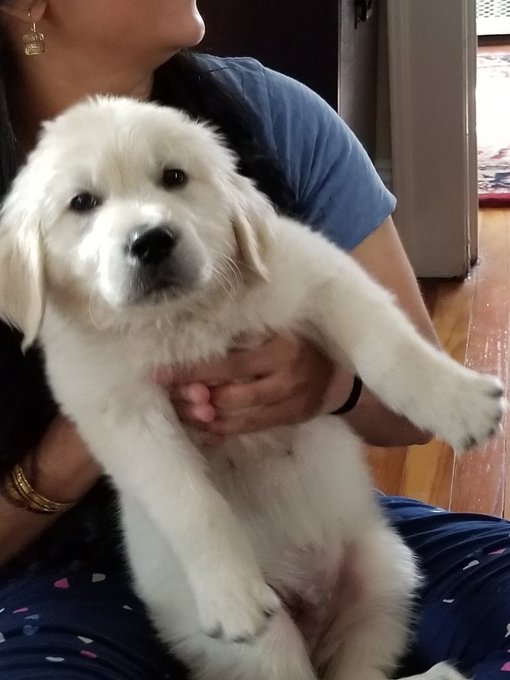
My wife wants us to get a puppy and name him Zeus. The second half of that sentence is calculating because she knows that I would enjoy nothing more than training a dog to follow commands in ancient Greek and shouting the vocative O Zeu in city parks. She also made this argument after watching me play with her sister’s dog, Apollo: down on the floor wrestling with an energetic English cream retriever of over 70 pounds, she said I looked happy.
Apollo as a puppy
I have been saying no to pets for a decade. After our daughter and son were born our first cat together, Chineh had to be put to sleep. She had been on hormone supplements for a year and was suffering from congestive heart failure three weeks after our son was born. I took her to the vet knowing it would be the last time and did not know that the Dr. would ask me to stay and hold her while he administered the drugs. I told myself that would be the last time. And I had to say that, because it was not the first by far.
Anyone who follows the twitter feed for this account knows that my promise went unfulfilled. Last year, we capitulated and got a cat from a shelter. He’s a polydactyl tuxedo cat named Mowgli. He might be the sweetest cat I have ever known. But he was so sweet that he ruined our family. There was just not enough cat to go around.
One day, I came home from some summer meetings at work and the family was huddled around a computer. The three of them (with Mowgli in hand at 10 weeks) had been watching cat videos all day. My wife informed me that we had to drive to Maine. My first thought was that someone had died (I grew up in Maine). When I asked what was wrong, she told me, “Oh, nothing, we have to go put a deposit on a cat and choose which one we want.”
I do not talk a lot about my wife in essays because she is not a social media person and values her privacy. But anyone who knows her also knows her powers. We were in a car and looking at Maine Coon Cat kittens within three hours. Three weeks later, we returned.
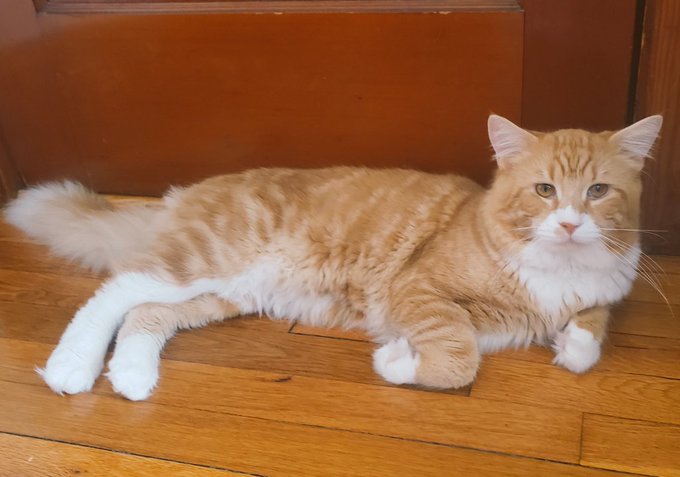
Again, anyone who follows this account on twitter knows Hermes, his attempts to escape our home, his eye infections, and his surgery. (Oh, the cat birthday parties too.) What people do not know is that when I can’t sleep at night and lay on the couch wondering what the fuck is happening to the world, Hermes comes over and starts grooming me. He licks my hair from root to end and then, if I do not start petting him, he bonks me in the cheek with his massive hairy paw.
If we get a dog, it’s Hermes’ fault. He’s, well, unleashed something that’s hard to explain.
Homer, Od. 17.301-305
“Then, indeed, [Argos] noticed that Odysseus was near And he wagged his tail and relaxed both ears, But he wasn’t able to go any closer to his master then. Odysseus saw him to the side and wiped away a tear, Keeping it secret from Eumaios….”
When I talk about the Odyssey’s crucial recognition scenes, I always forget about this one. Odysseus needs his scar to be known to Eurykleia; he needs the story of the bed to finally prove himself to Penelope; and he has to tell the story of generations of trees to calm his father’s suspicions. Argos seems to need no sign, he just knows (ὡς ἐνόησεν). All that worry about some other Odysseus coming home dissipates with a wag of the tail.
I came from one of those families that always had a dog. I do not think it was possible for my parents to conceive of a family that did not have a dog. Before I was born, that had an Irish Setter named Duchess and a St. Bernard named Sam who used to follow the kids to the school bus and ride around town to the school (it was the 1970s, the world was different). When I was born, in a rare show of unity, my grandmothers made them give Sam away because they thought he was too dangerous. I used to see him at my godfather’s farm, tied up on a heavy chain, laying a distance from the house, flies swirling around him.
One of the things that is hard for me to explain to my spouse and impossible for me to talk about to my kids is that my life with pets is not a source of happy memories. My earliest memories of Duchess are of fear. And not fear of her, but fear for her. My parents, unlike Odysseus it seems, never trained their dogs well. Duchess used to run away and return after some time. It was such a regular occurrence that once my grandfather showed up in a pickup with someone else’s Irish Setter because he thought she was ours.
Duchess used to have accidents in the house because she was never walked and she was poorly trained. Every time, my father would scream, swear (“duchess, you fucking stupid bitch” is probably the earliest profanity I ever heard), and often hit or kicked her. More than once, he opened the door to the basement and threw her down the stairs. These are some of my earliest memories of my father and they do not add up to the man my wife met nearly 20 years later. And my siblings never saw him that way either.
When Duchess was a decade old, she gave birth to a single puppy. I must have been too young for kindergarten at the time, but I remember the utter confusion this inspired in our household but I do not quite remember my parents’ response. I was enchanted with this little squealing thing, this new life in our home. I named him Mud.
Three days later, I found Mud stiff and dead in the basement. My parents tried to explain to me that Duchess was too old to take care of a puppy and that Mud wasn’t meant to be born to begin with. We buried him in our back yard not too far off from where we grew squash and green beans.
We moved a few years later. Duchess was alive when we were getting ready to sell our home. Then, she was not when we moved. I have no memory of what happened to her. My father died almost ten years ago and I never asked him about it.
Homer, Od. 17.305-310
“…then Odysseus asked him ‘Eumaios, it is a great wonder that this dog lies in the manure. His form is beautiful and I do not know clearly Whether his speed was equal to his looks, Or he was like those table dogs of certain men, Those ones their masters raise for appearances.”
When Odysseus is asking about Argos, he wants to know if he grew up to be the dog he trained him to be. Odysseus applies an epic physiognomy here he also assumes for people: beauty should translate into good deeds; beauty without action makes you a useless suitor (or Phaeacian prince). But Odysseus also taps into an ancient distinction between working animals and, well, ‘pets’. Do we keep animals close to us just for show?
Hermes is a “show” cat, for sure. He’s handsome, it’s true. Part of the reason I am so undone by Hermes is that he’s not like other cats I have been around. Where other cats are skittish, he is still. Where Mowgli and other cats I have had have rushed to the sound of cat food being opened, Hermes takes his time, eats a little and then walks away. He watches me do everything. My wife says I anthropomorphize his actual limited intelligence as contemplative. But who knows the thoughts of a quiet cat?
I did not grow up with cats. The first cat we ever had was an accident. We moved to 3 or 4 acres on the age of a large re-forested area in southern Maine (some of the land had been farmland in the late 19th century; some of it had been logged before the second World War; much had been burned in a famous fire mid-century). We had no neighbors by sight and few within a quarter mile.
One day, a small white and brown kitten was sitting, meowing at our door. Honest to goodness, I don’t know if there is anything cuter in the universe than a kitten. My mother was allergic to cats and forbade us to bring it in the house, but my sister and I took out a saucer of milk for the kitten creatively named, “Kitty”. When we returned from school, she was still there. At great urging from three children, my mother got some cat food and we fed her more.
The next day? Kitty was still there. We fed her and played with her outside, losing time the way only kids and new pets can. When we returned from school, she was still there. Later, after dinner, I went out to check on her and she was running strangely in the driveway. I caught her, and something was coming out of her rear end: a lot of something, most of her intestines. I called to my dad, who had recently returned home, and he looked at me, at the kitten and went inside.
He came out with a loaded .22, took the kitten, and walked into the woods. I have no idea how far he walked but there’s no way I wouldn’t have heard the report of the gun firing. I didn’t realize until later than Kitty had probably been hit by a car. It took me years to really think about which car that most likely was.
Homer, Od. 17.311-317
“Eumaios, my swineherd, you answered: “Yes, this is the dog of a man who died far away. If he were the way he was in looks and speed When Odysseus left him to go to Troy, You’d soon observe his great speed and valor. Nothing ever escaped him in the deep forest When he pursued. And he was clever at tracking too.
Argos has heroic qualities, even specifically Iliadic ones. Speed and valor (ταχυτῆτα καὶ ἀλκήν)? You have an Achillean dog there, sir. But he’s also smart, like Odysseus: he is preeminent at tracking (ἴχνεσι γὰρ περιῄδη) and nothing ever escaped him in the deep darks of the wood. I don’t know if this is some foreshadowing of the murder of the suitors, but if a student claimed it on a paper, I’d give it a nice big check.
I stayed home the next day from school and generally made enough of a nuisance of myself that we got a kitten I named Nina the next week. Nina was the first pet who was almost solely mine. (My sister got a cat the next year named Jackie, mainly to taunt my father whose nickname was Jack.) I tried to establish the rule that she could not go outside, and this held for a while. When she was a month home, I was dropped off by a family friend early from school at the end of our dirt road. I came home to someone breaking into our home and stealing my father’s firearms.
The man in our driveway told me my mother was inside (which I knew to be a lie) and I silently stood at the end of the driveway. I probably scared the thief more than anything, and I certainly never felt myself in danger. He got in his car and drove off. I ran inside, through the door that had been kicked in, and called 911. The dispatcher was, in retrospect understandably, quite concerned about my safety. But I told her I had to put the phone down to find my cat. She was outside and in danger.
(I found her. She was fine, that day.)
My attachment to cats at that moment was linked to our trouble with dogs. After we moved, we had a new home so of course we needed a new dog. We picked up a shepherd-retriever mix from a shelter and named her Alfie after the ever present television Alien. Alfie was pure joy for three kids living on the edge of a forest with no friends around. My strongest memory of the time is just running around that house chased by that adorable puppy.
Puppies grow up to be dogs and when they are not fixed and are let to wander around outside, they get pregnant. Alfie gave birth to a litter of puppies a year later. Neither of my parents talked about her being pregnant and when she started giving birth to puppies, I was the only one down in the basement with her. She had six puppies. Over the next few months, we found homes for four of them.
No one who hasn’t spent time with a half dozen puppies understands how exhilarating and exhausting they are. We named each puppy and trounced around in the Maine snow with them until each one left. The two who remained, stayed for good. And it did not go well with Alfie. My parents built a pen outside and a large shed and the dogs were kept there, rain, snow or otherwise. They got loose once, attacked a neighbor’s dog, and nearly ripped his leg off. Alfie kept trying to run away from her puppies.
One day, I tried to corral the three dogs in the basement. Alfie would not go down the stairs with her offspring. She turned on me and attacked, leaving a four-inch gash in my leg. I don’t think I was mad at that dog for even a second because I never thought she was mad at me. My parents called the game warden. They told us Alfie was getting a “new home”. At age 11, I knew this was not how these stories ended.
I have no memory of what happened to the other two dogs. I do know they were still around two years later when a friend from junior high came to visit. Upon seeing the dogs, chained to trees a 100 feet from the house, dirty and ragged, he asked me how we could treat animals that way. I don’t know if I answered.
Homer, Od. 17.318-323
“But now he is overcome by evil and his master has died Far away in another land. These shameless women don’t care for him. The Enslaved women, whenever their rulers are gone, Aren’t willing to do the right thing any longer. Wide-browed Zeus strips a person of half their worth Whenever slavery’s day overcomes them.”
Argos serves here, I think, to represent some of the general entropy of the household in Odysseus’ action and as part of a process of vilifying the enslaved women before their deaths. I don’t understand why Eumaios says nothing of the rest of the family. (I mean, Telemachus parades around the island with two dogs.) Perhaps his place as the “good slave” makes it impossible for him to criticize family-Odysseus. But I’ve always thought a pet, because it depends on us, is a family’s shared responsibility.
I don’t usually get to the part of my story where Alfie is put to sleep. And I don’t know if I ever mention her puppies because even though I was not yet a teenager, I feel guilt for their lives and their ends. It is harder to tell the whole story because it is long and it seems embellished. And that’s before the next part.
Our second cat Nina eventually got to go outside. We lived on a large lot and we spent all our time outside in the summers. My mother was a school teacher and now I understand that she was suffering from depression and other issues. At the time, what I knew was that in summers, she slept a lot and spent the rest of the time in her bedroom, with the only air conditioner on, and the door closed. My siblings and I did what kids did then in the summer: we watched TV, we wandered in the woods, and we tried not to bring ticks in the house.
Nina turned out to be pregnant at the beginning of one summer vacation. I don’t know if my parents ever took her to a vet and we had gotten her from someone in the southern part of our town. She gave birth to seven kittens and they were just the cutest things I had ever seen.
The problem was that that summer saw the worst plague of fleas in decades. Our cats brought them home and the infestation was so bad when you stepped on the carpet, you could see dozens of fleas jump up and start to crawl up your leg. A day or two after they were born, the kittens were covered. I would pick one up and they would drip off them like water. And Nina stopped feeding them.
I told my mother. I told my father. Eventually, they called the vet and let me speak to them. I was told to use a comb and rubbing alcohol to try to get the fleas off the kittens. I did this with each one. Multiple times. The fleas came back. Then Nina stopped caring for the litter. One by one, the kittens stopped moving.
I don’t know what was going on between my parents. My father was gone for long days and overnight trips; my mother was distant as always. Neither of them came done to the basement to see the kittens. And I didn’t even think of asking how I would know if they were really dead. Even when I was burying them in our yard, I kept thinking I could hear them meow. We never discussed it.
We had the house fumigated, but the fleas came back. And you know what else? Nina came back, pregnant at the end of the summer. This is the part of the story I shake my head at even now. She gave birth again in a house covered in fleas. The kittens each died again one by one even after I combed them clean and tried to feed them with a washcloth dipped in milk. No one called the veterinarian the second time. Neither of my parents ever talked to me about that summer. That was three decades ago. I still feel nauseous when I think about it.
Homer, Od. 17.324-328
“So he spoke and went inside the inhabited home.
He went straight among the arrogant suitors in the hall.
But then the fate of dark death overtook Argos
Right after he saw Odysseus in his twentieth year.”
Does Argos count as blessed in Solon’s words because he had a happy moment before he died? Does that one moment of relief at his master’s return make up for two decades of neglect? Will Odysseus go and get a puppy after the epic’s end?
There was another cat named Skye who lost an eye in a fight with a raccoon and like my sister’s cat Jackie just ended up wandering away one day as cats on the edge of a forest sometime do. Now I know that the cats probably fell prey to some predator or disease. But then, well, pets just kind of disappeared.
Once the last two of Alfie’s offspring were gone—wherever they went—my parents wanted another dog. This time, they went to a breeder with the plans of doing things right. We got a male chocolate lab and for reasons that are too convoluted to explain but include community theater, he was named Tevye.
We must have gotten Tevye in late spring or early summer, because by the fall he was a good-sized dog, but not yet full grown. My parents tried to keep this dog inside, closer to us, but they never put in the work to train him not to go to the bathroom in the house. He would go sometimes, my dad would explode and open the door and kick him outside. This went on until Tevye mostly whined at the door until someone let him out.
While we lived on a dirt road on one side of our property, the other side was bounded by a state road that ran north-south. There wasn’t a lot of traffic on the road and at night you could hear a car coming from a mile away. Our mailbox was a good walk from the front door to this main road. Tevye would go down there and look over the stone wall. My father would scream if he got too close.
One day, we were outside repairing the stone wall because some car had skidded off the road. As my father and I levered stones back into position, Tevye jumped over the wall and neared the road. My father started screaming and went after the dog, but I stepped in front of him and just said “no.” I pushed him back. I was in eighth grade and I was nearly the height I am now and the same weight. It was the only time in my life that I thought he would hit me and I wanted him too. But he didn’t.
On Thanksgiving, we were racing around the house trying to get everyone ready to go to my grandmother’s when there was a knock on the door. We rarely received door knocks, rarely enough in fact that my father was as likely to answer the door with a gun as he was to answer at all (he was deaf). At the door were two young men. They asked if we had a brown dog and said that one had jumped in front of their car.
They did not have a dog with them. My mother started screaming at them. My younger brother and sister started crying. I don’t know where my father went. But I was silent. I didn’t see any sense of losing it when we knew nothing. The world has more than one brown dog.
The walk from our home to the place where the dog was on the side of the road is three to five minutes, depending on your speed. Tevye was there, definitely dead, near the stone wall we had repaired. I had never handled a corpse that large before. My father hand grown up hunting, but when he took me out to learn to shoot at age six, I had no interest in the firearm or what you might do with it. Tevye was almost 50 pounds of deadweight and carrying him over that wall to a stand of pine trees felt like a lifetime.
No one else had exited the house yet. I walked the same distance back to the garage and got a shovel and then back to the stand of pine trees near the road. I started to dig near a large stone and had a large enough hole dug by the time my father came out to see what I was doing that there was no work left to be done. When I think of this now, I tremble, still confused: it was at least 20 minutes from when I left the house and started digging the hole before either of my parents came to see if their dog was really dead.
I finished the job alone. I went to three funerals that year and one of them was a cousin who died at age 16 in a car accident. I remember that fourth funeral the most, standing alone over Tevye’s shallow grave.
In similar tone to Odysseus’ dismissal of “table dogs”, Greek and Latin words for “pets” tend to emphasize their status as a luxury or adornment. In a fragment, Euripides calls a dog a “decoration [agalma] of Hekate” (Ἑκάτης ἄγαλμα φωσφόρου κύων ἔσῃ, fr. 968). Catullus’ Lesbia has a delicia; Martial’s Stella has a delicium (Ep. 1.7; cf. Seneca Apocolyntosis 13, subalbam canem in deliciis habere adsueverat). Exotic pets are signs of decadence: Theophrastus sees an obsequious person as likely to have a pet monkey (Characters 5); Plutarch records that comic poets slandered Perikles’ friend for his pet birds (Perikles 13.14). Diogenes Laertius tells of Heraclides and his pet snake (5.6, 89-90 These animals are different from foodstock and working animals: Alciphron calls his mistress’ Maltese puppy a “delight” (ἄθυρμα, Letters of Farmers 3.22) an here, as in Lucian (Assembly of the Gods, 5) and elsewhere the pet dog gets a diminutive: κυνίδιον.
In ancient literature, we see animals functioning as reflections for human characters. When Achilles’ horse Xanthus talks to him in the Iliad, he has the same color hair as his master and speaks to give a very Achillean message: you’re going to die. Alexander is paired in legend with Bucephalus, a horse who could be tamed only by the man who tamed the world. And Odysseus comes home to a loyal dog he forgot when he went to war. Bucephalus exists in narrative only to confirm Alexander’s greatness. Xanthus would speak for no other hero. Epic Argos exists only to increase Odysseus’ sense of loss and meaning.
My family got a Newfoundland puppy after Tevye’s death. I kept a cautious distance from that dog and was off to college by the time she was four years old. I never had a conversation with my father about dogs and their deaths. I know he grew up with hunting dogs and my mother grew up with barn cats and farm animals and that both of them saw animals come and go in a way I never would. When my father died, he left behind a golden retriever and a wish that any donations in his name be made to the ASPCA. I bit my tongue at the irony.
When I turned 21 my future wife got me a kitten for my birthday. In truth, I think she really wanted a pet because she had never had one, but she also said that the way I talked about animals made her want to get one. I couldn’t tell her why getting a kitten caused me so much pain because I did not want to detract at all from the joy she experienced at getting one.
Chineh—which was a bastardized version of Tamil for “small”—was a feral cat who hated everyone except for my wife and me. When we went to the shelter, she put her paw outside the cage at us and meowed and it was over. My roommates and parents called her a devil cat. When I was in graduate school, my apartment burned out in an electric fire and somehow she survived. We put several thousand dollars on a credit card and spent a month cupping her rib cages to get her to cough up the smoke. I don’t know if that caused her health problems later, but it may have.
Chineh was 11 when our daughter was born. She was already having serious hormonal problems and was already less friendly than before. But I swear she changed around the baby. As our daughter grew and started to move, she would follow the cat around, pulling her tail, abusing her at every chance. And Chineh, who had scratched and bitten dozens of people before never hurt her at all.
When I left the clinic where Chineh was put to sleep, I gave them two different cat carriers and other accessories (they specialized in cats). They were hesitant because they thought I might get another cat someday. I told them I wouldn’t.
And here we are, a decade later, with two cats and hundreds of pictures on twitter to prove that I am, as my wife declares, obsessed with Hermes. Yes, he follows me to get a treat near dawn every morning. Yes, I brush him every night so his long hair won’t get matted. During the day, though, we stick to our own business.
I didn’t want to get more pets because I didn’t want to fail them. I resisted getting them because I don’t want to feel the grief of loss again. I didn’t want to get pets because I don’t want to see the pain in my children’s eyes when they die. But, as my wife says, that’s really no way to live at all.
I am going to resist getting a puppy named Zeus. Right now, my argument is that it will upset Hermes, because I can’t get these old stories out fast enough to make sense.