“This is the reason it is possible to estimate a greater number of divinities than there are humans: individuals make a number of gods equal to their number by adopting their own Junos and Genii. Indeed, some peoples have animals, even horrible ones, for gods and many others too shameful to report, such as swearing by rotten food or other similar things.
Believing in marriage among the gods but without anyone being born from them for such a great span of time or that some are always old and graying while others are eternally young even children, or that some gods are dark-colored, winged, crippled born from eggs, or dying and living on alternating days, these beliefs are like childhood delusions. But it is beyond every kind of shame to imagine adultery among them, then strife and hatred, and that there are powers of thieves and criminals. “God” is a person helping another person; this is the path to eternal fame.”
quamobrem maior caelitum populus etiam quam hominum intellegi potest, cum singuli quoque ex semetipsis totidem deos faciant Iunones Geniosque adoptando sibi, gentes vero quaedam animalia et aliqua etiam obscena pro dis habeant ac multa dictu magis pudenda, per fetidos cibos et alia similia iurantes. matrimonia quidem inter deos credi tantoque aevo ex eis neminem nasci, et alios esse grandaevos semper canosque, alios iuvenes atque pueros, atricolores, aligeros, claudos, ovo editos et alternis diebus viventes morientesque, puerilium prope deliramentorum est; sed super omnem inpudentiam adulteria inter ipsos fingi, mox iurgia et odia, atque etiam furtorum esse et scelerum numina. deus est mortali iuvare mortalem, et haec ad aeternam gloriam via.
Barbarism is a word pronounced with a corrupted letter or sound. In the case of a letter, you might have floriet where it is appropriate to say florebit. In the case of sound, the first syllable might be drawn forth in place of the middle, as in latebrae, tenebrae. It is called barbarism after barbarians, since they were ignorant of the purity of Latin speech. For every people who became part of the Romans transmitted, along with its resources, all of its faults in language and customs.
But between barbarism and barbarolexis, there is this difference, that barbarism occurs in a Latin word when it is corrupted. When, however, barbarian words are brought into Latin speech, it is called barbarolexis. Similarly, when a fault of speech occurs in prose, it is called barbarism; but when it occurs in verse, it is called metaplasmus.
Barbarism, however, occurs both in writing and in pronunciation. In writing, it can take four forms: if someone adds, subtracts, transposes, or reduces a letter or syllable in a word. In pronunciation, it happens in time, tones, aspiration, and the rest which follow. In time, barbarism occurs if a short syllable is used in place of a long or a long in place of a short. In tone, it occurs if an accent is transferred to other syllables. In aspiration, it happens if H is added where it is not appropriate, or taken from a place where it belongs. In hiatus, it happens whenever a verse is broken off in pronunciation before it is completed, or whenever a vowel follows another vowel, as in the phrase ‘Musae Aonides.’
Barbarism can occur through motacismos, iotacismos, and labdacismos. Motacismos occurs whenever a vowel follows the letter M, as in ‘bonum aurum’, ‘iustum amicum’; but we can avoid this problem either by the suspension of the letter M or its removal. Iotacismus occurs whenever the sound of the letter i is duplicated, as in words like ‘Troia’ and ‘Maia’, where the pronunciation of those letters is so light than one iota, not two seem to be pronounced. Labdacismus is when two Ls are pronounced in place of two, as people from Africa tend to do, as in words like ‘colloquium’ instead of ‘conloquium’; or whenever we pronounce one L rather lightly, but two Ls more generously. Which is bass-ackwards. We should pronounce one L more expansively, while pronouncing Ls lighter when part of a pair. Collision occurs whenever the end of the last syllable is the beginning of the next syllable, as in the word ‘matertera’.
If this bear’s name were Ian, he could be a Bar Bear Ian.
Barbarismus est verbum corrupta littera vel sono enuntiatum. Littera, ut “floriet” dum “florebit’ dicere oporteat; sono, si pro media syllaba prima producatur, ut “latebrae” “tenebrae” Appellatus autem barbarismus a barbaris gentibus, dum latinae orationis integritatem nescirent. Vnaquaeque enim gens facta Romanorum cum opibus suis vitia quoque et verborum et morum Romam transmisit. Inter barbarismum autem et barbarolexim hoc interest, quod barbarismus in verbo latino fit, dum corrumpitur; quando autem barbara verba latinis eloquiis inferuntur, barbarolexis dicitur. Item quando in prosa vitium fit sermonis, barbarismus vocatur; quando in metro, metaplasmus dicitur. Barbarismus autem fit scripto et pronuntiatione. Scripto quattuor modis: si quis in verbo litteram vel syllabam adiciat, mutet, transmutet, vel minuat. Pronuntiatione autem fit in temporibus, tonis, aspirationibus et reliquis quae sequuntur. Per tempora quippe fit barbarismus, si pro longa syllaba brevis ponatur, aut pro brevi longa. Per tonos, si accentus in alia syllaba commutetur. Per aspirationem, si adiciatur H littera ubi non debet, aut detrahatur ubi esse oportet. Per hiatum, quotiens in pronuntiatione scinditur versus antequam conpleatur, sive quotiens vocalis vocalem sequitur, ut “Musae Aonides” Fit barbarismus et per motacismos, [iotacismos] et labdacismos. Motacismus est, quotiens M litteram vocalis sequitur, ut “bonum aurum” “iustum amicum’; sed hoc vitium aut suspensione M litterae, aut detractione vitamus.Iotacismus est, quotiens in iota littera duplicatur sonus, ut “Troia” “Maia’; ubi earum litterarum adeo exilis erit pronuntiatio, ut unum iota, non duo sonare videantur. Labdacismus est, si pro una L duo pronuntientur, ut Afri faciunt, sicut “colloquium” pro “conloquium’; vel quotiens unam L exilius, duo largius proferimus. Quod contra est; nam unum largius, duo exilius proferre debemus. Conlisio est, quotiens novissimae syllabae finis in alterius principio est, ut “matertera”.
The Romans fought a war in Africa against the Numidians led by their King, Jugurtha (112-104 BCE). The Romans won. Sallust tells the tale of the war, but he ends it with the ominous anticipation of future dangers:
Sallust, Bellum Jugurthinum 114
“At that time, a battle was fought and lost against the Gauls by the generals Quintus Caepio and Gnaeus Mallius. Because of this, all of Italy quaked in fear. The Romans from that time down to our own have believed that while all other matters give way to our virtue, with the Gauls it is an issue of safety, not glory.
After it was made known that the war in Numidia was concluded and that Jugurtha was being returned as a prisoner, Marius was made consul even though absent, and Gaul was set as his province. On the first day of January, he celebrated his triumph as consul in great glory. And at that moment, the hope and health of the state resided with him.”
Per idem tempus adversum Gallos ab ducibus nostris Q. Caepione et Cn. Manlio male pugnatum. Quo metu Italia omnis contremuerat. Illincque [et inde] usque ad nostram memoriam Romani sic habuere, alia omnia virtuti suae prona esse, cum Gallis pro salute, non pro gloria certare. Sed postquam bellum in Numidia confectum et Iugurtham Romam vinctum adduci nuntiatum est, Marius consul absens factus est, et ei decreta provincia Gallia, isque Kalendis Ianuariis magna gloria consul triumphavit. Et ea tempestate spes atque opes civitatis in illo sitae.
“A life without parties is a long journey without inns.”
βίος ἀνεόρταστος μακρὴ ὁδὸς ἀπανδόκευτος.
Plato, Laws 653d
“Great. Now, since many of these kinds of education—which accustom us to correctly manage pleasures and pains—lose their effectiveness during life, the gods took pity on the human race because it is born to toil and assigned to us as well parties as vacations from our toil. In addition, they have also given us the Muses, Apollo the master of music, and Dionysus as party-guests so that people can straighten out their habits because they are present at the festival with the gods.”
“Certainly we have furnished our mind with the greatest reliefs from our labors, maintaining games and feasts throughout the year in public and in private living with care and finery, all those things which provide pleasure to expel our grief. Because of the greatness of our city, everything comes to us from the earth and we are lucky enough to harvest all of the goods from our own land with no less familiar pleasure than those we gather from other peoples.”
Giovanni Boccaccio, Genealogy of the Pagan Gods (1.5):
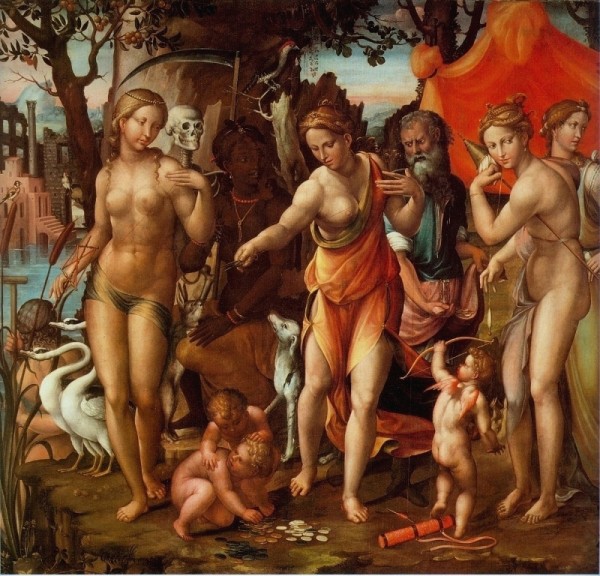
“Proper names have already been discussed, so we must speak now of common names. Cicero calls the Fates the Parcae, through antiphrasis as I believe, because they would spare (parcant) no one. They admit no exceptions for any persons, and God alone is able to change their power and order. The name Fatum or Fata is, however, derived from the verb for fari [=to speak], as if the people who imposed the name on them wished to indicate that what they do is irrevocable, as if spoken or preordained by God. We can see this readily enough in the words of Boethius, and even Augustine seems to agree in his City of God. But he holds back from using the word itself, advising us that if anyone should wish to call the will or power of God by the name of Fate, they should hold their opinion and bridle their tongue.”
Marco Bigio, The Three Parcae (1550)
De nominibus propriis predictum est, de appellativis dicendum. Vocat igitur has Tullius Parcas, ut reor per antiphrasin, quia nemini parcant; nulla enim apud eas est acceptio personarum, solus deus potest pervertere earum vires et ordinem. Fatum autem aut Fata a for faris tractum nomen est, quasi velint, qui id imposuere nomen, quod ab eis agitur a deo quasi irrevocabile dictum sit seu previsum, ut per verba Boetii satis assumitur, et etiam sentire videtur Augustinus, ubi De civitate dei. Sed abhorret ipse vocabulum admonens, ut si quisquam voluntatem dei seu potestatem nomine Fati appellet, sententiam teneat, linguam coerceat.
“Cosimo, if you read the title of my book in the upper margin, you will see that it is The Hermaphrodite. There is a bit of pussy in this book, and a bit of cock as well. Ah, what a fitting name it has, then! But if you called my book The Asshole because it sings with the old rectal flute, it will still have a pretty fitting name. If neither this name nor that seems good to you, put down whatever you would like – just make sure that it isn’t chaste!
Si titulum nostri legisti, Cosme, libelli
Marginibus primis, Hermaphroditus erat.
Cunnus et est nostro, simul est et mentula, libro:
Conveniens igitur quam bene nomen habet!
At si podicem vocites, quod podice cantet,
Non inconveniens nomen habebit adhuc.
Quod si non placeat nomen nec et hoc nec et illud,
Dummodo non castum, pone quod ipse velis.
“It is not surprising [that ancient words have unclear meanings] since not only was Epimenides not recognized by many when he got up from sleep after 50 years, but Teucer as well was unknown by his family after only 15 years, according to Livius Andronicus. But what is this to the age of poetic words? If the source of the words in theCarmen Saliorumis the reign of Numa Pompilius and those words were not taken up from previous composers, they are still 700 years old.
Why, then, would you criticize the labor of an author who has not successfully found the name of a hero’s great-grandfather or that man’s grandfather, when you cannot name the mother of your own great-grandfather’s grandfather? This distance is so much closer to us than the period from now to the beginning of the Salians when people say the Roman’s poetic words were first in Latin.”
Nec mirum, cum non modo Epimenides sopore post annos L experrectus a multis non cognoscatur, sed etiam Teucer Livii post XV annos ab suis qui sit ignoretur. At hoc quid ad verborum poeticorum aetatem? Quorum si Pompili regnum fons in Carminibus Saliorum neque ea ab superioribus accepta, tamen habent DCC annos. Quare cur scriptoris industriam reprehendas qui herois tritavum, atavum non potuerit reperire, cum ipse tui tritavi matrem dicere non possis? Quod intervallum multo tanto propius nos, quam hinc ad initium Saliorum, quo Romanorum prima verba poetica dicunt Latina.
Teucer was a king of Salamis who was absent during the Trojan War.
Epimenides was a poet from Crete who wrote a Theogony. He allegedly went to sleep as a boy and awoke 57 years later. Here’s his strange entry from the Suda.
“Epimenides, son of Phaistos or Dosiados or Agiasarkhos and his mother was Blastos. A Cretan from Knossos and epic poet. As the story goes, his soul could leave his body for however long the time was right and then return again. When he died, after some time his skin was found to be tattooed with words. He lived near the 30th olympiad and he was among the first of the seven sages and those after them. For he cleansed Athens of the plague of Kylôneios at the time of the 44th Olympiad when he was an old man. He wrote many epic poems, including in catalog form about mysteries, purifications, and other riddling matters. Solon wrote to him asking for the cleansing of the city. He lived 150 years but he slept for 50 of them. “The Epimenidean skin” is a proverb for mysterious writings.”
“By chance, Nero had gone to Campania then, while Petronius progressed to Cumae, where he was detained. He no longer put up with the delays of fear and hope, but he did not end his life precipitately. He cut his veins, as it pleased him, and bound them up. He then reopened them as he talked to his friends not about serious things or the kinds of things which would earn him a reputation for firmness of character. He heard no speeches about the immortality of the soul or the systems of philosophers, but rather, he enjoyed some trifling poems and a couple of silly verses. He gave some of his slaves a pension, and had some of the others beaten. He had dinner and then took a little nap, so that his death – though compulsory – would be similar to one by chance. Unlike many others who died at the time, he did not flatter Nero or Tigellinus or any of the other potentates in his will. Rather, he wrote a detailed account of the emperor’s debaucheries with the names of his boy-toys and lady lovers, describing the utter novelty of each lewd act. He signed this and sent it to Nero. Afterward, he broke his signet ring, so that no one could afterward use it to endanger other lives.”
Forte illis diebus Campaniam petiverat Caesar, et Cumas usque progressus Petronius illic attinebatur; nec tulit ultra timoris aut spei moras. neque tamen praeceps vitam expulit, sed incisas venas, ut libitum, obligatas aperire rursum et adloqui amicos, non per seria aut quibus gloriam constantiae peteret. audiebatque referentis nihil de immortalitate animae et sapientium placitis, sed levia carmina et facilis versus. servorum alios largitione, quosdam verberibus adfecit. iniit epulas, somno indulsit, ut quamquam coacta mors fortuitae similis esset. ne codicillis quidem, quod plerique pereuntium, Neronem aut Tigellinum aut quem alium potentium adulatus est, sed flagitia principis sub nominibus exoletorum feminarumque et novitatem cuiusque stupri perscripsit atque obsignata misit Neroni. fregitque anulum ne mox usui esset ad facienda pericula.
“If I, knowing a thing, say it (dico) to someone who does not know it and impart to them what they were previously ignorant of, you may see the derivation of the verb ‘teach’ (doceo). This is either because we speak (dicimus) when we teach (docemus), or because those who are taught (docentur) are being led into (inducuntur) that which they are being taught. From the fact that one knows how to lead, one is a leader (dux aut ductor); and the word doctor is one who leads students in such a way that he teaches (doceat) them. From leading (ducendo) comes teaching (docere) and from discipline (disciplina) comes learning (discere), with a few letters changed. From the same principle we have documents (documenta), which are examples spoken for the sake of teaching (docendi).”
Si dico quid sciens nescienti, quod ei quod ignoravit trado, hinc doceo declinatum vel quod cum docemus dicimus vel quod qui docentur inducuntur in id quod docentur. Ab eo quod scit ducere qui est dux aut ductor; hinc doctor qui ita inducit, ut doceat. Ab ducendo docere disciplina discere litteris commutatis paucis. Ab eodem principio documenta, quae exempla docendi causa dicuntur.
“Curved, well-turned, with a single ear on a long neck,
Slim-throated, speaking through lips close-kept,
You happy server of Bacchus, the Muses, and Aphrodite,
Our party’s delightful mistress, laughing sweetly.
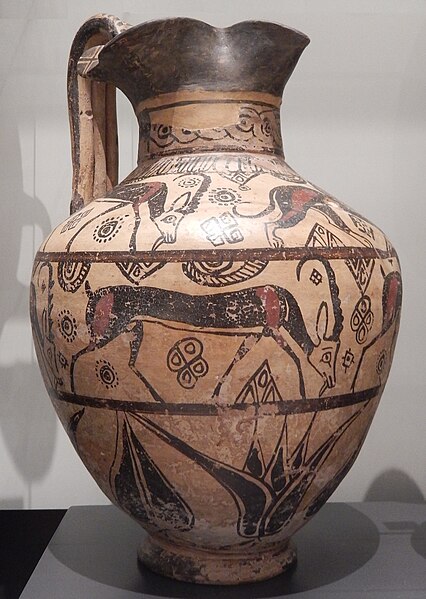
Why are you drunk when I’m sober, but when I’m trashed,
You’re sober? You break the rules of the drinker’s pact.”