Pity the Cruel

Boethius, Consolation 3.140-150 (Full text on the Scaife Viewer)

“Evil people themselves, too, if they were allowed to catch some sight of the virtue they left through a small imperfection, and they could note that they would put down the filth of their vices thanks to the tortures of their punishments, once they weighed them against the value of acquiring goodness, they would not consider them torturous at all, but they would refuse the aid of defense attorneys and surrender themselves fully to their accusers and judges.

If this happened, there would be no place among wise men any longer for hatred. For who hates good people except for complete fools? But hating the wicked lacks reason too. For if, just as feeling faint is a sickness of the body, in the same way vice is a kind of sickness of minds. And since we should think those sick in body worthy less of hatred than of pity, so much more should those who are sick in mind not be attacked but be pitied, those whose minds are afflicted by a wickedness more cruel than any frailty.”

Ipsi quoque improbi, si eis aliqua rimula virtutem relictam fas esset aspicere vitiorumque sordes poenarum cruciatibus se deposituros viderent, compensatione adipiscendae probitatis nec hos cruciatus esse ducerent defensorumque operam repudiarent ac se totos accusatoribus iudicibusque permitterent. Quo fit ut apud sapientes nullus prorsus odio locus relinquatur. Nam bonos quis nisi stultissimus oderit? Malos vero odisse ratione caret. Nam si, uti corporum languor, ita vitiositas quidam est quasi morbus animorum, cum aegros corpore minime dignos odio sed potius miseratione iudicemus, multo magis non insequendi sed miserandi sunt quorum mentes omni languore atrocior urget improbitas.

Image result for boethius

4 Years of Presidential Memories: Hey Boethius, Philosopher Beats Tyrant

Boethius, Consolation of Philosophy, 2.15-35 (Full text on the Scaife Viewer)

(In this passage, Boethius probably alludes to a popular story about the death of Zeno of Elea)

“What in reality is this desired and famous power of yours? Won’t you, earth-born creatures, contemplate who it is you think you command and how? If you saw one mouse among the rest declaring that he had right and power over them, you would laugh so much! Indeed, if you consider only our body, can you find anything weaker than man, whom a fly often kills with a bite or by burrowing into some internal place? How, truly, is there any control over anyone except over his body or, over what is less important than his body, his fortune? Is there any way to rule a free mind? Is there any way to disturb a mind strengthened by true reason from a state of fundamental peace?

When a tyrant thought he was going to force a free man to betray the men conspiring against him with torture, that man bit his own tongue, severed it, and spat it at the face of the rabid tyrant. Thus, the torture, which the tyrant believed to be a tool of cruelty, the wise man made his weapon of virtue. What, then, is there which anyone could do against a man which he could not have done to himself by another?”

boethius

Quae vero est ista vestra expetibilis ac praeclara potentia? Nonne, o terrena animalia, consideratis quibus qui praesidere videamini? Nunc si inter mures videres unum aliquem ius sibi ac potestatem prae ceteris vindicantem, quanto movereris cachinno! Quid vero, si corpus spectes, inbecillius homine reperire queas quos saepe muscularum quoque vel morsus vel in secreta quaeque reptantium necat introitus? Quo vero quisquam ius aliquod in quempiam nisi in solum corpus et quod infra corpus est, fortunam loquor, possit exserere? Num quidquam libero imperabis animo? Num mentem firma sibi ratione cohaerentem de statu propriae quietis amovebis? Cum liberum quendam virum suppliciis se tyrannus adacturum putaret, ut adversum se factae coniurationis conscios proderet, linguam ille momordit atque abscidit et in os tyranni saevientis abiecit; ita cruciatus, quos putabat tyrannus materiam crudelitatis, vir sapiens fecit esse virtutis. Quid autem est quod in alium facere quisquam possit, quod sustinere ab alio ipse non possit?

Even Plato Could Not Ban Poets

Coluccio Salutati, de Laboribus Herculis, 1.7-10:

“But to return to my topic, these men do not know that their teacher Aristotle did not spurn poets, but rather brought them forth as authorities. They also know that he treated of the art of poetry specially in a singular book, in order to provide a complement to his literary philosophy. To that extent, the chief of philosophers (I do not omit Plato as Cicero did) did not neglect poetry. But the successors of his studies (though they perhaps are more worthy of that title than that reality), censure poetry in direct proportion to their ignorance. But this is not surprising: they want to be called Aristotelians without any Aristotle. You would injure them if you called them Platonists, although they seem to hold an even more extreme opinion than Plato, in thinking that poets should not be expelled from an imagined state, but should be prohibited from the entire world.

Plato, however, did not expel all the poets from every city, but only the disreputable Attelani and comic poets, who exercised too much license in noting and describing various vices; even then, he expelled them from a city which he had never seen, but rather invented. For, though in portraying an ideal republic, rather than one he had seen, yet neither in his speech in life nor his authority after death (granted, from admiration of his divinity, eloquence, and the length of his life, which ended in the eighty-first year of his age – a number which is said to possess the highest perfection because it possesses multiplied roots of odd numbers – he was honored with temples and shrines), I repeat, neither his speech in life nor his authority after death prevailed to such a degree that even the comic poets were excluded from real cities. Perhaps some people were receptive to all of that in the schools – but it is manifest that the people were not receptive to that in the theaters, which were bustling with daily recitations of plays and new productions of the poets. The admiration for and authority of the poets was so great among the Athenians, and even all of Greece, that they were not only not expelled from the cities, but were received as the chief administrators of government, placed in command of wars, and welcomed into the counsel chambers of kings, so that the business of the greatest empires was conducted in accordance with the plans of the poets themselves.”

Jean-Baptiste Regnault: Socrates Tears Alcibiades from the Embrace of Sensual Pleasure

Sed uti ad propositum redeam, nesciunt hi magistrum suum Aristotilem non sprevisse sed allegasse poetas. Nesciunt et ipsum, ut sermocinali philosophie traderet complementum, de arte poetica singulari libro specialiter tractavisse. Adeo princeps ille philosophorum (nec Platonem ut Arpinas excipio) poeticam non contempsit. Quam hi successores studiorum suorum, si tamen id esse vel potius dici merentur, non minus nesciunt quam reprehendunt. Sed hoc mirum non est: sine Aristotile quidem volunt Aristotelici nominari. Quibus iniuriam feceris si Platonicos appellaris, quanquam et hoc ultra Platonem sentire videantur ut poete non de ficta solum per ipsum civitate pellendi sint sed a totius orbis ambitu prohibendi. Sed expulit Plato poetas non quoslibet nec ex qualibet civitate sed inhonestos Athelanos et comicos veteres, quorum nimia licentia fuit circa obicienda et describenda flagitia. Et istos ex illa solum urbe depulit cuius statum nullo modo videre potuit sed confinxit. Nam licet rem publicam describens non qualem vidit sed qualem esse debere sibi persuaserat depinxerit civitatem, non tamen tantum valuit vel viventis oratio vel mortui autoritas (licet admiratione divinitatis et eloquentie ac vite sue periodo, que octogesimo primo anno sue etatis terminata est, qui numerus propter imparium numerorum radices in se, imo per se, multiplicatas perfectionis maxime predicatur, templis et aris cultus fuerit), non, inquam, tantum valuit vel viventis oratio vel mortui autoritas quod ex veris civitatibus etiam comici truderentur. Receperunt illa forsan aliqui tunc in scolis. Palam autem est quod id populi non receperunt in theatris, que quotidianis recitationibus fabularum et novis poetarum editionibus effervebant. Tantaque fuit apud Athenienses et totam Greciam admiratio et autoritas poetarum ut non solum non pulsi de civitate fuerint sed inter principes administrande rei publice sint recepti, prepositi bellis, et regum asciti consiliis, ut iuxta determinationes ipsorum maximorum regnorum negocia gererentur.

Galen Yields to Pliny

Petrarch, Against a Certain Physician 1.17:

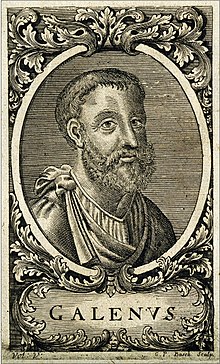
I expect in your next letter, you most absurd censor of the world, that you will order that grammar be subservient to the wool trade, that dialectic be subservient to weapons manufacturing. What could I think that you would not dare to do, when you think that I have set my mouth against even by touching on doctors, that divine and celestial race, when you yourself were not afraid to open your disgusting mouth against Pliny, the most preeminent man in learning and intellect of his entire age? Thus I see that they wrote about him, without excepting Galen, his contemporary (if I am not mistaken) who was himself a not unlearned man, but he had the most ample supply of uneducated and talkative successors.

Galenus.jpg

Proximis tuis literis expecto, ridiculosissime rerum censor, ut lanificio iubeas subesse grammaticam, dyaleticam armature. Quid enim te rursus non ausurum putem, qui me os in celum posuisse dicas, quoniam medicos divinum ac celeste genus attigerim, cum tu impurissimum os aperire non sis veritus in Plinium Secundum, virum ex omnibus sue etatis doctrina ingenioque prestantissimum? Ita enim de illo scriptum video; nec excipitur Galienus, coetaneus – nisi fallor – suus, vir et ipse non indoctus, sed indoctorum atque loquacium abundantissimus successorum.

The Rites of the Dead Adorn Us

Euripides, Suppliant Women 77-86 (Full Greek text on the Scaife Viewer)

“The rites of the dead adorn those who perform them.
This invincible gift of mourning,
Its many labors, moves me,
As a stream rushing forward
Without stopping, flowing out
Of a steep cliff.

The grief over dead children
Plants the pain of mourning
Deep inside women…Alas,
I hope that I forget these pains when I die.”

τὰ γὰρ φθιτῶν τοῖς ὁρῶσι κόσμος.
ἄπληστος ἅδε μ᾿ ἐξάγει
χάρις γόων πολύπονος, ὡς
ἀλιβάτου <τις> ἐκ πέτρας
ὑγρὰ ῥέουσα σταγὼν
ἄπαυστος αἰεὶ †γόων†.
τὸ γὰρ θανόντων τέκνων
ἐπίπονόν τι κατὰ γυναῖ-
κας ἐς γόους πάθος πέφυκεν· αἰαῖ.
θανοῦσα τῶνδ᾿ ἀλγέων λαθοίμαν.

For more reflections on what ancient Greek narratives have to tell us about the importance of burial rites and mourning, see “What the Greek Classics Tell us about Grief and the Importance of Mourning‘ in The Conversation . For more from Euripides Suppliants, tune in this Wednesday, September 23rd, at 3 PM for Reading Greek Tragedy Online from the Center for Hellenic Studies and Out of Chaos Theater.

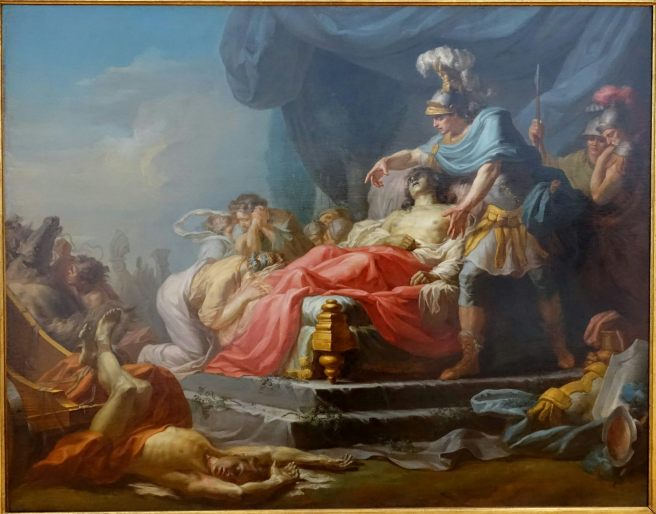
Achilles with the body of Hector  Jean-Joseph Taillasson/Krannert Art Museum

4 Years of Presidential Memories: Some Greek Passages for Treason For No Particular Reason

[We previously posted some similar passages in Latin]

Some Greek Words for Treason

ἀπιστία, “treachery”
προδοσία, “high treason”, “betrayal”
προδότης “traitor”
ἐπιβουλή, “plot”

From the Suda (Full text on the Scaife Viewer)

“Dêmadês: He was king in Thebes after Antipater. A son of Dêmeas the sailor, he was also a sailor, a shipbuilder, and a ferry-operator. He gave up these occupations to enter politics and turned out to be a traitor—he grew very wealthy from this and obtained, as a bribe from Philip, property in Boiotia.”
Δημάδης, μετ’ ᾿Αντίπατρον βασιλεύσας Θήβας ἀνέστησε, Δημέου ναύτου, ναύτης καὶ αὐτός, ναυπηγὸς καὶ πορθμεύς. ἀποστὰς δὲ τούτων ἐπολιτεύσατο καὶ ἦν προδότης καὶ ἐκ τούτου εὔπορος παντὸς καὶ κτήματα ἐν Βοιωτίᾳ παρὰ Φιλίππου δωρεὰν ἔλαβεν. οὗτος Δημο-

Euripides’ Orestes 1057-1060 (Full text on the Scaife Viewer)

[Elektra] Did he not speak for you, eager that you not die,
Menelaos the coward, our father’s traitor?
[Orestes] He didn’t show his face, because he yearning
For the scepter—he was careful not to save his relatives

Ηλ. οὐδ’ εἶφ’ ὑπὲρ σοῦ μὴ θανεῖν σπουδὴν ἔχων
Μενέλαος ὁ κακός, ὁ προδότης τοὐμοῦ πατρός;
Ορ. οὐδ’ ὄμμ’ ἔδειξεν, ἀλλ’ ἐπὶ σκήπτροις ἔχων
τὴν ἐλπίδ’ ηὐλαβεῖτο μὴ σώιζειν φίλους.

Dinarchus, Against Philocles, 8-9 

“Don’t you understand that while, in other cases, it is necessary to impose a penalty on those who have committed crimes after examining the matter precisely and uncovering the truth over time, but for instances of clear and agreed-upon treason, we must yield first to anger and what comes from it? Don’t you think that this man would betray any of the things most crucial to the state, once you made him in charge of it?”

ἆρ᾿ ἴσθ᾿ ὅτι ἐπὶ μὲν τῶν ἄλλων ἀδικημάτων σκεψαμένους ἀκριβῶς δεῖ μεθ᾿ ἡσυχίας καὶ τἀληθὲς ἐξετάσαντας, οὕτως ἐπιτιθέναι τοῖς ἠδικηκόσι τὴν τιμωρίαν, ἐπὶ δὲ ταῖς φανεραῖς καὶ παρὰ πάντων ὡμολογημέναις προδοσίαις πρώτην5 τετάχθαι τὴν ὀργὴν καὶ τὴν μετ᾿ αὐτῆς6 γιγνομένην τιμωρίαν; τί γὰρ τοῦτον οὐκ ἂν οἴεσθε ἀποδόσθαι τῶν ἐν τῇ πόλει σπουδαιοτάτων, ὅταν ὑμεῖς ὡς πιστὸν αὐτὸν καὶ δίκαιον φύλακα καταστήσητε;

Lycurgus, Against Leocrates, 126-7

“It is right that punishments for other crimes come after them, but punishment for treason should precede the dissolution of the state. If you miss that opportune moment when those men are about to do something treacherous against their state, it is not possible for you to obtain justice from the men who did wrong: for they become stronger than the punishment possible from those who have been wronged.”

τῶν μὲν γὰρ ἄλλων ἀδικημάτων ὑστέρας δεῖ τετάχθαι τὰς τιμωρίας, προδοσίας δὲ καὶ δήμου καταλύσεως προτέρας. εἰ γὰρ προήσεσθε τοῦτον τὸν καιρὸν, ἐν ᾧ μέλλουσιν ἐκεῖνοι κατὰ τῆς πατρίδος φαῦλόν τι πράττειν, οὐκ ἔστιν ὑμῖν μετὰ ταῦτα δίκην παρ’ αὐτῶν ἀδικούντων λαβεῖν· κρείττους γὰρ ἤδη γίγνονται τῆς παρὰ τῶν ἀδικουμένων τιμωρίας.

thracian-tattoos

Forget Patriotism: Public Service Ruins You

Pausanias, Description of Greece 1.8:

Following the statues of the Eponymoi there are images of the gods, Amphiaraus and Eirene carrying the child Ploutos. Here is a bronze statue of Lycurgus son of Lycophron, and Kallias, who made peace (so most of the Athenians say) between the Greeks and Atarxerxes, the son of Xerxes. There is also a statue of Demosthenes, whom the Athenians forced into exile at Kalaureia, an island near Troizen, and whom they welcomed back but banished again following the embarassment in Lamia. In his second exile, Demosthenes went again to Kalaureia, where he drank a poison and died. He is the only Greek exile whom Archias did not lead back to Antipater and the Macedonians. This Archias, who came from Thuria, had set his heart on an unholy work: he rounded up all of the Greeks who had opposed the Macedonians before the Greek defeat in Thessaly and gave them to Antipater to be punished. So the goodwill which Demosthenes felt toward the Athenians came to this. It seems to me to be well said that whenever a man becomes devoted to his polis and relies upon the confidence of the people, he never suffers a good end.

μετὰ δὲ τὰς εἰκόνας τῶν ἐπωνύμων ἐστὶν ἀγάλματα θεῶν, Ἀμφιάραος καὶ Εἰρήνη φέρουσα Πλοῦτον παῖδα. ἐνταῦθα Λυκοῦργός τε κεῖται χαλκοῦς ὁ Λυκόφρονος καὶ Καλλίας, ὃς πρὸς Ἀρταξέρξην τὸν Ξέρξου τοῖς Ἕλλησιν, ὡς Ἀθηναίων οἱ πολλοὶ λέγουσιν, ἔπραξε τὴν εἰρήνην: ἔστι δὲ καὶ Δημοσθένης, ὃν ἐς Καλαυρείαν Ἀθηναῖοι τὴν πρὸ Τροιζῆνος νῆσον ἠνάγκασαν ἀποχωρῆσαι, δεξάμενοι δὲ ὕστερον διώκουσιν αὖθις μετὰ τὴν ἐν Λαμίᾳ πληγήν. Δημοσθένης δέ ὡς τὸ δεύτερον ἔφυγε, περαιοῦται καὶ τότε ἐς τὴν Καλαυρείαν, ἔνθα δὴ πιὼν φάρμακον ἐτελεύτησεν: φυγάδα τε Ἕλληνα μόνον τοῦτον Ἀντιπάτρῳ καὶ Μακεδόσιν οὐκ ἀνήγαγεν Ἀρχίας. ὁ δὲ Ἀρχίας οὗτος Θούριος ὢν ἔργον ἤρατο ἀνόσιον: ὅσοι Μακεδόσιν ἔπραξαν ἐναντία πρὶν ἢ τοῖς Ἕλλησι τὸ πταῖσμα τὸ ἐν Θεσσαλίᾳ γενέσθαι, τούτους ἦγεν Ἀρχίας Ἀντιπάτρῳ δώσοντας δίκην. Δημοσθένει μὲν ἡ πρὸς Ἀθηναίους ἄγαν εὔνοια ἐς τοῦτο ἐχώρησεν: εὖ δέ μοι λελέχθαι δοκεῖ ἄνδρα ἀφειδῶς ἐκπεσόντα ἐς πολιτείαν καὶ πιστὰ ἡγησάμενον τὰ τοῦ δήμου μήποτε καλῶς τελευτῆσαι.

From Boswell’s Life of Samuel Johnson:

“Sir Adam introduced the ancient Greeks and Romans. JOHNSON. ‘Sir, the mass of both of them were barbarians. The mass of every people must be barbarous where there is no printing, and consequently knowledge is not generally diffused. Knowledge is diffused among our people by the news-papers.’ Sir Adam mentioned the orators, poets, and artists of Greece. JOHNSON. ‘Sir, I am talking of the mass of the people. We see even what the boasted Athenians were. The little effect which Demosthenes’s orations had upon them, shews that they were barbarians.’”

Social Distancing in the Field: Be Goats, Not Sheep

Varro, On Agriculture 2. 9-11

“What can I say about the health of animals that are never healthy? There’s only this: the masters of the flock have special written instructions on what treatments to use for some of their diseases and for bodily wounds which they often suffer, since they are often fighting one another with horns and since they graze in thorny areas.

All that remains is the topic of numbers. This is smaller for herds of goats than for flocks of sheep, since goats are horny and spread themselves out but sheep gather together and crowd in a single space. In the Gallic territory, people keep greater numbers of flocks instead of bigger ones because an epidemic develops quickly in large ones, which will bring an owner to ruin. They believe that a flock of fifty people is big enough.”

Quid dicam de earum sanitate, quae numquam sunt sanae? Nisi tamen illud unum: quaedam scripta habere magistros pecoris, quibus remediis utantur ad morbos quosdam earum ac vulneratum corpus, quod usu venit iis saepe, quod inter se cornibus pugnant atque in spinosis locis pascuntur. Relinquitur de numero, qui in gregibus est minor caprino quam in ovillo, quod caprae lascivae et quae dispargant se; contra oves quae se congregent ac condensent in locum unum. Itaque in agro Gallico greges plures potius faciunt quam magnos, quod in magnis cito existat pestilentia, quae ad perniciem eum perducat. Satis magnum gregem putant esse circiter quinquagenas.

A daily reminder, Od. 17.246 (for more, go here)

“Bad shepherds ruin their flocks.”

… αὐτὰρ μῆλα κακοὶ φθείρουσι νομῆες.

Also, to practice your imitation:

Sheep say baa, βῆ λέγειν. while goats say may, Μῆ μῆ (as in, may I stand at least six feet away from you?)

File:KAMA Ulysse fuyant Polyphème.jpg
For some cognitive dissonance. Pelikè représentant Ulysse s’échappant de la caverne de Polyphème en s’agrippant à la toison d’un bélier. Vers 500 a. C. Musée archéologique du Céramique n°THW 195.

4 Years of Presidential Memories: Intellectual Intolerance In an Ancient Democracy

Protagoras, from Diogenes Laertius, 9.51

“[Protagoras] was also the first to say that there are two arguments in opposition to each other concerning every matter. He argued with these and was the first to do this. He also began his work in this way: “A person is the measure of all things, that they are what they are and that they are not what they are not.”

And he used to say that the soul was nothing besides the senses, as Plato claims in the Theaetetus and that everything is true. Elsewhere, he began in this way: “Concerning the gods, I am not able to know that they exist or that they don’t exist. For many things impede knowledge—including both a lack of clarity and the brevity of human life.” Protagoras was expelled by the Athenians because of this introduction. They then burned his books in the marketplace once they had sent a herald around to collect them from those who owned them.”

protagoras-2

Καὶ πρῶτος ἔφη (DK 80 B 6a) δύο λόγους εἶναι περὶ παντὸς πράγματος ἀντικειμένους ἀλλήλοις· οἷς καὶ συνηρώτα, πρῶτος τοῦτο πράξας. ἀλλὰ καὶ ἤρξατό που τοῦτον τὸν τρόπον (DK 80 B 1)· “πάντων χρημάτων μέτρον ἄνθρωπος, τῶν μὲν ὄντων ὡς ἔστιν, τῶν δὲ οὐκ ὄντων ὡς οὐκ ἔστιν.” ἔλεγέ τε μηδὲν εἶναι ψυχὴν παρὰ τὰς αἰσθήσεις, καθὰ καὶ Πλάτων φησὶν ἐν Θεαιτήτῳ, καὶ πάντα εἶναι ἀληθῆ. καὶ ἀλλαχοῦ δὲ τοῦτον ἤρξατο τὸν τρόπον (DK 80 B 4)· “περὶ μὲν θεῶν οὐκ ἔχω

εἰδέναι οὔθ’ ὡς εἰσίν, οὔθ’ ὡς οὐκ εἰσίν· πολλὰ γὰρ τὰ κωλύοντα εἰδέναι, ἥ τ’ ἀδηλότης καὶ βραχὺς ὢν ὁ βίος τοῦ ἀνθρώπου.” διὰ  ταύτην δὲ τὴν ἀρχὴν τοῦ συγγράμματος ἐξεβλήθη πρὸς ᾿Αθηναίων· καὶ τὰ βιβλία αὐτοῦ κατέκαυσαν ἐν τῇ ἀγορᾷ, ὑπὸ κήρυκι ἀναλεξάμενοι παρ’ ἑκάστου τῶν κεκτημένων.