I Won’t Bury My Treasure

Epistles of Phalaris, 12:

To Aglaos

I have stored up as much wealth as god has provided for the reversals of fortune not in the bosom of the earth, as you have suggested, but with those of my friends who wished to accept it as a gift. But you have not graced me by offering yourself enthusiastically to this plan to have some measure of hope in you who are my friends if I should ever lose my power. But indeed, though you have not done it now, take it and make the deed a kind of storing up which will guard our friendship. For I will not regard any part of the earth as trustworthy as I pass it if you, the greatest of my friends, are less sure and abiding than a handful of dust. But if you are doing well, even if I find myself wrapped up by a different fortune, I will in my vanquished state appear to be no less fortunate.

᾿Αγλάῳ.

     Τεθησαυρίκαμεν τοῦ πλούτου ὅσον παρέσχεν ὁ θεὸς εἰς μεταβολὰς τῆς τύχης οὐκ ἐν τοῖς κόλποις τῆς γῆς, ὡς παρῄνεις, ἀλλ’ εἰς τοὺς βουληθέντας τῶν φίλων τὰς δωρεὰς λαμβάνειν. σὺ δ’ οὐδ’ εἰς τοῦτο πρόθυμον ἡμῖν σεαυτὸν ἐχαρίσω, τὸ κατά γε ὑμᾶς τοὺς φίλους,κἂν ἀποσφαλῶμεν τῆς ἀρχῆς, ἔχεσθαι τῶν ἐλπίδων. οὐ μὴν ἀλλ’ εἰ καὶ μὴ πρότερον, νῦν γε λαβὼν ὡς παρακαταθήκην ἐμοὶ φυλαχθησομένην φίλου τι ποίησον ἔργον· πιστὸν γὰρ οὐδὲν ἡγησόμεθα γῆς μέρος παρελθόντες ὡς κόνεως ἀπιστοτέρους τοὺς ἐξ ὑμῶν τῶν ἑταίρων κρατίστους. ὧν εὐτυχούντων, κἂν αὐτὸς ἑτέρῳ συμπλακῶ δαίμονι, ἡσθεὶς οὐδὲν ἧττον εὐτυχεῖν δόξω.

Wanna Be A Baller, Shot Caller, Lib’ral Arts Degree Hanging On The Wall-a

Pier Paolo Vergerio,
de Ingenuis Moribus et Liberalibus Adulescentiae Studiis (§2):

But while it is right that all people (especially parents) should be such as to seek to educate their children properly and since it is fitting that children should be such that they seem worthy of good parents, yet it is especially true for those who occupy a lofty place in society, whose every saying and deed is exposed to the public eye, that they should be educated in the most important subjects, so that they can be considered worthy of the fortune and rank of dignity which they achieve. It is only fair that those who think that all the best is owed to them should be examples of the best themselves. Nor is there any more sure or stable principle of ruling than that those who get hold of power should be judged by all to be the most worthy of it.

Image result for medieval manuscript king
“But there’s got to be a better way!”

Verum cum omnes homines deceat (parentes quidem in primis) eos esse qui recte erudire suos liberos studeant et filios deinde tales qui parentibus bonis digni videri possint, praecipue tamen qui excelsiore loco sunt, quorumque nihil neque dictum neque factum latere potest, decens est ita principalibus artibus instructos esse, ut et fortuna et gradu dignitatis quam obtinent digni habeantur. Aequum est enim qui sibi summa omnia deberi volunt, debere et eos summa omnia de se praestare. Nec est ulla certior aut stabilior regnandi ratio quam si hi qui regna obtinent, ab omnibus dignissimi omnium regno iudicentur.

A Leader’s First Duty

Plutarch, Theseus and Romulus 2

“A ruler’s first duty is to save the state itself. This is saved no less in refraining from what is not fitting than from pursuing what is fitting. But the one who shirks or overreaches is no longer a king or a ruler, but in fact becomes a demagogue or a despot. He fills the subjects with hatred and contempt. While the first problem seems to come from being too lenient or a concern for humanity, the second comes from self-regard and harshness.”

δεῖ γὰρ τὸν ἄρχοντα σώζειν πρῶτον αὐτὴν τὴν ἀρχήν· σώζεται δ᾿ οὐχ ἧττον ἀπεχομένη τοῦ μὴ προσήκοντος ἢ περιεχομένη τοῦ προσήκοντος. ὁ δ᾿ ἐνδιδοὺς ἢ ἐπιτείνων οὐ μένει βασιλεὺς οὐδὲ ἄρχων, ἀλλ᾿ ἢ δημαγωγὸς ἢ δεσπότης γιγνόμενος, ἐμποιεῖ τὸ μισεῖν ἢ καταφρονεῖν τοῖς ἀρχομένοις. οὐ μὴν ἀλλ᾿ ἐκεῖνο μὲν ἐπιεικείας δοκεῖ καὶ φιλανθρωπίας εἶναι, τοῦτο δὲ φιλαυτίας ἁμάρτημα καὶ χαλεπότητος.

Theseus Minotaur BM Vase E84.jpg
Tondo of an Attic red-figured kylix, ca. 440-430 BC BM E84

Nothing But Hate, Bad News, and Disgust!

Robert Burton, The Anatomy of Melancholy 2.3.7:

“I say the same of scoffs, slanders, contumelies, obloquies, defamations, detractions, pasquilling libels, and the like, which may tend any way to our disgrace: ’tis but opinion; if we could neglect, contemn, or with patience digest them, they would reflect on them that offered them at first. A wise citizen, I know not whence, had a scold to his wife: when she brawled, he played on his drum, and by that means madded her more, because she saw that he would not be moved. Diogenes in a crowd when one called him back, and told him how the boys laughed him to scorn, Ego, inquit, non rideor [I am not being laughed at], took no notice of it. Socrates was brought upon the stage by Aristophanes, and misused to his face, but he laughed as if it concerned him not: and as Aelian relates of him, whatsoever good or bad accident or fortune befel him going in or coming out, Socrates still kept the same countenance; even so should a Christian do, as Hierom describes him, per infamiam et bonam famam grassari ad immortalitatem, march on through good and bad reports to immortality, not to be moved: for honesty is a sufficient reward, probitas sibi praemium; and in our times the sole recompense to do well, is, to do well: but naughtiness will punish itself at last, Improbis ipsa nequitia supplicium [to the wicked, their own worthlessness is their punishment]. As the diverb is,

Qui bene fecerunt, illi sua facta sequentur;
Qui male fecerunt, facta sequentur eos:
They that do well, shall have reward at last:
But they that ill, shall suffer for that’s past.

Yea, but I am ashamed, disgraced, dishonoured, degraded, exploded: my notorious crimes and villainies are come to light (deprendi miserum est [it is a miserable thing to be caught]), my filthy lust, abominable oppression and avarice lies open, my good name’s lost, my fortune’s gone, I have been stigmatised, whipped at post, arraigned and condemned, I am a common obloquy, I have lost my ears, odious, execrable, abhorred of God and men. Be content, ’tis but a nine days’ wonder, and as one sorrow drives out another, one passion another, one cloud another, one rumour is expelled by another; every day almost, come new news unto our ears, as how the sun was eclipsed, meteors seen in the air, monsters born, prodigies, how the Turks were overthrown in Persia, an earthquake in Helvetia, Calabria, Japan, or China, an inundation in Holland, a great plague in Constantinople, a fire at Prague, a dearth in Germany, such a man is made a lord, a bishop, another hanged, deposed, pressed to death, for some murder, treason, rape, theft, oppression, all which we do hear at first with a kind of admiration, detestation, consternation, but by and by they are buried in silence: thy father’s dead, thy brother robbed, wife runs mad, neighbour hath killed himself; ’tis heavy, ghastly, fearful news at first, in every man’s mouth, table talk; but after a while who speaks or thinks of it?

It will be so with thee and thine offence, it will be forgotten in an instant, be it theft, rape, sodomy, murder, incest, treason, &c., thou art not the first offender, nor shalt not be the last, ’tis no wonder, every hour such malefactors are called in question, nothing so common, Quocunque in populo, quocunque sub axe [in every population, under every pole]? Comfort thyself, thou art not the sole man. If he that were guiltless himself should fling the first stone at thee, and he alone should accuse thee that were faultless, how many executioners, how many accusers wouldst thou have? If every man’s sins were written in his forehead, and secret faults known, how many thousands would parallel, if not exceed thine offence? It may be the judge that gave sentence, the jury that condemned thee, the spectators that gazed on thee, deserved much more, and were far more guilty than thou thyself. But it is thine infelicity to be taken, to be made a public example of justice, to be a terror to the rest; yet should every man have his desert, thou wouldst peradventure be a saint in comparison; vexat censura columbas [criticism harasses the doves], poor souls are punished; the great ones do twenty thousand times worse, and are not so much as spoken of.”

http://figura.art.br/images/2014/cheney_20.jpg

4 Years of Presidential Memories: Herodotus on Being Greek and Resisting Tyranny

7.102.1-7

“After he heard these things, Dêmarêtos was saying the following: “King, since you order me to tell the truth completely and to say things that someone might not be caught in a lie by you later, poverty has always been Greece’s companion, but virtue is acquired, nurtured by wisdom and strong custom. By cultivating this excellence, Greece has warded off both poverty and tyranny.”

῾Ως δὲ ταῦτα ἤκουσε Δημάρητος, ἔλεγε τάδε· «Βασιλεῦ, ἐπειδὴ ἀληθείῃ διαχρήσασθαι πάντως κελεύεις ταῦτα λέγοντα τὰ μὴ ψευδόμενός τις ὕστερον ὑπὸ σέο ἁλώσεται, τῇ ῾Ελλάδι πενίη μὲν αἰεί κοτε σύντροφός ἐστι, ἀρετὴ δὲ ἔπακτός ἐστι, ἀπό τε σοφίης κατεργασμένη καὶ νόμου ἰσχυροῦ· τῇ διαχρεωμένη ἡ ῾Ελλὰς τήν τε πενίην ἀπαμύνεται καὶ τὴν δεσποσύνην.


8.144.1-3

“To the Spartan representatives, the Athenians answered as follows: “It was a very human response that the Spartans feared we might make an agreement with the Barbarian. But because we believe it shameful that the Athenian spirit should shudder so, know that there is no amount of gold anywhere or land so exceeding in beauty and location which we would ever wish to take to align with the Persians and enslave Greece.

“There are many, serious reasons which would prevent us from doing these things, even if we were willing: first and greatest are the temples and dedications to the gods which were burned and destroyed. This compels us to seek extreme vengeance rather than making agreements with the man who contrived it. Second, is our common Hellenic blood, our shared language, the shrines of the gods and the sacrifices, customs and ways of living we keep in common—never would it be right for the Athenians to betray these things.

Know this too if you did not happen to know it before, as long as a single Athenian survives there will never be a treaty with Xerxes. Still, we give you thanks for your concern about us, that you have worried for out destroyed home enough that you are willing to supply and feed our people.”cropped-hoplites.jpg

πρὸς δὲ τοὺς ἀπὸ Σπάρτης ἀγγέλους τάδε. ‘τὸ μὲν δεῖσαι Λακεδαιμονίους μὴ ὁμολογήσωμεν τῷ βαρβάρῳ, κάρτα ἀνθρωπήιον ἦν: ἀτὰρ αἰσχρῶς γε οἴκατε ἐξεπιστάμενοι τὸ Ἀθηναίων φρόνημα ἀρρωδῆσαι, ὅτι οὔτε χρυσός ἐστι γῆς οὐδαμόθι τοσοῦτος οὔτε χώρη κάλλεϊ καὶ ἀρετῇ μέγα ὑπερφέρουσα, τὰ ἡμεῖς δεξάμενοι ἐθέλοιμεν ἂν μηδίσαντες καταδουλῶσαι τὴν Ἑλλάδα. ’

‘ [2] πολλά τε γὰρ καὶ μεγάλα ἐστι τὰ διακωλύοντα ταῦτα μὴ ποιέειν μηδ᾽ ἢν ἐθέλωμεν, πρῶτα μὲν καὶ μέγιστα τῶν θεῶν τὰ ἀγάλματα καὶ τὰ οἰκήματα ἐμπεπρησμένα τε καὶ συγκεχωσμένα, τοῖσι ἡμέας ἀναγκαίως ἔχει τιμωρέειν ἐς τὰ μέγιστα μᾶλλον ἤ περ ὁμολογέειν τῷ ταῦτα ἐργασαμένῳ, αὖτις δὲ τὸ Ἑλληνικὸν ἐὸν ὅμαιμόν τε καὶ ὁμόγλωσσον καὶ θεῶν ἱδρύματά τε κοινὰ καὶ θυσίαι ἤθεά τε ὁμότροπα, τῶν προδότας γενέσθαι Ἀθηναίους οὐκ ἂν εὖ ἔχοι. ’

‘ [3] ἐπίστασθέ τε οὕτω, εἰ μὴ πρότερον ἐτυγχάνετε ἐπιστάμενοι, ἔστ᾽ ἂν καὶ εἷς περιῇ Ἀθηναίων, μηδαμὰ ὁμολογήσοντας ἡμέας Ξέρξῃ. ὑμέων μέντοι ἀγάμεθα τὴν προνοίην τὴν πρὸς ἡμέας ἐοῦσαν, ὅτι προείδετε ἡμέων οἰκοφθορημένων οὕτω ὥστε ἐπιθρέψαι ἐθέλειν ἡμέων τοὺς οἰκέτας. ’

Horses from the Tyrant’s Stable

Epistles of Phalaris, 11:

To Megacles

I have sent you some horses all outfitted for the competition, and I have ordered Teucrus to give you the money. If you need anything else, don’t hesitate to write. There can be no request so great that I will not be entirely delighted by if you only ask.

The significance of the horse in ancient Greece | It's All Greek

Μεγακλεῖ.

     Καὶ τοὺς ἵππους ἐκπέπομφά σοι κεκοσμημένους ἐπὶ τὸν ἀγῶνα καὶ τὰ χρήματα δοῦναι Τεύκρῳ προστέταχα. κἂν ἄλλου του δέῃ, μὴ κατόκνει γράφειν· οὐδὲν γὰρ οὕτως ἔσται μέγα τῶν αἰτημάτων, ὃ μὴ πάντως αἰτησαμένῳ χαριούμεθα.

Hey Poindexter, You Don’t Know Sh*t!

Petrarch, On His Own Ignorance (32):

“I don’t say these things in an effort to avoid their judgment, but so that they who are ignorant may feel some shame (if they are capable of it) in making their judgment. For, on this subject, I do not just embrace the opinion of friendly jealousy, but even the judgment of hostile hatred, and in sum, if someone pronounces that I am ignorant, I agree with him! When I myself think over how many things are lacking to me, toward which my mind, eager for knowledge, exerts itself, I sadly and silently recognize my own ignorance. But in the meantime, while the end of my present exile is near, at which point this imperfection (from whence our knowledge derives) will be terminated, I am consoled by the thought of our shared nature. I think that it happens to all good and modest minds, that they learn about themselves and derive consolation therefrom. For those who get hold of great knowledge (I am speaking according to the standards of human learning), it is always small when considered in itself, but it becomes great in light of the narrow circumstances from which it is derived, and certainly looks great when compared to others. Otherwise, I ask you, how small and insignificant is the knowledge granted to one mind? Nay, how much like nothing is the knowledge of any one person, whoever they be, when it is compared not just to the knowledge of God, but to one’s own fund of ignorance?”

Petrarch-engraving

Non hec dico, ut declinem forum, sed ut pudeat, siquis est pudor, iudicasse qui nesciunt. Ego etenim de hac re non modo sententiam amicabilis amplector invidie, sed hostilis odii, et ad summam, quisquis ignarum me pronuntiat, mecum sentit. Nam et ego ipse recogitans quam multa michi desint ad id quo sciendi avida mens suspirat, ignorantiam meam dolens ac tacitus recognosco. Sed me interim, dum presentis exilii finis adest, quo nostra hec imperfectio terminetur, qua ex parte nunc scimus, nature communis extimatione consolor. Idque omnibus bonis ac modestis ingeniis evenire arbitror, ut agnoscant se pariter ac solentur; his etiam quibus ingens obtigit scientia — secundum humane scientie morem loquor — que in se semper exigua, pro angustiis quibus excipitur, et collata aliis ingens fit. Alioquin quantulum, queso, est, quantumcunque est, quod nosse uni ingenio datum est? Imo quam nichil est scire hominis, quisquis sit, si non dicam scientie Dei, sed sui ipsius ignorantie comparetur?

Like Something Written By a Child: Self-Publishing Rich Guys

Pliny, Letters 4.7

To My Friend Catius Lepidus,

I have often told you about the force of Regulus. It is a wonder how he completes whatever he dreams up. It was to his taste to mourn his son, so he mourns as no one does. It was to his taste to have as many statues and images of him made as possible. He assigned this to all the shops: he makes boy in colors, the boy in wax, the boy in bronze, the boy in silver, the boy in gold, ivory, marble.

He also recently recited a book on the life of his son to a huge audience he had summoned. It was about he life of a boy, but he read it still. And then he sent that same story copied out countless times through all of Italy and the provinces. He wrote openly to the members of the town leaderships so that the most eloquent of their number would read the book in public: it is done!

If he had used this force—or by whatever other name the desire to get what we want should be called—if he had focused on better things, how much good he could have accomplished! A good person is just less forceful than a bad one, as the saying goes, “ignorance makes you bold, thought makes you hesitate. A sense of propriety weakens right thinking people; depravity encourages rash daring.”

Regulus is a good example of this. His lungs are weak, his mouth is muddled, his tongue isn’t fluent, he is really slow at composing with a worthless memory and has nothing apart from a crazy wit. But his lack of shame has won him so much passion that he is considered an orator. For this reason, Herennius Senecio has marvelously altered that Catonian comment on an oratory for him: “This orator is a bad man, untrained at speaking.” My god, Cato himself did not define an orator as well as Senecio described Regulus!

Are you at all able of making a letter equal to this one in thanks? You are if you will write about whether any of my friends in your town—even you—has been forced to read out Regulus’ mournful book like a carnival barker in the forum or, putting it the way Demosthenes does, “crying out and harmonizing his voice”. For it is so ridiculous that it is as likely to elicit laughter as sorrow. You would think it was written by a boy not about one! Goodbye!

C. Plinius Catio Lepido Suo S.

Saepe tibi dico inesse vim Regulo. Mirum est quam efficiat in quod incubuit. Placuit ei lugere filium: luget ut nemo. Placuit statuas eius et imagines quam plurimas facere: hoc omnibus officinis agit, illum coloribus illum cera illum aere illum argento illum auro ebore marmore effingit. Ipse vero nuper adhibito ingenti auditorio librum de vita eius recitavit; de vita pueri, recitavit tamen. Eundem in exemplaria mille transcriptum per totam Italiam provinciasque dimisit. Scripsit publice, ut a decurionibus eligeretur vocalissimus aliquis ex ipsis, qui legeret eum populo: factum est. Hanc ille vim, seu quo alio nomine vocanda est intentio quidquid velis optinendi, si ad potiora vertisset, quantum boni efficere potuisset! Quamquam minor vis bonis quam malis inest, ac sicut ἀμαθíα μὲν θράσoς, λoγισμòς δὲ ὄκνoν φέρει, ita recta ingenia debilitat verecundia, perversa confirmat audacia. Exemplo est Regulus. Imbecillum latus, os confusum, haesitans lingua, tardissima inventio, memoria nulla, nihil denique praeter ingenium insanum, et tamen eo impudentia ipsoque illo furore pervenit, ut orator habeatur. Itaque Herennius Senecio mirifice Catonis illud de oratore in hunc e contrario vertit: “Orator est vir malus dicendi imperitus.” Non mehercule Cato ipse tam bene verum oratorem quam hic Regulum expressit. Habesne quo tali epistulae parem gratiam referas? Habes, si scripseris num aliquis in municipio vestro ex sodalibus meis, num etiam ipse tu hunc luctuosum Reguli librum ut circulator in foro legeris, ἐπάρας scilicet, ut ait Demosthenes, τὴν φωνὴν καì γεγηθὼς καì λαρυγγíζων. Est enim tam ineptus ut risum magis possit exprimere quam gemitum: credas non de puero scriptum sed a puero. Vale.

Image result for roman funeral masks

Four Years of Presidential Memories: Cranky about the State of the Country

Cicero, letters to Atticus 375 (11 May 44)

“I have no doubt that our state is looking at war. This affair has been managed with a man’s bravery and a child’s planning. Can’t everyone see that a king was removed but his heir was left on the throne?

What is more ridiculous? To fear this but not to consider that a risk at all! There is still in this moment much which is crooked. That the house of Pontius near Naples is held by the mother of that tyrannicide! Oh!

I should read the “Cato the Elder” I made for you more often. Old age is making me rather cranky. I am annoyed by everything. But, certainly, I have lived. Let the young men see to these things. You will care for my affairs as you do.”

Mihi autem non est dubium quin res spectet ad castra. acta enim illa res est animo virili, consilio puerili. quis enim hoc non vidit, <regem sublatum>,2 regni heredem relictum? quid autem absurdius? ‘hoc metuere, alterum in metu non ponere!’ quin etiam hoc ipso tempore multa ὑποσóλοικα. Ponti Neapolitanum a matre tyrannoctoni possideri! legendus mihi saepius est ‘Cato maior’ ad te missus. amariorem enim me senectus facit. stomachor omnia. sed mihi quidem βεβíωται; viderint iuvenes. tu mea curabis, ut curas.

cranky cicero

Solon Says: Sue Bad Leaders of State

Aeschines, Against Timarchus

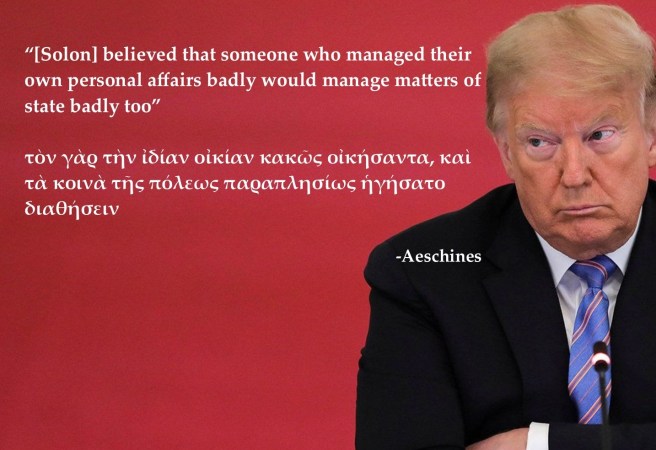
“[Solon] believed that someone who managed their own personal affairs badly would manage matters of state similarly. It did not seem likely to the lawgiver that that the same person who was a scoundrel in private would be a useful citizen in public. He also did not think right that a person should come to speak in public before being prepared for it, not just for words but in life.

And he also thought that advice from a good and noble person, however poorly and simply it was framed, is beneficial to those who hear it, while the words of a person who has no shame, who has made a mockery of his own body and who has shamefully managed his inheritance—well, these words he believed would never help the people who heard them, not even if they were delivered well.

This is why he keeps these kinds of people from the platform, why he forbids them from addressing the public. If someone speaks, then, not merely against these precepts but also for the sake of bribery and criminality, and if the state can no longer endure such a person, he adds “Let any citizens who desires it, and who is able, sue him…”

τὸν γὰρ τὴν ἰδίαν οἰκίαν κακῶς οἰκήσαντα, καὶ τὰ κοινὰ τῆς πόλεως παραπλησίως ἡγήσατο διαθήσειν, καὶ οὐκ ἐδόκει οἷόν τ᾿ εἶναι τῷ νομοθέτῃ τὸν αὐτὸν ἄνθρωπον ἰδίᾳ μὲν εἶναι πονηρόν, δημοσίᾳ δὲ χρηστόν, οὐδ᾿ ᾤετο δεῖν τὸν ῥήτορα ἥκειν ἐπὶ τὸ βῆμα τῶν λόγων ἐπιμεληθέντα πρότερον, ἀλλ᾿ οὐ τοῦ βίου. καὶ παρὰ μὲν ἀνδρὸς καλοῦ καὶ ἀγαθοῦ, κἂν πάνυ κακῶς καὶ ἁπλῶς ῥηθῇ, χρήσιμα τὰ λεγόμενα ἡγήσατο εἶναι τοῖς ἀκούουσι· παρὰ δὲ ἀνθρώπου βδελυροῦ, καὶ καταγελάστως μὲν κεχρημένου τῷ ἑαυτοῦ σώματι, αἰσχρῶς δὲ τὴν πατρῴαν οὐσίαν κατεδηδοκότος, οὐδ᾿ ἂν εὖ πάνυ λεχθῇ συνοίσειν ἡγήσατο τοῖς ἀκούουσι. τούτους οὖν ἐξείργει ἀπὸ τοῦ βήματος, τούτους ἀπαγορεύει μὴ δημηγορεῖν. ἐὰν δέ τις παρὰ ταῦτα μὴ μόνον λέγῃ, ἀλλὰ καὶ συκοφαντῇ καὶ ἀσελγαίνῃ, καὶ μηκέτι τὸν τοιοῦτον ἄνθρωπον δύνηται φέρειν ἡ πόλις, “Δοκιμασίαν μέν,” φησίν, “ἐπαγγειλάτω Ἀθηναίων ὁ βουλόμενος, οἷς ἔξεστιν,” ὑμᾶς δ᾿ ἤδη κελεύει

File:Portrait bust of Sophocles on Herm (known as Solon)-Uffizi.jpg
Bust Labeled “Solon” but Probably actually Sophocles. Sue Me.