Four Years of Presidential Memories:: One Who Is Disordered Cannot Create Order

Plutarch’s “To the Uneducated Ruler” has no relevance today, at all (780a-c)...

“The majority of kings and rulers are stupid–they imitate those artless sculptors who believe that their over-sized figures seem large and solid if they make them with a wide stance, flexing their muscles, mouths gaped open. For these types of rulers seem merely to be imitating the impressiveness and seriousness of leadership with their deep voice, severe glance, bitter manners and their separate way of living: but they are not really any different from the sculpted colossus which is heroic and godly on the outside, but filled with dirt, stone or lead within.

The real difference is that the weight of the statue keeps it standing straight, never leaning; these untaught generals and leaders often wobble and overturn because of their native ignorance. For, because they have built their homes on a crooked foundation, they lean and slide with it. Just as a carpenter’s square, if it is straight and solid, straightens out everything else that is measured according to it, so too a leader must first master himself and correct his own character and only then try to guide his people. For one who is falling cannot lift others; one who is ignorant cannot teach; one who is simple cannot manage complicated affairs; one who is disordered cannot create order; and one who does not rule himself cannot rule.”

Ἀλλὰ νοῦν οὐκ ἔχοντες οἱ πολλοὶ τῶν βασιλέων καὶ ἀρχόντων μιμοῦνται τοὺς ἀτέχνους ἀνδριαντοποιούς, οἳ νομίζουσι μεγάλους καὶ ἁδροὺς φαίνεσθαι τοὺς κολοσσούς, ἂν διαβεβηκότας σφόδρα καὶ διατεταμένους καὶ κεχηνότας πλάσωσι· καὶ γὰρ οὗτοι βαρύτητι φωνῆς καὶ βλέμματος τραχύτητι καὶ δυσκολίᾳ τρόπων καὶ ἀμιξίᾳ διαίτης ὄγκον ἡγεμονίας καὶ σεμνότητα μιμεῖσθαι δοκοῦσιν, οὐδ᾿ ὁτιοῦν τῶν κολοσσικῶν διαφέροντες ἀνδριάντων, οἳ τὴν ἔξωθεν ἡρωικὴν καὶ θεοπρεπῆ μορφὴν ἔχοντες ἐντός εἰσι γῆς μεστοὶ καὶ λίθου καὶ μολίβδου· πλὴν ὅτι τῶν μὲν ἀνδριάντων ταῦτα τὰ βάρη τὴν ὀρθότητα μόνιμον καὶ ἀκλινῆ διαφυλάττει, οἱ δ᾿ ἀπαίδευτοι στρατηγοὶ καὶ ἡγεμόνες ὑπὸ τῆς ἐντὸς ἀγνωμοσύνης πολλάκις σαλεύονται καὶ περιτρέπονται· βάσει γὰρ οὐ κειμένῃ πρὸς ὀρθὰς ἐξουσίαν ἐποικοδομοῦντες ὑψηλὴν συναπονεύουσι. δεῖ δέ, ὥσπερ ὁ κανὼν αὐτός, ἀστραβὴς γενόμενος καὶ ἀδιάστροφος, οὕτως ἀπευθύνει τὰ λοιπὰ τῇ πρὸς αὑτὸν ἐφαρμογῇ καὶ παραθέσει συνεξομοιῶν, παραπλησίως τὸν ἄρχοντα πρῶτον τὴν ἀρχὴν κτησάμενον ἐν ἑαυτῷ καὶ κατευθύναντα τὴν ψυχὴν καὶ καταστησάμενον τὸ ἦθος οὕτω συναρμόττειν τὸ ὑπήκοον· οὔτε γὰρ πίπτοντός ἐστιν ὀρθοῦν οὔτε διδάσκειν ἀγνοοῦντος οὔτε κοσμεῖν ἀκοσμοῦντος ἢ τάττειν ἀτακτοῦντος ἢ ἄρχειν μὴ ἀρχομένου·

Image result for Ancient Roman Statue colossus

782b-c

“Among the weak, base and private citizens, ignorance when combined with a lack of power yields little wrongdoing, as in nightmares some trouble upsets the mind, making it incapable of responding to its desires. But when power has been combined with wickedness it adds energy to latent passions. And so that saying of Dionysus is true—for he used to say that he loved his power most when he could do what he wanted quickly. It is truly a great danger when one who wants what is wrong has the power to do what he wants to do.

As Homer puts it “When the plan was made, then the deed was done.” When wickedness has an open course because of its power, it compels every passion to emerge, producing rage, murder, lust, adultery, and greedy acquisition of public wealth.”

Ἐν μὲν γὰρ τοῖς ἀσθενέσι καὶ ταπεινοῖς καὶ ἰδιώταις τῷ ἀδυνάτῳ μιγνύμενον τὸ ἀνόητον εἰς τὸ ἀναμάρτητον τελευτᾷ, ὥσπερ ἐν ὀνείρασι φαύλοις τις ἀνία τὴν ψυχὴν διαταράττει συνεξαναστῆναι ταῖς ἐπιθυμίαις μὴ δυναμένην· ἡ δ᾿ ἐξουσία παραλαβοῦσα τὴν κακίαν νεῦρα τοῖς πάθεσι προστίθησι· καὶ τὸ τοῦ Διονυσίου ἀληθές ἐστιν· ἔφη γὰρ ἀπολαύειν μάλιστα τῆς ἀρχῆς, ὅταν ταχέως ἃ βούλεται ποιῇ. μέγας οὖν ὁ κίνδυνος βούλεσθαι ἃ μὴ δεῖ τὸν ἃ βούλεται ποιεῖν δυνάμενον· αὐτίκ᾿ ἔπειτά γε μῦθος ἔην, τετέλεστο δὲ ἔργον (Il. 19.242). ὀξὺν ἡ κακία διὰ τῆς ἐξουσίας δρόμον ἔχουσα πᾶν πάθος ἐξωθεῖ, ποιοῦσα τὴν ὀργὴν φόνον τὸν ἔρωτα μοιχείαν τὴν πλεονεξίαν δήμευσιν.

782

“It is not possible to hide wickedness in power. But, as when someone with vertigo* might go up in a high place and move around, only to become dizzy and uncertain, thus revealing their suffering, so fortune amplifies the untaught and ignorant a little with some wealth, reputation or offices and, once they have risen up, it shows them falling. Or rather, it is the same as when you cannot tell which of some containers is solid and which is cracked but when you pour water into them, the culprit leak is clear: rotten minds cannot manage power, but they ooze out random desires, rages, improprieties, and base manners.”

Οὐδὲ γὰρ λαθεῖν οἷόν τε τὰς κακίας ἐν ταῖς ἐξουσίαις· ἀλλὰ τοὺς μὲν ἐπιληπτικούς, ἂν ἐν ὕψει τινὶ γένωνται καὶ περιενεχθῶσιν, ἴλιγγος ἴσχει καὶ σάλος, ἐξελέγχων τὸ πάθος αὐτῶν, τοὺς δ᾿ ἀπαιδεύτους καὶ ἀμαθεῖς ἡ τύχη μικρὸν ἐκκουφίσασα πλούτοις τισὶν ἢ δόξαις ἢ ἀρχαῖς μετεώρους γενομένους εὐθὺς ἐπιδείκνυσι πίπτοντας· μᾶλλον δ᾿, ὥσπερ τῶν κενῶν ἀγγείων οὐκ ἂν διαγνοίης τὸ ἀκέραιον καὶ πεπονηκός, ἀλλ᾿ ὅταν ἐγχέῃς, φαίνεται τὸ ῥέον· οὕτως αἱ σαθραὶ ψυχαὶ τὰς ἐξουσίας μὴ στέγουσαι ῥέουσιν ἔξω ταῖς ἐπιθυμίαις, ταῖς ὀργαῖς, ταῖς ἀλαζονείαις, ταῖς ἀπειροκαλίαις.

*The original Greek seems to be about people with epilepsy (tous epilêptikous)

Four Years of Presidential Memories: A Predator and His Advisor, Another Fable for Our Time

Phaedrus 2.6: The Eagle and the Crow

“Against those in power, no one has enough defense
If a wicked advisor also enters the scene
His power and malice ruins their opposition.
An eagle carried a tortoise on high,
When he pulled his body in his armored home to hide,
And rested hidden untouched by any attack,
A crow came on a breeze flying near them:
“You have well seized a precious prize with you talons,
But, if I don’t show what you need to do,
It will pointlessly wear you out with its heavy weight.”
Promised a portion, the crow instructs the eagle to drop
The hard shell from the stars upon a cliff’s rock.
It would be easy to feed on the broken flesh!
The eagle followed up these wicked instructions
And also split the feast with her teacher.
Just so, the tortoise who was safe by nature’s gift.
Was ill-matched to those two and died a sad death.”

Contra potentes nemo est munitus satis;
si vero accessit consiliator maleficus,
vis et nequitia quicquid oppugnant, ruit.
Aquila in sublime sustulit testudinem:
quae cum abdidisset cornea corpus domo,
nec ullo pacto laedi posset condita,
venit per auras cornix, et propter volans
“Opimam sane praedam rapuisti unguibus;
sed, nisi monstraro quid sit faciendum tibi,
gravi nequiquam te lassabit pondere.”
promissa parte suadet ut scopulum super
altis ab astris duram inlidat corticem,
qua comminuta facile vescatur cibo.
inducta vafris aquila monitis paruit,
simul et magistrae large divisit dapem.
sic tuta quae naturae fuerat munere,
impar duabus, occidit tristi nece.

Image result for medieval manuscript eagle and crow and tortoise

Empty Talk: A Fly and a Mule

Phaedrus 3.6: Fly and Mule

A fly sat on a wagon buzzing at the mule:

“You’re going so slow: why don’t you want to go faster”
Be careful or I will sink my sting in your neck!”

The mule answered, “Your words are not my master;
I fear this fool who sits at the front of my cart:
He holds me back with flicking whip
And pulls at my face with dripping reins as I start!
So screw off with your arrogant show!
I know where I need to dawdle and when I need to run.”

With this story it is therefore right to mock,
Whoever without action offers empty talk.

Musca in temone sedit et mulam increpans
“Quam tarde es” inquit “non vis citius progredi?
Vide ne dolone collum conpungam tibi.”
Respondit illa: “Verbis non moveor tuis;
sed istum timeo sella qui prima sedens
cursum flagello temperat lento meum,
et ora frenis continet spumantibus.
quapropter aufer frivolam insolentiam;
nam et ubi tricandum et ubi sit currendum scio.”
Hac derideri fabula merito potest
qui sine virtute vanas exercet minas.

Image result for medieval manuscript mule

Don’t Waste Time – Read Read Read!

Vergerio, de ingenuis moribus et liberalibus adulescentiae studiis, LIV:

“There is indeed good reason to gather together those times which others tend to neglect, as when we read at dinner or awaits sleep (or avoids it) by reading. Yet, the doctors tell us that these practices are bad for our sight and eyes; this is true if we read too much, that is to say, either too intently or after an excessive meal. But it will also be to our advantage if we set up, in our libraries and right before our eyes, those instruments which are used to measure the hours and times more generally, so that we may see time as it flows and slips away from us. It would also be useful if we were to use those places for nothing else than what they were established, allowing there no external business or thought.”

Bonae etenim rationis est ea quoque bona colligere quae solent neglegere ceteri, ut si quis super cenam legat et somnum quidem inter libros exspectet aut certe per libros fugiat. Quamquam physici obesse ea visui luminibusque contendunt; quod et verum est, si modo praeter modum, id est, aut intentione nimia aut super multam saturitatem id fiat. Sed et illud quoque proderit nonnihil, si intra bibliothecas nostras coram atque in oculis instrumenta haec constituamus, quibus horas ac tempora metiri solent, ut quasi tempus ipsum fluere labique videamus, et si eis ipsis locis ad nihil aliud quam ad quod instituta sunt utamur, nullam ibi aut occupationem aut cogitationem extremam admittentes.

“Something for people in the Future to Sing About” Reading Homer’s “Iliad” Online

Homer, Iliad 22.304-5

“May I not die without a fight and without glory
but after doing something big for men to come to learn about”

μὴ μὰν ἀσπουδί γε καὶ ἀκλειῶς ἀπολοίμην,
ἀλλὰ μέγα ῥέξας τι καὶ ἐσσομένοισι πυθέσθαι.

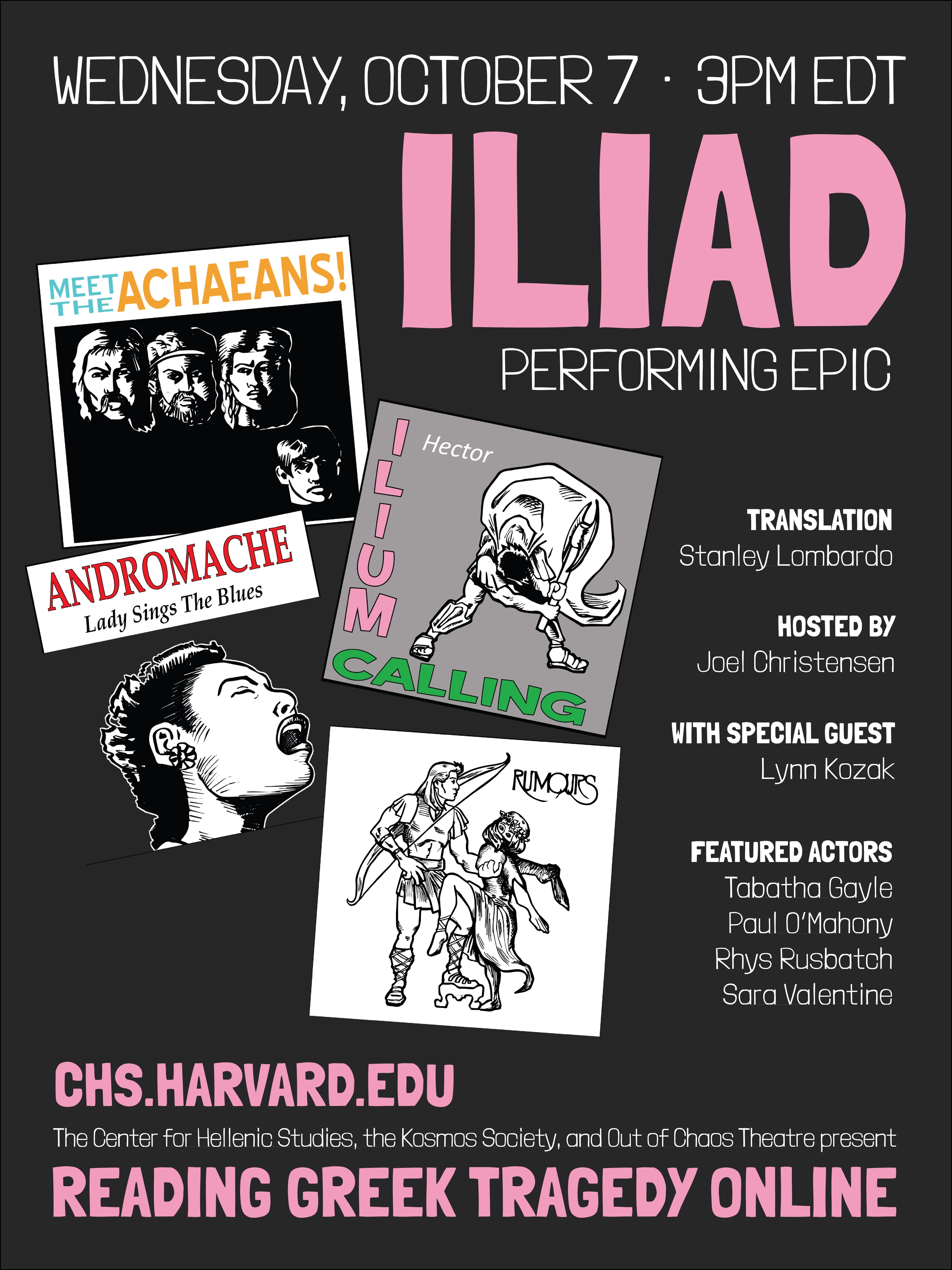
The Center for Hellenic Studies , the Kosmos Society and Out of Chaos Theatre has been presenting scenes from Greek tragedy on the ‘small screen’ since the beginning of the US lockdown in March. As our director Paul O’Mahony has put it, since we are “unable to explore the outside world, we have no option but to explore further the inner one.

This week, we turn to the most tragic of epics (according to Aristotle, at least), Homer’s Iliad

Image

As everyone knows, the Iliad begins with the rage of Achilles. As many of us forget, it ends not with the Trojan Horse or the death of Achilles, but instead with the burial of horse-taming Hektor. I think it is probably dangerous to ask a Homerist to tell you about the Iliad, because so often we don’t know where to start, whether it should be in thinking about its relationship with the Odyssey or about what it means to say the word “Homer”. True Story: many years ago, while patronizing a drinking establishment in Queens, my wife asked me to tell her what the Iliad was about. After about 45 minutes, she asked how much more there was to it. I had not even finished book 1 yet…

Ancient performers of the epics didn’t have these challenges because audiences grew up hearing stories about most of the events and characters they would be singing about and because the performance contexts didn’t expect them to tell the whole story. We don’t know a lot about the actual performance contexts and practices of Homeric poetry in the ancient world (see the work of José Gonzalez on rhapsodes, Casey Dué’s work on multiformity, Egbert Bakker’s From Formula to Poetics or any of Gregory Nagy’s Poetry as Performance or Plato’s Rhapsogy and Homer’s Music), but it seems likely that the stories were performed in episodes at various occasions and at times in monumental performances at festivals. How these performances were prepared is another issue: some think they were memorized from a script, others think they were composed in performance. I tend towards the latter belief with the acknowledgement that even when something is composed in performance, there are various degress of fixity from one performance to another and one singer to another…

And, here again, I have started to trail off. Often people talk about performance of song within Homer to start us thinking about epic performance (the songs of Demodokos and Phemios in the Odyssey; Achilles singing to his lyre in the Iliad) but there’s some evidence outside the poems too. One passage comes from Plato’s Ion:

Plato, Ion 535d-e

Ion: Now this proof is super clear to me, Socrates! I’ll tell you without hiding anything: whenever I say something pitiable, my eyes fill with tears. Whenever I say something frightening, my hair stands straight up in fear and my heart leaps!

Socrates: What is this then, Ion? Should we say that a person is in their right mind when they are all dressed up in decorated finery and gold crowns at the sacrifices or the banquests and then, even though they haven’t lost anything, they are afraid still even though they stand among twenty thousand friendly people and there is no one attacking him or doing him wrong?

Ion: Well, by Zeus, not at all, Socrates, TBH.

Socrates: So you understand that you rhapsodes produce the same effects on most of your audiences?

Ion: Oh, yes I do! For I look down on them from the stage at each moment to see them crying and making terrible expressions, awestruck by what is said. I need to pay special attention to them since if I make them cry, then I get to laugh when I receive their money. But if I make them laugh, then I’ll cry over the money I’ve lost!”

ΙΩΝ. Ὡς ἐναργές μοι τοῦτο, ὦ Σώκρατες, τὸ τεκμήριον εἶπες· οὐ γάρ σε ἀποκρυψάμενος ἐρῶ. ἐγὼ γὰρ ὅταν ἐλεεινόν τι λέγω, δακρύων ἐμπίπλανταί μου οἱ ὀφθαλμοί· ὅταν τε φοβερὸν ἢ δεινόν, ὀρθαὶ αἱ τρίχες ἵστανται ὑπὸ φόβου καὶ ἡ καρδία πηδᾷ.

ΣΩ. Τί οὖν; φῶμεν, ὦ Ἴων, ἔμφρονα εἶναι τότε τοῦτον τὸν ἄνθρωπον, ὃς ἂν κεκοσμημένος ἐσθῆτι ποικίλῃ καὶ χρυσοῖς στεφάνοις κλαίῃ τ᾿ ἐν θυσίαις καὶ ἑορταῖς, μηδὲν ἀπολωλεκὼς τούτων, ἢ φοβῆται πλέον ἢ ἐν δισμυρίοις ἀνθρώποις ἑστηκὼς φιλίοις, μηδενὸς ἀποδύοντος ἢ ἀδικοῦντος;

ΙΩΝ. Οὐ μὰ τὸν Δία, οὐ πάνυ, ὦ Σώκρατες, ὥς γε τἀληθὲς εἰρῆσθαι.

ΣΩ. Οἶσθα οὖν ὅτι καὶ τῶν θεατῶν τοὺς πολλοὺς ταὐτὰ ταῦτα ὑμεῖς ἐργάζεσθε;

ΙΩΝ. Καὶ μάλα καλῶς οἶδα· καθορῶ γὰρ ἑκάστοτε αὐτοὺς ἄνωθεν ἀπὸ τοῦ βήματος κλαίοντάς τε καὶ δεινὸν ἐμβλέποντας καὶ συνθαμβοῦντας τοῖς λεγομένοις. δεῖ γάρ με καὶ σφόδρ᾿ αὐτοῖς τὸν νοῦν προσέχειν· ὡς ἐὰν μὲν κλαίοντας αὐτοὺς καθίσω, αὐτὸς γελάσομαι ἀργύριον λαμβάνων, ἐὰν δὲ γελῶντας, αὐτὸς κλαύσομαι ἀργύριον ἀπολλύς.

Note in this passage that Plato’s Socrates assumes that Ion is faithfull performing a ‘text’ ascribed to Homer and that they both identify as salient features of the performance the context (“sacrifices” and “festivals”) the emotional affect (crying and carrying on, channeling the emotive content of the scenes) and the impact on the audience (making them cry too) all while emphasizing the material benefit accruing to a rhapsode who pleases his audiences.

When I think about Homeric performance, I think a lot about how little we know about the audiences and their responses and how crucial this was to the shape of the poems we have. I too often forget that the performers were an important part of this process in shaping the reception through their use of intonation, voice, gesture, and tune. So, in our readings from the Iliad today, I will be thinking about the parts, and not the whole, and how performance creates a new text of its own.

We’ve selected some passages today for performance from different parts of the epic to give an idea of the power of the whole and to provide a range of characters for our actors. We will get some of the debate in book 1, some family scenes in Troy, and a whole range of lament and regret. What more could one ask for a Wednesday?

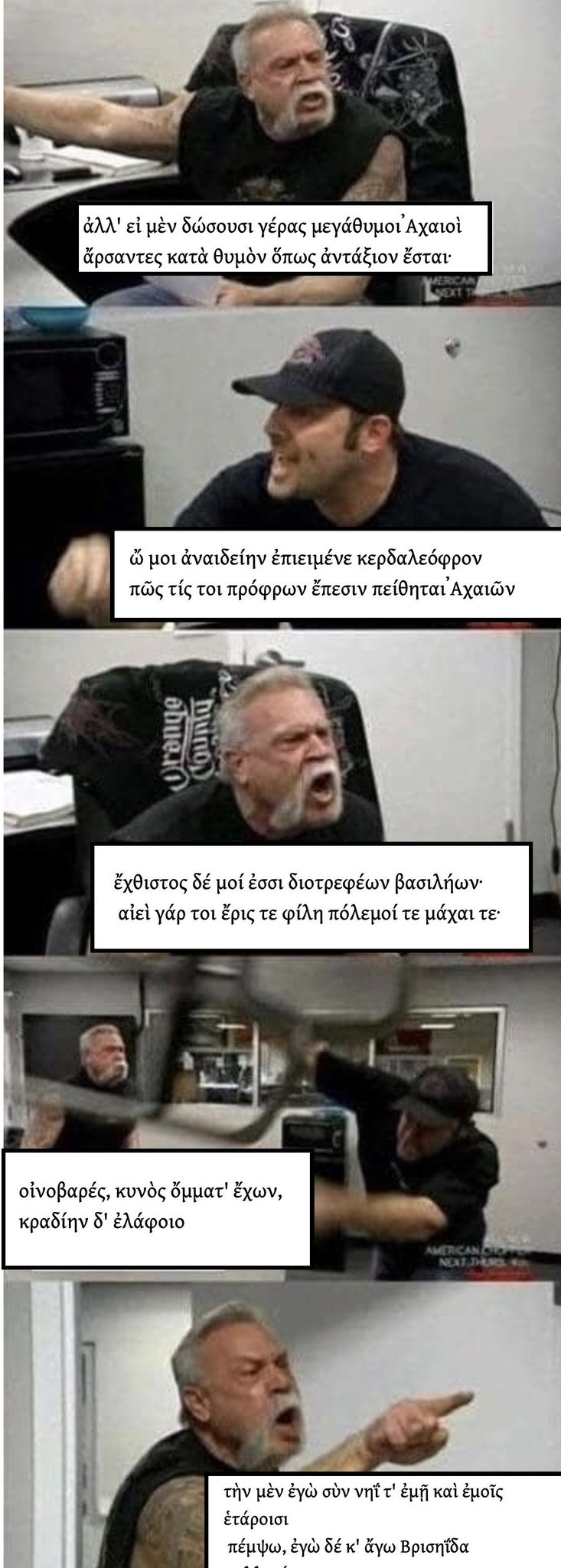
Homer, Iliad 1.158–168 [Achilles addressing Agamemnon]

“But, you great shamepot, we follow you so that you feel joy,
As we collect honor for Menelaos and you, dog-face,
From the Trojans—you don’t shudder at this, you don’t care.”

ἀλλὰ σοὶ ὦ μέγ’ ἀναιδὲς ἅμ’ ἑσπόμεθ’ ὄφρα σὺ χαίρῃς,
τιμὴν ἀρνύμενοι Μενελάῳ σοί τε κυνῶπα
πρὸς Τρώων· τῶν οὔ τι μετατρέπῃ οὐδ’ ἀλεγίζεις·

Selected Passages (Using the Stanley Lombardo translation with permission from Hackett)

Iliad 1 Agamemnon and Achilles’ argument
Iliad 6 Hector and Andromache
Iliad 19 Agamemnon and Achilles reconcile – may be cut for time
Iliad 22 Andromache’s first lament for Hector
Iliad 24 Achilles and Priam
Iliad 24 Priam, Hecuba, Andromache and Helen laments for Hector

Iliad 1.224–228 [Achilles Addressing Agamemnon]

“Wine-sod! Dog-eyes! You have the heart of a deer!
You never suffer to arm yourself to enter battle with the army
Nor to set an ambush with the best of the Achaeans.
That seems like death itself to you!”

οἰνοβαρές, κυνὸς ὄμματ’ ἔχων, κραδίην δ’ ἐλάφοιο,
οὔτέ ποτ’ ἐς πόλεμον ἅμα λαῷ θωρηχθῆναι
οὔτε λόχον δ’ ἰέναι σὺν ἀριστήεσσιν ᾿Αχαιῶν
τέτληκας θυμῷ· τὸ δέ τοι κὴρ εἴδεται εἶναι.

Performers

Tabatha Gayle
Paul O’Mahony
Rhys Rusbatch
Sara Valentine
 
Special Guest, Lynn Kozak

Homer, Iliad 9.32-34

“After a while, Diomedes good-at-the warcry, addressed them:
“I will fight with you first because you are being foolish, son of Atreus,
Which is right, Lord, in the assembly. So don’t get angry at all.”

ὀψὲ δὲ δὴ μετέειπε βοὴν ἀγαθὸς Διομήδης·
᾿Ατρεΐδη σοὶ πρῶτα μαχήσομαι ἀφραδέοντι,
ἣ θέμις ἐστὶν ἄναξ ἀγορῇ· σὺ δὲ μή τι χολωθῇς.

Producers and Crew

Artistic Director: Paul O’Mahony (Out of Chaos Theatre)
Associate Director: Liz Fisher
Director of Outreach: Amy Pistone (Gonzaga University)
Dramaturg: Emma Pauly
Executive Producer: Lanah Koelle (Center for Hellenic Studies)
Producers: Keith DeStone (Center for Hellenic Studies), Hélène Emeriaud, Janet Ozsolak, and Sarah Scott (Kosmos Society)
Poster Artist: John Koelle
Poster Designer: Allie Marbry (Center for Hellenic Studies)

Iliad 21.461-465

“Then lord Apollo the far-shooter answered,
“Earthshaker, you would not think that I would be prudent
If indeed I fought with you over mortals,
Wretched men who are like the leaves now flourish
Until they grow full, eat the fruit of fields,
And then they diminish until they die…”

Τὸν δ’ αὖτε προσέειπεν ἄναξ ἑκάεργος ᾿Απόλλων·
ἐννοσίγαι’ οὐκ ἄν με σαόφρονα μυθήσαιο
ἔμμεναι, εἰ δὴ σοί γε βροτῶν ἕνεκα πτολεμίξω
δειλῶν, οἳ φύλλοισιν ἐοικότες ἄλλοτε μέν τε
ζαφλεγέες τελέθουσιν ἀρούρης καρπὸν ἔδοντες,
ἄλλοτε δὲ φθινύθουσιν ἀκήριοι…

Upcoming Episodes (Go to CHS Project Page for more information)

October 14 Rhesus, Euripides
with Mary Ebbott (College of the Holy Cross)

Saturday, October 17 Assemblywomen, Aristophanes
with Francisco Barrenechea (University of Maryland, College Park)

October 21 Agamemnon, Aeschylus
with Fiona Macintosh (University of Oxford)

Iliad 24.503-6

“Achilles, respect the gods and take pity,
Once you think of your own father. I am even more pitiable,
Since I endure what no other mortal person ever has,
To reach my hands to the lips of the man who slaughtered my child.”

ἀλλ’ αἰδεῖο θεοὺς ᾿Αχιλεῦ, αὐτόν τ’ ἐλέησον
μνησάμενος σοῦ πατρός· ἐγὼ δ’ ἐλεεινότερός περ,
ἔτλην δ’ οἷ’ οὔ πώ τις ἐπιχθόνιος βροτὸς ἄλλος,
ἀνδρὸς παιδοφόνοιο ποτὶ στόμα χεῖρ’ ὀρέγεσθαι.

Iliad 24.732–738

“You, child, will also either follow me
Where you will toil completing the wretched works
Of a cruel master or some Achaean will grab you
And throw you from the wall to your evil destruction
Because he still feels anger at Hektor killing his brother
Or father or son, since many a man of the Achaeans dined
On the endless earth under Hektor’s hands.”

… σὺ δ’ αὖ τέκος ἢ ἐμοὶ αὐτῇ
ἕψεαι, ἔνθά κεν ἔργα ἀεικέα ἐργάζοιο
ἀθλεύων πρὸ ἄνακτος ἀμειλίχου, ἤ τις ᾿Αχαιῶν
ῥίψει χειρὸς ἑλὼν ἀπὸ πύργου λυγρὸν ὄλεθρον
χωόμενος, ᾧ δή που ἀδελφεὸν ἔκτανεν ῞Εκτωρ
ἢ πατέρ’ ἠὲ καὶ υἱόν, ἐπεὶ μάλα πολλοὶ ᾿Αχαιῶν
῞Εκτορος ἐν παλάμῃσιν ὀδὰξ ἕλον ἄσπετον οὖδας.

Iliad 24.801–804

“After heaping up the mound [sêma] they returned. Then
Once they were well gathered they shared a fine feast
In the halls of the god-nourished king, Priam.
Thus they were completing the burial of horse-taming Hektor.”

χεύαντες δὲ τὸ σῆμα πάλιν κίον· αὐτὰρ ἔπειτα
εὖ συναγειρόμενοι δαίνυντ’ ἐρικυδέα δαῖτα
δώμασιν ἐν Πριάμοιο διοτρεφέος βασιλῆος.
῝Ως οἵ γ’ ἀμφίεπον τάφον ῞Εκτορος ἱπποδάμοιο.

Media preview

Four Years of Presidential Memories: “Come, Let Us Build Walls”

Pindar, Fr. 194

“Come, let us build walls now,
A speaking, intricate, construction of words”

εἶα τειχίζωμεν ἤδη ποικίλον
κόσμον αὐδάεντα λόγων

Dio Chrysostom, Diogenes, Or On Tyranny (6.37)

“And still when he was awake, he would pray to be asleep to forget his fears. But when he was asleep, he jumped up as soon as possible because he believed he was being killed by his dreams, that the golden-plane tree, all the mansions of Semiramis, and the walls of Babylon were useless to him”

ἔτι δὲ ἐγρηγορότα μὲν εὔχεσθαι καθυπνῶσαι ὅπως ἐπιλάθηται τῶν φόβων, κοιμώμενον δὲ ἀναστῆναι τὴν ταχίστην, ἅτε ὑπ᾿ αὐτῶν τῶν ἐνυπνίων ἀπολλύμενον, τῆς δὲ χρυσῆς αὐτῷ πλατάνου καὶ τῶν Σεμιράμιδος οἰκοδομημάτων καὶ τῶν ἐν Βαβυλῶνι τειχῶν μηδὲν ὄφελος γιγνόμενον.

Diogenes Laertius, Antisthenes 13

“[Antisthenes used to say] “rational thought is the mightiest wall. It never falls apart or betrays you. We must build walls in our own unconquerable calculations.”

Τεῖχος ἀσφαλέστατον φρόνησιν· μήτε γὰρ καταρρεῖν μήτε προδίδοσθαι. τείχη κατασκευαστέον ἐν τοῖς αὑτῶν ἀναλώτοις λογισμοῖς.

Marcus Aurelius, Meditations 3.7

“Value nothing which compels you to break your promise, to abandon your honor, to hate, suspect or curse anyone, to be a hypocrite, or to lust after anything which needs walls or decorations.”

Μὴ τιμήσῃς ποτὲ ὡς συμφέρον σεαυτοῦ, ὃ ἀναγκάσει σέ ποτε τὴν πίστιν παραβῆναι, τὴν αἰδῶ ἐγκαταλιπεῖν, μισῆσαί τινα, ὑποπτεῦσαι, καταράσασθαι, ὑποκρίνασθαι, ἐπιθυμῆσαί τινος τοίχων καὶ παραπετασμάτων δεομένου.

Aristotle, Politics 1276a

“Imagine that a set of people inhabit the same place, what should make us believe that they inhabit a single state? For, it could not be walls since it would certainly be possible to build a wall around all of the Peloponnese.”

ὁμοίως δὲ καὶ12 τῶν τὸν αὐτὸν τόπον κατοικούντων ἀνθρώπων πότε δεῖ νομίζειν μίαν εἶναι τὴν πόλιν; οὐ γὰρ δὴ τοῖς τείχεσιν, εἴη γὰρ ἂν Πελοποννήσῳ περιβαλεῖν ἓν τεῖχος·

Dio Chrystostom, The Euboean Discourse 50

“But you will give us a home there, or how will we be able to survive the cold? You have many homes in your walls left empty. One of them is enough for us.”

ἀλλ᾿ ὅπως δώσετε ἡμῖν ἐνθάδε οἰκίαν· ἢ πῶς ὑπενεγκεῖν δυνησόμεθα τοῦ χειμῶνος; ἔστιν ὑμῖν οἰκήματα πολλὰ ἐντὸς τοῦ τείχους, ἐν οἷς οὐδεὶς οἰκεῖ· τούτων ἡμῖν ἓν ἀρκέσει.

Cicero, Republic, 1.19

“Don’t you think that we should know what affects our homes—what is happening and what occurs in a home which is not bounded by our walls but is instead the whole world, the dwelling and homeland the gods gave us to share, since, especially, if we are ignorant of these things, we must be ignorant of many other weighty matters too?”

An tu ad domos nostras non censes pertinere scire, quid agatur et quid fiat domi, quae non ea est, quam parietes nostri cingunt, sed mundus hic totus, quod domicilium quamque patriam di nobis communem secum dederunt, cum praesertim, si haec ignoremus, multa nobis et magna ignoranda sint?

[for the the theme of being a citizen of the world, see this post]

wall

Seneca, De Tranquillitate Animi 4-5

“We do not shut ourselves up in the walls of a single city as proof of our great souls, but instead we enter into exchange with the whole world and claim the world as our homeland so that we are allowed to give our virtue a wider field.”

Ideo magno animo nos non unius urbis moenibus clusimus, sed in totius orbis commercium emisimus patriamque nobis mundum professi sumus, ut liceret latiorem virtuti campum dare.

Wall Hating

Four Years of Precious Memories: The Way of Kings, To Love and Hate Without Reason

Homer, Odyssey 4.687–693

“Did they not hear from you, when they were children,
What kind of a man Odysseus was among your parents,
He did nothing unfair nor said anything [unfair]
Among the people? This is the right of divine kings—
They can hate some people and love another.”

ὑμετέρων τὸ πρόσθεν ἀκούετε, παῖδες ἐόντες,
οἷος ᾿Οδυσσεὺς ἔσκε μεθ’ ὑμετέροισι τοκεῦσιν,
οὔτε τινὰ ῥέξας ἐξαίσιον οὔτε τι εἰπὼν
ἐν δήμῳ; ἥ τ’ ἐστὶ δίκη θείων βασιλήων·
ἄλλον κ’ ἐχθαίρῃσι βροτῶν, ἄλλον κε φιλοίη.

Scholia PQ ad. Hom. Od. 4.691

“this is the way of kings, to hate one person but love another. Etc. This line is presented gnomically about kings, because they hate some people but love another. This is not strictly applicable to Odysseus. Therefore line must be taken for use in this particular situation.”

ἥτ’ ἐστὶ δίκη] ὥσπερ τρόπος ἐστὶ τῶν βασιλέων τὸ ἄλλον μὲν μισεῖν, ἄλλον δὲ φιλεῖν. Καὶ ἄλλως. γνωμικὸς ὁ στίχος περὶ τῶν βασιλέων λεγόμενος, ὅτι τοὺς μὲν μισοῦσι, τοὺς δὲ φιλοῦσιν· ὅπερ οὐ προσῆν ᾿Οδυσσεῖ. καὶ αὐτὸν οὖν κατ’ ἰδίαν προενεκτέον τὸν στίχον. P.Q.

Image result for medieval manuscript evil king
Royal_ms_20_a_ii_f005r_detail from British Library

Read Read Read ’til the Eyeballs Bleed

J.E. Sandys, A History of Scholarship Vol 3.

“A new era begins with the name of Friedrich August Wolf 1824). His father was the schoolmaster and organist of the little village of Hamrode near Nordhausen, south of the Harz, and it was to his mother that he owed the awakening of his intellectual life. Before he had attained the age of two, he knew a large number of Latin words, and, before he was eight, had acquired the rudiments of Greek and French, and could read an easy Latin author. His memory was as remarkable as that of Porson, who was born in the same year. His parents soon removed to Nordhausen, where, by the age of twelve, he had learned all that his instructors could teach him. At his new home, the first of his three head-masters was Johann Andreas Fabricius (1696 1769), the author of a History of Learning. Towards the end of his school-days he became his own teacher. Starting once more with the declensions, he ‘read with new eyes the Latin and Greek Classics, some carefully, others more cursorily; learnt by heart several books of Homer, and large portions of the Tragedians and Cicero, and went through Scapula’s Lexicon and Faber’s Thesaurus’. During this time of strenuous study, ‘he would sit up the whole night in a room without a stove, his feet in a pan of cold water, and one of his eyes bound up to rest the other’. Happily this severe ordeal ended with his removal to the university of Gottingen.”

Four Years of Cautionary Memories: Choosing a Captain on the Ship of Fools

Plato, Republic 6 488a7-89a2

[This was inspired by the “Ship of Fools” post at LitKicks]

Consider this how this could turn out on many ships or even just one: there is a captain of some size and strength beyond the rest of the men in the ship, but he is deaf and similarly limited at seeing, and he knows as much about sailing as these qualities might imply. So, the sailors are struggling with one another about steering the ship, because each one believes that he should be in charge, even though he has learned nothing of the craft nor can indicate who his teacher was nor when he had the time to learn. Some of them are even saying that it is not teachable, and that they are ready to cut down the man who says it can be taught.

They are always hanging all over the captain asking him and making a big deal of the fact that he should entrust the rudder to them. There are times when some of them do not persuade him, and some of them kill others or kick them off the ship, and once they have overcome the noble captain through a mandrake, or drugs, or something else and run the ship, using up its contents drinking, and partying, and sailing just as such sort of men might. In addition to this, they praise as a fit sailor, and call a captain and knowledgeable at shipcraft the man who is cunning at convincing or forcing the captain that they should be in charge. And they rebuke as useless anyone who is not like this.

Such men are unaware what a true helmsman is like, that he must be concerned about the time of year, the seasons, the sky, the stars, the wind and everything that is appropriate to the art, if he is going to be a leader of a ship in reality, how he might steer the ship even if some desire it or not, when they believe that it is not possible to obtain art or practice about how to do this, something like an art of ship-steering. When these types of conflicts are occurring on a ship, don’t you think the one who is a true helmsman would be called a star-gazer, a blabber, or useless to them by the sailors in the ships organized in this way?

νόησον γὰρ τοιουτονὶ γενόμενον εἴτε πολλῶν νεῶν πέρι εἴτε μιᾶς· ναύκληρον μεγέθει μὲν καὶ ῥώμῃ ὑπὲρ τοὺς ἐν τῇ νηὶ πάντας, ὑπόκωφον δὲ καὶ ὁρῶντα ὡσαύτως βραχύ τι καὶ γιγνώσκοντα περὶ ναυτικῶν ἕτερα τοιαῦτα, τοὺς δὲ ναύτας στασιάζοντας πρὸς ἀλλήλους περὶ τῆς κυβερνήσεως, ἕκαστον οἰόμενον δεῖν κυβερνᾶν, μήτε μαθόντα πώποτε τὴν τέχνην μέτε ἔχοντα ἀποδεῖξαι διδάσκαλον ἑαυτοῦ μηδὲ χρόνον ἐν ᾧ ἐμάνθανεν, πρὸς δὲ τούτοις φάσκοντας μηδὲ διδακτὸν εἶναι, ἀλλὰ καὶ τὸν λέγοντα ὡς διδακτὸν ἑτοίμους κατατέμνειν, αὐτοὺς δὲ αὐτῷ ἀεὶ τῷ ναυκλήρῳ περικεχύσθαι δεομένους καὶ πάντα ποιοῦντας ὅπως ἂν σφίσι τὸ πηδάλιον ἐπιτρέψῃ, ἐνίοτε δ’ ἂν μὴ πείθωσιν ἀλλὰ ἄλλοι μᾶλλον, τοὺς μὲν ἄλλους ἢ ἀποκτεινύντας ἢ ἐκβάλλοντας ἐκ τῆς νεώς, τὸν δὲ γενναῖον ναύκληρον μανδραγόρᾳ ἢ μέθῃ ἤ τινι ἄλλῳ συμποδίσαντας τῆς νεὼς ἄρχειν χρωμένους τοῖς ἐνοῦσι, καὶ πίνοντάς τε καὶ εὐωχουμένους πλεῖν ὡς τὸ εἰκὸς τοὺς τοιούτους, πρὸς δὲ τούτοις ἐπαινοῦντας ναυτικὸν μὲν καλοῦντας καὶ κυβερνητικὸν καὶ ἐπιστάμενον τὰ κατὰ ναῦν, ὃς ἂν συλλαμβάνειν δεινὸς ᾖ ὅπως ἄρξουσιν ἢ πείθοντες ἢ βιαζόμενοι τὸν ναύκληρον, τὸν δὲ μὴ τοιοῦτον ψέγοντας ὡς ἄχρηστον, τοῦ δὲ ἀληθινοῦ κυβερνήτου πέρι μηδ’ ἐπαΐοντες, ὅτι ἀνάγκη αὐτῷ τὴν ἐπιμέλειαν ποιεῖσθαι ἐνιαυτοῦ καὶ ὡρῶν καὶ οὐρανοῦ καὶ ἄστρων καὶ πνευμάτων καὶ πάντων τῶν τῇ τέχνῃ προσηκόντων, εἰ μέλλει τῷ ὄντι νεὼς ἀρχικὸς ἔσεσθαι, ὅπως δὲ κυβερνήσει ἐάντε τινες βούλωνται ἐάντε μή, μήτε τέχνην τούτου μήτε μελέτην οἰόμενοι δυνατὸν εἶναι λαβεῖν ἅμα καὶ τὴν κυβερνητικήν. τοιούτων δὴ περὶ τὰς ναῦς γιγνομένων τὸν ὡς ἀληθῶς κυβερνητικὸν οὐχ ἡγῇ ἂν τῷ ὄντι μετεωροσκόπον τε καὶ ἀδολέσχην καὶ ἄχρηστόν σφισι καλεῖσθαι ὑπὸ τῶν ἐν ταῖς οὕτω κατεσκευασμέναις ναυσὶ πλωτήρων;

The Ship of Fools by Hieronymous Bosch

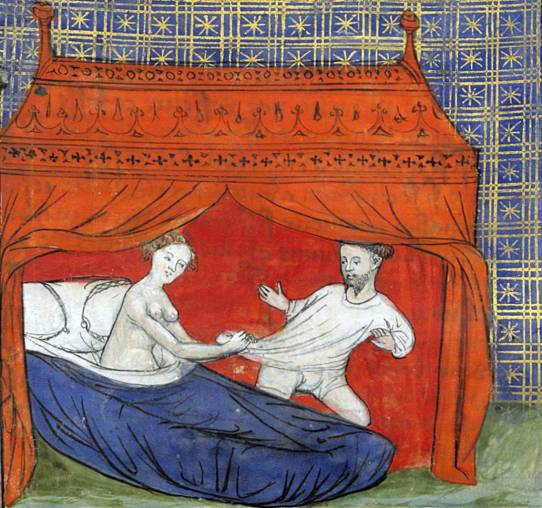
Four Years of Presidential Memories: It’s Ok, Tyrants Don’t Get Real Pleasure from Sex

Xenophon, Hiero 1.29-30

“In his sexual relationships with boyfriends, much more even  than those activities for having children, a tyrant falls short of happiness. Certainly, we all understand that sexual pleasures are much increased under the influence of desire. But desire is certainly least willing to arise in a tyrant.

For lust does not take pleasure in aiming for things ready at hand, but instead for those things that are only hoped for. For this reason, a man who knows nothing of thirst gets no pleasure from drinking; and the man untested by desire is inexperienced of the sweetest sexual delights”

Ἐν δὲ τοῖς παιδικοῖς ἀφροδισίοις ἔτι αὖ πολὺ μᾶλλον ἢ ἐν τοῖς τεκνοποιοῖς μειονεκτεῖ τῶν εὐφροσυνῶν ὁ τύραννος. ὅτι μὲν γὰρ τὰ μετ᾿ ἔρωτος ἀφροδίσια πολὺ διαφερόντως εὐφραίνει, πάντες δήπου ἐπιστάμεθα. ὁ δὲ ἔρως πολὺ αὖ ἐθέλει ἥκιστα τῷ τυράννῳ ἐγγίγνεσθαι. οὐ γὰρ τῶν ἑτοίμων ἥδεται ὁ ἔρως ἐφιέμενος, ἀλλὰ τῶν ἐλπιζομένων. ὥσπερ οὖν οὐκ ἄν τις ἄπειρος ὢν δίψους τοῦ πιεῖν ἀπολαύοι, οὕτω καὶ ὁ ἄπειρος ὢν ἔρωτος ἄπειρός ἐστι τῶν ἡδίστων ἀφροδισίων.

Image from here