The noblest of the Greeks lived in poverty for their whole lives. Some people can go ahead and praise wealth after the best of the Greeks, for whom poverty was allotted for all of life. These are people like Aristides, son of Lysimachus, a man who set a lot of things right in war and imposed taxes on the Greeks.
Phocion, too, was poor. When Alexander set him a hundred talents, he asked, ‘For what reason does he give them to me?’ When they responded that Alexander thought that Phocion alone of the Athenians was noble, he responded, ‘Then he should let me stay that way.’
“Hesitation is fear of future action. Agony is fear of failure and otherwise fear of worse outcomes. Shock is fear of an uncustomary surprise. Shame is fear of a bad reputation. A ruckus is fear pressing down with sound. Divine fright is fear of gods or divine power. Terror is fear of a terrible thing. A fright is fear that comes from a story.”
“Fear: flight or cowardice. Fear is expecting evil. These emotions are categorized as fear: terror, hesitation, shame, shock, commotion, anxiety. Terror is fear that brings dread. Hesitation is fear about future action. Shame is fear about a bad reputation. Shock is fear from an unusual thing. Commotion is fear from a striking sound. Anxiety is fear of an uncertain matter.”
In the spirit of the week before Halloween, below are the major accounts of Diomedes’ father, Tydeus, who was rejected by Athena after eating brains.
Hom. Il. 5.801
“Tydeus was a little man, but a fighter.”
Τυδεύς τοι μικρὸς μὲν ἔην δέμας, ἀλλὰ μαχητής·
Schol. AbT ad Il. 5.126
“They say that when Tydeus was wounded by Melanippos Astakos’ son, he got pretty upset. And Amphiarus, after he killed Melanippus, gave his head to Tydeus. Like a beast, Tydeus ripped it open and slurped up his brains to his fill. Athena happened to be there at that time, bringing some immortal medicine to him from heaven, and she turned back out of disgust. When he saw her, he asked that she favor his son with the divine favor. That’s Pherecydes’ story.”
“That Melanippos was Theban and stood in battle against Tydeus. It seems that Tydeus took his head in rage, smashed it, and gulped up his brains. For this reason, Athena turned back even though she was bringing him a revitalizing drug.”
“Of the head-munching Tydeus: the story goes that during the Theban war, Tydeus ate up Melanippus’ head. Thus, Tydeus is called “head-muncher” and his child is Diomedes.”
“Tydeus, from tuthon (“a little”); for he was small for his age group.”
Τυδεύς: Παρὰ τὸ τυτθόν· μικρὸς γὰρ ἦν τῇ ἡλικίᾳ.
Note the variations in the narrative Apollodorus introduces by bringing all the details together: Amphiarus becomes the villain here!
Apollodorus, 3.76-77
“Melanippus, the last of Astacus’ children, wounded Tydeus in the stomach. While he was lying there half-dead, Athena brought him medicine she had begged from Zeus in order to make him immortal. But when Amphiarus perceived this, because he hated Tydeus for persuading the Argives to march against Thebes against his own judgment, he cut off Melanippus’ head and gave it to him (Tydeus killed him when he was wounded). He drew out the brains and gobbled them up. When Athena saw him, she was disturbed, and withheld and kept the medicine.”
“We consider eating human flesh to be wrong; but it is a matter of ambivalence among the barbarians. But why should we even speak of ‘barbarians’ when Tydeus is said to have eaten an enemy’s brains and when the Stoics claim it is not strange for someone to eat another’s flesh or his own?”
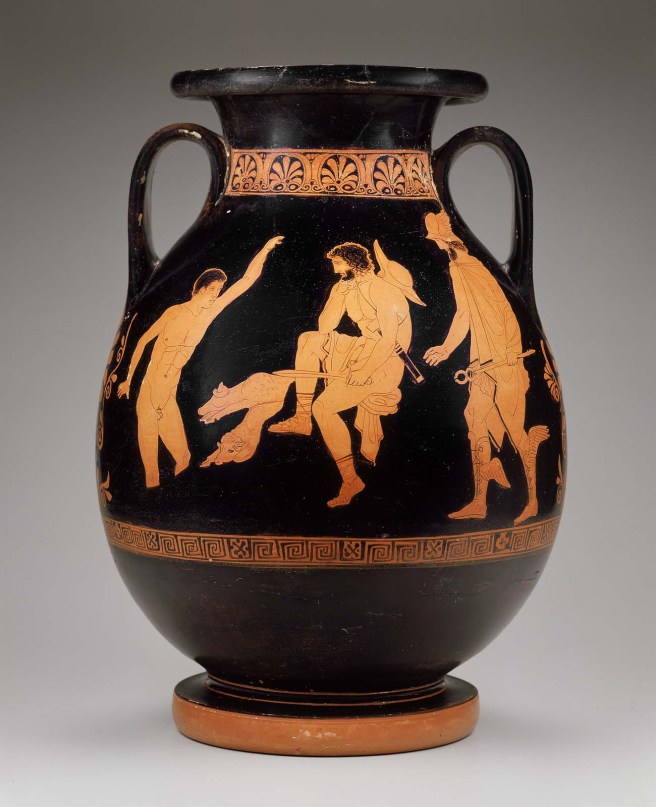
It is the right time of the year for raising the dead. A few years back, a student paper on the Elpenor Pelike at the MFA in Boston drew my attention to the following passage.
Servius ad Aen. 6.107
“For this reason the place is named without joy since, as people claim, it would not have been there but for necromancy or spell-craft. For, Aeneas completed these sacred rites when Misenus was killed and Ulysses did it with the death of Elpenor.
This very scene Homer himself presented falsely from the detail of its location which he specifies along with the length of time of the journey. For he claims that Ulysses sailed for one night and came to the place where he completed these sacrifices. For this reason it is abundantly clear that he doesn’t mean the ocean but Campania.”
sine gaudio autem ideo ille dicitur locus, quod necromantia vel sciomantia, ut dicunt, non nisi ibi poterat fieri: quae sine hominis occisione non fiebant; nam et Aeneas illic occiso Miseno sacra ista conplevit et Vlixes occiso Elpenore. quamquam fingatur in extrema Oceani parte Vlixes fuisse: quod et ipse Homerus falsum esse ostendit ex qualitate locorum, quae commemorat, et ex tempore navigationis; dicit enim eum a Circe unam noctem navigasse et ad locum venisse, in quo haec sacra perfecit: quod de Oceano non procedit, de Campania manifestissimum est.
The relevant passages from the Odyssey don’t give any hint that Elpenor was intentionally killed for black magic. When Odysseus actually does summon the dead, now that gets a little dark.
Odyssey, 10.552–560
“I could not even lead my companions unharmed from there.
The youngest of my companions was a certain Elpênor,
He was neither especially brave in battle or composed in his thoughts.
He separated himself from the companions in Kirkê’s holy home
Because he needed some air; then he fell asleep because he was drunk.
When he heard the noise and trouble of our companions moving out,
He got up immediately and it completely escaped his thoughts
To climb down again by the long ladder—
So he fell straight from the roof and his neck
Shattered along his spine; then his spirit flew down to Hades.”
Nekuomanteia, glossed by Hesychius as nekromanteia (i.e. “necromancy”) is an alternate name for the Nekyuia, the parade of the dead in book 11 of the Odyssey. From the Greek Anthology: ᾿Εν τῷ Η ἡ τοῦ ᾿Οδυσσέως νεκυομαντεία· (3.8); Scholia to the Odyssey, Hypotheses: Λ. Νεκυομαντεία, ἢ, Νεκυία. Cf. Eustathius, Comm. Ad Od. 1.396.10
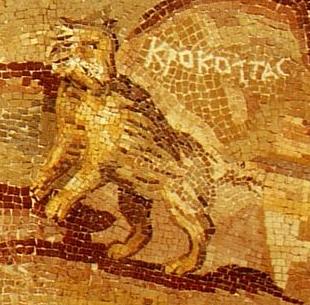
2 “Daliôn says in the first book of his Ethiopian Matters that there is an animal in Ethiopia called a krokotta. When that creature goes near backyards it hears people chattering, and especially the words/names of children. But when it goes out at night, it speaks words/names and the children who come out are devoured by it”
“[We should note the fact that] there is a creature in Ethiopia which is named krokottas which is like a combination of wolf and a dog, but it is more savage than both and is heavier in its face and at the end of its feet. It is also amazing for its boldness, and it is extremely capable compared to the rest in its teeth and its belly. For they also tear to pieces easily every type of bone and whatever they take up is consumed easily and their digestion is indescribable.
In addition, while some of them have been described as imitating human language, we don’t believe it. Nevertheless, some have added that they call out people by name at night—and that they try to use a human voice in doing this—and then they gobble up whoever comes out as they fall upon them.”
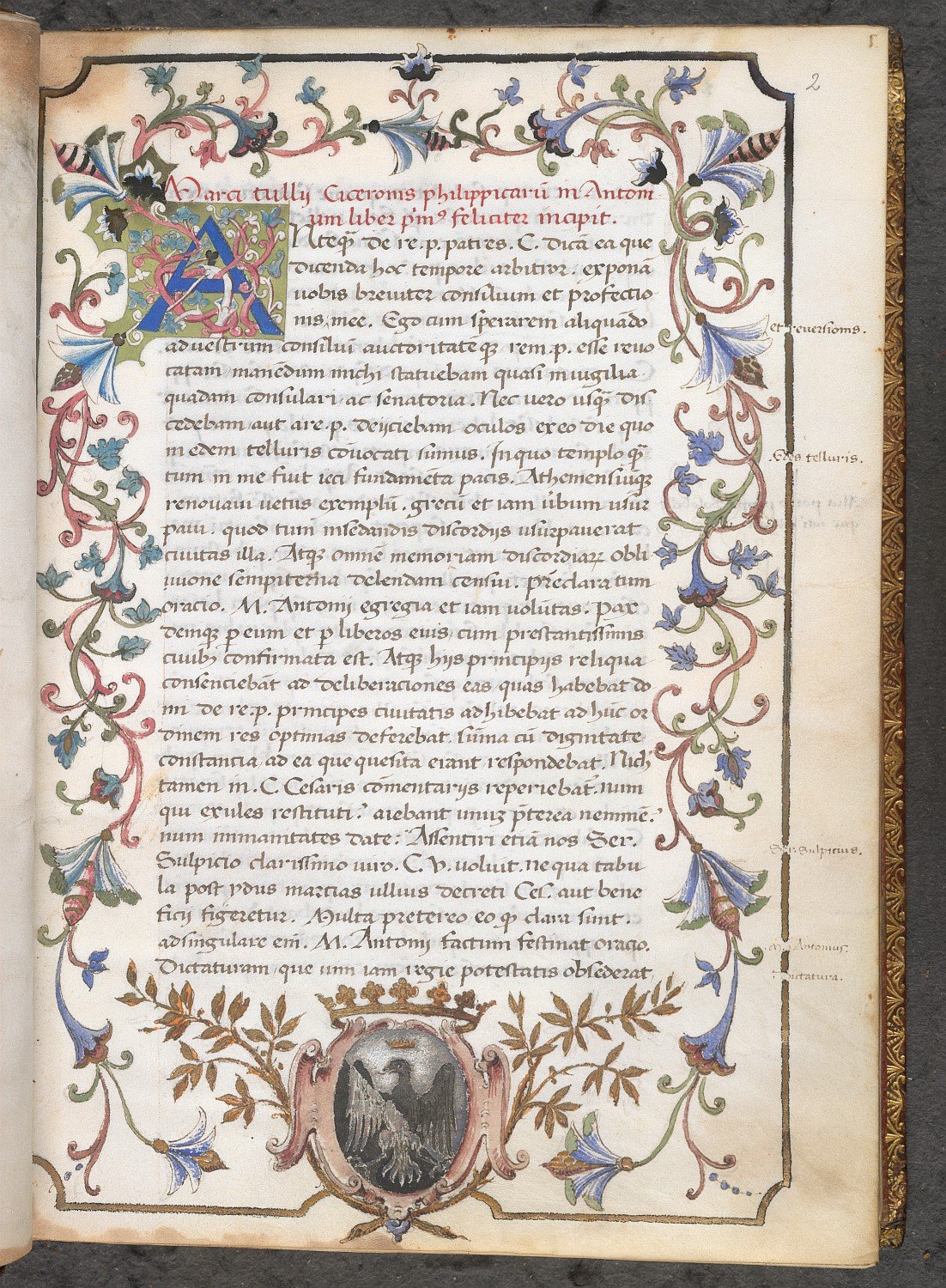
“There has been no civil war in our state which I can remember in which, regardless of which side was victorious, there was not some hope for a government in the future. In this conflict, however, I could not easily confirm what government we would have if we are victorious, but there will surely never be another if we lose.
This is why I put forth harsh legislation against Antony and Lepidus too, not so much for the sake of vengeance as to frighten the lawless citizens among us from besieging their own country and to prepare for posterity a reason why no one should desire to emulate such insanity.
Although this idea certainly was not more mine than everyone’s, in one way it seems cruel: the fact that children, who have earned none of this, suffer the same punishment as their parents. But this is an ancient practice which has existed in every kind of state. Even the children of Themistocles lived in deprivation! If the same penalty attends citizens condemned in court, how could we possibly be easier against our enemies? And what can anyone complain about me when he would have to admit that if he had defeated me he would have treated me worse?”
nullum enim bellum civile fuit in nostra re publica omnium quae memoria mea fuerunt, in quo bello non, utracumque pars vicisset, tamen aliqua forma esset futura rei publicae: hoc bello victores quam rem publicam simus habituri non facile adfirmarim, victis certe nulla umquam erit. dixi igitur sententias in Antonium, dixi in Lepidum severas, neque tam ulciscendi causa quam ut et in praesens sceleratos civis timore ab impugnanda patria deterrerem et in posterum documentum statuerem ne quis talem amentiam vellet imitari. quamquam haec quidem sententia non magis mea fuit quam omnium. in qua videtur illud esse crudele, quod ad liberos, qui nihil meruerunt, poena pervenit. sed id et antiquum est et omnium civitatum, si quidem etiam Themistocli liberi eguerunt. et si iudicio damnatos eadem poena sequitur civis, qui potuimus leniores esse in hostis? quid autem queri quisquam potest de me qui si vicisset acerbiorem se in me futurum fuisse confiteatur necesse est?
Siege of Montargis. Chroniques de France ou de Saint Denis (from 1422 to 1460) France, N. (Calais?); 1487. ff. 1-299v. British Library, Royal 20 E VI f. 22
And I have the unbearable feeling that my entire life won’t be enough to remove this drop from my soul.
And the thought haunts me that if I was burnt alive, this persistent moment would be surrendered last.
G. Seferis, London, June 5th, 1932
Κι έχω το ασήκωτο συναίσθημα πως ολόκληρη η ζωή που μου απομένει δε θα ‘ναι
αρκετή για να καταλύσει αυτή τη στάλα μέσα στην ψυχή μου.
Και με καταδιώκει η σκέψη πως αν μ’ έκαιγαν ζωντανό
αυτή η επίμονη στιγμή θα παραδινότανε τελευταία.
Gregory Buchakjian, Sursock Palace after the 4 August blast, 2020, photograph
“We were waiting for the apocalypse and the apocalypse finally came”. Those were the words of Gregory, the Lebanese art historian and photographer with whom I’ve corresponded for almost a decade, during which admiration gave way to friendship, and finally to complicity. He is locked in his apartment on Abdul Aziz street in Beirut, or at his parents’ home in the mountains near the city, avoiding the infernal traffic and the visual field where all the catastrophes of history blend with garbage, with tar, and with the vision of the Last Things. After that spectacular explosion that changed Lebanon forever, and partially destroyed forty percent of Beirut, with their homes shattered, people had to flock into the streets, to reclaim the city, to protest, to scream, to weep, to supplicate, to deny, to fight. There are some moments in history in which certain things can be done only collectively, even if they produce absolutely no result; this was one of those moments. It is necessary to bury Polynices’ body, even if it’s forbidden by law on punishment of death, and the tragic heroine is a whole city, dressed in its rubble.
The death penalty seems like an immaterial punishment in a situation like this; for in Beirut death wouldn’t mean to cross the threshold towards the indeterminate, but rather and simply, a change of position within the same chessboard, without entry or exit permits. Gregory has spent the last ten years photographing the abandoned houses of Beirut, or at least those that have survived not only the wars (there have been a few of them), but also the reconstructions, restorations, or simply time itself. And that photographic labor, that at first dealt with a historical document, has become an obsession, a terrifying desire, and a species of invasive archaeology, hunting ghosts, recollecting their personal objects, and speculating about the past, as if it were possible this way, to rectify the present without canceling it altogether. All those who seek the truth are punished by the gods with doubt, that little fragment of discrepancy, in which the scientific method and theology meet face to face, for just one second.
After ten years (even though he had been photographing Beirut since his teens in the 1980s, during the first years of the civil war), this passion became a doctoral thesis at the Sorbonne in Paris, a book and two museum exhibitions. Then, the photographer, lost in his own distance from the images, has become also a forensic investigator. The corpse is always unprepared, and the circumstances of death unknown. Sometimes, shocking events take place: The dead rises to his feet while the autopsy is in course, and while his condition of being ‘alive’ is immediately recognized, it is also well known that he will never recover, and his identity cannot be verified – the state of decomposition is very advanced. How can matter decompose while being still alive? The generic term life seems to encompass an infinite number of contradictions between biology, inorganic chemistry and historical experience. This isn’t about a loss of memory, for memories are never lost, but they can become so disarrayed to a point where continuity and coherence are lost.
A week after the explosion, Joana, another Lebanese artist and filmmaker, writes me from her shattered apartment in the neighborhood of Achrafiyeh, to say that she and her husband Khalil, survived miraculously without as little as a minor wound, but that they’re not really alive. How to differentiate between architecture, images, the body, living matter and rubble? When we say that everything else has been destroyed, it’s impossible to specify what do we mean by ‘everything’; in the absence of referents that place rational limits on reality, it’s no longer practical to classify particulars and universals as taxonomic categories. Brick dust and molten metal contain all the states of matter. In a video that Gregory produced with Valérie, his friend and companion in the journey of photography, work which resembles more an elegy to the fragment, to loss and disappearance, they meticulously organize and classify personal objects found in the houses. Gregory reads aloud from a found letter: “I shall miss the Orient all my life… People say I live in the past.”
Traveling from Occident to Orient, as metaphor and possibility, every day at dusk, I ride on a ferry boat, from Rumelia, the further corner of southern Europe, towards Anatolia, the Mediterranean border of the Orient with Europe. While on the ferry, I watch Gregory’s video on repeat every day. But it’s not a long journey, it takes not even 20 minutes, and we are still inside the same city: Istanbul. It’s a city larger than some small countries, and with a population more or less as big as Chile’s (some twenty million souls survive in this irregular and viscous space), and here it’s not possible to speak of history proper, except in extremes: Either a ridiculous and touristic version of history, that Turks themselves do not believe but to which they’re condemned, or the other version that is an interminable series of catastrophes and miseries – it’s impossible to count them all, there are not enough numbers. How to tell here the time, date, day and hour? One can leave the house casually to go somewhere and end up in some other day, another era, in some other life.
And since life itself doesn’t really work out here, because there’s too much bureaucratic paperwork for the twenty million souls, we have begun to believe in miracles. Not in the great miracles, like those of Jesus Christ, but in the very tiny ones: Every day you’re grateful that gravity still exists, and that amidst all this chaos, all this hate, all this disarray, all this cruelty, this motherfucking city hasn’t just fallen into the water, killing us all instantly. The city has tried to kill herself in all possible forms – conquests, fires, earthquakes, crises, recessions and evil winds, but nothing has worked out. Half mythological creature, half prostitute, this is a city that carries really deep wounds, but is at the same time immortal and sadly invincible. For all of these reasons, she doesn’t understand history or time, and she’s not even interested. Everything seems to her a foolish game, like an Aegean mermaid, diverting sailors lost at sea, or driving them to madness. But the history of the Homeric mermaids doesn’t end well; some medieval scholia say that they jumped to their deaths after Odysseus’ escape.
Valérie Cachard and Gregory Buchakjian, Abandoned Dwellings. Archive, 2018. Still from film. Cinematography: Malek Hosni.
I know all of this might sound very romantic, but the result is usually something very mediocre – a love without limits or horizons, is also a feeling without specific content, and without concrete promises to anchor it in the present. Everything happens in the optative mode of the verb. There’s a myth that goes like this: When the colonizers from Megara, a city in Ancient Greece, consulted the Delphic oracle, at Apollo’s temple, the Pythia warned them not to go to Byzantion (the first artistic name of Istanbul, in Archaic Greece), because the place was cursed. They didn’t listen though, and went on to found the city. But it’s also possible I’m making up this story or greatly exaggerating it, based on a misunderstanding of a Persian account. The important detail is that for a city so capricious and amnesiac, her greatest disgrace is being a prisoner of history. Sometimes it seems as if this weren’t a real city; its beauty is unbearable, exaggerated, terrifying, impalpable. That’s why she’s always threatened with destruction and bombarded with infernal skyscrapers.
When speaking about history, therefore, Turks are really bad, they only tells lies and slander. The more natural version of what is known as history, is the intrigue and the rumor, which they probably learnt from the Byzantines, great experts in gossip, conspiracy and self-destruction. Time here is completely out of joint, and it already was eight years ago when I arrived in this country as a temporary visitor, en route to some other country, and I ended up stranded like many Syrians, Afghans and Iranians. In those days, when this was a rich country (that also turned out to be a lie), there was a rage in the streets, so desperate, that I was surprised I didn’t get poisoned by breathing the same air as them. But then the protests began in 2013, and since then, we have lived in something similar to a diet version of hell: with room service, currency exchange and stunningly beautiful views of the city, when you stand on fashionable rooftops, posing like fine people, parading yourself on the catwalk of amnesia, enjoying the sunsets.
Hell here is not a metaphor for fire, or even for suffering, it’s more about the interminability of everything that is taking place. The pandemic took us by surprise, but not too much. People are so used to bad news, and they know how to fall on all four without getting hurt too much. The curfews and states of emergency were well known, from the military dictatorship in the 1980s to the self-coup in 2016, and in a city of this enormous size, you have always been alone, and it’s difficult to forge lasting friendships in an atmosphere of so much paranoia and lack of trust. Locked in the house, we began to drink, and to accumulate bottles of wine to mark the passage of time, since the clock no longer had any use. But that experience of being outside of history is not new. That’s why I find it funny when they speak of the end of the world (or capitalism), the end of history, the end of time. The world never ends, insofar as human conversations continue, and time is a temporal structure, not only in the sense of pure time but also of permanence.
Hera Büyüktaşçıyan, Neither in the Sky nor on the Ground, IFA, Berlin, 2019, photograph by the author
Biblical literature leaves us precise instructions: Time will not last. So in that sense, the end of history is a thesis as ridiculous as the death of God, how can something end of which we have no certainty whether it ever began? If by history we mean the veracity of historiographic accounts, then we are in trouble. But if this refers to the historical experience of human beings, to the conscience of historical contingence, all these concepts are very new and it could be very well possible that history is just beginning. The end of history is the experience of a kind of void, the inability to conceive the future, so that we return to the past obsessively, in order to rebuild it, hoping that this may eventually reorganize the future. But this strategy always ends very bad for Istanbul. When they were building one of the metro lines near the old city, the excavations lasted for a few years and when they reached the layer of the sixth millennium BC, they decided to stop. It’s impossible to live with so much rubble, with so many broken vases. A famous archaeologist used to say that sometimes you find so many things buried in this city, that you need to bury them again in order to continue living.
One of the happiest days of my life was the end of the pandemic lockdowns, and then we got on a ferry to travel to the Princes Islands with Greek artists Mirsini and Mairi who had spent a few months quarantined in the city during an artist residency and who had never seen the islands before. There we walked a few kilometers between the sun and the Marmara sea on the island of Halki, until we reached the monastery of Terk-i Dünya that is translated as “Abandon the world!” (in imperative), and on a certain corner, where there is an eternal tree, quite magical, I directed a long gaze at the infinite blue. I toyed with the idea that some kind of freedom was still possible. But the history of this place is also sad: The islands were places of exile during the Byzantine period, and that tradition continued during the Ottoman empire, at the same time that the monastic foundations began to wither and the islands became summer residences for the elite, and eventually, a district for minorities – Greeks, Armenians, Jews. But then the massacres began again, the exiles, the expropriations, the deep burials, the rotten wood, the lost memory.
Here you need to forget everything, if you want to live even one day. But we don’t want to forget. And that’s why I need to return to Joana: A few years ago, she and Khalil traveled to Izmir, an ancient city on the coast of the Asia Minor in Turkey, on the Aegean Sea, to make a film with the writer Etel Adnan, about the exile of the Greeks of Anatolia that arrived in Beirut in the year 1922 (including Joana’s grandfather). They became very curious about the many headless Greek and Roman statues at the archaeological museum, and they documented them carefully to utilize the footage at a later date.
Terk-i Dünya, Halki, Istanbul, June 2020, photograph by the author
During the pandemic lockdown in Paris, Joana and Khalil assembled the images into an spectacular video on the background of which a fragment of a poem of Seferis (one of the great Greek poets of the 20th century, who was also born in the Izmir area) is read aloud:
They were telling us you will win once you surrender.
We surrendered and found ashes.
…
They were telling us once you abandon your life, you will win.
We abandoned our life and found ashes.
G. Seferis, London, June 5th, 1932
Μας έλεγαν θα νικήσετε όταν υποταχτείτε.
Υποταχτήκαμε και βρήκαμε τη στάχτη.
…
Μας έλεγαν θα νικήσετε όταν εγκαταλείψετε τη ζωή σας.
Εγκαταλείψαμε τη ζωή μας και βρήκαμε τη στάχτη.
The first time I heard about this video was in a letter from Gregory, and then I wrote to Joana…
Joana Hadjithomas & Khalil Joreige, Where is My Mind, 2020, installation views, “I Stared At Beauty So Much…”, FRAC Corsica.
My letter was sent on the 1st of August, and for a week an answer didn’t come. The 4th of August there was the massive explosion in the port of Beirut. Then a week later, Joana understood my letter as if it had been sent after the explosion… and after finally seeing the video, I also found only ashes. The ashes of the rubble of Beirut.
A year prior, I myself traveled to Izmir, and was also moved by the headless statues, and documented them as well. Soon afterwards, I traveled to Germany to give a lecture about Seferis’ poetry, in which I used images of the statues as visual support material and metaphor for the survival of history through time, deep memory and transmission of trauma:
Our country is a closed place, all mountains
roofed over by the low sky day and night.
We have no rivers we have no wells we have no springs,
only a few underground tanks, empty too, that echo and
we treat as sacred.
G. Seferis, Mythistorima X
Ο τόπος μας είναι κλειστός, όλο βουνά
που έχουν σκεπή το χαμηλό ουρανό μέρα και νύχτα.
Δεν έχουμε ποτάμια δεν έχουμε πηγάδια δεν έχουμε πηγές,
μονάχα λίγες στέρνες, άδειες κι αυτές, που ηχούν και που
τις προσκυνούμε.
This lecture performance was part of an exhibition in Berlin about the history of Pergamon (with reference to both the ancient city and the Berlin museum) by another artist friend, Hera, who lives on the island of Halki – there I spent that precious day after the end of pandemic lockdowns. A few weeks later, in the same venue in Berlin where Hera’s exhibition took place and where I had earlier spoken, Joana and Khalil would present another video, on the intimate relationship between archaeology, architecture and the destruction from the Lebanese wars, a video which is today more pertinent than ever and that hauntingly, ends with a long aerial shot of the Port of Beirut, now destroyed.
We both remembered a future yet to arrive then, through inhabiting a space with images and words, an idea central to Hera’s delicate treatment of historical narratives across long spans of time. In the forest of time, all movements are circular, and we always return to the same starting points; that long lost gaze towards the infinite blue.
Joana Hadjithomas & Khalil Joreige, Palimpsest, 2017, still from film. Part of Unconformities.
But during the pandemic, I also found my own ashes: Locked in my apartment with Musab for a few months, I began a very long correspondence with Arca (it’s pronounced Arja) that lasted for something like half a year, in between curfews, prohibitions and lockdowns, punctuated by fear and uncertainty, even though we were at a distance of only about 7 km. And the correspondence encompassed millions of words, that always reminded me of what Joana said to me in 2017, after a major terror attack in Istanbul: “You have to remember the light!”, and in between so many letters, invented memories, fragile promises and intervals, during which life seemed more or less possible, the idea of an encounter acquired certain aura of hope.
In those moments of doubt about the reality of things that occur so naturally during an event as perplexing as a pandemic, we’re not even dealing here with love or feelings, but more with the possibility of reaffirming reality through confirming the existence of the other, who is present beyond yourself, since we don’t have an authentic history without shared memories.
It was a beautiful day in October, when the encounter finally took place in an almost cinematic set: The rays of sunlight filtered through the trees, moving back and forth slowly with the fresh breeze of the end of summer, followed by many hours of casual conversations, without any trajectory – time disappeared until sunset. And that was the last time. The next letter remains unanswered, it turned to ashes.
Lives are complicated, the histories, the bets of luck and chance, the crossed destinies, the fears, and above all, the feeling of having lost the world to a certain degree. We have only fragments left. At the end of the video with Seferis, another part of the poem:
It remains to find our life again,
Now that we have nothing left anymore.
G. Seferis, London, June 5th, 1932
Μένει να ξαναβρούμε τη ζωή
μας, τώρα που δεν έχουμε πια τίποτα.
But there’s another fragment of the poem that Joana and Khalil didn’t include:
I imagine that he who will find life again, out of so many papers, so many feelings, so many disputes, so many lessons, he will be someone like us, only less forgiving in memory.
G. Seferis, London, June 5th, 1932
Φαντάζομαι, εκείνος που θα ξανάβρει τη ζωή, έξω από τόσα χαρτιά, τόσα
συναισθήματα, τόσες διαμάχες και τόσες διδασκαλίες, θα είναι κάποιος σαν εμάς,
μόνο λιγάκι πιο σκληρός στη μνήμη.
Notes and letters, March-October 2020, photograph by the author
And like this the apocalypse came to pass, and passed. Without having told him the story of Arca, I wrote to Gregory a few days ago: “I don’t think there’s a viable way to ‘fix’ our lives at this point. But we have to re-inscribe them poetically, I think this is what Joana meant by ‘Remember the light!’”. And also like this, we return to the starting point, within the same history, like our cities, like the ashes of our cities. We have to find again our freedom, in the metaphysical and in the political sense (we’ve lost even the freedom of movement).
On that same week, I wrote to Nektaria, a Greek writer from Istanbul: “Nobody is condemned to history, to time, to the circumstances. One can always break free. Freedom is really hard, you fall all the time, there’s so much vertigo, it’s mostly a series of accidents and errors, but there’s just no other way.” Nektaria had published recently a novel about Daphne, a Greek-American woman traveling to modern day Istanbul in search of her roots. She had signed a copy of the novel for Arca’s birthday, a few weeks in advance, and that I brought with me to those spectacular hours among the wallowing trees. Is our eviction from the world perhaps a punishment for having constantly violated the rules of time?
As Joana told me in an interview in 2016: “When you superimpose so many temporalities, so many images, little by little there is a kind of duplicity, so you have many suns appearing. Things were happening to some people; this idea of multiple suns when you feel this chaotic time. It’s not only what’s happening to men; it’s affecting nature, it’s affecting the universe, and it’s affecting everything.”
Back in April I was daydreaming with Arca, from the depth of the confinement: “We are still in Beirut, maybe we went to Abu Hassan for dinner, got very drunk, and you met Gregory and Joana and Khalil. It was a beautiful day.” A long human chain now connected us all: The colonizers from Megara, a Hadjithomas grandfather on a journey from Izmir to Beirut, Gregory, Joana and Khalil, Daphne’s journey on the other direction to Istanbul, Hera, Arca, and me (alongside many known and unknown others). A long human chain, connecting these two cities, through a series of long winding promises, made near the end of the world.
But still Nektaria answered with fire: “If Arca or anyone in your life feels condemned to circumstances, then perhaps he is not for you. I have heard so many people use the circumstances excuse (and I have used it myself). It’s a mirage if the person believes it and an excuse if he doesn’t. We can always be free if we choose freedom. Anything else is rubbish.”
Joana Hadjithomas & Khalil Joreige, Where is My Mind, 2020, installation views, “I Stared at Beauty So Much”, FRAC Corsica
Note: This piece was originally written in Spanish for literary magazine El Imparcial and translated into English by the author, presented here with substantial edits and additions. The text is part of the extended research of the author for the exhibition “Beirut is a Fragment”, Istanbul, April 2021. Joana Hadjithomas & Khalil Joreige’s exhibition “I Stared at Beauty So Much…” at FRAC Corsica, ran from July 7th through October 24th.
Arie Amaya-Akkermans is a writer and art critic based in Istanbul. He’s also tweeting about Classics, continental philosophy, contemporary art and Turkey/Greece.
“But in Italy they also believe that the gaze of a wolf is harmful—specifically that it will take the voice from any man they see first. Africa and Egypt have wolves that are slow and small, while the colder climates produce fierce and wild animals. We ought to believe with certainty that accounts of men turning into wolves and then back to themselves again are false; or we should be prepared to believe all the tales that are fantastic from as many generations.
Nevertheless, since the tale is popular enough that it has earned the curse-term “versepellis”, I will explain its origin. Euanthes, not unknown among Greek authors, reports that the Arcadians hold that a member of a family of a certain Anthus is selected by lot, transported to a certain lake in the region, and, after he hangs his clothes on an oak tree, he crosses the lake and enters the desert where he turns into a wolf and joins with others of his kind for nine years.
If he keeps himself from humans for this period of time, he returns to the same lake and once he has crossed it regains his form, except that nine years of age have accumulated. Fabius adds to this tale that he also regains his clothing. It is amazing how far Greek gullibility will go! There is no lie so shameful that it will lack partisans.
Similarly, the author Apollas who wrote the Olympionics, claims that Demaenetus of Parrhasia, when the Arcadians were still performing human sacrifices to Jupiter Lycaeus, sampled the entrails of a child who had been sacrificed, and transformed into a wolf. That same man transformed back 10 years later, became an athlete, and returned to the Olympic games as a victor.
It is also believed that there is a thin tip of hair on the tail of this animal which acts as an aphrodisiac—when the animal is caught, it has no force unless it is plucked while the animal is still alive.”
Sed in Italia quoque creditur luporum visus esse noxius vocemque homini, quem priores contemplentur, adimere ad praesens. inertes hos parvosque Africa et Aegyptus gignunt, asperos trucesque frigidior plaga. homines in lupos verti rursusque restitui sibi falsum esse confidenter existimare debemus aut credere omnia quae fabulosa tot saeculis conperimus. unde tamen ista vulgo infixa sit fama in tantum, ut in maledictis versipelles habeat, indicabitur.
Euanthes, inter auctores Graeciae non spretus, scribit Arcadas tradere ex gente Anthi cuiusdam sorte familiae lectum ad stagnum quoddam regionis eius duci vestituque in quercu suspenso tranare atque abire in deserta transfigurarique in lupum et cum ceteris eiusdem generis congregari per annos VIIII. quo in tempore si homine se abstinuerit, reverti ad idem stagnum et, cum tranaverit, effigiem recipere, ad pristinum habitum addito novem annorum senio. id quoque adicit, eandem recipere vestem.
mirum est quo procedat Graeca credulitas! nullum tam inpudens mendacium est, ut teste careat. item Apollas, qui Olympionicas scripsit, narrat Demaenetum Parrhasium in sacrificio, quod Arcades Iovi Lycaeo humana etiamtum hostia facebant, immolati pueri exta degustasse et in lupum se convertisse, eundem X anno restitutum athleticae se exercuisse in pugilatu victoremque Olympia reversum.
quin et caudae huius animalis creditur vulgo inesse amatorium virus exiguo in villo eumque, cum capiatur, abici nec idem pollere nisi viventi dereptum.
This popped into my mind for no particular reason.
μύκης, μύκητος: “mushroom”…2. membrum virile
Herodian. Anecd. Ox. iii.231.5 = Archilochus 252
“Mushroom: can also mean a man’s genitals—which is what Archilochus says when he presents it with the same number of syllables: “The tendons of my ‘mushroom’ were ruptured.”
Beekes, Etymological Dictionary of Ancient Greek 2010
Dio Cassius, Rom. Hist. Ep. 41
“Nero has also left for us a saying worth remembering. For he used to say that mushrooms were food of the gods because [Claudius] became a god thanks to a mushroom”
“The young daughter of Pausanias ate a raw mushroom and felt nausea, choking, and stomach pain. Drinking warm melicrêt and puking relieved her along with a warm bath. She puked up the mushroom in the bath and she sweated while she was getting better”
The Second Philippic, though technically perfect, is not a political oration, for it was never delivered: it is an exercise in petty rancour and impudent defamation like the invectives against Piso. The other speeches against Antonius, however, may be counted for vigour, passion and intensity, among the most splendid of all the orations. But oratory can be a menace to posterity as well as to its author or its audience. There was another side – not Antonius only, but the neutrals. Cicero was not the only consular who professed to be defending the highest good of the Roman People. The survival of the Philippics imperils historical judgment and wrecks historical perspective.