Many Meanings for Many-Wayed

A re-post in honor of Odyssey Round the World

Homer, Odyssey, 1.1

“Sing to me, Muse, of the man of many ways…”

῎Ανδρα μοι ἔννεπε, Μοῦσα, πολύτροπον, ὃς μάλα πολλὰ

Scholia Od ad 1.1

“The problem: Polytropos [“many-wayed”] Antisthenes claims that Homer doesn’t praise Odysseus as much as he criticizes him when he calls him polytropos. He didn’t make Achilles and Ajax polytropoi, but they were direct [‘simple’] and noble. Nor did he make Nestor the wise tricky, by Zeus, and devious in character—he simply advised Agamemnon and the rest and if he had anything good to counsel, he would not stand apart keeping it hidden; in the manner Achilles showed that he believed the man the same as death “who says one thing but hides another in his thoughts.”

᾿Απορία. πολύτροπον] οὐκ ἐπαινεῖν φησιν ᾿Αντισθένης ῞Ομηρον τὸν ᾿Οδυσσέα μᾶλλον ἢ ψέγειν, λέγοντα αὐτὸν πολύτροπον. οὐκ οὖν τὸν ᾿Αχιλλέα καὶ τὸν Αἴαντα πολυτρόπους πεποιηκέναι, ἀλλ’ ἁπλοῦς καὶ γεννάδας· οὐδὲ τὸν Νέστορα τὸν σοφὸν οὐ μὰ Δία δόλιον καὶ παλίμβολον τὸ ἦθος, ἀλλ’ ἁπλῶς τε ᾿Αγαμέμνονι συνόντα καὶ τοῖς ἄλλοις ἅπασι, καὶ εἰς τὸ στρατόπεδον εἴ τι ἀγαθὸν εἶχε συμβουλεύοντα καὶ οὐκ ἀποκρυπτόμενον τοσοῦτον ἀπεῖχε τοιοῦτον τρόπον ἀποδέχεσθαι ὁ ᾿Αχιλλεὺς ὡς ἐχθρὸν ἡγεῖσθαι ὁμοίως τῷ θανάτῳ ἐκεῖνον “ὅς χ’ ἕτερον μὲν κεύθει ἐνὶ φρεσὶν, ἄλλο δὲ εἴπῃ” (Il. ι, 313.).

“Antisthenes in interpreting this asks “why, then, is wretched Odysseus called polytropos? Really, this is the way to mark him out as wise. Isn’t it true that his manner never indicates his character, but that instead it signals his use of speech? The man who has a character difficult to penetrate is well-turned. These sorts of inventions of words are tropes/ways/manners

λύων οὖν ὁ ᾿Αντισθένης φησὶ, Τί οὖν; ἆρά γε πονηρὸς ὁ ᾿Οδυσσεὺς ὅτι πολύτροπος ἐκλήθη; καὶ μὴν διότι σοφὸς οὕτως αὐτὸν προσείρηκε. μήποτε οὖν ὁ τρόπος τὸ μέν τι σημαίνει τὸ ἦθος, τὸ δέ τι σημαίνει τὴν τοῦ λόγου χρῆσιν; εὔτροπος γὰρ ἀνὴρ ὁ τὸ ἦθος ἔχων εἰς τὸ εὖ τετραμμένον· τρόποι δὲ λόγων αἱ ποιαὶ πλάσεις.

Schol. ad Demosthenes. Orat. 20

“For a man of many ways changes himself in accordance with the nature of the matters at hand.”

πολύτροπος γὰρ ὁ ἀνὴρ καὶ πρὸς τὴν τῶν πραγμά-των φύσιν συμμεταβάλλεται.

Plato, Hippias Minor 366a

Soc. “People who are many-wayed are deceptive because of their foolishness and thoughtlessness, or because of wickedness and some thought?

Hippias: Most of all, because of wickedness and intelligence.

Soc. So, it seems, they are really intelligent.

Hip. Yes, by Zeus, wicked smart.

Soc. And men who are smart—are they ignorant of what they do or do they understand it?

Hip. They really understand what they are doing. For this reason, they also do evil.

Soc. So, is it the ignorant or the wise who know these things which they understand?

Hip. The wise know these very things, how to deceive.

—ΣΩ. Πολύτροποι δ’ εἰσὶ καὶ ἀπατεῶνες ὑπὸ ἠλιθιότητος καὶ ἀφροσύνης, ἢ ὑπὸ πανουργίας καὶ φρονήσεώς τινος;

—ΙΠ. ῾Υπὸ πανουργίας πάντων μάλιστα καὶ φρονήσεως.

—ΣΩ. Φρόνιμοι μὲν ἄρα εἰσίν, ὡς ἔοικεν.

—ΙΠ. Ναὶ μὰ Δία, λίαν γε.

—ΣΩ. Φρόνιμοι δὲ ὄντες οὐκ ἐπίστανται ὅτι ποιοῦσιν, ἢ ἐπίστανται; —

—ΙΠ. Καὶ μάλα σφόδρα ἐπίστανται· διὰ ταῦτα καὶ κακουργοῦσιν.

—ΣΩ. ᾿Επιστάμενοι δὲ ταῦτα ἃ ἐπίστανται πότερον ἀμαθεῖς εἰσιν ἢ σοφοί;

—ΙΠ. Σοφοὶ μὲν οὖν αὐτά γε ταῦτα, ἐξαπατᾶν.

Pseudo-Phocylides, Sententiae

“Don’t trust the people;  the mob is many-wayed. For the people, water, and fire are all uncontrollable things.”

Λαῶι μὴ πίστευε, πολύτροπός ἐστιν ὅμιλος· λαὸς <γὰρ> καὶ ὕδωρ καὶ πῦρ ἀκατάσχετα πάντα.

Hesychius

Polytropos: One who [is turned] toward many things; or, someone who changes his understanding at each opportune moment.”

πολύτροπος· ὁ ἐπὶ πολλὰ τρεπόμενος, ἢ τρέπων τὴν ἑαυτοῦ διάνοιαν ὑφ’ ἕνα καιρόν

Schol HM 1.1 ex 62-74 (Attributed to Porphyry)

“If wise men are clever at speaking to others, then they also know how to speak the same thought in different ways; and, because they know the many different ways of words about the same matter. And if wise men are also good, then this is reason Homer says that Odysseus who is wise is many-wayed: he knew how to engage with people in many ways.

Thus Pythagoras is said to have known the right way to address speeches to children, to make those addresses appropriate for women to women, those fit for leaders to leaders, and those appropriate for youths to youths. It is a mark of wisdom to find the manner best for each group of people; and it is a mark of ignorance to use a single type of address toward people who are unaccustomed to it. It is the same for medicine in the successful use of its art, which fits the many-wayed nature of therapy through the varied application to those who need assistance. This manner of character is unstable, much-changing.

Many-wayedness of speech is also a finely crafted use of language for different audiences and it becomes single-wayed. For, one approach is appropriate to each. Therefore, fitting the varied power of speech to each, shaping what is proper to each for the single iteration, makes the many-wayed in turns single in form and actually ill-fit to different types of audiences, rejected by many because it is offensive to them.

εἰ δὲ οἱ σοφοὶ δεινοί εἰσι διαλέγεσθαι, καὶ ἐπίστανται τὸ αὐτὸ νόημα κατὰ πολλοὺς τρόπους λέγειν· ἐπιστάμενοι δὲ πολλοὺς τρόπους λόγων περὶ τοῦ αὐτοῦ πολύτροποι ἂν εἶεν. εἰ δὲ οἱ σοφοὶ καὶ ἀγαθοί εἰσι, διὰ τοῦτό φησι τὸν ᾿Οδυσσέα ῞Ομηρος σοφὸν ὄντα πολύτροπον εἶναι, ὅτι δὴ τοῖς ἀνθρώποις ἠπίστατο πολλοῖς τρόποις συνεῖναι. οὕτω καὶ Πυθαγόρας λέγεται, πρὸς παῖδας ἀξιωθεὶς ποιήσασθαι λόγους, διαθεῖναι πρὸς αὐτοὺς λόγους παιδικούς, καὶ πρὸς γυναῖκας γυναιξὶν ἁρμοδίους, καὶ πρὸς ἄρχοντας ἀρχοντικούς, καὶ πρὸς ἐφήβους ἐφηβικούς. τὸ γὰρ ἑκάστοις πρόσφορον τρόπον ἐξευρίσκειν σοφίας εἶναι, ἀμαθίας δὲ τὸ πρὸς τοὺς ἀνομοίως ἔχοντας τῷ τοῦ λόγου χρῆσθαι μονοτρόπῳ. ἔχειν δὲ τοῦτο καὶ τὴν ἰατρικὴν ἐν τῇ τῆς τέχνης κατορθώσει, ἠσκηκυῖαν τῆς θεραπείας τὸ πολύτροπον, διὰ τὴν τῶν θεραπευομένων ποικίλην σύστασιν. τρόπος μὲν οὖν τὸ παλίμβολον τοῦτο τοῦ ἤθους, τὸ πολυμετάβολον. λόγου δὲ πολυτροπία καὶ χρῆσις ποικίλη λόγου εἰς ποικίλας ἀκοὰς μονοτροπία γίνεται. ἓν γὰρ τὸ ἑκάστῳ οἰκεῖον· διὸ καὶ τὸ ἁρμόδιον ἑκάστῳ τὴν ποικιλίαν τοῦ λόγου εἰς ἓν συναγείρει τὸ ἑκάστῳ πρόσφορον, τὸ δ’ αὖ μονοειδές, ἀνάρμοστον ὂν πρὸς ἀκοὰς διαφόρους, πολύτροπον ποιεῖ τὸν ὑπὸ πολλῶν ἀπόβλητον ὡς αὐτοῖς ἀπότροπον λόγον. H M1 Q R

Image result for Ancient Greek Odysseus

Tawdry Tuesday: What Did the Greeks Eat and Screw for 10 Years at Troy?

Students often complain about the lack of verisimilitude in the heroic diet–even though the Odyssey  mentions that Odysseus’ companions fish and hunt birds before they kill the cattle in Thrinacia, students find something odd about a diet of meat, bread and wine.

Apparently ancient comic poets did too–and they were concerned about the reality of heroic sexual habits as well. Obviously, as the beginning of book 1 of the Iliad makes clear, eligible ladies were not in excess supply.

[Warning: this next passage is a little, well, explicit]
Athenaeus, Deipnosophists 1.46

“Sarpedon makes it clear that they ate fish when he says that being captured is similar to hunting with a fishing net. In the comic charm, Eubolos also says jokingly:

Where dies Homer say that any of the Achaeans
Ate fish? They only ever roast meat—he never has
Anyone of them boil it at all!
And not a one of them sees a single prostitute—
They were stroking themselves for ten years!
They knew a bitter expedition, those men who
After taking a single city went back home
With assholes much wider than the city they captured.

The heroes also didn’t allow freedom to the birds in the air, but they set snares and nets for thrushes and doves. They practices for bird hunting when they tied the dove to the mast of the ship and shot arrows at it, as is clear from the Funeral Games. But Homer leaves out their consumption of vegetables, fish and birds because of gluttony and because cooking is inappropriate, he judged it inferior to heroic and godly deeds.”

prostitute
The Achaeans did not have this option…

ὅτι δὲ καὶ ἰχθῦς ἤσθιον Σαρπηδὼν δῆλον ποιεῖ (Ε 487), ὁμοιῶν τὴν ἅλωσιν πανάγρου δικτύου θήρᾳ. καίτοι Εὔβουλος κατὰ τὴν κωμικὴν χάριν φησὶ παίζων (II 207 K)·

ἰχθὺν δ’ ῞Ομηρος ἐσθίοντ’ εἴρηκε ποῦ
τίνα τῶν ᾿Αχαιῶν; κρέα δὲ μόνον ὤπτων, ἐπεὶ
ἕψοντά γ’ οὐ πεποίηκεν αὐτῶν οὐδένα.
ἀλλ’ οὐδὲ μίαν ἀλλ’ ἑταίραν εἶδέ τις
αὐτῶν, ἑαυτοὺς δ’ ἔδεφον ἐνιαυτοὺς δέκα.
πικρὰν στρατείαν δ’ εἶδον, οἵτινες πόλιν
μίαν λαβόντες εὐρυπρωκτότεροι πολὺ
τῆς πόλεος ἀπεχώρησαν ἧς εἷλον τότε.

οὐδὲ τὸν ἀέρα δ’ <οἱ> ἥρωες τοῖς ὄρνισιν εἴων ἐλεύθερον, παγίδας καὶ νεφέλας ἐπὶ ταῖς κίχλαις καὶ πελειάσιν ἱστάντες. ἐγυμνάζοντο δὲ πρὸς ὀρνεοθηρευτικὴν [καὶ] τὴν πελειάδα τῇ μηρίνθῳ κρεμάντες ἀπὸ νηὸς ἱστοῦ καὶ τοξεύοντες ἑκηβόλως εἰς αὐτήν, ὡς ἐν τῷ ἐπιταφίῳ δηλοῦται (Ψ 852). παρέλιπε δὲ τὴν χρῆσιν τῶν λαχάνων καὶ ἰχθύων καὶ τῶν ὀρνίθων διά τε τὴν λιχνείαν καὶ προσέτι τὴν ἐν ταῖς σκευασίαι ἀπρέπειαν, ἐλάττω κεκρικὼς ἡρωικῶν καὶ θείων ἔργων.

How “Long” From Sparta to Pylos? Time and Distance in the Odyssey

A re-post in honor of Odyssey ‘Round the World.

In the Odyssey Telemachus goes from Ithaka to Sparta (via Pylos) and back. When he travels in both directions, he makes a stop for the night in a scene that I think most of us often forget:

Od. 15.185-188 (=3.486-490)

“All day long they shook the yoke around their necks.
The sun set and the wide ways were shadowed.
They arrived at Phêrai, the home of Diokles,
The son of Ortilokhos, the child whom Alpheios fathered.
There they spent the night and he gave them guest-gifts.”

οἱ δὲ πανημέριοι σεῖον ζυγὸν ἀμφὶς ἔχοντες.
δύσετό τ’ ἠέλιος σκιόωντό τε πᾶσαι ἀγυιαί·
ἐς φηρὰς δ’ ἵκοντο Διοκλῆος ποτὶ δῶμα,
υἱέος ᾿Ορτιλόχοιο, τὸν ᾿Αλφειὸς τέκε παῖδα.
ἔνθα δὲ νύκτ’ ἄεσαν, ὁ δὲ τοῖς πὰρ ξείνια θῆκεν.

Though he stops at this town twice, we get very little information about it from the epic itself. The scholia do provide some information:

Scholia HQ Ad Od. 15.186-193:

“Phêrai: the name of a town in Laconia. The journey from Sparta to Phêrai is one day; and it is nearly another day from Phêrai to Pylos… This is the same night that Odysseus sleeps at Eumaios’ place.”

ἐς Φηρὰς] διὰ τοῦ η τὴν πόλιν τὴν Λακωνικήν. H. ἀπὸ Λακεδαιμονίας ἕως Φηρᾶς ἡμέρας ὁδὸς, ἀπὸ δὲ τῆς Φηρᾶς ἄχρι καὶ Πύλου ἄλλη ἡμέρα…. Q. ταύτην πρώτην νύκτα κοιμᾶται παρὰ Εὐμαίῳ ᾿Οδυσσεύς. H

Most interesting for me here is the almost throw-away line from the scholiast that this night spent in Phêrai is the same night during which Odysseus is entertained by Eumaios. Although some scholars entertain this seriously (e.g. Olson 1995, 91ff) a more standard take is presented by De Jong in her Narratological Commentary… (2001, 588):

De Jong 2001

If we count the days from Odysseus’ return to Ithaca (when Athena leaves him to go find Telemachus (13.439-440: ἡ μὲν ἔπειτα / ἐς Λακεδαίμονα δῖαν ἔβη μετὰ παῖδ’ ᾿Οδυσῆος.), we get a slightly different timeline for the second half of the Odyssey:

Day 1
14: Odysseus goes to Eumaios, they sleep (14.523)

15: Telemachus leaves Sparta, sleeps at Diokles’ house (Simultaneous action shown in parallel)

Day 2
15.301-494: Eumaios and Odysseus dine again and talk through most of the night

15: Telemachus bypasses Pylos for his ship,(15.296-300) (Simultaneous action shown in parallel)

Day 3
15.495-500: Telemachus arrives arrives in Ithaca and goes to Eumaios’ home (16); the suitors return from their ambush; Eumaios, Telemachus and Odysseus sleep (16)

Day 4
17: Telemachus and Odysseus go to their home separately; the suitors go home to sleep (18.427-428); Penelope sleeps (19.600-604); Odysseus sleeps (20.54-55)

Day 5
20.91: Dawn comes and the suitors return; 21: The Bow; 22: Mnesterophonia; 23.342-43: They sleep

Day 6
23.345-349 Dawn comes, Odysseus wakes and goes to see his father; the second Nekyuia; Testing of Laertes; Ithacan Assembly; Final showdown

Of course, thanks to a thing called “Zielinski’s Law” (see De Jong 2001, 590 for a bibliography and Cook 2009, 148 for a brief discussion) Homerists tend not to believe that Homeric narrative shows simultaneous actions…

Who is Diokles? Why do we care if the end of the Odyssey takes 6 or 7 days? Tune in next week….

You Might Even Say It’s Good To Be King: Odysseus’ Geras

A re-post in honor of Odyssey Round the World

Odysseus on his geras, 11.174–176:

“Tell me of the father and son I left behind,
does my geras still belong to them or does some other man
already have it because they think I will not come home?”

εἰπὲ δέ μοι πατρός τε καὶ υἱέος, ὃν κατέλειπον,
ἢ ἔτι πὰρ κείνοισιν ἐμὸν γέρας, ἦέ τις ἤδη
ἀνδρῶν ἄλλος ἔχει, ἐμὲ δ’ οὐκέτι φασὶ νέεσθαι.

From Beekes 2010

geras

Telemachus on Eurymakhos, 15.518–522:

“… Eurymakhos, the shining son of sharp-minded Polyboios,
whom the Ithakans now look upon the way they would a god.
He is by far the best man remaining and the best
to marry my mother and receive my father’s geras.”

Εὐρύμαχον, Πολύβοιο δαΐφρονος ἀγλαὸν υἱόν,
τὸν νῦν ἶσα θεῷ ᾿Ιθακήσιοι εἰσορόωσι·
καὶ γὰρ πολλὸν ἄριστος ἀνὴρ μέμονέν τε μάλιστα
μητέρ’ ἐμὴν γαμέειν καὶ ᾿Οδυσσῆος γέρας ἕξειν.”

Antinoos on kingship, 1.383–387:

“Then Antinoos, the son of Eupeithes, answered him,
“Telemachus, the gods themselves have taught you
to be a big speaker and to address us boldly.
May Zeus never make you king in sea-girt Ithaca
which is your inheritance by birth.”

τὸν δ’ αὖτ’ ᾿Αντίνοος προσέφη, Εὐπείθεος υἱός·
“Τηλέμαχ’, ἦ μάλα δή σε διδάσκουσιν θεοὶ αὐτοὶ
ὑψαγόρην τ’ ἔμεναι καὶ θαρσαλέως ἀγορεύειν.
μὴ σέ γ’ ἐν ἀμφιάλῳ ᾿Ιθάκῃ βασιλῆα Κρονίων
ποιήσειεν, ὅ τοι γενεῇ πατρώϊόν ἐστιν.”

Telemachus on his geras, 1.388–398:

“Antinoos, even if you are annoyed at whatever I say,
I would still pray to obtain this should Zeus grant it.
Do you really think that this is the worst thing among people?
To be king is not at all bad. A king’s house grows rich quickly
and he is more honored himself. But, certainly, there are other kings of the Achaeans, too, many on sea-girt Ithaka, young and old,
who might have this right, since shining Odysseus is dead.
But I will be master of my household and my servants,
the ones shining Odysseus obtained for me.”

“᾿Αντίνο’, εἴ πέρ μοι καὶ ἀγάσσεαι ὅττι κεν εἴπω,
καί κεν τοῦτ’ ἐθέλοιμι Διός γε διδόντος ἀρέσθαι.
ἦ φῂς τοῦτο κάκιστον ἐν ἀνθρώποισι τετύχθαι;
οὐ μὲν γάρ τι κακὸν βασιλευέμεν· αἶψά τέ οἱ δῶ
ἀφνειὸν πέλεται καὶ τιμηέστερος αὐτός.
ἀλλ’ ἦ τοι βασιλῆες ᾿Αχαιῶν εἰσὶ καὶ ἄλλοι
πολλοὶ ἐν ἀμφιάλῳ ᾿Ιθάκῃ, νέοι ἠδὲ παλαιοί,
τῶν κέν τις τόδ’ ἔχῃσιν, ἐπεὶ θάνε δῖος ᾿Οδυσσεύς·
αὐτὰρ ἐγὼν οἴκοιο ἄναξ ἔσομ’ ἡμετέροιο
καὶ δμώων, οὕς μοι ληΐσσατο δῖος ᾿Οδυσσεύς.”

Some things to read

Elton Barker. Entering the Agôn: Dissent and Authority in Homer, Historiography and Tragedy. Oxford, 2009.

Colleen Chaston. “Three Models of Authority in the “Odyssey”.” CW 96 (2002) 3-19.

J. Halverson. “The Succession Issue in the Odyssey.” Greece and Rome 33 (1986) 119–28.

Johannes Haubold. Homer’s People: Epic Poetry and Social Formation. Cambridge: 2000.

Daniel Silvermintz. “Unravelling the Shroud for Laertes and Weaving the Fabric of the City: Kingship and Politics in Homer’s Odyssey.” Polis 21 (2004) 26-41.

“Lies That Sound Like the Truth”: 24 Hours of the Odyssey #OdysseyRTW

Aristotle, Rhetoric

“Alcidamas called the Odyssey a ‘fine mirror of human life’ ”

καλὸν ἀνθρωπίνου βίου κάτοπτρον

Odyssey 19.203

“He was like someone speaking many lies similar to the truth.”

ἴσκε ψεύδεα πολλὰ λέγων ἐτύμοισιν ὁμοῖα·

Homer, Odyssey 15.398–401

“Let us take pleasure in calling to mind each other’s terrible pains
while we drink and dine in my home.
For someone may even find pleasure among pains
when they have suffered many and gone through much.”

νῶϊ δ’ ἐνὶ κλισίῃ πίνοντέ τε δαινυμένω τε
κήδεσιν ἀλλήλων τερπώμεθα λευγαλέοισι
μνωομένω· μετὰ γάρ τε καὶ ἄλγεσι τέρπεται ἀνήρ,
ὅς τις δὴ μάλα πολλὰ πάθῃ καὶ πόλλ’ ἐπαληθῇ

Now that we have finished all of the extant Greek tragedies, we are turning to a truly epic day: 24 hours of performances of the Odyssey around the world. We will start at 4 pm EST (9 PM UK) today (December 8th) with book 1 and each book will be performed by a different group around the world, culminating  in a dramatic reading of book 24 at our usual time, 3 pm EST on Wednesday. December 9th. Check out the list of participants.

We know less about the performance of Homeric epic than we’d like to. The evidence of singers in the poems and references in works like Plato’s Ion imply that episodes of each epic were performed independently. Similar evidence supports the idea of competitive, monumental performances of the Iliad and the Odyssey at festivals like the Panathenaia. While good evidence supports a performance of the poems in a festival contest with rhapsodes working in sequence, many have also argued for a three-part performance of the Iliad, with breaks happening at thematically significant moments.

Whatever the context and length, the most salient thing of Homeric epic in performance was the presence of the audience, of people enjoying these narratives together. We can’t gather for a symposium or crowd into an amphitheater for a festival, but even remotely we can share the same words at the same time. So, for one day we invite you to escape your isolation into a worldwide community, taking the Odyssey on a global tour.

Homer, Odyssey 6.205-210

“We live at a great distance from others amid the much-sounding sea,
Far away, and no other mortals visit us.
But this man who has wandered here, who is so ill-starred,
It is right to care for him now. For all are from Zeus,
The strangers and the beggars, and our gift is small but dear to them.
Come, handmaidens, give the stranger food and drink;
Bathe him in the river, where there is shelter from the wind.”

οἰκέομεν δ’ ἀπάνευθε πολυκλύστῳ ἐνὶ πόντῳ,
ἔσχατοι, οὐδέ τις ἄμμι βροτῶν ἐπιμίσγεται ἄλλος.
ἀλλ’ ὅδε τις δύστηνος ἀλώμενος ἐνθάδ’ ἱκάνει,
τὸν νῦν χρὴ κομέειν· πρὸς γὰρ Διός εἰσιν ἅπαντες
ξεῖνοί τε πτωχοί τε, δόσις δ’ ὀλίγη τε φίλη τε.
ἀλλὰ δότ’, ἀμφίπολοι, ξείνῳ βρῶσίν τε πόσιν τε,
λούσατέ τ’ ἐν ποταμῷ, ὅθ’ ἐπὶ σκέπας ἔστ’ ἀνέμοιο.”

Translations: Will vary based on group

Odyssey 23.230-242

“So she spoke, and his longing for mourning swelled within him—
He wept holding the wife fit to his heart, a woman who knew careful thoughts.

As when the land appears welcome to men as the swim
Whose well-made ship Poseidon has dashed apart on the sea,
As it is driven by the wind and a striking wave.
Then few men flee from the grey sea to the shore
As they swim and the bodies are covered with brine on their skin,
They happily climb on the shore, escaping evil.

So welcome a sight was her husband to her as she looked upon him
And she would not pull her white arms away from his neck.”

ὣς φάτο, τῷ δ’ ἔτι μᾶλλον ὑφ’ ἵμερον ὦρσε γόοιο·
κλαῖε δ’ ἔχων ἄλοχον θυμαρέα, κεδνὰ ἰδυῖαν.
ὡς δ’ ὅτ’ ἂν ἀσπάσιος γῆ νηχομένοισι φανήῃ,
ὧν τε Ποσειδάων εὐεργέα νῆ’ ἐνὶ πόντῳ
ῥαίσῃ, ἐπειγομένην ἀνέμῳ καὶ κύματι πηγῷ·
παῦροι δ’ ἐξέφυγον πολιῆς ἁλὸς ἤπειρόνδε
νηχόμενοι, πολλὴ δὲ περὶ χροῒ τέτροφεν ἅλμη,
ἀσπάσιοι δ’ ἐπέβαν γαίης, κακότητα φυγόντες·
ὣς ἄρα τῇ ἀσπαστὸς ἔην πόσις εἰσοροώσῃ,
δειρῆς δ’ οὔ πω πάμπαν ἀφίετο πήχεε λευκώ.

Performers


Homer, Odyssey 21.407-409

“Just as a man who knows both lyre and song
easily stretches a string on a new peg
as he attaches the twisted sheep-gut to both sides
just so, without haste, Odysseus strung the great bow”

ὡς ὅτ’ ἀνὴρ φόρμιγγος ἐπιστάμενος καὶ ἀοιδῆς
ῥηϊδίως ἐτάνυσσε νέῳ περὶ κόλλοπι χορδήν,
ἅψας ἀμφοτέρωθεν ἐϋστρεφὲς ἔντερον οἰός,
ὣς ἄρ’ ἄτερ σπουδῆς τάνυσεν μέγα τόξον ᾿Οδυσσεύς.

Cast And Crew

Artistic Director: Paul O’Mahony (Out of Chaos Theatre)
Director of Outreach: Amy Pistone (Gonzaga University)
Dramaturg: Emma Pauly
Executive Producer: Lanah Koelle (Center for Hellenic Studies); help from Madeleine Cahn

Producers: Keith DeStone (Center for Hellenic Studies), Hélène Emeriaud, Janet Ozsolak, and Sarah Scott (Kosmos Society)
Poster Artist: John Koelle
Poster Designer: Allie Marbry (Center for Hellenic Studies)

Odyssey 5.488-493

“Just as when someone hides a firebrand in black ash
On the farthest edge of the wilderness where there are no neighbors
And saves the seed of fire when there is no other way to kindle it,
Just so Odysseus covered himself in leaves. Then Athena
Poured sleep over his eyes so he might immediately rest
From his exhausting toil, once she closed his dear lashes.”

ὡς δ’ ὅτε τις δαλὸν σποδιῇ ἐνέκρυψε μελαίνῃ
ἀγροῦ ἐπ’ ἐσχατιῆς, ᾧ μὴ πάρα γείτονες ἄλλοι,
σπέρμα πυρὸς σῴζων, ἵνα μή ποθεν ἄλλοθεν αὕοι,
ὣς ᾿Οδυσεὺς φύλλοισι καλύψατο. τῷ δ’ ἄρ’ ᾿Αθήνη
ὕπνον ἐπ’ ὄμμασι χεῦ’, ἵνα μιν παύσειε τάχιστα
δυσπονέος καμάτοιο, φίλα βλέφαρ’ ἀμφικαλύψας.

Upcoming Episodes (Go to CHS Project Page for more information)

December 9 Performing Epic: The Odyssey
with Suzanne Lye (University of North Carolina at Chapel Hill), Leonard Muellner (Brandeis University), Sheila Murnaghan (University of Pennsylvania), and Greg Nagy (Harvard University); translation by Stanley Lombardo, courtesy of Hackett Publishing Company

December 16 Cyclops, Euripides
with Carl Shaw (New College of Florida)

December 23 Series Finale: Frogs, Aristophanes

Odyssey 11.126–129 (Teiresias’ prophecy)

I will speak to you an obvious sign [sêma] and it will not escape you.
Whenever some other traveler meets you and asks
Why you have a winnowing fan on your fine shoulder,
At that very point drive the well-shaped oar into the ground

σῆμα δέ τοι ἐρέω μάλ’ ἀριφραδές, οὐδέ σε λήσει·
ὁππότε κεν δή τοι ξυμβλήμενος ἄλλος ὁδίτης
φήῃ ἀθηρηλοιγὸν ἔχειν ἀνὰ φαιδίμῳ ὤμῳ,
καὶ τότε δὴ γαίῃ πήξας εὐῆρες ἐρετμόν

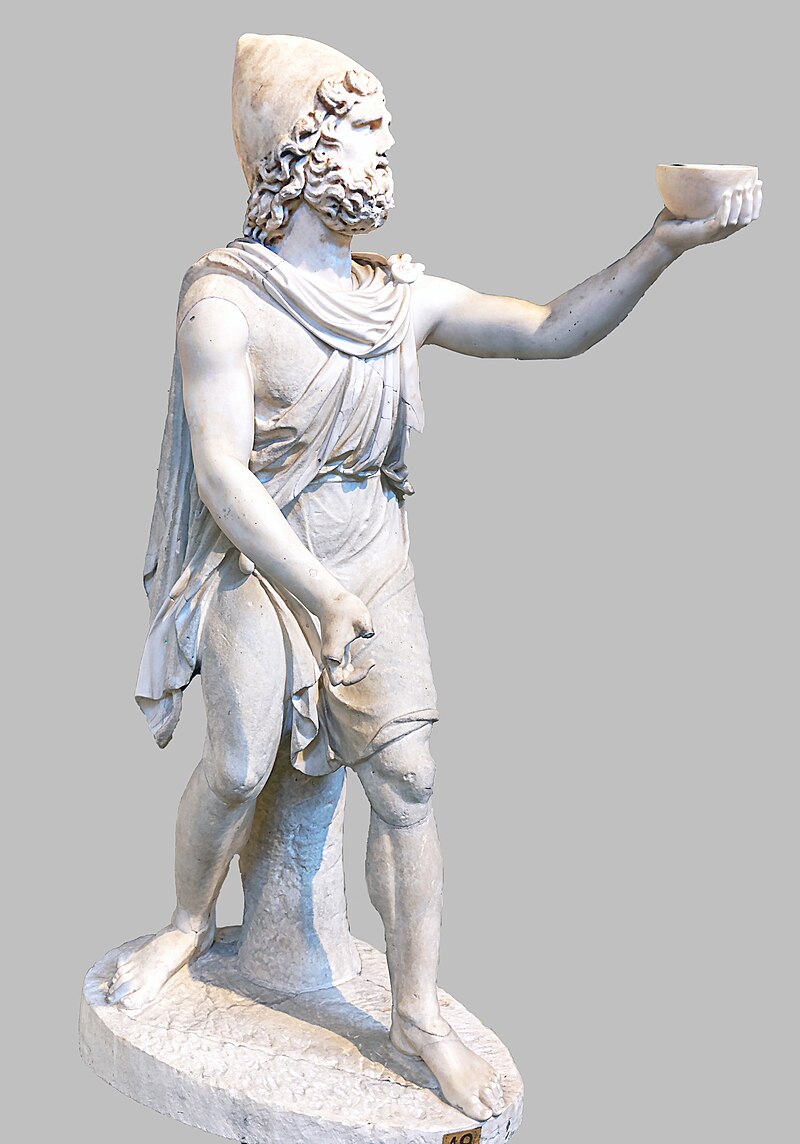
Römische Statuette des Odysseus aus der zweiten Hälfte des 2. https://commons.wikimedia.org/wiki/File:Odysseus_(Rom).jpg

I’ll Take Cicero’s Word

Anthony Trollope, Life of Cicero Chp. 9:

It has been said of Antony that we hear of him only from his enemies. He left behind him no friend to speak for him, and we have heard of him certainly from one enemy; but the tidings are of a nature to force upon us belief in the evil which Cicero spoke of him. Had he been a man of decent habits of life, and of an honest purpose, would Cicero have dared to say to the Romans respecting him the words which he produced, not only in the second Philippic, which was unspoken, but also in the twelve which followed?

The record of him, as far as it goes, is altogether bad. Plutarch tells us that he was handsome, and a good soldier, but altogether vicious. Plutarch is not a biographer whose word is to be taken as to details, but he is generally correct in his estimate of character. Tacitus tells us but little about him as direct history, but mentions him ever in the same tone. Tacitus knew the feeling of Rome regarding him. Paterculus speaks specially of his fraud, and breaks out into strong repudiation of the murder of Cicero. Valerius Maximus, in his anecdotes, mentions him slightingly, as an evil man is spoken of who has forced himself into notice. Virgil has stamped his name with everlasting ignominy. “Sequiturque nefas Egyptia conjux.” I can think of no Roman writer who has named him with honor. He was a Roman of the day—what Rome had made him—brave, greedy, treacherous, and unpatriotic.

Anthony Trollope - Wikipedia

Philo Can’t Trust His Mind: On Senses and Self

Philo, On the Cherubim, 116 (33)

“Is my mind my own private possession? It is a creator of lies, a founder of wandering, of paranoia, of foolishness, a thing revealed to be the opposite of a mind in its mania and depression and eventual old age.

Is what I say my own private possession or the organs of speech? Isn’t a minor sickness enough to weaken the tongue or to sew up the mouth of even the most articulate? Doesn’t the expectation of terror strike and render most people mute?

And I am not revealed to be master even of my perception—instead, I think I am even its servant following wherever it leads to colors, shapes, sounds, smells, tastes and other corporeal things.”

ὁ δὲ νοῦς ἐμόν ἐστιν ἴδιον κτῆμα; ὁ ψευδῶν εἰκαστικός, ὁ πλάνης οἰστικός, ὁ παρανοῶν, ὁ μωραίνων, ὁ εὑρισκόμενος ἄνους ἐν ἐκστάσει καὶ μελαγχολίᾳ καὶ μακρῷ γήρᾳ; ἀλλ᾿ ὁ λόγος κτῆμα ἐμόν; ἢ τὰ φωνῆς ὄργανα; μικρὰ νόσου πρόφασις οὐ τὴν γλῶτταν ἐπήρωσεν, οὐ τὸ στόμα καὶ τῶν πάνυ λογίων ἀπέρραψεν; οὐχὶ δεινοῦ προσδοκία καταπλήξασα μυρίους ἀχανεῖς ἐποίησε; καὶ μὴν οὐδὲ τῆς αἰσθήσεως ἡγεμὼν εὑρίσκομαι, τάχα δέ που καὶ δοῦλος ἀκολουθῶν ᾗ ἂν ἄγῃ, πρὸς χρώματα, πρὸς σχήματα, πρὸς φωνάς, πρὸς ὀσμάς, πρὸς χυλούς, πρὸς τὰ ἄλλα σώματα.


This image has nothing to do with this passage. I just think it is amazing.

University Library Heidelberg

A Letter to the President of UVM on Proposed Budget Cuts

Below is the text of a letter I will be sending to the President of UVM and the Board of Trustees. Please consider signing this petition for Classics and this one for geology. For information see @JPenelope_Evans’ eloquent thread, and her medium post, news reports like this, and the coverage on IHE

Dear President Garimella,

I am writing to express my shock and deep concern for the proposal Dean Falls of the Colleges of Arts and Sciences has produced to cut the University of Vermont’s programs in Geology, Classics, Religion, Asian studies, Latin American and Caribbean studies, and Italian studies. This proposal represents a betrayal of UVM’s historical mission and its responsibility to its community and, in addition, an outright attack on shared governance. It threatens the standing of the University as an institution of higher learning and it sets a disastrous example of educational leadership in a time of crisis.

I write first as a native New Englander who had to leave my home state of Maine to study Classics because my state system did not offer the degree. Your University fulfills a vital role in serving the people of Vermont and neighboring states. During my childhood, my dentist, pediatrician, and many of my teachers graduated from UVM. They were deeply caring and engaged members of our community because they had an education grounded in the Liberal Arts and the traditions of a great public university. Cutting these programs will impoverish the education your students receive and drive many more students out of state for their education.

I write also from personal experience with UVM. Both of my siblings graduated from your institution and my sister earned a degree in Classics. As a member of the discipline, I know that the Department of Classics at UVM produces remarkable scholarship, recently in the work of Professors Franklin, Usher and Chiu. But I also know that the department’s faculty are amazing teachers and mentors: a recent graduate student at Brandeis just beams when recalling Jessica Evans’ Greek classes; and, well over a decade later, Professor Bailly still asks me about my sister when he and I correspond. I have little doubt that the other programs on the cutting block are also filled with fine scholars and exemplary teachers. We can slash operational budgets, run deficits, draw on endowments, and cut salaries. We cannot replace the talent, memory, and dedication of faculty and staff once their programs are gone.

I also write as the Chair of the Faculty Senate at Brandeis University. Cutting academic programs in the way that Dean Falls has proposed undermines your University’s commitment to shared governance by depriving the Faculty of the ability to shape the curriculum and share responsibility in managing this crisis. These cuts are not a result of immediate financial exigency and certainly do not make up for even 10% of anticipated revenue shortfalls. Instead, these cuts represent a calculated attempt to take advantage of a crisis to eliminate programs that do not adhere to some preconceived notion of profitability and utility. The financial measures applied in making these decisions, moreover, are intellectually dishonest. By employing a measure of majors graduated by year instead of total credit-hours taught compared to cost of instruction, Dean Falls’ proposal cloaks ideological prejudice in false quantities. Even worse, Provost’s Prelock’s written comments claiming that these moves will “strengthen the liberal arts at UVM” (via Inside Higher Ed) enact a political doublespeak unworthy of your institution and proof that there is no solid financial justification for making these moves.

The next few years will indeed be a time of financial crisis for higher education. Instead of capitulating before future shortfalls are clear, educational leaders need to tell the truth of what is happening—how decades of divestment in higher education from state legislatures and the federal government put institutions in budgetary crises before the pandemic even started. University presidents and provosts should work together to lobby their state governments and the federal government for relief. Every avenue should be tried before cutting the most important resource Universities possess: the people they bring together.  Now is not the time to make minor, symbolic cuts to our budgets. Higher education is facing its most serious challenge in generations and now is the time to articulate our values. We are not how much we have; we are not what we desire; we are what we are willing to fight for.


The UVM Classics Building at 481 Main StreetCheck out the UVM Classics homepage, and send them some love.

What’s Your Writing Like Without Quotations?

Diogenes Laertius, Chrysippos  7.7.180

“Apollodorus the Athenian in his Summary of Beliefs, because he wants to demonstrate that the works of Epicurus were written with personal force and were prepared with far fewer quotations than the books of Chrysippos, says in this very wording: “if the books of [Chrysippos] were scrubbed of all the superfluous quotations, only empty paper would be left to him.”

So much for Apollodorus.  The old women who used to sit next to [Chrysippos], according to Diocles, used to claim that he wrote 500 lines each day. Hekatôn reports that he turned to philosophy because the property left to him by his father was confiscated to the royal treasury.”

Καὶ Ἀπολλόδωρος δ᾿ ὁ Ἀθηναῖος ἐν τῇ Συναγωγῇ τῶν δογμάτων, βουλόμενος παριστάνειν ὅτι τὰ Ἐπικούρου οἰκείᾳ δυνάμει γεγραμμένα καὶ ἀπαράθετα ὄντα μυρίῳ πλείω ἐστὶ τῶν Χρυσίππου βιβλίων, φησὶν οὕτως αὐτῇ τῇ λέξει· “εἰ γάρ τις ἀφέλοι τῶν Χρυσίππου βιβλίων ὅσ᾿ ἀλλότρια παρατέθειται, κενὸς αὐτῷ ὁ χάρτης καταλελείψεται.” καὶ ταῦτα μὲν Ἀπολλόδωρος. ἡ δὲ παρεδρεύουσα πρεσβῦτις αὐτῷ, ὥς φησι Διοκλῆς, ἔλεγεν ὡς πεντακοσίους γράφοι στίχους ἡμερησίους. Ἑκάτων δέ φησιν ἐλθεῖν αὐτὸν ἐπὶ φιλοσοφίαν, τῆς οὐσίας αὐτοῦ τῆς πατρῴας εἰς τὸ βασιλικὸν ἀναληφθείσης.

25909_2[1]
Hedgehog number 2,  British Library, MS Egerton 1121, f. 44v.

Known Unknowns, Truth Isn’t Truth, Etc.

Jonathan Mayhew, The Difference Between Truth and Falsehood, Right and Wrong:

IF there be any such thing as wisdom, as opposed to ignorance and folly, it consists in knowing the truth; and a man is wise in the same degree that he does so. There is no knowledge, but of some truth or fact: Or, in other words, knowledge presupposes the being of truth, or something to be known. Now if there be no such thing as truth, there is nothing to be known: and consequently every man, yea, every being whatever, must be intirely ignorant and destitute of knowledge; as destitute of it, not only as the horse and mule which have no understanding, but as any part of senseless inanimate matter. So that notwithstanding all the noise there has been in the world about wisdom and folly; notwithstanding the universal applause that has been bestowed on some persons, as gloriously distinguished from the rest of mankind by a happy genius and peculiar sagacity; yet in reality all this is at bottom nothing but empty words without any meaning at all. Socrates and Plato, Locke and Newton, were not superiour, in point of wisdom, to the most illiterate husband-man.

Nay; upon this sup|position, even Pyrrho and Arcesilaus themselves, the great leaders of the sceptic tribe, knew no more than those whom they upbraided with their ignorance. This, indeed, is a consequence which the Pyrrhonists will hardly be perswaded to own. For there are none more apt than they, to value themselves upon their superiour wisdom and penetration. And they please themselves in par|ticular with the thought of their being the discoverers of this mighty arcanum, that there is no such thing as truth, as distinguished from error. But if there be no such thing as truth, why will they please themselves for their sagacity in making this discovery? Or why will they endeavour to bring others over to their opinion, when by their first, and I might add, their only, principle, those others are no more in an error than themselves. Such is the perplexity, the endless labyrinth, that a man brings himself into, by asserting for truth, that there is no such thing as truth.

Old Rudy G, the modern Pyrrho